REVIEW 3 major objections 4 minor 50 references
Stochastic Zeroth-Order Method for Computing Generalized Rayleigh Quotients
T0 review · 3 major / 4 minor · reviewed 2026-08-03 · deepseek-v4-flash
Pith's one-line read A stochastic zeroth-order Riemannian algorithm that takes exact optimal steps along random tangent directions computes the maximum generalized Rayleigh quotient almost surely, at a sublinear rate, using only matrix-vector products with A an
desk verdict Solid one-sample convergence theory; the m-sample algorithm behind the numerics lacks the same guarantee — a real gap, not a fatal one. read the letter →
The pith
A machine-rendered reading of the paper's core claim, the machinery that carries it, and where it could break.
The reading
What carries the argument
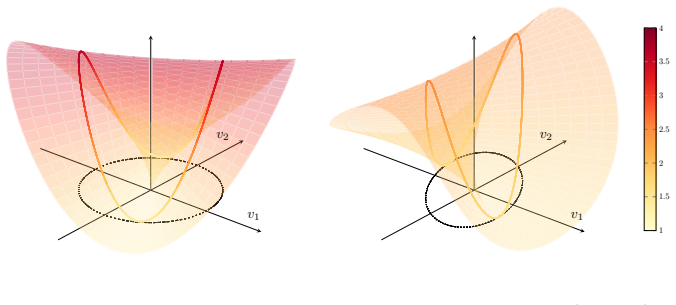
The central object is the one-sample exact-line-search update. For v∈S_B^{d−1} and x∈T_v, the restricted quotient g(τ)=r(A,B,v+τx) is a rational function of form (a+τ b+τ^2 c)/(1+τ^2 d), whose stationary equation g'(τ)=0 is a quadratic with closed-form solution (12). This reduces each stochastic iteration to an exact one-dimensional solve. The paper also relates b_k x_k to the zeroth-order gradient estimator (Theorem 7.1), showing E[b_k x_k | v_k] = (1/(d−1)) grad f(v_k), so the method is a zeroth-order Riemannian method with an optimal deterministic step along a random direction, and the monotone increase τ_k b_k/2 plays the role of the sufficient-decrease condition.
What would settle it
Run Algorithm 1 on a small diagonal instance, say d=3, B=I, A=diag(3,2,1), which has dim(Gmax)=1<d−1. The theorem says r(A,B,v_k)→3 a.s. and min_{k≤n} b_k^2 ≤ C/(n+1). If exact-arithmetic trials ever settle at a lower eigenvalue or the empirical minimal squared derivative decays slower than 1/n, the almost-sure convergence or the sublinear rate would be contradicted.
Extended reading notes
Core claim
On its own terms, the paper's central claim is: for real matrices A and symmetric positive definite B, maximizing r(A,B,v) can be achieved by repeatedly sampling a uniformly random unit tangent direction x_k at v_k, computing the step size τ_k via formula (12) that exactly maximizes the quotient on the line v_k+τ x_k, and setting v_{k+1} to the B-normalized v_k+τ_k x_k. Under the condition dim(Gmax)<d−1, this yields almost sure convergence r(A,B,v_k)→R(A,B) and dist(Gmax,v_k)→0, with b_k→0 and min_{k≤n} b_k^2 ≤ C/(n+1) almost surely (Theorem 5.6, Lemma 6.1). The formula's inputs are a=⟨v,Av⟩, b=⟨x,Av⟩+⟨Ax,v⟩, c=⟨x,Ax⟩ and d=⟨x,Bx⟩, all of which require only A and B products, not A^T or B^{-1
Load-bearing premise
The load-bearing premise for the practical claims is that the multi-sample Algorithm 2 inherits the one-sample convergence theorems: the paper states only an informal justification, noting that its search-direction distribution remains absolutely continuous, and numerical experiments rely on this unproved extension.
Editorial extensions
If this is right
- For dim(Gmax)<d−1, Algorithm 1 (one sample) converges to a global maximizer almost surely and the objective increases monotonically at every step; as a corollary, it never terminates prematurely.
- The stopping statistic b_k^2 is certified: it goes to zero almost surely, has the sublinear bound min_{k≤n} b_k^2 ≤ 8∥A∥^2∥B^{-1}∥(1+3κ(B))/(n+1), and in expectation controls the squared Riemannian gradient up to a factor d−1.
- For dim(Gmax)=d−1 the algorithm terminates after one step almost surely; for dim(Gmax)=d it terminates immediately.
- The method extends to complex matrices A,B∈C^{d×d} by realification, preserving the convergence guarantees for the maximal real generalized Rayleigh quotient.
Reading between the lines
- If the informal m-sample extension can be made rigorous, the multi-sample algorithm would provide a practical variance-reduced eigensolver for streaming or large-scale generalized eigenproblems, with each iteration still costing only products with A and B and with no step-size parameter to tune.
- Because the step is an exact one-dimensional maximizer, the method is closer to a randomized coordinate descent with optimal steps than to standard zeroth-order gradient ascent; this suggests that local linear convergence under an eigengap may hold, a stronger rate the paper does not claim.
- The exact line-search step could be replaced by deterministic or low-discrepancy tangent directions, yielding a quasi-Monte Carlo variant with deterministic error control while remaining adjoint-free and inverse-free.
- A clean empirical check of the variance-reduction claim: for a fixed v, the conditional variance of the estimator b_k x_k should scale as 1/m; the paper's Remark 7.1 predicts this, and it is directly measurable from samples.
Editorial analysis
A structured set of objections, weighed in public.
Referee Report
Summary. The paper proposes a stochastic zeroth-order Riemannian algorithm for maximizing the generalized Rayleigh quotient R(A,B)=max_v ⟨v,Av⟩/⟨v,Bv⟩ without using A^T or B^{-1}. Algorithm 1 samples a uniformly random direction in the tangent space of the B-unit sphere and performs an exact line search along that direction; the step size has a closed form (Eq. 12). For dim(Gmax)<d−1, the paper proves monotone increase of the Rayleigh quotient, a.s. convergence of the objective to R(A,B), a.s. convergence of the iterates to the maximal eigenspace, and sublinear best-iterate rates for the quantity b_k (and a probabilistic bound for the eigen-residual). Algorithm 2 is a multi-sample variant used in the numerical experiments, but the paper only informally asserts that the convergence proofs extend to it.
Significance. If the claims are established, Algorithm 1 gives a conceptually simple, adjoint-free, inverse-free stochastic method with global a.s. convergence to the generalized Rayleigh quotient maximum, and the closed-form line search is a nice feature. The proofs are largely self-contained and include measure-theoretic details, a Borel–Cantelli argument, and explicit constants. The paper also makes code available and compares against Gen-Oja. The main limitation is that the practically recommended multi-sample Algorithm 2—used in all numerical demonstrations and for the advertised m>1 speedup—is not covered by the proofs; this weakens the significance of the multi-sample claims, though the one-sample method remains a meaningful contribution.
major comments (3)
- [Section 3 / Lemma 5.5 / Theorem 5.6] Algorithm 2 is not covered by the convergence theory. The only support is the informal sentence in Section 3: "We give only an informal justification that all these results can be extended to Algorithm 2." The convergence proof for Algorithm 1 hinges on Lemma 5.5, which provides a uniform lower bound p>0 on the surface measure of D_v under the uniform distribution on T_v∩S^{d−1}. For Algorithm 2 the search direction x_k is no longer uniform, and absolute continuity alone does not imply a uniform lower bound on P_{X_k|V_k=v}(D_v). Without such a bound, the Borel–Cantelli argument in Theorem 5.6 cannot be applied. Because Figures 2–7 and the claimed multi-sample improvement use Algorithm 2, this gap is load-bearing. The paper should either prove the required uniform lower bound for Algorithm 2's conditional distribution or explicitly restrict the theoretical claims to Algorithm 1 and prese
- [Section 7 / Theorem 7.1] As stated, the equality b_k x_k = 2 dgrad1 f(v_k) does not follow from the definition (11), where x_i∼N(0,I_d), the update uses R_v(μP_v x_i), and the denominator is μ. Algorithm 1 uses the normalized tangent vector x_k and the line-search parameter τ_k. The claimed equality holds only if dgrad1 is redefined with normalized tangent directions and the finite-difference scaling is adjusted accordingly. Since Remark 7.1 uses this equality to motivate the variance reduction in Algorithm 2, the statement should be corrected or the estimator redefined.
- [Section 6 / Abstract] The abstract states that the norm of the Riemannian gradient vanishes at a sublinear rate with probability one. The body proves a.s. convergence to Gmax (hence a.s. gradf→0 by continuity), but the quantitative statements are: Lemma 6.1 gives min_{0≤k≤n} b_k^2 ≤ O(1/n) a.s.; Theorem 6.3 is a Markov bound on the squared eigen-residual in probability. No theorem states an a.s. sublinear rate for ∥gradf(v_k)∥ itself. The final paragraph of Section 6 also switches between 'error' and 'squared error' when interpreting ε. Please state the precise best-iterate/probabilistic rates and adjust the abstract accordingly.
minor comments (4)
- [Appendix A, Lemma 5.5 proof] The spherical-cap area formula appears to have a typo: the integral upper limit and exponent are inconsistent with the usual beta-integral expression. Since only positivity of p is needed, this does not affect the proof, but the formula should be corrected.
- [Section 5, Theorem 5.4 proof] In the displayed chain after Eq. (19), the expression tends to λ_j, not to 0. The surrounding text uses the intended limit λ_j, so this is a typo.
- [Section 6, final paragraph] The phrase "the error is bounded by 1/√(n+1)" and "the error is O(1/n)" should be stated consistently for the squared eigen-residual; otherwise the reader may infer a rate for the norm that is not proved.
- [Algorithm 2] If \bar{x}_k = 0, the normalization in Step 4 makes x_k undefined. This event has probability zero for continuous sampling, but adding an explicit guard or stopping condition would make the algorithm statement rigorous.
Circularity Check
No significant circularity: Algorithm 1's convergence is derived self-containedly; the informal extension to Algorithm 2 is an unproved gap, not a circular assumption.
full rationale
The paper's derivation chain is self-contained for Algorithm 1 and does not reduce any prediction to its inputs. The one-sample algorithm samples x_k uniformly on the tangent sphere (Lemma 4.1), computes the step size by the closed-form maximizer (Theorem 3.1) using only products with A and B, establishes monotone increase via exact algebra (Theorem 5.1), proves a positive-probability geometric lemma (Lemma 5.5) with a full proof in Appendix A, and then uses Borel-Cantelli to conclude convergence to R(A,B) and dist(Gmax,v_k)->0 (Theorem 5.6). The rate bounds in Lemma 6.1 and Theorem 6.3 are obtained by telescoping sums and Markov's inequality, not by assuming the conclusion. The only self-citation, [41], is used for Lemma 5.5, but the appendix reproduces the proof, so the citation is not load-bearing. The paper explicitly flags the extension to the m-sample Algorithm 2 as informal ('We give only an informal justification that all these results can be extended to Algorithm 2'), which is a genuine proof gap rather than circularity: Algorithm 2's convergence is not assumed in the proofs for Algorithm 1, it is merely asserted as a plausible inheritance. I find no self-definitional step, no fitted parameter renamed as a prediction, and no uniqueness or ansatz imported solely from the authors' prior work.
Assumptions & free parameters
assumptions (5)
- domain assumption B is symmetric positive definite (B ∈ Sym_{≻0}^d).
- domain assumption The main convergence theorem assumes dim(Gmax) < d−1; the cases dim(Gmax)=d and d−1 are handled separately in Remark 4.2 and Theorem 4.5.
- domain assumption Sampled search directions are uniformly distributed on the tangent unit sphere, obtained by projecting Gaussian vectors (Lemma 4.1).
- standard math Affine subspaces of dimension < d−1 have surface measure zero on the sphere (Lemma 4.2).
- standard math Borel-Cantelli lemma and dominated convergence theorem are available.
Cite this review
Pith. "Pith review of Stochastic Zeroth-Order Method for Computing Generalized Rayleigh Quotients." pith.science (2026). https://pith.science/paper/VAZ2JBCM
@misc{pith2026251205520,
  author       = {Pith},
  title        = {Pith review of: Stochastic Zeroth-Order Method for Computing Generalized Rayleigh Quotients},
  year         = {2026},
  howpublished = {\url{https://pith.science/paper/VAZ2JBCM}},
  note         = {Machine review of arXiv:2512.05520}
}
read the original abstract
The maximization of the (generalized) Rayleigh quotient is a central problem in numerical linear algebra. Conventional algorithms for its computation typically rely on matrix-adjoint products, making them sensitive to errors arrissing from adjoint mismatches. To address this issue, we introduce a stochastic zeroth-order Riemannian algorithm that maximizes the generalized Rayleigh quotient without requiring adjoint or matrix inverse computations. We provide theoretical convergence guarantees showing that the iterates converge to the set of global maximizers of the (generalized) Rayleigh quotient and the norm of the Riemannian gradient vanishes at a sublinear rate with probability one. Our theoretical results are supported by numerical experiments, which demonstrate the excellent performance of the proposed method compared to state-of-the-art algorithms.
Figures


Figures from the paper (3 more)


Reference graph
Works this paper leans on
- [41]
-
[1]
Axelsson, V
O. Axelsson, V. A. Barker, Finite Element Solution of Boundary Value Problems, Society for Industrial and Applied Mathematics, 2001, pp. 338–345.doi:10.1137/ 1.9780898719253
2001
-
[2]
G. H. Golub, C. F. Van Loan, Matrix Computations, 4th Edition, Johns Hopkins 25 sin2 B 0 100 200 300 400 500 iteration 10 9 10 7 10 5 10 3 10 1 sinB2-error Gen-Oja on KL problem (matrix-free) Gen-Oja deterministic Gen-Oja stochastic (avg.) Alg. 2 (m = 1) Alg. 2 (m = 10) Alg. 2 (m = 100) 0.0 0.2 0.4 0.6 0.8 1.0 x 2.0 1.5 1.0 0.5 0.0 0.5 1.0 Leading KL mode...
2013
-
[3]
T. G. Kolda, J. R. Mayo, An adaptive shifted power method for computing gen- eralized tensor eigenpairs, SIAM J. Matrix Anal. Appl. 35 (4) (2014) 1563–1581. doi:10.1137/140951758
-
[4]
B. F. Farrell, P. J. Ioannou, Generalized stability theory. Part II: Nonau- tonomous operators, J. Atmos. Sci. 53 (14) (1996) 2041 – 2053.doi:10.1175/ 1520-0469(1996)053<2041:GSTPIN>2.0.CO;2
1996
-
[5]
L. N. Trefethen, M. Embree, IV. Transient Effects and Nonnormal Dynamics, Princeton University Press, Princeton, NJ, USA, 2005, pp. 133–192.doi:10.1515/ 9780691213101-006
2005
-
[6]
Benzi, Some uses of the field of values in numerical analysis, Boll
M. Benzi, Some uses of the field of values in numerical analysis, Boll. Unione Mat. Ital. 14 (1) (2021) 2198–2759.doi:10.1007/s40574-020-00249-2. 26
-
[7]
R. von Mises, H. Pollaczek-Geiringer, Praktische Verfahren der Glei- chungsaufl¨ osung, Z. Angew. Math. Mech. 9 (1929) 152–164.doi:10.1002/zamm. 19290090206
doi:10.1002/zamm 1929
Show all 50 references
-
[8]
M¨ untz, Solution directe de l’´ equation s´ eculaire et de quelques probl` emes ana- logues transcendants, C
H. M¨ untz, Solution directe de l’´ equation s´ eculaire et de quelques probl` emes ana- logues transcendants, C. R. Acad. Sci. 156 (1913) 43–46
1913
-
[9]
M¨ untz, Sur la solution des ´ equations s´ eculaires et des ´ equations int´ egrales, C
H. M¨ untz, Sur la solution des ´ equations s´ eculaires et des ´ equations int´ egrales, C. R. Acad. Sci. 156 (1913) 860–862
1913
-
[10]
B. N. Parlett, The Rayleigh quotient iteration and some generalizations for nonnormal matrices, Math. Comp. 28 (127) (1974) 679–693.doi:10.1090/ S0025-5718-1974-0405823-3
1974
-
[11]
Knyazev, K
A. Knyazev, K. Neymeyr, et al., Block locally optimal preconditioned eigenvalue Xolvers (BLOPEX) in hypre and PETSc, SIAM J. Sci. Comput. 29 (5) (2007) 2224–2239.doi:10.1137/060661624
2007 doi
-
[12]
B. N. Parlett, The Symmetric Eigenvalue Problem, Classics in Applied Mathemat- ics, Society for Industrial and Applied Mathematics, Philadelphia, PA, USA, 1998. doi:10.1137/1.9781611971163
1998 doi
-
[13]
A. V. Knyazev, Toward the optimal preconditioned eigensolver: Locally optimal block preconditioned conjugate gradient method, SIAM J. Sci. Comput. 23 (2) (2001) 517–541.doi:10.1137/S1064827500366124
2001 doi
-
[14]
Schanze, Robust Rayleigh quotient minimization and generalized eigenvalue problems, GAMMAS 5 (1) (2023) 1–9.doi:10.14464/gammas.v5i1.540
H. Schanze, Robust Rayleigh quotient minimization and generalized eigenvalue problems, GAMMAS 5 (1) (2023) 1–9.doi:10.14464/gammas.v5i1.540
2023 doi
-
[15]
Z. Bai, D. Lu, B. Vandereycken, Robust Rayleigh quotient minimization and non- linear eigenvalue problems, SIAM J. Sci. Comput. 40 (5) (2018) A3495–A3522. doi:10.1137/18M1167681
2018 doi
-
[16]
Nishioka, M
A. Nishioka, M. Toyoda, M. Tanaka, Y. Kanno, On a minimization problem of the maximum generalized eigenvalue: Properties and algorithms, Comput. Optim. Appl. 90 (1) (2025) 303–336.doi:10.1007/s10589-024-00621-4
2025 doi
-
[17]
Zhang, S
H. Zhang, S. J Reddi, S. Sra, Riemannian SVRG: Fast stochastic optimization on Riemannian manifolds, NeurIPS 29 (2016) 4599–4607. URLhttps://proceedings.neurips.cc/paper_files/paper/2016/file/ 98e6f17209029f4ae6dc9d88ec8eac2c-Paper.pdf
2016
-
[18]
Alimisis, P
F. Alimisis, P. Davies, B. Vandereycken, D. Alistarh, Distributed principal compo- nent analysis with limited communication, NeurIPS 34 (2021) 2823–2834. URLhttps://proceedings.neurips.cc/paper_files/paper/2021/file/ 1680e9fa7b4dd5d62ece800239bb53bd-Paper.pdf 27
2021
-
[19]
Alimisis, B
F. Alimisis, B. Vandereycken, Geodesic convexity of the symmetric eigenvalue prob- lem and convergence of steepest descent, J. Optim. Theory Appl. 203 (1) (2024) 920–959.doi:10.1007/s10957-024-02538-8
2024 doi
-
[20]
Guglielmi, M
N. Guglielmi, M. L. Overton, Fast algorithms for the approximation of the pseu- dospectral abscissa and pseudospectral radius of a matrix, SIAM J. Matrix Anal. Appl. 32 (4) (2011) 1166–1192.doi:10.1137/100817048
2011 doi
-
[21]
Kressner, B
D. Kressner, B. Vandereycken, Subspace methods for computing the pseudospectral abscissa and the stability radius, SIAM J. Matrix Anal. Appl. 35 (1) (2014) 292–313. doi:10.1137/120869432
2014 doi
-
[22]
D. Lu, B. Vandereycken, Criss-cross type algorithms for computing the real pseu- dospectral abscissa, SIAM J. Matrix Anal. Appl. 38 (3) (2017) 891–923.doi: 10.1137/16M107952X
2017 doi
-
[23]
Halko, P
N. Halko, P. G. Martinsson, J. A. Tropp, Finding structure with randomness: Prob- abilistic algorithms for constructing approximate matrix decompositions, SIAM Re- view 53 (2) (2011) 217–288.doi:10.1137/090771806
2011 doi
-
[24]
Y. Li, H. L. Nguyen, D. P. Woodruff, On sketching matrix norms and the top singular vector, in: Proceedings of the 25th annual ACM-SIAM symposium on Discrete algorithms, SIAM, 2014, pp. 1562–1581.doi:10.1137/1.9781611973402. 114
2014 doi
-
[25]
Martinsson, J
P.-G. Martinsson, J. A. Tropp, Randomized numerical linear algebra: Foun- dations and algorithms, Acta Numer. 29 (2020) 403–572.doi:10.1017/ S0962492920000021
2020
-
[26]
T. M. Buzug, Computed tomography from photon statistics to modern cone-beam CT, Springer, Berlin, 2008.doi:10.1007/978-3-540-39408-2
2008 doi
-
[27]
L. Xie, Y. Hu, B. Yan, L. Wang, B. Yang, W. Liu, L. Zhang, L. Luo, H. Shu, Y. Chen, An effective CUDA parallelization of projection in iterative tomography reconstruction, PLOS ONE 10 (11) (2015) 1–17.doi:10.1371/journal.pone. 0142184
2015 doi
-
[28]
Zhang, L
H. Zhang, L. Wang, L. Li, A. Cai, G. Hu, B. Yan, Iterative metal artifact reduction for x-ray computed tomography using unmatched projector/backprojector pairs, Med. Phys. 43 (6 Part 1) (2016) 3019–3033.doi:https://doi.org/10.1118/1. 4950722
2016 doi
-
[29]
Peterson, J
M. Peterson, J. Gustafsson, M. Ljungberg, Monte Carlo-based quantitative pinhole SPECT reconstruction using a ray-tracing back-projector, EJNMMI Phys. 4 (1) (2017) 32.doi:10.1186/s40658-017-0198-z
2017 doi
-
[30]
T. F. Chan, L. de Pillis, H. van der Vorst, Transpose-free formulations of Lanczos- type methods for nonsymmetric linear systems, Numer. Algorithms 17 (1-2) (1998) 51–66.doi:10.1023/A:1011637511962. 28
1998 doi
-
[31]
Balasubramanian, S
K. Balasubramanian, S. Ghadimi, Zeroth-order nonconvex stochastic optimiza- tion: Handling constraints, high dimensionality, and saddle points, Found. Comput. Math. 22 (1) (2022) 35–76.doi:10.1007/s10208-021-09499-8
2022 doi
-
[32]
J. Li, K. Balasubramanian, S. Ma, Stochastic zeroth-order Riemannian derivative estimation and optimization, Math. Oper. Res. 48 (2) (2023) 1183–1211.doi: 10.1287/moor.2022.1302
2023
-
[33]
J. V. Burke, A. S. Lewis, M. L. Overton, Two numerical methods for optimiz- ing matrix stability, Linear Algebra Appl. 351-352 (2002) 117–145.doi:10.1016/ S0024-3795(02)00260-4
2002
-
[34]
Oja, Simplified neuron model as a principal component analyzer, Journal of Mathematical Biology 15 (3) (1982) 267–273.doi:10.1007/BF00275687
E. Oja, Simplified neuron model as a principal component analyzer, Journal of Mathematical Biology 15 (3) (1982) 267–273.doi:10.1007/BF00275687
1982 doi
-
[35]
Riedl, T
K. Riedl, T. Klock, C. Geldhauser, M. Fornasier, How consensus-based optimiza- tion can be interpreted as a stochastic relaxation of gradient descent, in: ICML 2024 Workshop on Differentiable Almost Everything: Differentiable Relaxations, Algorithms, Operators, and Simulators,...
2024
- [36]
-
[37]
Fornasier, H
M. Fornasier, H. Huang, L. Pareschi, P. S¨ unnen, Consensus-based optimiza- tion on hypersurfaces: Well-posedness and mean-field limit, Mathematical Mod- els and Methods in Applied Sciences 30 (2021) 2725–2751.doi:10.1142/ S0218202520500530
2021
-
[38]
Fornasier, H
M. Fornasier, H. Huang, L. Pareschi, P. S¨ unnen, Consensus-based optimization on the sphere: Convergence to global minimizers and machine learning, J. Mach. Learn. Res. 22 (1) (2021) 10722–10776. URLhttps://dl.acm.org/doi/10.5555/3546258.3546495
2021
-
[39]
Quellmalz, R
M. Quellmalz, R. Beinert, G. Steidl, Sliced optimal transport on the sphere, Inverse Probl. 39 (10) (2023) 105005.doi:10.1088/1361-6420/acf156
2023 doi
-
[40]
Quellmalz, L
M. Quellmalz, L. Buecher, G. Steidl, Parallelly sliced optimal transport on spheres and on the rotation group, J. Math. Imaging Vis. 66 (6) (2024) 951–976.doi: 10.1007/s10851-024-01206-w
2024 doi
-
[42]
Mitchell, Convergence rate analysis and improved iterations for numerical ra- dius computation, SIAM J
T. Mitchell, Convergence rate analysis and improved iterations for numerical ra- dius computation, SIAM J. Sci. Comput 45 (2) (2023) A753–A780.doi:10.1137/ 21M1455826. 29
2023
-
[43]
Boumal, An Introduction to Optimization on Smooth Manifolds, Cambridge University Press, Cambridge, UK, 2023.doi:10.1017/9781009166164
N. Boumal, An Introduction to Optimization on Smooth Manifolds, Cambridge University Press, Cambridge, UK, 2023.doi:10.1017/9781009166164
2023 doi
-
[44]
J. Zhou, K. Deng, H. Wang, Z. Peng, Inexact Riemannian gradient descent method for nonconvex optimization with strong convergence, J. Sci. Comput. 103 (3) (2025) 96.doi:10.1007/s10915-025-02913-1
2025 doi
-
[45]
K. B. Athreya, S. N. Lahiri, Measure Theory and Probability Theory, Springer, 2006.doi:10.1007/978-0-387-35434-7
2006 doi
-
[46]
Bhatia, A
K. Bhatia, A. Pacchiano, N. Flammarion, P. L. Bartlett, M. I. Jordan, Gen-Oja: A simple and efficient algorithm for streaming generalized eigenvector computation, in: Proceedings of the 32nd International Conference on Neural Information Processing Systems, NIPS’18, Curran Ass...
2018
-
[47]
R. Vershynin, High-Dimensional Probability: An Introduction with Applications in Data Science, Cambridge Series in Statistical and Probabilistic Mathematics, Cambridge University Press, Cambridge, UK, 2018.doi:10.1017/9781108231596
2018 doi
-
[48]
J. M. Lee, Introduction to Smooth Manifolds, 2nd Edition, Graduate Texts in Math- ematics, Springer, New York, NY, USA, 2012.doi:10.1007/978-1-4419-9982-5
2012 doi
-
[49]
Li, Concise formulas for the area and volume of a hyperspherical cap, Asian J
S. Li, Concise formulas for the area and volume of a hyperspherical cap, Asian J. Math. Stat. 4 (1) (2011) 66–70.doi:10.3923/ajms.2011.66.70. A. Proofs Lemma 4.1For a fixedv∈S d−1 B and ˜X∼ N(0, Id), the random variableX := Pv ˜X/∥P v ˜X∥is uniformly distributed onT v ∩S d−1 ≃...
2011 doi
-
[50]
Since B∈Sym d ≻0, the norm∥·∥ B is strongly
In this case, we takeS=B r,B(˜u) wherer :=ε 2/8,c :=ε/4 √ 2 and ˜u:= u ∥u∥B withu :=v ∗ −c(v ∗ −v) = (1−c)v ∗ +cv.(22) Next, we step-by-step show that this choice ofSsatisfies all desired properties. Since B∈Sym d ≻0, the norm∥·∥ B is strongly. By definition,uis a convex combi...
Reviewed August 3, 2026 · model on record in the stance chip above.
Discussion (0). Continue with ORCID to comment.