REVIEW 3 major objections 4 minor 43 references
Fairness Perceptions in Regression-based Predictive Models
T0 review · 3 major / 4 minor · reviewed 2026-08-15 · deepseek-v4-flash
Pith's one-line read A regression-fairness framework based on KL divergence, applied to a kidney allocation tool, finds that the public prefers separation and sufficiency over independence and views age-based disparities as unfair.
desk verdict A serious first attempt at measuring fairness preferences for a regression-based clinical tool, but the headline preference claim needs identifiability and distributional robustness checks before it can be trusted. read the letter →
The pith
A machine-rendered reading of the paper's core claim, the machinery that carries it, and where it could break.
The reading
What carries the argument
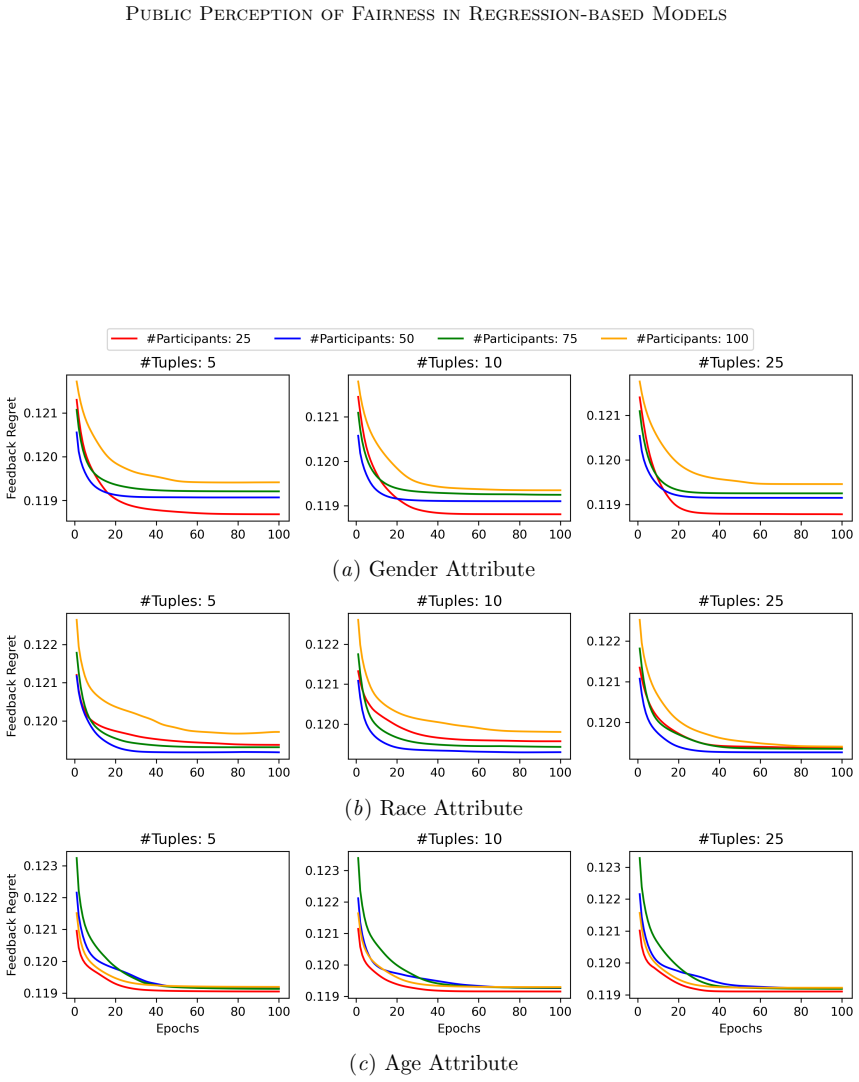
The core mechanism is the fairness-score triple φ_ℓ(d_m), each a Kullback-Leibler divergence between two social groups' conditional distributions: φ₁ compares prediction distributions P(ŷ|group) (independence), φ₂ compares predictions conditioned on the surgeon's decision P(ŷ|z, group) (separation), and φ₃ compares decision distributions conditioned on predictions P(z|ŷ, group) (sufficiency). Since the tool emits two conditionally independent predictions—time-to-next-offer and mortality likelihood—each divergence splits into a sum over the two components; the paper evaluates the sums with the closed-form KL divergence for Weibull distributions (Eqs. 3–4), and the authors flag in the limitations that the Weibull assumption may not match the underlying log-logistic and Cox models. The scores are min-max normalized per data tuple, and each participant combines them into a latent aggregated score ψ = Σ β φ̄, which is modeled as Beta-distributed and mapped onto the 7-point Likert regions; a mixed-logit softmax turns region utilities into response probabilities. The social preference vector β* is then fitted by projected-gradient minimization of mean-squared feedback regret (the SAFF algorithm). This chain—divergence scores, weighted aggregation, stochastic choice, regret minimization—is what turns subjective fairness ratings into the reported social weights.
What would settle it
Take the same 10 donor-recipient data tuples the survey used, recompute the three fairness scores from the actual prediction outputs using nonparametric density estimates instead of the Weibull closed forms, and rerun the preference-learning algorithm; if the age-group divergences drop to the gender/race range (around 0.1) or the recovered social weights stop favoring separation and sufficiency, the reported age-unfairness verdict is an artifact of the distributional assumption.
Extended reading notes
Core claim
The paper's central claim is that the standard classification fairness families—independence, separation, and sufficiency—carry over to regression when each is expressed as a zero Kullback-Leibler divergence between group-conditioned distributions, and that social preference over these notions can be learned from Likert-scale feedback. On the transplant tool, the recovered social weights are pronounced: sufficiency and separation dominate independence, most clearly for race (β*₃=0.42, β*₂=0.44, β*₁=0.14), indicating that participants judge fairness conditionally on the surgeon's decision and on calibration. The same data classify gender and race as completely fair (social feedback score 7) and age as completely unfair (score 1), because the age-group divergences are roughly an order of magnitude larger. The authors conclude that transparency about age-stratified clinical risk is needed to preserve public trust, and that conditional fairness metrics must be monitored even when overall verdicts are fair.
Load-bearing premise
All the fairness scores feeding the public-preference estimate are computed by assuming each prediction follows a particular statistical curve (a Weibull distribution), although the tool's own prediction models are built on different curve types; the paper concedes this may not hold, and if it does not, the scores, weights, and the age-unfairness verdict all shift.
Editorial extensions
If this is right
- Fairness reporting for regression-based clinical decision support should include separation and sufficiency metrics alongside demographic outcome parity, because those are the criteria the surveyed public weights most heavily.
- The transplant network should treat the age-group unfairness verdict as a public-trust issue even if the underlying age-stratified risk is clinically justified; the survey response landed at 'completely unfair' for age.
- Monitoring efforts should track the separation score φ₂ for gender and race, since it is non-negligible (0.30 and 0.23) even where the overall social verdict is 'completely fair,' and a rise could erode trust.
- The same KL-based fairness scoring and preference-learning pipeline can be applied to other regression-based healthcare prediction tools, such as liver allocation or cancer risk models, after checking the distributional assumptions.
Reading between the lines
- Beyond the paper: since the time-to-next-offer model deliberately excludes demographic attributes while the mortality model includes age, the age-group divergence most likely originates in the mortality model and in surgeons' decisions about older candidates; a follow-up presenting the two predictions separately could isolate which one drives the unfairness rating.
- Beyond the paper: recomputing the KL divergences with nonparametric density estimates could move the age scores substantially; if they fall toward the gender/race range, the age-unfairness verdict would be partly an artifact of the Weibull assumption rather than a property of the tool.
- Beyond the paper: the participant pool skews younger, more educated, and less Hispanic than the U.S. population, so the learned social weights may not generalize; a preference-elicitation study with transplant patients, older adults, and clinicians could reveal heterogeneous fairness standards.
- Beyond the paper: if public preference for decision-conditional fairness holds more broadly, then fairness regulation for clinical AI should mandate subgroup calibration and error-rate parity reporting, not just demographic balance of predictions.
Signed reviews
Editorial analysis
A structured set of objections, weighed in public.
Referee Report
Summary. The paper proposes three KL-divergence-based group fairness notions for regression-based predictive models (independence, separation, and sufficiency), applies them to a real kidney-transplant decision-support tool (UPAT), and uses a Prolific survey with 85 participants to estimate social preferences over these notions via a mixed-logit model and a projected-gradient learning algorithm (SAFF). The authors report that participants weight separation and sufficiency more heavily than independence, that UPAT is perceived as fair with respect to gender and race, and that it is perceived as unfair with respect to age. They also provide simulation results on convergence and discuss clinical justifications for age-based disparities.
Significance. If the reported findings are reliable, the paper would be a meaningful contribution to fairness in regression and to human-factors research on algorithmic fairness in a high-stakes medical setting. Its strengths include the use of a deployed clinical prediction tool, the extension of classification fairness notions to continuous regression outputs, a substantial crowd-sourced preference-elicitation study, careful modeling of discrete-choice responses through mixed logit, and an explicit limitations section. The claim that the public cares more about decision-conditional fairness notions than about independence in a regression-based organ-placement tool is both novel and actionable for deployment decisions. However, the central preference estimate rests on distributional assumptions and an identification assumption that are not adequately validated, so the headline claim is currently not fully supported.
major comments (3)
- [Section 3.1, Eqs. (2)-(4) and Table 5] The closed-form fairness scores rely on two unvalidated assumptions: that the predictions y_T and y_D are mutually independent, and that each marginally follows a Weibull distribution. Section 2 states that TTNO is produced by a log-logistic accelerated failure time model and mortality by a Cox proportional hazards model, and Section 6 concedes that the Weibull assumption may not fit. Because the phi_l values in Table 5 propagate through Eqs. (10)-(11) into every estimated preference weight, any distributional misspecification directly affects the paper's central 'strong preference' claim. A sensitivity analysis using empirical KL estimates or alternative fitted distributions is needed before the numeric preference weights can be trusted.
- [Section 5.1, Initialization 3 and Table 5] The simulation section explicitly reports that under Initialization 3, where no single fairness notion dominates, SAFF produces inconsistent socially preferred notions across runs because the loss landscape has multiple minima. The survey estimates in Table 5, such as gender (0.29, 0.31, 0.40) and age (0.27, 0.39, 0.34), lie precisely in the near-equal-weight regime where this identification problem occurs, yet they are reported as deterministic point estimates without confidence intervals, bootstrap replicates, or a multi-start analysis. The abstract's claim of a strong preference for separation and sufficiency over independence therefore requires an identification or robustness analysis that the manuscript does not provide.
- [Section 3.1, Definition 3 and Eq. (8); Table 5] The sufficiency score phi_3 is defined as a KL divergence between two Bernoulli distributions conditional on a fixed prediction vector y, but the manuscript does not specify how this pointwise divergence is integrated or averaged over the empirical distribution of prediction vectors to produce the single number reported in Table 5. Without this aggregation step, the reported sufficiency scores are not reproducible, and the comparison of phi_3 across gender, race, and age is not well defined.
minor comments (4)
- [Section 2.3 vs. Section 4] Section 2.3 states that 83 participants remained after attention-check exclusions, while Section 4 reports N=75 in the survey experiment; this discrepancy should be resolved.
- [Appendix B, Eqs. (24)-(27)] The notation 'tan^{-1}' appears in several beta-derivative derivations where 't^{a_n-1}' is evidently intended; this is likely a typesetting error and should be corrected for readability.
- [Section 3.1, Eq. (8)] The denominator in Eq. (8) should consistently display the group condition X_{m'}; the current mixed notation makes the compared distributions harder to parse.
- [Table 5] The table reports no uncertainty measures for beta* or s*, which is especially important given the identifiability concern raised above; adding bootstrap or multi-start summaries would substantially improve the manuscript.
Circularity Check
No significant circularity: the preference estimates are fit to independent survey responses, and no fitted parameter is relabeled as an out-of-sample prediction.
full rationale
The paper's derivation chain is self-contained in the respects that matter for circularity. The fairness scores phi_l(d_m) are computed from UPAT output distributions and surgeon decisions via KL divergences (Eqs. 1-8), independently of the survey. The social preference vector beta* is estimated by minimizing the regret in Eq. (15) against observed Prolific Likert ratings, so the reported preference for separation/sufficiency is an empirical fit to external data rather than a quantity forced by the definitions. The social feedback score s* in Table 5 is a deterministic function of the fitted beta* and phi, but the paper presents it as a model output summarizing public feedback, not as an out-of-sample prediction; the underlying fair/unfair pattern for gender, race, and age is directly contained in the observed ratings. Self-citations (Telukunta et al., 2024) are motivational and non-load-bearing; SAFF is fully specified in Algorithm 1 and Eqs. (15)-(21), so no uniqueness claim or external result is imported from prior work. The Section 6 Limitations passage admits that the Weibull assumption may not fit the actual Cox/log-logistic UPAT models, and Section 5.1 reports non-identifiability under Initialization 3; these are validity and robustness concerns, not circularity, because misspecification or multiple minima would make the estimates inaccurate rather than making the derivation equivalent to its inputs. No step in the derivation reduces to its own input by construction.
Assumptions & free parameters
free parameters (3)
- Precision parameter c of Beta distribution
- Temperature parameter lambda in softmax
- Learning rate delta in SAFF =
0.5
assumptions (4)
- ad hoc to paper UPAT predictions y_T and y_D follow Weibull distributions
- ad hoc to paper Predictions y_T and y_D are statistically independent
- domain assumption Participants combine fairness scores via a convex weighted sum
- domain assumption Min-max normalization of fairness scores per data-tuple
Cite this review
Pith. "Pith review of Fairness Perceptions in Regression-based Predictive Models." pith.science (2026). https://pith.science/paper/VB3YLCXH
@misc{pith2026250504886,
  author       = {Pith},
  title        = {Pith review of: Fairness Perceptions in Regression-based Predictive Models},
  year         = {2026},
  howpublished = {\url{https://pith.science/paper/VB3YLCXH}},
  note         = {Machine review of arXiv:2505.04886}
}
read the original abstract
Regression-based predictive analytics used in modern kidney transplantation is known to inherit biases from training data. This leads to social discrimination and inefficient organ utilization, particularly in the context of a few social groups. Despite this concern, there is limited research on fairness in regression and its impact on organ utilization and placement. This paper introduces three novel divergence-based group fairness notions: (i) independence, (ii) separation, and (iii) sufficiency to assess the fairness of regression-based analytics tools. In addition, fairness preferences are investigated from crowd feedback, in order to identify a socially accepted group fairness criterion for evaluating these tools. A total of 85 participants were recruited from the Prolific crowdsourcing platform, and a Mixed-Logit discrete choice model was used to model fairness feedback and estimate social fairness preferences. The findings clearly depict a strong preference towards the separation and sufficiency fairness notions, and that the predictive analytics is deemed fair with respect to gender and race groups, but unfair in terms of age groups.
Figures


Figures from the paper (3 more)


Reference graph
Works this paper leans on
-
[1]
Fair Regression: Quantitative Definitions and Reduction-based Algorithms
Alekh Agarwal, Miroslav Dud \' k, and Zhiwei Steven Wu. Fair Regression: Quantitative Definitions and Reduction-based Algorithms . In International Conference on Machine Learning, pages 120--129. PMLR, 2019
work page 2019
-
[2]
Survival Analysis of Patients with Breast Cancer using Weibull Parametric Model
Ahmad Reza Baghestani, Sahar Saeedi Moghaddam, Hamid Alavi Majd, Mohammad Esmaeil Akbari, Nahid Nafissi, and Kimiya Gohari. Survival Analysis of Patients with Breast Cancer using Weibull Parametric Model . Asian Pacific Journal of Cancer Prevention, 16 0 (18): 0 8567--8571, 2016
work page 2016
-
[3]
Solon Barocas, Moritz Hardt, and Arvind Narayanan. Fairness and machine learning. fairmlbook. org, 2019
work page 2019
-
[4]
Kernel archetypal analysis for clustering web search frequency time series
Christian Bauckhage and Kasra Manshaei. Kernel archetypal analysis for clustering web search frequency time series. In 2014 22nd International Conference on Pattern Recognition, pages 1544--1549. IEEE, 2014
work page 2014
-
[5]
Improving Access to HLA-matched Kidney Transplants for African American Patients
Dulat Bekbolsynov, Beata Mierzejewska, Sadik Khuder, Obinna Ekwenna, Michael Rees, Robert C Green, and Stanislaw M Stepkowski. Improving Access to HLA-matched Kidney Transplants for African American Patients . Frontiers in Immunology, 13: 0 832488, 2022
work page 2022
-
[6]
Derivatives of the incomplete beta function
Robert J Boik and James F Robinson-Cox. Derivatives of the incomplete beta function. Journal of Statistical Software, 3: 0 1--20, 1999
work page 1999
-
[7]
U.S. Census Bureau. ACS Demographic and Housing Estimates . U.S. Census Bureau, 2021
work page 2021
-
[8]
We Recently Went Viral on TikTok - Here’s What We Learned
Nick Charalambides. We Recently Went Viral on TikTok - Here’s What We Learned . August 2021
work page 2021
Show all 43 references
-
[9]
Fair Prediction with Disparate Impact: A Study of Bias in Recidivism Prediction Instruments
Alexandra Chouldechova. Fair Prediction with Disparate Impact: A Study of Bias in Recidivism Prediction Instruments . Big data, 5 0 (2): 0 153--163, 2017
2017
-
[10]
The Frontiers of Fairness in Machine Learning
Alexandra Chouldechova and Aaron Roth. The Frontiers of Fairness in Machine Learning . arXiv preprint arXiv:1810.08810, 2018
2018 arXiv
-
[11]
Fair Regression with Wasserstein Barycenters
Evgenii Chzhen, Christophe Denis, Mohamed Hebiri, Luca Oneto, and Massimiliano Pontil. Fair Regression with Wasserstein Barycenters . Advances in Neural Information Processing Systems, 33: 0 7321--7331, 2020
2020
-
[12]
External Validation of the Estimated Posttransplant Survival Score for Allocation of Deceased Donor Kidneys in the United States
PA Clayton, SP McDonald, JJ Snyder, N Salkowski, and SJ Chadban. External Validation of the Estimated Posttransplant Survival Score for Allocation of Deceased Donor Kidneys in the United States . American Journal of Transplantation, 14 0 (8): 0 1922--1926, 2014
1922
-
[13]
Applicability of Modified Weibull Extension Distribution in Modeling Censored Medical Datasets: A Bayesian Perspective
Navid Feroze, Uroosa Tahir, Muhammad Noor-ul Amin, Kottakkaran Sooppy Nisar, Mohammed S Alqahtani, Mohamed Abbas, Rashid Ali, and Anuwat Jirawattanapanit. Applicability of Modified Weibull Extension Distribution in Modeling Censored Medical Datasets: A Bayesian Perspective . S...
2022
-
[14]
On the Properties of the Softmax Function with Application in Game Theory and Reinforcement Learning
Bolin Gao and Lacra Pavel. On the Properties of the Softmax Function with Application in Game Theory and Reinforcement Learning . arXiv preprint arXiv:1704.00805, 2017
2017 arXiv
-
[15]
The Role of Heterogeneity of Patients’ Preferences in Kidney Transplantation
Mesfin G Genie, Antonio Nicol \'o , and Giacomo Pasini. The Role of Heterogeneity of Patients’ Preferences in Kidney Transplantation . Journal of Health Economics, 72: 0 102331, 2020
2020
-
[16]
The promise of machine learning applications in solid organ transplantation
Neta Gotlieb, Amirhossein Azhie, Divya Sharma, Ashley Spann, Nan-Ji Suo, Jason Tran, Ani Orchanian-Cheff, Bo Wang, Anna Goldenberg, Michael Chass \'e , et al. The promise of machine learning applications in solid organ transplantation. NPJ Digital Medicine , 5 0 (1): 0 89, 2022
2022
-
[17]
Sex/Gender-based Disparities in Early Transplant Access by Attributed Cause of Kidney Disease - Evidence from a Multiregional Cohort in the Southeast United States
Jessica L Harding, Mengyu Di, Stephen O Pastan, Ana Rossi, Derek DuBay, Annika Gompers, and Rachel E Patzer. Sex/Gender-based Disparities in Early Transplant Access by Attributed Cause of Kidney Disease - Evidence from a Multiregional Cohort in the Southeast United States . Ki...
2023
-
[18]
Hardt, E
M. Hardt, E. Price, and N. Srebro. Equality of Opportunity in Supervised Learning . In D. D. Lee, M. Sugiyama, U. V. Luxburg, I. Guyon, and R. Garnett, editors, Advances in Neural Information Processing Systems 29, pages 3315--3323. Curran Associates, Inc., 2016
2016
-
[19]
An Empirical Study on the Perceived Fairness of Realistic, Imperfect Machine Learning Models
Galen Harrison, Julia Hanson, Christine Jacinto, Julio Ramirez, and Blase Ur. An Empirical Study on the Perceived Fairness of Realistic, Imperfect Machine Learning Models . In Proceedings of the 2020 Conference on Fairness, Accountability, and Transparency, pages 392--402, 2020
2020
-
[20]
A Comparison between Cox Regression and Parametric Methods in Analyzing Kidney Transplant Survival
Amir Hossein Hashemian, Behrouz Beiranvand, Mansour Rezaei, Dariush Reissi, et al. A Comparison between Cox Regression and Parametric Methods in Analyzing Kidney Transplant Survival . World Applied Sciences Journal, 26 0 (4): 0 502--7, 2013
2013
-
[21]
Quality and Consumer Choice in Healthcare: Evidence from Kidney Transplantation
David H Howard. Quality and Consumer Choice in Healthcare: Evidence from Kidney Transplantation . The BE Journal of Economic Analysis & Policy, 5 0 (1): 0 0000101515153806531349, 2006
2006
-
[22]
The Development of an Extended Weibull Model with Applications to Medicine, Industry and Actuarial Sciences
Muhammad Imran, Najwan Alsadat, MH Tahir, Farrukh Jamal, Mohammed Elgarhy, Hijaz Ahmad, and Arne Johannssen. The Development of an Extended Weibull Model with Applications to Medicine, Industry and Actuarial Sciences . Scientific Reports, 14 0 (1): 0 12338, 2024
2024
-
[23]
Inherent Trade-Offs in the Fair Determination of Risk Scores
Jon Kleinberg, Sendhil Mullainathan, and Manish Raghavan. Inherent Trade-Offs in the Fair Determination of Risk Scores . Innovations in Theoretical Computer Science (ITCS) Conference, 2017
2017
-
[24]
Applicants’ Fairness Perceptions of Algorithm-Driven Hiring Procedures
Maude Lavanchy, Patrick Reichert, Jayanth Narayanan, and Krishna Savani. Applicants’ Fairness Perceptions of Algorithm-Driven Hiring Procedures . Journal of Business Ethics, pages 1--26, 2023
2023
-
[25]
Pediatric Transplantation
John C Magee, John C Bucuvalas, Douglas G Farmer, William E Harmon, Tempie E Hulbert-Shearon, and Eric N Mendeloff. Pediatric Transplantation . American Journal of Transplantation, 4: 0 54--71, 2004
2004
-
[26]
A Risk Index for Living Donor Kidney Transplantation
Allan B Massie, Joseph Leanza, Lara M Fahmy, Eric KH Chow, Niraj M Desai, Xun Luo, Elizabeth A King, Mary G Bowring, and Dorry L Segev. A Risk Index for Living Donor Kidney Transplantation . American Journal of Transplantation, 16 0 (7): 0 2077--2084, 2016
2016
-
[27]
Lifetime Data Analysis of Disease and Aging by the Weibull Probability Distribution
Satoru Matsushita, Kouichi Hagiwara, Takahiro Shiota, Hiroyuki Shimada, Kizuku Kuramoto, and Yasuo Toyokura. Lifetime Data Analysis of Disease and Aging by the Weibull Probability Distribution . Journal of Clinical Epidemiology , 45 0 (10): 0 1165--1175, 1992
1992
-
[28]
An Experiment on the Impact of Predictive Analytics on Kidney Offer Acceptance Decisions
Ian McCulloh, Darren Stewart, Kevin Kiernan, Ferben Yazicioglu, Heather Patsolic, Christopher Zinner, Sumit Mohan, and Laura Cartwright. An Experiment on the Impact of Predictive Analytics on Kidney Offer Acceptance Decisions . American Journal of Transplantation, 23: 0 957--965, 2023
2023
-
[29]
Conditional Logit Analysis of Qualitative Choice Behavior
Daniel McFadden et al. Conditional Logit Analysis of Qualitative Choice Behavior . Frontiers in Econometrics, pages 105--142, 1973
1973
-
[30]
Ensuring Fairness in Machine Learning to Advance Health Equity
Alvin Rajkomar, Michaela Hardt, Michael D Howell, Greg Corrado, and Marshall H Chin. Ensuring Fairness in Machine Learning to Advance Health Equity . Annals of Internal Medicine , 169 0 (12): 0 866--872, 2018
2018
-
[31]
Survival Benefit of Solid-Organ Transplant in the United States
Abbas Rana, Angelika Gruessner, Vatche G Agopian, Zain Khalpey, Irbaz B Riaz, Bruce Kaplan, Karim J Halazun, Ronald W Busuttil, and Rainer WG Gruessner. Survival Benefit of Solid-Organ Transplant in the United States . JAMA Surgery, 150 0 (3): 0 252--259, 2015
2015
-
[32]
Living Kidney Donation: Outcomes, Ethics, and Uncertainty
Peter P Reese, Neil Boudville, and Amit X Garg. Living Kidney Donation: Outcomes, Ethics, and Uncertainty . The Lancet, 385 0 (9981): 0 2003--2013, 2015
2003
-
[33]
Equal Opportunity Supplemented by Fair Innings: Equity and Efficiency in Allocating Deceased Donor Kidneys
Lainie F Ross, William Parker, Robert M Veatch, Sommer E Gentry, and JR Thistlethwaite Jr. Equal Opportunity Supplemented by Fair Innings: Equity and Efficiency in Allocating Deceased Donor Kidneys . American Journal of Transplantation, 12 0 (8): 0 2115--2124, 2012
2012
-
[34]
Sex and Gender Disparity in Kidney Transplantation: Historical and Future Perspectives
Maria Aurora Posadas Salas, Elizabeth Chua, Ana Rossi, Silvi Shah, Goni Katz-Greenberg, Lisa Coscia, Deirdre Sawinski, and Deborah Adey. Sex and Gender Disparity in Kidney Transplantation: Historical and Future Perspectives . Clinical Transplantation , 36 0 (12): 0 e14814, 2022
2022
-
[35]
Developing prediction models for clinical use using logistic regression: An overview
Maren E Shipe, Stephen A Deppen, Farhood Farjah, and Eric L Grogan. Developing prediction models for clinical use using logistic regression: An overview. Journal of thoracic disease, 11 0 (Suppl 4): 0 S574, 2019
2019
-
[36]
Mathematical Notions vs
Megha Srivastava, Hoda Heidari, and Andreas Krause. Mathematical Notions vs. Human Perception of Fairness: A Descriptive Approach to Fairness for Machine Learning . In Proceedings of the 25th ACM SIGKDD International Conference on Knowledge Discovery & Data Mining, pages 2459-...
2019
-
[37]
Fairness measures for regression via probabilistic classification
Daniel Steinberg, Alistair Reid, and Simon O'Callaghan. Fairness measures for regression via probabilistic classification. arXiv preprint arXiv:2001.06089, 2020
2001 arXiv
-
[38]
Learning Social Fairness Preferences from Non-Expert Stakeholder Opinions in Kidney Placement
Mukund Telukunta, Sukruth Rao, Gabriella Stickney, Venkata Sriram Siddhardh Nadendla, and Casey Canfield. Learning Social Fairness Preferences from Non-Expert Stakeholder Opinions in Kidney Placement . In Tom Pollard, Edward Choi, Pankhuri Singhal, Michael Hughes, Elena Siziko...
2024
-
[39]
Discrete choice methods with simulation
Kenneth E Train. Discrete choice methods with simulation. Cambridge university press, 2009
2009
-
[40]
Recruiting Older Adult Participants through Crowdsourcing Platforms: Mechanical Turk versus Prolific Academic
Anne M Turner, Thomas Engelsma, Jean O Taylor, Rashmi K Sharma, and George Demiris. Recruiting Older Adult Participants through Crowdsourcing Platforms: Mechanical Turk versus Prolific Academic . In AMIA Annual Symposium Proceedings, volume 2020, page 1230. American Medical In...
2020
-
[41]
Good Intentions are Not Enough: How Informatics Interventions Can Worsen Inequality
Tiffany C Veinot, Hannah Mitchell, and Jessica S Ancker. Good Intentions are Not Enough: How Informatics Interventions Can Worsen Inequality . Journal of the American Medical Informatics Association, 25 0 (8): 0 1080--1088, 2018
2018
-
[42]
Age is an Important Predictor of Kidney Transplantation Outcome
Massimiliano Veroux, Giuseppe Grosso, Daniela Corona, Antonio Mistretta, Alessia Giaquinta, Giuseppe Giuffrida, Nunzia Sinagra, and Pierfrancesco Veroux. Age is an Important Predictor of Kidney Transplantation Outcome . Nephrology Dialysis Transplantation, 27 0 (4): 0 1663--1671, 2012
2012
-
[43]
Predicting Potential Survival Rates of Kidney Transplant Candidates from Databases with Existing Allocation Policies
Inbal Yahav and Galit Shmueli. Predicting Potential Survival Rates of Kidney Transplant Candidates from Databases with Existing Allocation Policies . In Proceedings of the 5th INFORMS Workshop on Data Mining and Health Informatics (DM-HI 2010), Austin, TX, 2010
2010
Reviewed August 15, 2026 · model on record in the stance chip above.
Discussion (0). Continue with ORCID to comment.