Vadere: An open-source simulation framework to promote interdisciplinary understanding
Pith reviewed 2026-05-24 21:11 UTC · model grok-4.3
The pith
Vadere supplies an open-source lightweight framework with pre-implemented pedestrian locomotion models to let researchers from different fields compare competing approaches.
A machine-rendered reading of the paper's core claim, the machinery that carries it, and where it could break.
Core claim
Vadere is an open-source simulation framework that is lightweight in its approach and in its user interface while offering pre-implemented versions of the most widely spread models, thereby meeting the interdisciplinary demand for a tool that lets researchers compare competing locomotion approaches.
What carries the argument
A single lightweight open-source interface that bundles pre-implemented versions of the most widely spread pedestrian locomotion models so users can run and contrast them without deep expertise in each.
If this is right
- Researchers can now run the same scenario under several locomotion models without rewriting code.
- Developers gain direct insight into modeling choices made by other approaches.
- Simulation studies can more readily quantify how model characteristics alter predicted crowd behavior.
- Cross-disciplinary teams obtain a shared platform for discussing model differences.
- The set of pre-implemented models becomes a de-facto reference collection for pedestrian dynamics.
Where Pith is reading between the lines
- The framework could serve as a neutral test bed for new models once they are added to the same interface.
- Standardized output formats across models would allow direct quantitative comparison of metrics such as evacuation time or density distributions.
- Integration with existing data sets from real crowds would let users calibrate and validate multiple models on identical empirical benchmarks.
Load-bearing premise
That bundling pre-implemented competing models inside one lightweight open-source tool will let scientists from different disciplines assess the practical consequences of each model and thereby promote interdisciplinary understanding.
What would settle it
A survey or usage study showing that researchers who adopt Vadere still cannot evaluate the simulation consequences of models outside their own specialty.
Figures

read the original abstract
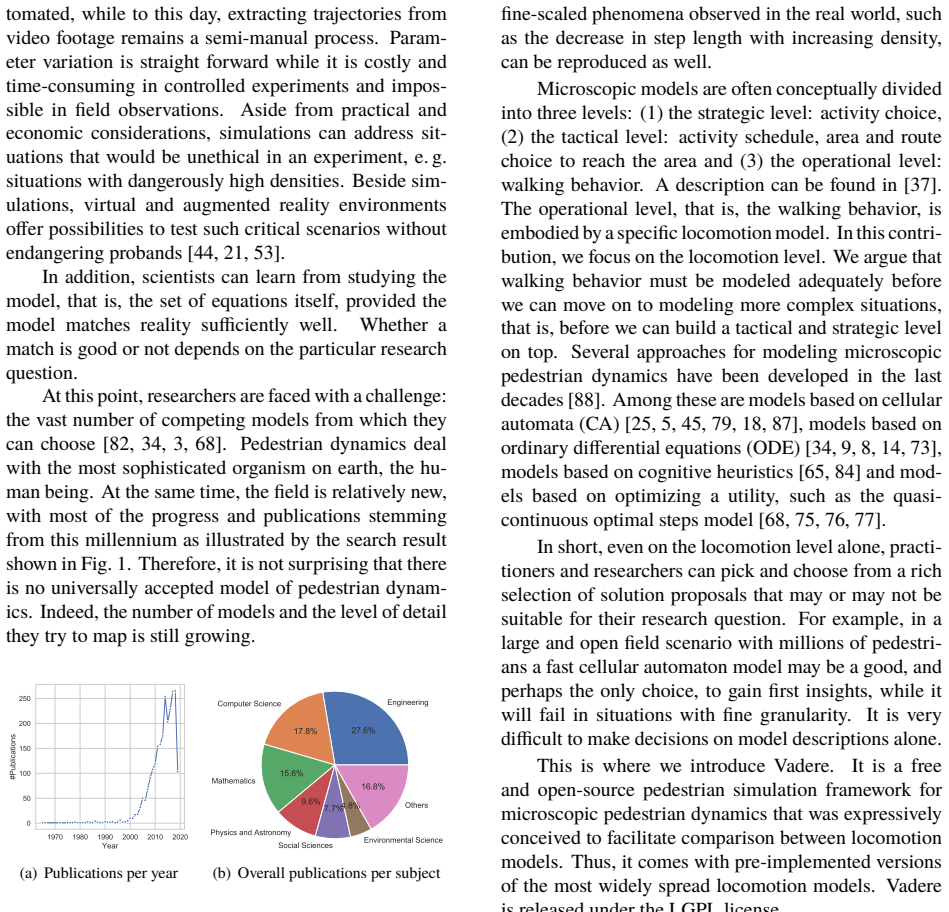
Pedestrian dynamics is an interdisciplinary field of research. Psychologists, sociologists, traffic engineers, physicists, mathematicians and computer scientists all strive to understand the dynamics of a moving crowd. In principle, computer simulations offer means to further this understanding. Yet, unlike for many classic dynamical systems in physics, there is no universally accepted locomotion model for crowd dynamics. On the contrary, a multitude of approaches, with very different characteristics, compete. Often only the experts in one special model type are able to assess the consequences these characteristics have on a simulation study. Therefore, scientists from all disciplines who wish to use simulations to analyze pedestrian dynamics need a tool to compare competing approaches. Developers, too, would profit from an easy way to get insight into an alternative modeling ansatz. Vadere meets this interdisciplinary demand by offering an open-source simulation framework that is lightweight in its approach and in its user interface while offering pre-implemented versions of the most widely spread models.
Editorial analysis
A structured set of objections, weighed in public.
Referee Report
Summary. The manuscript describes Vadere, an open-source simulation framework for pedestrian dynamics. It claims to address the lack of a universally accepted locomotion model by providing a lightweight tool and user interface that includes pre-implemented versions of the most widely used models from multiple disciplines, thereby enabling comparison of competing approaches and promoting interdisciplinary understanding.
Significance. If the framework is implemented as described and the models function correctly, Vadere could provide a practical common platform that reduces the expertise barrier for researchers wishing to compare models. The open-source release is a clear strength, as it permits direct inspection, reproduction, and extension by the community.
major comments (2)
- [Abstract] Abstract: the central claim that Vadere 'meets this interdisciplinary demand' rests on the assertion that it supplies pre-implemented versions of the most widely spread models in a lightweight framework, yet the manuscript supplies neither a concrete list of included models with references to their original formulations nor any verification that the implementations reproduce published behavior.
- [Abstract] Abstract, paragraph 3: no runtime, memory, or usability metrics are reported to support the repeated characterization of the framework as 'lightweight,' leaving the usability claim for an interdisciplinary audience unsubstantiated.
minor comments (1)
- [Abstract] The abstract would benefit from an explicit statement of the source-code repository URL and licensing terms so that readers can immediately access the claimed open-source implementation.
Simulated Author's Rebuttal
We thank the referee for the constructive feedback and positive recommendation. We address the two major comments point by point below.
read point-by-point responses
-
Referee: [Abstract] Abstract: the central claim that Vadere 'meets this interdisciplinary demand' rests on the assertion that it supplies pre-implemented versions of the most widely spread models in a lightweight framework, yet the manuscript supplies neither a concrete list of included models with references to their original formulations nor any verification that the implementations reproduce published behavior.
Authors: The body of the manuscript (Sections 2–4) already provides a concrete list of the implemented models (Social Force Model, Optimal Steps Model, Centrifugal Force Model, and others) together with citations to their original formulations, plus validation results demonstrating that the implementations reproduce published quantitative and qualitative behavior. To address the referee’s concern that this information is not immediately visible from the abstract, we will revise the abstract to include a brief enumerated list of models and an explicit statement that the implementations have been verified against published results. revision: yes
-
Referee: [Abstract] Abstract, paragraph 3: no runtime, memory, or usability metrics are reported to support the repeated characterization of the framework as 'lightweight,' leaving the usability claim for an interdisciplinary audience unsubstantiated.
Authors: We agree that quantitative evidence would strengthen the repeated claim that the framework is lightweight. The term is used in the manuscript to denote both a modest code base and a simple graphical user interface; however, we will add a short benchmark subsection (new Table and accompanying text) reporting wall-clock time and peak memory usage on standard hardware for representative simulation scenarios, thereby substantiating the claim for an interdisciplinary readership. revision: yes
Circularity Check
No circularity: tool-description paper with no derivations or predictions
full rationale
The paper presents Vadere as an open-source framework with pre-implemented pedestrian models. No equations, derivations, parameter fitting, or predictions are advanced. The central claim is a factual statement about software architecture and availability, with no load-bearing steps that reduce to self-definition, fitted inputs, or self-citation chains. This matches the default expectation of no significant circularity for non-mathematical tool papers.
Axiom & Free-Parameter Ledger
Reference graph
Works this paper leans on
-
[1]
JUnit test tool, http://www.junit.org. http://www. junit.org. Accessed: 2018-11-07
work page 2018
-
[2]
Juliane Adrian, Nikolai Bode, Martyn Amos, Mitra Baratchi,MiraBeermann,MaikBoltes,AlessandroCor- betta, Guillaume Dezecache, John Drury, Zhijian Fu, RolandGeraerts,SteveGwynne,GesineHofinger,Aoife Hunt,TinusKanters,AngelikaKneidl,KrisztinaKonya, Gerta Köster, Mira Küpper, Georgios Michalareas, Fer- gus Neville, Evangelos Ntontis, Stephen Reicher, En- rico ...
work page 2019
-
[3]
GianlucaAntonini. ADiscreteChoiceModelingFrame- work for Pedestrian Walking Behavior with Application to Human Tracking in Video Sequences. PhD thesis, École polytechnique fédérale de Lausanne, 2005
work page 2005
-
[4]
Guy, Ming Lin, and Dinesh Manocha
Jur Berg, Stephen J. Guy, Ming Lin, and Dinesh Manocha. Reciprocal n-body collision avoidance. Springer Tracts in Advanced Robotics, 70:3–19, 2011
work page 2011
-
[5]
C. Burstedde, K. Klauck, A. Schadschneider, and J. Zit- tartz. Simulation of pedestrian dynamics using a two- dimensional cellular automaton. Physica A: Statistical Mechanics and its Applications, 295:507–525, 2001
work page 2001
-
[6]
Rose Challenger, Chrus W. Clegg, Mark A. Robinson, andMarkLeigh. Understandingcrowdbehaviours: Sup- porting evidence. Technical report, University of Leeds, 2009
work page 2009
-
[7]
Oscillating behavior within the social force model.arXiv, 2014
Mohcine Chraibi. Oscillating behavior within the social force model.arXiv, 2014
work page 2014
-
[8]
Force-based models of pedes- trian dynamics
MohcineChraibi,UlrichKemloh,AndreasSchadschnei- der, and Armin Seyfried. Force-based models of pedes- trian dynamics. Networks and Heterogeneous Media, 6(3):425–442, 2011
work page 2011
-
[9]
Generalized centrifugal-force model for pedestrian dynamics.Physical Review E, 82(4):046111, 2010
Mohcine Chraibi, Armin Seyfried, and Andreas Schad- schneider. Generalized centrifugal-force model for pedestrian dynamics.Physical Review E, 82(4):046111, 2010
work page 2010
-
[10]
JuPedSim: an open framework for simulating and analyzing the dynam- ics of pedestrians
Mohcine Chraibi and Jun Zhang. JuPedSim: an open framework for simulating and analyzing the dynam- ics of pedestrians. In SUMO2016 - Traffic, Mobil- ity, and Logistics, Proceedings, volume 30 ofBerichte aus dem DLR-Institut für Verkehrssystemtechnik, pages 127–134, Braunschweig,May2016.SUMOConference 2016, Berlin (Germany), 23 May 2016 - 25 May 2016, Deutsc...
work page 2016
-
[11]
Some problems of digital systems simulation
R.W.Conway,B.M.Johnson,andW.L.Maxwell. Some problems of digital systems simulation. Management Science, 6(1):92–110, 1959
work page 1959
-
[12]
SeanCurtis,AndrewBest,andDineshManocha.Menge: A modular framework for simulating crowd movement. Collective Dynamics, 2016
work page 2016
-
[13]
Guy, Basim Zafar, and Dinesh Manocha
Sean Curtis, Stephen J. Guy, Basim Zafar, and Dinesh Manocha. Virtual Tawaf: A Velocity-Space-Based So- lution for Simulating Heterogeneous Behavior in Dense Crowds, chapter 1, pages 181–209. Springer Science + Business Media, 2013
work page 2013
-
[14]
Gradient navigation model for pedestrian dynamics
Felix Dietrich and Gerta Köster. Gradient navigation model for pedestrian dynamics. Physical Review E, 89(6):062801, 2014
work page 2014
-
[15]
Bridging the gap: From cellular automata to differential equation models for pedestrian dynamics
FelixDietrich, GertaKöster, MichaelSeitz, andIsabella von Sivers. Bridging the gap: From cellular automata to differential equation models for pedestrian dynamics. Journal of Computational Science, 5(5):841–846, 2014
work page 2014
-
[16]
JohnDruryandSteveReicher. Theintergroupdynamics of collective empowerment: Substantiating the social identity model of crowd behavior.Group Processes & Intergroup Relations, 2(4):381–402, 1999
work page 1999
-
[17]
Collectiveactionandpsy- chological change: The emergence of new social iden- tities
JohnDruryandSteveReicher. Collectiveactionandpsy- chological change: The emergence of new social iden- tities. British Journal of Social Psychology, 39(4):579– 604, 2010
work page 2010
-
[18]
Simulation of space acquisition process of pedestrians using proxemic floor field model
Takahiro Ezaki, Daichi Yanagisawa, Kazumichi Oht- suka, and Katsuhiro Nishinari. Simulation of space acquisition process of pedestrians using proxemic floor field model. Physica A: Statistical Mechanics and its Applications, 391(1–2):291–299, 2012
work page 2012
-
[19]
Fahy, Guylène Proulx, and Lata Aiman
Rita F. Fahy, Guylène Proulx, and Lata Aiman. Panic or not in fire: Clarifying the misconception.Fire and Materials, 36(5–6):328–338, 2012
work page 2012
-
[20]
Fire Dynamics Sim- ulator with Evacuation (FDS+Evac)
FDS+Evac Contributors. Fire Dynamics Sim- ulator with Evacuation (FDS+Evac). Online: http://virtual.vtt.fi/virtual/proj6/ fdsevac/documents/FDS+Evac_webpages.pdf,
- [21]
-
[22]
González, Robert Amor, Rug- giero Lovreglio, and Guillermo Cabrera-Guerrero
Zhenan Feng, Vicente A. González, Robert Amor, Rug- giero Lovreglio, and Guillermo Cabrera-Guerrero. Im- mersivevirtualrealityseriousgamesforevacuationtrain- ing and research: A systematic literature review.Com- puters & Education, 127:252–266, 2018
work page 2018
-
[23]
P. Fiorini and Z. Shiller. Motion planning in dynamic environmentsusingvelocityobstacles. TheInternational Journal of Robotics Research, 17(7):760–772, 1998
work page 1998
-
[24]
Design Patterns: Elements of Reusable Object-Oriented Software
Erich Gamma, Richard Helm, Ralph Johnson, and John Vlissides. Design Patterns: Elements of Reusable Object-Oriented Software. Addison-Wesley, Boston, MA, 1994
work page 1994
-
[25]
P.G. Gipps. The role of computer graphics in validat- ing simulation models.Mathematics and Computers in Simulation, 28(4):285–289, 1986
work page 1986
-
[26]
P.G. Gipps and B. Marksjö. A micro-simulation model for pedestrian flows. Mathematics and Computers in Simulation, 27(2–3):95–105, 1985
work page 1985
-
[27]
GitLab Contributors. GitLab. Online: https:// about.gitlab.com/, 2018. Accessed 26. October 2018
work page 2018
-
[28]
AutomatedRoutinginPedestrianDynamics
ArneGraf. AutomatedRoutinginPedestrianDynamics. Master’s thesis, Fachhochschule Aachen, 2015
work page 2015
-
[29]
S.M.V. Gwynne, E.D. Kuligowski, K.E. Boyce, D. Nils- son, A.P. Robbins, R. Lovreglio, J.R. Thomas, and A.Roy-Poirier. Enhancingegressdrills: Preparationand assessmentofevacueeperformance. FireandMaterials , 2017
work page 2017
-
[30]
Steve M.V. Gwynne, K.E. Boyce, Erica D. Kuligowski, Daniel Nilsson, A P. Robbins, and Ruggiero Lovreglio. Pros and cons of egress drills. InInterflam 2016, 14th InternationalConferenceonFireScienceandEngineer- ing, 07 2016
work page 2016
- [31]
-
[32]
Filip Hanik. The kiss principle. Online: https: //people.apache.org/~fhanik/kiss.html, 2006. Accessed 05. November 2018
work page 2006
-
[33]
Dynamic medium scale navigation us- ing dynamic floor fields
Dirk Hartmann, Jana Mille, Alexander Pfaffinger, and Christian Royer. Dynamic medium scale navigation us- ing dynamic floor fields. In Ulrich Weidmann, Uwe Kirsch, and Michael Schreckenberg, editors, Pedes- trianandEvacuationDynamics2012 ,pages1237–1249. Springer International Publishing, 2014
work page 2014
-
[34]
Simulat- ingdynamicalfeaturesofescapepanic
Dirk Helbing, Illés Farkas, and Tamás Vicsek. Simulat- ingdynamicalfeaturesofescapepanic. Nature,407:487– 490, 2000
work page 2000
-
[35]
Social Force Model for pedestrian dynamics
Dirk Helbing and Péter Molnár. Social Force Model for pedestrian dynamics. Physical Review E, 51(5):4282– 4286, 1995
work page 1995
-
[36]
Crowd disasters as systemic failures: analysis of the love parade disaster
Dirk Helbing and Pratik Mukerji. Crowd disasters as systemic failures: analysis of the love parade disaster. EPJ Data Science, 1(7):1–40, 2012
work page 2012
-
[37]
K. Hirai and K. Tarui. A simulation of the behavior of a crowd in panic. In Proc. of the 1975 International ConferenceonCyberneticsandSociety ,page409,1975
work page 1975
-
[38]
Serge P. Hoogendoorn and Piet H. L. Bovy. Pedestrian route-choice and activity scheduling theory and mod- els. Transportation Research Part B: Methodological, 38(2):169–190, 2004
work page 2004
-
[39]
Roger L. Hughes. A continuum theory for the flow of pedestrians. Transportation Research Part B: Method- ological, 36(6):507–535, 2001
work page 2001
-
[40]
Roadvehicles—Functionalsafety—Part6: Prod- uct development at the software level, 2018
ISO. Roadvehicles—Functionalsafety—Part6: Prod- uct development at the software level, 2018
work page 2018
-
[41]
Specificationofthesocialforcepedestrianmodelbyevo- lutionaryadjustmenttovideotrackingdata
AndersJohansson,DirkHelbing,andPradyumnShukla. Specificationofthesocialforcepedestrianmodelbyevo- lutionaryadjustmenttovideotrackingdata. Advancesin Complex Systems, 10:271–288, 2007
work page 2007
-
[42]
The many roles of the relaxation time parameter in force based models of pedestrian dy- namics
FredrikJohansson,DorineDuives,WinnieDaamen,and Serge Hoogendoorn. The many roles of the relaxation time parameter in force based models of pedestrian dy- namics. Transportation Research Procedia, 2:300–308,
-
[43]
TheConferenceonPedestrianandEvacuationDy- namics 2014 (PED 2014), 22-24 October 2014, Delft, The Netherlands
work page 2014
-
[44]
Peter Kielar, Daniel Biedermann, and Andre Borrmann. MomenTUMv2: A Modular, Extensible, and Generic Agent-Based Pedestrian Behavior Simulation Frame- work. Technical report, TUM, 08 2016
work page 2016
-
[45]
Peter M. Kielar and André Borrmann. Modeling pedes- trians’ interest in locations: A concept to improve simu- lationsofpedestriandestinationchoice. SimulationMod- elling Practice and Theory, 61:47–62, 2016
work page 2016
-
[46]
M. Kinateder, E. Ronchi, D. Nilsson, M. Kobes, M. Müller, Pauli P., and A. Mühlberger. Virtual real- ity for fire evacuation research. In2014 Federated Con- ference on Computer Science and Information Systems, pages 313–321, 09 2014
work page 2014
-
[47]
Ansgar Kirchner, Hubert Klüpfel, Katsuhiro Nishinari, Andreas Schadschneider, and Michael Schreckenberg. Simulation of competitive egress behavior: comparison with aircraft evacuation data.Physica A: Statistical Me- chanics and its Applications, 324(3–4):689–697, 2003
work page 2003
-
[48]
Integration of anagentbasedevacuationsimulationandstate-of-the-art fire simulation
TimoKorhonen,SimoHostikka,SimoHeliövaara,Harri Ehtamo, and Katri Johanna Matikainen. Integration of anagentbasedevacuationsimulationandstate-of-the-art fire simulation. InProceedings of the 7th Asia-Oceania Symposium on Fire Science & Technology, Hong Kong, 2007
work page 2007
-
[49]
Avoid- ing numerical pitfalls in social force models.Physical Review E, 87(6):063305, 2013
Gerta Köster, Franz Treml, and Marion Gödel. Avoid- ing numerical pitfalls in social force models.Physical Review E, 87(6):063305, 2013
work page 2013
-
[50]
Queuing at bot- tlenecks using a dynamic floor field for navigation
Gerta Köster and Benedikt Zönnchen. Queuing at bot- tlenecks using a dynamic floor field for navigation. In TheConferenceinPedestrianandEvacuationDynamics 2014,TransportationResearchProcedia,pages344–352, Delft, The Netherlands, 2014
work page 2014
-
[51]
A queuing model basedonsocialattitudes
Gerta Köster and Benedikt Zönnchen. A queuing model basedonsocialattitudes. InVictorL.KnoopandWinnie Daamen, editors,Traffic and Granular Flow ’15, pages 193–200,Nootdorp,theNetherlands,2016.SpringerIn- ternational Publishing. 27–30 October 2015
work page 2016
-
[52]
Daniel Krajzewicz, Jakob Erdmann, Michael Behrisch, and Laura Bieker. Recent Development and Applica- tions of SUMO - Simulation of Urban MObility.Inter- national Journal On Advances in Systems and Measure- ments, 5(3&4):128–138, 12 2012
work page 2012
-
[53]
Quick- estpathsinsimulationsofpedestrians
Tobias Kretz, Andree Große, Stefan Hengst, Lukas Kautzsch, Andrej Pohlmann, and Peter Vortisch. Quick- estpathsinsimulationsofpedestrians. AdvancesinCom- plex Systems, 10:733–759, 2011
work page 2011
- [54]
-
[55]
A review of augmented reality ap- plications for building evacuation
Ruggiero Lovreglio. A review of augmented reality ap- plications for building evacuation. In17th International Conference on Computing in Civil and Building Engi- neering, 2018
work page 2018
-
[56]
Kevin McGrattan, Simo Hostikka, Randall McDermott, Floyd Jason, and Marcos Vanella.Fire Dynamics Simu- lator User’s Guide. National Institute of Standards and Technology and VTT Technical Research Centre of Fin- land, sixth edition edition, 2019
work page 2019
-
[57]
The walking behaviour of pedestriansocialgroupsanditsimpactoncrowddynam- ics
Mehdi Moussaïd, Niriaska Perozo, Simon Garnier, Dirk Helbing, and Guy Theraulaz. The walking behaviour of pedestriansocialgroupsanditsimpactoncrowddynam- ics. PLoS ONE, 5(4):e10047, 2010
work page 2010
-
[58]
Shigeyuki Okazaki. A study of pedestrian movement in architectural space: part 1 pedestrian movement by the application of magnetic models.Transactions of the Architectural Institute of Japan, 283:111–119, 1979
work page 1979
-
[59]
Acriticalassessmentofpedestrianbehaviourmod- els
Eleonora Papadimitriou, George Yannis, and John Go- lias. Acriticalassessmentofpedestrianbehaviourmod- els. Transportation Research Part F: Traffic Psychology and Behaviour, 12(3):242–255, 2009
work page 2009
-
[60]
Parisi, Marcelo Gilman, and Herman Moldovan
Daniel R. Parisi, Marcelo Gilman, and Herman Moldovan. A modification of the social force model can reproduce experimental data of pedestrian flows in normalconditions. PhysicaA:StatisticalMechanicsand its Applications, 388(17):3600–3608, 2009
work page 2009
-
[61]
N. Pelechano, J. M. Allbeck, and N. I. Badler. Con- trolling individual agents in high-density crowd simu- lation. In D. Metaxas and J. Popovic, editors, ACM SIGGRAPH/Eurographics Symposium on Computer an- imation, 2007
work page 2007
-
[62]
The Logic of Scientific Discovery (1934, 1959)
Karl Popper. The Logic of Scientific Discovery (1934, 1959). RoutledgeClassics,LondonandNewYork,2002
work page 1934
-
[63]
Stephen D. Reicher. The St. Pauls’ riot: An explanation ofthelimits ofcrowdactioninterms ofasocialidentity model.EuropeanJournalofSocialPsychology ,14(1):1– 21, 1984
work page 1984
- [64]
-
[65]
Guideline for Microscopic Evacuation Analy- sis
RiMEA. Guideline for Microscopic Evacuation Analy- sis. RiMEA e.V., 3.0.0 edition, 2016
work page 2016
-
[66]
Seitz.Simulating pedestrian dynamics: To- wards natural locomotion and psychological decision making
Michael J. Seitz.Simulating pedestrian dynamics: To- wards natural locomotion and psychological decision making. PhD thesis, Technische Universität München, Munich, Germany, 2016
work page 2016
-
[67]
Michael J. Seitz, Nikolai W. F. Bode, and Gerta Köster. How cognitive heuristics can explain social interactions in spatial movement.Journal of the Royal Society Inter- face, 13(121):20160439, 2016
work page 2016
-
[68]
Seitz, Felix Dietrich, and Gerta Köster
Michael J. Seitz, Felix Dietrich, and Gerta Köster. The effect of stepping on pedestrian trajectories.Physica A: StatisticalMechanicsanditsApplications ,421:594–604, 2015
work page 2015
-
[69]
The superposition principle: A con- ceptual perspective on pedestrian stream simulations
MichaelJ.Seitz,FelixDietrich,GertaKöster,andHans- Joachim Bungartz. The superposition principle: A con- ceptual perspective on pedestrian stream simulations. Collective Dynamics, 1:A2, 2016
work page 2016
-
[70]
MichaelJ.SeitzandGertaKöster. Naturaldiscretization of pedestrian movement in continuous space.Physical Review E, 86(4):046108, 2012
work page 2012
-
[71]
Michael J. Seitz and Gerta Köster. How update schemes influence crowd simulations. Journal of Statistical Mechanics: Theory and Experiment, 2014(7):P07002, 2014
work page 2014
-
[72]
SUMO – Simulation of Urban MObility
SUMO Contributors. SUMO – Simulation of Urban MObility. Online: www.dlr.de/ts/en/ desktopdefault.aspx/tabid-9883/16931_ read-41000/, 2015. Accessed 11. January 2016
work page 2015
-
[73]
Anne Templeton, John Drury, and Andrew Philippides. From mindless masses to small groups: Conceptualiz- ing collective behavior in crowd modeling.Review of General Psychology, 19(3):215–229, 2015
work page 2015
-
[74]
Collision-freefirstordermodelforpedestriandynamics
AntoineTordeux,MohcineChraibi,andArminSeyfried. Collision-freefirstordermodelforpedestriandynamics. InTrafficandGranularFlow’15 ,Nootdorp,theNether- lands, 2015. 27–30 October 2015
work page 2015
-
[75]
Antoine Tordeux and Armin Seyfried. Collision-free nonuniform dynamics within continuous optimal veloc- ity models.Physical Review E, 90:042812, 2014
work page 2014
-
[76]
Adrien Treuille, Seth Cooper, and Zoran Popović. Con- tinuum crowds. ACM Transactions on Graphics (SIG- GRAPH 2006), 25(3):1160–1168, 2006
work page 2006
-
[77]
Dynamic Stride Length Adaptation According to Utility And Personal Space
Isabella von Sivers and Gerta Köster. How stride adap- tation in pedestrian models improves navigation.arXiv, 1401.7838(v1), 2014
work page internal anchor Pith review Pith/arXiv arXiv 2014
-
[78]
Dynamic stride length adaptation according to utility and personal space
Isabella von Sivers and Gerta Köster. Dynamic stride length adaptation according to utility and personal space. Transportation Research Part B: Methodologi- cal, 74:104–117, 2015
work page 2015
-
[79]
Modelling so- cial identification and helping in evacuation simulation
Isabella von Sivers, Anne Templeton, Florian Künzner, Gerta Köster, John Drury, Andrew Philippides, Tobias Neckel, and Hans-Joachim Bungartz. Modelling so- cial identification and helping in evacuation simulation. Safety Science, 89:288–300, 2016
work page 2016
-
[80]
Isabella Katharina Maximiliana von Sivers. Mod- ellierung sozialpsychologischer Faktoren in Perso- nenstromsimulationen - Interpersonale Distanz und soziale Identitäten. PhD thesis, Technische Universität München, 2016
work page 2016
discussion (0)
Sign in with ORCID, Apple, or X to comment. Anyone can read and Pith papers without signing in.