REVIEW 3 major objections 5 minor 37 references
Periodic solutions for a pair of delay-coupled excitable theta neurons
T0 review · 3 major / 5 minor · reviewed 2026-08-12 · deepseek-v4-flash
Pith's one-line read For a pair of identical excitable theta neurons coupled by delayed pulses, this paper derives exact synchronous and alternating periodic solutions, proves that stability of each branch reduces to one parameter, and locates the…
desk verdict Solid analytic extension of the single-neuron delay-coupled theta neuron results; the firing-map-to-Floquet equivalence is unproved but likely patchable, and the abstract overstates the scope. read the letter →
The pith
A machine-rendered reading of the paper's core claim, the machinery that carries it, and where it could break.
The reading
What carries the argument
The carrying mechanism is the firing-time map: because the theta neuron integrates explicitly between pulses, the next firing time of each neuron is a closed-form function of earlier firing times. Linearising this map about a periodic solution gives characteristic polynomials whose roots are treated as the Floquet multipliers, and all dependence on coupling strength, delay, period, and firing count is condensed into the single parameter gamma. Factoring these polynomials separates dynamics within the symmetry subspace from transverse dynamics, which is what makes the symmetry-breaking bifurcation appear as a clean analytic condition.
What would settle it
Compute the Floquet multipliers of the full discontinuous system by direct numerical integration with small pulse perturbations for a chosen branch, and compare them with the roots of the characteristic polynomial; the analytic criterion is wrong if any multiplier exits the unit circle at a parameter value different from the stated symmetry-breaking or saddle-node values, or if stability changes when a perturbed firing time crosses the edge of the delay window without a corresponding root crossing.
Extended reading notes
Core claim
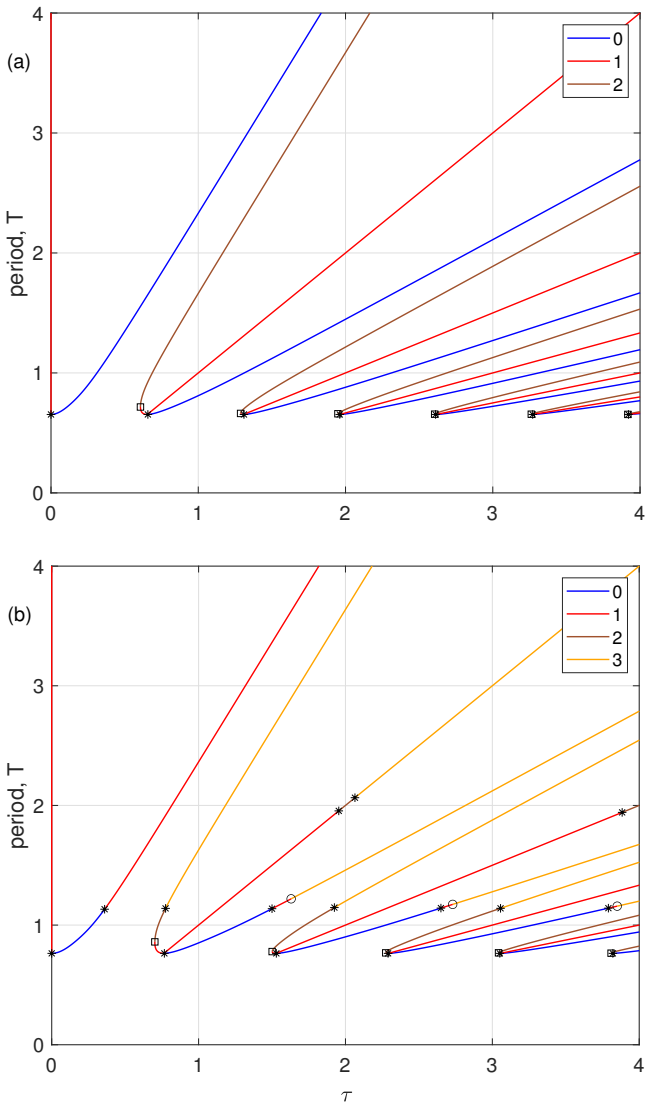
The paper establishes that, for coupling strength greater than 2, the delay-coupled pair has infinitely many branches of synchronous periodic solutions satisfying an exact coth equation and infinitely many branches of alternating periodic solutions satisfying the analogous half-integer equation, where the integer counts past firings inside the delay window; the primary synchronous branch has an explicit period formula. Stability of both families is governed by a single parameter: for values between 0 and 1 every Floquet multiplier is inside the unit circle, at one it crosses at the trivial multiplier, which is a symmetry-breaking bifurcation at the minimum of the period-versus-delay curve, and it exits at stated saddle-node values for higher parameter values. The alternating branch with zero firings in the delay window is stable for all positive delays and persists at zero delay, where it coexists with a one-parameter family of neutrally stable symmetry-broken solutions; all other symmetry-broken branches are unstable. Numerical continuation with smooth pulse coupling reproduces the same branch geometry, with extra stability changes appearing only when the pulse is wide.
Load-bearing premise
The stability analysis assumes that stability of the periodic orbit of the discontinuous system is exactly the stability of the linearised firing-time map, and that small perturbations never change the number of firings inside the delay window or the order in which pulses arrive; if a perturbation makes a firing cross the boundary of the delay interval, the analytic stability prediction could miss a border-collision change of stability.
Editorial extensions
If this is right
- On any branch with at least one firing in the delay window, the stable region is exactly the part of the period-versus-delay curve to the right of its minimum, so the minimum period doubles as a symmetry-breaking boundary.
- The synchronous and alternating families interleave: substituting a half-integer shift turns the synchronous existence equation and characteristic equation into the alternating ones, so the two rhythm types form one analytic structure.
- In the strong-coupling limit the system becomes an infinite fan of neutrally stable rays, with synchronous periods and alternating periods scaling as fixed fractions of the delay, so all nontrivial stability in this model comes from finite coupling strength.
- All symmetry-broken solutions that branch from the synchronous and alternating families are unstable except the zero-delay alternating family, which is neutrally stable, so the network cannot settle into a slightly desynchronised periodic state.
- The Dirac-delta system acts as a normal form: with smooth pulse coupling of sharp width the computed branches and stability agree with the analytics, and only wider pulses introduce additional bifurcations such as Hopf points.
Reading between the lines
- Extension: the stability criterion predicts a robust experimental fingerprint: any realisation of two delay-coupled excitable elements with pulsatile coupling should lose its in-phase or anti-phase rhythm exactly at the turning point of the period-versus-delay curve, independent of pulse shape.
- Extension: because the existence equations are pure coth identities, the same branch skeleton should hold for any excitable unit whose pulse-triggered phase advance approximates the tangent shift of the saddle-node-on-invariant-circle normal form, such as class-1 neurons with suitable phase-resetting curves.
- Extension: the paper mentions more complex periodic solutions with multiple firings per neuron per period; the same spike-time-map machinery should be able to derive their existence and stability, although the event order inside the delay window is no longer fixed.
- Extension: for wide smooth pulses, the extra stability changes invite the question of whether they are always Hopf bifurcations and whether a pulse-width perturbation expansion around the delta-function limit could predict them.
Editorial analysis
A structured set of objections, weighed in public.
Referee Report
Summary. This manuscript studies two identical excitable theta neurons mutually coupled by delayed Dirac delta pulses, system (2)-(3). It constructs synchronous periodic solutions via the single-neuron existence condition (8), and alternating solutions via the substitution tau -> tau - T/2 leading to (29). For each family the authors linearize the firing-time return map and obtain characteristic equations Ds(lambda)=0 [Eq. (19)] and Da(lambda)=0 [Eq. (45)] in terms of a single parameter gamma. They conclude that both families are stable for 0<gamma<1, lose stability in a symmetry-breaking bifurcation at gamma=1 located at the minimum of T(tau), and undergo saddle-node bifurcations at gamma=(n+1)/n or gamma=(2n+1)/(2n-1). Symmetry-broken branches are constructed explicitly (Eqs. (25) and (53)) and shown unstable except for the neutrally stable tau=0 alternating continuum. The final section verifies the qualitative picture by numerical continuation for smooth pulses.
Significance. If the spectral reduction is accepted, the paper provides a complete, explicit two-parameter bifurcation description of two central periodic solution families of a canonical two-neuron network. The formulas are derived rather than fitted, and the smooth-pulse continuation gives falsifiable predictions about persistence and additional stability changes. The n <-> n+1/2 duality between synchronous and alternating solutions is elegant, and the tau=0 reversible family is well explained. The main caveat is that the equivalence between roots of the firing-time-map characteristic equation and Floquet multipliers of the infinite-dimensional impulsive DDE is asserted rather than proved; the paper's stability conclusions are conditional on that equivalence.
major comments (3)
- [Sec. 2.1 and Sec. 3.1.3 (Eqs. (19) and (45))] The paper states without proof that the roots of Ds(lambda) and Da(lambda) are the Floquet multipliers of the corresponding periodic solutions. System (2)-(3) is an impulsive delay differential equation whose phase space includes a history segment, so its monodromy operator is infinite-dimensional; the linearized firing-time map (13)-(16) and (38)-(39) only tracks event times. The authors need either a theorem or a precise reference showing that all multipliers except those computed from the event map are strictly inside the unit circle, and that the event count n and the order of events inside the delay window are locally rigid under small perturbations. Without this, the stability intervals, the symmetry-breaking bifurcation at gamma=1, and the saddle-node statements rest on an unproved reduction. This is the load-bearing step of the paper.
- [Abstract and Appendix A.2] The abstract and the discussion state that all symmetry-broken periodic solutions are unstable, but Appendix A.2 explicitly finds that the tau=0 family of symmetry-broken alternating solutions is neutrally stable: the characteristic equation (64) has lambda=1 as a double root, and Sec. 3.3 describes a one-parameter continuum. The claim should be qualified to 'all branches with tau>0' or 'all except the neutrally stable tau=0 family'; as written, the summary of results is not accurate.
- [Sec. 3.1.3, Proposition 2(4)] Proposition 2(4) proves only that no root of Da lies outside the unit circle for 0<gamma<1. Since Da always has the trivial root lambda=1, stability additionally requires that no nontrivial root lies on the unit circle. This can be fixed with a short argument: for |lambda|=1 and gamma>0, the modulus equation |lambda^{2n-1}||lambda-gamma|^2=(1-gamma)^2 forces |lambda-gamma|=1-gamma and hence lambda=1. As written, the proof is incomplete for the central stability claim.
minor comments (5)
- [Sec. 2.1 and Sec. 3.1.3] The stability criterion should read 'all nontrivial multipliers lie inside the unit circle', because Ds and Da always contain the trivial multiplier lambda=1 corresponding to time translation; the quotation of [19, Proposition 1] should carry the same caveat.
- [Sec. 3.1.3] The sentence 'we find it more convenient to consider Da(lambda) in (19)' should refer to Eq. (45), not Eq. (19).
- [Sec. 1] The phrase 'find all periodic solutions of system (2)-(3)' overstates the scope, since only synchronous and alternating families are analyzed and Sec. 5 exhibits other stable periodic solutions in Fig. 12; suggest rephrasing to 'find all solutions of the considered symmetry classes'.
- [Throughout] The text contains numerous broken cross-references (e.g., 'Sec. 33.13.1.1', 'Sec. 22.1', 'Sec. 33.3', 'Appendix AA.1') and typos ('symmtry-broken', 'sytem', 'additonal', 'minumum'); these should be corrected before publication.
- [Sec. 2.2, Eq. (24)] The derivation divides by sinh(2 phi T), which implicitly assumes phi != 0; this is fine for the symmetry-broken branches but should be stated explicitly.
Circularity Check
No significant circularity: all claimed existence and stability results are derived from explicit firing-time maps or from an independently published, parameter-free single-neuron result.
full rationale
The paper's central claims are not circular. Existence of synchronous solutions is imported from the authors' own prior work [19] via Eq. (8), but that is a parameter-free, published analytic result for a single self-coupled theta neuron, and the reduction to that problem follows exactly from the synchronous symmetry of the two-neuron system; it is independent support rather than a self-referential derivation. The stability analysis is new: the firing-time maps (11)-(12) and (34)-(35) are derived explicitly from the theta-neuron dynamics and the delta-coupling rule, and the characteristic equations (19) and (45) are obtained by linearizing those maps, not by fitting or by renaming a known quantity. Alternating solutions are obtained from Eq. (8) by the exact substitution tau -> tau - T/2, which is a symmetry reduction (y(t)=x(t+T/2)) rather than a circular renaming: Eq. (29) is a derived consequence of the alternating ansatz, and the subsequent stability computation is independent. No free parameters are fitted, no subset of the target results is used as an input to predict itself, and no 'prediction' is statistically forced. The paper's main weakness, flagged by the skeptical reading, is that the roots of the linearized firing-time characteristic equations are asserted to be the Floquet multipliers of the discontinuous delay system (Eqs. (19) and (45) with the surrounding text), and this equivalence is not proved; in particular, the linearization assumes the firing count and event order are locally rigid, so border-collision events could invalidate it. That is a correctness or rigor concern, not a circularity: it is an unproved modeling assumption, not an equation that reduces to its own input by construction. The self-citations used (e.g., [19] for Eq. (8) and for properties of g_s, and [36] for reappearance of periodic solutions) are either parameter-free published results or standard external theorems, and they do not themselves contain the paper's stability conclusions. Hence the derivation chain is self-contained from the stated model, and the circularity score is 0.
Assumptions & free parameters
assumptions (6)
- standard math The theta neuron is the SNIC normal form and for I<0 has exactly two equilibria; I is set to -1 without loss of generality.
- domain assumption A Dirac-delta input acts as the instantaneous phase jump tan(theta+/2) = tan(theta-/2) + kappa (Eq. 4).
- standard math Between kicks each neuron follows the unperturbed excitable theta dynamics with explicit solution (5)-(7).
- standard math The 'reappearance' principle: a T-periodic solution of a DDE with delay s persists as a solution at delays s+nT (Yanchuk and Perlikowski [36]).
- domain assumption Stability of periodic solutions is equivalent to stability of the linearized firing-time map; roots lambda of characteristic equations are Floquet multipliers.
- domain assumption For tau=0 symmetry-broken alternating solutions, the system is reversible under (t,theta1,theta2) -> (-t,-theta1,-theta2) and has the stated phase portrait.
Cite this review
Pith. "Pith review of Periodic solutions for a pair of delay-coupled excitable theta neurons." pith.science (2026). https://pith.science/paper/VBOJ4JXZ
@misc{pith2026241206804,
  author       = {Pith},
  title        = {Pith review of: Periodic solutions for a pair of delay-coupled excitable theta neurons},
  year         = {2026},
  howpublished = {\url{https://pith.science/paper/VBOJ4JXZ}},
  note         = {Machine review of arXiv:2412.06804}
}
read the original abstract
We consider a pair of identical theta neurons in the excitable regime, each coupled to the other via a delayed Dirac delta function with the same delay. This simple network can support different periodic solutions, and we concentrate on two important types: those for which the neurons are perfectly synchronous, and those where the neurons are exactly half a period out of phase and fire alternatingly. Owing to the specific type of pulsatile feedback, we are able to determine these solutions and their stability analytically. More specifically, (infinitely many) branches of periodic solutions of either type are created at saddle-node bifurcations, and they gain stability at symmetry-breaking bifurcations when their period as a function of delay is at its minimum. We also determine the respective branches of symmetry-broken periodic solutions and show that they are all unstable. We demonstrate by considering smoothed pulse-like coupling that the special case of the Dirac delta function can be seen as a sort of normal form: the basic structure of the different periodic solutions of the two theta neurons is preserved, but there may be additional changes of stability along the different branches.
Figures


Figures from the paper (10 more)




Reference graph
Works this paper leans on
-
[19]
Theta neuron subject to delayed feedback: a prototypical model for self-sustained pulsing
Carlo R Laing and Bernd Krauskopf. Theta neuron subject to delayed feedback: a prototypical model for self-sustained pulsing. Proc. R. Soc. A , 478:20220292, 2022
work page 2022
-
[1]
Time-delay-induced phase- transition to synchrony in coupled bursting neurons
Bhim Mani Adhikari, Awadhesh Prasad, and Mukeshwar Dhamala. Time-delay-induced phase- transition to synchrony in coupled bursting neurons. Chaos: An Interdisciplinary Journal of Nonlinear Science, 21(2):023116, 2011
work page 2011
-
[2]
Effects of noisy drive on rhythms in networks of exci- tatory and inhibitory neurons
Christoph B¨ orgers and Nancy Kopell. Effects of noisy drive on rhythms in networks of exci- tatory and inhibitory neurons. Neural computation, 17(3):557–608, 2005
work page 2005
-
[3]
Dynamics of fitzhugh-nagumo excitable systems with delayed coupling
Nikola Buri´ c and Dragana Todorovi´ c. Dynamics of fitzhugh-nagumo excitable systems with delayed coupling. Phys. Rev. E , 67:066222, Jun 2003
work page 2003
-
[4]
Dynamics of delay- coupled excitable neural systems
Markus A Dahlem, G Hiller, Anastasiia Panchuk, and Eckehard Sch¨ oll. Dynamics of delay- coupled excitable neural systems. International Journal of Bifurcation and Chaos , 19(02):745– 753, 2009
work page 2009
- [5]
-
[6]
Type I membranes, phase resetting curves, and synchrony
Bard Ermentrout. Type I membranes, phase resetting curves, and synchrony. Neural Compu- tation, 8(5):979–1001, 1996
work page 1996
-
[7]
Parabolic bursting in an excitable system coupled with a slow oscillation
G B Ermentrout and N Kopell. Parabolic bursting in an excitable system coupled with a slow oscillation. SIAM J Appl Math , 46(2):233–253, 1986
work page 1986
Show all 37 references
-
[8]
Topological solitons as addressable phase bits in a driven laser
Bruno Garbin, Julien Javaloyes, Giovanna Tissoni, and St´ ephane Barland. Topological solitons as addressable phase bits in a driven laser. Nature Communications, 6, jan 2015
2015
-
[9]
Singularities and Groups in Bifurca- tion Theory: Volume II , volume 69
Martin Golubitsky, Ian Stewart, and David G Schaeffer. Singularities and Groups in Bifurca- tion Theory: Volume II , volume 69. Springer Science & Business Media, 2012. 27
2012
-
[10]
Pulse-coupled chemical oscillators with time delay
Viktor Horvath, Pier Luigi Gentili, Vladimir K Vanag, and Irving R Epstein. Pulse-coupled chemical oscillators with time delay. Angewandte Chemie, 124(28):6984–6987, 2012
2012
-
[11]
Izhikevich
E.M. Izhikevich. Dynamical Systems in Neuroscience: The Geometry of Excitability and Burst- ing. The MIT press, 2007
2007
-
[12]
Kelleher, C
B. Kelleher, C. Bonatto, P. Skoda, S. P. Hegarty, and G. Huyet. Excitation regeneration in delay-coupled oscillators. Physical Review E , 81(3), mar 2010
2010
-
[13]
Multi-jittering instability in oscillatory systems with pulse coupling
Vladimir Klinshov, Leonhard L¨ ucken, Serhiy Yanchuk, and Vladimir Nekorkin. Multi-jittering instability in oscillatory systems with pulse coupling. In Mark Edelman, Elbert E. N. Macau, and Miguel A. F. Sanjuan, editors, Chaotic, Fractional, and Complex Dynamics: New Insights ...
2018
-
[14]
Synchronization of time-delay coupled pulse oscillators
VV Klinshov and VI Nekorkin. Synchronization of time-delay coupled pulse oscillators. Chaos Solitons Fractals, 44(1-3):98–107, 2011
2011
-
[15]
Krauskopf, K
B. Krauskopf, K. R. Schneider, J. Sieber, S. M. Wieczorek, and M. Wolfrum. Excitability and self-pulsations near homoclinic bifurcations in semiconductor laser systems. Optics Commu- nications, 215:367–379, 2003
2003
-
[16]
Krauskopf and J
B. Krauskopf and J. J. Walker. Bifurcation study of a semiconductor laser with saturable absorber and delayed optical feedback. In Kathy L¨ udge, editor, Nonlinear Laser Dynamics , pages 161–181. Wiley-VCH, 2012
2012
-
[17]
Chaos in small networks of theta neurons
Carlo R Laing. Chaos in small networks of theta neurons. Chaos: An Interdisciplinary Journal of Nonlinear Science , 28(7):073101, 2018
2018
-
[18]
Carlo R. Laing. Periodic solutions for a pair of delay-coupled active theta neurons. to appear in The ANZIAM Journal , 2024
2024
-
[20]
Dynamics of deterministic and stochastic paired excitatory- inhibitory delayed feedback
Carlo R Laing and Andr´ e Longtin. Dynamics of deterministic and stochastic paired excitatory- inhibitory delayed feedback. Neural computation, 15(12):2779–2822, 2003
2003
-
[21]
P. Li, W. Lin, and K. Efstathiou. Isochronous dynamics in pulse coupled oscillator networks with delay. Chaos, 27(5):053103, 2017
2017
-
[22]
Perlikowski, S
P. Perlikowski, S. Yanchuk, O. V. Popovych, and P. A. Tass. Periodic patterns in a ring of delay-coupled oscillators. Phys. Rev. E , 82:036208, Sep 2010
2010
-
[23]
Control of neuronal syn- chrony by nonlinear delayed feedback
Oleksandr V Popovych, Christian Hauptmann, and Peter A Tass. Control of neuronal syn- chrony by nonlinear delayed feedback. Biological Cybernetics, 95(1):69–85, 2006
2006
-
[24]
Phase-flip bifurcation induced by time delay
Awadhesh Prasad, J¨ urgen Kurths, Syamal Kumar Dana, and Ramakrishna Ramaswamy. Phase-flip bifurcation induced by time delay. Physical Review E , 74(3):035204, 2006
2006
-
[25]
Chaos and time-reversal symmetry
John AG Roberts and GR W Quispel. Chaos and time-reversal symmetry. order and chaos in reversible dynamical systems. Physics Reports, 216(2-3):63–177, 1992
1992
-
[26]
Romeira, R
B. Romeira, R. Av´ o, J. M. L. Figueiredo, S. Barland, and J. Javaloyes. Regenerative memory in time-delayed neuromorphic photonic resonators. Scientific Reports, 6, 2016. 28
2016
-
[27]
Time-delayed feedback in neurosystems
Eckehard Sch¨ oll, Gerald Hiller, Philipp H¨ ovel, and Markus A Dahlem. Time-delayed feedback in neurosystems. Philosophical Transactions of the Royal Society A: Mathematical, Physical and Engineering Sciences , 367(1891):1079–1096, 2009
2009
-
[28]
Mutual entrainment of two limit cycle oscillators with time delayed coupling
Heinz Georg Schuster and Peter Wagner. Mutual entrainment of two limit cycle oscillators with time delayed coupling. Prog. Theor. Phys., 81(5):939–945, 1989
1989
-
[29]
Sieber, K
J. Sieber, K. Engelborghs, T. Luzyanina, G. Samaey, and D. Roose. DDE-BIFTOOL Manual — Bifurcation analysis of delay differential equations . 2015. arXiv preprint arXiv:1406.7144; available at: https://sourceforge.net/projects/ddebiftool
2015 arXiv
-
[30]
Inphase and antiphase synchronization in a delay-coupled system with applications to a delay-coupled FitzHugh–Nagumo system
Yongli Song and Jian Xu. Inphase and antiphase synchronization in a delay-coupled system with applications to a delay-coupled FitzHugh–Nagumo system. IEEE Trans Neural Netw Learn Syst, 23(10):1659–1670, 2012
2012
-
[31]
Time delay effect in a living coupled oscillator system with the plasmodium of physarum polycephalum
Atsuko Takamatsu, Teruo Fujii, and Isao Endo. Time delay effect in a living coupled oscillator system with the plasmodium of physarum polycephalum. Physical Review Letters, 85(9):2026, 2000
2026
-
[32]
Soizic Terrien, Bernd Krauskopf, Neil G. R. Broderick, Louis Andr´ eoli, Foued Selmi, R´ emy Braive, Gr´ egoire Beaudoin, Isabelle Sagnes, and Sylvain Barbay. Asymmetric noise sensitivity of pulse trains in an excitable microlaser with delayed optical feedback. Physical Review...
2017
-
[33]
Pulse train interaction and control in a microcavity laser with delayed optical feedback
Soizic Terrien, Bernd Krauskopf, Neil GR Broderick, R´ emy Braive, Gr´ egoire Beaudoin, Isabelle Sagnes, and Sylvain Barbay. Pulse train interaction and control in a microcavity laser with delayed optical feedback. Optics Letters, 43(13):3013–3016, 2018
2018
-
[34]
Robust spike timing in an excitable cell with delayed feedback
Kyle CA Wedgwood, Piotr S lowi´ nski, James Manson, Krasimira Tsaneva-Atanasova, and Bernd Krauskopf. Robust spike timing in an excitable cell with delayed feedback. Journal of the Royal Society Interface , 18(177):20210029, 2021
2021
-
[35]
Analytical and experi- mental study of two delay-coupled excitable units
Lionel Weicker, Thomas Erneux, Lars Keuninckx, and Jan Danckaert. Analytical and experi- mental study of two delay-coupled excitable units. Phys. Rev. E , 89:012908, Jan 2014
2014
-
[36]
Delay and periodicity.Phys Rev E, 79(4):046221, 2009
Serhiy Yanchuk and Przemyslaw Perlikowski. Delay and periodicity.Phys Rev E, 79(4):046221, 2009
2009
-
[37]
Time delay in the Kuramoto model of coupled oscillators
MK Stephen Yeung and Steven H Strogatz. Time delay in the Kuramoto model of coupled oscillators. Phys Rev Lett , 82(3):648, 1999. 29
1999
Reviewed August 12, 2026 · model on record in the stance chip above.
Discussion (0). Continue with ORCID to comment.