REVIEW 4 major objections 4 minor 2 cited by
Practical Fidelity Limits of Toffoli Gates in Superconducting Quantum Processors
T0 review · 4 major / 4 minor · reviewed 2026-08-05 · deepseek-v4-flash
Pith's one-line read On two 127-qubit superconducting processors, a connectivity-optimized Toffoli gate achieves only 56–64% state fidelity on real hardware, versus 98–99% in noiseless simulation, with the drop varying by input state class.
desk verdict Useful raw numbers, unsupported headline claim: the state-dependent comparison is confounded by using different IBM processors for different states. read the letter →
The pith
A machine-rendered reading of the paper's core claim, the machinery that carries it, and where it could break.
The reading
What carries the argument
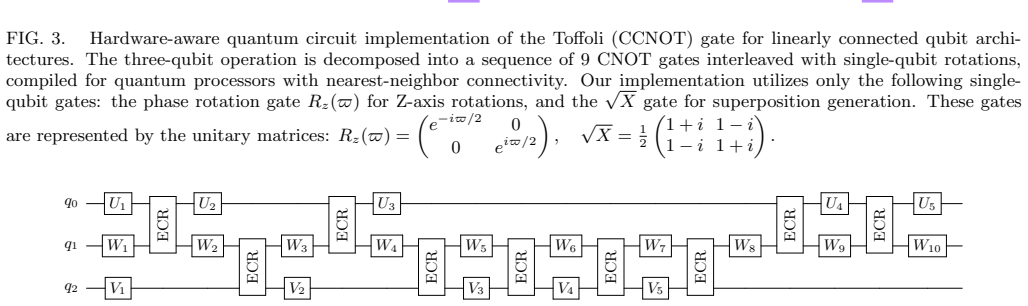
The central object is the three-qubit Toffoli (CCNOT) gate, decomposed into a native-gate sequence of echoed cross-resonance (ECR) gates plus single-qubit rotations (X, Rz, and sqrt-X) that respects the heavy-hexagonal connectivity of the 127-qubit processors. The measurement machinery is quantum state tomography (QST), which reconstructs the output density matrix from Pauli-basis measurements, and quantum process tomography (QPT), which reconstructs the process matrix via 12^3 circuits; the fidelity metric is the standard state fidelity between density operators and the average gate fidelity derived from it. This machinery carries the argument because the paper's central numbers are these r
What would settle it
Run all three input-state classes on the same 127-qubit device, or swap which device handles which state class; if the fidelity ordering tracks each device's median two-qubit error rate instead of the state class, the state-dependence claim is refuted.
Extended reading notes
Core claim
On the author's terms, the discovery is a measured map of Toffoli-gate fidelity as a function of environment and input state. For the GHZ input, state fidelity falls from 98.442% in noise-free simulation to 81.470% in noise-aware emulation to 56.368% on hardware; for W states the corresponding numbers are 98.739%, 79.900%, and 63.689%; for the uniform superposition over all three-qubit basis states, 99.490%, 85.469%, and 61.161%. Quantum process tomography on the same decomposition yields 98.976% process fidelity in noiseless simulation and 80.160% under noise-aware emulation; full process tomography on hardware was not run because the 1,728 required circuits were impractical. The author int
Load-bearing premise
The fidelity differences attributed to input-state class assume the two processors are comparable in noise; because each state class was run on a different device, device quality could fully explain the pattern.
Editorial extensions
If this is right
- A circuit designer who composes Toffoli gates on current 127-qubit superconducting hardware should expect roughly 56–64% state fidelity per gate for entanglement-heavy or superposition inputs, not the 98–99% predicted by noiseless simulation.
- Input-state class becomes a first-order performance parameter: GHZ, W, and uniform-superposition inputs do not degrade identically, so benchmarks and error-mitigation strategies should be state-aware.
- Noise-aware emulation predicts 80–85% fidelity and therefore overestimates real hardware by roughly 20–25 percentage points, so hardware-in-the-loop testing remains necessary for three-qubit gates.
- Because full QPT on three qubits requires 1,728 circuits and was not performed on hardware, certification of process-level performance for multi-qubit gates will need lighter-weight protocols.
- Algorithms that rely on Toffoli gates—quantum arithmetic, Grover search, and error-correction circuits—must budget for a per-gate fidelity cost far above what single- and two-qubit gate error rates would suggest.
Reading between the lines
- The paper's hardware runs place the GHZ and W measurements on one processor and the uniform-superposition measurement on a second processor with a different median two-qubit error rate; because the state class and device are not crossed, the reported 'state-dependent' ordering is not uniquely attributable to state class. Re-running all three states on both devices would separate the effects.
- The gap between noise-aware emulation (80–85%) and hardware (56–64%) suggests the emulator's noise model omits correlated errors, crosstalk, and drift; an emulator calibrated with day-of-run device error rates and pulse schedules could test whether hardware numbers are reproducible.
- The paper notes but did not execute full QPT on hardware because 1,728 circuits were impractical; a randomized-benchmarking-style protocol would give a hardware process fidelity at a fraction of that cost.
- A citation placeholder appears where the ECR-based decomposition is introduced, so the origin of the executed decomposition needs to be pinned down before reproducing the work.
Editorial analysis
A structured set of objections, weighed in public.
Referee Report
Summary. The paper reports an experimental characterization of a connectivity-compliant Toffoli-gate decomposition on IBM 127-qubit superconducting processors. Quantum state tomography is used to estimate output state fidelities for three input classes—GHZ, W, and uniform superposition—under noise-free simulation, noise-aware emulation, and real hardware execution; quantum process tomography is performed only in simulation and emulation. The headline numbers are state fidelities of 98.4–99.5% (noise-free), 79.9–85.5% (emulation), and 56.4–63.7% (hardware), and the abstract claims these 'empirically characterize state-dependent error patterns in multi-qubit circuits.'
Significance. If the central claim were supported, the paper would be a useful benchmark of a practical Toffoli decomposition on current superconducting hardware, and the distinction between simulation, emulation, and hardware fidelities would be informative for circuit designers. The raw hardware numbers are plausible single-run measurements and the tables of device calibration data are a useful record. However, the state-dependence claim is the main contribution, and as presented it is not supported: the hardware measurements for different input states were taken on different devices with different calibrations, and no uncertainty estimates are given. The paper therefore does not currently deliver its advertised empirical conclusion, although the underlying measurement campaign could in principle be revised to do so.
major comments (4)
- [Section III / Table I] The hardware runs for GHZ and W states were performed on ibm_sherbrooke, while the uniform-superposition run was performed on ibm_brisbane (Table I and Section V). These devices differ in median ECR error (7.56e-3 vs 8.32e-3), coherence times (T1 272.21 vs 242.99 µs), and readout length (1,244 vs 4,000 ns). Input-state class and device are therefore perfectly confounded: the ordering 56.368% (GHZ), 63.689% (W), 61.161% (uniform) cannot be attributed to state dependence. A same-device, same-calibration comparison, or an explicit statistical adjustment for device effects, is required before the headline 'state-dependent error patterns' claim can be made.
- [Section III C / Table I] The text states that 'uncertainty estimates were derived' (Section III C), but no error bars, confidence intervals, or repeated runs are reported anywhere in Table I or the figures. The 'noise-free' fidelities are already only 98–99.5% because of finite-shot sampling, so the hardware differences (e.g., 61.161% vs 63.689%) are not tested against sampling noise. Without uncertainties, the reported fidelity ordering is not statistically meaningful.
- [Section IV / Conclusion] The conclusion that 'entangled states' degrade more than 'simpler superpositions' is internally inconsistent with Table I: the W state is entangled yet outperforms the uniform superposition on hardware (63.689% vs 61.161%). Even before the device confound is considered, the data do not show a consistent state-dependence pattern, so the narrative overstates and misstates the results.
- [Section III A / Figure 9] The 'noise-aware quantum emulation' results appear to be based on FakePerth() (Figure 9), a 27-qubit fake backend, rather than on a noise model calibrated to the 127-qubit ibm_sherbrooke/ibm_brisbane devices used for the hardware runs. If so, the emulation-to-hardware comparison is not apples-to-apples. The emulator backend and its noise model must be specified; otherwise the quantitative gap between emulation and hardware (Section IV) is not interpretable.
minor comments (4)
- [General] The manuscript has numerous duplicated passages, misnumbered figures (several Figures 3–5, a 'Figure 14' that appears as Figure 11), and unresolved citation placeholders such as '[?]' in Sections II C and in the captions of Figures 4–5. The text needs careful editorial cleanup.
- [Table I footnote] The footnote correctly states that 'noise-free' fidelities below 100% are due to finite-shot sampling. This should be reflected in the main text terminology: calling 98–99.5% values 'fidelities' without this caveat is misleading.
- [Section V] Readout errors are documented in Tables II–IV but are not corrected or mitigated in the reported state fidelities. Since the GHZ/W/uniform runs used very different readout lengths (1,244 ns vs 4,000 ns), the readout contribution to the reported fidelities should be explicitly acknowledged in the error analysis.
- [Section IV] The sentence 'The missing hardware process fidelity measurements would likely show even more severe degradation' is speculative and should be removed or clearly labeled as a conjecture.
Circularity Check
No circularity: fidelity numbers are direct measurements; only a minor self-citation to the underlying Toffoli decomposition is present.
full rationale
This is a benchmarking paper. The Toffoli decomposition is taken from the author's earlier ECR-based work (ref. [108]) and then independently measured by QST/QPT on a noise-free simulator, a noise-aware emulator, and two IBM 127-qubit devices. The reported 98.4%/81.5%/56.4% etc. are experimental outputs, not quantities derived from the input decomposition; no parameter is fitted to those outputs and then renamed a prediction. The footnote in Table I explicitly attributes sub-100% 'noise-free' fidelity to finite-shot sampling, so the simulator column is not an independent theoretical prediction. The emulator uses an external Qiskit noise model, so the emulation column is not the paper's own fit. The only load-bearing self-citation is the gate decomposition itself, and citing the construction of the object under test is normal. There is no equation in which a claimed result is defined in terms of the data it purports to explain. The more serious issues — the device/state confound (GHZ and W on ibm_sherbrooke, uniform on ibm_brisbane, Tables I–IV) and the missing [?] reference for the decomposition validation — are threats to validity and completeness, not circular reductions. Accordingly no circular step is identified; score 1 reflects the presence of a minor self-citation, not load-bearing circularity.
Assumptions & free parameters
assumptions (5)
- domain assumption The two IBM processors (ibm_sherbrooke and ibm_brisbane) have effectively equivalent noise characteristics, so cross-device fidelity differences can be attributed to input state class.
- domain assumption The noisy emulator (FakePerth or similar) accurately reproduces the real hardware noise channel, so QPT results in emulation are valid proxies for hardware process fidelity.
- domain assumption QST with finite shots yields unbiased fidelity estimates, and quoted fidelities are exact despite sampling noise.
- standard math The decomposition in Figure 5 exactly implements the Toffoli gate when composed with the specified single-qubit gates.
- domain assumption Reported hardware state fidelities can be interpreted as Toffoli gate fidelity, despite including state preparation and readout errors in the QST pipeline.
Cite this review
Pith. "Pith review of Practical Fidelity Limits of Toffoli Gates in Superconducting Quantum Processors." pith.science (2026). https://pith.science/paper/VBUV7VRA
@misc{pith2026250905395,
  author       = {Pith},
  title        = {Pith review of: Practical Fidelity Limits of Toffoli Gates in Superconducting Quantum Processors},
  year         = {2026},
  howpublished = {\url{https://pith.science/paper/VBUV7VRA}},
  note         = {Machine review of arXiv:2509.05395}
}
read the original abstract
High-fidelity multi-qubit gates are a critical resource for near-term quantum computing, as they underpin the execution of both quantum algorithms and fault-tolerant protocols. The Toffoli gate (CCNOT), in particular, plays a central role in quantum error correction and quantum arithmetic, yet its efficient implementation on current quantum hardware remains limited by noise and connectivity constraints. In this work, we present a hardware-aware characterization of the Toffoli gate using optimized, connectivity-compliant decompositions executed on IBM's 127-qubit superconducting quantum processors. Our study integrates state preparation, gate synthesis, and quantum state/process tomography (QST/QPT) to evaluate fidelity across three distinct classes of input states: Greenberger-Horne-Zeilinger (GHZ), W, and the uniform superposition of all three-qubit computational basis states -- under noise-free simulation, noise-aware emulation, and real hardware execution. For GHZ states, we report state fidelities of 98.442% (noise-free simulation), 81.470% (noise-aware quantum emulation), and 56.368% (real quantum hardware). For W states, state fidelities are 98.739%, 79.900%, and 63.689%, respectively, and for the uniform superposition state, we observe state fidelities of 99.490%, 85.469%, and 61.161%. Comparative QPT experiments yield process fidelities of 98.976% (noise-free) and 80.160% (noise-aware emulation). Our results empirically characterize state-dependent error patterns in multi-qubit circuits and quantify trade-offs between gate decomposition strategies and native hardware performance, offering practical insights for scalable, hardware-efficient quantum circuit design.
Figures


Figures from the paper (7 more)


Forward citations
Cited by 2 Pith papers
-
Claim against Measurement: Statistical Artefacts in Quantum Error Mitigation Benchmarks
Systematic review of 81 QEM papers finds only 25% use inferential methods and demonstrates via ZNE case studies that parameter sensitivity and temporal drift can create illusory performance gains.
-
Claim against Measurement: Statistical Artefacts in Quantum Error Mitigation Benchmarks
Implicit ZNE parameter choices flip significance in ~12% of tested configurations and hardware drift changes apparent effect size up to 3.4×, so QEM benchmarks need stricter statistical reporting.
Reference graph
Works this paper leans on
-
[1]
The maximally entangled GHZ state:|ψ GHZ⟩= 1/ √ 2(|000⟩+|111⟩), which test coherence in max- imally entangled systems
-
[2]
The W state:|ψ W⟩= 1√ 3 (|001⟩+|010⟩+|100⟩), sensitive to asymmetric error
-
[3]
Noise-free
A uniform superposition of all three-qubit compu- tational basis states:|ψ unif⟩= 1√ 8 P7 i=0 |bi⟩, where bi spans|000⟩to|111⟩, to assess gate performance under balanced computational basis conditions. C. T omography Protocol QPT and QST are fundamental characterization tech- niques in quantum computing used to analyze quantum systems. QST is a procedure ...
2025
-
[4]
T. D. Ladd, F. Jelezko, R. Laflamme, Y. Nakamura, C. Monroe , J. L. O’Brien, Quantum computers.Nature 464, 45–53 (2010)
2010
-
[5]
AbuGhanem, IBM quantum computers: evolution, performance, and future directions.J Supercomput81, 687 (2025)
M. AbuGhanem, IBM quantum computers: evolution, performance, and future directions.J Supercomput81, 687 (2025). 16
2025
-
[6]
Dirac, The principles of quantum mechanics.Claren- don Press, Oxford(1930)
P. Dirac, The principles of quantum mechanics.Claren- don Press, Oxford(1930)
1930
-
[7]
Properties of some quantum com- puting models,
M. AbuGhanem, “Properties of some quantum com- puting models,” Master’s Thesis, Fac. Sci., Ain Shams Univ. (2019)
2019
-
[8]
Bardin, Rami Barends, Rupak Biswas, Sergio Boixo, Fernando G
Frank Arute, Kunal Arya, Ryan Babbush, Dave Ba- con, Joseph C. Bardin, Rami Barends, Rupak Biswas, Sergio Boixo, Fernando G. S. L. Brandao, David A. Buell, Brian Burkett, Yu Chen, Zijun Chen, Ben Chiaro, Roberto Collins, William Courtney, Andrew Dunsworth, Edward Farhi, Brooks Foxen, Austin Fowler, Craig Gidney, Marissa Giustina, Rob Graff, Keith Guerin, ...
2019
Show all 133 references
-
[9]
Yulin Wu, Wan-Su Bao, Sirui Cao, Fusheng Chen, Ming-Cheng Chen, Xiawei Chen, Tung-Hsun Chung, Hui Deng, Yajie Du, Daojin Fan, Ming Gong, Cheng Guo, Chu Guo, Shaojun Guo, Lianchen Han, Linyin Hong, He-Liang Huang, Yong-Heng Huo, Liping Li, Na Li, Shaowei Li, Yuan Li, Futian Lia...
2021
-
[10]
Information processing at the speed of light
M. AbuGhanem, “Information processing at the speed of light.”Front. Optoelectron.17, 33 (2024)
2024
-
[11]
Qingling Zhu, Sirui Cao, Fusheng Chen, Ming-Cheng Chen, Xiawei Chen, Tung-Hsun Chung, Hui Deng, Ya- jie Du, Daojin Fan, Ming Gong, Cheng Guo, Chu Guo, Shaojun Guo, Lianchen Han, Linyin Hong, He-Liang Huang, Yong-Heng Huo, Liping Li, Na Li, Shaowei Li, Yuan Li, Futian Liang, Ch...
2022
-
[12]
Youngseok Kim, Andrew Eddins, Sajant Anand, Ken Xuan Wei, Ewout van den Berg, Sami Rosenblatt, Hasan Nayfeh, Yantao Wu, Michael Zaletel, Kristan Temme and Abhinav Kandala, Evidence for the utility of quantum computing before fault tolerance.Nature 618:500–505 (2023)
2023
-
[13]
NISQ computers: a path to quantum supremacy,
M. AbuGhanem and H. Eleuch, “NISQ computers: a path to quantum supremacy,”IEEE Access,12, 102941- 102961 (2024)
2024
-
[14]
Abanin, Laleh Aghababaie- Beni, Igor Aleiner, Trond I
Rajeev Acharya, Dmitry A. Abanin, Laleh Aghababaie- Beni, Igor Aleiner, Trond I. Andersen, Markus Ans- mann, Frank Arute, Kunal Arya, Abraham Asfaw, Nikita Astrakhantsev, Juan Atalaya, Ryan Babbush, Dave Bacon, Brian Ballard, Joseph C. Bardin, Jo- hannes Bausch, Andreas Bengts...
2025
-
[15]
AbuGhanem, Google Quantum AI’s Quest for Error-Corrected Quantum Computers, arXiv preprint arXiv:2410.00917 (2024)
M. AbuGhanem, Google Quantum AI’s Quest for Error-Corrected Quantum Computers, arXiv preprint arXiv:2410.00917 (2024)
2024 arXiv
-
[16]
Jones, Julia E
Mario Motta, Gavin O. Jones, Julia E. Rice, Tanvi P. Gujarati, Rei Sakuma, Ieva Liepuoniute, Jeannette M. Garciaa and Yu-ya Ohnishi, Quantum chemistry simu- lation of ground- and excited-state properties of the sul- fonium cation on a superconducting quantum processor ,Chem. S...
2023
-
[17]
Blunt, Joan Camps, Ophelia Crawford, R´ obert Izs´ ak, Sebastian Leontica, Arjun Mirani, Alexandra E
Nick S. Blunt, Joan Camps, Ophelia Crawford, R´ obert Izs´ ak, Sebastian Leontica, Arjun Mirani, Alexandra E. Moylett, Sam A. Scivier, Christoph S¨ underhauf, Patrick Schopf, Jacob M. Taylor, Nicole Holzmann, Perspective on the Current State-of-the-Art of Quantum Comput- ing f...
2022
-
[18]
Par- rish, Nicholas C
Raffaele Santagati, Alan Aspuru-Guzik, Ryan Bab- bush, Matthias Degroote, Leticia Gonz´ alez, Elica Kyo- seva, Nikolaj Moll, Markus Oppel, Robert M. Par- rish, Nicholas C. Rubin, Michael Streif, Christofer S. Tautermann, Horst Weiss, Nathan Wiebe and Clemens Utschig-Utschig, D...
2024
-
[19]
Quantum computing in logis- tics and supply chain management an overview
Frank Phillipson. Quantum computing in logis- tics and supply chain management an overview. arXiv:2402.17520, (2024)
2024 arXiv
-
[20]
P. W. Shor, Polynomial-time algorithms for prime fac- torization and discrete logarithms on a quantum com- puter.SIAM J. Comput.26, 1484–1509 (1997)
1997
-
[21]
Craig Gidney and Martin Eker ˚ a, How to factor 2048 bit RSA integers in 8 hours using 20 million noisy qubits, Quantum5, 433 (2021)
-
[22]
Photonic Quantum Computers,
M. AbuGhanem, “Photonic Quantum Computers,” arXiv:2409.08229, (2024)
2024 arXiv
-
[23]
A. Y. Kitaev. Fault-tolerant quantum computation by anyons.Annals of Physics303(1), 2–30. (2003)
2003
-
[24]
P. W. Shor, Fault-tolerant quantum computation.Pro- ceedings of the 37th Annual Symposium on Foundations of Computer Science, Burlington, VT, USA (pp. 56–65). IEEE. (1996)
1996
-
[25]
John Preskill, Quantum Computing in the NISQ era and beyond,Quantum2, 79 (2018)
2018
-
[26]
Beverland, Prakash Murali, Matthias Troyer, Krysta M
Michael E. Beverland, Prakash Murali, Matthias Troyer, Krysta M. Svore, Torsten Hoefler, Vadym Kli- uchnikov, Guang Hao Low, Mathias Soeken, Aarthi Sundaram, Alexander Vaschillo, Assessing require- ments to scale to practical quantum advantage, arXiv:2211.07629 (2022)
2022 arXiv
-
[27]
Toffoli, Reversible computing, In: de Bakker, J., van Leeuwen, J
T. Toffoli, Reversible computing, In: de Bakker, J., van Leeuwen, J. (eds)Automata, Languages and Program- ming. ICALP 1980. Lecture Notes in Computer Science, vol 85. Springer, Berlin, Heidelberg. (1980)
1980
-
[28]
M. A. Nielsen and I. L. Chuang, Quantum computa- tion and quantum information, Cambridge:Cambridge University Press, 10 th anniversary ed., (2011)
2011
-
[29]
Nature 481(7380), 170–172
Fedorov, A., Steffen, L., Baur, M.,et al.Implementation of a Toffoli gate with superconducting circuits. Nature 481(7380), 170–172. (2012)
2012
-
[30]
AbuGhanem, Superconducting quantum computers: who is leading the future?.EPJ Quantum Technology 12, 102 (2025)
M. AbuGhanem, Superconducting quantum computers: who is leading the future?.EPJ Quantum Technology 12, 102 (2025)
2025
-
[31]
H., Cleve, R.,et al.Elemen- tary gates for quantum computation.Physical Review A52(5), 3457–3467 (1995)
Barenco, A., Bennett, C. H., Cleve, R.,et al.Elemen- tary gates for quantum computation.Physical Review A52(5), 3457–3467 (1995)
1995
-
[32]
V. V. Shende, S. S. Bullock and I. L. Markov, ”Syn- thesis of quantum-logic circuits,” inIEEE Transactions on Computer-Aided Design of Integrated Circuits and Systems, vol. 25, no. 6, pp. 1000-1010, (2006)
2006
-
[33]
C´ orcoles, Antonio Mezzacapo, Jerry M
Abhinav Kandala, Kristan Temme, Antonio D. C´ orcoles, Antonio Mezzacapo, Jerry M. Chow, Jay M. Gambetta, Error mitigation extends the computa- tional reach of a noisy quantum processor,Nature567, 491–495 (2019)
2019
-
[34]
M. Amy, D. Maslov, M. Mosca and M. Roetteler, A meet-in-the-middle algorithm for fast synthesis of depth-optimal quantum circuits. IEEE Transactions on Computer-Aided Design, 32(6), 818-830. (2013)
2013
-
[35]
Self-consistent quantum process tomography,
S. T. Merkel, J. M. Gambetta, J. A. Smolin, S. Poletto, A. D. Corcoles, B. R. Johnson, C. A. Ryan, and M. Steffen, “Self-consistent quantum process tomography,” Phys. Rev. A87, 062119 (2013)
2013
-
[36]
Prescription for ex- perimental determination of the dynamics of a quantum black box,
I. L. Chuang and M. A. Nielsen, “Prescription for ex- perimental determination of the dynamics of a quantum black box,”J. Mod. Opt.44, 2455 (1997)
1997
-
[37]
Complete char- acterization of a quantum process: the two-bit quantum gate,
J. F. Poyatos, J. I. Cirac, and P. Zoller, “Complete char- acterization of a quantum process: the two-bit quantum gate,”Phys. Rev. Lett.78, 390 (1997)
1997
-
[38]
Full quantum tomog- raphy study of Google’s Sycamore gate on IBM’s quan- tum computers,
M. AbuGhanem and H. Eleuch, “Full quantum tomog- raphy study of Google’s Sycamore gate on IBM’s quan- tum computers,”EPJ Quantum Technology11(1), 36 (2024)
2024
-
[39]
Experimental characterization of Google’s Sycamore quantum AI on IBM’s quantum computers,
M. AbuGhanem, “Experimental characterization of Google’s Sycamore quantum AI on IBM’s quantum computers,”Elsevier,SSRN4299338 (2025)
2025
-
[40]
H. N. Tinkeyet al.Quantum process tomography of a Mølmer–Sørensen gate via a global beam.Quantum Sci. Technol.6, 034013 (2021)
2021
-
[41]
Two-qubit entangling gates for superconducting quantum computers,
M. AbuGhanem and H. Eleuch, “Two-qubit entangling gates for superconducting quantum computers,”Results in Physics56, 107236 (2024). 18
2024
-
[42]
Kottmann, Tim Menke, Wai-Keong Mok, Sukin Sim, Leong-Chuan Kwek, Al´ an Aspuru-Guzik, Noisy intermediate-scale quantum algorithms,Rev
Kishor Bharti, Alba Cervera-Lierta, Thi Ha Kyaw, Tobias Haug, Sumner Alperin-Lea, Abhinav Anand, Matthias Degroote, Hermanni Heimonen, Jakob S. Kottmann, Tim Menke, Wai-Keong Mok, Sukin Sim, Leong-Chuan Kwek, Al´ an Aspuru-Guzik, Noisy intermediate-scale quantum algorithms,Rev...
2022
-
[43]
Symmetry enhanced variational quantum spin eigensolver
Chufan Lyu, Xusheng Xu, Man-Hong Yung, and Abol- fazl Bayat. “Symmetry enhanced variational quantum spin eigensolver”.Quantum7, 899 (2023)
2023
-
[44]
Obstacles to Variational Quantum Opti- mization from Symmetry Protection
Sergey Bravyi, Alexander Kliesch, Robert Koenig, and Eugene Tang. “Obstacles to Variational Quantum Opti- mization from Symmetry Protection”.Physical Review Letters125, 260505 (2020)
2020
-
[45]
Accelerated variational algorithms for digital quantum simulation of many-body ground states
Chufan Lyu, Victor Montenegro, and Abolfazl Bayat. “Accelerated variational algorithms for digital quantum simulation of many-body ground states”.Quantum4, 324 (2020)
2020
-
[46]
Quan- tum algorithms for electronic structure calculations: Particle-hole Hamiltonian and optimized wave-function expansions
Panagiotis Kl Barkoutsos, Jerome F. Gonthier, Igor Sokolov, Nikolaj Moll, Gian Salis, Andreas Fuhrer, Marc Ganzhorn, Daniel J. Egger, Matthias Troyer, Antonio Mezzacapo, Stefan Filipp, and Ivano Tavernelli. “Quan- tum algorithms for electronic structure calculations: Particle-...
2018
-
[47]
QuantumNAS: Noise-Adaptive Search for Robust Quantum Circuits
Hanrui Wang, Yongshan Ding, Jiaqi Gu, Yujun Lin, David Z. Pan, Frederic T. Chong, and Song Han. “QuantumNAS: Noise-Adaptive Search for Robust Quantum Circuits”.Proceedings - International Sym- posium on High-Performance Computer Architecture 2022-April, 692–708 (2021)
2022
-
[48]
Quantum circuit architecture search for variational quantum algorithms
Yuxuan Du, Tao Huang, Shan You, Min Hsiu Hsieh, and Dacheng Tao. “Quantum circuit architecture search for variational quantum algorithms”.npj Quantum Infor- mation8, 62 (2022)
2022
-
[49]
Robust resource-efficient quantum variational ansatz through evolutionary algorithm
Yuhan Huang, Qingyu Li, Xiaokai Hou, Rebing Wu, Man-Hong Yung, Abolfazl Bayat, and Xiaoting Wang. “Robust resource-efficient quantum variational ansatz through evolutionary algorithm”.Physical Review A 105, 052414 (2022)
2022
-
[50]
Machine Learning of Noise-Resilient Quantum Circuits
Lukasz Cincio, Kenneth Rudinger, Mohan Sarovar, and Patrick J. Coles. “Machine Learning of Noise-Resilient Quantum Circuits”.PRX Quantum2, 010324 (2021)
2021
-
[51]
Let Each Quantum Bit Choose Its Basis Gates
Sophia Fuhui Lin, Sara Sussman, Casey Duckering, Pranav S Mundada, Jonathan M Baker, Rohan S Kumar, Andrew A Houck, and Frederic T Chong. “Let Each Quantum Bit Choose Its Basis Gates” arXiv:2208.13380. (2022)
2022 arXiv
-
[52]
Nemkov, Evgeniy O
Nikita A. Nemkov, Evgeniy O. Kiktenko, Ilia A. Luchnikov, and Aleksey K. Fedorov, Efficient vari- ational synthesis of quantum circuits with coherent multi-start optimization,Quantum7, 993 (2023)
2023
-
[53]
QuantumCircuitOpt: An Open-source Frame- work for Provably Optimal Quantum Circuit Design
Harsha Nagarajan, Owen Lockwood, and Carleton Cof- frin. “QuantumCircuitOpt: An Open-source Frame- work for Provably Optimal Quantum Circuit Design”. Proceedings of QCS 2021: 2nd International Workshop on Quantum Computing Software, Held in conjunc- tion with SC 2021: The Inte...
2021
-
[54]
A Meet-in-the-Middle Algorithm for Fast Synthesis of DepthOptimal Quantum Circuits
Matthew Amy, Dmitri Maslov, Michele Mosca, and Martin Roetteler. “A Meet-in-the-Middle Algorithm for Fast Synthesis of DepthOptimal Quantum Circuits”. IEEE Transactions on Computer-Aided Design of In- tegrated Circuits and Systems32, 818–830 (2013)
2013
-
[55]
Quantum-assisted quantum compiling
Sumeet Khatri, Ryan LaRose, Alexander Poremba, Lukasz Cincio, Andrew T. Sornborger, and Patrick J. Coles. “Quantum-assisted quantum compiling”.Quan- tum3(2019)
2019
-
[56]
Automated optimization of large quantum circuits with continuous parameters
Yunseong Nam, Neil J. Ross, Yuan Su, Andrew M. Childs, and Dmitri Maslov. “Automated optimization of large quantum circuits with continuous parameters”. npj Quantum Information4(2018)
2018
-
[57]
Exploring ab initio machine synthesis of quan- tum circuits
Richard Meister, Cica Gustiani, and Simon C. Ben- jamin. “Exploring ab initio machine synthesis of quan- tum circuits” arXiv:2206.11245. (2022)
2022 arXiv
-
[58]
LEAP: Scaling Numerical Optimization Based Synthesis Us- ing an Incremental Approach
Ethan Smith, Marc Grau Davis, Jeffrey Larson, E D Younis, Lindsay Bassman Oftelie, Wim Lavrijsen, Costin Iancu, Marc Grau Davis, Ed Younis, Bassman Lindsay, Wim Oftelie, and Costin Lavrijsen. “LEAP: Scaling Numerical Optimization Based Synthesis Us- ing an Incremental Approach...
2023
-
[59]
Qubit- ADAPT-VQE: An Adaptive Algorithm for Construct- ing Hardware-Efficient Ans¨ atze on a Quantum Proces- sor
Ho Lun Tang, V. O. Shkolnikov, George S. Bar- ron, Harper R. Grimsley, Nicholas J. Mayhall, Ed- win Barnes, and Sophia E. Economou. “Qubit- ADAPT-VQE: An Adaptive Algorithm for Construct- ing Hardware-Efficient Ans¨ atze on a Quantum Proces- sor”.PRX Quantum2, 1–15 (2021)
2021
-
[60]
An adaptive vari- ational algorithm for exact molecular simulations on a quantum computer
Harper R. Grimsley, Sophia E. Economou, Edwin Barnes, and Nicholas J. Mayhall. “An adaptive vari- ational algorithm for exact molecular simulations on a quantum computer”.Nature Communications2019 10:1 10, 1–9 (2019)
2019
-
[61]
Quantum Circuit Evolution on NISQ Devices
Lukas Franken, Bogdan Georgiev, Sascha M¨ ucke, Moritz Wolter, Raoul Heese, Christian Bauckhage, and Nico Piatkowski. “Quantum Circuit Evolution on NISQ Devices” arXiv:2012.13453. (2020)
2012 arXiv
-
[62]
MoG-VQE: Mul- tiobjective genetic variational quantum eigensolver
D. Chivilikhin, A. Samarin, V. Ulyantsev, I. Iorsh, A. R. Oganov, and O. Kyriienko. “MoG-VQE: Mul- tiobjective genetic variational quantum eigensolver” arXiv:2007.04424. (2020)
2007 arXiv
-
[63]
Ansatz Learning for Quantum Circuit Optimization
Mathias Weiden, John Kubiatowicz, Ed Younis, and Costin Iancu. “Ansatz Learning for Quantum Circuit Optimization”.Bulletin of the American Physical Soci- ety(2023)
2023
-
[64]
Quantum circuit optimization with deep reinforcement learning
Thomas F¨ osel, Murphy Yuezhen Niu, Florian Mar- quardt, and Li Li. “Quantum circuit optimization with deep reinforcement learning” arXiv:2103.07585. (2021)
2021 arXiv
-
[65]
Efficient quantum gate decomposition via adaptive circuit compression
P´ eter Rakyta and Zolt´ an Zimbor´ as. “Efficient quantum gate decomposition via adaptive circuit compression” arXiv:2203.04426. (2022)
2022 arXiv
-
[66]
QF AST: Conflating Search and Numerical Op- timization for Scalable Quantum Circuit Synthesis
Ed Younis, Koushik Sen, Katherine Yelick, and Costin Iancu. “QF AST: Conflating Search and Numerical Op- timization for Scalable Quantum Circuit Synthesis”. Proceedings - 2021 IEEE International Conference on Quantum Computing and Engineering, QCE 2021 Pages 232– 243 (2021)
2021
-
[67]
Approaching the theoretical limit in quantum gate decomposition
P´ eter Rakyta and Zolt´ an Zimbor´ as. “Approaching the theoretical limit in quantum gate decomposition” arXiv:2109.06770. (2021)
2021 arXiv
-
[68]
Best Approxi- mate Quantum Compiling Problems
Liam Madden and Andrea Simonetto. “Best Approxi- mate Quantum Compiling Problems”.ACM Transac- tions on Quantum Computing3, 1–29 (2021)
2021
-
[69]
Learning Unitaries by Gradient Descent
Bobak Toussi Kiani, Seth Lloyd, and Reevu Maity. “Learning Unitaries by Gradient Descent” arXiv:2001.11897. (2020) 19
2001 arXiv
-
[70]
OpenQASM 3: A broader and deeper quantum assembly language,
A. W. Cross, A. Javadi-Abhari, T. Alexander, N. de Beaudrap, L. S. Bishop, S. Heidel, C. A. Ryan, J. Smolin, J. M. Gambetta, and B. R. John- son,“OpenQASM 3: A broader and deeper quantum assembly language,”arXiv:2104.14722, (2021)
2021 arXiv
-
[71]
G. S. Paraoanu, Microwave-induced coupling of super- conducting qubits,Phys. Rev. B74:140504 (2006)
2006
-
[72]
Quantum circuits for general multi- qubit gates,
M. M¨ ott¨ onen, J. J. Vartiainen, V. Bergholm, and M. M. Salomaa, “Quantum circuits for general multi- qubit gates,”Physical Review Letters,9313, 130502, (2004)
2004
-
[73]
Efficient decomposition of quantum gates,
J. J. Vartiainen, M. M¨ ott¨ onen, and M. M. Salomaa, “Efficient decomposition of quantum gates,”Physical Review Letters,92, 17, 177902, (2004)
2004
-
[74]
Syn- thesis of quantum-logic circuits,
V. V. Shende, S. S. Bullock, and I. L. Markov, “Syn- thesis of quantum-logic circuits,”IEEE Transactions on Computer-Aided Design of Integrated Circuits and Sys- tems,256, 1000–1010, (2006)
2006
-
[75]
Towards optimal topology aware quan- tum circuit synthesis,
M. G. Davis, E. Smith, A. Tudor, K. Sen, I. Siddiqi, and C. Iancu, “Towards optimal topology aware quan- tum circuit synthesis,” inInternational Conference on Quantum Computing and Engineering. IEEE, 223–234 (2020)
2020
-
[76]
Low-overhead constructions for the fault- tolerant Toffoli gate,
C. Jones, “Low-overhead constructions for the fault- tolerant Toffoli gate,”Physical Review A,872, 022328, (2013)
2013
-
[77]
Fast parallel circuits for the quantum Fourier transform,
R. Cleve and J. Watrous, “Fast parallel circuits for the quantum Fourier transform,” inProceedings of the 41st Annual Symposium on Foundations of Computer Sci- ence. IEEE, 526–536 (2000)
2000
-
[78]
Mapping from multiple-control Toffoli circuits to linear nearest neigh- bor quantum circuits,
X. Cheng, Z. Guan, and W. Ding, “Mapping from multiple-control Toffoli circuits to linear nearest neigh- bor quantum circuits,”Quantum Information Process- ing,177, 1–26, (2018)
2018
-
[79]
Effi- cient circuits for quantum search over 2D square lattice architecture,
S. Hu, D. Maslov, M. Pistoia, and J. Gambetta, “Effi- cient circuits for quantum search over 2D square lattice architecture,” inProceedings of the 56th Annual Design Automation Conference, 1–2, (2019)
2019
-
[80]
Ac- cessed April (2025)
Qiskit,https://www.ibm.com/quantum/qiskit. Ac- cessed April (2025)
2025
-
[81]
t|ket⟩: A retargetable compiler for NISQ devices,
S. Sivarajah, S. Dilkes, A. Cowtan, W. Simmons, A. Edgington, and R. Duncan,“t|ket⟩: A retargetable compiler for NISQ devices,”Quantum Science and Technology,61, 014003, (2020)
2020
-
[82]
org/record/5182845, (2021)
Cirq developers, “Cirq,” Available:https://zenodo. org/record/5182845, (2021). Accessed April 05, 2025
2021
-
[83]
Quantum circuit simplification and level compaction,
D. Maslov, G. W. Dueck, D. M. Miller, and C. Ne- grevergne, “Quantum circuit simplification and level compaction,”IEEE Transactions on Computer-Aided Design of Integrated Circuits and Systems,273, 436– 444, (2008)
2008
-
[84]
Optimal creation of entangle- ment using a two-qubit gate,
B. Kraus and J. Cirac, “Optimal creation of entangle- ment using a two-qubit gate,”Physical Review A,636, 062309, (2001)
2001
-
[85]
Not all swaps have the same cost: A case for optimization-aware qubit rout- ing,
J. Liu, Li, and H. Zhou, “Not all swaps have the same cost: A case for optimization-aware qubit rout- ing,” in2022 IEEE International Symposium on High- Performance Computer Architecture (HPCA). IEEE, 709–725, (2022)
2022
-
[86]
Relaxed peephole op- timization: A novel compiler optimization for quantum circuits,
J. Liu, L. Bello, and H. Zhou, “Relaxed peephole op- timization: A novel compiler optimization for quantum circuits,”in 2021 IEEE/ACM International Symposium on Code Generation and Optimization(CGO). IEEE, 301–314. (2021)
2021
-
[87]
Software mitigation of crosstalk on noisy intermediate-scale quantum computers,
P. Murali, D. C. McKay, M. Martonosi, and A. Javadi- Abhari, “Software mitigation of crosstalk on noisy intermediate-scale quantum computers,” inProceedings of the Twenty-Fifth International Conference on Archi- tectural Support for Programming Languages and Oper- ating System...
2020
-
[88]
Ti- mestitch: Exploiting slack to mitigate decoherence in quantum circuits,
K. N. Smith, G. S. Ravi, Murali, J. M. Baker, N. Earnest, A. Javadi-Cabhari and F. T. Chong, “Ti- mestitch: Exploiting slack to mitigate decoherence in quantum circuits,”ACM Transactions on Quantum Computing,4, 1, 1–27, (2022)
2022
-
[89]
Qcontext: Context- aware decomposition for quantum gates,
J. Liu, M. Bowman, Gokhale, S. Dangwal, J. Larson, F. T. Chong, and P. D. Hovland, “Qcontext: Context- aware decomposition for quantum gates,”in 2023 IEEE International Symposium on Circuits and Systems(IS- CAS) pp. 1–5 (2023)
2023
-
[90]
Shi, Both toffoli and controlled-not need little help to do universal quantum computing,Quantum Info
Y. Shi, Both toffoli and controlled-not need little help to do universal quantum computing,Quantum Info. Com- put.3, 84-92 (2003)
2003
-
[91]
Aharonov, A simple proof that toffoli and hadamard are quantum universal, arXiv:quant-ph/0301040, (2003)
D. Aharonov, A simple proof that toffoli and hadamard are quantum universal, arXiv:quant-ph/0301040, (2003)
2003 arXiv
-
[92]
Fredkin and T
E. Fredkin and T. Toffoli, Conservative logic,Int. J. Theor. Phys.21(3-4), 219–253 (1982)
1982
-
[93]
Characterizing Grover search algo- rithm on large-scale superconducting quantum comput- ers,
M. AbuGhanem, “Characterizing Grover search algo- rithm on large-scale superconducting quantum comput- ers,”Scientific Reports15(1), 1281 (2024)
2024
-
[94]
H¨ aner, M
T. H¨ aner, M. Roetteler, and K. M. Svore, Factoring using 2n+ 2 qubits with toffoli based modular multipli- cation,Quantum Info. Comput.17, 673–684 (2017)
2017
-
[95]
P. W. Shor, Polynomial-time algorithms for prime fac- torization and discrete logarithms on a quantum com- puter,SIAM J. Comput.26(5), 1484–1509 (1997)
1997
-
[96]
Paetznick and B
A. Paetznick and B. W. Reichardt, Universal fault- tolerant quantum computation with only transversal gates and error correction,Phys. Rev. Lett.111(9), 090505 (2013)
2013
-
[97]
Dennis, Toward fault-tolerant quantum computa- tion without concatenation,Phys
E. Dennis, Toward fault-tolerant quantum computa- tion without concatenation,Phys. Rev. A63(5), 052314 (2001)
2001
-
[98]
Schindler, J
P. Schindler, J. T. Barreiro, and T. Monzet al., Ex- perimental repetitive quantum error correction,Science 332(6033), 1059–1061 (2011)
2011
-
[99]
D. G. Cory, M. D. Price, and W. Maaset al., Ex- perimental quantum error correction,Phys. Rev. Lett. 81(10), 2152–2155 (1998)
1998
-
[100]
M. D. Reed, L. DiCarlo, and S. E. Nigget al., Realiza- tion of three-qubit quantum error correction with super- conducting circuits,Nature482(7385), 382–385 (2012)
2012
-
[101]
N. Yu, R. Duan, and M. Ying, Five 2-qubit gates are necessary for implementing the Toffoli gate,Phys. Rev. A88(1), 010304 (2013)
2013
-
[102]
V. V. Shende and I. L. Markov, On the CNOT-cost of TOFFOLI gates, arXiv:0803.2316 (2009)
2009 arXiv
-
[103]
Gwinner, M
J. Gwinner, M. Bria´ nski, W. Burkot, L. Czerwi´ nski, and V. Hlembotskyi, Benchmarking 16-element quan- tum search algorithms on superconducting quantum processors, arXiv:2007.06539 (2021)
2007 arXiv
-
[104]
Pulse-engineered controlled-V gate and its applications on superconducting quantum device.IEEE Transactions on Quantum Engineering,3 (2022) 20
Takahiko Satoh, Shun Oomura, Michihiko Sugawara, and Naoki Yamamoto. Pulse-engineered controlled-V gate and its applications on superconducting quantum device.IEEE Transactions on Quantum Engineering,3 (2022) 20
2022
-
[105]
Max Aksel Bowman, Pranav Gokhale, Jeffrey Larson, Ji Liu, Martin Suchara, Hardware-Conscious Optimiza- tion of the Quantum Toffoli Gate,ACM Transactions on Quantum Computing4, 4, 1-19, (2023)
2023
-
[106]
Pedro M. Q. Cruz, Bruno Murta, Shallow unitary de- compositions of quantum Fredkin and Toffoli gates for connectivity-aware equivalent circuit averaging,APL Quantum1, 016105 (2024)
2024
-
[107]
Xiangyu Ren, Mengyu Zhang, Antonio Barbalace, A Hardware-Aware Gate Cutting Framework for Practical Quantum Circuit Knitting, arXiv:2409.03870 (2024)
2024 arXiv
-
[108]
Byrd, Paul Franzon, An- alyzing Quantum Circuit Depth Reduction with Ancilla Qubits in MCX Gates, arXiv:2408.01304 (2024)
Ahmad Bennakhi, Gregory T. Byrd, Paul Franzon, An- alyzing Quantum Circuit Depth Reduction with Ancilla Qubits in MCX Gates, arXiv:2408.01304 (2024)
2024 arXiv
-
[109]
Yun-Jie Wang, Sheng Zhang, Tai-Ping Sun, Ze-An Zhao, Xiao-Fan Xu, Xi-Ning Zhuang, Huan-Yu Liu, Cheng Xue, Peng Duan, Yu-Chun Wu, Zhao-Yun Chen,3, and Guo-Ping Guo, Hardware-Efficient Quan- tum Random Access Memory Design with a Native Gate Set on Superconducting Platforms, arX...
2024 arXiv
-
[110]
Orchestrated Trios: Compiling for Efficient Communication in Quantum Programs with 3-Qubit Gates,
C. Duckering, J. M. Baker, A. Litteken, and F. T. Chong, “Orchestrated Trios: Compiling for Efficient Communication in Quantum Programs with 3-Qubit Gates,”in Proceedings of the 26th ACM International Conference on Architectural Support for Programming Languages and Operating ...
-
[111]
AbuGhanem, Hardware-aware Toffoli gate decompo- sition via echoed cross-resonance gates.Quantum Stud.: Math
M. AbuGhanem, Hardware-aware Toffoli gate decompo- sition via echoed cross-resonance gates.Quantum Stud.: Math. Found.12, 24 (2025)
2025
-
[112]
D. L. Underwood, J. A. Glick, K. Inoue, D. J. Frank, J. Timmerwilke, E. Pritchett, S. Chakraborty, K. Tien, M. Yeck, J. F. Bulzacchelli, C. Baks, Rosno, R. Rober- tazzi, M. Beck, R. V. Joshi, D. Wisnieff, D. Ramirez, J. Ruedinger, S. Lekuch, B. P. Gaucher, D. J. Friedman Using...
2023 arXiv
-
[113]
Jurcevic, A
P. Jurcevic, A. Javadi-Abhari, L. S. Bishop, I. Lauer, D. F. Bogorin, M. Brink, L. Capelluto, O. G¨ unl¨ uk, T. Itoko, N. Kanazawa, A. Kandala, G. A. Keefe, K. Kr- sulich, W. Landers, E. P. Lewandowski, D. T. McClure, G. Nannicini, A. Narasgond, H. M. Nayfeh, E. Pritchett, M. ...
2021
-
[114]
Sundaresan, I
N. Sundaresan, I. Lauer, E. Pritchett, E. Magesan, Ju- rcevic, and J. M. Gambetta, Reducing Unitary and Spectator Errors in Cross Resonance with Optimized Rotary Echoes,PRX Quantum,1, 2, 020318 (2020)
2020
-
[115]
Sheldon, E
S. Sheldon, E. Magesan and J. Chow, J. Gambetta, Procedure for systematically tuning up cross-talk in the cross-resonance gate.Phys. Rev. A93, 060302(R). (2016)
2016
-
[116]
Guimar˜ aes, James Lim, Mikhail I
Jos´ e D. Guimar˜ aes, James Lim, Mikhail I. Vasilevskiy, Susana F. Huelga, Martin B. Plenio, Noise-assisted digi- tal quantum simulation of open systems,PRX Quantum 4, 040329 (2023)
2023
-
[117]
J. A. Smolin, J. M. Gambetta and G. Smith. Efficient method for computing the maximum-likelihood quan- tum state from measurements with additive Gaussian noise.Phys. Rev. Lett.108, 070502, (2012)
2012
-
[118]
Y. S. Teoet al. Quantum-state reconstruction by max- imizing likelihood and entropy.Phys. Rev. Lett.107, 020404, (2011)
2011
-
[119]
D. F. James, P. G. Kwiat, W. J. Munro, and A. G. White. On the measurement of qubits.Physical Review A64, 052312 (2001)
2001
-
[120]
Bolduc, G
E. Bolduc, G. C. Knee, E. M. Gauger, and J. Leach. Pro- jected gradient descent algorithms for quantum state tomography.npj Quantum Information3(2017)
2017
-
[121]
B. Qiet al. Adaptive quantum state tomography via linear regression estimation: Theory and two-qubit ex- periment.npj Quantum Information3(2017)
2017
-
[122]
Ivanova-Rohling, Niklas Rohling, Guido Burkard, Optimal quantum state tomography with noisy gates,EPJ Quantum Technology10, 25 (2023)
Violeta N. Ivanova-Rohling, Niklas Rohling, Guido Burkard, Optimal quantum state tomography with noisy gates,EPJ Quantum Technology10, 25 (2023)
2023
-
[123]
R. C. Bialczaket al.Quantum process tomography of a universal entangling gate implemented with Josephson phase qubits.Nat. Phys.6, 409–413 (2010)
2010
-
[124]
Jozsa, Fidelity for mixed quantum states.J
R. Jozsa, Fidelity for mixed quantum states.J. Mod. Opt.41(12), 2315–2323 (1994)
1994
-
[125]
M. D. Choi. Completely positive linear maps on complex matrices.Linear Algebra Appl.10, 285 (1975)
1975
-
[126]
Fast universal entangling gate for superconducting quantum computers,
M. AbuGhanemet al.“Fast universal entangling gate for superconducting quantum computers,”Elsevier, SSRN, 4726035 (2024)
2024
-
[127]
K. Kraus. States, Effects, and Operations. Springer- Verlag. Berlin. (1983)
1983
-
[128]
Mitchellet al.Diagnosis, prescription, and prog- nosis of a Bell-State filter by quantum process tomog- raphyPhys
M.W. Mitchellet al.Diagnosis, prescription, and prog- nosis of a Bell-State filter by quantum process tomog- raphyPhys. Rev. Lett.91, 120402 (2003)
2003
-
[129]
J. L. O’Brienet al.Quantum process tomography of a controlled-not gate.Phys. Rev. Lett.93, 080502 (2004)
2004
-
[130]
Jamio lkowski
A. Jamio lkowski. Linear transformations which preserve trace and positive semidefiniteness of operators.Rep. Math. Phys.3, 275 (1972)
1972
-
[131]
AbuGhanem, Full Quantum Process Tomography of a Universal Entangling Gate on an IBM’s Quantum Computer.Arab J Sci Eng(2025)
M. AbuGhanem, Full Quantum Process Tomography of a Universal Entangling Gate on an IBM’s Quantum Computer.Arab J Sci Eng(2025)
2025
-
[132]
Horodecki, P
M. Horodecki, P. Horodecki, and R. Horodecki, General teleportation channel, singlet fraction, and quasidistil- lation,Phys. Rev. A60, 1888 (1999)
1999
-
[133]
M. A. Nielsen, A simple formula for the average gate fidelity of a quantum dynamical operation,Physics Let- ters A303, 249 (2002)
2002
Reviewed August 5, 2026 · model on record in the stance chip above.
Discussion (0). Sign in to comment.