Neutrino oscillation in a minimal length spacetime
Pith reviewed 2026-06-30 01:48 UTC · model grok-4.3
The pith
Neutrino oscillation probability in minimal-length spacetime gains an extra phase from the deformation parameter that produces a beat pattern.
A machine-rendered reading of the paper's core claim, the machinery that carries it, and where it could break.
Core claim
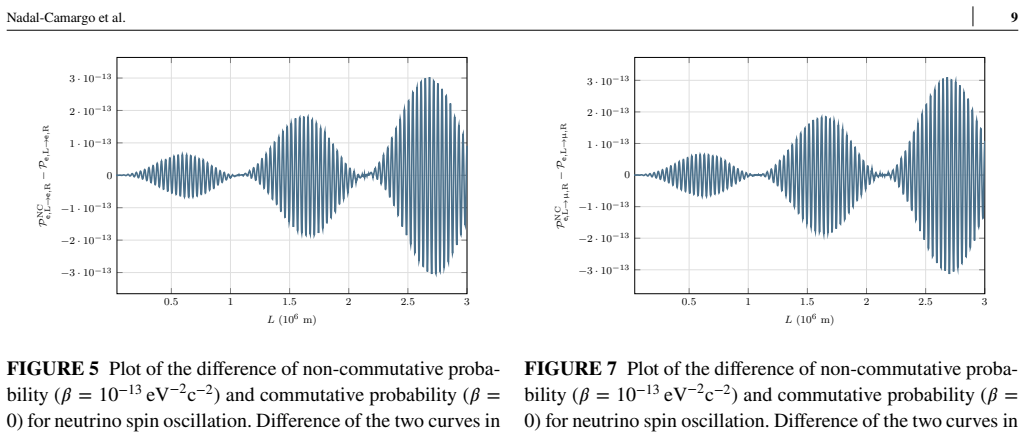
In the Quesne-Tkachuk non-commutative spacetime the two-flavor oscillation probability depends on the usual mass-squared difference together with a fourth-order mass difference scaled by the deformation parameter β. The resulting expression generates a beat pattern that induces a small shift in the oscillation profiles.
What carries the argument
The Quesne-Tkachuk deformation parameter β inserted into the effective neutrino mass, which supplies the fourth-order mass term in the oscillation phase.
If this is right
- The oscillation probability acquires an additional non-commutative phase proportional to β times a fourth-order mass difference.
- Comparison with the standard probability reveals a beat pattern and a small shift in the oscillation profiles.
- The magnetic-field dependence of neutrino propagation is retained in the non-commutative setting.
Where Pith is reading between the lines
- Precision neutrino experiments could place bounds on the size of the minimal length scale through the size of the shift.
- The same insertion procedure might be tested in other flavor-mixing processes such as neutral-meson oscillations.
- Long-baseline data could separate the β-dependent beat from ordinary matter effects by its distinct energy dependence.
Load-bearing premise
The deformation parameter β can be inserted directly into the effective neutrino mass without additional consistency conditions from the full non-commutative field theory.
What would settle it
High-precision measurement of oscillation probabilities that either detects or rules out the predicted beat pattern at a given value of β.
Figures
read the original abstract
We investigate how neutrino oscillations are modified in a non-commutative spacetime characterized by a minimal length scale, described by the Quesne-Tkachuk algebra. By incorporating the algebra's deformation parameter $\beta$ into the effective neutrino mass, we derive the 2-flavor oscillation probability in this non-commutative setting. The resulting probability depends not only on the usual mass-squared difference but also on a fourth-order mass difference scaled by $\beta$. A comparison between the standard and non-commutative oscillation probabilities reveals a beat pattern arising from the additional non-commutative phase, which induces a small shift in the oscillation profiles. Finally, we extend our analysis to include the effects of a magnetic field on neutrino propagation.
Editorial analysis
A structured set of objections, weighed in public.
Referee Report
Summary. The manuscript investigates modifications to neutrino oscillations arising from a minimal-length non-commutative spacetime described by the Quesne-Tkachuk algebra. By inserting the deformation parameter β directly into an effective neutrino mass, the authors obtain a 2-flavor oscillation probability containing both the standard Δm² term and an additional β-scaled fourth-order mass-difference term; the interference produces a beat pattern that shifts the oscillation profile. The analysis is extended to include the effects of an external magnetic field.
Significance. A rigorously derived β-dependent correction to the oscillation phase could in principle furnish new phenomenological bounds on the minimal length scale from existing or future neutrino data. The present construction, however, rests on an unverified substitution rather than an explicit solution of the deformed Dirac equation, so the result does not yet supply a falsifiable prediction grounded in the underlying algebra.
major comments (2)
- [Abstract] Abstract, paragraph 2: the central probability formula is obtained by “incorporating … β into the effective neutrino mass.” No derivation is supplied showing that this replacement follows from the Quesne-Tkachuk commutator [x_i, p_j] = iħ δ_ij (1 + β p²) applied to the Dirac operator; without the deformed energy eigenvalues E_±(p, β) the claimed fourth-order mass term remains an assumption rather than a consequence.
- [Abstract] The beat-pattern claim requires that the additional phase δϕ_β ∝ β (m_1^4 – m_2^4) L / (2E) be independent of the standard oscillation phase. Because the substitution m → m(β) is performed by hand, it is impossible to verify whether higher-order corrections in β that would arise from the full non-commutative dispersion relation cancel or reinforce this term.
minor comments (1)
- [Abstract] The abstract mentions an extension to magnetic fields but provides no explicit form for the modified Hamiltonian or the resulting probability; this section should be expanded or removed.
Simulated Author's Rebuttal
We thank the referee for the thorough review and constructive feedback on our manuscript. The comments correctly identify that our treatment of the deformation parameter β relies on a direct substitution into the effective mass rather than a derivation from the deformed Dirac equation. We respond to each major comment below and indicate the revisions we will make to address the concerns.
read point-by-point responses
-
Referee: [Abstract] Abstract, paragraph 2: the central probability formula is obtained by “incorporating … β into the effective neutrino mass.” No derivation is supplied showing that this replacement follows from the Quesne-Tkachuk commutator [x_i, p_j] = iħ δ_ij (1 + β p²) applied to the Dirac operator; without the deformed energy eigenvalues E_±(p, β) the claimed fourth-order mass term remains an assumption rather than a consequence.
Authors: We agree that the manuscript presents the incorporation of β into the effective neutrino mass as a modeling choice without deriving the corresponding deformed energy eigenvalues from the Quesne-Tkachuk algebra applied to the Dirac operator. This substitution is phenomenological, motivated by the form of the minimal-length commutator, and is adopted to obtain a first estimate of possible effects on the oscillation probability. We will revise the abstract and add a dedicated paragraph in the introduction (and methods section) explicitly stating that the fourth-order term is obtained under this assumption, that a full solution of the non-commutative Dirac equation lies outside the present scope, and that the result should be viewed as exploratory rather than a direct consequence of the algebra. revision: yes
-
Referee: [Abstract] The beat-pattern claim requires that the additional phase δϕ_β ∝ β (m_1^4 – m_2^4) L / (2E) be independent of the standard oscillation phase. Because the substitution m → m(β) is performed by hand, it is impossible to verify whether higher-order corrections in β that would arise from the full non-commutative dispersion relation cancel or reinforce this term.
Authors: The referee is correct that, absent the complete β-dependent dispersion relation, one cannot rigorously exclude possible cancellations or reinforcements from higher-order terms. Within the present phenomenological framework we retain only the leading correction linear in β and treat higher orders as negligible for the small values of β considered. We will expand the discussion section to emphasize the perturbative character of the approximation, state the regime of validity (small β), and note that a non-perturbative treatment based on the exact deformed eigenvalues remains an open task for future work. revision: yes
Circularity Check
β inserted into effective neutrino mass by definition, making β-dependent oscillation term tautological
specific steps
-
self definitional
[Abstract]
"By incorporating the algebra's deformation parameter β into the effective neutrino mass, we derive the 2-flavor oscillation probability in this non-commutative setting. The resulting probability depends not only on the usual mass-squared difference but also on a fourth-order mass difference scaled by β."
The β-dependent fourth-order term and beat pattern in the probability are introduced by the act of incorporating β into the effective mass; the claimed new features therefore follow directly from the definitional input rather than from an independent calculation using the Quesne-Tkachuk operators.
full rationale
The paper's central derivation begins by incorporating the Quesne-Tkachuk deformation parameter β directly into the effective neutrino mass. This substitution is presented as the starting point for deriving the modified 2-flavor oscillation probability, which then necessarily includes a fourth-order mass difference scaled by β and produces the claimed beat pattern. Because the new term is introduced by this definitional step rather than obtained from solving the deformed Dirac equation, the probability's β dependence and the resulting shift are equivalent to the input assumption by construction. The abstract provides no evidence of an independent derivation from the algebra applied to the Hamiltonian or energy eigenvalues.
Axiom & Free-Parameter Ledger
free parameters (1)
- β
axioms (1)
- domain assumption Quesne-Tkachuk non-commutative algebra defines a minimal length scale
Reference graph
Works this paper leans on
-
[1]
Snyder, Hartland S. , title =. doi:10.1103/PhysRev.71.38 , journal =
-
[2]
Achim Kempf and Gianpiero Mangano , title =. Phys. Rev. D , volume =. 1995 , eprint =
1995
-
[3]
doi:10.1007/BF01690456 , journal =
Achim Kempf , title = ". doi:10.1007/BF01690456 , journal =
-
[4]
Lorentz-covariant deformed algebra with minimal length and application to the (1 + 1)-dimensional Dirac oscillator , volume=. Journal of Physics. A, Mathematical and General , author=. 2006 , month=. doi:10.1088/0305-4470/39/34/021 , number=
-
[5]
Ferreira, Thiago Oliveira and Vasconcellos, C \'e sar A. Z. and Hadjimichef, Dimiter. A seesaw-like mechanism for the neutrino in the presence of a minimal length space-time. Astron. Nachr. 2023. doi:10.1002/asna.20220127
-
[6]
Moayedi, S. K. and Setare, M. R. and Moayeri, H. and Poorakbar, M. , title =. International Journal of Modern Physics A , volume =. 2011 , doi =
2011
-
[7]
Popov, Artem and Studenikin, Alexander , year=. Neutrino eigenstates and flavour, spin and spin-flavour oscillations in a constant magnetic field , volume=. The European Physical Journal C , publisher=. doi:10.1140/epjc/s10052-019-6657-z , number=
-
[8]
Agostini, M. and Altenmüller, K. and Appel, S. and Atroshchenko, V. and Bagdasarian, Z. and et al. , year=. Limiting neutrino magnetic moments with Borexino Phase-II solar neutrino data , volume=. Physical Review D , publisher=. doi:10.1103/physrevd.96.091103 , number=
-
[9]
Spin-flavor oscillations of relic neutrinos in primordial magnetic field , author =. Phys. Rev. D , volume =. 2024 , month =. doi:10.1103/PhysRevD.109.055011 , url =
-
[10]
A review of the homestake solar neutrino experiment , journal =. 1994 , issn =. doi:https://doi.org/10.1016/0146-6410(94)90004-3 , url =
-
[11]
Poon, A. W. P. , year=. Neutrino observations from the Sudbury Neutrino Observatory , volume=. doi:10.1063/1.1469931 , booktitle=
-
[12]
Samar, M. I. and Tkachuk, V. M. Perturbation Hydrogen-atom Spectrum in a Space With the Lorentz-covariant Deformed Algebra With Minimal Length. J. Phys. Stud. 2010. doi:10.30970/jps.14.1001
discussion (0)
Sign in with ORCID, Apple, or X to comment. Anyone can read and Pith papers without signing in.