Magnetic HIP-NN for spin dynamics in disordered itinerant magnets
Pith reviewed 2026-06-27 11:19 UTC · model grok-4.3
The pith
mHIP-NN learns effective local magnetic fields directly from geometric-spin configurations to drive large-scale Landau-Lifshitz-Gilbert dynamics.
A machine-rendered reading of the paper's core claim, the machinery that carries it, and where it could break.
Core claim
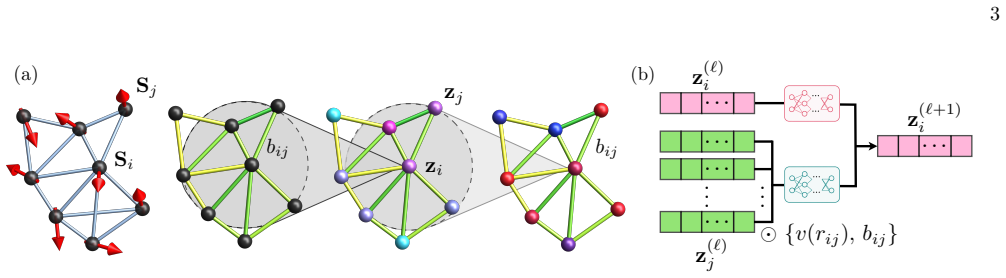
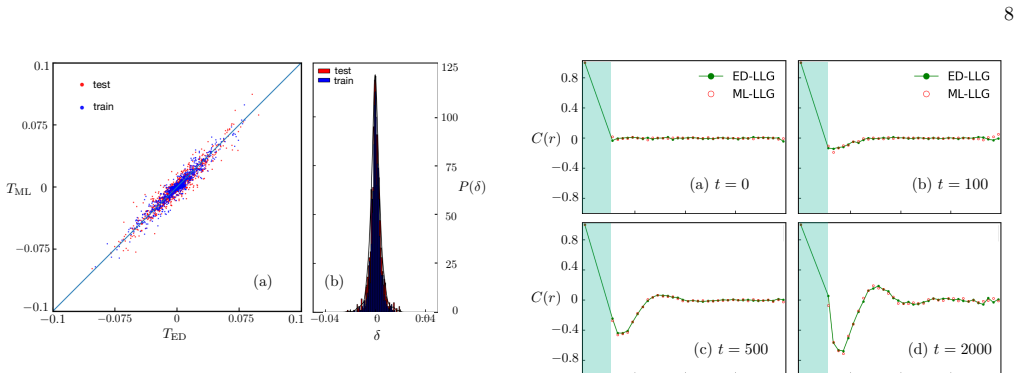
The mHIP-NN incorporates rotationally invariant spin correlations directly into hierarchical message-passing layers, enabling the network to learn emergent magnetic energy landscapes and effective local fields from coupled geometric-spin environments while preserving spin-rotation symmetry. In benchmark applications to structurally disordered itinerant s-d exchange models, mHIP-NN accurately reproduces the local torques that govern Landau-Lifshitz-Gilbert dynamics and faithfully captures the nonequilibrium evolution of spatial spin correlations following thermal quenches.
What carries the argument
Hierarchical message-passing layers that embed rotationally invariant spin correlations to map coupled atomic positions and spins onto effective local fields and energy landscapes.
If this is right
- The learned energy functional remains fully differentiable with respect to both atomic coordinates and spin variables.
- The framework supplies a natural foundation for spin-dependent interatomic potentials.
- Large-scale simulations of frustrated itinerant spin systems become feasible without repeated electronic diagonalizations.
- Nonequilibrium magnetic dynamics, including the evolution of spatial spin correlations after thermal quenches, can be followed at system sizes inaccessible to conventional methods.
Where Pith is reading between the lines
- The same trained network could be inserted into existing molecular-dynamics codes to evolve atoms and spins simultaneously.
- Because the architecture is symmetry-aware, it may transfer across different disorder realizations or lattice types with minimal retraining.
- Extension to finite-temperature Langevin dynamics or driven systems would follow directly from the differentiability of the learned functional.
Load-bearing premise
The hierarchical message-passing layers can learn the emergent magnetic energy landscapes and effective local fields directly from coupled geometric-spin environments without requiring explicit electronic structure calculations at runtime.
What would settle it
Running exact diagonalization on small disordered s-d clusters after a thermal quench and comparing the resulting spin-spin correlation functions point-by-point with those produced by an mHIP-NN trained on the same model would falsify the claim if the two sets of correlations diverge beyond statistical error.
Figures
read the original abstract
We present a magnetic extension of the Hierarchically Interacting Particle Neural Network (HIP-NN) that enables large-scale simulations of electron-mediated spin dynamics in disordered itinerant magnets. The resulting magnetic HIP-NN (mHIP-NN) incorporates rotationally invariant spin correlations directly into hierarchical message-passing layers, enabling the network to learn emergent magnetic energy landscapes and effective local fields from coupled geometric-spin environments while preserving spin-rotation symmetry. As a benchmark application, we consider structurally disordered itinerant $s$-$d$ exchange models in which the effective magnetic forces arise dynamically from the instantaneous electronic structure and are computationally prohibitive to evaluate using conventional exact-diagonalization-based approaches. We show that mHIP-NN accurately reproduces the local torques governing Landau-Lifshitz-Gilbert dynamics and faithfully captures the nonequilibrium evolution of spatial spin correlations following thermal quenches. Our results establish symmetry-aware hierarchical message-passing networks as an efficient and scalable framework for large-scale simulations of frustrated itinerant spin systems and nonequilibrium magnetic dynamics. More broadly, because the learned energy functional remains fully differentiable with respect to both atomic coordinates and spin variables, the framework also provides a natural foundation for spin-dependent interatomic potentials and coupled atom-spin dynamics.
Editorial analysis
A structured set of objections, weighed in public.
Referee Report
Summary. The manuscript introduces mHIP-NN, a magnetic extension of the Hierarchically Interacting Particle Neural Network, which incorporates rotationally invariant spin correlations into hierarchical message-passing layers to learn effective magnetic energy landscapes and local fields from coupled geometric-spin environments while preserving spin-rotation symmetry. The central claim is that, once trained on electronic-structure data for structurally disordered itinerant s-d exchange models, mHIP-NN reproduces the local torques that govern Landau-Lifshitz-Gilbert dynamics and captures the nonequilibrium evolution of spatial spin correlations after thermal quenches, thereby enabling large-scale simulations without repeated exact diagonalizations at inference time. The learned energy functional is fully differentiable with respect to both atomic coordinates and spin variables.
Significance. If the benchmark results hold, the work supplies a symmetry-aware, scalable ML framework for nonequilibrium dynamics in frustrated itinerant magnets where conventional diagonalization-based methods become prohibitive. The hierarchical architecture and differentiability constitute clear strengths that align with established ML-potential practice and open a route to coupled atom-spin simulations. The construction is internally consistent and does not rely on hidden assumptions about correlation lengths or training coverage that would falsify the claim on its own terms.
minor comments (2)
- [Abstract] Abstract: the statements that mHIP-NN 'accurately reproduces the local torques' and 'faithfully captures the nonequilibrium evolution' are presented without any quantitative metrics, error bars, training-set sizes, or validation splits, which weakens the reader's ability to gauge the strength of the benchmark claim.
- The acronym HIP-NN is used in the title and abstract before its expansion appears in the text; a parenthetical definition on first use would improve clarity.
Simulated Author's Rebuttal
We thank the referee for the positive assessment of our manuscript, the recognition of its significance for scalable simulations of nonequilibrium spin dynamics, and the recommendation of minor revision. No major comments were raised in the report.
Circularity Check
No significant circularity detected
full rationale
The paper presents mHIP-NN as a hierarchical message-passing network trained on external electronic-structure data to learn effective magnetic energies and local fields, then deployed for LLG dynamics and quench simulations. This follows standard supervised ML-potential practice with no load-bearing steps that reduce predictions to inputs by construction, no self-definitional equations, and no reliance on self-citation chains for uniqueness or ansatzes. The benchmark claims are framed as empirical reproduction of torques and correlations from held-out data, keeping the derivation self-contained against external electronic-structure benchmarks.
Axiom & Free-Parameter Ledger
free parameters (1)
- network weights and biases
axioms (1)
- domain assumption Effective local magnetic fields and torques can be learned from instantaneous geometric-spin configurations via symmetry-preserving message passing.
Reference graph
Works this paper leans on
-
[1]
Behler and M
J. Behler and M. Parrinello, Generalized neural-network representation of high-dimensional potential-energy sur- faces, Phys. Rev. Lett.98, 146401 (2007)
2007
-
[2]
A. P. Bart´ ok, M. C. Payne, R. Kondor, and G. Cs´ anyi, Gaussian approximation potentials: The accuracy of quantum mechanics, without the electrons, Phys. Rev. Lett.104, 136403 (2010)
2010
-
[3]
Z. Li, J. R. Kermode, and A. De Vita, Molecular dy- namics with on-the-fly machine learning of quantum- mechanical forces, Phys. Rev. Lett.114, 096405 (2015)
2015
-
[4]
A. V. Shapeev, Moment tensor potentials: A class of sys- tematically improvable interatomic potentials, Multiscale Modeling & Simulation14, 1153 (2016)
2016
-
[5]
V. Botu, R. Batra, J. Chapman, and R. Ramprasad, Ma- chine learning force fields: Construction, validation, and outlook, The Journal of Physical Chemistry C121, 511 (2017)
2017
-
[6]
J. S. Smith, O. Isayev, and A. E. Roitberg, Ani-1: an extensible neural network potential with dft accuracy at force field computational cost, Chem. Sci.8, 3192 (2017)
2017
-
[7]
Zhang, J
L. Zhang, J. Han, H. Wang, R. Car, and W. E, Deep potential molecular dynamics: A scalable model with the accuracy of quantum mechanics, Phys. Rev. Lett.120, 143001 (2018)
2018
-
[8]
Lubbers, J
N. Lubbers, J. S. Smith, and K. Barros, Hierarchical modeling of molecular energies using a deep neural net- work, The Journal of Chemical Physics148, 241715 (2018)
2018
-
[9]
V. L. Deringer, M. A. Caro, and G. Csanyi, Machine learning interatomic potentials as emerging tools for ma- terials science, Advanced Materials31, 1902765 (2019)
2019
-
[10]
Drautz, Atomic cluster expansion for accurate and transferable interatomic potentials, Phys
R. Drautz, Atomic cluster expansion for accurate and transferable interatomic potentials, Phys. Rev. B99, 014104 (2019)
2019
-
[11]
Chmiela, A
S. Chmiela, A. Tkatchenko, H. E. Sauceda, I. Poltavsky, K. T. Sch¨ utt, and K.-R. M¨ uller, Machine learning of ac- 11 curate energy-conserving molecular force fields, Science Advances3, e1603015 (2017)
2017
-
[12]
Chmiela, H
S. Chmiela, H. E. Sauceda, K.-R. M¨ uller, and A. Tkatchenko, Towards exact molecular dynamics sim- ulations with machine-learned force fields, Nature Com- munications9, 3887 (2018)
2018
-
[13]
H. E. Sauceda, M. Gastegger, S. Chmiela, K.-R. M¨ uller, and A. Tkatchenko, Molecular force fields with gradient- domain machine learning (GDML): Comparison and syn- ergies with classical force fields, The Journal of Chemical Physics153, 124109 (2020)
2020
-
[14]
Scarselli, M
F. Scarselli, M. Gori, A. C. Tsoi, M. Hagenbuchner, and G. Monfardini, The graph neural network model, IEEE Transactions on Neural Networks20, 61 (2009)
2009
-
[15]
J. Gilmer, S. S. Schoenholz, P. F. Riley, O. Vinyals, and G. E. Dahl, Neural message passing for quantum chem- istry, inProceedings of the 34th International Conference on Machine Learning, Vol. 70 (PMLR, 2017) pp. 1263– 1272, arXiv:1704.01212
Pith/arXiv arXiv 2017
-
[16]
W. L. Hamilton, R. Ying, and J. Leskovec, Inductive representation learning on large graphs, inAdvances in Neural Information Processing Systems, Vol. 30 (2017) arXiv:1706.02216
Pith/arXiv arXiv 2017
-
[17]
K. Xu, W. Hu, J. Leskovec, and S. Jegelka, How powerful are graph neural networks?, inInternational Conference on Learning Representations (ICLR)(2019) arXiv:1810.00826
Pith/arXiv arXiv 2019
-
[18]
H. Maron, H. Ben-Hamu, N. Shamir, and Y. Lipman, In- variant and equivariant graph networks, inInternational Conference on Learning Representations (ICLR)(2019) arXiv:1812.09902
Pith/arXiv arXiv 2019
-
[19]
Xie and J
T. Xie and J. C. Grossman, Crystal graph convolutional neural networks for an accurate and interpretable predic- tion of material properties, Phys. Rev. Lett.120, 145301 (2018)
2018
-
[20]
K. T. Sch¨ utt, H. E. Sauceda, P.-J. Kindermans, A. Tkatchenko, and K.-R. M¨ uller, Schnet – a deep learn- ing architecture for molecules and materials, The Journal of Chemical Physics148, 241722 (2018)
2018
-
[21]
Choudhary and B
K. Choudhary and B. DeCost, Atomistic line graph neu- ral network for improved materials property predictions, npj Computational Materials7, 185 (2021)
2021
-
[22]
M. Dai, M. F. Demirel, Y. Liang, and J.-M. Hu, Graph neural networks for an accurate and interpretable pre- diction of the properties of polycrystalline materials, npj Computational Materials7, 103 (2021)
2021
-
[23]
Reiser, M
P. Reiser, M. Neubert, A. Eberhard, L. Torresi, C. Zhou, C. Shao, H. Metni, C. van Hoesel, H. Schopmans, T. Sommer, and P. Friederich, Graph neural networks for materials science and chemistry, Communications Mate- rials3, 93 (2022)
2022
-
[24]
I. Batatia, D. P. Kov´ acs, G. N. C. Simm, C. Ortner, and G. Cs´ anyi, Mace: Higher order equivariant mes- sage passing neural networks for fast and accurate force fields, inAdvances in Neural Information Processing Sys- tems, Vol. 35 (2022) pp. 11423–11436, arXiv:2206.07697 [stat.ML]
arXiv 2022
-
[25]
T. S. Cohen and M. Welling, Group equivariant con- volutional networks, inProceedings of the 33rd Interna- tional Conference on Machine Learning, Proceedings of Machine Learning Research, Vol. 48 (PMLR, 2016) pp. 2990–2999, arXiv:1602.07576 [cs.LG]
Pith/arXiv arXiv 2016
-
[26]
T. S. Cohen, M. Geiger, M. Weiler, and M. Welling, A general theory of equivariant cnns on homogeneous spaces, inAdvances in Neural Information Processing Systems, Vol. 31 (2018) arXiv:1811.02017 [cs.LG]
arXiv 2018
-
[27]
M. Weiler, M. Geiger, M. Welling, W. Boomsma, and T. S. Cohen, 3d steerable cnns: Learning rotationally equivariant features in volumetric data, inAdvances in Neural Information Processing Systems, Vol. 31 (Curran Associates, Inc., 2018) arXiv:1807.02547 [cs.LG]
Pith/arXiv arXiv 2018
-
[28]
Kondor, The principles behind equivariant neural net- works for physics and chemistry, Proceedings of the Na- tional Academy of Sciences122, e2415656122 (2025)
R. Kondor, The principles behind equivariant neural net- works for physics and chemistry, Proceedings of the Na- tional Academy of Sciences122, e2415656122 (2025)
2025
-
[29]
Batzner, A
S. Batzner, A. Musaelian, L. Sun, M. Geiger, J. P. Mailoa, M. Kornbluth, N. Molinari, T. E. Smidt, and B. Kozinsky, E(3)-equivariant graph neural networks for data-efficient and accurate interatomic potentials, Nature Communications13, 2453 (2022)
2022
-
[30]
S.-O. Kaba and S. Ravanbakhsh, Equivariant networks for crystal structures, inAdvances in Neural Informa- tion Processing Systems, Vol. 35 (2022) pp. 300–314, arXiv:2211.15420 [cs.LG]
arXiv 2022
-
[31]
Musaelian, S
A. Musaelian, S. Batzner, A. Johansson, L. Sun, C. J. Owen, M. Kornbluth, and B. Kozinsky, Learning local equivariant representations for large-scale atomistic dy- namics, Nature Communications14, 579 (2023)
2023
-
[32]
X. Gong, H. Li, N. Zou, R. Xu, W. Duan, and Y. Xu, General framework for e(3)-equivariant neural network representation of density functional theory hamiltonian, Nature Communications14, 2848 (2023)
2023
-
[33]
Batatia, S
I. Batatia, S. Batzner, D. P. Kov´ acs, A. Musaelian, G. N. C. Simm, R. Drautz, C. Ortner, B. Kozinsky, and G. Cs´ anyi, The design space of e(3)-equivariant atom- centred interatomic potentials, Nature Machine Intelli- gence7, 56 (2025)
2025
-
[34]
Z. Yang, X. Wang, Y. Li, Q. Lv, C. Y.-C. Chen, and L. Shen, Efficient equivariant model for machine learning interatomic potentials, npj Computational Materials11, 49 (2025)
2025
-
[35]
Nebgen, N
B. Nebgen, N. Lubbers, J. S. Smith, A. E. Sifain, A. Lokhov, O. Isayev, A. E. Roitberg, K. Barros, and S. Tretiak, Transferable dynamic molecular charge as- signment using deep neural networks, Journal of Chemi- cal Theory and Computation14, 4687 (2018)
2018
-
[36]
J. S. Smith, O. Isayev, and A. E. Roitberg, Approach- ing coupled cluster accuracy with a general-purpose neu- ral network potential through transfer learning, Nature Communications10, 2903 (2019)
2019
-
[37]
G. Zhou, B. Nebgen, N. Lubbers, F. Malone, A. Niklas- son, and S. Tretiak, Deep learning of dynamically respon- sive chemical hamiltonians with semiempirical quantum mechanics, Proceedings of the National Academy of Sci- ences119, e2120333119 (2022)
2022
-
[38]
Chigaev, J
M. Chigaev, J. S. Smith, S. Anaya, B. Nebgen, M. Bet- tencourt, K. Barros, and N. Lubbers, Lightweight and effective tensor sensitivity for atomistic neural networks, The Journal of Chemical Physics158, 184108 (2023)
2023
-
[39]
Zhang, M
S. Zhang, M. Chigaev, O. Isayev, R. A. Messerly, and N. Lubbers, Including physics-informed atomization con- straints in neural networks for reactive chemistry, Journal of Chemical Information and Modeling65, 4367 (2025)
2025
-
[40]
Eckhoff and J
M. Eckhoff and J. Behler, High-dimensional neural network potentials for magnetic systems using spin- dependent atom-centered symmetry functions, npj Com- putational Materials7, 170 (2021)
2021
-
[41]
A. S. Kotykhov, K. Gubaev, V. Sotskov, C. Tantardini, M. Hodapp, A. V. Shapeev, and I. S. Novikov, Fitting to 12 magnetic forces improves the reliability of magnetic mo- ment tensor potentials, Computational Materials Science 245, 113331 (2024)
2024
-
[42]
H. Yu, Y. Zhong, L. Hong, C. Xu, W. Ren, X. Gong, and H. Xiang, Spin-dependent graph neural network potential for magnetic materials, Phys. Rev. B109, 144426 (2024)
2024
-
[43]
H. Yu, B. Liu, Y. Zhong, L. Hong, J. Ji, C. Xu, X. Gong, and H. Xiang, Physics-informed time-reversal equivariant neural network potential for magnetic materials, Phys. Rev. B110, 104427 (2024)
2024
-
[44]
Huang, T
Z. Huang, T. Yang, H. Liu, and B. Xu, Simultaneous optimization of lattice and spin configurations in atomic scale simulation of magnetic materials, Phys. Rev. B111, 134412 (2025)
2025
-
[45]
W. Xu, R. Y. Sanspeur, A. Kolluru, B. Deng, P. Har- rington, S. Farrell, K. Reuter, and J. R. Kitchin, Spin- informed universal graph neural networks for simulating magnetic ordering, Proceedings of the National Academy of Sciences122, e2422973122 (2025)
2025
-
[46]
Zhang and G.-W
P. Zhang and G.-W. Chern, Arrested phase separation in double-exchange models: Large-scale simulation en- abled by machine learning, Phys. Rev. Lett.127, 146401 (2021)
2021
-
[47]
Zhang and G.-W
P. Zhang and G.-W. Chern, Machine learning nonequilib- rium electron forces for spin dynamics of itinerant mag- nets, npj Computational Materials9, 32 (2023)
2023
-
[48]
Cheng, S
X. Cheng, S. Zhang, P. C. H. Nguyen, S. Azarfar, G.-W. Chern, and S. S. Baek, Convolutional neural networks for large-scale dynamical modeling of itinerant magnets, Phys. Rev. Res.5, 033188 (2023)
2023
-
[49]
Y. Fan, S. Zhang, and G.-W. Chern, Coarsening of chi- ral domains in itinerant electron magnets: A machine learning force-field approach, Phys. Rev. B110, 245105 (2024)
2024
-
[50]
Tyberg, Y
A. Tyberg, Y. Fan, and G.-W. Chern, Machine learning force field model for kinetic monte carlo simulations of itinerant ising magnets, Phys. Rev. B111, 235132 (2025)
2025
-
[51]
Chern, Y
G.-W. Chern, Y. Fan, S. Zhang, and P. Zhang, Machine- learning force-field models for dynamical simulations of metallic magnets, AIP Advances16, 025031 (2026)
2026
-
[52]
Chern, Y
G.-W. Chern, Y. Fan, S. Zhang, and P. Zhang, Machine- learning modeling of magnetization dynamics in itinerant magnets, Journal of Magnetism and Magnetic Materials 628, 173679 (2026)
2026
-
[53]
P. G. Mezard, M. and M. Virasoro,Spin Glass Theory and Beyond(World Scientific, Singapore, 1987)
1987
-
[54]
Binder and A
K. Binder and A. P. Young, Spin glasses: Experimen- tal facts, theoretical concepts, and open questions, Rev. Mod. Phys.58, 801 (1986)
1986
-
[55]
J. A. Mydosh,Spin Glasses: An Experimental Introduc- tion(Taylor & Francis, London, 1993)
1993
-
[56]
J. A. Mydosh, Spin glasses: redux: an updated experi- mental/materials survey, Reports on Progress in Physics 78, 052501 (2015)
2015
-
[57]
Cannella and J
V. Cannella and J. A. Mydosh, Magnetic ordering in gold-iron alloys, Phys. Rev. B6, 4220 (1972)
1972
-
[58]
F. J. Lamelas, S. A. Werner, S. M. Shapiro, and J. A. Mydosh, Intrinsic spin-density-wave magnetism in cu-mn alloys, Phys. Rev. B51, 621 (1995)
1995
-
[59]
M. A. Ruderman and C. Kittel, Indirect exchange cou- pling of nuclear magnetic moments by conduction elec- trons, Phys. Rev.96, 99 (1954)
1954
-
[60]
Kasuya, A Theory of Metallic Ferro- and Antifer- romagnetism on Zener’s Model, Progress of Theoretical Physics16, 45 (1956)
T. Kasuya, A Theory of Metallic Ferro- and Antifer- romagnetism on Zener’s Model, Progress of Theoretical Physics16, 45 (1956)
1956
-
[61]
Yosida, Magnetic properties of Cu-Mn alloys, Phys
K. Yosida, Magnetic properties of Cu-Mn alloys, Phys. Rev.106, 893 (1957)
1957
-
[62]
Zener, Interaction between the d shells in the transi- tion metals, Physical Review81, 440 (1951)
C. Zener, Interaction between the d shells in the transi- tion metals, Physical Review81, 440 (1951)
1951
-
[63]
de Gennes, Effects of double exchange in magnetic crystals, Physical Review118, 141 (1960)
P.-G. de Gennes, Effects of double exchange in magnetic crystals, Physical Review118, 141 (1960)
1960
-
[64]
P. W. Anderson, Localized magnetic states in metals, Phys. Rev.124, 41 (1961)
1961
-
[65]
K. He, X. Zhang, S. Ren, and J. Sun, Deep residual learn- ing for image recognition, inProceedings of the IEEE Conference on Computer Vision and Pattern Recognition (CVPR)(2016) pp. 770–778
2016
-
[66]
Landau and E
L. Landau and E. Lifshitz, On the theory of the disper- sion of magnetic permeability in ferromagnetic bodies, Physikalische Zeitschrift der Sowjetunion8, 153 (1935)
1935
-
[67]
T. L. Gilbert, A phenomenological theory of damping in ferromagnetic materials, IEEE Transactions on Magnet- ics40, 3443 (2004)
2004
-
[68]
R. F. L. Evans, W. J. Fan, P. Chureemart, T. A. Ostler, M. O. A. Ellis, and R. W. Chantrell, Atomistic spin model simulations of magnetic nanomaterials, Journal of Physics: Condensed Matter26, 103202 (2014)
2014
-
[69]
R. P. Feynman, Forces in molecules, Physical Review56, 340 (1939)
1939
-
[70]
D. P. Kingma and J. Ba, Adam: A method for stochastic optimization (2017), arXiv:1412.6980 [cs.LG]
Pith/arXiv arXiv 2017
discussion (0)
Sign in with ORCID, Apple, or X to comment. Anyone can read and Pith papers without signing in.