Blind-spots of Randomized Benchmarking Under Temporal Correlations
Pith reviewed 2026-05-25 07:41 UTC · model grok-4.3
The pith
Randomized benchmarking yields analytic expressions for average sequence fidelity even under temporally correlated noise from quantum environments.
A machine-rendered reading of the paper's core claim, the machinery that carries it, and where it could break.
Core claim
Under temporally correlated noise whose memory arises from a quantum environment, the average sequence fidelity admits exact analytic formulas that continue to support extraction of the usual RB parameters; certain classes of interaction Hamiltonians make the temporal correlations cancel inside the RB average, while operational signatures in the same data can witness quantum memory; classical memory correlations that remain invisible to ASF can nevertheless change the diamond norm, sometimes reducing worst-case errors.
What carries the argument
Analytic expressions for the average sequence fidelity (ASF) derived under non-Markovian noise with classical memory generated by specific interaction Hamiltonians.
If this is right
- Standard RB fitting procedures remain valid for extracting average gate fidelity when noise possesses classical memory.
- Entire families of interaction Hamiltonians exist for which temporal correlations produce no signature in RB data.
- RB experiments can be augmented with operational criteria that detect quantum memory effects.
- Classical correlations invisible to the ASF can still modify diamond-norm errors, including cases where they reduce those errors.
- Worst-case error bounds used in fault-tolerance analysis must be checked separately from RB averages when memory is present.
Where Pith is reading between the lines
- Hardware teams could use the derived expressions as a diagnostic to decide whether their RB numbers are being distorted by hidden memory.
- The observation that some memory effects can suppress diamond-norm errors suggests that certain non-Markovian environments might be less harmful to fault tolerance than Markovian approximations predict.
- Extending the same Hamiltonian classification to other noise metrics beyond ASF and diamond norm could map which error quantifiers are blind to memory.
- Real-device validation would require preparing the specific interaction Hamiltonians in the paper and comparing observed sequences against the analytic predictions.
Load-bearing premise
The temporal correlations must be generated by interactions with a quantum environment whose Hamiltonians belong to the analytically tractable classes identified in the derivations.
What would settle it
A controlled experiment in which a known quantum-environment Hamiltonian from the identified classes produces measured ASF values that systematically deviate from the closed-form expressions derived in the paper.
Figures




read the original abstract
Randomized benchmarking (RB) is a widely adopted protocol for estimating the average gate fidelity in quantum hardware. However, its standard formulation relies on the assumption of temporally uncorrelated noise, an assumption often violated in current devices. In this work, we derive analytic expressions for the average sequence fidelity (ASF) in the presence of temporally correlated (non-Markovian) noise with classical memory, including cases where such correlations originate from interactions with a quantum environment. We show how the ASF can be interpreted to extract meaningful benchmarking parameters under such noise and identify classes of interaction Hamiltonians that render temporal correlations completely invisible to RB. We further provide operational criteria for witnessing temporal correlations due to quantum memory through RB experiments. Importantly, while classical correlations may remain undetectable in the ASF data, they can nonetheless significantly affect worst-case errors quantified by the diamond norm, a metric central to fault tolerant quantum computing. In particular, we demonstrate that temporal correlations may suppress worst-case errors highlighting that temporal correlations may not always have detrimental effects on gate performance.
Editorial analysis
A structured set of objections, weighed in public.
Referee Report
Summary. The paper derives analytic expressions for the average sequence fidelity (ASF) in randomized benchmarking (RB) under temporally correlated (non-Markovian) noise with classical memory, including cases originating from interactions with a quantum environment. It shows how the ASF can be interpreted to extract meaningful benchmarking parameters, identifies classes of interaction Hamiltonians that render temporal correlations invisible to RB, provides operational criteria for witnessing quantum memory through RB experiments, and demonstrates that classical correlations can significantly affect diamond-norm errors (sometimes suppressing worst-case errors) even when invisible in the ASF.
Significance. If the derivations hold, the work is significant for quantum characterization protocols. RB is a standard tool whose Markovian assumption is frequently violated; analytic ASF expressions under non-Markovian noise, explicit identification of blind-spot Hamiltonians, and the ASF-versus-diamond-norm separation supply concrete guidance for experimental interpretation and fault-tolerance considerations. The provision of machine-checkable analytic forms and falsifiable witnessing criteria strengthens the contribution.
major comments (1)
- [Abstract and §3] Abstract and §3 (analytic derivations): the invisibility criteria and closed-form ASF expressions are explicitly restricted to particular classes of interaction Hamiltonians that permit analytic treatment. The manuscript should add a dedicated paragraph quantifying how restrictive these classes are (e.g., by giving the measure of the allowed Hamiltonian space or an example of a physically relevant Hamiltonian that falls outside the class) so that readers can assess applicability to real devices.
minor comments (2)
- Notation for the memory kernel and correlation functions should be introduced once with a clear table of symbols to avoid repeated re-definition across sections.
- Figure captions for any plots of ASF versus sequence length should explicitly state the Hamiltonian class and noise parameters used, for reproducibility.
Simulated Author's Rebuttal
We thank the referee for their positive assessment of the work and for the constructive suggestion. We address the single major comment below and will incorporate the requested clarification in the revised manuscript.
read point-by-point responses
-
Referee: [Abstract and §3] Abstract and §3 (analytic derivations): the invisibility criteria and closed-form ASF expressions are explicitly restricted to particular classes of interaction Hamiltonians that permit analytic treatment. The manuscript should add a dedicated paragraph quantifying how restrictive these classes are (e.g., by giving the measure of the allowed Hamiltonian space or an example of a physically relevant Hamiltonian that falls outside the class) so that readers can assess applicability to real devices.
Authors: We agree that the analytic derivations and invisibility criteria apply only to specific classes of interaction Hamiltonians that admit closed-form treatment. In the revised manuscript we will insert a dedicated paragraph (in §3, immediately following the statement of the main theorems) that explicitly discusses the scope of these classes. We will give a concrete example of a physically relevant Hamiltonian that lies outside the class (a general two-qubit interaction containing all Pauli terms with independent coefficients) and note that the allowed class corresponds to Hamiltonians that commute with a fixed set of operators or possess a particular symmetry (e.g., pure dephasing or amplitude-damping channels with classical memory). While we do not provide a formal measure of the allowed subspace (as the space of all two-qubit Hamiltonians is continuous), the added discussion will make clear that the results cover many experimentally common noise models but do not exhaust all possible non-Markovian interactions. revision: yes
Circularity Check
Analytic derivations of ASF under non-Markovian noise follow from stated Hamiltonian classes without reduction to inputs or self-citations.
full rationale
The paper derives closed-form expressions for average sequence fidelity starting from explicit models of temporally correlated noise (classical memory and quantum-environment interactions under restricted Hamiltonian classes). These steps proceed from the interaction Hamiltonians and correlation assumptions to the ASF formulas and invisibility criteria without any quoted reduction to fitted parameters renamed as predictions, self-definitional loops, or load-bearing self-citations. The separation between ASF visibility and diamond-norm effects is likewise derived directly from the same models rather than presupposed. No load-bearing step collapses by construction to the paper's own inputs.
Axiom & Free-Parameter Ledger
axioms (1)
- domain assumption Temporally correlated noise with classical memory from quantum environment interactions admits analytic treatment for RB sequence fidelity.
Reference graph
Works this paper leans on
-
[1]
An initial stateρis prepared. Ideally, this is taken to be a pure state|ψ⟩ ⟨ψ|, though in practice it may be subject to state-preparation errors
-
[2]
Under ideal gate implementationS i ≡ I, i.e
The prepared stateρis subject to a sequence of m+1 Clifford gatesS i ≡ C (i) m+1 ◦ C(i) m ◦ · · · ◦ C(i) 2 ◦ C(i) 1 where the firstmgates are sampled uniformly at random fromCG n and the final gate is a fixedmo- tion reversalgate chosen to invert the preceding sequence,C (i) m+1 = C(i) m ◦ · · · ◦ C(i) 2 ◦ C(i) 1 † . Under ideal gate implementationS i ≡ I...
-
[3]
The final state is measured using a positive operator-valued measure (POVM){E, E ⊥}satis- fyingE+E ⊥ =IwhereIis the identity opera- tor andE, E ⊥ are positive semi-definite. Ideally, E=|ψ⟩ ⟨ψ|, corresponding to perfect projective measurement onto the prepared state, but in prac- tice we allow for measurement errors
-
[4]
For each sequenceS i, the experiment is repeated multiple times to gather sufficient statistics. The outcomes from these runs are averaged to ob- tain the sequence fidelityF (m) i := Tr{ES i(ρ)} ∈ [0,1]. In this work, we do not explicitly account for statistical fluctuations due to finite number of shots. This analysis can be dealt with separately as poin...
-
[5]
Even for a qubit the sam- ple space comprises 24 m random sequences for se- quence lengthm
It is infeasible to sample the entire space of all the possible sequences. Even for a qubit the sam- ple space comprises 24 m random sequences for se- quence lengthm. For practical implementation, smallk≪ |CG n|subset of random sequences are chosen uniformly. The corresponding sequence fi- delity values{F (m) i }k i=1 can be treated as instances of a rand...
-
[6]
Finally, the procedure is repeated for multiple val- ues of the sequence lengthm. The dependence of the ASF onmis then fitted to an exponential decay 3 model, from which one extracts the average error rate of the implemented Clifford operations. Under the assumption of time and gate independent Markoviannoise, the ASF takes the exponential form. ¯F (m) =A...
-
[7]
Markovian processes In a Markovian process, environment does not mediate temporal correlations across time steps. In terms of the structure of process matrix, a Markovian process admits a tensor product factorization in terms of initial state and the channel connecting the labs as following [24, 33, 42] WM =ρ SI n−1O t=1 Nt SOSI ,(5) where Nt ∈ L HSO t ⊗ ...
-
[8]
(5) is called a non-Markovian process
Non-Markovian processes A process which does not admit factorization in the form of Eq. (5) is called a non-Markovian process. Phys- ically, a non-Markovian process can result from interac- tion with a common environment at various time steps, allowing the environment to retain memory and medi- ate temporal correlations between labs. Depending on the type...
-
[9]
Randomisation of initial state and final measurement The second reason for analysing time-dependent Markovian noise model is a subtle issue related to using different representations of noise model. As discussed in Sec. II A, the noisy gate can be represented in two ways,C t =G t ◦ N t orC t = ˜Nt ◦ G t. While both rep- resentations yield the same ASF for...
-
[10]
(7), which is aconvex mixture of Marko- vian processes
ASF for classical common cause (CCC) The process matrix for a CCC-type process is of the form given in Eq. (7), which is aconvex mixture of Marko- vian processes. The underlying cause of this correlation can be either classical or quantum, and in [30] a class of system–environment interaction Hamiltonians was iden- tified that gives rise to such memory ef...
-
[11]
ASF for classical feed-forward (CFF) To derive the ASF for CFF type error models we start with an initial stateρfollowed by a unitary rotation V. We now ignore the effects of noise mapsP,Mas we argued in previous sections that their contribution are accounted for in SPAM error term and and small correction term to the overall ASF expression. Define ρa0|x0...
-
[12]
[H E0 m , HE0 n ] = 0 for allm, nand for bothH 1 and H2
-
[13]
[H E1 m , HE1 n ] = 0 for allm, nforH 2
-
[14]
Initial system-environment state is uncorrelated in spacesE 1 andE 2 then it is straightforward to show that the resulting process matrix is of the form, W= X xy pxρAI x ⊗ Ey|x AOBI ⊗ Txy BOCI . (B5) Here, Ey|x is CJ map corresponding to the CP map Ey|x withP y Ey|x being a CPTP map for allx, and Txy are CJ maps corresponding to CPTP maps, andp(x)ρ AI x h...
-
[15]
ym = q2 1 q2 2 1 q3 1 q3 2 1
The ASF data for a sequence lengthm [y1, y2,· · ·, y m] can be expressed in the following matrix equation: y1 y2 ... ym = q2 1 q2 2 1 q3 1 q3 2 1 ... ... ... qm+1 1 qm+1 2 1 A1 A2 B + n1 n2 ... nm
-
[16]
Splitting and writing the data in the form of a Han- kel matrix of dimensionl×(m−l+ 1): y1 · · ·y m−l+1 ... ... ... yl · · ·y m = q2 1 q2 2 1 ... ... ... ql+1 1 ql+1 2 1 A1 · · ·A 1qm−l 1 A2 · · ·A 2qm−l 2 B· · ·B + n1 · · ·n m−l+1 ... ... ... nl · · ·n m ,(C2) we obtain its singular values. Eq. (C2) can be rewritten ...
-
[17]
The number of dominant singular values (supplied as the “model order”) as well as the data serve as input for the ESPRIT algorithm, which outputs the different exponents
-
[18]
Using the exponents, we determineA 1,A 2 and con- stantBby solving the linear equation Eq. (C2)
-
[19]
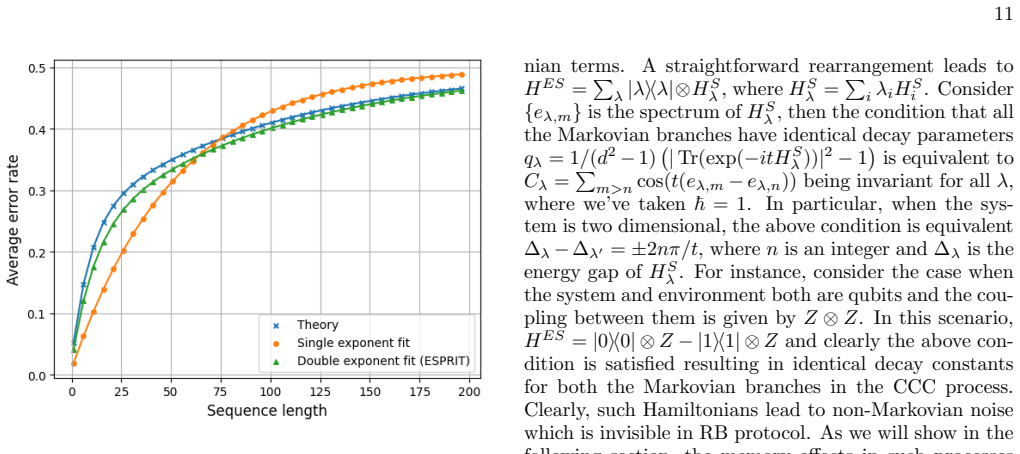
Once we obtain the parameter values for A1 andA 2, we can findp 1 andp 2 from the follow- ing relations:p 1 = A1 A1+A2 andp 2 = A2 A1+A2 . FIG. 8. The plot shows singular values of the Hankel matrix from the simulated data presented in Sec. IV B. The singular values are plotted in logarithmic scale in the Y-axis, and the two dominant singular values are c...
- [20]
-
[21]
R. Blume-Kohout, T. Proctor, and K. Young, Quan- tum characterization, verification, and validation (2025), arXiv:2503.16383 [quant-ph]
-
[22]
J. Emerson, R. Alicki, and K. ˙Zyczkowski, Scalable noise estimation with random unitary operators, Journal of Optics B: Quantum and Semiclassical Optics7, S347 (2005)
work page 2005
- [23]
-
[24]
E. Magesan, J. M. Gambetta, and J. Emerson, Scalable and robust randomized benchmarking of quantum pro- cesses, Phys. Rev. Lett.106, 180504 (2011)
work page 2011
-
[25]
E. Magesan, J. M. Gambetta, and J. Emerson, Charac- terizing quantum gates via randomized benchmarking, Phys. Rev. A85, 042311 (2012)
work page 2012
-
[26]
I. L. Chuang and M. A. Nielsen, Prescription for ex- perimental determination of the dynamics of a quantum black box, Journal of Modern Optics44, 2455 (1997)
work page 1997
-
[27]
J. M. Chow, J. M. Gambetta, L. Tornberg, J. Koch, L. S. Bishop, A. A. Houck, B. R. Johnson, L. Frunzio, S. M. Girvin, and R. J. Schoelkopf, Randomized benchmarking and process tomography for gate errors in a solid-state qubit, Phys. Rev. Lett.102, 090502 (2009)
work page 2009
-
[28]
A. D. C´ orcoles, J. M. Gambetta, J. M. Chow, J. A. Smolin, M. Ware, J. Strand, B. L. T. Plourde, and M. Steffen, Process verification of two-qubit quantum gates by randomized benchmarking, Phys. Rev. A87, 030301 (2013)
work page 2013
-
[29]
S. Olmschenk, R. Chicireanu, K. D. Nelson, and J. V. Porto, Randomized benchmarking of atomic qubits in an optical lattice, New Journal of Physics12, 113007 (2010)
work page 2010
-
[30]
T. Xia, M. Lichtman, K. Maller, A. W. Carr, M. J. Piotrowicz, L. Isenhower, and M. Saffman, Random- ized benchmarking of single-qubit gates in a 2d array of neutral-atom qubits, Phys. Rev. Lett.114, 100503 (2015)
work page 2015
-
[31]
A. Silva and E. Greplova, Hands-on introduction to ran- domized benchmarking (2025), arXiv:2410.08683 [quant- ph]
-
[32]
J. M. Gambetta, A. D. C´ orcoles, S. T. Merkel, B. R. Johnson, J. A. Smolin, J. M. Chow, C. A. Ryan, C. Rigetti, S. Poletto, T. A. Ohki, M. B. Ketchen, and M. Steffen, Characterization of addressability by simulta- neous randomized benchmarking, Phys. Rev. Lett.109, 240504 (2012)
work page 2012
-
[33]
E. Magesan, J. M. Gambetta, B. R. Johnson, C. A. Ryan, J. M. Chow, S. T. Merkel, M. P. da Silva, G. A. Keefe, M. B. Rothwell, T. A. Ohki, M. B. Ketchen, and M. Steffen, Efficient measurement of quantum gate er- ror by interleaved randomized benchmarking, Phys. Rev. Lett.109, 080505 (2012)
work page 2012
-
[34]
D. S. Fran¸ ca and A. K. Hashagen, Approximate random- ized benchmarking for finite groups, Journal of Physics A: Mathematical and Theoretical51, 395302 (2018)
work page 2018
- [35]
-
[36]
J. J. Wallman, Randomized benchmarking with gate- dependent noise, Quantum2, 47 (2018)
work page 2018
-
[37]
T. J. Proctor, A. Carignan-Dugas, K. Rudinger, E. Nielsen, R. Blume-Kohout, and K. Young, Direct randomized benchmarking for multiqubit devices, Phys. Rev. Lett.123, 030503 (2019)
work page 2019
-
[38]
Logical Randomized Benchmarking
J. Combes, C. Granade, C. Ferrie, and S. T. Flammia, Logical randomized benchmarking (2017), arXiv:1702.03688 [quant-ph]
work page internal anchor Pith review Pith/arXiv arXiv 2017
-
[39]
M. McEwen, D. Kafri, Z. Chen, J. Atalaya, K. J. Satzinger, C. Quintana, P. V. Klimov, D. Sank, C. Gid- ney, A. G. Fowler, F. Arute, K. Arya, B. Buckley, B. Bur- kett, N. Bushnell, B. Chiaro, R. Collins, S. Demura, A. Dunsworth, C. Erickson, B. Foxen, M. Giustina, T. Huang, S. Hong, E. Jeffrey, S. Kim, K. Kechedzhi, F. Kostritsa, P. Laptev, A. Megrant, X. ...
work page 2021
-
[40]
J. Morris, F. A. Pollock, and K. Modi, Quan- tifying non-markovian memory in a super- conducting quantum computer, Open Systems & Information Dynamics29, 2250007 (2022), https://doi.org/10.1142/S123016122250007X
-
[41]
P. Figueroa-Romero, K. Modi, R. J. Harris, T. M. Stace, and M.-H. Hsieh, Randomized benchmarking for non- markovian noise, PRX Quantum2, 040351 (2021)
work page 2021
-
[42]
P. Figueroa-Romero, K. Modi, and M.-H. Hsieh, Towards a general framework of Randomized Benchmarking incor- porating non-Markovian Noise, Quantum6, 868 (2022)
work page 2022
-
[43]
C. Giarmatzi and F. Costa, Witnessing quantum memory in non-Markovian processes, Quantum5, 440 (2021)
work page 2021
-
[44]
P. Taranto, M. T. Quintino, M. Murao, and S. Milz, Characterising the Hierarchy of Multi-time Quantum Processes with Classical Memory, Quantum8, 1328 17 (2024)
work page 2024
-
[45]
H. Ball, T. M. Stace, S. T. Flammia, and M. J. Biercuk, Effect of noise correlations on randomized benchmarking, Phys. Rev. A93, 022303 (2016)
work page 2016
-
[46]
M. A. Fogarty, M. Veldhorst, R. Harper, C. H. Yang, S. D. Bartlett, S. T. Flammia, and A. S. Dzurak, Non- exponential fidelity decay in randomized benchmark- ing with low-frequency noise, Phys. Rev. A92, 022326 (2015)
work page 2015
- [47]
-
[48]
M. Veldhorst, J. C. C. Hwang, C. H. Yang, A. W. Leen- stra, B. de Ronde, J. P. Dehollain, J. T. Muhonen, F. E. Hudson, K. M. Itoh, A. Morello, and A. S. Dzurak, An addressable quantum dot qubit with fault-tolerant control-fidelity, Nature Nanotechnology9, 981 (2014)
work page 2014
-
[49]
K. Goswami, A. K. Roy, V. Srivastava, B. Perez, C. Gia- rmatzi, A. Gilchrist, and F. Costa, Hamiltonian charac- terisation of multi-time processes with classical memory (2024), arXiv:2412.01998 [quant-ph]
-
[50]
P. Mundada, G. Zhang, T. Hazard, and A. Houck, Sup- pression of qubit crosstalk in a tunable coupling super- conducting circuit, Phys. Rev. Appl.12, 054023 (2019)
work page 2019
-
[51]
Z. Ni, S. Li, L. Zhang, J. Chu, J. Niu, T. Yan, X. Deng, L. Hu, J. Li, Y. Zhong, S. Liu, F. Yan, Y. Xu, and D. Yu, Scalable method for eliminating residualzzinteraction between superconducting qubits, Phys. Rev. Lett.129, 040502 (2022)
work page 2022
-
[52]
F. A. Pollock, C. Rodr´ ıguez-Rosario, T. Frauenheim, M. Paternostro, and K. Modi, Non-markovian quantum processes: Complete framework and efficient characteri- zation, Phys. Rev. A97, 012127 (2018)
work page 2018
-
[53]
Y. R. Sanders, J. J. Wallman, and B. C. Sanders, Bound- ing quantum gate error rate based on reported average fidelity, New Journal of Physics18, 012002 (2015)
work page 2015
- [54]
-
[55]
C. A. Ryan, M. Laforest, and R. Laflamme, Randomized benchmarking of single- and multi-qubit control in liquid- state nmr quantum information processing, New Journal of Physics11, 013034 (2009)
work page 2009
-
[56]
J. M. Epstein, A. W. Cross, E. Magesan, and J. M. Gam- betta, Investigating the limits of randomized benchmark- ing protocols, Phys. Rev. A89, 062321 (2014)
work page 2014
- [57]
-
[58]
J. J. Wallman and S. T. Flammia, Randomized bench- marking with confidence, New Journal of Physics16, 103032 (2014)
work page 2014
-
[59]
C. Granade, C. Ferrie, and D. G. Cory, Accelerated randomized benchmarking, New Journal of Physics17, 013042 (2015)
work page 2015
-
[60]
O. Oreshkov, F. Costa, and C. Brukner, Quantum corre- lations with no causal order, Nature Communications3, 1092 (2012)
work page 2012
-
[61]
F. Costa and S. Shrapnel, Quantum causal modelling, New Journal of Physics18, 063032 (2016)
work page 2016
-
[62]
F. A. Pollock, C. Rodr´ ıguez-Rosario, T. Frauenheim, M. Paternostro, and K. Modi, Operational markov condi- tion for quantum processes, Phys. Rev. Lett.120, 040405 (2018)
work page 2018
-
[63]
M.-D. Choi, Completely positive linear maps on complex matrices, Linear Algebra and its Applications10, 285 (1975)
work page 1975
-
[64]
A. Jamio lkowski, Linear transformations which preserve trace and positive semidefiniteness of operators, Reports on Mathematical Physics3, 275 (1972)
work page 1972
-
[65]
M. Ara´ ujo, C. Branciard, F. Costa, A. Feix, C. Giar- matzi, and C. Brukner, Witnessing causal nonseparabil- ity, New Journal of Physics17, 102001 (2015)
work page 2015
-
[66]
A. K. Roy, V. Srivastava, S. Mahanti, C. Giarmatzi, and A. Gilchrist, Semi-device-independent certification of quantum non-markovianity using sequential random access codes, Phys. Rev. A110, 012608 (2024)
work page 2024
-
[67]
G. A. L. White, F. A. Pollock, L. C. L. Hollenberg, C. D. Hill, and K. Modi, What can unitary sequences tell us about multi-time physics?, Quantum9, 1695 (2025)
work page 2025
-
[68]
P. Taranto, S. Milz, M. Murao, M. T. Quintino, and K. Modi, Higher-order quantum operations (2025), arXiv:2503.09693 [quant-ph]
-
[69]
H. Weyl,The Theory of Groups and Quantum Mechan- ics, Dover Books on Mathematics (Dover Publications, 1950)
work page 1950
-
[70]
A. A. Mele, Introduction to Haar Measure Tools in Quan- tum Information: A Beginner’s Tutorial, Quantum8, 1340 (2024)
work page 2024
-
[71]
T. P. Harty, D. T. C. Allcock, C. J. Ballance, L. Guidoni, H. A. Janacek, N. M. Linke, D. N. Stacey, and D. M. Lu- cas, High-fidelity preparation, gates, memory, and read- out of a trapped-ion quantum bit, Phys. Rev. Lett.113, 220501 (2014)
work page 2014
-
[72]
S. Crain, C. Cahall, G. Vrijsen, E. E. Wollman, M. D. Shaw, V. B. Verma, S. W. Nam, and J. Kim, High- speed low-crosstalk detection of a 171yb+ qubit using su- perconducting nanowire single photon detectors (2019), arXiv:1902.04059 [quant-ph]
work page internal anchor Pith review Pith/arXiv arXiv 2019
-
[73]
R. Roy, A. Paulraj, and T. Kailath,MILCOM 1986-IEEE Military Communications Conference: Communication- sComputers: Teamed for the 90’s, Vol. 3 (IEEE, 1986)
work page 1986
- [74]
-
[75]
A. Ceasura, P. Iyer, J. J. Wallman, and H. Pashayan, Non-exponential behaviour in logical randomized bench- marking (2022), arXiv:2212.05488 [quant-ph]
-
[76]
S. Gandhari and M. J. Gullans, Quantum non-markovian noise in randomized benchmarking of spin-boson models (2025), arXiv:2502.14702 [quant-ph]
-
[77]
S. Mavadia, C. L. Edmunds, C. Hempel,et al., Exper- imental quantum verification in the presence of tem- porally correlated noise, npj Quantum Information4, 10.1038/s41534-017-0052-0 (2018)
-
[78]
R. Schmidt, Multiple emitter location and signal pa- rameter estimation, IEEE Transactions on Antennas and Propagation34, 276 (1986)
work page 1986
-
[79]
M. F. Sacchi, Minimum error discrimination of pauli channels, Journal of Optics B: Quantum and Semiclassi- cal Optics7, S333 (2005)
work page 2005
-
[80]
P. Skrzypczyk and D. Cavalcanti,Semidefinite Program- ming in Quantum Information Science, 2053-2563 (IOP Publishing, 2023)
work page 2053
discussion (0)
Sign in with ORCID, Apple, or X to comment. Anyone can read and Pith papers without signing in.