Hydrodynamical Simulations of Resonant Breaking in Multi-Planet Systems via Rebound Migration During Disk Dispersal
Pith reviewed 2026-06-27 11:16 UTC · model grok-4.3
The pith
Rebound migration during inside-out disk dispersal can break resonant chains in multi-planet systems and produce wider non-resonant orbits.
A machine-rendered reading of the paper's core claim, the machinery that carries it, and where it could break.
Core claim
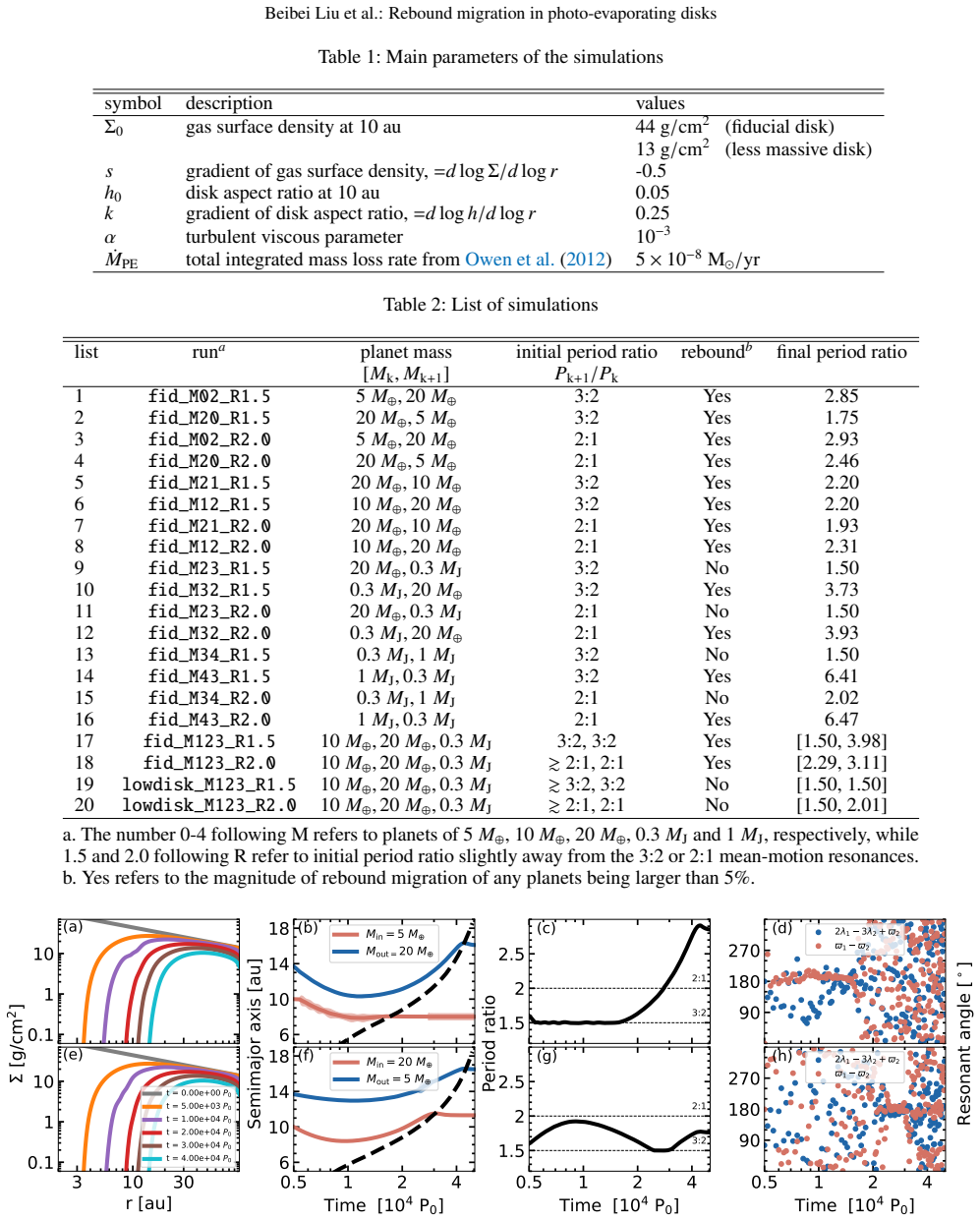
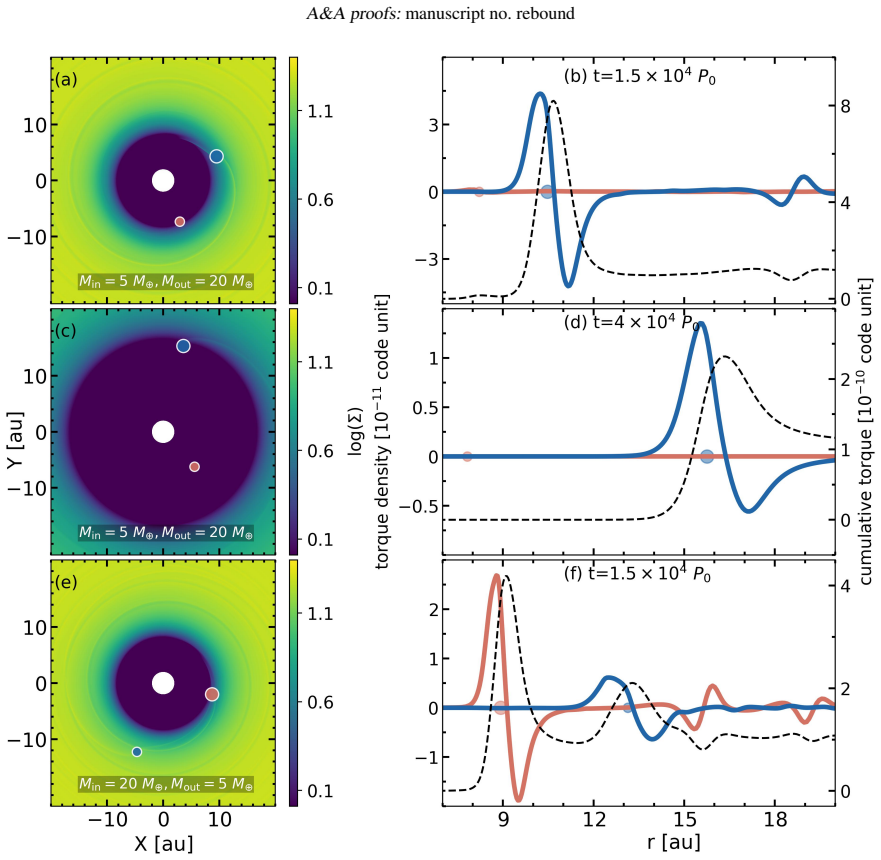
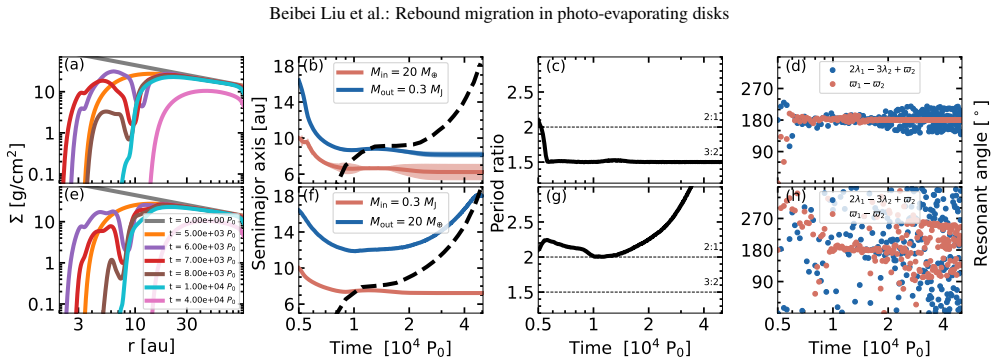
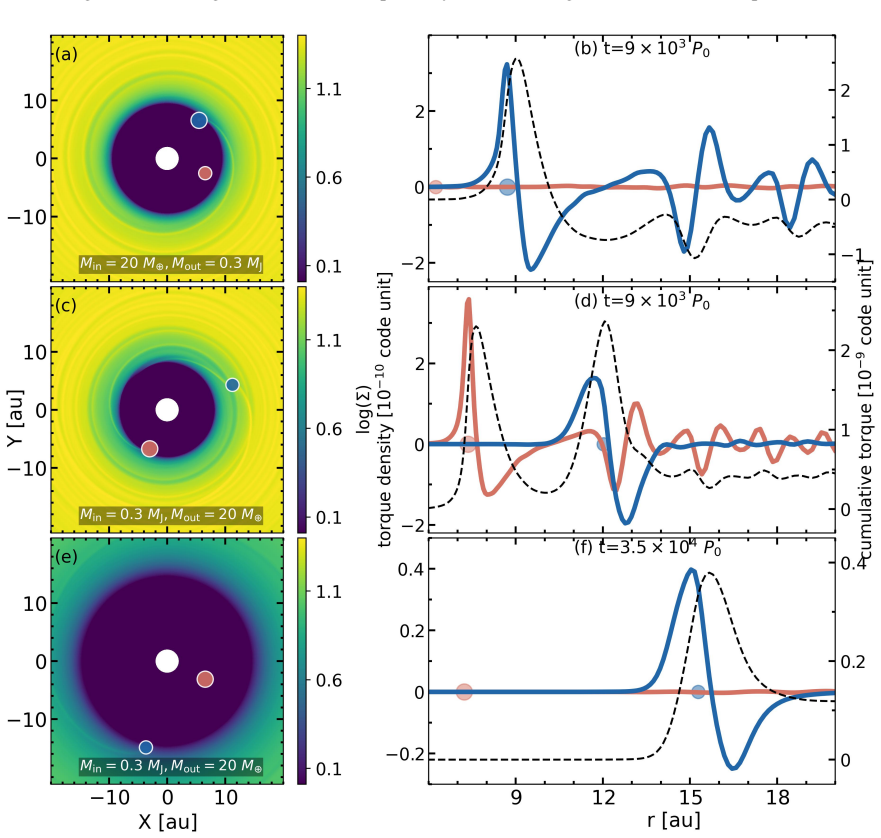
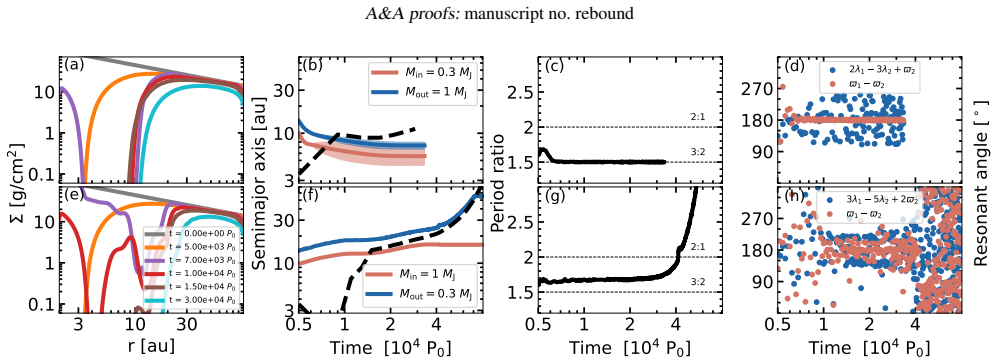
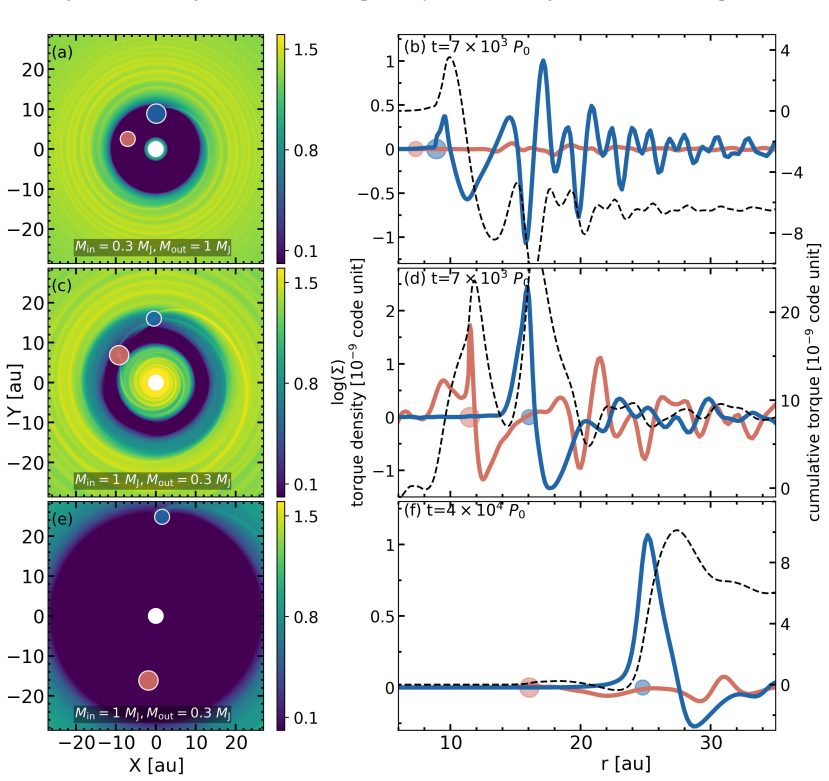
Rebound migration, driven by the positive corotation torque on the planet nearest the expanding cavity edge, produces divergent migration that breaks resonant configurations and widens period ratios in multi-planet systems; the effect strengthens with higher planet masses and slower disk dispersal timescales.
What carries the argument
The rebound outward migration mechanism triggered by the positive corotation torque on the planet near the expanding inner cavity edge.
If this is right
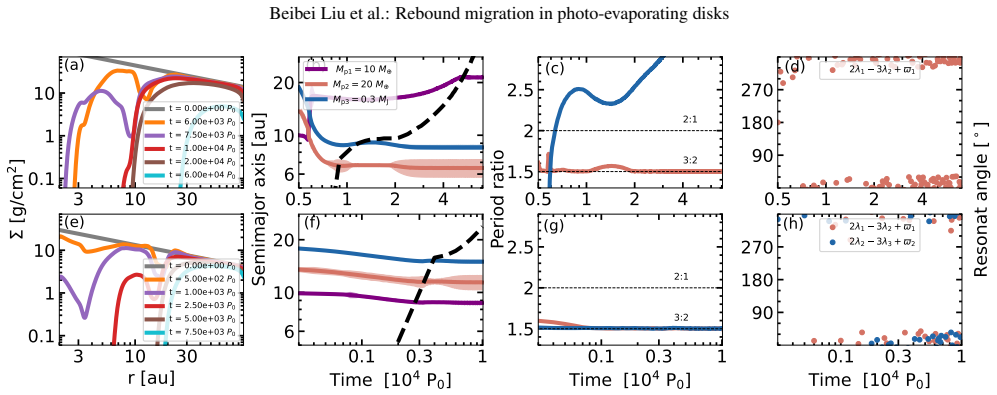
- Resonant chains can be disrupted into non-resonant orbits with larger period ratios during the final stages of disk clearing.
- Lower-mass planets and faster cavity expansion suppress the rebound effect and preserve resonances.
- The process supplies one pathway to the non-resonant, widely spaced architectures common among observed exoplanets.
Where Pith is reading between the lines
- The timing of resonance breaking may correlate with the stellar X-ray luminosity that controls photoevaporation rates.
- Systems that retain resonances could indicate disks that dispersed too quickly for rebound to act.
- The same torque imbalance might operate at other disk features, such as gaps opened by giant planets, producing similar architectural changes.
Load-bearing premise
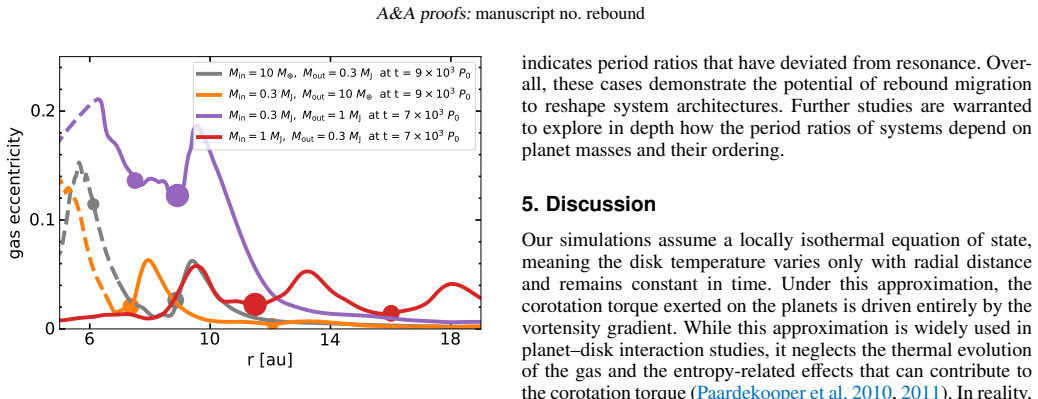
The two-dimensional hydrodynamical treatment with inside-out cavity expansion accurately reproduces the corotation torques and migration behavior that occur in three-dimensional disks.
What would settle it
Three-dimensional simulations of the same planet-disk setups that show no resonant breaking or no mass-dependent widening of period ratios would falsify the central claim.
Figures
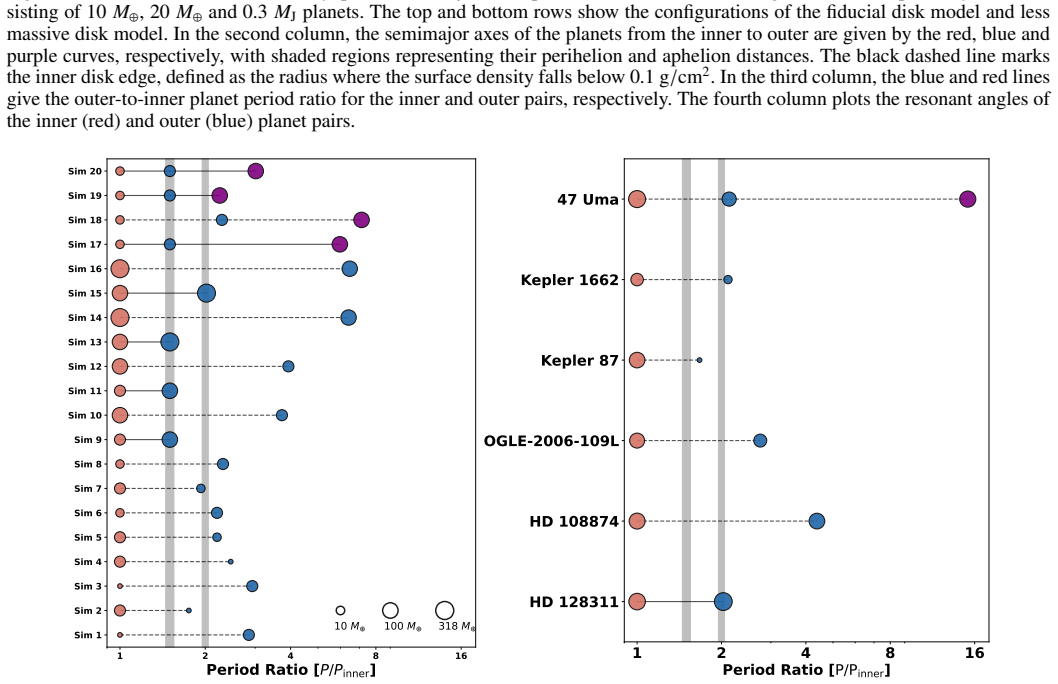
read the original abstract
This study extends the investigation of rebound outward migration to multi-planet systems near an inner expanding disk cavity driven by stellar X-ray photoevaporation. Using 2D hydrodynamical simulations, we explore how systems of two and three planets that span masses from super-Earths to Jupiters evolve as the disk disperses from the inside out. Our results show that rebound migration can substantially reshape multi-planet architectures in the final stages of disk clearing. Owing to the strong, positive corotation torque exerted onto the planet near the cavity edge, divergent migration of the neighbouring planets can break resonant configurations and trigger dynamical instabilities, producing non-resonant orbits with widened period ratios. However, the outcome depends critically on planet mass and the disk dispersal timescale. In lower-mass disks where cavity expansion is too rapid, rebound migration is suppressed, and systems tend to preserve resonant chains. These findings suggest that the rebound mechanism can provide a compelling pathway to explain the prevalence of widely separated, non-resonant architecture observed in the exoplanet population.
Editorial analysis
A structured set of objections, weighed in public.
Referee Report
Summary. The manuscript uses 2D hydrodynamical simulations to investigate rebound outward migration in two- and three-planet systems as an inner disk cavity expands due to stellar X-ray photoevaporation. It claims that the resulting positive corotation torque on the innermost planet drives divergent migration that breaks resonant chains, producing non-resonant orbits with widened period ratios; outcomes depend on planet mass (super-Earth to Jupiter) and disk dispersal timescale, with rapid dispersal suppressing rebound and preserving resonances. This is presented as a mechanism to explain the prevalence of widely separated, non-resonant exoplanet architectures.
Significance. If the 2D hydrodynamic results hold under more realistic conditions, the work identifies a late-stage dynamical process capable of reshaping resonant multi-planet systems into the non-resonant configurations observed in the exoplanet population. The direct numerical experiments generate falsifiable predictions tied to planet mass and dispersal timescale without circular fitting, extending prior rebound-migration studies to multi-planet cases.
major comments (2)
- [Abstract] Abstract: the central claim that rebound migration produces divergent migration and resonance breaking rests on the assumption of a strong positive corotation torque at the cavity edge in the adopted 2D hydrodynamical treatment with imposed inside-out expansion. In 3D disks with realistic thermodynamics, corotation torques depend on entropy gradients, vertical buoyancy, and horseshoe dynamics that are absent in 2D and can reverse or weaken the torque; without 3D benchmarks or resolution studies this assumption is load-bearing for the reported mass- and timescale-dependent outcomes.
- [Abstract] Abstract: the statement that outcomes depend critically on planet mass and disk dispersal timescale is presented without accompanying information on numerical resolution, torque convergence, or sensitivity to initial conditions. This omission leaves the qualitative distinction between resonance breaking and preservation unverified and undermines confidence in the mechanism's robustness.
Simulated Author's Rebuttal
We thank the referee for the constructive comments on our manuscript. We address each major comment point by point below and indicate where revisions will be made.
read point-by-point responses
-
Referee: Abstract: the central claim that rebound migration produces divergent migration and resonance breaking rests on the assumption of a strong positive corotation torque at the cavity edge in the adopted 2D hydrodynamical treatment with imposed inside-out expansion. In 3D disks with realistic thermodynamics, corotation torques depend on entropy gradients, vertical buoyancy, and horseshoe dynamics that are absent in 2D and can reverse or weaken the torque; without 3D benchmarks or resolution studies this assumption is load-bearing for the reported mass- and timescale-dependent outcomes.
Authors: We acknowledge that our simulations are performed in 2D and that 3D effects involving entropy gradients, vertical buoyancy, and horseshoe dynamics could alter the strength or sign of the corotation torque. The positive corotation torque at the cavity edge is a robust outcome of the 2D setup with inside-out dispersal used here, consistent with prior 2D studies. We will revise the abstract to explicitly note the 2D nature of the simulations and expand the discussion section to address potential 3D limitations and the value of future 3D work. Performing new 3D benchmarks is outside the scope of the present study. revision: partial
-
Referee: Abstract: the statement that outcomes depend critically on planet mass and disk dispersal timescale is presented without accompanying information on numerical resolution, torque convergence, or sensitivity to initial conditions. This omission leaves the qualitative distinction between resonance breaking and preservation unverified and undermines confidence in the mechanism's robustness.
Authors: Details on grid resolution, torque convergence tests, and sensitivity to initial conditions are provided in the Methods (Section 2) and Results (Section 3) sections. To address the concern about the abstract, we will add a concise statement noting that the mass- and timescale-dependent outcomes are based on converged torques and have been checked for robustness against variations in initial conditions. revision: yes
Circularity Check
No significant circularity in numerical hydrodynamical study
full rationale
The paper reports results from direct 2D hydrodynamical simulations governed by the standard hydrodynamic equations with imposed cavity expansion and initial planet configurations. Central claims about resonance breaking and divergent migration follow from the computed torques and orbital evolution in those runs, without analytic derivations, fitted parameters renamed as predictions, or load-bearing self-citations that reduce the outcomes to prior inputs. Self-citations to earlier rebound-migration work provide context but are not required to establish the new simulation results. This is a standard non-circular numerical experiment.
Axiom & Free-Parameter Ledger
free parameters (3)
- planet masses
- disk dispersal timescale
- initial disk surface density profile
axioms (2)
- standard math 2D hydrodynamical equations with standard torque prescriptions govern planet-disk interaction
- domain assumption Disk cavity expands from the inside out due to stellar X-ray photoevaporation
Reference graph
Works this paper leans on
-
[1]
2016, ApJ, 818, 152
Bai, X.-N., Ye, J., Goodman, J., & Yuan, F. 2016, ApJ, 818, 152
2016
-
[2]
2014, Protostars and Planets VI, 667
Baruteau, C., Crida, A., Paardekooper, S.-J., et al. 2014, Protostars and Planets VI, 667
2014
-
[3]
& Papaloizou, J
Baruteau, C. & Papaloizou, J. C. B. 2013, ApJ, 778, 7
2013
-
[4]
2018, ApJ, 864, L8
Brasser, R., Matsumura, S., Muto, T., & Ida, S. 2018, ApJ, 864, L8
2018
-
[5]
2024, AJ, 168, 239
Dai, F., Goldberg, M., Batygin, K., et al. 2024, AJ, 168, 239
2024
-
[6]
M., Muñoz, D
Dempsey, A. M., Muñoz, D. J., & Lithwick, Y . 2021, ApJ, 918, L36
2021
-
[7]
C., Lissauer, J
Fabrycky, D. C., Lissauer, J. J., Ragozzine, D., et al. 2014, ApJ, 790, 146
2014
-
[8]
& Sari, R
Goldreich, P. & Sari, R. 2003, ApJ, 585, 1024
2003
-
[9]
& Schlichting, H
Goldreich, P. & Schlichting, H. E. 2014, AJ, 147, 32
2014
-
[10]
Gorti, U., Hollenbach, D., & Dullemond, C. P. 2015, ApJ, 804, 29
2015
-
[11]
Hansen, B. M. S., Yu, T.-Y ., Nagarajan, N., & Hasegawa, Y . 2025, arXiv e-prints, arXiv:2510.01332
arXiv 2025
-
[12]
2025, ApJ, 995, 206
Hu, Z., Dai, F., Zhu, W., et al. 2025, ApJ, 995, 206
2025
-
[13]
Ida, S., Li, Y .-P., Pan, J.-P., Chen, Y .-X., & Lin, D. N. C. 2026, ApJ, 997, 160
2026
-
[14]
N., et al
Izidoro, A., Ogihara, M., Raymond, S. N., et al. 2017, MNRAS, 470, 1750
2017
-
[15]
C., & Johansen, A
Kajtazi, K., Petit, A. C., & Johansen, A. 2023, A&A, 669, A44
2023
-
[16]
& Nelson, R
Kley, W. & Nelson, R. P. 2012, ARA&A, 50, 211
2012
-
[17]
2026, arXiv e-prints, arXiv:2602.20525
Lin, L., Liu, B., Dai, F., et al. 2026, arXiv e-prints, arXiv:2602.20525
Pith/arXiv arXiv 2026
-
[18]
2025, A&A, 702, A161
Lin, L., Liu, B., & Zheng, Z. 2025, A&A, 702, A161
2025
-
[19]
2025, A&A, 702, A142
Liu, B., Baruteau, C., Zhu, Z., Li, Y .-P., & Paardekooper, S.-J. 2025, A&A, 702, A142
2025
-
[20]
& Ormel, C
Liu, B. & Ormel, C. W. 2017, A&A, 606, A66
2017
-
[21]
W., & Lin, D
Liu, B., Ormel, C. W., & Lin, D. N. C. 2017, A&A, 601, A15
2017
-
[22]
N., & Jacobson, S
Liu, B., Raymond, S. N., & Jacobson, S. A. 2022, Nature, 604, 643
2022
-
[23]
2010, A&A, 514, L4
Marzari, F., Baruteau, C., & Scholl, H. 2010, A&A, 514, L4
2010
-
[24]
& Snellgrove, M
Masset, F. & Snellgrove, M. 2001, MNRAS, 320, L55
2001
-
[25]
Masset, F. S. 2008, in EAS Publications Series, V ol. 29, EAS Publications Series, ed. M. J. Goupil & J. P. Zahn (EDP), 165–244
2008
-
[26]
S., Morbidelli, A., Crida, A., & Ferreira, J
Masset, F. S., Morbidelli, A., Crida, A., & Ferreira, J. 2006, ApJ, 642, 478
2006
-
[27]
J., & Ida, S
Ogihara, M., Duncan, M. J., & Ida, S. 2010, ApJ, 721, 1184
2010
-
[28]
E., Clarke, C
Owen, J. E., Clarke, C. J., & Ercolano, B. 2012, MNRAS, 422, 1880
2012
-
[29]
E., Ercolano, B., & Clarke, C
Owen, J. E., Ercolano, B., & Clarke, C. J. 2011, MNRAS, 412, 13
2011
-
[30]
2023, in Astronomical Society of the Pacific Conference Series, V ol
Paardekooper, S., Dong, R., Duffell, P., et al. 2023, in Astronomical Society of the Pacific Conference Series, V ol. 534, Protostars and Planets VII, ed. S. In- utsuka, Y . Aikawa, T. Muto, K. Tomida, & M. Tamura, 685
2023
-
[31]
2010, MNRAS, 401, 1950
Paardekooper, S.-J., Baruteau, C., Crida, A., & Kley, W. 2010, MNRAS, 401, 1950
2010
-
[32]
2011, MNRAS, 410, 293
Paardekooper, S.-J., Baruteau, C., & Kley, W. 2011, MNRAS, 410, 293
2011
-
[33]
2025, ApJ, 994, 33
Pan, M., Izidoro, A., & Shibata, S. 2025, ApJ, 994, 33
2025
-
[34]
Papaloizou, J. C. B. 2011, Celestial Mechanics and Dynamical Astronomy, 111, 83
2011
-
[35]
2023, in Astronomical Society of the Pacific Conference Series, V ol
Pascucci, I., Cabrit, S., Edwards, S., et al. 2023, in Astronomical Society of the Pacific Conference Series, V ol. 534, Protostars and Planets VII, ed. S. Inut- suka, Y . Aikawa, T. Muto, K. Tomida, & M. Tamura, 567
2023
-
[36]
2024, Nature Astronomy, 8, 1408
Pichierri, G., Morbidelli, A., Batygin, K., & Brasser, R. 2024, Nature Astronomy, 8, 1408
2024
-
[37]
Quillen, A. C. 2006, MNRAS, 365, 1367
2006
-
[38]
Lovelace, R. V . E. 2025, arXiv e-prints, arXiv:2507.15115
arXiv 2025
-
[39]
K., Ogihara, M., Morbidelli, A., Crida, A., & Guillot, T
Suzuki, T. K., Ogihara, M., Morbidelli, A., Crida, A., & Guillot, T. 2016, A&A, 596, A74
2016
-
[40]
& Ogilvie, G
Teyssandier, J. & Ogilvie, G. I. 2016, MNRAS, 458, 3221
2016
-
[41]
& Ogilvie, G
Teyssandier, J. & Ogilvie, G. I. 2017, MNRAS, 467, 4577
2017
-
[42]
2024, ApJ, 971, 5 Article number, page 10 of 10
Wu, Y ., Malhotra, R., & Lithwick, Y . 2024, ApJ, 971, 5 Article number, page 10 of 10
2024
discussion (0)
Sign in with ORCID, Apple, or X to comment. Anyone can read and Pith papers without signing in.