REVIEW 3 major objections 1 minor 24 references
Rethinking Fractional Programming for Joint Uplink Scheduling and Power Control in Multicell Wireless Networks
T0 review · 3 major / 1 minor · reviewed 2026-07-03 · grok-4.3
Pith's one-line read A reciprocal-inversion transform produces a tighter lower bound on the log-rate function than the Lagrangian dual transform, enabling a surrogate-enhanced fractional programming algorithm with closed-form updates for multicell uplink schedu
desk verdict RIT tightens the surrogate for log-rate in FP but the abstract gives no proof that this yields better stationary points after discrete re-optimization. read the letter →
The pith
A machine-rendered reading of the paper's core claim, the machinery that carries it, and where it could break.
The reading
What carries the argument
The reciprocal-inversion transform (RIT), which replaces the reciprocal-coordinate construction of the Lagrangian dual transform to obtain a tighter minorization of the log-rate function and remains compatible with the quadratic transform.
What would settle it
Run the SEFP and classical FP algorithms on the same multicell network instances with identical utility weights; if the weighted sum rates achieved by SEFP are never higher than those of classical FP across repeated trials, the claim that the RIT yields a practically superior surrogate would be falsified.
Extended reading notes
Core claim
The paper claims that the reciprocal-inversion transform constructs a tighter first-order Taylor expansion lower bound for the logarithmic rate function than the Lagrangian dual transform, and that this tighter bound, when combined with the quadratic transform, produces a surrogate-enhanced fractional programming algorithm whose iterates achieve higher weighted sum rates than the classical fractional programming method while retaining per-cell separability and closed-form updates for scheduling decisions and transmit powers.
Load-bearing premise
The reciprocal-inversion transform produces a strictly tighter first-order Taylor lower bound than the Lagrangian dual transform for the logarithmic rate function, and this tightness translates into measurably better optimization outcomes.
Editorial extensions
If this is right
- The SEFP algorithm retains per-cell separability of the optimization problem.
- All auxiliary variables, scheduling decisions, and transmit powers admit closed-form updates at each iteration.
- The method applies to different network utilities while preserving the same algorithmic structure.
- The approach extends the classical FP framework without sacrificing its computational advantages.
Reading between the lines
- The same RIT construction could be tested on downlink power control or beamforming problems that also rely on log-rate minorization.
- If the tightness gain persists in larger networks, the method might reduce the number of outer iterations needed for convergence.
- The per-cell separability suggests straightforward parallel implementation across cells in a distributed setting.
Signed reviews
Editorial analysis
A structured set of objections, weighed in public.
Referee Report
Summary. The paper considers the weighted sum-rate maximization problem for joint uplink scheduling and power control in a multicell network with single-antenna BSs and users, where at most one user per cell is active. It revisits the Lagrangian dual transform (LDT) of classical fractional programming from a minorization-maximization viewpoint, identifies its surrogate as conservative due to the reciprocal-coordinate construction, and introduces a reciprocal-inversion transform (RIT) claimed to yield a strictly tighter first-order Taylor lower bound on the logarithmic rate. The RIT is combined with the quadratic transform to produce the surrogate-enhanced FP (SEFP) algorithm, which is asserted to retain per-cell separability and closed-form updates while delivering consistent outperformance over classical FP and other baselines across different network utilities.
Significance. A rigorously validated tighter surrogate that improves fixed-point quality in the mixed discrete-continuous setting would be a useful incremental advance for FP-based resource allocation methods. The retention of closed-form per-cell updates is a practical strength that would facilitate distributed implementation if the performance gains hold.
major comments (3)
- [Abstract] Abstract: the claim that RIT produces a strictly tighter first-order Taylor lower bound than LDT and that this tightness translates into measurably better optimization outcomes is load-bearing for the central contribution, yet the abstract supplies neither the explicit functional form of the RIT surrogate nor a direct comparison (e.g., via the difference in the two lower bounds at a fixed auxiliary point) that would allow verification of strict improvement.
- [Abstract] Abstract: even if the pointwise minorizer is tighter, the SEFP iteration alternates between continuous power variables and discrete scheduling indicators; no argument is given that the composite map is monotonic with respect to the original WSR objective or that a locally tighter surrogate produces a stationary point with smaller optimality gap once the discrete decisions are re-optimized.
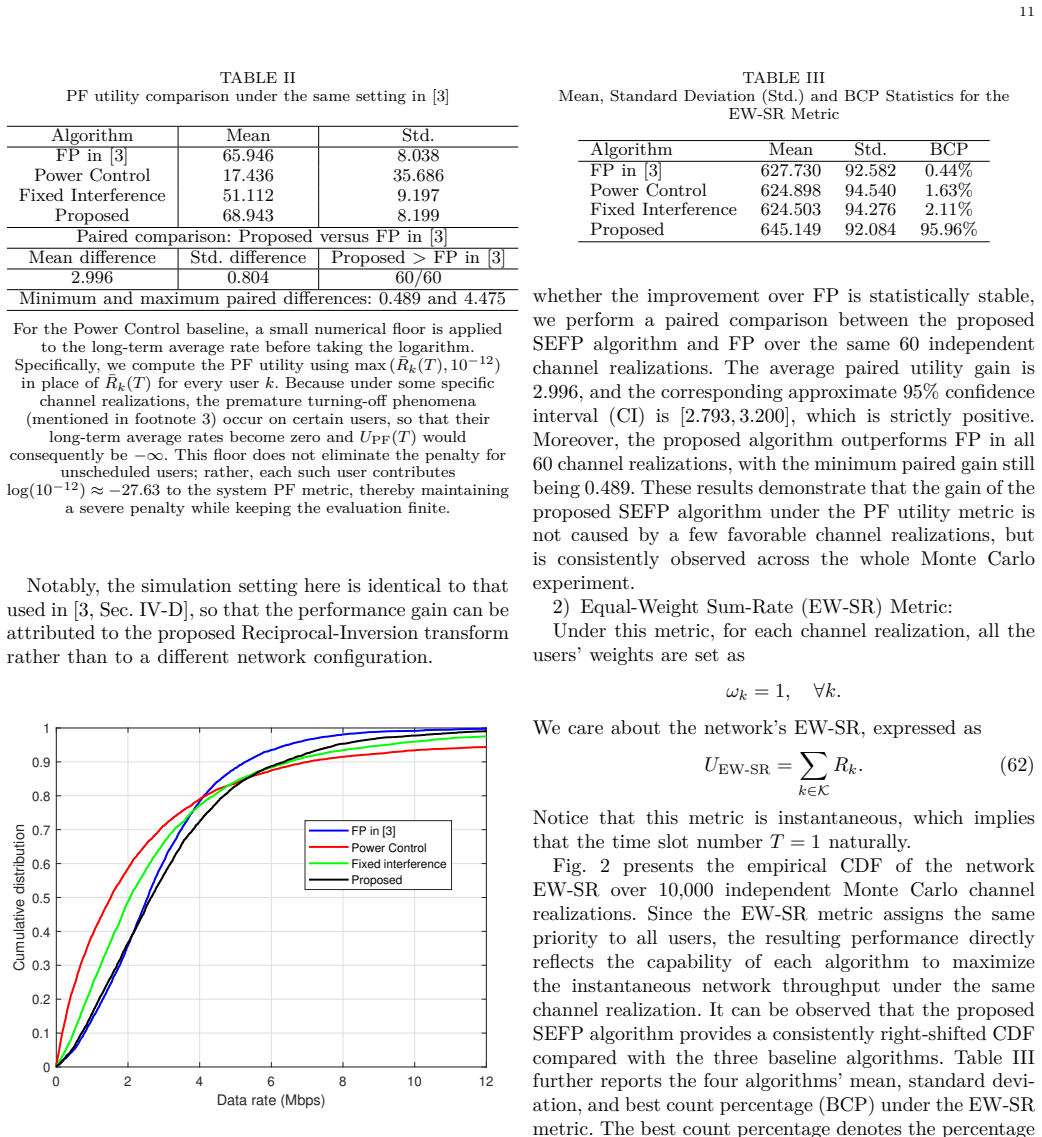
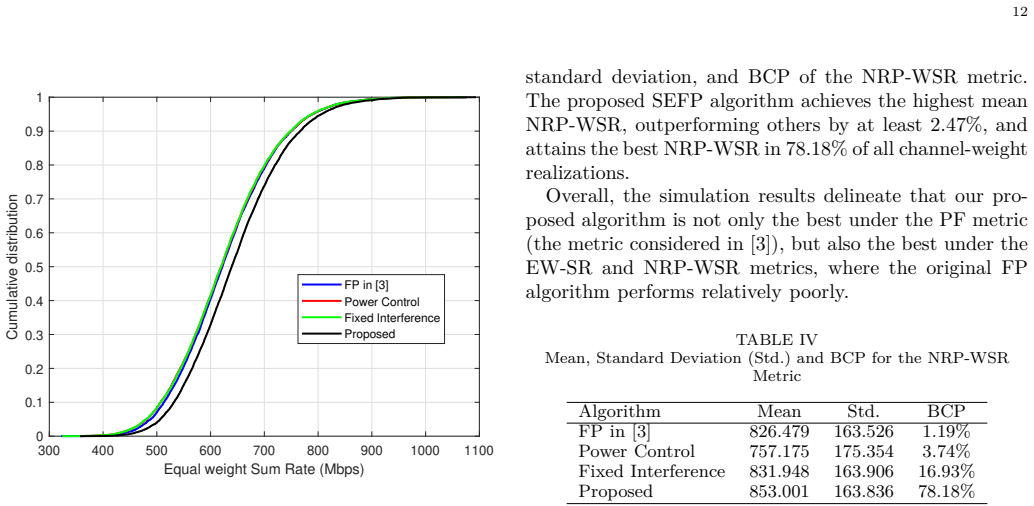
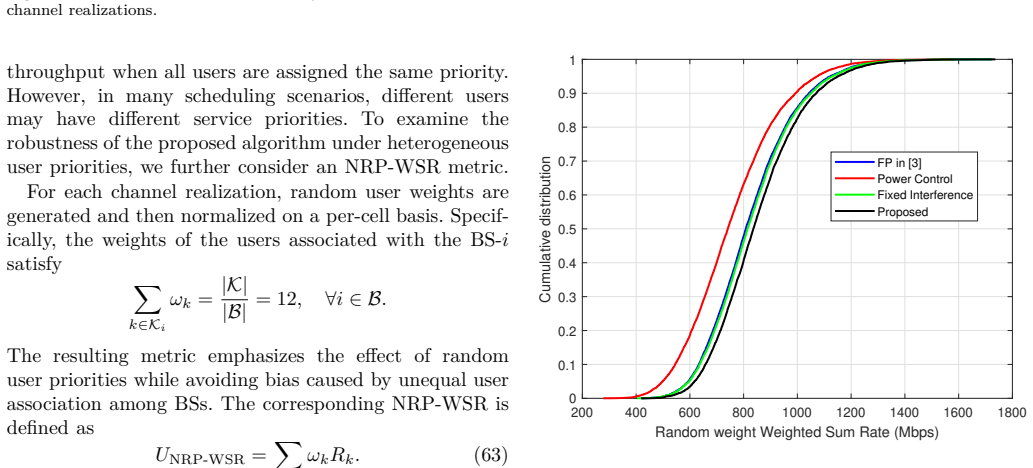
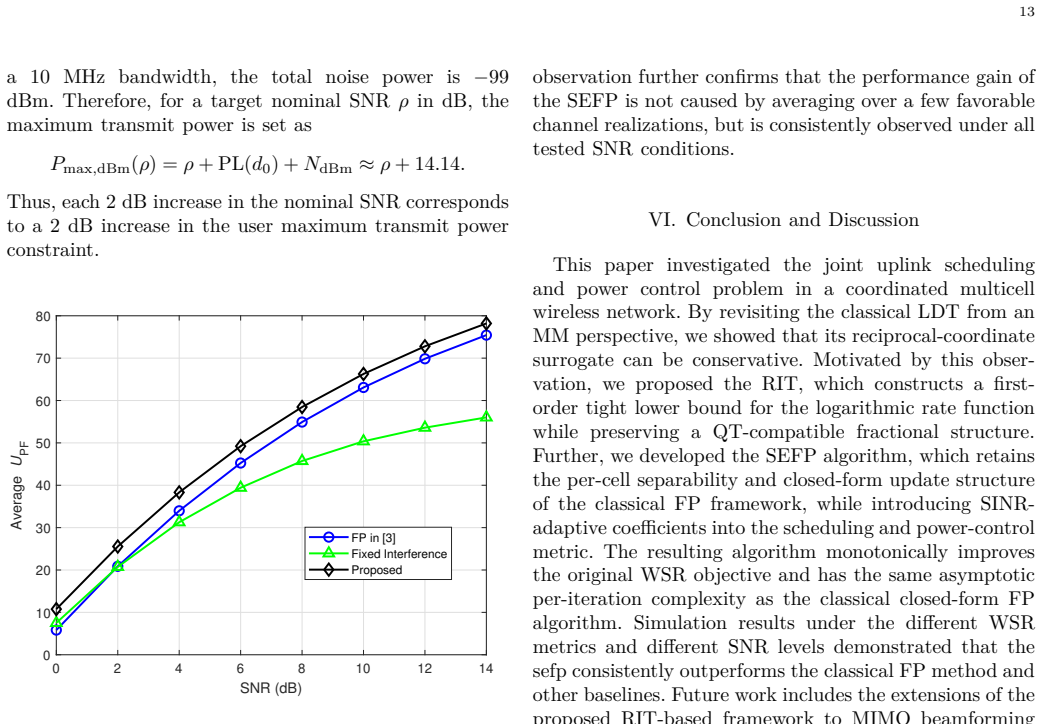
- [Abstract] Abstract: the assertion of “consistent” outperformance across utilities rests entirely on unreviewed simulation evidence; the abstract provides no information on the number of Monte-Carlo realizations, confidence intervals, or the precise network parameters (cell radius, path-loss model, noise variance) used to generate the reported gains.
minor comments (1)
- [Abstract] The phrase “somehow conservative” used to characterize the LDT surrogate is imprecise; a quantitative measure (e.g., the gap between the surrogate and the true rate at the fixed point of the auxiliary-variable update) would clarify the motivation.
Simulated Author's Rebuttal
We thank the referee for the constructive feedback on the abstract. We will revise the manuscript to improve clarity on the RIT surrogate and simulation details while providing additional discussion on convergence aspects. Point-by-point responses follow.
read point-by-point responses
-
Referee: [Abstract] Abstract: the claim that RIT produces a strictly tighter first-order Taylor lower bound than LDT and that this tightness translates into measurably better optimization outcomes is load-bearing for the central contribution, yet the abstract supplies neither the explicit functional form of the RIT surrogate nor a direct comparison (e.g., via the difference in the two lower bounds at a fixed auxiliary point) that would allow verification of strict improvement.
Authors: We agree that the abstract should be more self-contained. In the revision we will insert the explicit RIT surrogate expression (the inversion-based first-order lower bound on the log-rate) and state that its difference from the LDT bound is nonnegative and strictly positive except at the fixed point, referencing the proof in Proposition 1. This addition keeps the abstract concise while enabling direct verification of the claimed tightness. revision: yes
-
Referee: [Abstract] Abstract: even if the pointwise minorizer is tighter, the SEFP iteration alternates between continuous power variables and discrete scheduling indicators; no argument is given that the composite map is monotonic with respect to the original WSR objective or that a locally tighter surrogate produces a stationary point with smaller optimality gap once the discrete decisions are re-optimized.
Authors: The observation is correct: the paper does not supply a formal proof that the alternating composite map is monotonic in the original WSR or that the tighter surrogate necessarily yields a stationary point with smaller optimality gap after discrete re-optimization. Each subproblem is solved exactly for the current surrogate, but the mixed discrete-continuous nature precludes a simple monotonicity guarantee. We will add a clarifying paragraph in Section IV noting this limitation and emphasizing that the reported gains are empirical; no stronger theoretical claim will be made. revision: partial
-
Referee: [Abstract] Abstract: the assertion of “consistent” outperformance across utilities rests entirely on unreviewed simulation evidence; the abstract provides no information on the number of Monte-Carlo realizations, confidence intervals, or the precise network parameters (cell radius, path-loss model, noise variance) used to generate the reported gains.
Authors: We accept the criticism. The revised abstract will state that results are averaged over 1000 Monte-Carlo trials with error bars indicating one standard deviation, and will briefly list the key parameters (500 m cell radius, 3GPP urban path-loss, noise spectral density -174 dBm/Hz). The complete simulation setup already appears in Section V-A; the abstract change will simply reference it. revision: yes
Circularity Check
No significant circularity detected in derivation chain
full rationale
The paper constructs the RIT explicitly as a new first-order Taylor lower bound motivated by an MM re-examination of the LDT's reciprocal form, then combines it with the QT to obtain the SEFP updates. This is a direct constructive proposal whose claimed tightness is asserted by the explicit form of the new surrogate rather than by any reduction to fitted parameters, self-referential definitions, or load-bearing self-citations. The per-cell separability and closed-form property follow from algebraic compatibility with the QT and do not presuppose the target performance outcome. No step in the abstract reduces the claimed improvement to an input by construction; the outperformance is presented as an empirical observation.
Assumptions & free parameters
assumptions (1)
- domain assumption At most one single-antenna user accesses the single-antenna base station per cell simultaneously.
Cite this review
Pith. "Pith review of Rethinking Fractional Programming for Joint Uplink Scheduling and Power Control in Multicell Wireless Networks." pith.science (2026). https://pith.science/paper/VDSUEH45
@misc{pith2026260701769,
  author       = {Pith},
  title        = {Pith review of: Rethinking Fractional Programming for Joint Uplink Scheduling and Power Control in Multicell Wireless Networks},
  year         = {2026},
  howpublished = {\url{https://pith.science/paper/VDSUEH45}},
  note         = {Machine review of arXiv:2607.01769}
}
read the original abstract
This paper investigates the joint uplink scheduling and power control problem in a coordinated multicell wireless network, where at most one single-antenna user is allowed to access the single-antenna base station in each cell simultaneously. The resulting weighted sum-rate (WSR) maximization problem is a mixed discrete-continuous, nonconvex optimization problem that is notoriously difficult to solve directly. Classical fractional programming (FP) methods tackle this problem by leveraging the Lagrangian dual transform (LDT) followed by the quadratic transform (QT), yielding a tractable closed-form solution for scheduling and power control, with the LDT playing a crucial role in handling discrete variables. In this paper, we revisit the LDT from a minorization-maximization (MM) perspective and observe that its induced surrogate is somehow conservative due to the reciprocal-coordinate construction. Motivated by this observation, we propose a novel reciprocal-inversion transform (RIT) that constructs a tighter first-order Taylor expansion lower bound for the logarithmic rate function. The proposed RIT remains fully compatible with the QT, leading to a surrogate-enhanced FP (SEFP) algorithm for joint uplink scheduling and power control. The proposed SEFP algorithm retains the desirable per-cell separability of the classical FP framework and admits closed-form updates for the auxiliary variables, scheduling decisions, and transmit powers. Simulation results demonstrate that the SEFP algorithm consistently outperforms the classical FP method and other baselines for different network utilities.
Figures
Figures from the paper (1 more)
Reference graph
Works this paper leans on
-
[1]
Rate Scaling Laws in Multicell Networks Under Distributed Power Control and User Schedul- ing,
D. Gesbert and M. Kountouris, “Rate Scaling Laws in Multicell Networks Under Distributed Power Control and User Schedul- ing,” IEEE Trans. Inf. Theory, vol. 57, no. 1, pp. 234–244, Jan. 2011
work page 2011
-
[2]
D. Gesbert, S. G. Kiani, A. Gjendemsjo and G. E. Oien, “Adap- tation, Coordination, and Distributed Resource Allocation in Interference-Limited Wireless Networks,” Proceedings of the IEEE, vol. 95, no. 12, pp. 2393-2409, Dec. 2007
work page 2007
-
[3]
Fractional Programming for Communica- tion Systems—Part II: Uplink Scheduling via Matching,
K. Shen and W. Yu, “Fractional Programming for Communica- tion Systems—Part II: Uplink Scheduling via Matching,” IEEE Trans. Signal Process., vol. 66, no. 10, pp. 2631-2644, May 2018
work page 2018
-
[4]
Multicell Coordination via Joint Scheduling, Beamforming, and Power Spectrum Adaptation,
W. Yu, T. Kwon, and C. Shin, “Multicell Coordination via Joint Scheduling, Beamforming, and Power Spectrum Adaptation,” IEEE Trans. Wireless Commun., vol. 12, no. 7, pp. 3300–3313, Jul. 2013
work page 2013
-
[5]
S-MAPEL: Monotonic opti- mization for non-convex joint power control and scheduling problems,
L. P. Qian and Y. J. Zhang, “S-MAPEL: Monotonic opti- mization for non-convex joint power control and scheduling problems,” IEEE Trans. Wireless Commun., vol. 9, no. 5, pp. 1708-1719, May 2010
work page 2010
-
[6]
Joint network-wide oppor- tunistic scheduling and power control in multi-cell networks,
J. -w. Cho, J. Mo and S. Chong, “Joint network-wide oppor- tunistic scheduling and power control in multi-cell networks,” IEEE Trans. Wireless Commun., vol. 8, no. 3, pp. 1520-1531, March 2009
work page 2009
-
[7]
Joint scheduling and power control for wireless ad hoc networks,
T. ElBatt and A. Ephremides, “Joint scheduling and power control for wireless ad hoc networks,” IEEE Trans. Wireless Commun., vol. 3, no. 1, pp. 74-85, Jan. 2004
work page 2004
-
[8]
Fast algorithms for joint power control and scheduling in wireless networks,
L. Fu, S. C. Liew and J. Huang, “Fast algorithms for joint power control and scheduling in wireless networks,” IEEE Trans. Wireless Commun., vol. 9, no. 3, pp. 1186-1197, March 2010
work page 2010
Show all 24 references
-
[9]
Energy-Efficient Joint Scheduling and Power Control in Multi-Cell Wireless Networks,
S. Lahoud, K. Khawam, S. Martin, G. Feng, Z. Liang, and J. Nasreddine, “Energy-Efficient Joint Scheduling and Power Control in Multi-Cell Wireless Networks,” IEEE J. Sel. Areas Commun., vol. 34, no. 12, pp. 3409–3426, Dec. 2016. 15
2016
-
[10]
LORM: Learning to Optimize for Resource Management in Wireless Networks With Few Training Samples,
Y. Shen, Y. Shi, J. Zhang and K. B. Letaief, “LORM: Learning to Optimize for Resource Management in Wireless Networks With Few Training Samples,” IEEE Trans. Wireless Commun., vol. 19, no. 1, pp. 665-679, Jan. 2020
2020
-
[11]
Bounded Deep Unfolding for Joint Beamforming and Scheduling in Multi- Cell MIMO Networks,
J. Li, S. Chai, F. Xu, K. Shen, G. Zhu, and J. Chen, “Bounded Deep Unfolding for Joint Beamforming and Scheduling in Multi- Cell MIMO Networks,” arXiv preprint arXiv:2606.05246, Jun. 2026
2026 arXiv
-
[12]
Joint User Scheduling and Beamforming Design for Multiuser MISO Downlink Systems,
S. He, J. Yuan, Z. An, W. Huang, Y. Huang and Y. Zhang, “Joint User Scheduling and Beamforming Design for Multiuser MISO Downlink Systems,” IEEE Trans. Wireless Commun., vol. 22, no. 5, pp. 2975-2988, May 2023
2023
-
[13]
Fractional Programming for Communica- tion Systems—Part I: Power Control and Beamforming,
K. Shen and W. Yu, “Fractional Programming for Communica- tion Systems—Part I: Power Control and Beamforming,” IEEE Trans. Signal Process., vol. 66, no. 10, pp. 2616-2630, May 2018
2018
-
[14]
K. Shen, W. Yu, L. Zhao and D. P. Palomar, ”Optimiza- tion of MIMO Device-to-Device Networks via Matrix Frac- tional Programming: A Minorization–Maximization Approach,” IEEE/ACM Trans. Netw., vol. 27, no. 5, pp. 2164-2177, Oct. 2019
2019
-
[16]
Weighted sum-rate maximization using weighted MMSE for MIMO-BC beamforming design,
S. S. Christensen, R. Argawal, E. de Carvalho, and J. M. Cioffi, “Weighted sum-rate maximization using weighted MMSE for MIMO-BC beamforming design,” IEEE Trans. Wireless Commun., vol. 7, no. 12, pp. 1–7, Dec. 2008
2008
-
[17]
An Iteratively Weighted MMSE Approach to Distributed Sum-Utility Max- imization for a MIMO Interfering Broadcast Channel,
Q. Shi, M. Razaviyayn, Z. -Q. Luo and C. He, “An Iteratively Weighted MMSE Approach to Distributed Sum-Utility Max- imization for a MIMO Interfering Broadcast Channel,” IEEE Trans. Signal Process., vol. 59, no. 9, pp. 4331-4340, Sept. 2011
2011
-
[18]
Discerning and enhancing the weighted sum-rate max- imization algorithms in communications,
Z. Zhang, Z. Zhao, K. Shen, D. P. Palomar, and W. Yu, “Discerning and enhancing the weighted sum-rate max- imization algorithms in communications,” arXiv preprint., arXiv:2311.04546, 2023
2023
-
[19]
Majorization- minimization algorithms in signal processing, communications, and machine learning,
Y. Sun, P. Babu, and D. P. Palomar, “Majorization- minimization algorithms in signal processing, communications, and machine learning,” IEEE Trans. Signal Process., vol. 65, no. 3, pp. 794–816, 2016
2016
-
[20]
A learning-to-unfold approach to fractional programming for massive MIMO beamforming,
Z. Jiao, X. Yi, and S. Jin, “A learning-to-unfold approach to fractional programming for massive MIMO beamforming,” in Proc. IEEE Int. Symp. Inf. Theory (ISIT), 2026
2026
-
[21]
Optimiza- tion of MIMO Device-to-Device Networks via Matrix Frac- tional Programming: A Minorization–Maximization Approach,
K. Shen, W. Yu, L. Zhao and D. P. Palomar, “Optimiza- tion of MIMO Device-to-Device Networks via Matrix Frac- tional Programming: A Minorization–Maximization Approach,” IEEE/ACM Trans. Netw., vol. 27, no. 5, pp. 2164-2177, Oct. 2019
2019
-
[22]
Accelerating Quadratic Transform and WMMSE,
K. Shen, Z. Zhao, Y. Chen, Z. Zhang and H. Victor Cheng, “Accelerating Quadratic Transform and WMMSE,” IEEE J. Sel. Areas Commun., vol. 42, no. 11, pp. 3110-3124, Nov. 2024
2024
-
[23]
DeepFP: Deep-Unfolded Fractional Programming for MIMO Beamform- ing,
J. Zhu, T. -H. Chang, L. Xiang and K. Shen, “DeepFP: Deep-Unfolded Fractional Programming for MIMO Beamform- ing,” in IEEE Trans. Commun., early access, Jan. 2026, doi: 10.1109/TCOMM.2026.3653777
2026 doi
-
[24]
Fast Fractional Programming for Multi-Cell Integrated Sensing and Communi- cations,
Y. Chen, Y. Feng, X. Li, L. Zhao and K. Shen, “Fast Fractional Programming for Multi-Cell Integrated Sensing and Communi- cations,” IEEE Trans. Wireless Commun., vol. 24, no. 8, pp. 6797-6812, Aug. 2025
2025
-
[25]
Fractional Programming for Stochastic Precoding over Generalized Fading Channels,
W. Wang and K. Shen, “Fractional Programming for Stochastic Precoding over Generalized Fading Channels,” IEEE Trans. Signal Process., vol. 74, pp. 1414 - 1427, Mar. 2026
2026
Reviewed July 3, 2026 · model on record in the stance chip above.
Discussion (0). Continue with ORCID to comment.