REVIEW 3 major objections 5 minor 65 references
BridgeVLA++: A Data-Efficient, Generalizable, and Memory-Augmented Vision-Language-Action Framework for 3D Manipulation
T0 review · 3 major / 5 minor · reviewed 2026-08-06 · deepseek-v4-flash
Pith's one-line read A spatio-temporal memory module lets a heatmap-based 3D robot policy solve memory-dependent tasks near perfectly, without losing data efficiency or generalization.
desk verdict A strong engineering extension with a real confound in the RMBench comparison: the temporal-memory ablation removes the privileged sub-goal gate along with the memory, so MemoryBench is the clean validation. read the letter →
The pith
A machine-rendered reading of the paper's core claim, the machinery that carries it, and where it could break.
The reading
What carries the argument
The carrying object is the memory-conditioned token interface built on BridgeVLA's input–output alignment: point clouds are rendered into three orthographic views, the pre-trained PaliGemma VLM produces image tokens, and actions are decoded from 2D heatmaps via convex upsampling. Memory is stored as visual tokens rather than raw images: the temporal buffer caches coarse-stage tokens from the initial anchor, neighboring keyframes, and adaptive sub-goal keyframes, and a compact cross-attention module fuses them into the current coarse representation; the spatial memory keeps the initial colored point cloud and re-renders and re-encodes it under each predicted coarse waypoint so that current fine-stage tokens attend to their view-aligned, less-occluded counterparts. The adaptive sub-goal selection gate, trained with per-segment language labels on RMBench, decides which keyframes are retained as sub-goal evidence.
What would settle it
Run the RMBench experiment with the sub-goal gate trained without per-segment language annotations, for example using a self-supervised novelty score or random retention, while keeping the temporal memory mechanism identical; if the score drops far below 96% toward the 21.3% no-temporal-memory ablation, the gate's supervision, not the memory, is the load-bearing part.
Extended reading notes
Core claim
The central claim is that an explicit scene-level memory, split into temporal and spatial components and injected into the coarse and fine stages of a heatmap-based 3D VLA, lets the policy track completed sub-goals and recover occluded target geometry. The temporal memory (initial anchor views, the two most recent keyframes, and gated sub-goal keyframes) conditions the coarse-stage tokens through cross-attention, determining what to do next; the spatial memory re-renders the initial point cloud under the same zoom as the current fine-stage crop and cross-attends view-aligned tokens, determining where exactly to act. The memory modules add about 270M parameters (9.2% of the 2.92B backbone) and keep the heatmap action interface unchanged. The evidence is that removing temporal memory collapses RMBench success from 96.0% to 21.3%, near the 18.9% of the memory-free base, while removing spatial memory only slightly affects precision-heavy RLBench tasks such as Sort Shape.
Load-bearing premise
The claim that temporal memory, rather than the extra language supervision used to train the sub-goal selector, is the decisive component on RMBench rests on assuming that this supervision did not secretly carry the result.
Editorial extensions
If this is right
- A keyframe-based 3D VLA can handle tasks that require counting, trial-and-error tracking, and uncovering actions, not just current-frame perception.
- The memory extension is additive: on RLBench, COLOSSEUM, and GemBench, BridgeVLA++ matches or slightly exceeds the memory-free BridgeVLA, so episodic memory does not trade away data efficiency or out-of-distribution generalization.
- Bimanual tasks can share one memory and backbone, with only arm-specific action heads duplicated, which keeps the memory-dependent bimanual extension computationally cheap.
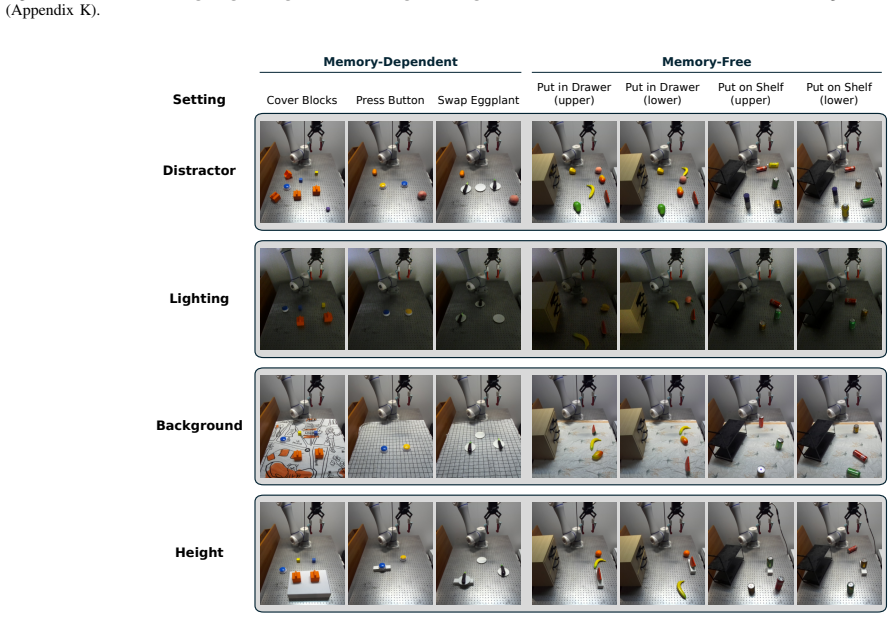
- Real robots can learn memory-dependent tasks from ten demonstrations per instruction and keep near-perfect basic success across distractors, background changes, height, and lighting.
- The token-space memory injection leaves the heatmap action interface unchanged, so the same memory design can be carried over to other heatmap-based action decoders without retraining the backbone interface.
Reading between the lines
- I infer that the temporal memory architecture would generalize to cross-episode or lifelong learning, because the token-space memory injection is agnostic to timescale and only needs the memory buffer to persist across episodes.
- The paper's own future-work note suggests that replacing the annotation-dependent sub-goal gate with a self-supervised one is the main barrier to applying the same memory design to benchmarks without per-segment language labels.
- A testable extension is to run BridgeVLA++ on RMBench with the gate supervised by a learned novelty score instead of language-derived labels; if performance holds, the memory mechanism, not the privileged supervision, is the decisive component.
Editorial analysis
A structured set of objections, weighed in public.
Referee Report
Summary. The manuscript extends the authors' earlier BridgeVLA framework with a unified spatio-temporal memory for 3D vision-language-action manipulation. BridgeVLA itself projects point clouds into multi-view orthographic images and predicts 2D heatmaps before translating them into 3D end-effector poses, preserving the input--output alignment of a pre-trained VLM. BridgeVLA++ adds a coarse-stage temporal memory (initial anchor views, recent neighboring keyframes, and adaptively selected sub-goal keyframes) to determine what to do next, and a fine-stage spatial memory that re-renders the initial scene point cloud under the current zoom to recover occluded geometry for precise localization. The paper evaluates the framework on RLBench, COLOSSEUM, GemBench, RMBench, MemoryBench, and two real-robot platforms, claiming state-of-the-art results on the two memory-dependent benchmarks while preserving the data efficiency and out-of-distribution generalization of the base model. Extensive ablations, per-task tables, and implementation details are provided in the main text and appendices.
Significance. If the claims hold, the paper makes a solid contribution: a lightweight memory mechanism (269.77M parameters, 9.2% of the backbone) that plugs into an existing 3D VLA without changing its action interface, a natural bimanual extension, and strong empirical results across simulation and real hardware. The paper is unusually complete in its reporting: per-task success rates, ablation configurations, training schedules, and latency figures are all given. The internal ablations are consistent with the proposed mechanism: removing heatmap decoding collapses RLBench (90.5% to 31.4%, Table I), removing temporal memory collapses RMBench (96.0% to 21.3%, Table XVII), and MemoryBench shows large gains over the memory-free base without using sub-goal annotations. The MemoryBench and real-world memory results are not affected by the main confound I raise below and provide genuine evidence for the memory architecture. However, the headline 'state-of-the-art on two memory-dependent benchmarks' is weakened by a confound in the RMBench experiment and by the best-checkpoint selection protocol, so the central claim needs additional experimental support before it can be fully credited.
major comments (3)
- [Sec. V-C, Table II, Appendix D-b, Table XVII] The claim that temporal memory is 'indispensable' on RMBench is not cleanly supported, because the w/oT ablation removes both the temporal memory and the adaptive sub-goal selection module, whose training on RMBench uses per-segment language annotations (Appendix D-b). These annotations constitute privileged task-progress and segmentation information that baselines such as MemoryW AM do not receive. The collapse from 96.0% to 21.3% therefore conflates the memory mechanism with the privileged sub-goal supervision. To isolate the memory contribution, please provide an additional ablation on RMBench in which the gate is trained without the per-segment labels (e.g., a heuristic or self-supervised selection rule, or random keyframe sampling), or report a variant that keeps the neighboring-keyframe memory and anchor views but disables the sub-goal gate entirely. Without such an experiment, the 96.0% result cannot be attributed to temporal memory alone.
- [Appendix E-d] The RMBench numbers in Tables II and XVII are obtained by training one model per task and selecting the best-performing checkpoint of that task's training run. This protocol can substantially inflate reported success rates, and the paper does not state whether the quoted baselines (MemoryW AM, Mem-0, etc.) follow the same selection procedure. Please clarify the checkpoint-selection protocol for all methods and, ideally, report results for a fixed checkpoint (e.g., final epoch or a validation-selected single checkpoint) or the mean over checkpoints. Without this, the 13-point margin over MemoryW AM could be an artifact of favorable checkpoint selection.
- [Abstract and Sec. V-C] Because of the two issues above, the paper's headline claim that BridgeVLA++ 'achieves state-of-the-art results on two challenging memory-dependent manipulation benchmarks' overstates the evidence. The MemoryBench result (99.7% vs. 94.3% for SAM2Act+, Table XII) is clean and supports a more qualified claim, as does the real-world Dobot evaluation. Please temper the abstract and conclusion to reflect that the RMBench comparison is currently confounded, or strengthen the analysis as requested in the previous comments, so that the stated claim matches the experimental support.
minor comments (5)
- [Table II] The grouping of the nine tasks under the 'M(1) tasks' and 'M(n) tasks' headers is visually confusing because the column headers span two levels without a clear separator; consider splitting the table or using a merged-header layout.
- [Sec. IV-D and Appendix F] The parameter counts are reported as 'approximately 168M and 84M' for the temporal and spatial memory modules in the main text, while Appendix F gives 83.95M per block and 17.91M for the gate. These numbers are consistent arithmetically but should be reconciled explicitly to avoid the appearance of inconsistency.
- [Appendix D-b] The description of the sub-goal labels says positives cover 9--15% of keyframes depending on the task; it would be helpful to state the per-task positive fractions in a small table or figure, since this directly determines how informative the privileged supervision is.
- [Sec. V-E and Appendix L] The real-world memory-dependent evaluation uses only three tasks with ten trials per instruction per setting. While the improvements over baselines are large, the small trial counts make the point estimates noisy; a brief note on whether any trials were discarded or repeated, and on the variance across trials, would improve the report.
- [Conclusion] The future-work sentence already acknowledges that the sub-goal gate is 'annotation-dependent,' which is commendable; however, given that this is a known limitation, the paper should state it earlier (e.g., in the RMBench section) so that readers can properly interpret the ablation results.
Circularity Check
No circular derivation: results are empirical and self-contained; the RMBench sub-goal gate is a confound, not circularity.
full rationale
The paper's central claims are empirical rather than derived: BridgeVLA++ is trained on benchmark demonstrations, the memory modules are trained from scratch (Appendix B), and the headline numbers are measured on held-out episodes against external baselines and benchmarks (RLBench, COLOSSEUM, GemBench, RMBench, MemoryBench, and real-robot suites). No equation equates a predicted quantity to a training input, and the memory-free BridgeVLA results are established by experiments in this paper rather than by self-citation. External references (PaliGemma, RoboPoint, RVT) serve as building blocks, not as the authority for the memory claim. The one notable limitation is the annotation-dependent sub-goal gate on RMBench: Appendix D-b states that the gate is supervised with per-segment language annotations, and the w/oT ablation in Table XVII removes the gate together with temporal memory, so the 96.0% to 21.3% drop cannot be cleanly attributed to the memory mechanism alone. This is a fairness/attribution confound due to privileged sub-goal supervision, not a circular reduction of the result to its inputs. MemoryBench, which does not use the gate, and the real-robot memory tasks provide partially independent, gate-free validation. Overall circularity is minimal.
Assumptions & free parameters
free parameters (5)
- Sub-goal gate threshold =
0.5
- Positive-class weight for sub-goal gate loss =
5.5
- Memory slot budget K =
2 (RLBench/COLOSSEUM/GemBench/MemoryBench) or 12 (RMBench)
- Neighboring keyframes n =
2
- Stage-2 zoom jitter =
0.05 or 0.005 per benchmark
assumptions (5)
- domain assumption Calibrated RGB-D cameras allow accurate colored point-cloud reconstruction of the scene.
- domain assumption PaliGemma's pre-trained VLM weights and RoboPoint detection data provide transferable object-grounding knowledge.
- domain assumption Benchmark success rate is a valid proxy for manipulation capability.
- domain assumption On RMBench, per-segment language annotations in demonstrations are usable as privileged sub-goal labels.
- domain assumption The initial point cloud P0 is less occluded and geometrically consistent for re-rendering later in the episode.
Cite this review
Pith. "Pith review of BridgeVLA++: A Data-Efficient, Generalizable, and Memory-Augmented Vision-Language-Action Framework for 3D Manipulation." pith.science (2026). https://pith.science/paper/VEDDTEHS
@misc{pith2026260805042,
  author       = {Pith},
  title        = {Pith review of: BridgeVLA++: A Data-Efficient, Generalizable, and Memory-Augmented Vision-Language-Action Framework for 3D Manipulation},
  year         = {2026},
  howpublished = {\url{https://pith.science/paper/VEDDTEHS}},
  note         = {Machine review of arXiv:2608.05042}
}
read the original abstract
Leveraging pre-trained vision-language models (VLMs) to construct vision-language-action (VLA) models has emerged as a promising paradigm for 3D robot manipulation. However, existing 3D VLA methods remain data-hungry, exhibit limited generalization under distribution shifts, and lack explicit memory of past observations. These limitations hinder their application to data-scarce, open-world, and memory-dependent manipulation scenarios. Our previous work, BridgeVLA, improves data efficiency and generalization by preserving the input--output alignment of a pre-trained VLM during 3D action learning: raw point clouds are projected into multi-view images, and intermediate heatmaps are predicted before generating robot actions. In this work, we develop BridgeVLA++ by equipping BridgeVLA with a unified spatio-temporal memory architecture that models persistent spatial context and temporal interaction history. The resulting memory-augmented framework can reason over observation histories while preserving BridgeVLA's data efficiency and generalization capabilities. Extensive experiments show that our framework achieves strong performance on spatial manipulation tasks while exhibiting robust generalization. BridgeVLA++ further achieves state-of-the-art performance on two challenging memory-dependent manipulation benchmarks without sacrificing the data efficiency and generalization of the original BridgeVLA. In addition, BridgeVLA++ performs effectively in bimanual manipulation settings and is validated on an additional real-world robotic platform, demonstrating its scalability across tasks, environments, and robotic platforms. These results establish BridgeVLA++ as a unified 3D vision-language-action framework that simultaneously supports data-efficient learning, robust generalization, and effective memory-aware robot manipulation. Project website: https://bridgevla-plus.github.io/.
Figures


Figures from the paper (18 more)




Reference graph
Works this paper leans on
-
[1]
OpenVLA: An open-source vision-language-action model,
M. J. Kimet al., “OpenVLA: An open-source vision-language-action model,” inConference on Robot Learning, 2025, pp. 2679–2713
2025
-
[2]
π0.5: a vision-language-action model with open-world generalization,
Physical Intelligenceet al., “π0.5: a vision-language-action model with open-world generalization,” 2025, arXiv:2504.16054
arXiv 2025
-
[3]
W ALL-OSS-0.5 technical report,
R. Yuet al., “W ALL-OSS-0.5 technical report,” 2026, arXiv:2605.30877
arXiv 2026
-
[4]
Vision-language foundation models as effective robot imitators,
X. Liet al., “Vision-language foundation models as effective robot imitators,” inInternational Conference on Learning Representations (ICLR), 2024
work page 2024
-
[5]
RT-2: Vision-language-action models transfer web knowledge to robotic control,
A. Brohanet al., “RT-2: Vision-language-action models transfer web knowledge to robotic control,” inConference on Robot Learning. PMLR, 2023, pp. 2165–2183
work page 2023
-
[6]
Perceiver-Actor: A multi-task transformer for robotic manipulation,
M. Shridhar, L. Manuelli, and D. Fox, “Perceiver-Actor: A multi-task transformer for robotic manipulation,” inConference on Robot Learning. PMLR, 2023, pp. 785–799
work page 2023
-
[7]
3D Diffuser Actor: Policy diffusion with 3D scene representations,
T.-W. Ke, N. Gkanatsios, and K. Fragkiadaki, “3D Diffuser Actor: Policy diffusion with 3D scene representations,” inConference on Robot Learning, 2025, pp. 1949–1974
work page 2025
-
[8]
Act3D: 3D feature field transformers for multi-task robotic manipulation,
T. Gervet, Z. Xian, N. Gkanatsios, and K. Fragkiadaki, “Act3D: 3D feature field transformers for multi-task robotic manipulation,” inCon- ference on Robot Learning. PMLR, 2023, pp. 3949–3965
work page 2023
Show all 65 references
-
[9]
RVT: Robotic view transformer for 3D object manipulation,
A. Goyal, J. Xu, Y . Guo, V . Blukis, Y .-W. Chao, and D. Fox, “RVT: Robotic view transformer for 3D object manipulation,” inConference on Robot Learning. PMLR, 2023, pp. 694–710
2023
-
[10]
RVT-2: Learning precise manipulation from few demonstrations,
A. Goyal, V . Blukis, J. Xu, Y . Guo, Y .-W. Chao, and D. Fox, “RVT-2: Learning precise manipulation from few demonstrations,” inRobotics: Science and Systems (RSS), 2024
2024
-
[11]
3D-VLA: A 3D vision-language-action generative world model,
H. Zhenet al., “3D-VLA: A 3D vision-language-action generative world model,” inInternational Conference on Machine Learning. PMLR, 2024, pp. 61 229–61 245
2024
-
[12]
SpatialVLA: Exploring spatial representations for visual- language-action models,
D. Quet al., “SpatialVLA: Exploring spatial representations for visual- language-action models,” inRobotics: Science and Systems (RSS), 2025
2025
-
[13]
RLBench: The robot learning benchmark & learning environment,
S. James, Z. Ma, D. R. Arrojo, and A. J. Davison, “RLBench: The robot learning benchmark & learning environment,”IEEE Robotics and Automation Letters, vol. 5, no. 2, pp. 3019–3026, 2020
2020
-
[14]
The Colosseum: A benchmark for evaluating generalization for robotic manipulation,
W. Pumacay, I. Singh, J. Duan, R. Krishna, J. Thomason, and D. Fox, “The Colosseum: A benchmark for evaluating generalization for robotic manipulation,” 2024, arXiv:2402.08191
2024 arXiv
-
[15]
Towards generalizable vision- language robotic manipulation: A benchmark and LLM-guided 3D policy,
R. Garcia, S. Chen, and C. Schmid, “Towards generalizable vision- language robotic manipulation: A benchmark and LLM-guided 3D policy,” in2025 IEEE International Conference on Robotics and Au- tomation (ICRA). IEEE, 2025, pp. 8996–9002
2025
-
[16]
RMBench: Memory-dependent robotic manipulation benchmark with insights into policy design,
T. Chenet al., “RMBench: Memory-dependent robotic manipulation benchmark with insights into policy design,” 2026. [Online]. Available: https://arxiv.org/abs/2603.01229
2026 arXiv
-
[17]
SAM2Act: Integrating visual foundation model with a memory architecture for robotic manipulation,
H. Fanget al., “SAM2Act: Integrating visual foundation model with a memory architecture for robotic manipulation,” inInternational Confer- ence on Machine Learning. PMLR, 2025, pp. 15 925–15 942
2025
-
[18]
BridgeVLA: Input-output alignment for efficient 3D ma- nipulation learning with vision-language models,
P. Liet al., “BridgeVLA: Input-output alignment for efficient 3D ma- nipulation learning with vision-language models,”Advances in Neural Information Processing Systems, vol. 38, pp. 63 635–63 673, 2025
2025
-
[19]
RT-1: Robotics transformer for real-world control at scale,
A. Brohanet al., “RT-1: Robotics transformer for real-world control at scale,” inRobotics: Science and Systems (RSS), 2023
2023
-
[20]
π 0: A vision-language-action flow model for general robot control,
K. Blacket al., “π 0: A vision-language-action flow model for general robot control,” inRobotics: Science and Systems (RSS), 2025
2025
-
[21]
FAST: Efficient action tokenization for vision- language-action models,
K. Pertschet al., “FAST: Efficient action tokenization for vision- language-action models,” inRobotics: Science and Systems (RSS), 2025
2025
-
[22]
π ∗ 0.6: a vla that learns from experience,
Physical Intelligenceet al., “π ∗ 0.6: a vla that learns from experience,” 2025, arXiv:2511.14759
2025 arXiv
-
[23]
π 0.7: a steerable generalist robotic foundation model with emergent capabilities,
——, “π 0.7: a steerable generalist robotic foundation model with emergent capabilities,” 2026, arXiv:2604.15483
2026 arXiv
-
[24]
GEN-0: Embodied foundation models that scale with physical interaction,
Generalist Team, “GEN-0: Embodied foundation models that scale with physical interaction,” Generalist AI Blog, 2025. [Online]. Available: https://generalistai.com/blog/gen-0
2025
-
[25]
GEN-1: Scaling embodied foundation models to mastery,
——, “GEN-1: Scaling embodied foundation models to mastery,” Generalist AI Blog, 2026. [Online]. Available: https://generalistai.com/ blog/gen-1
2026
-
[26]
GENE-26.5: Advancing robotic manipulation to human level,
Genesis AI Team, “GENE-26.5: Advancing robotic manipulation to human level,” Genesis AI Blog, May 2026. [Online]. Available: https://genesis.ai/blog/ gene-26-5-advancing-robotic-manipulation-to-human-level
2026
-
[27]
ACT-2 preview: Generalizing reliability,
Sunday Robotics, “ACT-2 preview: Generalizing reliability,” Sunday Robotics Blog, Jul. 2026. [Online]. Available: https://www.sunday.ai/ blog/act-2-preview
2026
-
[28]
Open X-Embodiment: Robotic learning datasets and RT-X models,
A. O’Neillet al., “Open X-Embodiment: Robotic learning datasets and RT-X models,” in2024 IEEE International Conference on Robotics and Automation (ICRA). IEEE, 2024, pp. 6892–6903
2024
-
[29]
PolarNet: 3D point clouds for language-guided robotic manipulation,
S. Chen, R. G. Pinel, C. Schmid, and I. Laptev, “PolarNet: 3D point clouds for language-guided robotic manipulation,” inConference on Robot Learning. PMLR, 2023, pp. 1761–1781
2023
-
[30]
M2T2: Multi-task masked transformer for object-centric pick and place,
W. Yuan, A. Murali, A. Mousavian, and D. Fox, “M2T2: Multi-task masked transformer for object-centric pick and place,” inConference on Robot Learning. PMLR, 2023, pp. 3619–3630
2023
-
[31]
FP3: A 3D foundation policy for robotic manipulation,
R. Yang, G. Chen, C. Wen, and Y . Gao, “FP3: A 3D foundation policy for robotic manipulation,” 2025, arXiv:2503.08950
2025 arXiv
-
[32]
Coarse-to-fine Q- attention: Efficient learning for visual robotic manipulation via discreti- sation,
S. James, K. Wada, T. Laidlow, and A. J. Davison, “Coarse-to-fine Q- attention: Efficient learning for visual robotic manipulation via discreti- sation,” inProceedings of the IEEE/CVF Conference on Computer Vision and Pattern Recognition, 2022, pp. 13 739–13 748
2022
-
[33]
PointVLA: Injecting the 3D world into vision-language-action models,
C. Li, J. Wen, Y . Peng, Y . Peng, and Y . Zhu, “PointVLA: Injecting the 3D world into vision-language-action models,”IEEE Robotics and Automation Letters, vol. 11, no. 3, pp. 2506–2513, 2026
2026
-
[34]
Lift3D policy: Lifting 2D foundation models for robust 3D robotic manipulation,
Y . Jiaet al., “Lift3D policy: Lifting 2D foundation models for robust 3D robotic manipulation,” inProceedings of the IEEE/CVF Conference on Computer Vision and Pattern Recognition, 2025, pp. 17 347–17 358
2025
-
[35]
DINOv2: Learning robust visual features without supervision,
M. Oquabet al., “DINOv2: Learning robust visual features without supervision,”Transactions on Machine Learning Research, 2024
2024
-
[36]
OG- VLA: Orthographic image generation for 3D-aware vision-language action model,
I. Singh, A. Goyal, S. Birchfield, D. Fox, A. Garg, and V . Blukis, “OG- VLA: Orthographic image generation for 3D-aware vision-language action model,” 2025, arXiv:2506.01196. IEEE TRANSACTIONS ON PATTERN ANALYSIS AND MACHINE INTELLIGENCE 15
2025
-
[37]
Instruction-driven history-aware policies for robotic manipulations,
P.-L. Guhur, S. Chen, R. G. Pinel, M. Tapaswi, I. Laptev, and C. Schmid, “Instruction-driven history-aware policies for robotic manipulations,” in Conference on Robot Learning. PMLR, 2023, pp. 175–187
2023
-
[38]
Causal world modeling for robot control,
L. Liet al., “Causal world modeling for robot control,” 2026, arXiv:2601.21998
2026 arXiv
-
[39]
World-language-action model for unified world model- ing, language reasoning, and action synthesis,
Y . Yanget al., “World-language-action model for unified world model- ing, language reasoning, and action synthesis,” 2026, arXiv:2606.05979
2026 arXiv
-
[40]
MemoryW AM: Efficient world action modeling with persistent memory,
S. Yanget al., “MemoryW AM: Efficient world action modeling with persistent memory,” 2026, arXiv:2606.20562
2026 arXiv
-
[41]
TraceVLA: Visual trace prompting enhances spatial- temporal awareness for generalist robotic policies,
R. Zhenget al., “TraceVLA: Visual trace prompting enhances spatial- temporal awareness for generalist robotic policies,” inInternational Conference on Learning Representations (ICLR), 2025
2025
-
[42]
RoboMemory: A brain-inspired multi-memory agentic framework for interactive environmental learning in physical embodied systems,
M. Leiet al., “RoboMemory: A brain-inspired multi-memory agentic framework for interactive environmental learning in physical embodied systems,” 2025, arXiv:2508.01415
2025
-
[43]
MemoryVLA: Perceptual-cognitive memory in vision- language-action models for robotic manipulation,
H. Shiet al., “MemoryVLA: Perceptual-cognitive memory in vision- language-action models for robotic manipulation,” inInternational Con- ference on Learning Representations (ICLR), 2026
2026
-
[44]
Gated memory policy,
Y . Gao, J. Liu, S. Li, and S. Song, “Gated memory policy,” 2026, arXiv:2604.18933
2026 arXiv
-
[45]
You only scan once: A dynamic scene reconstruction pipeline for 6-DoF robotic grasping of novel objects,
L. Zhou, H. Wang, Z. Zhang, Z. Liu, F. E. Tay, and M. H. Ang, “You only scan once: A dynamic scene reconstruction pipeline for 6-DoF robotic grasping of novel objects,” inIEEE International Conference on Robotics and Automation (ICRA), 2024
2024
-
[46]
Mem-World: Memory-augmented action- conditioned world models for persistent robot manipulation,
Z. Zhenget al., “Mem-World: Memory-augmented action- conditioned world models for persistent robot manipulation,” 2026, arXiv:2606.18960
2026 arXiv
-
[47]
Coarse-to-fine imitation learning: Robot manipulation from a single demonstration,
E. Johns, “Coarse-to-fine imitation learning: Robot manipulation from a single demonstration,” in2021 IEEE international conference on robotics and automation (ICRA). IEEE, 2021, pp. 4613–4619
2021
-
[48]
RoboPoint: A vision-language model for spatial affordance prediction for robotics,
W. Yuanet al., “RoboPoint: A vision-language model for spatial affordance prediction for robotics,” 2024, arXiv:2406.10721
2024 arXiv
-
[49]
PaliGemma: A versatile 3B VLM for transfer,
L. Beyeret al., “PaliGemma: A versatile 3B VLM for transfer,” 2024, arXiv:2407.07726
2024 arXiv
-
[50]
Sigmoid loss for language image pre-training,
X. Zhai, B. Mustafa, A. Kolesnikov, and L. Beyer, “Sigmoid loss for language image pre-training,” inProceedings of the IEEE/CVF international conference on computer vision, 2023, pp. 11 975–11 986
2023
-
[51]
Gemma: Open models based on Gemini research and technology,
Gemma Teamet al., “Gemma: Open models based on Gemini research and technology,” 2024, arXiv:2403.08295
2024 arXiv
-
[52]
RAFT: Recurrent all-pairs field transforms for optical flow,
Z. Teed and J. Deng, “RAFT: Recurrent all-pairs field transforms for optical flow,” inComputer Vision–ECCV 2020: 16th European Conference, Glasgow, UK, August 23–28, 2020, Proceedings, Part II
2020
-
[53]
Springer, 2020, pp. 402–419
2020
-
[54]
On the continuity of rotation representations in neural networks,
Y . Zhou, C. Barnes, J. Lu, J. Yang, and H. Li, “On the continuity of rotation representations in neural networks,” inProceedings of the IEEE/CVF Conference on Computer Vision and Pattern Recognition, 2019, pp. 5745–5753
2019
-
[55]
V-REP: A versatile and scalable robot simulation framework,
E. Rohmer, S. P. Singh, and M. Freese, “V-REP: A versatile and scalable robot simulation framework,” in2013 IEEE/RSJ international conference on intelligent robots and systems. IEEE, 2013, pp. 1321– 1326
2013
-
[56]
Perceiver IO: A general architecture for structured inputs & outputs,
A. Jaegleet al., “Perceiver IO: A general architecture for structured inputs & outputs,” inInternational Conference on Learning Represen- tations, 2022
2022
-
[57]
Diffusion policy: Visuomotor policy learning via action diffusion,
C. Chiet al., “Diffusion policy: Visuomotor policy learning via action diffusion,”The International Journal of Robotics Research, 2024
2024
-
[58]
Learning fine-grained bimanual manipulation with low-cost hardware,
T. Z. Zhao, V . Kumar, S. Levine, and C. Finn, “Learning fine-grained bimanual manipulation with low-cost hardware,” inRobotics: Science and Systems (RSS), 2023
2023
-
[59]
X-VLA: Soft-prompted transformer as scalable cross- embodiment vision-language-action model,
J. Zhenget al., “X-VLA: Soft-prompted transformer as scalable cross- embodiment vision-language-action model,” 2025, arXiv:2510.10274
2025 arXiv
-
[60]
Fast-W AM: Do world action models need test-time future imagination?
T. Yuan, Z. Dong, Y . Liu, and H. Zhao, “Fast-W AM: Do world action models need test-time future imagination?” 2026, arXiv:2603.16666
2026 arXiv
-
[61]
R3M: A universal visual representation for robot manipulation,
S. Nair, A. Rajeswaran, V . Kumar, C. Finn, and A. Gupta, “R3M: A universal visual representation for robot manipulation,” 2022, arXiv:2203.12601
2022 arXiv
-
[62]
Masked visual pre- training for motor control,
T. Xiao, I. Radosavovic, T. Darrell, and J. Malik, “Masked visual pre- training for motor control,” 2022, arXiv:2203.06173
2022 arXiv
-
[63]
RoboTwin 2.0: A scalable data generator and benchmark with strong domain randomization for robust bimanual robotic manipu- lation,
T. Chenet al., “RoboTwin 2.0: A scalable data generator and benchmark with strong domain randomization for robust bimanual robotic manipu- lation,” 2025, arXiv:2506.18088
2025 arXiv
-
[64]
SAPIEN: A simulated part-based interactive environ- ment,
F. Xianget al., “SAPIEN: A simulated part-based interactive environ- ment,” inProceedings of the IEEE/CVF Conference on Computer Vision and Pattern Recognition, 2020, pp. 11 097–11 107
2020
-
[65]
Point transformer V3: Simpler faster stronger,
X. Wuet al., “Point transformer V3: Simpler faster stronger,” in Proceedings of the IEEE/CVF Conference on Computer Vision and Pattern Recognition, 2024, pp. 4840–4851. IEEE TRANSACTIONS ON PATTERN ANALYSIS AND MACHINE INTELLIGENCE 16 TABLE VII Per-benchmark fine-tuning config...
2024
Reviewed August 6, 2026 · model on record in the stance chip above.
Discussion (0). Sign in to comment.