A search for Fast Radio Bursts from globular clusters in M49 with FAST
Pith reviewed 2026-06-26 03:14 UTC · model grok-4.3
The pith
No fast radio bursts were detected from globular clusters in M49, yielding an upper limit of 4.7 x 10^{-4} per cluster per hour above 16.5 mJy ms fluence.
A machine-rendered reading of the paper's core claim, the machinery that carries it, and where it could break.
Core claim
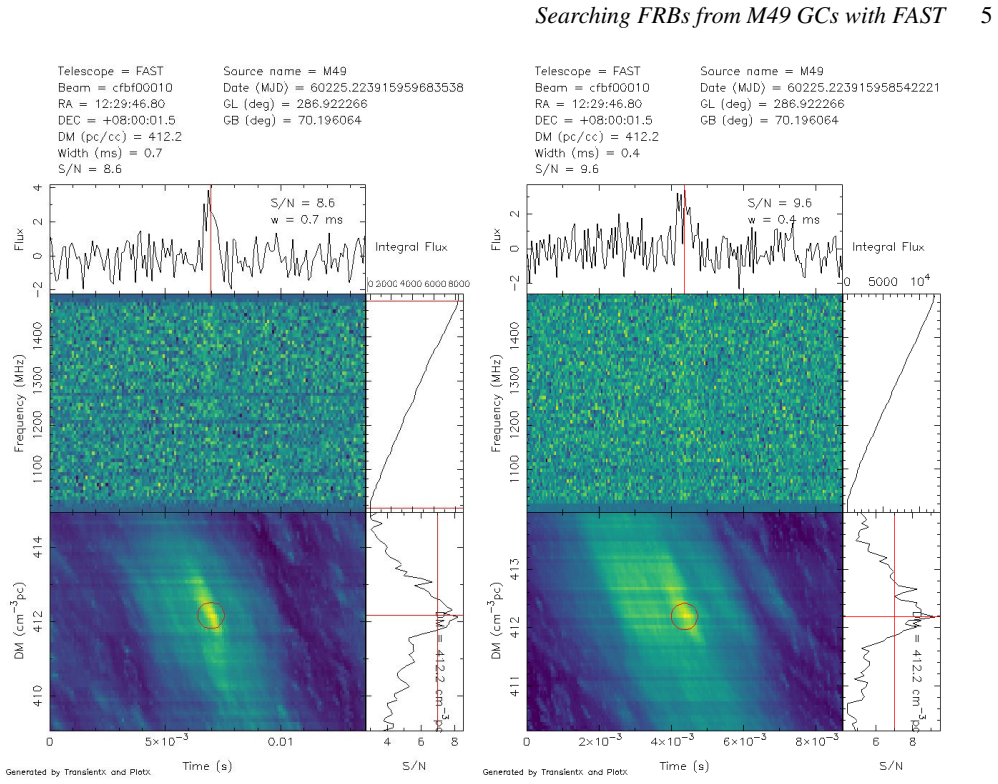
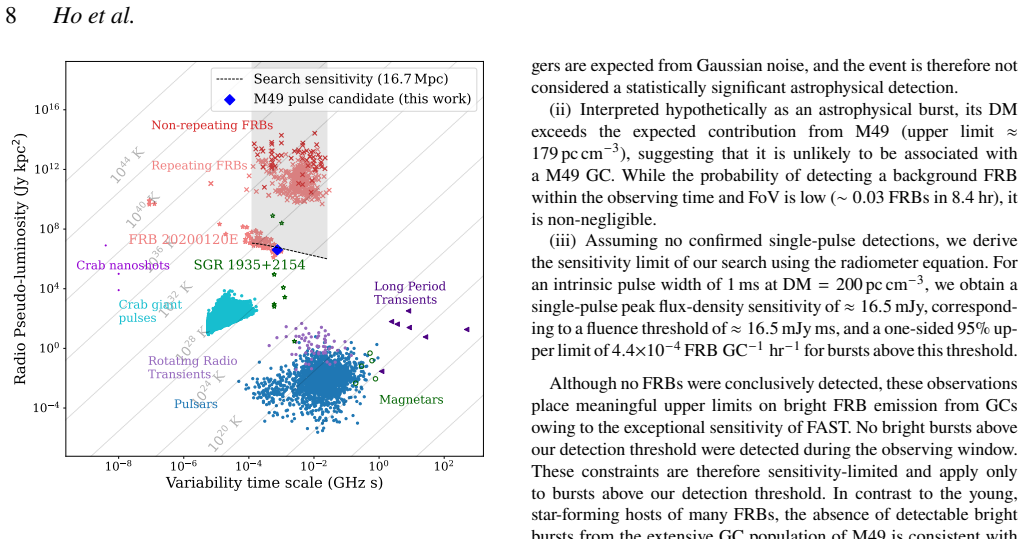
No unambiguous astrophysical FRBs were detected. The most significant trigger reached only 8.6 sigma at DM 412.2 pc cm^{-3} and proved consistent with thermal noise once the false-alarm rate was accounted for. A beam-averaged peak flux-density sensitivity of about 16.5 mJy was achieved, corresponding to a fluence limit of about 16.5 mJy ms for a 1 ms burst. From the non-detection the authors derive an upper limit on the FRB occurrence rate of 4.7 x 10^{-4} FRB GC^{-1} hr^{-1}. The limit applies only to bright bursts above this fluence threshold during the specific observing windows.
What carries the argument
The single-pulse search pipeline run on the 19-beam FAST data, calibrated for false-alarm rate across the full DM range, that converts non-detections into the beam-averaged sensitivity and rate upper limit.
Load-bearing premise
Any real fast radio burst occurring inside the 2.1-hour window per cluster would exceed the 16.5 mJy ms fluence threshold after dispersion and beam averaging and would be distinguishable from noise.
What would settle it
A confirmed astrophysical FRB with fluence above 16.5 mJy ms from any of the observed M49 globular clusters would exceed the stated upper limit on occurrence rate.
Figures
read the original abstract
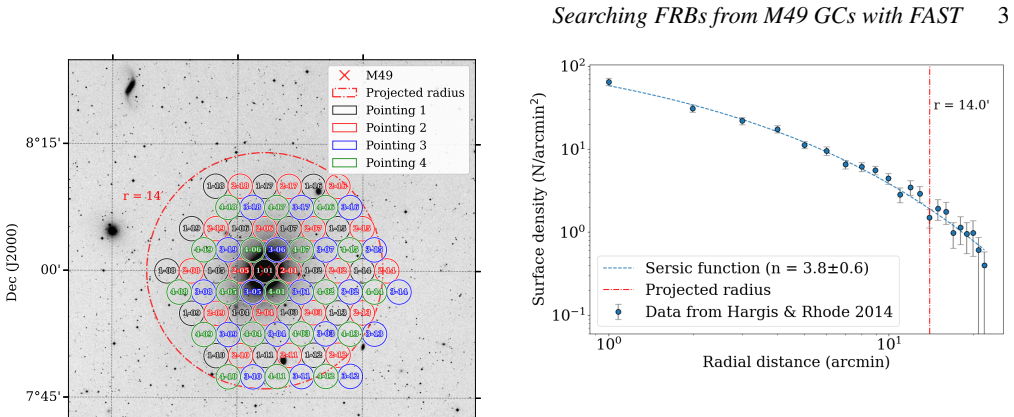
The origins of fast radio bursts (FRBs) remain uncertain, although magnetars are a leading progenitor candidate. Because magnetars are thought to form primarily through core-collapse supernovae in young stellar populations, the discovery of FRB 20200120E in a globular cluster (GC) in the nearby galaxy M81 was unexpected given the ancient stellar populations of GCs. Expanding the sample of FRBs localised to nearby galaxies is therefore essential for testing FRB formation channels in old stellar environments. M49 (NGC 4472) is a nearby (~17 Mpc), radio-quiet giant elliptical galaxy in the Virgo cluster hosting about 7000 GCs, making it an ideal target for GC FRB searches. We conducted a 9-hour SnapShotCal observation of M49 using the Five-hundred-meter Aperture Spherical Telescope (FAST) 19-beam receiver, covering approximately 4230 GCs (2.1 hr per GC), and performed a comprehensive single-pulse search over a dispersion measure range of 0-5000 pc cm^-3. No unambiguous astrophysical FRBs were detected. The most significant trigger reached a post-processed signal-to-noise ratio of 8.6 sigma at a dispersion measure of 412.2 pc cm^-3, but is statistically consistent with thermal noise after accounting for the false-alarm rate. We derive a beam-averaged peak flux-density sensitivity of about 16.5 mJy (corresponding to a fluence limit of about 16.5 mJy ms for a 1 ms burst) and place an upper limit on the FRB occurrence rate of 4.7 x 10^-4 FRB GC^-1 hr^-1. Our non-detection constrains only bright bursts above this fluence threshold during the observing window.
Editorial analysis
A structured set of objections, weighed in public.
Referee Report
Summary. The manuscript reports a 9-hour FAST observation of M49 targeting ~4230 globular clusters (2.1 hr per GC) with a single-pulse search over DM 0-5000 pc cm^-3. No unambiguous astrophysical FRBs are detected; the sole 8.6-sigma trigger at DM 412.2 pc cm^-3 is consistent with noise after false-alarm correction. A beam-averaged sensitivity of 16.5 mJy (fluence limit ~16.5 mJy ms for 1 ms bursts) is derived, yielding an upper limit of 4.7 x 10^-4 FRB GC^-1 hr^-1.
Significance. If the non-detection and sensitivity hold, the result supplies a direct, observationally grounded upper limit on bright FRB rates in old stellar populations, complementing the M81 GC detection and helping test magnetar formation channels. The exposure accounting and standard single-pulse search pipeline are strengths; the limit follows directly from the non-detection without fitted parameters.
minor comments (3)
- [§3] §3 (Observations and data reduction): the precise mapping of the 19-beam receiver footprint onto the GC catalog positions and the resulting effective integration time per cluster could be shown explicitly (e.g., a histogram or table) to allow readers to verify the quoted 2.1 hr per GC average.
- [§4] §4 (Search and candidate vetting): the exact formula and trial factor used for the false-alarm probability of the 8.6-sigma event (accounting for DM trials, time samples, and beams) is stated only qualitatively; adding the numerical value would strengthen the claim that it is noise-consistent.
- [Figure 2] Figure 2 (or equivalent sensitivity plot): the fluence threshold is given for a 1 ms burst; clarifying whether the quoted 16.5 mJy ms limit assumes a top-hat pulse or includes the effects of intra-channel dispersion smearing at DM ~400 would remove ambiguity.
Simulated Author's Rebuttal
We thank the referee for their positive review, recognition of the manuscript's strengths, and recommendation to accept. No major comments were raised.
Circularity Check
No circularity: observational non-detection yields rate upper limit directly from data
full rationale
The paper reports a standard single-pulse search on FAST observations of M49 GCs, with no detections after false-alarm accounting for the sole 8.6-sigma trigger. The beam-averaged sensitivity (16.5 mJy, 16.5 mJy ms fluence) is computed from telescope parameters and beam response; the rate upper limit (4.7e-4 FRB GC^-1 hr^-1) follows arithmetically from non-detection, exposure (2.1 hr/GC over 4230 GCs), and that sensitivity. No equations reduce to fitted inputs, no self-citations are load-bearing for any derivation, and no ansatz or uniqueness claim is invoked. The result is self-contained against external benchmarks with no internal reduction to its own inputs.
Axiom & Free-Parameter Ledger
axioms (1)
- domain assumption Standard single-pulse search assumptions including DM smearing, beam response averaging, and false-alarm rate calculation from trial statistics hold for the FAST 19-beam data.
Reference graph
Works this paper leans on
-
[1]
A bright millisecond radio burst of extragalactic origin
A Bright Millisecond Radio Burst of Extragalactic Origin. Science , keywords =. doi:10.1126/science.1147532 , archivePrefix =. 0709.4301 , primaryClass =
work page internal anchor Pith review Pith/arXiv arXiv doi:10.1126/science.1147532
-
[2]
Fast radio bursts at the dawn of the 2020s. , keywords =. doi:10.1007/s00159-022-00139-w , archivePrefix =. 2107.10113 , primaryClass =
-
[3]
The discovery and significance of fast radio bursts. , keywords =. doi:10.1007/s10509-024-04322-6 , archivePrefix =. 2405.19106 , primaryClass =
-
[4]
A fast radio burst associated with a Galactic magnetar. , keywords =. doi:10.1038/s41586-020-2872-x , archivePrefix =. 2005.10828 , primaryClass =
-
[5]
Formation of Very Strongly Magnetized Neutron Stars: Implications for Gamma-Ray Bursts. , keywords =. doi:10.1086/186413 , adsurl =
-
[6]
The Soft Gamma Repeaters as Very Strongly Magnetized Neutron Stars. II. Quiescent Neutrino, X-Ray, and Alfven Wave Emission. , keywords =. doi:10.1086/178147 , adsurl =
-
[7]
Supernova remnant energetics and magnetars: no evidence in favour of millisecond proto-neutron stars. , keywords =. doi:10.1111/j.1745-3933.2006.00178.x , archivePrefix =. astro-ph/0604187 , primaryClass =
-
[8]
Magnetars. , keywords =. doi:10.1146/annurev-astro-081915-023329 , archivePrefix =. 1703.00068 , primaryClass =
work page internal anchor Pith review Pith/arXiv arXiv doi:10.1146/annurev-astro-081915-023329
-
[9]
A repeating fast radio burst source in a globular cluster. , keywords =. doi:10.1038/s41586-021-04354-w , archivePrefix =. 2105.11445 , primaryClass =
-
[10]
Prospects for Detecting Fast Radio Bursts in the Globular Clusters of Nearby Galaxies. , keywords =. doi:10.3847/1538-4357/acabbf , archivePrefix =. 2210.04907 , primaryClass =
-
[11]
Implications of a rapidly varying FRB in a globular cluster of M81. , keywords =. doi:10.1093/mnras/stab3500 , archivePrefix =. 2107.04059 , primaryClass =
-
[12]
White Dwarf Subsystems in Core-Collapsed Globular Clusters. , keywords =. doi:10.3847/1538-4357/ac06d4 , archivePrefix =. 2104.11751 , primaryClass =
-
[13]
2020, Research in Astronomy and Astrophysics, 20, 064, doi: 10.1088/1674-4527/20/5/64
The fundamental performance of FAST with 19-beam receiver at L band. Research in Astronomy and Astrophysics , keywords =. doi:10.1088/1674-4527/20/5/64 , archivePrefix =. 2002.01786 , primaryClass =
-
[14]
Searches for Giant Pulses from Extragalactic Pulsars
Searches for Giant Pulses from Extragalactic Pulsars. , keywords =. doi:10.1086/378232 , archivePrefix =. astro-ph/0304365 , primaryClass =
work page internal anchor Pith review Pith/arXiv arXiv doi:10.1086/378232
-
[15]
Searching for pulsars, magnetars, and fast radio bursts in the sculptor galaxy using MeerKAT. , keywords =. doi:10.1093/mnras/stae1880 , archivePrefix =. 2408.01217 , primaryClass =
-
[16]
A Catalog of Globular Cluster Systems: What Determines the Size of a Galaxy's Globular Cluster Population?. , keywords =. doi:10.1088/0004-637X/772/2/82 , archivePrefix =. 1306.2247 , primaryClass =
work page internal anchor Pith review Pith/arXiv arXiv doi:10.1088/0004-637x/772/2/82
-
[17]
The ACS Fornax Cluster Survey. V. Measurement and Recalibration of Surface Brightness Fluctuations and a Precise Value of the Fornax-Virgo Relative Distance. , keywords =. doi:10.1088/0004-637X/694/1/556 , archivePrefix =. 0901.1138 , primaryClass =
work page internal anchor Pith review Pith/arXiv arXiv doi:10.1088/0004-637x/694/1/556
-
[18]
A Repeating Fast Radio Burst Source in the Outskirts of a Quiescent Galaxy. , keywords =. doi:10.3847/2041-8213/ad9ddc , archivePrefix =. 2410.23374 , primaryClass =
-
[19]
The Massive and Quiescent Elliptical Host Galaxy of the Repeating Fast Radio Burst FRB 20240209A. , keywords =. doi:10.3847/2041-8213/ad9de2 , archivePrefix =. 2410.23336 , primaryClass =
-
[20]
FAST: Its Scientific Achievements and Prospects. The Innovation , keywords =. doi:10.1016/j.xinn.2020.100053 , archivePrefix =. 2011.13542 , primaryClass =
-
[21]
Commissioning Progress of the FAST
Commissioning progress of the FAST. Science China Physics, Mechanics, and Astronomy , keywords =. doi:10.1007/s11433-018-9376-1 , archivePrefix =. 1903.06324 , primaryClass =
work page internal anchor Pith review Pith/arXiv arXiv doi:10.1007/s11433-018-9376-1 1903
-
[22]
Selection bias obfuscates the discovery of fast radio burst sources. , keywords =. doi:10.1038/s41586-024-08065-w , archivePrefix =. 2408.01876 , primaryClass =
-
[23]
A Nearby Repeating Fast Radio Burst in the Direction of M81. , keywords =. doi:10.3847/2041-8213/abeaa6 , archivePrefix =. 2103.01295 , primaryClass =
-
[24]
Mapping the Spatial Distribution of Fast Radio Bursts within their Host Galaxies. arXiv e-prints , keywords =. doi:10.48550/arXiv.2506.06453 , archivePrefix =. 2506.06453 , primaryClass =
-
[25]
The Five-Hundred-Meter Aperture Spherical Radio Telescope (FAST) Project
The Five-Hundred Aperture Spherical Radio Telescope (fast) Project. International Journal of Modern Physics D , keywords =. doi:10.1142/S0218271811019335 , archivePrefix =. 1105.3794 , primaryClass =
work page internal anchor Pith review Pith/arXiv arXiv doi:10.1142/s0218271811019335
-
[26]
The FAST Galactic Plane Pulsar Snapshot survey: I. Project design and pulsar discoveries. Research in Astronomy and Astrophysics , keywords =. doi:10.1088/1674-4527/21/5/107 , archivePrefix =. 2105.08460 , primaryClass =
-
[27]
Globular Cluster Systems and their Host Galaxies: Comparison of Spatial Distributions and Colors
Globular Cluster Systems and their Host Galaxies: Comparison of Spatial Distributions and Colors. , keywords =. doi:10.1088/0004-637X/796/1/62 , archivePrefix =. 1409.6306 , primaryClass =
work page internal anchor Pith review Pith/arXiv arXiv doi:10.1088/0004-637x/796/1/62
-
[28]
and Haberland, Matt and Reddy, Tyler and Cournapeau, David and Burovski, Evgeni and Peterson, Pearu and Weckesser, Warren and Bright, Jonathan and
Virtanen, Pauli and Gommers, Ralf and Oliphant, Travis E. and Haberland, Matt and Reddy, Tyler and Cournapeau, David and Burovski, Evgeni and Peterson, Pearu and Weckesser, Warren and Bright, Jonathan and. Nature Methods , year =
-
[29]
Two High-Sensitivity Pulsar Searches
-
[30]
A Fast Radio Burst Discovered in FAST Drift Scan Survey. , keywords =. doi:10.3847/2041-8213/ab8e46 , archivePrefix =. 2004.14029 , primaryClass =
-
[31]
The SUrvey for Pulsars and Extragalactic Radio Bursts II: New FRB discoveries and their follow-up
The SUrvey for Pulsars and Extragalactic Radio Bursts - II. New FRB discoveries and their follow-up. , keywords =. doi:10.1093/mnras/stx3074 , archivePrefix =. 1711.08110 , primaryClass =
work page internal anchor Pith review Pith/arXiv arXiv doi:10.1093/mnras/stx3074
-
[32]
The SUrvey for Pulsars and Extragalactic Radio Bursts I: Survey Description and Overview
The SUrvey for Pulsars and Extragalactic Radio Bursts - I. Survey description and overview. , keywords =. doi:10.1093/mnras/stx2126 , archivePrefix =. 1706.04459 , primaryClass =
work page internal anchor Pith review Pith/arXiv arXiv doi:10.1093/mnras/stx2126
-
[33]
The Parkes multi-beam pulsar survey - I. Observing and data analysis systems, discovery and timing of 100 pulsars. Monthly Notices of the Royal Astronomical Society , keywords =. doi:10.1046/j.1365-8711.2001.04751.x , archivePrefix =. astro-ph/0106522 , primaryClass =
-
[34]
The first interferometric detections of Fast Radio Bursts
The first interferometric detections of fast radio bursts. , keywords =. doi:10.1093/mnras/stx638 , archivePrefix =. 1703.10173 , primaryClass =
work page internal anchor Pith review Pith/arXiv arXiv doi:10.1093/mnras/stx638
-
[35]
Milliarcsecond Localization of the Repeating FRB 20201124A. , keywords =. doi:10.3847/2041-8213/ac540f , archivePrefix =. 2111.01600 , primaryClass =
-
[36]
Milliarcsecond localization of the hyperactive repeating FRB 20220912A. , keywords =. doi:10.1093/mnras/stae632 , archivePrefix =. 2312.14490 , primaryClass =
-
[37]
TRAPUM pulsar and transient search in the Sextans A and B galaxies and discovery of background FRB 20210924D. , keywords =. doi:10.1093/mnras/stae2308 , archivePrefix =. 2410.04658 , primaryClass =
-
[38]
The ACS Virgo Cluster Survey. X. Half-Light Radii of Globular Clusters in Early-Type Galaxies: Environmental Dependencies and a Standard Ruler for Distance Estimation. , keywords =. doi:10.1086/497092 , archivePrefix =. astro-ph/0508219 , primaryClass =
work page internal anchor Pith review Pith/arXiv arXiv doi:10.1086/497092
-
[39]
A burst storm from the repeating FRB 20200120E in an M81 globular cluster. , keywords =. doi:10.1093/mnras/stad269 , archivePrefix =. 2206.03759 , primaryClass =
-
[40]
NE2001.I. A New Model for the Galactic Distribution of Free Electrons and its Fluctuations
NE2001.I. A New Model for the Galactic Distribution of Free Electrons and its Fluctuations. arXiv e-prints , keywords =. doi:10.48550/arXiv.astro-ph/0207156 , archivePrefix =. astro-ph/0207156 , primaryClass =
work page internal anchor Pith review Pith/arXiv arXiv doi:10.48550/arxiv.astro-ph/0207156
-
[41]
A New Electron Density Model for Estimation of Pulsar and FRB Distances
A New Electron-density Model for Estimation of Pulsar and FRB Distances. , keywords =. doi:10.3847/1538-4357/835/1/29 , archivePrefix =. 1610.09448 , primaryClass =
work page internal anchor Pith review Pith/arXiv arXiv doi:10.3847/1538-4357/835/1/29
-
[42]
TransientX: A high-performance single-pulse search package. , keywords =. doi:10.1051/0004-6361/202348247 , archivePrefix =. 2401.13834 , primaryClass =
-
[43]
PRESTO: PulsaR Exploration and Search TOolkit
-
[44]
DRAFTS: A Deep-learning-based Radio Fast Transient Search Pipeline. , keywords =. doi:10.3847/1538-4365/ad8f31 , archivePrefix =. 2410.03200 , primaryClass =
-
[45]
The Astrophysical Consequences of Intervening Galaxy Gas on Fast Radio Bursts
The astrophysical consequences of intervening galaxy gas on fast radio bursts. , keywords =. doi:10.1093/mnras/stx2824 , archivePrefix =. 1711.00323 , primaryClass =
work page internal anchor Pith review Pith/arXiv arXiv doi:10.1093/mnras/stx2824
-
[46]
The Dispersion of Fast Radio Bursts from a Structured Intergalactic Medium at Redshifts z < 1.5
The Dispersion of Fast Radio Bursts from a Structured Intergalactic Medium at Redshifts z < 1.5. , keywords =. doi:10.3847/2041-8213/aaa2fa , archivePrefix =. 1712.01280 , primaryClass =
work page internal anchor Pith review Pith/arXiv arXiv doi:10.3847/2041-8213/aaa2fa 2041
-
[47]
Probing Galactic Halos with Fast Radio Bursts
Probing Galactic haloes with fast radio bursts. , keywords =. doi:10.1093/mnras/stz261 , archivePrefix =. 1901.11051 , primaryClass =
work page internal anchor Pith review Pith/arXiv arXiv doi:10.1093/mnras/stz261 1901
-
[48]
The Galactic Halo Contribution to the Dispersion Measure of Extragalactic Fast Radio Bursts. , keywords =. doi:10.3847/1538-4357/ab58c4 , archivePrefix =. 1909.00849 , primaryClass =
-
[49]
A census of baryons in the Universe from localized fast radio bursts.Nature2020,581, 391–395
A census of baryons in the Universe from localized fast radio bursts. , keywords =. doi:10.1038/s41586-020-2300-2 , archivePrefix =. 2005.13161 , primaryClass =
-
[50]
A ROSAT determination of the mass of the central Virgo Cluster. , keywords =. doi:10.1093/mnras/274.4.1093 , adsurl =
-
[51]
Extended X-ray study of M49: the frontier of the Virgo Cluster
Extended X-Ray Study of M49: The Frontier of the Virgo Cluster. , keywords =. doi:10.3847/1538-3881/ab1d51 , archivePrefix =. 1904.11899 , primaryClass =
work page internal anchor Pith review Pith/arXiv arXiv doi:10.3847/1538-3881/ab1d51 1904
-
[52]
Burst timescales and luminosities as links between young pulsars and fast radio bursts. Nature Astronomy , keywords =. doi:10.1038/s41550-021-01569-9 , archivePrefix =. 2105.11446 , primaryClass =
-
[53]
Handbook of Pulsar Astronomy
-
[54]
The effect of digitisation on the signal-to-noise ratio of a pulsed radio signal. , keywords =. doi:10.1051/0004-6361:20011226 , adsurl =
-
[55]
The CHIME Fast Radio Burst Project: System Overview
The CHIME Fast Radio Burst Project: System Overview. , keywords =. doi:10.3847/1538-4357/aad188 , archivePrefix =. 1803.11235 , primaryClass =
work page internal anchor Pith review Pith/arXiv arXiv doi:10.3847/1538-4357/aad188
-
[56]
The Commensal Real-time ASKAP Fast Transients (CRAFT) survey
The Commensal Real-Time ASKAP Fast-Transients (CRAFT) Survey. , keywords =. doi:10.1071/AS09082 , archivePrefix =. 1001.2958 , primaryClass =
work page internal anchor Pith review Pith/arXiv arXiv doi:10.1071/as09082
-
[57]
CHIME/FRB Outriggers: KKO Station System and Commissioning Results. , keywords =. doi:10.3847/1538-3881/ad5838 , archivePrefix =. 2402.07898 , primaryClass =
-
[58]
1986, ApJ, 303, 336, doi: 10.1086/164079
Confidence Limits for Small Numbers of Events in Astrophysical Data. , keywords =. doi:10.1086/164079 , adsurl =
-
[59]
BURSTT: Bustling Universe Radio Survey Telescope in Taiwan. , keywords =. doi:10.1088/1538-3873/ac8f71 , archivePrefix =. 2206.08983 , primaryClass =
-
[60]
Future Constraints on Dark Matter with Gravitationally Lensed Fast Radio Bursts Detected by BURSTT. , keywords =. doi:10.3847/1538-4357/accb9e , archivePrefix =. 2304.04990 , primaryClass =
-
[61]
Planck intermediate results. XL. The Sunyaev-Zeldovich signal from the Virgo cluster. , keywords =. doi:10.1051/0004-6361/201527743 , archivePrefix =. 1511.05156 , primaryClass =
work page internal anchor Pith review Pith/arXiv arXiv doi:10.1051/0004-6361/201527743
-
[62]
A cooling flow in the giant, elliptical galaxy NGC 4472. , keywords =. doi:10.1093/mnras/220.4.949 , adsurl =
-
[63]
The Gas Dynamics of NGC 4472 Revealed by XMM-Newton. , keywords =. doi:10.1088/0004-637X/727/1/41 , adsurl =
-
[64]
, year = 1960, month = oct, volume =
Dust and gas in globular clusters. , year = 1960, month = oct, volume =. doi:10.1086/108288 , adsurl =
-
[65]
Limits on Ionized Gas in Globular Clusters. , keywords =. doi:10.1086/177144 , adsurl =
-
[66]
A VST and VISTA study of globular clusters in NGC253
A VST and VISTA study of globular clusters in NGC 253. , keywords =. doi:10.1051/0004-6361/201731325 , archivePrefix =. 1711.00805 , primaryClass =
work page internal anchor Pith review Pith/arXiv arXiv doi:10.1051/0004-6361/201731325
-
[67]
Characterizing the Fast Radio Burst Host Galaxy Population and its Connection to Transients in the Local and Extragalactic Universe. , keywords =. doi:10.3847/1538-3881/ac3aec , archivePrefix =. 2108.01282 , primaryClass =
-
[68]
The Demographics, Stellar Populations, and Star Formation Histories of Fast Radio Burst Host Galaxies: Implications for the Progenitors. , keywords =. doi:10.3847/1538-4357/ace5aa , archivePrefix =. 2302.05465 , primaryClass =
-
[69]
The physics of fast radio bursts.Rev
The physics of fast radio bursts. Reviews of Modern Physics , keywords =. doi:10.1103/RevModPhys.95.035005 , archivePrefix =. 2212.03972 , primaryClass =
-
[70]
A bright millisecond-duration radio burst from a Galactic magnetar. , keywords =. doi:10.1038/s41586-020-2863-y , archivePrefix =. 2005.10324 , primaryClass =
-
[71]
CRAFTS for Fast Radio Bursts: Extending the Dispersion-Fluence Relation with New FRBs Detected by FAST. , keywords =. doi:10.3847/2041-8213/abe7f0 , archivePrefix =. 2102.10546 , primaryClass =
-
[72]
H., Aggarwal, K., Li, D., et al
A repeating fast radio burst associated with a persistent radio source. , keywords =. doi:10.1038/s41586-022-04755-5 , archivePrefix =. 2110.07418 , primaryClass =
-
[73]
Essential Radio Astronomy
-
[74]
Murriyang cryogenic phased array feed: Spectral-line results and noise-reduction methods. , keywords =. doi:10.1017/pasa.2026.10164 , archivePrefix =. 2602.12677 , primaryClass =
-
[75]
Hotan, A. W. and van Straten, W. and Manchester, R. N. , title =. PASA , volume =
-
[76]
Detection of over 37 000 giant pulses per hour from PSR J1823‑3021A with UHF baseband observations from MeerKAT. , keywords =. doi:10.1093/mnras/staf995 , archivePrefix =. 2506.14887 , primaryClass =
-
[77]
Supergiant Pulses from Extragalactic Neutron Stars
Supergiant pulses from extragalactic neutron stars. , keywords =. doi:10.1093/mnras/stv2948 , archivePrefix =. 1501.00753 , primaryClass =
work page internal anchor Pith review Pith/arXiv arXiv doi:10.1093/mnras/stv2948
-
[78]
Fast radio bursts as giant pulses from young rapidly rotating pulsars
Fast radio bursts as giant pulses from young rapidly rotating pulsars. , keywords =. doi:10.1093/mnras/stw1669 , archivePrefix =. 1603.02891 , primaryClass =
work page internal anchor Pith review Pith/arXiv arXiv doi:10.1093/mnras/stw1669
-
[79]
Constraints on the X-ray-to-radio fluence ratio of FRB 20240114A. , keywords =. doi:10.1051/0004-6361/202453563 , archivePrefix =. 2503.02580 , primaryClass =
-
[80]
FRB 20240619D: a study of the hyperactivity, rotation measure evolution, and searches for a persistent radio source. , keywords =. doi:10.1093/mnras/staf2222 , adsurl =
discussion (0)
Sign in with ORCID, Apple, or X to comment. Anyone can read and Pith papers without signing in.