Quantum Otto engine powered by an anisotropic Heisenberg XYZ model under independent local magnetic fields
Pith reviewed 2026-06-27 06:57 UTC · model grok-4.3
The pith
Reducing the longitudinal coupling in an anisotropic two-qubit Heisenberg XYZ model improves both maximum work output and peak efficiency of a quantum Otto engine.
A machine-rendered reading of the paper's core claim, the machinery that carries it, and where it could break.
Core claim
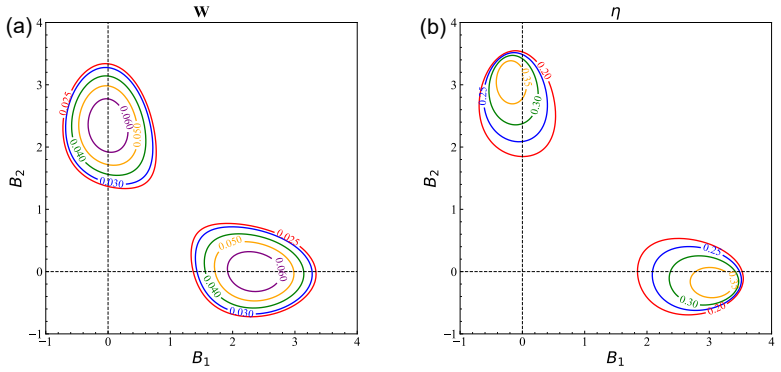
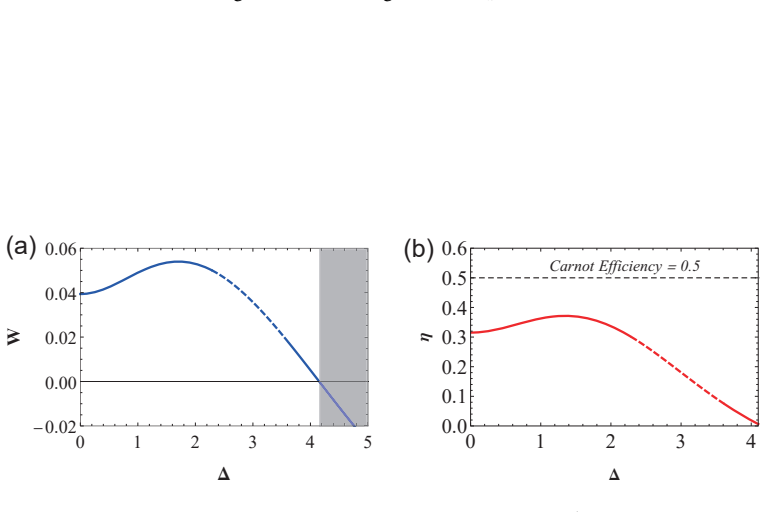
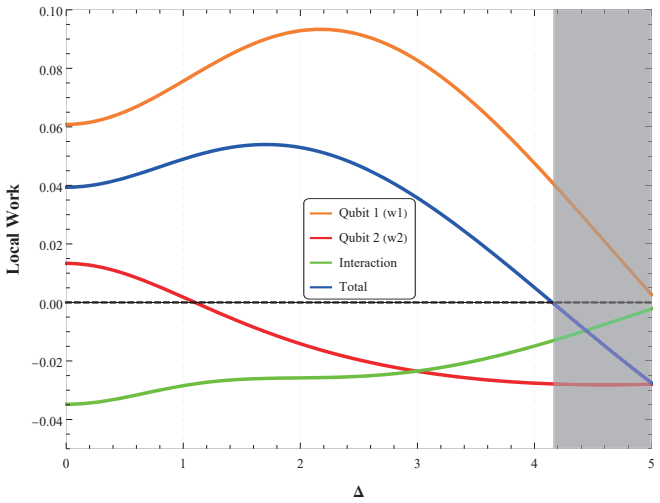
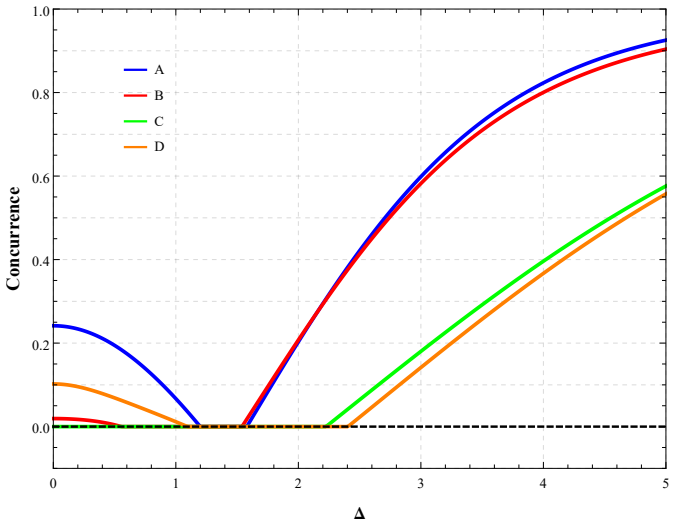
The working substance is an anisotropic two-qubit Heisenberg XYZ model under independent local magnetic fields. Reducing the longitudinal coupling markedly improves both the maximum work and the peak efficiency. The engine performance reaches an optimum at a particular value of the anisotropy parameter. A local work analysis shows the interaction term contributes crucially to the total work, with the two qubits playing different roles. A pronounced change in entanglement between the hot and cold isomagnetic strokes is closely correlated with the efficiency enhancement.
What carries the argument
The anisotropic Heisenberg XYZ Hamiltonian with independent local magnetic fields, which sets the energy levels during the isochoric heating and cooling strokes and drives unitary evolution during the isomagnetic strokes while work and concurrence are tracked.
If this is right
- Lowering the longitudinal coupling increases both maximum work output and peak efficiency.
- Engine performance reaches an optimum at one specific value of the anisotropy parameter.
- The spin-spin interaction term supplies a crucial contribution to the total work extracted.
- The two qubits perform markedly different thermodynamic roles because of the asymmetric local fields.
- A large change in concurrence between the hot and cold isomagnetic strokes is correlated with higher efficiency.
Where Pith is reading between the lines
- If the entanglement change is the dominant driver of efficiency, then preparing the qubits in states that maximize the concurrence difference between strokes could yield further gains.
- Because the qubits play asymmetric roles, independent tuning of the two local fields offers separate control parameters that could be optimized beyond the coupling strengths alone.
- The unitary-evolution assumption during the work strokes implies that any real device would require checking how weak decoherence alters the predicted work and efficiency curves.
Load-bearing premise
The working substance reaches thermal equilibrium with the hot and cold baths during the isochoric strokes and evolves unitarily during the isomagnetic strokes without additional decoherence or non-Markovian effects.
What would settle it
Measure the net work output and efficiency of the two-qubit system while systematically decreasing the longitudinal coupling strength and verify whether both quantities increase monotonically as the coupling is reduced.
Figures
read the original abstract
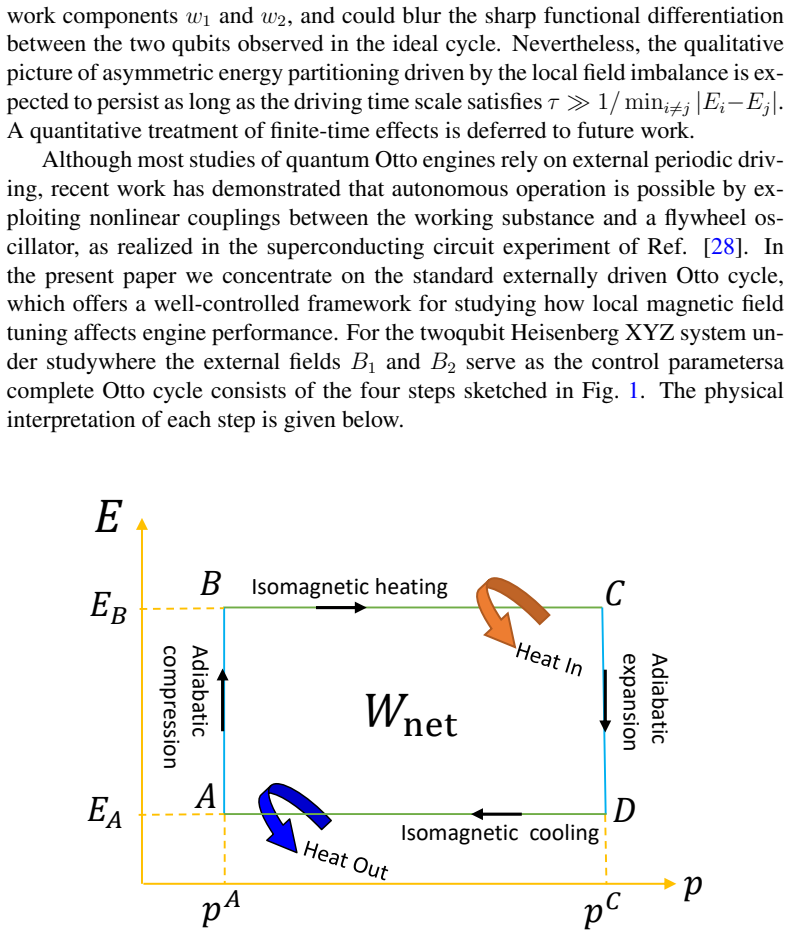
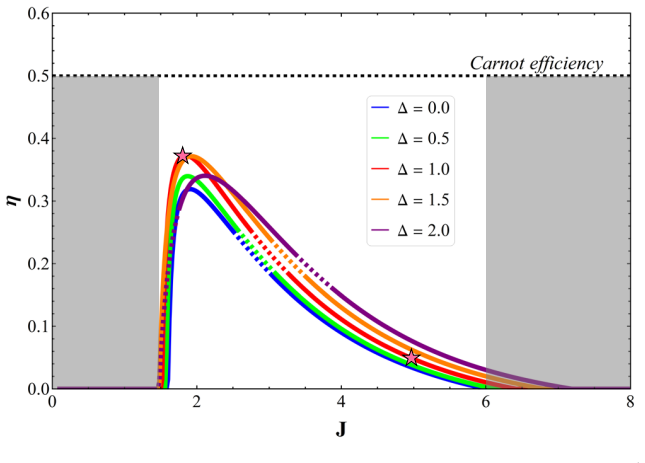
We study a quantum Otto heat engine whose working substance is an anisotropic two-qubit Heisenberg XYZ model. Independent local magnetic fields are used to control each spin individually. The influence of the longitudinal coupling, anisotropy, transverse coupling, and local fields on the net work output and efficiency is systematically examined. Reducing the longitudinal coupling is found to markedly improve both the maximum work and the peak efficiency. The engine performance reaches an optimum at a particular value of the anisotropy parameter. A local work analysis clarifies how work is produced during the cycle. Because of the asymmetric local fields and the intrinsic spin-spin interaction, the two qubits play markedly different thermodynamic roles; the interaction term itself contributes crucially to the total work. We further analyze the variation of quantum entanglement, quantified by concurrence, along the cycle. The results indicate that a pronounced change in entanglement between the hot and cold isomagnetic strokes is closely correlated with the efficiency enhancement. This work offers new insight into the operating principles and control of quantum Otto heat engines.
Editorial analysis
A structured set of objections, weighed in public.
Referee Report
Summary. The paper examines a quantum Otto heat engine with an anisotropic two-qubit Heisenberg XYZ model as the working substance, controlled by independent local magnetic fields. It systematically studies the effects of longitudinal coupling, anisotropy, transverse coupling, and local fields on net work and efficiency. Key findings include improved performance with reduced longitudinal coupling, an optimum at a specific anisotropy parameter, asymmetric thermodynamic roles of the two qubits, and a correlation between changes in entanglement (concurrence) during isomagnetic strokes and efficiency enhancement.
Significance. If the standard assumptions of the quantum Otto cycle hold, the results provide useful insights into parameter tuning for enhancing quantum engine performance using spin models. The local work analysis and the entanglement-efficiency correlation are particularly interesting contributions to quantum thermodynamics.
major comments (2)
- [Model Hamiltonian and Cycle Protocol] The central performance claims (improved work/efficiency at reduced J_z, optimum anisotropy, entanglement correlation) rest on the assumption that the system reaches exact thermal Gibbs states ρ = exp(−βH)/Z at the end of isochoric strokes and undergoes purely unitary evolution under the time-dependent Hamiltonian during isomagnetic strokes without decoherence. This is load-bearing but no analysis of finite-time thermalization or persistent bath effects is provided, which could modify W and the concurrence.
- [Numerical Results on Work and Efficiency] The statements that 'reducing the longitudinal coupling is found to markedly improve both the maximum work and the peak efficiency' and 'reaches an optimum at a particular value of the anisotropy parameter' are presented without reported numerical method details, convergence checks, or error estimates, undermining the ability to verify the quantitative claims.
minor comments (2)
- [Notation] The definition of the anisotropy parameter and how it enters the XYZ Hamiltonian should be clarified with an explicit equation early in the text.
- [Figures] Figure captions for the efficiency vs. parameter plots should include the fixed values of other parameters used in the computation.
Simulated Author's Rebuttal
We thank the referee for the careful review and constructive feedback on our manuscript. We address each major comment point-by-point below, clarifying our approach and indicating revisions where appropriate to strengthen the presentation.
read point-by-point responses
-
Referee: [Model Hamiltonian and Cycle Protocol] The central performance claims (improved work/efficiency at reduced J_z, optimum anisotropy, entanglement correlation) rest on the assumption that the system reaches exact thermal Gibbs states ρ = exp(−βH)/Z at the end of isochoric strokes and undergoes purely unitary evolution under the time-dependent Hamiltonian during isomagnetic strokes without decoherence. This is load-bearing but no analysis of finite-time thermalization or persistent bath effects is provided, which could modify W and the concurrence.
Authors: We agree that the analysis relies on the standard idealizations of the quantum Otto cycle (instantaneous thermalization to Gibbs states and purely unitary isomagnetic strokes), which are widely adopted in the quantum thermodynamics literature to isolate the effects of the working medium and control parameters. These assumptions allow direct comparison with prior studies on spin-based engines. We acknowledge that real systems involve finite-time effects and possible decoherence that could quantitatively alter work and concurrence. In the revised manuscript we will add an explicit paragraph in the Model section (and a short Limitations subsection) stating these assumptions, referencing relevant works on finite-time quantum thermodynamics, and noting that a full treatment of non-ideal thermalization lies beyond the present scope but is a natural direction for follow-up. revision: partial
-
Referee: [Numerical Results on Work and Efficiency] The statements that 'reducing the longitudinal coupling is found to markedly improve both the maximum work and the peak efficiency' and 'reaches an optimum at a particular value of the anisotropy parameter' are presented without reported numerical method details, convergence checks, or error estimates, undermining the ability to verify the quantitative claims.
Authors: We thank the referee for highlighting this omission. The two-qubit system permits exact diagonalization, so all thermodynamic quantities were obtained by direct computation of the eigenvalues and eigenvectors of the time-dependent Hamiltonian at each point in the cycle, with numerical integration of the unitary evolution performed via matrix exponentiation on a dense time grid. In the revised manuscript we will insert a new subsection (e.g., “Numerical Methods”) that specifies: (i) the exact-diagonalization procedure, (ii) the time-step size and convergence tests performed (doubling the number of steps until work and efficiency change by less than 0.1 %), (iii) the parameter grid used for J_z and the anisotropy Δ, and (iv) the absence of statistical error bars because the calculation is deterministic. These additions will enable independent verification of the reported trends. revision: yes
Circularity Check
No circularity; forward computation on explicit Hamiltonian
full rationale
The paper computes work output, efficiency, and concurrence directly from the time-dependent XYZ Hamiltonian under the stated thermalization and unitary-evolution assumptions. Reported trends (effect of Jz, optimum anisotropy, entanglement correlation) are obtained by evaluating the model's own equations on chosen parameter values; no parameter is fitted to the output quantities and then re-used as a prediction, no self-citation supplies a load-bearing uniqueness theorem, and no ansatz is smuggled in. The derivation chain is therefore self-contained against external benchmarks.
Axiom & Free-Parameter Ledger
free parameters (3)
- longitudinal coupling strength
- anisotropy parameter
- local magnetic field strengths
axioms (2)
- domain assumption The two-qubit system thermalizes to a Gibbs state with the bath temperature during the isochoric strokes
- domain assumption Evolution during the isomagnetic strokes is unitary and generated by the time-dependent XYZ Hamiltonian
Reference graph
Works this paper leans on
-
[1]
Kosloff, Entropy 15, 2100 (2013)
R. Kosloff, Entropy 15, 2100 (2013). doi: 10.3390/e15062100
-
[2]
L.M. Cangemi, C. Bhadra, A. Levy, Phys. Rep. 1087, 1 (2024). doi:10.1016/j.physrep.2024.07.001
-
[3]
H.T. Quan, H. Dong, C.P . Sun, Acta Phys. Sin. 72, 230501 (2023). doi:10.7498/aps.72.20231608
-
[4]
Gemmer, M
J. Gemmer, M. Michel, G. Mahler, Quantum Thermodynamics: Emergence of Thermodynamic Behavior Within Composite Quantum Systems (Springer, New Y ork, 2009)
2009
-
[5]
S. Vinjanampathy, J. Anders, Contemporary Physics 57, 545 (2016). doi:10.1080/00107514.2016.1201896
-
[6]
Binder, L.A
F. Binder, L.A. Correa, C. Gogolin, J. Anders, G. Adesso (Eds.), Thermody- namics in the Quantum Regime: Fundamental Aspects and New Directions (Springer, Cham, 2018). 25
2018
-
[7]
R. Uzdin, A. Levy, R. Kosloff, Phys. Rev. X 5, 031044 (2015). doi:10.1103/PhysRevX.5.031044
-
[8]
M.O. Scully, M.S. Zubairy, G.S. Agarwal, H. Walther, Science 299, 862 (2003). doi:10.1126/science.107895
-
[9]
T.D. Kieu, Phys. Rev. Lett. 93, 140403 (2004). doi:10.1103/PhysRevLett.93.140403
-
[10]
M.Y . Abd-Rabbou, A. ur Rahman, M.A. Y urischev, S. Haddadi, Phys. Rev. E 108, 034106 (2023). doi: 10.1103/PhysRevE.108.034106
-
[11]
H.T. Quan, Y .X. Liu, C.P . Sun, F. Nori, Phys. Rev. E 76, 031105 (2007). doi:10.1103/PhysRevE.76.031105
-
[12]
H.T. Quan, Phys. Rev. E 79, 041129 (2009). doi:10.1103/PhysRevE.79.041129
-
[13]
T. Zhang, W.T. Liu, P .X. Chen, C.Z. Li, Phys. Rev. A 75, 062102 (2007). doi:10.1103/PhysRevA.75.062102
-
[14]
T. Feldmann, R. Kosloff, Phys. Rev. E 61, 4774 (2000). doi:10.1103/PhysRevE.61.4774
-
[15]
T. Feldmann, R. Kosloff, Phys. Rev. E 68, 016101 (2003). doi:10.1103/PhysRevE.68.016101
-
[16]
T. Feldmann, R. Kosloff, Phys. Rev. E 70, 046110 (2004). doi:10.1103/PhysRevE.70.046110
-
[17]
K. Ono, S. N. Shevchenko, T. Mori, S. Moriyama, N. Franco, Phys. Rev. Lett. 125, 166802 (2020). doi: 10.1103/PhysRevLett.125.166802
-
[18]
J.H. Wang, J.Z. He, Z.Y . Mao, Sci. China Ser. G 50, 163 (2007). doi:10.1007/s11433-007-0006-1
-
[19]
X. Wu, L.G. Chen, F. Wu, F.R. Sun, Sci. China Ser. G-Phys. Mech. Astron. 52, 1976 (2009). doi: 10.1007/s11433-009-0300-1
-
[20]
J. Klatzow, J. N. Becker, P . M. Ledingham, C. Weinzetl, K. T. Kaczmarek, D. J. Saunders, E. Poem, Physical Review Letters 122, 110601 (2019). doi:10.1103/PhysRevLett.122.110601
-
[21]
J. Z. He, X. He, J. Zheng, Chin. Phys. B 21, 050303 (2012). doi:10.1088/1674-1056/21/5/050303 26
-
[22]
X.L. Huang, Q. Sun, D.Y . Guo, Q. Y u, Physica A 491, 604 (2018). doi:10.1016/j.physa.2017.09.104
-
[23]
G. Thomas, R.S. Johal, Phys. Rev. E 83, 031135 (2011). doi:10.1103/PhysRevE.83.031135
-
[24]
U. Jaegon, K. E. Dorfman, H. Park, Physical Review Research 4, L032034 (2022). doi:10.1103/PhysRevResearch.4.L032034
-
[25]
T. Uusnäkki, T. Mörstedt, W. Teixeira, M. Rasola, M. Möttönen, arXiv:2502.20143 (2025)
arXiv 2025
-
[26]
V . V adimov, M. Xu, J.T. Stockburger, J. Ankerhold, M. Möttönen, Phys. Rev. Res. 7, 013317 (2025). doi: 10.1103/PhysRevResearch.7.013317
-
[27]
M. Rasola, V . V adimov, T. Uusnäkki, M. Möttönen, SciPost Phys. 19, 101 (2025). doi:10.21468/SciPostPhys.19.4.101
-
[28]
T. Uusnäkki, M. Rasola, V . V adimov, P . Singh, M. Möttönen, arXiv:2603.15355 (2026)
arXiv 2026
-
[29]
S. Sundelin, M.A. Aamir, V .M. Kulkarni, C. Castillo-Moreno, S. Gas- parinetti, Nat. Commun. 17, 359 (2026). doi: 10.1038/s41467-026-47892-9
-
[30]
I. Dzyaloshinsky, J. Phys. Chem. Solids 4, 241 (1958). doi: 10.1016/0022- 3697(58)90076-3
-
[31]
T. Moriya, Phys. Rev. Lett. 4, 228 (1960). doi: 10.1103/PhysRevLett.4.228
-
[32]
H.-P . Peng, M.-F. Fang, C.-Y . Zhang, Int. J. Theor. Phys. 58, 1651 (2019). doi:10.1007/s10773-019-04061-3
-
[33]
S. Ahadpour, F. Mirmasoudi, Quantum Inf. Process. 20, 63 (2021). doi:10.1007/s11128-021-03019-x
-
[34]
E.I. Kuznetsova, M.A. Y urischev, S. Haddadi, Quantum Inf. Process.22, 192 (2023). doi:10.1007/s11128-023-03944-z
-
[35]
L.M. Zhao, G.F. Zhang, Quantum Inf. Process. 16, 216 (2017). doi:10.1007/s11128-017-1665-0
-
[36]
G.F. Zhang, Eur. Phys. J. D49, 123 (2008). doi:10.1140/epjd/e2008-00133-0
-
[37]
Y . Khlifi, A. El Allati, A. Salah, Y . Hassouni, Int. J. Mod. Phys. B 34, 2050212 (2020). doi:10.1142/S0217979220502124 27
-
[38]
L. Bresque, D. Das, É. Roldán, Phys. Rev. Lett. 134, 200402 (2025). doi:10.1103/PhysRevLett.134.200402
-
[39]
H.P . Liu, J.A. Plascak, D.P . Landau, Phys. Rev. E 97, 052118 (2018). doi:10.1103/PhysRevE.97.052118
-
[40]
Q. Wang, D. Cao, H.T. Quan, Phys. Rev. E 98, 022107 (2018). doi:10.1103/PhysRevE.98.022107
-
[41]
D.-C. Li, Z.-L. Cao, Eur. Phys. J. D 50, 207 (2008). doi:10.1140/epjd/e2008- 00208-x
-
[42]
A. Abliz, H.J. Gao, X.C. Xie, Y .S. Wu, W.M. Liu, Phys. Rev. A 74, 052105 (2006). doi:10.1103/PhysRevA.74.052105
-
[43]
S. Xu, X.K. Song, L. Y e, Quantum Information Processing 13, 1013 (2014). doi:10.1007/s11128-013-0706-6
-
[44]
Y . Sun, Y . Chen, H. Chen, Phys. Rev. A 68, 044301 (2003). doi:10.1103/PhysRevA.68.044301
-
[45]
L. Zhou, H.S. Song, Y .Q. Guo, C. Li, Phys. Rev. A 68, 024301 (2003). doi:10.1103/PhysRevA.68.024301
-
[46]
Y . Xiao, A. Liu, N. Zhang, Chinese Journal of Physics 103, 195 (2026). doi:10.1016/j.cjph.2026.05.012
-
[47]
S. Tang, Z. Pan, B. Wei, Physica A 689, 131434 (2026). doi:10.1016/j.physa.2026.131434
-
[48]
F. Altintas, Phys. Rev. E 92, 022142 (2015). doi:10.1103/PhysRevE.92.022142
-
[49]
A. El Makouri, A. Slaoui, A. Salah, M. Daoud, Journal of Physics B: Atomic, Molecular and Optical Physics 56, 085501 (2023). doi:10.1088/1361-6455/acc36d
-
[50]
Z. Zhu, H. Zhang, B. Wei, Physica A 682, 131136 (2026). doi:10.1016/j.physa.2025.131136
-
[51]
H. Han, L. Long, Physica A 685, 131262 (2026). doi:10.1016/j.physa.2025.131262
-
[52]
L. Mashhor, M.Y . Abd-Rabbou, K.A. Dib, M. Abdel-Aty, A.S.F. Obada, J. Phys. B: At. Mol. Opt. Phys. 58, 225501 (2025). doi: 10.1088/1361- 6455/ae216b 28
-
[53]
F. Campaioli, F. A. Pollock, F. C. Binder, L. Céleri, J. Goold, S. Vinjanampathy, K. Modi, Phys. Rev. Lett. 118, 150601 (2017). doi:10.1103/PhysRevLett.118.150601
-
[54]
D. Ferraro, M. Campisi, G. M. Andolina, V . Pellegrini, M. Polini, Phys. Rev. Lett. 120, 117702 (2018). doi: 10.1103/PhysRevLett.120.117702
-
[55]
W.K. Wootters, Phys. Rev. Lett. 80, 2245 (1998). doi:10.1103/PhysRevLett.80.2245 29
discussion (0)
Sign in with ORCID, Apple, or X to comment. Anyone can read and Pith papers without signing in.