Algorithms for Threshold Group Testing
Pith reviewed 2026-06-26 02:09 UTC · model grok-4.3
The pith
An efficient algorithm recovers exact defectives in threshold group testing at the information-theoretic minimum number of non-adaptive tests.
A machine-rendered reading of the paper's core claim, the machinery that carries it, and where it could break.
Core claim
The algorithm achieves exact recovery with high probability in the noiseless non-adaptive threshold group testing setting using the minimum number of tests needed for the constant-column design, thereby matching the information-theoretic threshold.
What carries the argument
Spatially coupled test design that structures the tests so the inference procedure admits a direct analysis without intricate weighted sums.
If this is right
- Exact recovery is possible at the information-theoretic limit for this class of threshold group testing problems.
- The algorithm applies directly to constant-column test designs.
- The analysis remains simpler than the weighted-sum techniques used for binary group testing.
- High-probability exact recovery holds at the minimum test count required by the design.
Where Pith is reading between the lines
- The spatial-coupling construction may transfer to other sparse-recovery settings that exhibit similar phase transitions.
- Implementations could exploit the simpler proof structure to obtain practical performance bounds more easily.
- Relaxing the analytic condition would widen the range of threshold values covered by the guarantee.
Load-bearing premise
An analytic condition under which threshold group testing undergoes a sharp information-theoretic phase transition for exact recovery on constant-column designs.
What would settle it
An explicit constant-column test matrix and defective set where the algorithm fails to output the correct vector with high probability when the number of tests equals the information-theoretic minimum.
Figures

read the original abstract
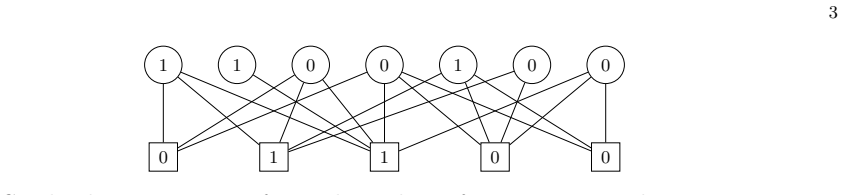
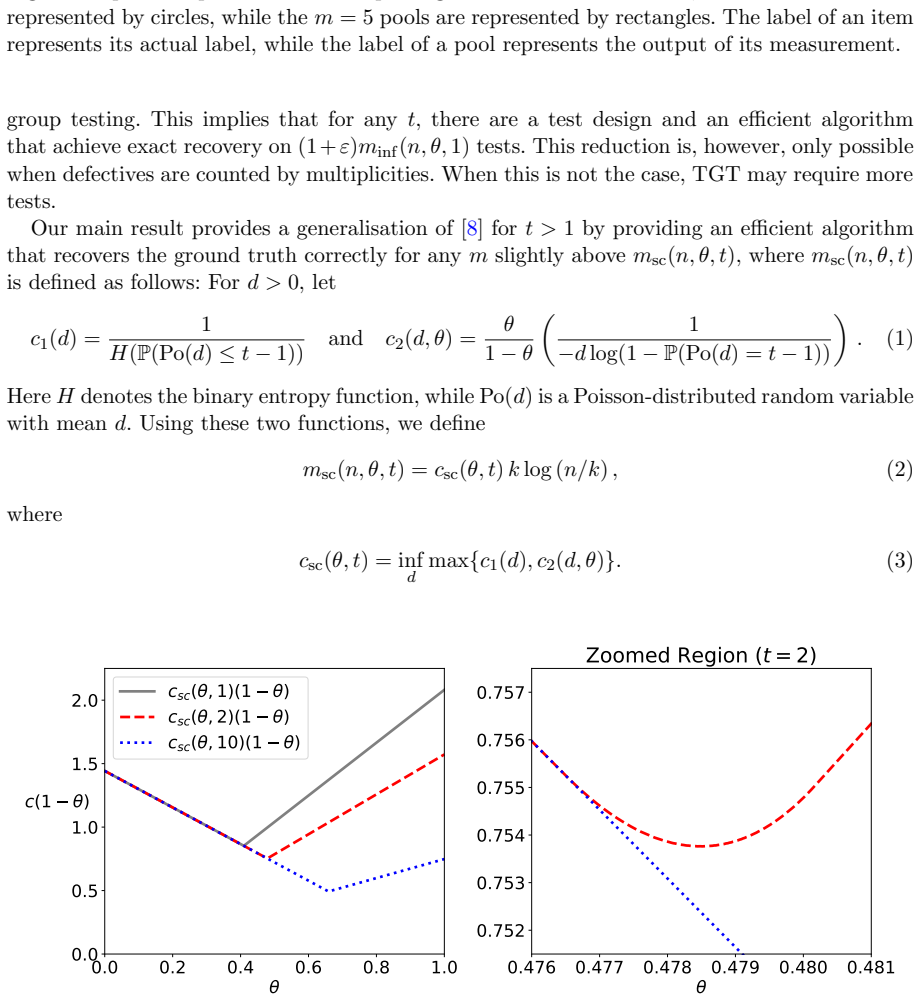
We study the Threshold Group Testing (TGT) problem without a gap in the noiseless, non-adaptive setting, where the goal is to exactly recover a sparse binary vector from pooled test outcomes using as few tests as possible. In TGT, a test applied to a subset of items returns a positive outcome if the number of defective items in the subset reaches a prescribed threshold, and a negative outcome otherwise. Under the assumption of an analytic condition, TGT has been shown to undergo a sharp information-theoretic phase transition for exact recovery on the class of constant-column test designs. In this paper, we develop an efficient inference algorithm that achieves exact recovery with high probability using the minimum number of non-adaptive tests that are needed for the constant-column design, thereby matching the information-theoretic threshold of a natural benchmark test design. Our approach is based on a spatially coupled test design and admits a significantly simpler analysis than existing algorithms for related group testing problems. In particular, unlike previous methods for binary group testing, our algorithm does not rely on the analysis of intricate weighted sums. This leads to a more straightforward proof technique, while still allowing near-optimal performance guarantees.
Editorial analysis
A structured set of objections, weighed in public.
Referee Report
Summary. The paper studies the noiseless non-adaptive Threshold Group Testing (TGT) problem. It develops an efficient inference algorithm based on a spatially coupled constant-column test design that achieves exact recovery with high probability at the information-theoretic minimum number of tests, matching the sharp phase transition established for constant-column designs under an assumed analytic condition. The analysis is presented as simpler than prior work because it avoids intricate weighted-sum arguments.
Significance. If the central claim holds, the result supplies a more accessible proof technique for near-optimal TGT recovery and demonstrates that spatially coupled constructions can attain the benchmark threshold without the analytic overhead of earlier methods. This could lower the barrier to extending such guarantees to related sparse-recovery settings.
major comments (1)
- [Abstract] Abstract: The claim that the algorithm matches the information-theoretic threshold rests on the sharp phase transition shown in prior work for constant-column designs under an unspecified analytic condition. The manuscript invokes this threshold directly for the spatially coupled construction but supplies no verification that the analytic condition continues to hold for the new design or in the operating regime of interest. This assumption is load-bearing for the matching claim.
Simulated Author's Rebuttal
We thank the referee for the careful reading and for highlighting this important point about the information-theoretic threshold claim. We address the concern directly below.
read point-by-point responses
-
Referee: [Abstract] Abstract: The claim that the algorithm matches the information-theoretic threshold rests on the sharp phase transition shown in prior work for constant-column designs under an unspecified analytic condition. The manuscript invokes this threshold directly for the spatially coupled construction but supplies no verification that the analytic condition continues to hold for the new design or in the operating regime of interest. This assumption is load-bearing for the matching claim.
Authors: We agree that the analytic condition is central to invoking the sharp threshold from prior work on constant-column designs. Our spatially coupled construction is a constant-column design whose parameters are chosen to lie within the regime where the condition was previously verified; the spatial coupling preserves the necessary regularity (uniform column weight and bounded row degrees) that the condition depends on. Nevertheless, the manuscript does not explicitly confirm this for the coupled case. In the revision we will add a short paragraph (or appendix entry) that directly checks the analytic condition for the design parameters and operating regime used in our theorems. This will make the matching claim self-contained without changing any results or proofs. revision: yes
Circularity Check
No significant circularity; algorithm analysis is independent of cited benchmark
full rationale
The paper cites prior work establishing the information-theoretic threshold for constant-column designs under an analytic condition, then constructs a spatially coupled design and provides a new, simpler analysis showing that its algorithm achieves exact recovery at that same number of tests. The derivation chain for the algorithm's performance guarantee does not reduce to the prior threshold result by construction, self-definition, or fitted inputs; the benchmark serves only as an external performance target. No load-bearing self-citation chain or ansatz smuggling is exhibited in the abstract or described claims. The result is therefore self-contained against the external benchmark.
Axiom & Free-Parameter Ledger
axioms (1)
- domain assumption An analytic condition produces a sharp information-theoretic phase transition for exact recovery on constant-column test designs.
Reference graph
Works this paper leans on
-
[1]
and Scarlett, J
Aldridge, M., Johnson, O. and Scarlett, J. (2019). Group Testing: An Information Theory Perspective. Found. Trends Commun. Inform. Theory 15 196–392
2019
-
[2]
Barbour, A. D. , Holst, L. and Janson, S. (1992). Poisson Approximation . Oxford University Press
1992
-
[3]
Bui, T. V. , Chee, Y. M. and Vu, V. K. (2024). Efficient Designs for Threshold Group Testing Without Gap. In IEEE Int. Symp. Inform. Theory (ISIT) 3005–3010
2024
-
[4]
Chan, C. L. , Cai, S. , Bakshi, M. , Jaggi, S. and Saligrama, V. (2013). Stochastic Threshold Group Testing. In IEEE Inform. Theory Workshop (ITW) 1–5
2013
-
[5]
S., Berger, T
Chan, D. S., Berger, T. and Tong, L. (2012). Carrier Sense Multiple Access Commu- nications on Multipacket Reception Channels: Theory and Applications to IEEE 802.11 Wireless Networks. IEEE Trans. Commun. 61 266–278
2012
-
[6]
and Fu, H.-L
Chen, H.-B. and Fu, H.-L. (2009). Nonadaptive Algorithms for Threshold Group Testing. Discrete Appl. Math. 157 1581–1585
2009
-
[7]
Coja-Oghlan, A. , Gebhard, O. , Hahn-Klimroth, M. and Loick, P. (2019). Information-Theoretic and Algorithmic Thresholds for Group Testing. CoRR abs/1902.02202
-
[8]
and Loick, P
Coja-Oghlan, A., Gebhard, O., Hahn-Klimroth, M. and Loick, P. (2021). Optimal Group Testing. Combin. Probab. Comput. 30 811–848
2021
-
[9]
, Hahn-Klimroth, M
Coja-Oghlan, A. , Hahn-Klimroth, M. , Hintze, L. , Kaaser, D. , Krieg, L. , Rolvien, M. and Scheftelowitsch, O. (2025). Noisy Group Testing via Spatial Cou- pling. Combin. Probab. Comput. 34 210–258
2025
-
[10]
Damaschke, P. (2006). Threshold Group Testing. In General Theory of Inform. Transfer and Combin. 707–718. Springer
2006
-
[11]
R., R´o˙za´nski, M
De Marco, G., Jurdzi´nski, T., Kowalski, D. R., R´o˙za´nski, M. and Stachowiak, G. (2020). Subquadratic Non-Adaptive Threshold Group Testing. J. Comput. Syst. Sci. 111 42–56
2020
-
[12]
Dorfman, R. (1943). The Detection of Defective Members of Large Populations. Ann. Math. Stat. 14 436–440
1943
-
[13]
and Ranjan, D
Dubhashi, D. and Ranjan, D. (1998). Balls and Bins: A Study in Negative Dependence. Random Structures and Algorithms 13 99–124
1998
-
[14]
Gage, B. F. , Waterman, A. D. , Shannon, W. , Boechler, M. , Rich, M. W. and Radford, M. J.(2001). Validation of Clinical Classification Schemes for Predicting Stroke. J. Amer. Med Assoc. 285 2864–2870
2001
-
[15]
and Papantoni-Kazakos, P.(1982)
Georgiadis, L. and Papantoni-Kazakos, P.(1982). A Collision Resolution Protocol for Random Access Channels with Energy Detectors. IEEE Trans. Commun. 30 2413–2420
1982
-
[16]
and Schwartz, S
Ghez, S., Verd´u, S. and Schwartz, S. C. (1989). Optimal Decentralized Control in the Random Access Multipacket Channel. IEEE Trans. Auto. Control 34 1153–1163
1989
-
[17]
and Riddlesden, C
Hahn-Klimroth, M., van der Hofstad, R., M¨uller, N. and Riddlesden, C. (2025). On a Near-Optimal and Efficient Algorithm for the Sparse Pooled Data Problem. Bernoulli 31 1579 – 1605
2025
-
[18]
An Information-Theoretic Analysis of Threshold Group Testing
van der Hofstad, R. , M¨uller, N. and Riddlesden, C. (2026). An Information- Theoretic Analysis of Threshold Group Testing. arXiv preprint arXiv:2606.11353 . 26
work page internal anchor Pith review Pith/arXiv arXiv 2026
-
[19]
Janson, S. (2002). On Concentration Of Probability. In Contemporary Combinatorics, Bolyai Society Mathematical Studies. Budapest, Hungary: J´ anos Bolyai Mathematical So- ciety 10 289–301
2002
-
[20]
and Rucinski, A
Janson, S., Luczak, T. and Rucinski, A. (2011). Random Graphs. John Wiley & Sons
2011
-
[21]
and Pfister, H
Kudekar, S. and Pfister, H. D. (2010). The Effect of Spatial Coupling on Compressive Sensing. In Conf. Commun. Contr. Comp. (Allerton) 347–353. IEEE
2010
-
[22]
and Urbanke, R
Kudekar, S., Richardson, T. and Urbanke, R. (2011). Threshold Saturation via Spa- tial Coupling: Why convolutional LDPC ensembles perform so well over the BEC. IEEE Trans. Inform. Theory 57 803–834
2011
-
[23]
and Urbanke, R
Kudekar, S., Richardson, T. and Urbanke, R. L.(2013). Spatially Coupled Ensembles Universally Achieve Capacity under Belief Propagation. IEEE Trans. Inform. Theory 59 7761–7813
2013
-
[24]
M., Varshney, K
Malioutov, D. M., Varshney, K. R., Emad, A. and Dash, S. (2017). Learning Inter- pretable Classification Rules with Boolean Compressed Sensing. Transparent Data Mining for Big and Small Data 95–121
2017
-
[25]
and Pedarsani, R
Reisizadeh, A., Abdalla, P. and Pedarsani, R. (2018). Sub-Linear Time Stochastic Threshold Group Testing via Sparse-Graph Codes. In IEEE Inform. Theory Workshop (ITW) 1–5
2018
-
[26]
Shin, I., Shen, Y., Xuan, Y., Thai, M. T. and Znati, T. (2009). Reactive Jamming Attacks in Multi-Radio Wireless Sensor Networks: An Efficient Mitigating Measure by Identifying Trigger Nodes. In ACM Int. Workshop on Foundations of Wireless Ad Hoc and Sensor Networking and Comput. 87–96. Appendix A: Probabilistic Toolbox In this section, we state some resu...
2009
discussion (0)
Sign in with ORCID, Apple, or X to comment. Anyone can read and Pith papers without signing in.