REVIEW 4 major objections 6 minor 57 references
From Tens of Hours to Tens of Thousands: Scaling Back-Translation for Speech Recognition
T0 review · 4 major / 6 minor · reviewed 2026-08-07 · deepseek-v4-flash
Pith's one-line read With only tens of hours of real transcribed speech per language, a fine-tuned TTS model can synthesize 500,000 hours of training audio and cut a strong multilingual ASR model's transcription errors by an average of 30 percent.
desk verdict A serious large-scale demonstration that TTS-synthesized speech can push multilingual ASR well beyond real-data-only training, with two experimental-design gaps that need closing before the 30% claim is taken at face value. read the letter →
The pith
A machine-rendered reading of the paper's core claim, the machinery that carries it, and where it could break.
The reading
What carries the argument
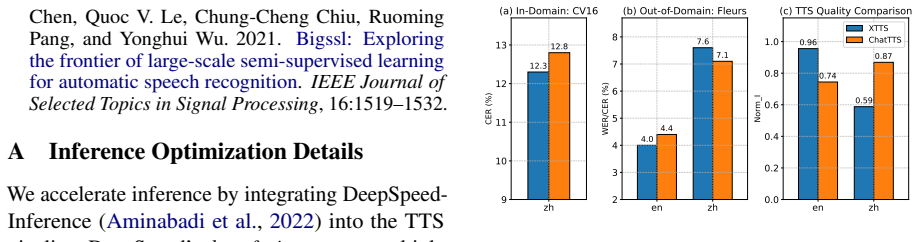
The load-bearing object is the Speech Back-Translation pipeline itself, whose critical design choice is freezing the audio tokenizer and vocoder of a pre-trained zero-shot TTS model and fine-tuning only its transformer on tens of hours of seed audio; this preserves acoustic stability while adapting to a new language, enabling a several-hundredfold expansion of training data. The second load-bearing piece is the normalized intelligibility metric, defined as $\mathrm{Norm\_I} = \exp\left((\mathrm{WER}_r - \mathrm{WER}_s)/\mathrm{WER}_r\right)$, a per-language quality gate that normalizes a judge ASR's error on synthetic speech ($\mathrm{WER}_s$) against its error on real speech ($\mathrm{WER}_r$) and yields a practical threshold near 0.01 for deciding whether synthetic data will help. Feasibility at the 500K-hour scale rests on speaker-embedding de-duplication of the roughly one million audio prompts (ECAPA2 at cosine-similarity threshold 0.8) and on a combined DeepSpeed-Inference and batch-inference speed-up of more than 30x. All three mechanisms work together: quality control via the metric, diversity via prompts and text, and scale via inference optimization.
What would settle it
Audit the roughly one million audio prompts (Appendix C) and the seed transcription data by computing speaker-embedding cosine similarity against the Common Voice, Voxpopuli, and MLS evaluation utterances; if any evaluation speaker appears among them above the 0.8 threshold, retrain the 500K-hour model with those clips removed and re-measure the reported 30 percent gain, and repeat the measurement for a test language whose prompt pool demonstrably excludes all evaluation voices.
Extended reading notes
Core claim
Speech Back-Translation treats an off-the-shelf zero-shot TTS model as the reverse model in back-translation: it is fine-tuned on only tens of hours of real transcribed speech per target language (with the audio tokenizer and vocoder frozen and only the transformer adapted, after BPE vocabulary expansion), then conditioned on roughly one million speaker-deduplicated audio prompts and large text corpora to synthesize speech at hundreds of times the seed volume. Scaled to ten languages, the authors generate 505,830 hours of synthetic speech—more than thirty times the 14,864 hours of real data—continue pre-training Whisper-large-v3 on the mixture, and report an average 30 percent transcription-error reduction over the base Whisper-large-v3 across Common Voice, Voxpopuli, and MLS, with low-resource languages improving 46 percent. The companion contribution is the normalized intelligibility score $\mathrm{Norm\_I} = \exp\!\left(\frac{\mathrm{WER}_r - \mathrm{WER}_s}{\mathrm{WER}_r}\right)$, which measures a judge ASR's error on synthetic speech relative to its error on real speech; empirically, values below about 0.01 predict that synthetic data will hurt ASR training while values above it predict gains. The authors' central claim is that this pipeline turns text corpora into a scalable substitute for human-labeled speech, making state-of-the-art multilingual ASR reachable with tens of hours of real audio per language.
Load-bearing premise
The 30 percent error reduction assumes that the audio prompts used for TTS synthesis and the seed transcription data share no speakers or recording conditions with the evaluation test sets, and that cosine-similarity speaker deduplication at 0.8 removes all near-identical voices.
Editorial extensions
If this is right
- Low-resource ASR can be scaled from textual corpora: languages with tens of hours of transcribed audio and access to text can receive hundreds of thousands of hours of training signal without new human transcription.
- Quality thresholds give a deployable gate: practitioners can measure a fine-tuned TTS's normalized intelligibility before mass synthesis and only generate data that clears the cutoff.
- Gains transfer out of domain: improvements on Common Voice carry over to Voxpopuli and MLS, so synthetic data adds robustness rather than mere benchmark fitting.
- The gains compound with model size and data volume: larger Whisper variants benefit more at larger synthetic data scales, implying the method will keep paying off as ASR models grow.
- Resource imbalance in natural corpora is flattened: the synthetic dataset rebalances per-language hours, addressing a structural weakness of Whisper's training distribution.
Reading between the lines
- A speaker-overlap audit is the obvious stress test: computing cosine similarity between the ~1M audio prompts and seed clips against the evaluation test sets would show whether the 30 percent figure survives removing any matching voices.
- The same pipeline likely extends to speech translation: synthesizing audio from parallel text corpora could attack the paired-audio bottleneck that end-to-end speech translation faces.
- The intelligibility threshold is probably judge- and task-dependent; re-calibrating Norm_I with a different judge ASR or noisy-reference speech would likely shift the cutoff, so the gate should be tuned per deployment setting.
- In-domain TTS prompting and fine-tuning amplified gains for Vietnamese, suggesting synthetic data should be actively steered toward target dialects, accents, or acoustic conditions rather than merely made diverse.
Editorial analysis
A structured set of objections, weighed in public.
Referee Report
Summary. The paper proposes Speech Back-Translation, a pipeline that fine-tunes a multilingual zero-shot TTS model on tens to a few hundred hours of real transcribed speech, then uses the fine-tuned model to synthesize large volumes of speech from text corpora. The synthetic audio is used to continue pre-training Whisper models for multilingual ASR. The authors report substantial gains: scaling synthetic data to 160,000 hours improves over a 3,800-hour real-data baseline (Table 2), and a 500,000-hour synthetic corpus yields an average 30% transcription error reduction over Whisper-large-v3 across ten languages (Table 4). They also propose a Normalized Intelligibility metric and claim to identify a threshold above which synthetic data helps ASR training.
Significance. If the empirical claims hold, this is an important result: it would demonstrate that off-the-shelf TTS systems fine-tuned on minimal real data can generate synthetic audio at hundreds of times the original volume and that this audio is sufficient to improve a strong multilingual ASR system, with particular benefit for low-resource languages. The paper provides extensive experiments across ten languages, three benchmarks, and five model sizes, and releases a repository. However, the central attribution of the gains to synthetic data is currently undermined by two issues: (1) the headline comparisons in Tables 2 and 4 vary both data source and data volume simultaneously, so the improvements could be driven by scale rather than by the synthetic channel; and (2) the evaluation benchmarks overlap with the TTS training, prompt, and seed-data channels in ways that are not verified to be disjoint, creating a credible leakage risk. The intelligibility threshold is also an empirical post-hoc finding rather than a predicted quantity.
major comments (4)
- [§5.2, Table 2] The central comparison 'Real-only' (3,800 hours of Common Voice) versus 'Speech BT' (160,000 hours) confounds data source with total training volume. The gains attributed to synthetic data may instead reflect the scaling behavior shown in Figure 4, where WER decreases monotonically with hours regardless of data type. A matched-size control is missing: for example, training on a sampled 3,800-hour subset of the synthetic data (to compare per-hour value), or, where available, training on larger real corpora (e.g., 160,000 hours of real data) or a pseudo-labeling baseline using the same text corpus. Without such a control, the claim that synthetic speech provides a specific benefit over simply using more real data is not established.
- [§5.5, Table 4] The 500K-hour experiment reports a 30% average error reduction over Whisper-large-v3, but the Real-only baseline uses 15,000 hours while Speech-BT uses 500,000 hours—a 33x difference in total data. The paper never states whether the real transcribed speech from Multilingual LibriSpeech, Voxpopuli, and viVoice was split into standard train/test partitions, so it is unclear if the evaluation sets of these benchmarks are included in the Real-only (or Speech-BT) training data. If any evaluation utterances are present in training, the reported improvements are inflated. The authors must specify the exact data provenance and verify disjointness between all training channels and each benchmark's test split.
- [Appendix B, Table 6, §5.1, §4.3] There is a substantial overlap risk between data used for TTS training/prompts/seed and the Common Voice evaluation set. XTTS's training data is stated as 'mainly from Common Voice' (Appendix B); 230K audio prompts are Common Voice clips (Table 6); Czech and Hungarian TTS seed data are sampled from Common Voice (§5.1); and Common Voice is also the in-domain evaluation. The deduplication described (cosine similarity 0.8) is applied among prompts, not between prompts/seed and evaluation speakers. Because XTTS is pretrained on Common Voice, even synthetic audio may inherit Common Voice acoustic characteristics, plausibly inflating in-domain results. The paper provides no check that evaluation speakers or recording conditions are absent from these channels; this must be verified (e.g., speaker-embedding comparison against test sets) before the reported gains can be attributed to the method.
- [§5.3, Figure 6] The 'critical intelligibility threshold around 0.01' is identified post hoc by inspecting the correlation plot; no confidence interval, cross-validation, or independent validation is provided. The abstract and introduction claim that the framework 'establish[es] clear thresholds' for when synthetic data benefits ASR, but the threshold is a single empirical observation. This weakens the claim that the metric is predictive, though it does not undermine the core scaling results if the data-leakage and volume-confound issues are resolved.
minor comments (6)
- [Abstract] The abstract claims 'just tens of hours of real transcribed speech' enables generation at 'hundreds of times the original volume', but the main 500K-hour experiment uses 15,000 hours of real data (Table 7); the 'tens of hours' statement applies only to the three low-resource languages in Section 5.1. Clarify this distinction to avoid overgeneralization.
- [§2.2] There is a typo: 'V ocoder' should be 'Vocoder'.
- [§3.2] The batch inference strategy groups multiple sentences with a single audio prompt, meaning all utterances in a batch share the same voice. This may reduce speaker diversity in the synthetic data; the paper could comment on how this affects downstream ASR performance.
- [§5.3, Figure 6] The x-axis label 'Normalized Intelligability' contains a spelling error; it should be 'Normalized Intelligibility'.
- [Table 3] The table layout for 'Approach 2' and 'Approach 3' is confusing: the rows 'Approach 2 + Synthetic data pre-train' and 'Approach 3 + Synthetic data pre-train' do not clearly indicate which components (in-domain fine-tuning, TTS prompting, TTS fine-tuning) are included. Restructure the table or add a column describing the method.
- [Appendix F.2] The sentence 'Back-Translation (Sennrich et al., 2016a; Edunov et al., 2018) is originally proposed machine translation' is grammatically incomplete; it should read 'is originally proposed for machine translation'.
Circularity Check
No significant circularity: the headline 30% ASR improvement is evaluated on external benchmarks and does not reduce to a fitted quantity, a self-citation, or a definitional identity.
full rationale
The paper's central empirical claim is that continuing pre-training Whisper-large-v3 on 15K real hours plus 500K synthetic hours reduces WER by about 30% on Common Voice, Voxpopuli, and MLS. This is an externally evaluated result: the improvement is measured against the base model on held-out benchmarks, not derived from the pipeline's own equations. The Normalized Intelligibility metric (Eq. 2) is an evaluation/analysis tool, not a training objective or a term in the loss, and the 0.01 threshold is a post-hoc summary of the correlation shown in Figure 6 rather than a predicted quantity used to construct the 500K-hour corpus. The paper does not claim to predict the 30% reduction from Norm_I; it reports an observed relationship. The self-citations (e.g., Wang and Lu 2022/2023; Wang et al. 2024) appear only as background references in related work and are not load-bearing for the main derivation. The unverified disjointness between TTS prompts, seed audio, real training data, and evaluation sets is a potential data-leakage/correctness concern, not a circularity: no equation or construction step in the paper makes the reported gains equal to the inputs. The scaling results, multilingual comparisons, and ablation-based conclusions are therefore not circular by construction.
Assumptions & free parameters
free parameters (3)
- Norm_I threshold =
~0.01
- Audio prompt deduplication cosine threshold =
0.8
- Vietnamese BPE vocabulary expansion size =
2,000 tokens
assumptions (3)
- domain assumption Whisper-large-v3 WER on synthetic speech is a valid proxy for synthetic speech quality for ASR training
- domain assumption Synthetic speech generated by TTS is sufficiently close to real speech to transfer to ASR training
- domain assumption Audio prompts and text corpus are diverse and disjoint from evaluation test speakers
Cite this review
Pith. "Pith review of From Tens of Hours to Tens of Thousands: Scaling Back-Translation for Speech Recognition." pith.science (2026). https://pith.science/paper/VFKTGZP3
@misc{pith2026250516972,
  author       = {Pith},
  title        = {Pith review of: From Tens of Hours to Tens of Thousands: Scaling Back-Translation for Speech Recognition},
  year         = {2026},
  howpublished = {\url{https://pith.science/paper/VFKTGZP3}},
  note         = {Machine review of arXiv:2505.16972}
}
read the original abstract
Recent advances in Automatic Speech Recognition (ASR) have been largely fueled by massive speech corpora. However, extending coverage to diverse languages with limited resources remains a formidable challenge. This paper introduces Speech Back-Translation, a scalable pipeline that improves multilingual ASR models by converting large-scale text corpora into synthetic speech via off-the-shelf text-to-speech (TTS) models. We demonstrate that just tens of hours of real transcribed speech can effectively train TTS models to generate synthetic speech at hundreds of times the original volume while maintaining high quality. To evaluate synthetic speech quality, we develop an intelligibility-based assessment framework and establish clear thresholds for when synthetic data benefits ASR training. Using Speech Back-Translation, we generate more than 500,000 hours of synthetic speech in ten languages and continue pre-training Whisper-large-v3, achieving average transcription error reductions of over 30\%. These results highlight the scalability and effectiveness of Speech Back-Translation for enhancing multilingual ASR systems.
Figures


Figures from the paper (3 more)


Reference graph
Works this paper leans on
-
[1]
online" 'onlinestring :=
ENTRY address archivePrefix author booktitle chapter edition editor eid eprint eprinttype howpublished institution journal key month note number organization pages publisher school series title type volume year doi pubmed url lastchecked label extra.label sort.label short.list INTEGERS output.state before.all mid.sentence after.sentence after.block STRING...
-
[2]
write newline
" write newline "" before.all 'output.state := FUNCTION n.dashify 't := "" t empty not t #1 #1 substring "-" = t #1 #2 substring "--" = not "--" * t #2 global.max substring 't := t #1 #1 substring "-" = "-" * t #2 global.max substring 't := while if t #1 #1 substring * t #2 global.max substring 't := if while FUNCTION word.in bbl.in capitalize " " * FUNCT...
-
[3]
2noise. 2024. Chattts. https://github.com/2noise/ChatTTS
work page 2024
-
[4]
Reza Yazdani Aminabadi, Samyam Rajbhandari, Minjia Zhang, Ammar Ahmad Awan, Cheng Li, Du Li, Elton Zheng, Jeff Rasley, Shaden Smith, Olatunji Ruwase, and Yuxiong He. 2022. https://api.semanticscholar.org/CorpusID:250243681 Deepspeed- inference: Enabling efficient inference of transformer models at unprecedented scale . SC22: International Conference for H...
work page 2022
-
[5]
Rosana Ardila, Megan Branson, Kelly Davis, Michael Henretty, Michael Kohler, Josh Meyer, Reuben Morais, Lindsay Saunders, Francis M. Tyers, and Gregor Weber. 2019. https://api.semanticscholar.org/CorpusID:209376338 Common voice: A massively-multilingual speech corpus . ArXiv, 1912.06670
arXiv 2019
-
[6]
Shekoofeh Azizi, Simon Kornblith, Chitwan Saharia, Mohammad Norouzi, and David J. Fleet. 2023. https://api.semanticscholar.org/CorpusID:258179174 Synthetic data from diffusion models improves imagenet classification . ArXiv, 2304.08466
arXiv 2023
-
[7]
Matthew Baas and Herman Kamper. 2021. https://api.semanticscholar.org/CorpusID:242757430 Voice conversion can improve asr in very low-resource settings . In Proceedings of Interspeech
work page 2021
-
[8]
Arun Babu, Changhan Wang, Andros Tjandra, Kushal Lakhotia, Qiantong Xu, Naman Goyal, Kritika Singh, Patrick von Platen, Yatharth Saraf, Juan Miguel Pino, Alexei Baevski, Alexis Conneau, and Michael Auli. 2021. https://api.semanticscholar.org/CorpusID:244270531 Xls-r: Self-supervised cross-lingual speech representation learning at scale . In Proceedings of...
work page 2021
Show all 57 references
-
[9]
Alexei Baevski, Henry Zhou, Abdel rahman Mohamed, and Michael Auli. 2020. https://api.semanticscholar.org/CorpusID:219966759 wav2vec 2.0: A framework for self-supervised learning of speech representations . ArXiv, 2006.11477
2020 arXiv
-
[10]
Ye Bai, Jingping Chen, Jitong Chen, Wei Chen, Zhuo Chen, Chen Ding, Linhao Dong, Qianqian Dong, Yujiao Du, Kepan Gao, Lu Gao, Yi Guo, Minglun Han, Ting Han, Wenchao Hu, Xinying Hu, Yuxiang Hu, Deyu Hua, Lu Huang, Ming Huang, Youjia Huang, Jishuo Jin, Fanliu Kong, Zongwei Lan, ...
2024 arXiv
-
[11]
Lo \"i c Barrault, Ond r ej Bojar, Marta R. Costa-juss \`a , Christian Federmann, Mark Fishel, Yvette Graham, Barry Haddow, Matthias Huck, Philipp Koehn, Shervin Malmasi, Christof Monz, Mathias M \"u ller, Santanu Pal, Matt Post, and Marcos Zampieri. 2019. https://aclanthology...
2019
-
[12]
Martijn Bartelds, Nay San, Bradley McDonnell, Dan Jurafsky, and Martijn B. Wieling. 2023. https://api.semanticscholar.org/CorpusID:258762740 Making more of little data: Improving low-resource automatic speech recognition using data augmentation . In Proceedings of ACL
2023
-
[13]
o lge, G \
Edresson Casanova, Kelly Davis, Eren G \"o lge, G \"o rkem G \"o knar, Iulian Gulea, Logan Hart, Aya Aljafari, Joshua Meyer, Reuben Morais, Samuel Olayemi, and Julian Weber. 2024. https://api.semanticscholar.org/CorpusID:270357767 Xtts: a massively multilingual zero-shot text-...
2024 arXiv
-
[14]
William Chen, Wangyou Zhang, Yifan Peng, Xinjian Li, Jinchuan Tian, Jiatong Shi, Xuankai Chang, Soumi Maiti, Karen Livescu, and Shinji Watanabe. 2024. https://api.semanticscholar.org/CorpusID:270869791 Towards robust speech representation learning for thousands of languages . ...
2024 arXiv
-
[15]
Shanbo Cheng, Zhichao Huang, Tom Ko, Hang Li, Ningxin Peng, Lu Xu, and Qini Zhang. 2024. https://api.semanticscholar.org/CorpusID:271571516 Towards achieving human parity on end-to-end simultaneous speech translation via llm agent . ArXiv, 2407.21646
2024 arXiv
-
[16]
Seamless Communication, Lo \"i c Barrault, Yu-An Chung, Mariano Coria Meglioli, David Dale, Ning Dong, Mark Duppenthaler, Paul-Ambroise Duquenne, Brian Ellis, Hady ElSahar, Justin Haaheim, John Hoffman, Min-Jae Hwang, Hirofumi Inaguma, Christopher Klaiber, Ilia Kulikov, Pengwe...
2023 arXiv
-
[17]
Alexis Conneau, Min Ma, Simran Khanuja, Yu Zhang, Vera Axelrod, Siddharth Dalmia, Jason Riesa, Clara Rivera, and Ankur Bapna. 2022. https://api.semanticscholar.org/CorpusID:249062909 Fleurs: Few-shot learning evaluation of universal representations of speech . 2022 IEEE Spoken...
2022
-
[18]
Marta Ruiz Costa-juss \`a , James Cross, Onur cCelebi, Maha Elbayad, Kenneth Heafield, Kevin Heffernan, Elahe Kalbassi, Janice Lam, Daniel Licht, Jean Maillard, Anna Sun, et al. 2022. https://api.semanticscholar.org/CorpusID:250425961 No language left behind: Scaling human-cen...
2022 arXiv
-
[19]
Galv \ a o Filho
Frederico Santos de Oliveira, Edresson Casanova, Arnaldo Candido J'unior, Anderson da Silva Soares, and Arlindo R. Galv \ a o Filho. 2023. https://api.semanticscholar.org/CorpusID:259203564 Cml-tts a multilingual dataset for speech synthesis in low-resource languages . ArXiv, ...
2023 arXiv
-
[20]
Sergey Edunov, Myle Ott, Michael Auli, and David Grangier. 2018. https://arxiv.org/abs/1808.09381 Understanding back-translation at scale . In Proceedings of EMNLP
2018 arXiv
-
[21]
Lijie Fan, Kaifeng Chen, Dilip Krishnan, Dina Katabi, Phillip Isola, and Yonglong Tian. 2023. https://api.semanticscholar.org/CorpusID:266052386 Scaling laws of synthetic images for model training … for now . In Proceedings of CVPR
2023
-
[22]
Hasegawa-Johnson, Shiyu Chang, and Yang Zhang
Heting Gao, Kaizhi Qian, Junrui Ni, Chuang Gan, Mark A. Hasegawa-Johnson, Shiyu Chang, and Yang Zhang. 2024. https://api.semanticscholar.org/CorpusID:272330629 Speech self-supervised learning using diffusion model synthetic data . In Proceedings of ICML
2024
-
[23]
Shah, Harkirat Singh Behl, Xin Wang, S \'e bastien Bubeck, Ronen Eldan, Adam Tauman Kalai, Yin Tat Lee, and Yuan-Fang Li
Suriya Gunasekar, Yi Zhang, Jyoti Aneja, Caio C'esar Teodoro Mendes, Allison Del Giorno, Sivakanth Gopi, Mojan Javaheripi, Piero Kauffmann, Gustavo de Rosa, Olli Saarikivi, Adil Salim, S. Shah, Harkirat Singh Behl, Xin Wang, S \'e bastien Bubeck, Ronen Eldan, Adam Tauman Kalai...
2023 arXiv
-
[24]
Di He, Yingce Xia, Tao Qin, Liwei Wang, Nenghai Yu, Tie-Yan Liu, and Wei-Ying Ma. 2016. https://api.semanticscholar.org/CorpusID:5758868 Dual learning for machine translation . In Proceedings of NeurIPS
2016
-
[25]
Haorui He, Zengqiang Shang, Chaoren Wang, Xuyuan Li, Yicheng Gu, Hua Hua, Liwei Liu, Chen Yang, Jiaqi Li, Peiyang Shi, Yuancheng Wang, Kai Chen, Pengyuan Zhang, and Zhizheng Wu. 2024. https://api.semanticscholar.org/CorpusID:271051306 Emilia: An extensive, multilingual, and di...
2024 arXiv
-
[26]
Cong Duy Vu Hoang, Philipp Koehn, Gholamreza Haffari, and Trevor Cohn. 2018. https://api.semanticscholar.org/CorpusID:51880064 Iterative back-translation for neural machine translation . In Proceedings of NMT@ACL
2018
-
[27]
Zhichao Huang, Rong Ye, Tom Ko, Qianqian Dong, Shanbo Cheng, Mingxuan Wang, and Hang Li. 2023. https://api.semanticscholar.org/CorpusID:266435250 Speech translation with large language models: An industrial practice . ArXiv, 2312.13585
2023 arXiv
-
[28]
Philipp Koehn. 2005. https://api.semanticscholar.org/CorpusID:38407095 Europarl: A parallel corpus for statistical machine translation . In Machine Translation Summit
2005
-
[29]
Jungil Kong, Jaehyeon Kim, and Jaekyoung Bae. 2020. https://api.semanticscholar.org/CorpusID:222291664 Hifi-gan: Generative adversarial networks for efficient and high fidelity speech synthesis . ArXiv, 2010.05646
2020 arXiv
-
[30]
Guillaume Lample, Ludovic Denoyer, and Marc'Aurelio Ranzato. 2018. https://api.semanticscholar.org/CorpusID:3518190 Unsupervised machine translation using monolingual corpora only . In Proceedings of ICLR
2018
-
[31]
Haoran Li, Qingxiu Dong, Zhengyang Tang, Chaojun Wang, Xingxing Zhang, Haoyang Huang, Shaohan Huang, Xiaolong Huang, Zeqiang Huang, Dongdong Zhang, Yuxian Gu, Xin Cheng, Xun Wang, Si-Qing Chen, Li Dong, et al. 2024. https://api.semanticscholar.org/CorpusID:267759981 Synthetic ...
2024 arXiv
-
[32]
Xingyuan Pan, Luyang Huang, Liyan Kang, Zhicheng Liu, Yu Lu, and Shanbo Cheng. 2024. https://api.semanticscholar.org/CorpusID:269930173 G-dig: Towards gradient-based diverse and high-quality instruction data selection for machine translation . In Proceedings of ACL
2024
-
[33]
Hannun, Vitaliy Liptchinsky, Gabriel Synnaeve, and Ronan Collobert
Vineel Pratap, Anuroop Sriram, Paden Tomasello, Awni Y. Hannun, Vitaliy Liptchinsky, Gabriel Synnaeve, and Ronan Collobert. 2020 a . https://api.semanticscholar.org/CorpusID:220380826 Massively multilingual asr: 50 languages, 1 model, 1 billion parameters . ArXiv, 2007.03001
2020 arXiv
-
[34]
Vineel Pratap, Andros Tjandra, Bowen Shi, Paden Tomasello, Arun Babu, Sayani Kundu, Ali Mamdouh Elkahky, Zhaoheng Ni, Apoorv Vyas, Maryam Fazel-Zarandi, Alexei Baevski, Yossi Adi, Xiaohui Zhang, Wei-Ning Hsu, Alexis Conneau, and Michael Auli. 2023. https://api.semanticscholar....
2023 arXiv
-
[35]
Vineel Pratap, Qiantong Xu, Anuroop Sriram, Gabriel Synnaeve, and Ronan Collobert. 2020 b . https://api.semanticscholar.org/CorpusID:226202134 Mls: A large-scale multilingual dataset for speech research . ArXiv, 2012.03411
2020 arXiv
-
[36]
Krishna C Puvvada, Piotr \.Z elasko, He Huang, Oleksii Hrinchuk, Nithin Rao Koluguri, Kunal Dhawan, Somshubra Majumdar, Elena Rastorgueva, Zhehuai Chen, Vitaly Lavrukhin, et al. 2024. https://arxiv.org/abs/2406.19674 Less is more: Accurate speech recognition & translation with...
2024 arXiv
-
[37]
Alec Radford, Jong Wook Kim, Tao Xu, Greg Brockman, Christine McLeavey, and Ilya Sutskever. 2022. https://api.semanticscholar.org/CorpusID:252923993 Robust speech recognition via large-scale weak supervision . ArXiv, 2212.04356
2022 arXiv
-
[38]
Samyam Rajbhandari, Jeff Rasley, Olatunji Ruwase, and Yuxiong He. 2019. https://api.semanticscholar.org/CorpusID:269617042 Zero: Memory optimizations toward training trillion parameter models . SC20: International Conference for High Performance Computing, Networking, Storage ...
2019
-
[39]
Blattmann, Dominik Lorenz, Patrick Esser, and Bj \"o rn Ommer
Robin Rombach, A. Blattmann, Dominik Lorenz, Patrick Esser, and Bj \"o rn Ommer. 2022. https://api.semanticscholar.org/CorpusID:245335280 High-resolution image synthesis with latent diffusion models . In Proceedings of CVPR
2022
-
[40]
Rico Sennrich, Barry Haddow, and Alexandra Birch. 2016 a . https://api.semanticscholar.org/CorpusID:15600925 Improving neural machine translation models with monolingual data . In Proceedings of ACL
2016
-
[41]
Rico Sennrich, Barry Haddow, and Alexandra Birch. 2016 b . https://api.semanticscholar.org/CorpusID:1114678 Neural machine translation of rare words with subword units . In Proceedings of ACL
2016
-
[42]
Hubert Siuzdak. 2023. https://arxiv.org/abs/2306.00814 Vocos: Closing the gap between time-domain and fourier-based neural vocoders for high-quality audio synthesis . ArXiv, 2306.00814
2023 arXiv
-
[43]
Jenthe Thienpondt and Kris Demuynck. 2023. https://api.semanticscholar.org/CorpusID:267027744 Ecapa2: A hybrid neural network architecture and training strategy for robust speaker embeddings . 2023 IEEE Automatic Speech Recognition and Understanding Workshop (ASRU), pages 1--8
2023
-
[44]
Yonglong Tian, Lijie Fan, Phillip Isola, Huiwen Chang, and Dilip Krishnan. 2023. https://api.semanticscholar.org/CorpusID:258999759 Stablerep: Synthetic images from text-to-image models make strong visual representation learners . ArXiv, 2306.00984
2023 arXiv
-
[45]
Hugo Touvron, Thibaut Lavril, Gautier Izacard, Xavier Martinet, Marie-Anne Lachaux, Timoth \'e e Lacroix, Baptiste Rozi \`e re, Naman Goyal, Eric Hambro, Faisal Azhar, Aur \'e lien Rodriguez, Armand Joulin, Edouard Grave, and Guillaume Lample. 2023 a . https://api.semanticscho...
2023 arXiv
-
[46]
Stone, Peter Albert, Amjad Almahairi, Yasmine Babaei, Nikolay Bashlykov, Soumya Batra, Prajjwal Bhargava, Shruti Bhosale, Daniel M
Hugo Touvron, Louis Martin, Kevin R. Stone, Peter Albert, Amjad Almahairi, Yasmine Babaei, Nikolay Bashlykov, Soumya Batra, Prajjwal Bhargava, Shruti Bhosale, Daniel M. Bikel, Lukas Blecher, Cristian Cant \'o n Ferrer, Moya Chen, Guillem Cucurull, David Esiobu, Jude Fernandes,...
2023 arXiv
-
[47]
Brandon Trabucco, Kyle Doherty, Max Gurinas, and Ruslan Salakhutdinov. 2023. https://api.semanticscholar.org/CorpusID:256900870 Effective data augmentation with diffusion models . ArXiv, 2302.07944
2023 arXiv
-
[48]
Changhan Wang, Morgane Rivi \`e re, Ann Lee, Anne Wu, Chaitanya Talnikar, Daniel Haziza, Mary Williamson, Juan Miguel Pino, and Emmanuel Dupoux. 2021. https://api.semanticscholar.org/CorpusID:230433640 Voxpopuli: A large-scale multilingual speech corpus for representation lear...
2021 arXiv
-
[49]
Chengyi Wang, Sanyuan Chen, Yu Wu, Zi-Hua Zhang, Long Zhou, Shujie Liu, Zhuo Chen, Yanqing Liu, Huaming Wang, Jinyu Li, Lei He, Sheng Zhao, and Furu Wei. 2023. https://api.semanticscholar.org/CorpusID:255440307 Neural codec language models are zero-shot text to speech synthesi...
2023 arXiv
-
[50]
Tianduo Wang, Shichen Li, and Wei Lu. 2024. https://api.semanticscholar.org/CorpusID:271431928 Self-training with direct preference optimization improves chain-of-thought reasoning . In Proceedings of ACL
2024
-
[51]
Tianduo Wang and Wei Lu. 2022. https://api.semanticscholar.org/CorpusID:253237244 Differentiable data augmentation for contrastive sentence representation learning . In Proceedings of EMNLP
2022
-
[52]
Tianduo Wang and Wei Lu. 2023. https://api.semanticscholar.org/CorpusID:259089125 Learning multi-step reasoning by solving arithmetic tasks . In Proceedings of ACL
2023
-
[53]
Tianwen Wei, Liang Zhao, Lichang Zhang, Bo Zhu, Lijie Wang, Haihua Yang, Biye Li, Cheng Cheng, Weiwei L \"u , Rui Hu, Chenxia Li, Liu Yang, Xilin Luo, Xue Gang Wu, Lunan Liu, Wenjun Cheng, et al. 2023. https://api.semanticscholar.org/CorpusID:264802115 Skywork: A more open bil...
2023 arXiv
-
[54]
Guanrou Yang, Fan Yu, Ziyang Ma, Zhihao Du, Zhifu Gao, Shiliang Zhang, and Xie Chen. 2024. https://api.semanticscholar.org/CorpusID:273507469 Enhancing low-resource asr through versatile tts: Bridging the data gap . ArXiv, 2410.16726
2024 arXiv
-
[55]
Heiga Zen, Viet Dang, Robert A. J. Clark, Yu Zhang, Ron J. Weiss, Ye Jia, Z. Chen, and Yonghui Wu. 2019. https://api.semanticscholar.org/CorpusID:102352475 Libritts: A corpus derived from librispeech for text-to-speech . In Proceedings of Interspeech
2019
-
[56]
Binbin Zhang, Hang Lv, Pengcheng Guo, Qijie Shao, Chao Yang, Lei Xie, Xin Xu, Hui Bu, Xiaoyu Chen, Chenchen Zeng, Di Wu, and Zhendong Peng. 2022. https://api.semanticscholar.org/CorpusID:238419629 Wenetspeech: A 10000+ hours multi-domain mandarin corpus for speech recognition ...
2022
-
[57]
Yu Zhang, Daniel S. Park, Wei Han, James Qin, Anmol Gulati, Joel Shor, Aren Jansen, Yuanzhong Xu, Yanping Huang, Shibo Wang, Zongwei Zhou, Bo Li, Min Ma, William Chan, Jiahui Yu, Yongqiang Wang, Liangliang Cao, Khe Chai Sim, Bhuvana Ramabhadran, Tara N. Sainath, Franccoise Bea...
2021
Reviewed August 7, 2026 · model on record in the stance chip above.
Discussion (0). Sign in to comment.