REVIEW 3 major objections 4 minor 34 references
Transfer Learning-Based Deep Residual Learning for Speech Recognition in Clean and Noisy Environments
T0 review · 3 major / 4 minor · reviewed 2026-08-16 · deepseek-v4-flash
Pith's one-line read A transfer-learned ResNet reaches 98.94% clean and 91.21% noisy digit accuracy on Aurora-2, beating four deep baselines.
desk verdict Transfer-learned ResNet on Aurora-2 gives plausible numbers, but the baseline comparison is borrowed from an intrusion-detection paper and the dataset description contradicts itself, so the claim is unverified. read the letter →
The pith
A machine-rendered reading of the paper's core claim, the machinery that carries it, and where it could break.
The reading
What carries the argument
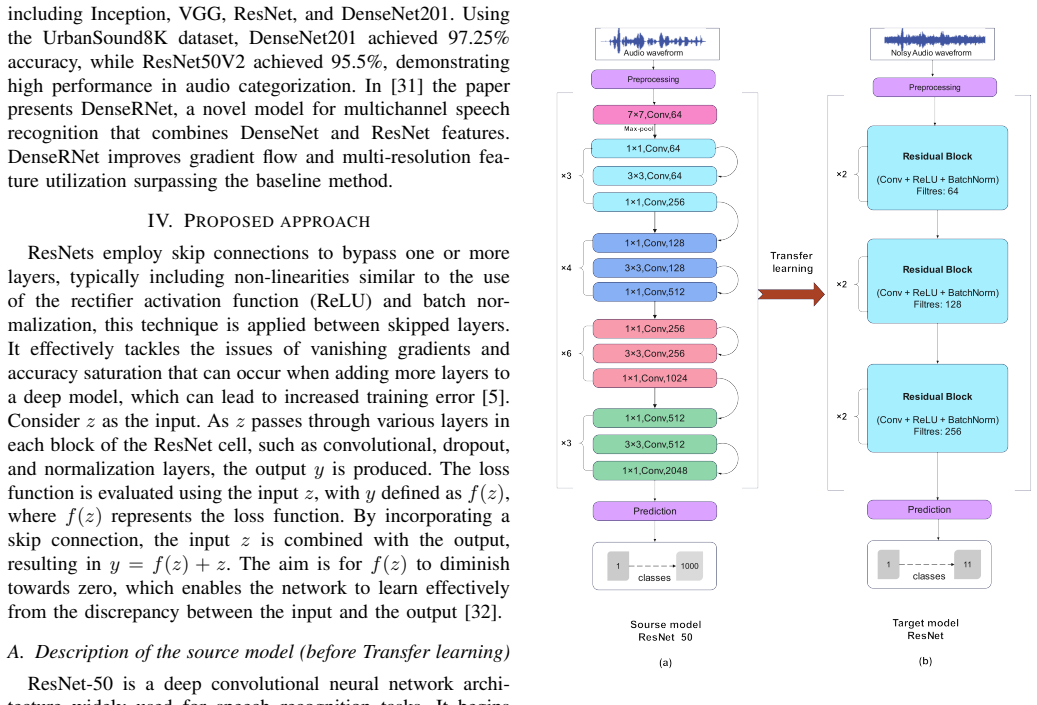
The load-bearing object is the residual block with skip connections, formulated as $y = f(z) + z$, where $f(z)$ is the layer output and $z$ the block input. The target model stacks three such blocks (64, 128, then 256 filters), each followed by max-pooling, and feeds the flattened output into a 128-unit dense layer with dropout 0.5 and an 11-way softmax. Transfer learning supplies the initial weights: the source ResNet-50, pretrained on ImageNet, is adapted to the speech task, so the first convolutional layers keep generic feature detectors while the final layers are replaced and fine-tuned. This combination is what the paper credits for the accuracy gain in both clean and noisy modes.
What would settle it
Re-run CNN, LSTM, BiLSTM, and CNN-LSTM on the same Aurora-2 clean and multi-condition training sets, using the same Mel-frequency features, optimizer, learning rate, and train/test split as the ResNet. If any of these baselines reaches or exceeds 98.94% in clean conditions or 91.21% in noisy conditions, the claimed superiority would not stand.
Extended reading notes
Core claim
The central discovery is that a 50-layer residual network, after being pretrained on ImageNet and then fine-tuned on Mel-frequency spectral features of Aurora-2 digits, recognizes isolated English digits with 98.94% accuracy in clean conditions and 91.21% in noisy conditions spanning four noise types and SNRs from 20 dB to 5 dB plus clean. The paper presents this as an improvement over four deep baselines—CNN, LSTM, BiLSTM, and concatenated CNN-LSTM—and over the same ResNet trained without transfer learning. The authors interpret the residual skip connections, which let the network learn the residual $y = f(z) + z$, together with transfer learning from a large visual domain, as the mechanism that makes deep training stable and keeps the model robust when noise is added.
Load-bearing premise
The claim that ResNet beats the four baselines assumes the baseline accuracies were measured on the same Aurora-2 data partition, features, and training conditions as the ResNet; the paper instead cites those numbers from a separate study, so the comparison may not be controlled.
Editorial extensions
If this is right
- For small-vocabulary digit recognition, transfer learning from an ImageNet-pretrained ResNet raises accuracy over training from scratch by roughly four points in clean and eight points in noisy conditions.
- The same fine-tuned ResNet yields lower word error rates than CNN, LSTM, BiLSTM, and CNN-LSTM in both clean and noisy modes, with the largest gap in noise.
- Multi-condition training with four noise types and several SNRs is sufficient for the transferred ResNet to generalize to unseen noise conditions in the Aurora-2 test sets.
- The 11-class softmax output makes the model directly usable as a frontend for connected-digit recognition tasks without modification.
Reading between the lines
- Because the baselines are imported from an unrelated intrusion-detection study, the fair comparison would require re-evaluating those architectures on the same Aurora-2 split; until then the reported margins over baselines are best read as indicative rather than measured.
- The same transfer-learning recipe could be tested on larger vocabulary or continuous speech benchmarks such as Aurora-4 or CHiME to see whether the ImageNet-pretrained frontend advantage persists beyond isolated digits.
- A direct ablation varying the input feature between MFCC and log-Mel spectrogram would clarify whether the gain comes from the residual architecture, the pretrained weights, or the feature choice.
Signed reviews
Editorial analysis
A structured set of objections, weighed in public.
Referee Report
Summary. The paper proposes a transfer-learning-based ResNet-50 system for isolated digit recognition in clean and noisy conditions, evaluated on a dataset the authors identify as Aurora-2. The authors report 98.94% clean and 91.21% noisy accuracy for their model, and claim these results are significantly higher than those of CNN, LSTM, BiLSTM, and a concatenated CNN-LSTM model. The paper provides architectural descriptions of the source and target models, a brief related-work survey, and an experimental section with two accuracy tables and one WER figure.
Significance. If the reported accuracy were obtained under a well-defined, reproducible protocol with properly matched baselines, the result would be a modest but potentially useful data point on transferring image-pretrained residual networks to small-vocabulary noisy speech recognition. The paper does not establish this, however: the baseline accuracies are attributed to an intrusion-detection paper rather than to experiments on Aurora-2, the dataset description is internally inconsistent, and no statistical analysis is provided. The claimed significance is therefore not currently supported.
major comments (3)
- [Table II and Section V-C] The central claim that ResNet outperforms CNN, LSTM, BiLSTM, and CNN-LSTM rests entirely on Table II, yet the four baseline accuracies are attributed to reference [17], which is a paper on IoT intrusion detection, not speech recognition. Section V-C describes the experimental protocol only for the proposed ResNet; no information is given about the feature front-end, data partition, noise conditions, or training details for the baselines. Without evidence that these numbers were produced on the same Aurora-2 task and setup, the margins in Table II (1.98 points clean, 0.49 points noisy) are meaningless and cannot support the claimed superiority.
- [Sections V-A and V-C] The dataset description is irreconcilable between two sections. Section V-A describes the standard Aurora-2 corpus with 8,440 clean training utterances and 4,004 test utterances, while Section V-C states that the experiments used a total of 4,824 isolated digit files, split equally into 2,412 clean and 2,412 noisy, with about 40% used for testing. These numbers cannot both describe the same corpus. The manuscript never clarifies which split was actually used, how the 11-class softmax model is applied to Aurora-2's connected-digit task, or how the binary clean/noisy split relates to the standard multi-condition training mode. As a result, even the proposed-model results are not tied to a reproducible public benchmark.
- [Tables I and II] All reported accuracies are single numbers with no error bars, no number of runs, and no statistical significance tests. Given the small differences in Table II, particularly the 0.49 percentage-point noisy-mode margin between ResNet (91.21%) and CNN-LSTM (90.72%), the improvements could easily be within run-to-run variance. The authors should report means and standard deviations over multiple independent runs and perform a significance test, for example a paired test across test sets, before claiming a significant improvement.
minor comments (4)
- [Abstract and Introduction] The phrase 'the authors evaluate' in the abstract should be 'we evaluate', and the sentence 'Addressing the detrimental impact... has been a persistent and significant research focus' is repeated nearly verbatim in the introduction; this should be streamlined.
- [Section II, reference [22]] The sentence introducing ResNet as 'introduced by He et al. in 2015' is cited to reference [22], which is a bird-call recognition paper, not the original ResNet paper. The correct citation is reference [10] (He et al., 2016).
- [Section IV-B] The final sentence of Section IV-B says the output dense layer uses softmax 'to classify the input 11 classes into one of several classes'; this is confusing and should be rewritten to say the softmax layer produces a probability distribution over the 11 digit classes.
- [Figure 4] The caption reads 'WER (%) Recognition rates obtained by CNN, LSTM, BiLSTM, and ResNet', but word error rate and recognition rate are distinct metrics and should not be conflated; the caption and the figure need to state clearly which quantity is plotted.
Circularity Check
No circularity: the reported accuracies are direct empirical measurements, not outputs forced by fitted inputs or self-citation.
full rationale
The paper's central claims are the measured accuracies in Tables I and II: ResNet before/after transfer learning on Aurora-2, and comparisons with CNN, LSTM, BiLSTM, and CNN-LSTM. These are empirical results, not derived quantities. There is no equation in which an input is defined in terms of an output, no parameter fitted to a subset and then renamed a prediction, and no uniqueness theorem invoked to force the architecture. The ResNet-50 source model, the three residual blocks of the target model, and the transfer-learning procedure are construction choices stated directly in Section IV; they are not derived from the Aurora-2 accuracies. The Table II comparison may be unreliable because the baselines are attributed to [17], an intrusion-detection paper, and the Aurora-2 description is internally inconsistent (Section V-A vs. V-C), but this is a reproducibility and external-validity concern, not circularity: the reported numbers are not mathematically forced by the paper's own definitions or by a self-citation chain. Since no specific circular reduction can be exhibited, the appropriate finding is no significant circularity.
Assumptions & free parameters
free parameters (5)
- Learning rate =
0.001
- Dropout rate =
0.5
- Residual block filter counts =
64, 128, 256
- Test split fraction =
~40%
- Dataset subset size =
4,824 files
assumptions (2)
- domain assumption Pre-trained ImageNet features are a useful starting point for speech spectrogram classification.
- domain assumption The described dataset and noise conditions are a valid subset of Aurora-2.
Cite this review
Pith. "Pith review of Transfer Learning-Based Deep Residual Learning for Speech Recognition in Clean and Noisy Environments." pith.science (2026). https://pith.science/paper/VFUN3ZHT
@misc{pith2026250501632,
  author       = {Pith},
  title        = {Pith review of: Transfer Learning-Based Deep Residual Learning for Speech Recognition in Clean and Noisy Environments},
  year         = {2026},
  howpublished = {\url{https://pith.science/paper/VFUN3ZHT}},
  note         = {Machine review of arXiv:2505.01632}
}
read the original abstract
Addressing the detrimental impact of non-stationary environmental noise on automatic speech recognition (ASR) has been a persistent and significant research focus. Despite advancements, this challenge continues to be a major concern. Recently, data-driven supervised approaches, such as deep neural networks, have emerged as promising alternatives to traditional unsupervised methods. With extensive training, these approaches have the potential to overcome the challenges posed by diverse real-life acoustic environments. In this light, this paper introduces a novel neural framework that incorporates a robust frontend into ASR systems in both clean and noisy environments. Utilizing the Aurora-2 speech database, the authors evaluate the effectiveness of an acoustic feature set for Mel-frequency, employing the approach of transfer learning based on Residual neural network (ResNet). The experimental results demonstrate a significant improvement in recognition accuracy compared to convolutional neural networks (CNN) and long short-term memory (LSTM) networks. They achieved accuracies of 98.94% in clean and 91.21% in noisy mode.
Figures


Figures from the paper (1 more)

Reference graph
Works this paper leans on
-
[17]
Enhancing iot security with cnn and lstm-based intrusion detection systems,
A. Gueriani, H. Kheddar, and A. C. Mazari, “Enhancing iot security with cnn and lstm-based intrusion detection systems,” in 2024 6th International Conference on Pattern Analysis and Intelligent Systems (PAIS). IEEE, 2024, pp. 1–7
work page 2024
-
[1]
Recent advances in end-to-end automatic speech recog- nition,
J. Li et al. , “Recent advances in end-to-end automatic speech recog- nition,” APSIPA Transactions on Signal and Information Processing , vol. 11, no. 1, 2022
2022
-
[2]
Enhancing cochlear implant signal coding with scaled dot-product attention,
B. Essaid, H. Kheddar, and N. Batel, “Enhancing cochlear implant signal coding with scaled dot-product attention,” in 2024 International Conference on Telecommunications and Intelligent Systems (ICTIS) . IEEE, 2024, pp. 1–6
work page 2024
-
[3]
B. Essaid, H. Kheddar, N. Batel, and M. E. Chowdhury, “Deep learning- based coding strategy for improved cochlear implant speech perception in noisy environments,” IEEE Access , 2025
work page 2025
-
[4]
Automatic speech recognition using advanced deep learning approaches: A survey,
H. Kheddar, M. Hemis, and Y . Himeur, “Automatic speech recognition using advanced deep learning approaches: A survey,” Information Fu- sion, p. 102422, 2024
2024
-
[5]
Advanced data exploitation in speech analysis: An overview,
Z. Zhang, N. Cummins, and B. Schuller, “Advanced data exploitation in speech analysis: An overview,” IEEE Signal Processing Magazine , vol. 34, no. 4, pp. 107–129, 2017
work page 2017
-
[6]
Automatic speech recognition with bert and ctc transformers: A review,
N. Djeffal, H. Kheddar, D. Addou, A. C. Mazari, and Y . Himeur, “Automatic speech recognition with bert and ctc transformers: A review,” in 2023 2nd International Conference on Electronics, Energy and Measurement (IC2EM), vol. 1. IEEE, 2023, pp. 1–8
work page 2023
-
[7]
Artificial intelligence for cochlear implants: Review of strategies, challenges, and perspectives,
B. Essaid, H. Kheddar, N. Batel, M. E. Chowdhury, and A. Lakas, “Artificial intelligence for cochlear implants: Review of strategies, challenges, and perspectives,” IEEE Access , 2024
work page 2024
Show all 34 references
-
[8]
Adversarial example detection techniques in speech recognition systems: A review,
K. Noureddine, H. Kheddar, and M. Maazouz, “Adversarial example detection techniques in speech recognition systems: A review,” in 2023 2nd International Conference on Electronics, Energy and Measurement (IC2EM), vol. 1. IEEE, 2023, pp. 1–7
2023
-
[9]
Noise-robust speech recognition: A comparative analysis of lstm and cnn approaches,
N. Djeffal, D. Addou, H. Kheddar, and S. A. Selouani, “Noise-robust speech recognition: A comparative analysis of lstm and cnn approaches,” in 2023 2nd International Conference on Electronics, Energy and Measurement (IC2EM), vol. 1. IEEE, 2023, pp. 1–6
2023
-
[10]
Deep residual learning for image recognition,
K. He, X. Zhang, S. Ren, and J. Sun, “Deep residual learning for image recognition,” in Proceedings of the IEEE conference on computer vision and pattern recognition , 2016, pp. 770–778
2016
-
[11]
Why resnet works? residuals generalize,
F. He, T. Liu, and D. Tao, “Why resnet works? residuals generalize,” IEEE transactions on neural networks and learning systems , vol. 31, no. 12, pp. 5349–5362, 2020
2020
-
[12]
The pascal chime speech separation and recognition challenge,
J. Barker, E. Vincent, N. Ma, H. Christensen, and P. Green, “The pascal chime speech separation and recognition challenge,” Computer Speech & Language , vol. 27, no. 3, pp. 621–633, 2013
2013
-
[13]
Boosted acoustic model learning and hypotheses rescoring on the chime-3 task,
S. Jalalvand, D. Falavigna, M. Matassoni, P. Svaizer, and M. Omologo, “Boosted acoustic model learning and hypotheses rescoring on the chime-3 task,” in 2015 IEEE Workshop on Automatic Speech Recog- nition and Understanding (ASRU) . IEEE, 2015, pp. 409–415
2015
-
[14]
A summary of the reverb challenge: state-of-the-art and remaining challenges in reverberant speech processing research,
K. Kinoshita, M. Delcroix, S. Gannot, E. A. P. Habets, R. Haeb-Umbach, W. Kellermann, V . Leutnant, R. Maas, T. Nakatani, B. Raj et al. , “A summary of the reverb challenge: state-of-the-art and remaining challenges in reverberant speech processing research,”EURASIP Journal on...
2016
-
[15]
Design of automatic speech recognition in noisy environments en- hancement and modification,
A. N. Nasret, A. B. Noori, A. A. Mohammed, and Z. S. Mahmood, “Design of automatic speech recognition in noisy environments en- hancement and modification,” Periodicals of Engineering and Natural Sciences, vol. 10, no. 1, pp. 71–77, 2021
2021
-
[16]
Discrete wavelet denoising into mfcc for noise suppressive in automatic speech recognition system
H. M. Soe Naing, R. Hidayat, R. Hartanto, and Y . Miyanaga, “Discrete wavelet denoising into mfcc for noise suppressive in automatic speech recognition system.” International Journal of Intelligent Engineering & Systems, vol. 13, no. 2, 2020
2020
-
[18]
Comparison of pre- trained cnns for audio classification using transfer learning,
E. Tsalera, A. Papadakis, and M. Samarakou, “Comparison of pre- trained cnns for audio classification using transfer learning,” Journal of Sensor and Actuator Networks , vol. 10, no. 4, p. 72, 2021
2021
-
[19]
Blind joint cfo and sto estimation for fbmc/oqam systems
D. Rebouh, A. B. Djebbar, and M. Besseghier, “Blind joint cfo and sto estimation for fbmc/oqam systems.” IEEE Communications Letters , 2023
2023
-
[20]
Improving pretrained yamnet for enhanced speech command detection via transfer learning,
S. Lachenani, H. Kheddar, and M. Ouldzmirli, “Improving pretrained yamnet for enhanced speech command detection via transfer learning,” in 2024 International Conference on Telecommunications and Intelligent Systems (ICTIS) . IEEE, 2024, pp. 1–6
2024
-
[21]
A comprehensive survey on transfer learning,
F. Zhuang, Z. Qi, K. Duan, D. Xi, Y . Zhu, H. Zhu, H. Xiong, and Q. He, “A comprehensive survey on transfer learning,” Proceedings of the IEEE , vol. 109, no. 1, pp. 43–76, 2020
2020
-
[22]
Bird call recognition using deep convolutional neural network, resnet-50,
M. Sankupellay and D. Konovalov, “Bird call recognition using deep convolutional neural network, resnet-50,” in Proc. Acoustics, vol. 7, no. 2018, 2018, pp. 1–8
2018
-
[23]
A transfer residual neural network based on resnet-50 for detection of steel surface defects,
L. Zhang, Y . Bian, P. Jiang, and F. Zhang, “A transfer residual neural network based on resnet-50 for detection of steel surface defects,” Applied Sciences , vol. 13, no. 9, p. 5260, 2023
2023
-
[24]
Deep transfer learning for automatic speech recognition: Towards better generalization,
H. Kheddar, Y . Himeur, S. Al-Maadeed, A. Amira, and F. Bensaali, “Deep transfer learning for automatic speech recognition: Towards better generalization,” Knowledge-Based Systems , vol. 277, p. 110851, 2023
2023
-
[25]
Deep learning-and transfer learning- based models for covid-19 detection using radiography images,
A. C. Mazari and H. Kheddar, “Deep learning-and transfer learning- based models for covid-19 detection using radiography images,” in 2023 International Conference on Advances in Electronics, Control and Communication Systems (ICAECCS) . IEEE, 2023, pp. 1–4
2023
-
[26]
Resnet based on multi-feature attention mechanism for sound classification in noisy environments,
C. Yang, X. Gan, A. Peng, and X. Yuan, “Resnet based on multi-feature attention mechanism for sound classification in noisy environments,” Sustainability, vol. 15, no. 14, p. 10762, 2023
2023
-
[27]
Learning noise robust resnet-based speaker em- bedding for speaker recognition,
M. MohammadAmini, D. Matrouf, J.-F. Bonastre, S. Dowerah, R. Ser- izel, and D. Jouvet, “Learning noise robust resnet-based speaker em- bedding for speaker recognition,” in Odyssey 2022: The Speaker and Language Recognition Workshop , 2022
2022
-
[28]
Deep residual neural net- works for audio spoofing detection,
M. Alzantot, Z. Wang, and M. B. Srivastava, “Deep residual neural net- works for audio spoofing detection,” arXiv preprint arXiv:1907.00501 , 2019
1907 arXiv
-
[29]
E2e-v2sresnet: Deep residual convolutional neural networks for end-to-end video driven speech synthesis,
N. Saleem, J. Gao, M. Irfan, E. Verdu, and J. P. Fuente, “E2e-v2sresnet: Deep residual convolutional neural networks for end-to-end video driven speech synthesis,” Image and Vision Computing , vol. 119, p. 104389, 2022
2022
-
[30]
Environmental sound classification based on transfer-learning techniques with multiple optimizers,
A. Ashurov, Y . Zhou, L. Shi, Y . Zhao, and H. Liu, “Environmental sound classification based on transfer-learning techniques with multiple optimizers,” Electronics, vol. 11, no. 15, p. 2279, 2022
2022
-
[31]
Acoustic model- ing with densely connected residual network for multichannel speech recognition,
J. Tang, Y . Song, L.-R. Dai, and I. V . McLoughlin, “Acoustic model- ing with densely connected residual network for multichannel speech recognition,” 2018
2018
-
[32]
A customized residual neural network and bi-directional gated recurrent unit-based automatic speech recognition model,
S. Reza, M. C. Ferreira, J. J. Machado, and J. M. R. Tavares, “A customized residual neural network and bi-directional gated recurrent unit-based automatic speech recognition model,” Expert Systems with Applications, vol. 215, p. 119293, 2023
2023
-
[33]
Transformers and large language models for efficient intrusion detection systems: A comprehensive survey,
H. Kheddar, “Transformers and large language models for efficient intrusion detection systems: A comprehensive survey,” arXiv preprint arXiv:2408.07583, 2024
2024 arXiv
-
[34]
Machine learning and vision transformers for thyroid carcinoma diagnosis: A review,
Y . Habchi, H. Kheddar, Y . Himeur, A. Boukabou, A. Chouchane, A. Ouamane, S. Atalla, and W. Mansoor, “Machine learning and vision transformers for thyroid carcinoma diagnosis: A review,” arXiv preprint arXiv:2403.13843, 2024. ‘
2024
Reviewed August 16, 2026 · model on record in the stance chip above.
Discussion (0). Continue with ORCID to comment.