REVIEW 3 major objections 5 minor 21 references
APEX: Approximate-but-exhaustive search for ultra-large combinatorial synthesis libraries
T0 review · 3 major / 5 minor · reviewed 2026-08-15 · deepseek-v4-flash
Pith's one-line read The paper claims that a factorized surrogate embedding lets a single GPU retrieve the approximate top million compounds of a 10-billion-compound synthesis library in under 30 seconds.
desk verdict APEX is a credible method with a genuinely useful open benchmark, but its headline retrieval claims hinge on a nested train/eval split and an additivity assumption whose tail behavior is never directly tested. read the letter →
The pith
A machine-rendered reading of the paper's core claim, the machinery that carries it, and where it could break.
The reading
What carries the argument
The reaction factorizer: a stack of encoders (SynthonEncoder, RgroupEncoder, ReactionEncoder) paired with a SynthonValueEncoder and RgroupKeyEncoder that yield an associative contribution u_{r,s} = K_r v_s for assigning synthon s to R-group r. The factorization replaces the surrogate embedding g_θ(x) with the sum of u_{r,s} over the molecule's R-group assignments, and feeding that into the surrogate's linear head produces the APEX score as a sum of per-synthon contributions plus a bias. This makes scoring additive across building blocks, enabling all synthon contributions to be precomputed and cached as a |S|×d matrix; scoring a molecule then costs a few additions, and a streamed GPU top-k pass over every product in the library finishes in seconds.
What would settle it
Measure, on the 12M enumerated library, the residual between the true docking score and the APEX additive score for each molecule. If, for molecules sharing one R-group, this residual is strongly predicted by the choice of the other R-groups, the additive model is missing cross-R-group interactions; a calculation showing that top-k recall at any k is not monotone in reconstruction error would likewise indicate the approximate objective selects for reconstruction accuracy rather than true docking quality.
Extended reading notes
Core claim
APEX's central claim is that a surrogate model whose tasks are linear heads on a shared molecular embedding can be factorized across the library's R-group structure. A pair of learned maps produces, for each R-group r and synthon s, an associative contribution u_{r,s} = K_r v_s, and the factorized embedding is the sum of these contributions over the molecule's R-group assignments. Because the objective and constraints are linear functions of the embedding, their factorized versions become sums of per-synthon terms v_{i,r,s}, so the score of each compound is computed with a few additions after the contributions are cached. The paper reports that, on a benchmark CSL of 12 million fully docked compounds, APEX's top-100,000 set recovers a substantially larger fraction of the ground-truth top-j compounds than random selection, matches or beats Thompson sampling with equal evaluation budgets, and that on a 10-billion-compound version of the library a top-1,000,000 retrieval completes in 10.9–24.3 seconds on a single Tesla T4 GPU. The reported scaling is made possible by replacing per-molecule neural evaluations with a streamed summation over cached contributions, using a GPU chain-of-batches top-k implementation.
Load-bearing premise
The load-bearing premise is that a molecule's docking-relevant embedding can be recovered as a sum of independent per-building-block contributions; if interactions between R-groups matter for docking scores, the additive reconstruction misorders molecules and the approximate top-k degrades.
Editorial extensions
If this is right
- If the central claim holds, a screening query becomes declarative: specifying an objective and constraints returns the factorized-optimal top-k in seconds, and changing constraints does not require re-running docking or the surrogate.
- Because every product in the library is scored rather than sampled, high-scoring compounds that stochastic search would miss are in principle retrievable, subject to the fidelity of the factorization.
- At matched evaluation budgets APEX matches or beats Thompson sampling on top-j recall, and it does so with a runtime that does not grow with the number of compounds scored per budget.
- The same cached synthon contributions serve any linear surrogate head, so the runtime cost of adding a new objective or constraint is negligible after the first factorized pass.
Reading between the lines
- If the factorization is as accurate as the reported aggregate R² suggests, the same cached contributions could serve any linear surrogate head, so the 30-second figure is not specific to docking; co-folding or ML affinity predictors with learnable embeddings would inherit the speedup.
- The benchmark library was built by fragmenting ZINC22 lead-like compounds with BRICS, which may not reproduce the synthon-reuse and reaction-size distributions of commercial make-on-demand libraries; the factorization error, and hence the retrieval guarantee, is library-dependent until shown otherwise.
- A natural diagnostic the paper does not report is recall as a function of per-molecule reconstruction error: if users could predict when the additive score is trustworthy for a given molecule, they could decide which retrieved compounds deserve re-docking without re-scoring the whole library.
- Because the factorizer is trained with no labels on the target library, nothing forces it to preserve the docking-relevant geometry of the embedding; an explicit stress test with fragments whose activity depends on their partner context would map where the approximation breaks.
Signed reviews
Editorial analysis
A structured set of objections, weighed in public.
Referee Report
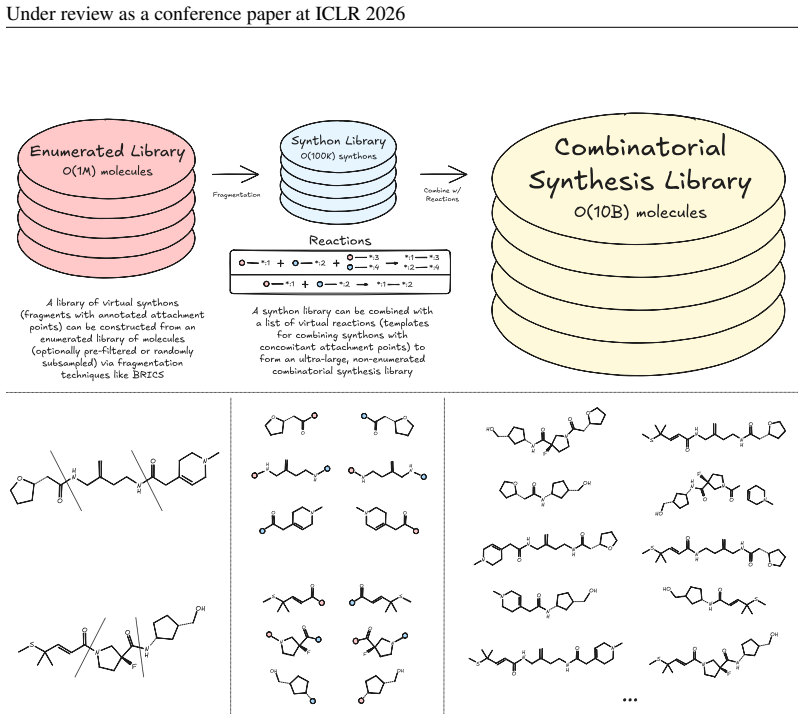
Summary. The paper introduces APEX, a protocol for exhaustive virtual screening of combinatorial synthesis libraries (CSLs). APEX first trains a neural surrogate g_θ on a labeled subset of molecules to predict docking scores and physicochemical properties. It then trains a 'factorizer' that reconstructs the surrogate's d-dimensional embedding as a sum of per-R-group associative contributions u_{r,s}, so that any product's predicted score is a sum of cached synthon terms plus a bias. This factorization allows all products in the library to be evaluated on a GPU in a streaming fashion, and the paper claims exact retrieval of the (surrogate-defined) top-k set. The authors construct a 10B-compound CSL by BRICS fragmentation of ZINC22 molecules, fully enumerate a 12M-compound subset with AutoDock Vina docking scores on five targets and RDKit properties, and evaluate APEX's recall of ground-truth top-j sets on the 12M library. They also compare against Thompson sampling and report GPU runtimes below 30 seconds for top-1M retrieval on the 10B library under drug-likeness constraints.
Significance. If the methodological concerns are resolved, APEX would be a significant contribution: it replaces per-molecule expensive scoring with a cached additive factorization, making exhaustive ranking of ultra-large CSLs practical, and it ships an open benchmark, code, and trained model weights. The central idea of factorizing surrogate embeddings to enable exhaustive top-k search is attractive and the engineering (GPU top-k with chain-of-batches) is a real strength. However, the two load-bearing assumptions—that the additive factorization preserves ranking in the upper tail, and that the empirical evaluation is not contaminated by training/evaluation overlap—are not sufficiently established in the current manuscript.
major comments (3)
- [Section 2.1 and Section 4.1] The training and evaluation sets appear to be nested, which threatens the validity of the recall numbers in Figure 3. Section 2.1 says the authors generated a 1M-product library and a 12M-product library by 'uniformly downsampling each reaction'. If the 1M library is a subset of the 12M library, then exact molecules and their docking labels used to train the surrogate also appear in the evaluation set, and the factorizer is trained on their embeddings during the 12M factorizer training. This would allow memorization to inflate recall. The sentence 'to address data leakage concerns' does not address this overlap because a random downsample of a larger library typically contains many of the same products. The authors should either prove that the 1M and 12M sets are disjoint, construct a held-out disjoint subset (e.g., by holding out whole reactions or by constraining synthon combinations), or rerun the evaluation on a set guaranteed to contain no training molecules.
- [Section 3.2, Eq. (11); Figure 7] The additive factorization in Eq. (11) is the sole mechanism that makes exhaustive search possible, but the paper does not establish that it preserves the ranking of the upper tail that defines top-k sets. Figure 7 reports aggregate R² of the factorized predictions on a random sample of the 12M library; aggregate R² is not sensitive to systematic misranking of a small subpopulation, and the top-k compounds are exactly such a subpopulation. The direct recall evaluation in Figure 3 is the right kind of evidence, but it is confounded by the possible train/test overlap in the previous comment. To support the 10B claims, the authors should report recall-j-at-k conditioned on per-molecule reconstruction error, stratify by the number of R-groups (two vs three components), and show where the retrieved top-j compounds sit in the reconstruction-error distribution relative to the full library. Without these diagnostics, one cannot tell whether the 30-second 10B search returns compounds that are close to the true top-k or merely products that happen to be well-approximated by the additive model.
- [Section 3.3, Eqs. (4) and (13)] The claimed robustness of the APEX factorization to 'errors in variables' is not supported. The argument appears to be that because the surrogate is trained with additive noise on embeddings (Eq. (4)), later replacing g_θ(x) with the factorized reconstruction ĝ_λ(χ) is a benign perturbation. But the factorizer is trained to minimize MSE (Eq. (12)), not to produce errors that match the isotropic noise p(ε); the reconstruction errors are structured, depend on the molecular graph, and can be systematic in the region of low docking scores that is most important for top-k retrieval. The paper should either provide a formal condition under which the substitution error behaves like the training-time noise, or soften the claim and instead state that this is an empirical approximation validated by the retrieval experiments.
minor comments (5)
- [Section 4.1 and Figure 3] The main recall plot does not specify the values of j used, the number of repeated trials, or error bars; please include these details so the reader can assess the variability of the reported recall rates.
- [Section 2.1] Please state explicitly whether the 1M and 12M libraries are generated as nested subsets of the same reaction grid, and if so, describe how the train/evaluation split avoids exact compound overlap.
- [Section 3.1, Eq. (4)] The embedding noise distribution p(ε) is not specified; please state the distribution and its variance, since the robustness claim in Section 3.3 depends on its properties.
- [Section 4.3, Table 1] The table reports averages over five targets; please report per-target runtimes or standard deviations, and clarify whether the reported GPU time includes the final SMILES/DataFrame construction step.
- [Figure 7] The caption says 'docking scores (in bold)' but does not enumerate the 28 endpoints; please list the endpoints or provide a table so the reader can distinguish docking-score R² from physicochemical-property R².
Circularity Check
No significant circularity: APEX's factorized top-k retrieval is validated against independently computed docking labels.
full rationale
The paper's central claim is not circular. APEX solves problem (17), which is defined in terms of its own factorized surrogate; the paper explicitly labels the retrieved set approximate and reserves 'exact' for exhaustive evaluation relative to that factorized objective (Eqs. 11, 16, 17). The utility claim is then tested against independently computed AutoDock Vina docking scores on a fully enumerated 12M-compound CSL (Section 4.1, Eq. 19), so recall is measured against external labels rather than the method's own outputs. The self-citation to Pedawi et al. (2022) supplies the hierarchical encoder/factorizer design (Section 3.2), but that design is implemented, trained, and empirically evaluated in this paper rather than being invoked as an unexamined theorem; no uniqueness or forbidden-alternatives argument rests on it. The additive factorization in Eq. 11 is an explicit modeling assumption whose reconstruction quality is measured (Figure 7); any resulting divergence between factorized and true top-k sets is a robustness/validity concern, not a circular reduction. The stated limitation about not ensuring synthetic feasibility (Section 2.1) is orthogonal to circularity. No load-bearing step reduces by definition or by self-citation to its own input, so the circularity score is 0.
Assumptions & free parameters
free parameters (2)
- embedding dimension d =
64
- embedding noise distribution p(epsilon) =
not specified (isotropic normal implied)
assumptions (4)
- domain assumption AutoDock Vina docking scores are a valid proxy for molecular binding affinity on the five targets.
- domain assumption A surrogate trained on the 1M-product CSL generalizes to the 12M and 10B product spaces.
- domain assumption The additive reconstruction in Eq. 11 captures the embedding information needed for top-k ranking.
- standard math Deep set encoders can represent the required permutation-invariant aggregation over synthons and R-groups.
Cite this review
Pith. "Pith review of APEX: Approximate-but-exhaustive search for ultra-large combinatorial synthesis libraries." pith.science (2026). https://pith.science/paper/VFUZQSFD
@misc{pith2026251024380,
  author       = {Pith},
  title        = {Pith review of: APEX: Approximate-but-exhaustive search for ultra-large combinatorial synthesis libraries},
  year         = {2026},
  howpublished = {\url{https://pith.science/paper/VFUZQSFD}},
  note         = {Machine review of arXiv:2510.24380}
}
read the original abstract
Make-on-demand combinatorial synthesis libraries (CSLs) like Enamine REAL have significantly enabled drug discovery efforts. However, their large size presents a challenge for virtual screening, where the goal is to identify the top compounds in a library according to a computational objective (e.g., optimizing docking score) subject to computational constraints under a limited computational budget. For current library sizes -- numbering in the tens of billions of compounds -- and scoring functions of interest, a routine virtual screening campaign may be limited to scoring fewer than 0.1% of the available compounds, leaving potentially many high scoring compounds undiscovered. Furthermore, as constraints (and sometimes objectives) change during the course of a virtual screening campaign, existing virtual screening algorithms typically offer little room for amortization. We propose the approximate-but-exhaustive search protocol for CSLs, or APEX. APEX utilizes a neural network surrogate that exploits the structure of CSLs in the prediction of objectives and constraints to make full enumeration on a consumer GPU possible in under a minute, allowing for exact retrieval of approximate top-k sets. To demonstrate APEX's capabilities, we develop a benchmark CSL comprised of more than 10 million compounds, all of which have been annotated with their docking scores on five medically relevant targets along with physicohemical properties measured with RDKit such that, for any objective and set of constraints, the ground truth top-k compounds can be identified and compared against the retrievals from any virtual screening algorithm. We show APEX's consistently strong performance both in retrieval accuracy and runtime compared to alternative methods.
Figures


Figures from the paper (5 more)


Reference graph
Works this paper leans on
-
[1]
write newline
" write newline "" before.all 'output.state := FUNCTION n.dashify 't := "" t empty not t #1 #1 substring "-" = t #1 #2 substring "--" = not "--" * t #2 global.max substring 't := t #1 #1 substring "-" = "-" * t #2 global.max substring 't := while if t #1 #1 substring * t #2 global.max substring 't := if while FUNCTION format.date year duplicate empty "emp...
-
[2]
CCCL : CUDA C++ C ore L ibraries , 2023
CCCL Development Team . CCCL : CUDA C++ C ore L ibraries , 2023. URL https://github.com/NVIDIA/cccl
work page 2023
-
[3]
Miles Congreve, Robin Carr, Chris Murray, and Harren Jhoti. A ``rule of three'' for fragment-based lead discovery? Drug Discovery Today, 8 0 (19): 0 876--877, 2003
work page 2003
-
[4]
Saulo HP de Oliveira, Aryan Pedawi, Victor Kenyon, and Henry van den Bedem. NGT : Generative AI with synthesizability guarantees discovers MC2R inhibitors from a tera-scale virtual screen. Journal of Medicinal Chemistry, 67 0 (21): 0 19417--19427, 2024
work page 2024
-
[5]
On the art of compiling and using ``drug-like'' chemical fragment spaces
Jorg Degen, Christof Wegscheid-Gerlach, Andrea Zaliani, and Matthias Rarey. On the art of compiling and using ``drug-like'' chemical fragment spaces. ChemMedChem, 3 0 (10): 0 1503, 2008
work page 2008
-
[6]
DOCKSTRING : Easy molecular docking yields better benchmarks for ligand design
Miguel Garc \' a-Orteg \'o n, Gregor NC Simm, Austin J Tripp, Jos \'e Miguel Hern \'a ndez-Lobato, Andreas Bender, and Sergio Bacallado. DOCKSTRING : Easy molecular docking yields better benchmarks for ligand design. Journal of Chemical Information and Modeling, 62 0 (15): 0 3486--3502, 2022
work page 2022
-
[7]
Errors in variables and other unobservables
Zvi Griliches. Errors in variables and other unobservables. Econometrica: Journal of the Econometric Society, pp.\ 971--998, 1974
work page 1974
-
[8]
Physiochemical drug properties associated with in vivo toxicological outcomes
Jason D Hughes, Julian Blagg, David A Price, Simon Bailey, Gary A DeCrescenzo, Rajesh V Devraj, Edmund Ellsworth, Yvette M Fobian, Michael E Gibbs, Richard W Gilles, et al. Physiochemical drug properties associated with in vivo toxicological outcomes. Bioorganic & Medicinal Chemistry Letters, 18 0 (17): 0 4872--4875, 2008
work page 2008
Show all 21 references
-
[9]
Thompson sampling: An efficient method for searching ultra-large synthesis on demand databases
Kathryn Klarich, Brian Goldman, Trevor Kramer, Patrick Riley, and W Patrick Walters. Thompson sampling: An efficient method for searching ultra-large synthesis on demand databases. Journal of Chemical Information and Modeling, 2024
2024
-
[10]
Experimental and computational approaches to estimate solubility and permeability in drug discovery and development settings
Christopher A Lipinski, Franco Lombardo, Beryl W Dominy, and Paul J Feeney. Experimental and computational approaches to estimate solubility and permeability in drug discovery and development settings. Advanced Drug Delivery Reviews, 23 0 (1-3): 0 3--25, 1997
1997
-
[11]
CU ina: An efficient GPU implementation of A uto D ock V ina
Adrian Morrison, Greg Friedland, and Izhar Wallach. CU ina: An efficient GPU implementation of A uto D ock V ina. In American Chemical Society Fall 2020 Virtual Meeting & Expo, August 2020. URL https://blog.atomwise.com/efficient-gpu-implementation-of-autodock-vina
2020
-
[12]
An efficient graph generative model for navigating ultra-large combinatorial synthesis libraries
Aryan Pedawi, Pawel Gniewek, Chaoyi Chang, Brandon Anderson, and Henry van den Bedem. An efficient graph generative model for navigating ultra-large combinatorial synthesis libraries. Advances in Neural Information Processing Systems, 35: 0 8731--8745, 2022
2022
-
[13]
Through the looking glass: Navigating in latent space to optimize over combinatorial synthesis libraries
Aryan Pedawi, Saulo De Oliveira, and Henry van den Bedem. Through the looking glass: Navigating in latent space to optimize over combinatorial synthesis libraries. In NeurIPS 2023 Generative AI and Biology (GenBio) Workshop, 2023
2023
-
[14]
Synthon-based ligand discovery in virtual libraries of over 11 billion compounds
Arman A Sadybekov, Anastasiia V Sadybekov, Yongfeng Liu, Christos Iliopoulos-Tsoutsouvas, Xi-Ping Huang, Julie Pickett, Blake Houser, Nilkanth Patel, Ngan K Tran, Fei Tong, et al. Synthon-based ligand discovery in virtual libraries of over 11 billion compounds. Nature, 601 0 (...
2022
-
[15]
ZINC -22: A free multi-billion-scale database of tangible compounds for ligand discovery
Benjamin I Tingle, Khanh G Tang, Mar Castanon, John J Gutierrez, Munkhzul Khurelbaatar, Chinzorig Dandarchuluun, Yurii S Moroz, and John J Irwin. ZINC -22: A free multi-billion-scale database of tangible compounds for ligand discovery. Journal of Chemical Information and Model...
2023
-
[16]
A uto D ock V ina: Improving the speed and accuracy of docking with a new scoring function, efficient optimization, and multithreading
Oleg Trott and Arthur J Olson. A uto D ock V ina: Improving the speed and accuracy of docking with a new scoring function, efficient optimization, and multithreading. Journal of Computational Chemistry, 31 0 (2): 0 455--461, 2010
2010
-
[17]
Molecular properties that influence the oral bioavailability of drug candidates
Daniel F Veber, Stephen R Johnson, Hung-Yuan Cheng, Brian R Smith, Keith W Ward, and Kenneth D Kopple. Molecular properties that influence the oral bioavailability of drug candidates. Journal of Medicinal Chemistry, 45 0 (12): 0 2615--2623, 2002
2002
-
[18]
Parallel top-k algorithms on GPU : A comprehensive study and new methods
Jingrong Zhang, Akira Naruse, Xipeng Li, and Yong Wang. Parallel top-k algorithms on GPU : A comprehensive study and new methods. In Proceedings of the International Conference for High Performance Computing, Networking, Storage and Analysis, SC '23, New York, NY, USA, 2023. A...
2023
-
[19]
@esa (Ref
\@ifxundefined[1] #1\@undefined \@firstoftwo \@secondoftwo \@ifnum[1] #1 \@firstoftwo \@secondoftwo \@ifx[1] #1 \@firstoftwo \@secondoftwo [2] @ #1 \@temptokena #2 #1 @ \@temptokena \@ifclassloaded agu2001 natbib The agu2001 class already includes natbib coding, so you should ...
-
[20]
\@lbibitem[] @bibitem@first@sw\@secondoftwo \@lbibitem[#1]#2 \@extra@b@citeb \@ifundefined br@#2\@extra@b@citeb \@namedef br@#2 \@nameuse br@#2\@extra@b@citeb \@ifundefined b@#2\@extra@b@citeb @num @parse #2 @tmp #1 NAT@b@open@#2 NAT@b@shut@#2 \@ifnum @merge>\@ne @bibitem@firs...
-
[21]
wO4ݾ8 3_F Ƞ+9 ut 70o J? n Z] 97NkҋY ol(E Կ8)[fl _ 9'8@ = b .&j (sG usa`o p8/vιnL?8y|ԋ Wm(p6.=?/ eP+jߏ3\ Fۿq= z?x:DGݫm D
@open @close @open @close and [1] URL: #1 \@ifundefined chapter * \@mkboth \@ifxundefined @sectionbib * \@mkboth * \@mkboth\@gobbletwo \@ifclassloaded amsart * \@ifclassloaded amsbook * \@ifxundefined @heading @heading NAT@ctr thebibliography [1] @ \@biblabel @NAT@ctr \@bibset...
2023 arXiv
Reviewed August 15, 2026 · model on record in the stance chip above.
Discussion (0). Continue with ORCID to comment.