REVIEW 3 major objections 4 minor 59 references
Density functional analysis: The theory of density-corrected DFT
T0 review · 3 major / 4 minor · reviewed 2026-08-14 · deepseek-v4-flash
Pith's one-line read Every energy difference between two DFT calculations can be decomposed exactly into a part caused by the change in functional and a part caused by the change in density.
desk verdict Exact error decomposition for arbitrary functional pairs is solid; the practical 'typical systems' criteria are under-validated, but the paper is worth serious review. read the letter →
The pith
A machine-rendered reading of the paper's core claim, the machinery that carries it, and where it could break.
The reading
What carries the argument
The load-bearing object is the energetic distance $D_v[\Delta n] = E_v[n_v + \Delta n] - E_v[n_v] \ge 0$, which measures how much a total energy functional rises when its density is moved away from its minimum. Adding and subtracting the crossed energy $E^{(1)}_v[n^{(0)}_v]$ in the definition of $\Delta E_v$ produces the exact decomposition, and the same trick reversed produces the second identity. The supporting machinery is the $\alpha$-interpolated functional $E^{(\alpha)}_{XC}[n] = E^{(0)}_{XC}[n] + \alpha\Delta E_{XC}[n]$, whose minimizing density $n^{(\alpha)}_v$ satisfies the Hellmann-Feynman relation $\partial E^{(\alpha)}_v/\partial\alpha = \Delta E_{XC}[n^{(\alpha)}_v]$, giving the integrated interpolation formula. Quadratic Taylor expansions of $D_v$ around the minima provide the practical basin criterion $D_v[\Delta n] \approx \tfrac12 K_v[\Delta n]$.
What would settle it
Perform, for a strongly stretched or strongly correlated system, a full self-consistent calculation with two functionals whose densities differ substantially, and compare the exact density-driven terms $D^{(0)}_v[\Delta n_v]$ and $D^{(1)}_v[-\Delta n_v]$ with their quadratic estimates $\tfrac12 K^{(j)}_v[\Delta n_v]$ and with the predictions of the linear density interpolation; if the quadratic estimate error is comparable to the terms themselves, the proposed basins and criteria would fail for that system.
Extended reading notes
Core claim
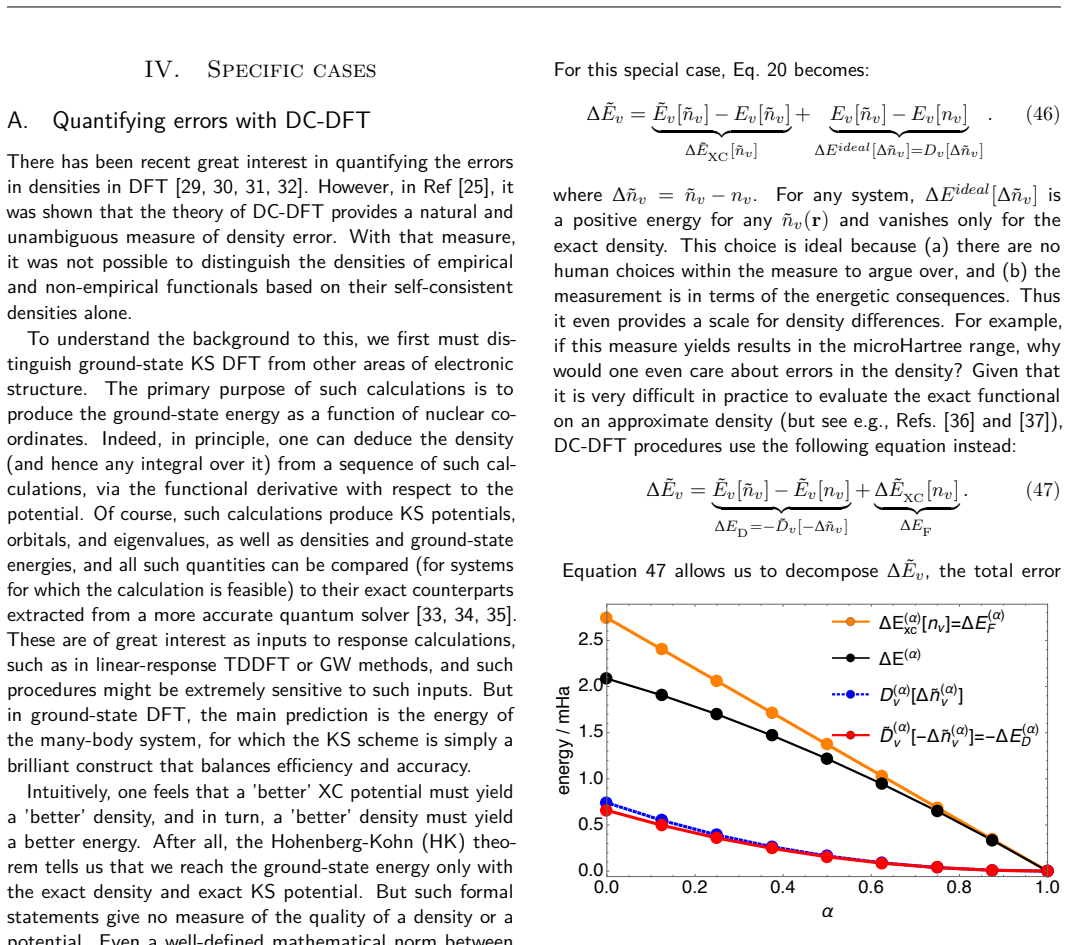
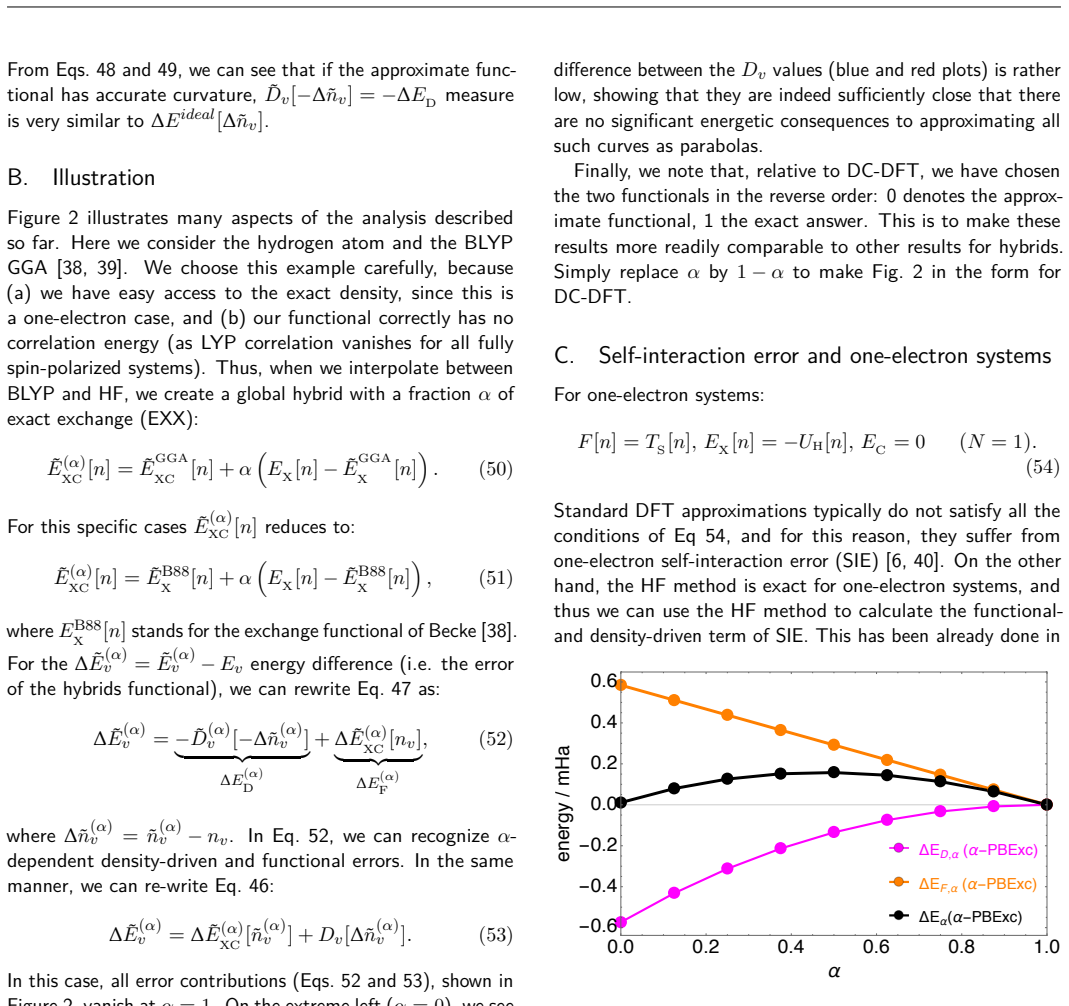
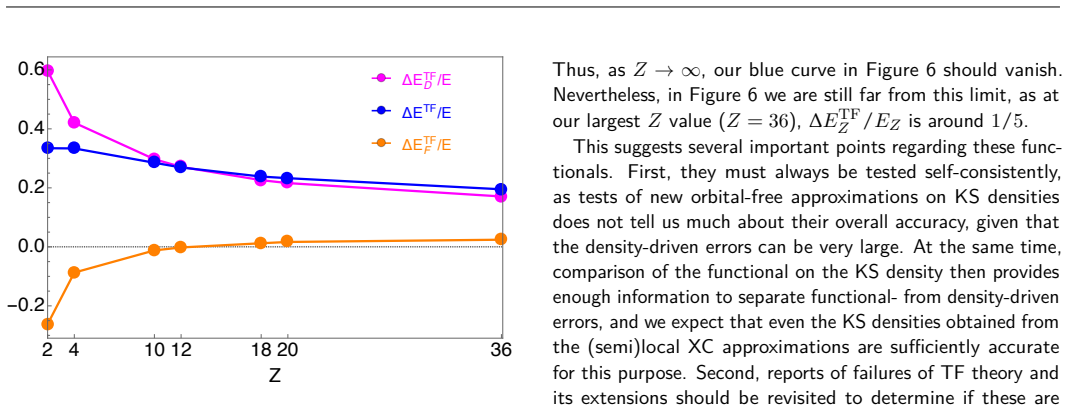
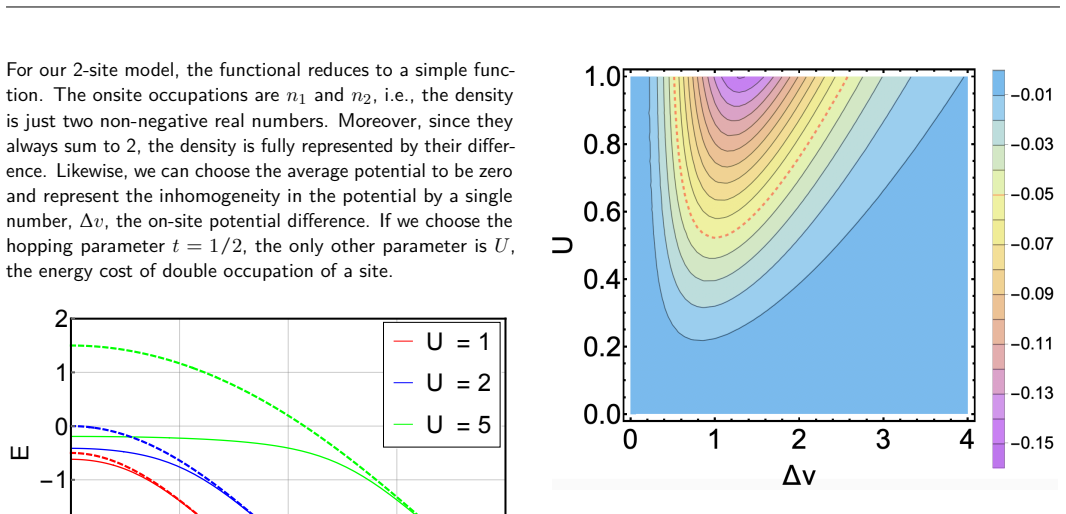
The central claim is that every energy difference $\Delta E_v = E^{(1)}_v[n^{(1)}_v] - E^{(0)}_v[n^{(0)}_v]$ between the ground-state solutions of two functionals obeys the exact identities $\Delta E_v = -D^{(1)}_v[-\Delta n_v] + \Delta E_{XC}[n^{(0)}_v] = \Delta E_{XC}[n^{(1)}_v] + D^{(0)}_v[\Delta n_v]$, where $\Delta n_v = n^{(1)}_v - n^{(0)}_v$, $D^{(j)}_v$ is the non-negative energetic distance of a density from the minimum of functional $j$, and $\Delta E_{XC}$ is the functional difference evaluated at one of the two self-consistent densities. These identities force the chain inequality $\Delta E_{XC}[n^{(1)}_v] \le \Delta E_v \le \Delta E_{XC}[n^{(0)}_v]$, so the energy difference lies between the functional differences evaluated at the two densities. The paper further derives a Hellmann-Feynman-type interpolation formula $\Delta E_v = \int_0^1 d\alpha\, \Delta E_{XC}[n^{(\alpha)}_v]$ for a linear path $E^{(\alpha)}_{XC} = E^{(0)}_{XC} + \alpha\Delta E_{XC}$, and uses second-order expansions around each endpoint to give practical criteria and basins in density space where the analysis applies. Applications to one-electron self-interaction, the Hartree approximation, Thomas-Fermi theory, and the Hubbard dimer show the decomposition in action, including cases where strong correlation produces large density-driven errors and cases where symmetry forces them to vanish.
Load-bearing premise
The quantitative criteria for when the analysis applies assume the energy functionals are smooth enough that the quadratic approximation $D_v[\Delta n] \approx \tfrac12 K_v[\Delta n]$ and the linear density interpolation $n^{(\alpha)}_v \approx n^{(0)}_v + \alpha\Delta n_v$ hold for the systems studied; the exact decomposition itself does not require this.
Editorial extensions
If this is right
- Any pair of density functional approximations can now be compared with the same language previously reserved for comparing an approximation with the exact functional; density-corrected DFT is one special case.
- When the density-driven term dominates, the practical remedy is to evaluate the approximate functional on a better density, for example the Hartree-Fock density, and the framework gives quantitative criteria for when this is legitimate.
- The chain inequality brackets the energy difference by functional differences at the two densities, so it can be used to bound errors in any DFT energy difference without computing the full density-driven term.
- For energy differences between systems, such as reaction energies or barrier heights, the density-driven terms acquire no definite sign and can cancel; the paper's abnormality measure $\bar{\eta}$ classifies when a property is density-driven abnormal.
- The Hubbard dimer analysis shows that strong correlation does not automatically imply large density-driven error; the fraction of density-driven error depends non-monotonically on correlation strength and inhomogeneity.
Reading between the lines
- An implication left implicit is that the same decomposition could be applied to time-dependent or response properties, where density quality matters: comparing densities through their energetic consequences may be more meaningful than comparing them through arbitrary norms.
- The interpolation formula suggests a diagnostic tool for functional development: deviations from the linear density interpolation $n^{(\alpha)}_v \approx n^{(0)}_v + \alpha\Delta n_v$ could be measured in benchmark systems and used to decide when a functional pair is too far apart for second-order analysis.
- The Hubbard dimer's non-monotonic density-driven fraction hints that in realistic strongly correlated solids or molecules, density-driven errors may be large in some regimes and negligible in others, so DC-DFT corrections should be applied system-by-system rather than globally.
- One could test the abnormality scale $\bar{\eta}$ directly by computing, for a database of properties and a functional pair, whether systems flagged abnormal are precisely those where HF-DFT improves over self-consistent DFT.
Signed reviews
Editorial analysis
A structured set of objections, weighed in public.
Referee Report
Summary. This paper develops a formal framework for comparing two ground-state density functional approximations at the same external potential. It introduces an energetic distance D_v[Δn] and derives exact decompositions (Eqs. 19 and 20) of the energy difference between two functionals into a functional-driven part ΔE_XC evaluated on one of the densities and a density-driven part D_v, together with the chain inequality (Eq. 21). The authors then introduce an α-interpolation between the two functionals, derive an adiabatic-connection-like formula (Eq. 28), and use a linear approximation for the interpolated density (Eq. 36) to obtain quadratic-in-α energy expressions. They propose quantitative criteria for 'basins' and 'abnormality', and illustrate the formalism on the hydrogen atom with global hybrids, on Thomas-Fermi atoms, and on the restricted-HF Hubbard dimer, including decompositions into density-driven and functional-driven errors.
Significance. The exact identities (Eqs. 19-20) and the interpolation formula (Eq. 28) are simple, general, and correct; if accepted, the framework gives a clean language for deciding when density-corrected DFT is needed and for attributing errors in energy differences. The hydrogen-atom and Thomas-Fermi illustrations are instructive, and the Hubbard-dimer example usefully shows that strong correlation does not automatically imply a large density-driven error. The main limitation is that the quantitative claims of the paper rest on approximations that are not benchmarked for typical multi-electron semilocal/hybrid calculations, so the practical significance will be fully realized only after those criteria are validated.
major comments (3)
- [Section III, Eq. (36)] The linear-interpolation approximation n_v^(α)(r) ≈ n_v^(0)(r) + α Δn_v(r) is asserted as an expectation, but the stated exactness condition (Eq. 37) is not an independent, checkable criterion: it requires equality of two slope functions that are themselves defined by expansions about the two endpoints, so that for a smooth path the condition is essentially equivalent to the linearity being tested. The numerical examples in Section IV do not validate the approximation for the intended applications: the hydrogen atom is one-electron (so Hartree-Fock is exact), the Thomas-Fermi section tests an orbital-free functional rather than semilocal KS calculations, and the Hubbard dimer is a two-site model without a spatial density path. Because the quadratic energy formula (Eq. 43) and the 'close enough' conclusion rely on Eq. (36), please either add a benchmark of the interpolation error on multi-electron molecules with GGA/hybrid functionals or explicitly reclassify Eq. (36) as an unvalidated heuristic.
- [Section II, Eqs. (14)-(16)] The basin definition and the formula for β_c use a second-order truncation of D_v[Δn] whose remainder is not estimated or bounded. The hydrogen-atom example demonstrates the quadratic approximation in one special case, but the manuscript later states as a result (Section VI) that 'typical density differences between reasonably accurate functionals' are 'close enough.' No evidence is provided for that statement for multi-electron molecules, and the tolerance Δc is left unspecified. Please provide a quantitative check of the quadratic truncation (for example, an estimate of the cubic term, or benchmark values of D_v[Δn] versus (1/2)K_v[Δn] for representative systems), or soften the conclusions so that the criteria are explicitly presented as proposed rather than demonstrated.
- [Section V, Eqs. (75)-(77)] The abnormality indicator η̅ and the cutoff η̅_c ≈ 1/3 are introduced without calibration or sensitivity analysis, and the paper states that numerical examples are left for future work. This makes the abstract's claim that the paper gives 'quantitative criteria for when DC-DFT should apply' stronger than what is actually demonstrated: the paper provides a definition plus an arbitrary threshold. Please either calibrate the cutoff using existing DC-DFT data or explicitly present it as a suggested default whose usefulness remains to be tested.
minor comments (4)
- [Section IV.C, after Fig. 4] The sentence 'the functional error strongly dominates its functional-driven counterpart' should read '... its density-driven counterpart.'
- [Section V, Eq. (76)] Using the symbol \bar{\Delta E}_D for the RMS abnormality scale conflicts with \Delta E_D used earlier for density-driven errors; a distinct symbol (for example, \Delta_{\rm scale}) would avoid confusion.
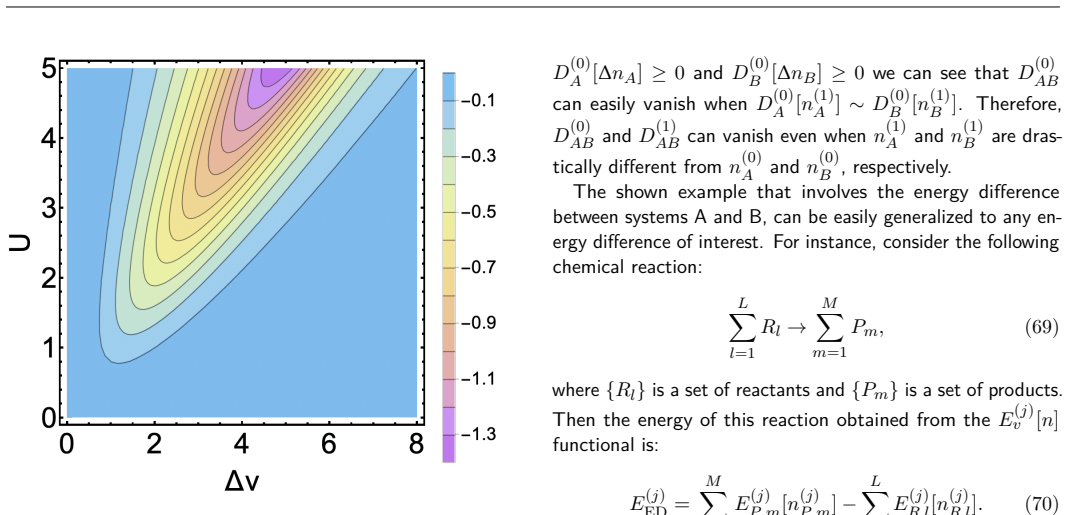
- [Section V, text after Eq. (68)] The expression D^(0)_A[n^(1)_A] should be D^(0)_A[Δn_A] (and similarly for B), since D^(0) is defined on density differences rather than on absolute densities.
- [Throughout] There are several minor typos and spacing errors, such as 'this specific cases' in Section IV.B, 'shouldalwaysestimate' in the text after Eq. (78), and 'The shown example' in Section V; these should be corrected.
Circularity Check
Core decomposition is exact and self-contained; no circularity found.
full rationale
The central identities of Section II, Eqs. (19) and (20), are obtained by adding and subtracting the same total-energy functional evaluated at the two minimizing densities. With the energetic distance D_v defined in Eq. (6) and the functional difference Delta E_XC defined in Eq. (17), the two equations are algebraic rearrangements of the definition of Delta E_v, so no fitted parameter, external benchmark, or self-cited result enters the derivation. The chain inequality, Eq. (21), follows solely from the non-negativity of D_v. The practical criteria used later, namely the quadratic truncation D_v[Delta n] approx (1/2) K_v[Delta n] in Eq. (14) and the linear density interpolation in Eq. (36), are explicitly presented as approximations rather than as derived consequences, and the paper tests them on independently known or analytically solvable cases (the hydrogen atom, CCSD atoms, and the Hubbard dimer). The exactness condition leading to Eq. (37) is a mathematical restatement of when the endpoint expansions agree, not a load-bearing inference used to establish numerical applicability. The many self-citations, e.g., Refs. [13,14,21-25], motivate density-corrected DFT and provide background, but the formal decomposition would still follow from the definitions if every self-citation were removed. Thus no specific circular step can be exhibited, and concerns about the validity of the quadratic/linear approximations belong to correctness risk rather than circularity.
Assumptions & free parameters
free parameters (2)
- Delta c (closeness tolerance)
- eta_bar_c (abnormality cutoff) =
~1/3
assumptions (8)
- standard math E_v[n] is twice differentiable around its minimizer, justifying Taylor expansion (Eq. 9).
- standard math Hellmann-Feynman theorem applies to the alpha-interpolated functional (Eq. 26).
- standard math K^(alpha)_v is invertible on the space of isoelectronic density changes (Eq. 35).
- domain assumption Densities are N-representable and isoelectronic (integral of Delta n = 0).
- domain assumption For one-electron systems, E_X[n] = -U_H[n] and E_C = 0 (Eq. 54).
- domain assumption For two-electron singlets, the restricted HF functional is F_RHF[n] = T_S[n] + U_H[n]/2 (Eq. 60).
- domain assumption Total Thomas-Fermi energy for neutral atoms is E_TF_Z ~ -0.7687 Z^(7/3).
- ad hoc to paper The linear interpolation n^(alpha) ~ n^(0) + alpha Delta n_v is accurate (Eq. 36).
Cite this review
Pith. "Pith review of Density functional analysis: The theory of density-corrected DFT." pith.science (2026). https://pith.science/paper/VG4NL7P3
@misc{pith2026190805721,
  author       = {Pith},
  title        = {Pith review of: Density functional analysis: The theory of density-corrected DFT},
  year         = {2026},
  howpublished = {\url{https://pith.science/paper/VG4NL7P3}},
  note         = {Machine review of arXiv:1908.05721}
}
read the original abstract
Density-corrected density functional theory (DC-DFT) is enjoying substantial success in improving semilocal DFT calculations in a wide variety of chemical problems. This paper provides the formal theoretical framework and assumptions for the analysis of any functional minimization with an approximate functional. We generalize DC-DFT to allow comparison of any two functionals, not just comparison with the exact functional. We introduce a linear interpolation between any two approximations, and use the results to analyze global hybrid density functionals. We define the basins of density-space in which this analysis should apply, and give quantitative criteria for when DC-DFT should apply. We also discuss the effects of strong correlation on density-driven error, utilizing the restricted HF Hubbard dimer as an illustrative example.
Figures

Figures from the paper (5 more)


Reference graph
Works this paper leans on
-
[1]
W. Kohn and L. J. Sham. Self-consistent equations including exchange and correlation effects.Phys. Rev., 140:A1133, 1965. 11
work page 1965
-
[2]
Dft: A theory full of holes?Annual review of physical chemistry, 66:283–304, 2015
Aurora Pribram-Jones, David A Gross, and Kieron Burke. Dft: A theory full of holes?Annual review of physical chemistry, 66:283–304, 2015
work page 2015
-
[3]
Stefan Grimme, Jens Antony, Stephan Ehrlich, and Helge Krieg. A consistent and accurate ab initio parametriza- tion of density functional dispersion correction (dft-d) for the 94 elements h-pu.The Journal of chemical physics , 132(15):154104, 2010
work page 2010
-
[4]
A. Savin. On degeneracy, near degeneracy and density functional theory. In J. M. Seminario, editor,Recent De- velopments of Modern Density Functional Theory , pages 327–357. Elsevier, Amsterdam, 1996
work page 1996
-
[5]
A. J. Cohen, P. Mori-Sanchez, and W. Yang. Insights into current limitations of density functional theory.Science, 321:792, 2008
work page 2008
-
[6]
Cohen, Paula Mori-Sánchez, and Weitao Yang
Aron J. Cohen, Paula Mori-Sánchez, and Weitao Yang. Challenges for density functional theory. Chem. Rev., 112:289, 2012
work page 2012
-
[7]
Roy G Gordon and Yung Sik Kim. Theory for the forces between closed-shell atoms and molecules.The Journal of Chemical Physics , 56(6):3122–3133, 1972
work page 1972
- [8]
Show all 59 references
-
[9]
Hartree– fock orbitals significantly improve the reaction barrier heights predicted by semilocal density functionals.The Journal of chemical physics , 128(24):244112, 2008
Benjamin G Janesko and Gustavo E Scuseria. Hartree– fock orbitals significantly improve the reaction barrier heights predicted by semilocal density functionals.The Journal of chemical physics , 128(24):244112, 2008
2008
-
[10]
The performance of the beck- eâĂ”leeâĂ”yangâĂ”parr (bâĂ”lyp) density functional theory with various basis sets.Chemical Physics Letters , 197(4-5):499–505, 1992
Peter MW Gill, Benny G Johnson, John A Pople, and Michael J Frisch. The performance of the beck- eâĂ”leeâĂ”yangâĂ”parr (bâĂ”lyp) density functional theory with various basis sets.Chemical Physics Letters , 197(4-5):499–505, 1992
1992
-
[11]
A simplification of the hartree-fock method
John C Slater. A simplification of the hartree-fock method. Phys. Rev., 81(3):385, 1951
1951
-
[12]
On the errors of local density (lda) and generalized gradient (gga) approximations to the kohn-sham potential and orbital energies
OV Gritsenko, ŁM Mentel, and EJ Baerends. On the errors of local density (lda) and generalized gradient (gga) approximations to the kohn-sham potential and orbital energies. J. Chem. Phys. , 144(20):204114, 2016
2016
-
[13]
Under- standing and reducing errors in density functional calcu- lations
Min-Cheol Kim, Eunji Sim, and Kieron Burke. Under- standing and reducing errors in density functional calcu- lations. Phys. Rev. Lett. , 111:073003, Aug 2013
2013
-
[14]
Halogen and chalcogen binding dominated by density- driven errors
Yeil Kim, Suhwan Song, Eunji Sim, and Kieron Burke. Halogen and chalcogen binding dominated by density- driven errors. The journal of physical chemistry letters , 10(2):295–301, 2018
2018
-
[15]
Stefan Vuckovic, Tom J. P. Irons, Lucas O. Wagner, Andrew M. Teale, and Paola Gori-Giorgi. Interpolated energy densities, correlation indicators and lower bounds from approximations to the strong coupling limit of dft. Phys. Chem. Chem. Phys. , 19:6169–6183, 2017
2017
-
[16]
Interaction-strength interpolation method for main-group chemistry: Benchmarking, lim- itations, and perspectives
Eduardo Fabiano, Paola Gori-Giorgi, Michael Seidl, and Fabio Della Sala. Interaction-strength interpolation method for main-group chemistry: Benchmarking, lim- itations, and perspectives. J. Chem. Theory Comput , 12(10):4885–4896, 2016
2016
-
[17]
Restoring size consistency of approxi- mate functionals constructed from the adiabatic connec- tion
Stefan Vuckovic, Paola Gori-Giorgi, Fabio Della Sala, and Eduardo Fabiano. Restoring size consistency of approxi- mate functionals constructed from the adiabatic connec- tion. J. Phys. Chem. Lett. , 2018
2018
-
[18]
Perspective on density functional theory
Kieron Burke. Perspective on density functional theory. J. Chem. Phys. , 136(15):150901, 2012
2012
-
[19]
A. D. Becke. Perspective: Fifty years of density-functional theory in chemical physics.J. Chem. Phys. , 140:18A301, 2014
2014
-
[20]
Taylor-series expansion of density functionals
Matthias Ernzerhof. Taylor-series expansion of density functionals. Physical Review A , 50(6):4593, 1994
1994
-
[21]
Ions in solution: Density corrected density functional theory (dc- dft)
Min-Cheol Kim, Eunji Sim, and Kieron Burke. Ions in solution: Density corrected density functional theory (dc- dft). J. Chem. Phys. , 140(18):18A528, 2014
2014
-
[22]
Improved dft potential energy surfaces via improved densities.J
Min-Cheol Kim, Hansol Park, Suyeon Son, Eunji Sim, and Kieron Burke. Improved dft potential energy surfaces via improved densities.J. Phys. Chem. Lett. , 6(19):3802– 3807, 2015
2015
-
[23]
The importance of being inconsistent
Adam Wasserman, Jonathan Nafziger, Kaili Jiang, Min- Cheol Kim, Eunji Sim, and Kieron Burke. The importance of being inconsistent. Annual Review of Physical Chem- istry, 68(1):555–581, 2017
2017
-
[24]
Benchmarks and reliable dft results for spin gaps of small ligand fe(ii) com- plexes
Suhwan Song, Min-Cheol Kim, Eunji Sim, Anouar Be- nali, Olle Heinonen, and Kieron Burke. Benchmarks and reliable dft results for spin gaps of small ligand fe(ii) com- plexes. Journal of Chemical Theory and Computation , 14(5):2304–2311, 2018
2018
-
[25]
Quantifying density errors in dft.The journal of physical chemistry letters, 9(22):6385–6392, 2018
Eunji Sim, Suhwan Song, and Kieron Burke. Quantifying density errors in dft.The journal of physical chemistry letters, 9(22):6385–6392, 2018
2018
-
[26]
Harris and R
J. Harris and R. Jones. The surface energy of a bounded electron gas. J. Phys. F , 4:1170, 1974
1974
-
[27]
The exchange- correlation energy of a metallic surface
David C Langreth and John P Perdew. The exchange- correlation energy of a metallic surface. Solid State Communications, 17(11):1425–1429, 1975. 12
1975
-
[28]
Gunnarsson and B
O. Gunnarsson and B. I. Lundqvist. Exchange and corre- lation in atoms, molecules, and solids by the spin-density- functional formalism. Phys. Rev. B , 13:4274, 1976
1976
-
[29]
Density functional theory is straying from the path toward the exact functional
Michael G Medvedev, Ivan S Bushmarinov, Jianwei Sun, John P Perdew, and Konstantin A Lyssenko. Density functional theory is straying from the path toward the exact functional. Science, 355(6320):49–52, 2017
2017
-
[30]
density functional theory is straying from the path toward the exact functional
Kasper P. Kepp. Comment on “density functional theory is straying from the path toward the exact functional”. Science, 356(6337):496–496, 2017
2017
-
[31]
A conundrum for density func- tional theory
Sharon Hammes-Schiffer. A conundrum for density func- tional theory. Science, 355(6320):28–29, 2017
2017
-
[32]
Density functional theory: Not quite the right answer for the right reason yet.Angewandte Chemie International Edition, 56(20):5396–5398, 2017
Martin Korth. Density functional theory: Not quite the right answer for the right reason yet.Angewandte Chemie International Edition, 56(20):5396–5398, 2017
2017
-
[33]
C. J. Umrigar and Xavier Gonze. Accurate exchange- correlation potentials and total-energy components for the helium isoelectronic series.Phys. Rev. A , 50:3827– 3837, Nov 1994
1994
-
[34]
Morrison, and Robert G
Qingsheng Zhao, Robert C. Morrison, and Robert G. Parr. From electron densities to kohn-sham kinetic ener- gies, orbital energies, exchange-correlation potentials, and exchange-correlation energies. Phys. Rev. A , 50:2138– 2142, Sep 1994
1994
-
[35]
Ryabinkin, Sviataslau V
Ilya G. Ryabinkin, Sviataslau V. Kohut, and Viktor N. Staroverov. Reduction of electronic wave functions to kohn-sham effective potentials. Phys. Rev. Lett. , 115:083001, Aug 2015
2015
-
[36]
Guaranteed convergence of the kohn- sham equations
Lucas O Wagner, EM Stoudenmire, Kieron Burke, and Steven R White. Guaranteed convergence of the kohn- sham equations. Physical review letters , 111(9):093003, 2013
2013
-
[37]
Exchange–correlation func- tionals via local interpolation along the adiabatic con- nection
Stefan Vuckovic, Tom JP Irons, Andreas Savin, Andrew M Teale, and Paola Gori-Giorgi. Exchange–correlation func- tionals via local interpolation along the adiabatic con- nection. J. Chem. Theory Comput. , 12(6):2598–2610, 2016
2016
-
[38]
Density-functional exchange-energy ap- proximation with correct asymptotic behavior.Phys
Axel D Becke. Density-functional exchange-energy ap- proximation with correct asymptotic behavior.Phys. Rev. A, 38(6):3098, 1988
1988
-
[39]
Devel- opment of the colle-salvetti correlation-energy formula into a functional of the electron density.Physical review B, 37(2):785, 1988
Chengteh Lee, Weitao Yang, and Robert G Parr. Devel- opment of the colle-salvetti correlation-energy formula into a functional of the electron density.Physical review B, 37(2):785, 1988
1988
-
[40]
Self-interaction cor- rection to density-functional approximations for many- electron systems
John P Perdew and Alex Zunger. Self-interaction cor- rection to density-functional approximations for many- electron systems. Physical Review B , 23(10):5048, 1981
1981
-
[41]
J. P. Perdew, K. Burke, and M. Ernzerhof. Generalized gradient approximation made simple.Phys. Rev. Lett. , 77:3865, 1996
1996
-
[42]
Rationale for mixing exact exchange with density func- tional approximations
John P Perdew, Matthias Ernzerhof, and Kieron Burke. Rationale for mixing exact exchange with density func- tional approximations. J. Chem. Phys. , 105(22):9982– 9985, 1996
1996
-
[43]
JacobâĂŹs ladder of density functional approximations for the exchange- correlation energy
John P Perdew and Karla Schmidt. JacobâĂŹs ladder of density functional approximations for the exchange- correlation energy. InAIP Conference Proceedings , vol- ume 577, pages 1–20. AIP, 2001
2001
-
[44]
Climbing the ladder of density functional approximations
John P Perdew. Climbing the ladder of density functional approximations. MRS bulletin, 38(9):743–750, 2013
2013
-
[45]
The calculation of atomic fields
Llewellyn H Thomas. The calculation of atomic fields. In Mathematical Proceedings of the Cambridge Philosophi- cal Society, volume 23, pages 542–548. Cambridge Univ Press, 1927
1927
-
[46]
A statistical method for the determination of some priorieta dell’atome.Rend
Enrico Fermi. A statistical method for the determination of some priorieta dell’atome.Rend. Accad. Nat. Lincei , 6(602-607):32, 1927
1927
-
[47]
The thomas-fermi theory of atoms, molecules and solids.Advances in mathematics, 23(1):22–116, 1977
Elliott H Lieb and Barry Simon. The thomas-fermi theory of atoms, molecules and solids.Advances in mathematics, 23(1):22–116, 1977
1977
-
[48]
R. G. Parr and W. Yang.Density-Functional Theory of Atoms and Molecules. Oxford University Press, New York, 1989
1989
-
[49]
Pyscf: the python-based simulations of chemistry framework
Qiming Sun, Timothy C Berkelbach, Nick S Blunt, George H Booth, Sheng Guo, Zhendong Li, Junzi Liu, James D McClain, Elvira R Sayfutyarova, Sandeep Sharma, et al. Pyscf: the python-based simulations of chemistry framework. Wiley Interdisciplinary Reviews: Computational Molecula...
2018
-
[50]
Thom H. Dunning. Gaussian basis sets for use in corre- lated molecular calculations. i. the atoms boron through neon and hydrogen. J. Chem. Phys. , 90:1007, 1989
1989
-
[51]
Thomas-fermi theory revisited
Elliott H Lieb and Barry Simon. Thomas-fermi theory revisited. Physical Review Letters , 31(11):681, 1973
1973
-
[52]
Locality of correlation in density functional theory
Kieron Burke, Antonio Cancio, Tim Gould, and Stefano Pittalis. Locality of correlation in density functional theory. The Journal of chemical physics , 145(5):054112, 2016
2016
-
[53]
Fitting a round peg into a round hole: Asymptotically correcting the generalized gradient ap- proximation for correlation
Antonio Cancio, Guo P Chen, Brandon T Krull, and Kieron Burke. Fitting a round peg into a round hole: Asymptotically correcting the generalized gradient ap- proximation for correlation. The Journal of chemical physics, 149(8):084116, 2018. 13
2018
-
[54]
Kati Finzel. Local conditions for the pauli potential in order to yield self-consistent electron densities exhibiting proper atomic shell structure.The Journal of chemical physics, 144(3):034108, 2016
2016
-
[55]
The local potential determining the square root of the ground-state electron density of atoms and molecules from the schrödinger equation.Physics Letters A, 113(9):476–478, 1986
NH March. The local potential determining the square root of the ground-state electron density of atoms and molecules from the schrödinger equation.Physics Letters A, 113(9):476–478, 1986
1986
-
[56]
Exact properties of the pauli potential for the square root of the electron density and the kinetic energy functional
Mel Levy and Hui Ou-Yang. Exact properties of the pauli potential for the square root of the electron density and the kinetic energy functional. Physical Review A , 38(2):625, 1988
1988
-
[57]
The hubbard dimer: a density functional case study of a many- body problem
D J Carrascal, J Ferrer, J C Smith, and K Burke. The hubbard dimer: a density functional case study of a many- body problem. Journal of Physics: Condensed Matter , 27(39):393001, 2015
2015
-
[58]
Carrascal, Jaime Ferrer, Neepa Maitra, and Kieron Burke
Diego J. Carrascal, Jaime Ferrer, Neepa Maitra, and Kieron Burke. Linear response time-dependent density functional theory of the hubbard dimer.The European Physical Journal B , 91(7):142, 07 2018
2018
-
[59]
Correlation-energy density- functional formulas from correlating first-order density matrices
Mel Levy and Andreas Görling. Correlation-energy density- functional formulas from correlating first-order density matrices. Phys. Rev. A , 52(3):R1808, 1995. 14
1995
Reviewed August 14, 2026 · model on record in the stance chip above.
Discussion (0). Continue with ORCID to comment.