REVIEW 3 major objections 4 minor 1 cited by
Seurat: From Moving Points to Depth
T0 review · 3 major / 4 minor · reviewed 2026-08-16 · deepseek-v4-flash
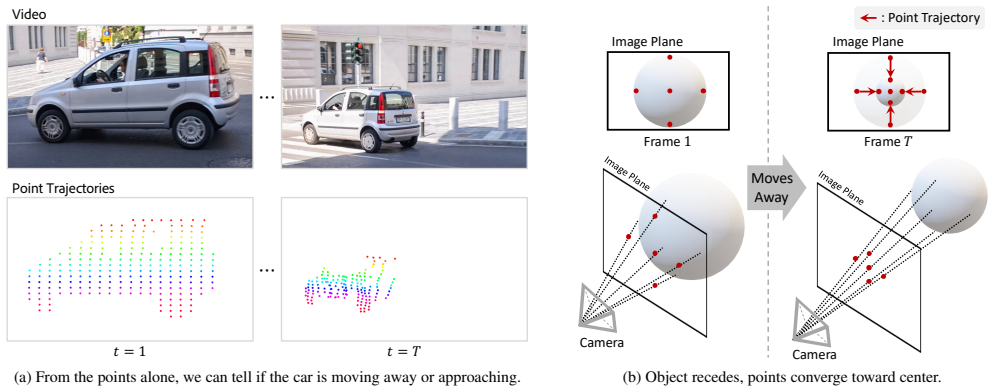
Pith's one-line read Trajectory patterns alone can reveal depth changes over time.
desk verdict Genuinely fresh idea—depth ratios from 2D trajectories—with strong TAPVid-3D results, but the unstated constant-focal-length assumption and the synthetic-to-real tracker gap need explicit handling before the generalization claim is safe. read the letter →
The pith
A machine-rendered reading of the paper's core claim, the machinery that carries it, and where it could break.
The reading
What carries the argument
The load-bearing object is the depth ratio along a trajectory, $r_{i,t}=d_{i,t}/d_{i,t_0}$, which the model predicts as a log ratio relative to the first frame of a sliding window. The architecture is a two-branch transformer: a supporting branch encodes a uniform grid of 24 by 24 trajectories with alternating temporal and spatial attention, capturing global scene motion, and a query branch processes the query trajectories with cross-attention into the supporting branch, so that biased query-point distributions do not contaminate the scene-motion estimate. The supervised target is an L1 loss on log depth ratios, with the theoretical density-depth identity $\rho^{\mathrm{image}}_{t_0}/\rho^{\mathrm{image}}_t = (d_{t_0}/d_t)^2(\cos\theta_t/\cos\theta_{t_0})^2$ as the motivating signal. At inference, ratios from overlapping windows of length 8 are accumulated by exponentiation and stitching, and per-visible-subsequence median scaling against a monocular depth estimator converts them to metric depths; iterative refinement and an auxiliary occlusion-position head stabilize the predictions.
What would settle it
Feed the trained model TAPVid-3D trajectories that have been perturbed with increasing levels of Gaussian noise or with realistic tracker failure modes, and plot 3D-AJ and APD against noise amplitude: if even small perturbations that are well within typical tracker error cause large depth-ratio errors, the synthetic-to-real transfer is riding on trajectory quality rather than on learned geometry.
Extended reading notes
Core claim
The central claim is that relative depth over time is recoverable from motion alone. Under a pinhole projection, the density of projected points from a small locally rigid patch scales inversely with the square of the depth, so the ratio of densities at two times determines the depth ratio up to an unknown surface-orientation factor; the paper argues that a transformer can learn this mapping implicitly without estimating surface normals explicitly. Concretely, the model predicts the log depth ratio $\ell^{w}_{i,t} = \log(d^{w}_{i,t}/d^{w}_{i,0})$ within short sliding windows, accumulates the ratios across windows, and rescales them to metric depth by matching medians with a monocular depth estimator per visible subsequence. Evaluated on TAPVid-3D with CoTracker and LocoTrack trajectories, the paper reports substantially better position accuracy and temporal coherence than unprojection baselines and video-depth estimators.
Load-bearing premise
The load-bearing premise is that the depth-ratio mapping learned from clean, ground-truth synthetic trajectories still holds when the input comes from real, noisy off-the-shelf trackers; the paper does not measure how quickly predictions degrade as tracker errors grow.
Editorial extensions
If this is right
- Monocular video depth becomes obtainable without stereo rigs, multi-view setups, inertial sensors, or a pretrained image backbone.
- Long and dynamic sequences, where per-frame depth estimators flicker, get temporally smooth depth because changes are predicted inside short windows and stitched across the whole video.
- The depth-ratio output is metric-free, so it can be combined with any monocular metric depth estimator through per-subsequence median scaling.
- Because the model is trained on synthetic data alone, the same recipe could be applied to new motion domains without collecting real depth labels.
Reading between the lines
- If trajectory geometry alone carries depth-change information, a promising next step is to train the same kind of model without depth supervision, for instance by enforcing consistency with rigid-flow or epipolar constraints between predicted depths.
- The texture-patch ablation result suggests that appearance can hurt transfer; a purely geometric, appearance-free input may generalize better across rendering styles, so swapping RGB patches out entirely is likely more robust than adding them.
- The sliding-window accumulation in Eq. (9) concatenates log-ratio errors, so very long videos may drift; adding overlap consistency or a global temporal smoothing term would be a natural robustness extension.
- Within a frame, the model has limited spatial relative-depth ability by design, so it functions as a temporal coherence module rather than a full depth estimator; end-to-end training with a monocular branch could remove the need for the median-scaling fusion step.
Signed reviews
Editorial analysis
A structured set of objections, weighed in public.
Referee Report
Summary. The paper proposes Seurat, a method that predicts per-point depth changes over time from 2D point trajectories and visibility masks. The input trajectories come from off-the-shelf trackers such as CoTracker or LocoTrack. A two-branch transformer architecture processes a dense supporting grid of trajectories and the query trajectories separately, with cross-attention from the supporting branch into the query branch, and predicts log depth ratios within sliding windows. The window-wise predictions are accumulated and then rescaled with a monocular depth estimator such as ZoeDepth or DepthPro to produce metric depth estimates. The method is trained on synthetic Kubric MOVi-F data with ground-truth trajectories and is evaluated zero-shot on the TAPVid-3D benchmark across Aria, DriveTrack, and PStudio, reporting 3D-AJ, APD, and temporal coherence. The paper reports consistent gains over baselines that combine point trackers with per-frame or video depth estimators, plus ablations supporting the two-branch design, sliding windows, and window-wise loss.
Significance. If the claims hold, the paper makes a useful contribution: it shows that temporal depth changes can be extracted from 2D trajectory patterns alone, without stereo, multi-view, or strong depth backbones at the ratio-prediction stage, and it demonstrates zero-shot transfer from a single synthetic dataset to real-world benchmarks. The evaluation is not circular: the ratio model is trained on synthetic ground-truth depth and tested on external real-world data, and the method works with two different trackers, which mitigates the concern that results depend on a particular tracker from the same group. The ablations are informative, including the handcrafted density baseline, the texture-input ablation, and the Gaussian-smoothing control. The main weaknesses are an unstated and untested constant-focal-length assumption, a train/inference mismatch in trajectory quality that is not analyzed, and a missing key hyperparameter for the sliding window.
major comments (3)
- [Sec. 3.2, Eqs. (1)-(4)] The derivation cancels the focal length f between times t and t0, which is valid only if the focal length is constant over time. Under optical zoom or digital crop, a static scene produces projected 2D trajectories that are formally indistinguishable from trajectories caused by depth motion, so the mapping from 2D trajectories to depth ratios is non-identifiable without an additional assumption or an input that encodes the changing intrinsics. The paper never states the constant-focal-length assumption, and no experiment with time-varying intrinsics is reported; both training (Sec. 4.2, Kubric with fixed camera intrinsics) and evaluation (TAPVid-3D, fixed-camera videos) avoid exercising this confound. I ask the authors to state the assumption explicitly and to either add an experiment with changing focal length (for example, synthetic sequences with smoothly varying f, or digitally cropped videos) or restrict the abstract and introduction claims to fixed-intrinsics videos.
- [Sec. 4.2 and supplementary Sec. 8] The model is trained on ground-truth trajectory positions and ground-truth occlusion masks, as stated in Sec. 8, while at inference it receives trajectories from CoTracker or LocoTrack, which contain tracking noise, drift, and failures. The reported benchmark results show that the pipeline works in practice with both trackers, but the sensitivity of the learned depth-ratio mapping to tracker error is never quantified. I request an analysis that corrupts ground-truth trajectories with Gaussian noise, drift, and incorrect occlusion labels during evaluation, reporting how APD, 3D-AJ, and TC degrade as a function of perturbation level. This would directly test the most fragile premise of the method.
- [Sec. 4.2 and Eq. (9)] The sliding-window stride S is a free parameter used in training, in the accumulation formula Eq. (9), and in inference, but the implementation details specify only the window size W = 8 and never state the value of S. Without S, the exact experimental setup and the ratio-accumulation procedure cannot be reproduced. Report the stride (and any overlap schedule) used in all experiments.
minor comments (4)
- [Sec. 3.2, Eq. (3)] The cosine factor in Eq. (3) appears to be squared by mistake: from Eq. (2), the density ratio is (d_t0/d_t)^2 * (cosθ_t/cosθ_t0), not (d_t0/d_t)^2 * (cosθ_t/cosθ_t0)^2. The subsequent Eq. (4) is consistent with the corrected form, so this seems to be a typographical error rather than a substantive one.
- [Table 7 caption and Table 9 header] Table 7's caption contains the typo 'meidan scaling' (should be 'median scaling'), and Table 9's header cites 'DepthPro [3]' where the reference should be [4].
- [Sec. 4.4, Table 3 (left)] The description of ablation (IV), 'ratio depth with respect to the query point,' is unclear: since query points are trajectories, please specify the anchor time and how this loss differs from the proposed window-wise log-ratio loss.
- [Table 6] Several numeric entries in Table 6 have irregular spacing (for example, '4.8 8 .6' and '7.7 14 .1'), which makes the table hard to read; reformat the entries.
Circularity Check
No significant circularity: Seurat's depth-ratio predictions are trained on synthetic ground truth and evaluated on an external benchmark; self-citations are inputs, not load-bearing reductions.
full rationale
The central claim is that temporal depth ratios can be predicted from 2D point trajectories by a transformer trained on synthetic Kubric data with ground-truth depth. The evaluation is on TAPVid-3D, an external real-world benchmark, and no parameter is fitted to the test set; the depth-ratio targets come from synthetic ground truth (Sec. 4.2, Eqs. 7-8), not from the benchmark. The theoretical derivation (Eqs. 1-4) is explicitly qualified as requiring unknown rotation information, and the paper does not use it as a closed-form predictor; Table 4 shows a handcrafted implementation of Eq. 4 underperforms, so the learned model is not equivalent to that formula by construction. The authors' own LocoTrack [9] is used as an off-the-shelf tracker, but the same architecture is also evaluated with CoTracker [24], and the tracker is an input to the depth-ratio model, not a component whose output is renamed as prediction. The focal-length/zoom ambiguity raised by the skeptic is a real generalization risk (the derivation cancels f only if f is constant), but it is an unstated assumption and a correctness concern, not a circular reduction of the prediction to its input. There is no imported uniqueness theorem, no ansatz smuggled in by citation, and no renaming of a known result. The derivation chain is therefore self-contained with respect to circularity.
Assumptions & free parameters
free parameters (5)
- window_size_W =
8
- window_stride_S =
not specified
- number_of_transformer_layers_L =
2
- supporting_grid_size =
24x24
- iterative_refinement_iterations =
4
assumptions (4)
- domain assumption Pinhole camera model with time-invariant intrinsics
- domain assumption Local rigidity of surface patches over the temporal window
- domain assumption Synthetic Kubric data is representative of real-world dynamics for zero-shot transfer
- domain assumption Off-the-shelf point trackers provide trajectories accurate enough for depth inference
Cite this review
Pith. "Pith review of Seurat: From Moving Points to Depth." pith.science (2026). https://pith.science/paper/VGGVM66W
@misc{pith2026250414687,
  author       = {Pith},
  title        = {Pith review of: Seurat: From Moving Points to Depth},
  year         = {2026},
  howpublished = {\url{https://pith.science/paper/VGGVM66W}},
  note         = {Machine review of arXiv:2504.14687}
}
read the original abstract
Accurate depth estimation from monocular videos remains challenging due to ambiguities inherent in single-view geometry, as crucial depth cues like stereopsis are absent. However, humans often perceive relative depth intuitively by observing variations in the size and spacing of objects as they move. Inspired by this, we propose a novel method that infers relative depth by examining the spatial relationships and temporal evolution of a set of tracked 2D trajectories. Specifically, we use off-the-shelf point tracking models to capture 2D trajectories. Then, our approach employs spatial and temporal transformers to process these trajectories and directly infer depth changes over time. Evaluated on the TAPVid-3D benchmark, our method demonstrates robust zero-shot performance, generalizing effectively from synthetic to real-world datasets. Results indicate that our approach achieves temporally smooth, high-accuracy depth predictions across diverse domains.
Figures


Figures from the paper (1 more)

Forward citations
Cited by 1 Pith paper
-
Emergent Temporal Correspondences from Video Diffusion Transformers
Video diffusion transformers encode temporal correspondences primarily in query-key similarities of a few specific attention layers, which can be extracted for zero-shot point tracking and used for training-free motio...
Reference graph
Works this paper leans on
-
[1]
Vivit: A video vision transformer
Anurag Arnab, Mostafa Dehghani, Georg Heigold, Chen Sun, Mario Lu ˇci´c, and Cordelia Schmid. Vivit: A video vision transformer. In Proceedings of the IEEE/CVF inter- national conference on computer vision , pages 6836–6846,
-
[2]
Drivetrack: A benchmark for long-range point tracking in real-world videos, 2023
Arjun Balasingam, Joseph Chandler, Chenning Li, Zhoutong Zhang, and Hari Balakrishnan. Drivetrack: A benchmark for long-range point tracking in real-world videos, 2023. 4, 6, 7, 9, 10
work page 2023
-
[3]
Zoedepth: Zero-shot trans- fer by combining relative and metric depth
Shariq Farooq Bhat, Reiner Birkl, Diana Wofk, Peter Wonka, and Matthias M ¨uller. Zoedepth: Zero-shot trans- fer by combining relative and metric depth. arXiv preprint arXiv:2302.12288, 2023. 3, 5, 6, 7, 9, 10
arXiv 2023
-
[4]
Depth pro: Sharp monocular metric depth in less than a second
Aleksei Bochkovskii, Ama ¨el Delaunoy, Hugo Germain, Marcel Santos, Yichao Zhou, Stephan R Richter, and Vladlen Koltun. Depth pro: Sharp monocular metric depth in less than a second. arXiv preprint arXiv:2410.02073, 2024. 2, 3, 5, 6, 7, 8, 9, 10
arXiv 2024
-
[5]
Recovering non-rigid 3d shape from image streams
Christoph Bregler, Aaron Hertzmann, and Henning Bier- mann. Recovering non-rigid 3d shape from image streams. In Proceedings IEEE Conference on Computer Vision and Pattern Recognition. CVPR 2000 (Cat. No. PR00662), pages 690–696. IEEE, 2000. 3
work page 2000
-
[6]
Efficient geometry-aware 3d generative adversarial networks
Eric R Chan, Connor Z Lin, Matthew A Chan, Koki Nagano, Boxiao Pan, Shalini De Mello, Orazio Gallo, Leonidas J Guibas, Jonathan Tremblay, Sameh Khamis, et al. Efficient geometry-aware 3d generative adversarial networks. In Pro- ceedings of the IEEE/CVF conference on computer vision and pattern recognition, pages 16123–16133, 2022. 3
2022
-
[7]
Pyramid stereo matching network
Jia-Ren Chang and Yong-Sheng Chen. Pyramid stereo matching network. InProceedings of the IEEE conference on computer vision and pattern recognition, pages 5410–5418,
-
[8]
Flowtrack: Revisiting optical flow for long- range dense tracking
Seokju Cho, Jiahui Huang, Seungryong Kim, and Joon- Young Lee. Flowtrack: Revisiting optical flow for long- range dense tracking. In Proceedings of the IEEE/CVF Conference on Computer Vision and Pattern Recognition (CVPR), pages 19268–19277, 2024. 4, 5, 6
work page 2024
Show all 57 references
-
[9]
Local all-pair correspon- dence for point tracking
Seokju Cho, Jiahui Huang, Jisu Nam, Honggyu An, Seun- gryong Kim, and Joon-Young Lee. Local all-pair correspon- dence for point tracking. arXiv preprint arXiv:2407.15420,
-
[10]
Tap-vid: A benchmark for track- ing any point in a video
Carl Doersch, Ankush Gupta, Larisa Markeeva, Adria Re- casens, Lucas Smaira, Yusuf Aytar, Joao Carreira, Andrew Zisserman, and Yi Yang. Tap-vid: A benchmark for track- ing any point in a video. Advances in Neural Information Processing Systems, 35:13610–13626, 2022. 2, 4
2022
-
[11]
Tapir: Tracking any point with per-frame initialization and temporal refinement
Carl Doersch, Yi Yang, Mel Vecerik, Dilara Gokay, Ankush Gupta, Yusuf Aytar, Joao Carreira, and Andrew Zisserman. Tapir: Tracking any point with per-frame initialization and temporal refinement. In Proceedings of the IEEE/CVF In- ternational Conference on Computer Vision , pag...
2023
-
[12]
Towards real-time monocular depth estimation for robotics: A survey
Xingshuai Dong, Matthew A Garratt, Sreenatha G Ana- vatti, and Hussein A Abbass. Towards real-time monocular depth estimation for robotics: A survey. IEEE Transactions on Intelligent Transportation Systems, 23(10):16940–16961,
-
[13]
Adaptive colour classifi- cation for structured light systems
Philipp Fechteler and Peter Eisert. Adaptive colour classifi- cation for structured light systems. IET Computer Vision, 3 (2):49–59, 2009. 1
2009
-
[14]
Fast and high resolution 3d face scanning
Philipp Fechteler, Peter Eisert, and Jurgen Rurainsky. Fast and high resolution 3d face scanning. In 2007 IEEE Interna- tional Conference on Image Processing, pages III–81. IEEE,
2007
-
[15]
Are we ready for autonomous driving? the kitti vision benchmark suite
Andreas Geiger, Philip Lenz, and Raquel Urtasun. Are we ready for autonomous driving? the kitti vision benchmark suite. In Conference on Computer Vision and Pattern Recog- nition (CVPR), 2012. 2
2012
-
[16]
Vision meets robotics: The kitti dataset
Andreas Geiger, Philip Lenz, Christoph Stiller, and Raquel Urtasun. Vision meets robotics: The kitti dataset. Interna- tional Journal of Robotics Research (IJRR), 2013. 2
2013
-
[17]
Unsupervised monocular depth estimation with left- right consistency
Cl ´ement Godard, Oisin Mac Aodha, and Gabriel J Bros- tow. Unsupervised monocular depth estimation with left- right consistency. In Proceedings of the IEEE conference on computer vision and pattern recognition, pages 270–279,
-
[18]
Kubric: A scalable dataset generator
Klaus Greff, Francois Belletti, Lucas Beyer, Carl Doersch, Yilun Du, Daniel Duckworth, David J Fleet, Dan Gnanapra- gasam, Florian Golemo, Charles Herrmann, et al. Kubric: A scalable dataset generator. In Proceedings of the IEEE/CVF Conference on Computer Vision and Pattern Re...
2022
-
[19]
Particle video revisited: Tracking through occlusions using point trajectories
Adam W Harley, Zhaoyuan Fang, and Katerina Fragkiadaki. Particle video revisited: Tracking through occlusions using point trajectories. In European Conference on Computer Vi- sion, pages 59–75. Springer, 2022. 2, 5
2022
-
[20]
Multiple view geometry in computer vision
Richard Hartley. Multiple view geometry in computer vision. Cambridge university press, 2003. 3
2003
-
[21]
Depthcrafter: Generating consistent long depth sequences for open-world videos
Wenbo Hu, Xiangjun Gao, Xiaoyu Li, Sijie Zhao, Xiaodong Cun, Yong Zhang, Long Quan, and Ying Shan. Depthcrafter: Generating consistent long depth sequences for open-world videos. arXiv preprint arXiv:2409.02095, 2024. 1, 6, 7, 9, 10
2024 arXiv
-
[22]
Panoptic studio: A massively multiview system for social motion capture
Hanbyul Joo, Hao Liu, Lei Tan, Lin Gui, Bart Nabbe, Iain Matthews, Takeo Kanade, Shohei Nobuhara, and Yaser Sheikh. Panoptic studio: A massively multiview system for social motion capture. In Proceedings of the IEEE inter- national conference on computer vision , pages 3334–3342,
-
[24]
Co- tracker: It is better to track together
Nikita Karaev, Ignacio Rocco, Benjamin Graham, Natalia Neverova, Andrea Vedaldi, and Christian Rupprecht. Co- tracker: It is better to track together. arXiv preprint arXiv:2307.07635v2, 2023. 2, 3, 4, 5, 6, 7, 9, 10
2023 arXiv
-
[25]
Fast encoder- based 3d from casual videos via point track processing.arXiv preprint arXiv:2404.07097, 2024
Yoni Kasten, Wuyue Lu, and Haggai Maron. Fast encoder- based 3d from casual videos via point track processing.arXiv preprint arXiv:2404.07097, 2024. 3
2024 arXiv
-
[26]
Exploring 11 temporally-aware features for point tracking
In `es Hyeonsu Kim, Seokju Cho, Jiahui Huang, Jung Yi, Joon-Young Lee, and Seungryong Kim. Exploring 11 temporally-aware features for point tracking. arXiv preprint arXiv:2501.12218, 2025. 2
2025 arXiv
-
[27]
Tapvid-3d: A benchmark for tracking any point in 3d
Skanda Koppula, Ignacio Rocco, Yi Yang, Joe Heyward, Jo˜ao Carreira, Andrew Zisserman, Gabriel Brostow, and Carl Doersch. Tapvid-3d: A benchmark for tracking any point in 3d. arXiv preprint arXiv:2407.05921, 2024. 2, 6, 7, 8, 9, 10
2024 arXiv
-
[28]
Ground- ing image matching in 3d with mast3r
Vincent Leroy, Yohann Cabon, and J´erˆome Revaud. Ground- ing image matching in 3d with mast3r. arXiv preprint arXiv:2406.09756, 2024. 2, 3
2024 arXiv
-
[29]
Taptrv2: Attention-based position update improves tracking any point
Hongyang Li, Hao Zhang, Shilong Liu, Zhaoyang Zeng, Feng Li, Tianhe Ren, Bohan Li, and Lei Zhang. Taptrv2: Attention-based position update improves tracking any point. arXiv preprint arXiv:2407.16291, 2024. 2
2024 arXiv
-
[30]
Taptr: Tracking any point with transformers as detection
Hongyang Li, Hao Zhang, Shilong Liu, Zhaoyang Zeng, Tianhe Ren, Feng Li, and Lei Zhang. Taptr: Tracking any point with transformers as detection. In European Confer- ence on Computer Vision, pages 57–75. Springer, 2025. 2
2025
-
[31]
Megadepth: Learning single- view depth prediction from internet photos
Zhengqi Li and Noah Snavely. Megadepth: Learning single- view depth prediction from internet photos. In Proceed- ings of the IEEE conference on computer vision and pattern recognition, pages 2041–2050, 2018. 3
2018
-
[32]
Dynibar: Neural dynamic image-based rendering
Zhengqi Li, Qianqian Wang, Forrester Cole, Richard Tucker, and Noah Snavely. Dynibar: Neural dynamic image-based rendering. In Proceedings of the IEEE/CVF Conference on Computer Vision and Pattern Recognition , pages 4273– 4284, 2023. 1
2023
-
[33]
Dual-frequency pattern scheme for high-speed 3-d shape measurement
Kai Liu, Yongchang Wang, Daniel L Lau, Qi Hao, and Lau- rence G Hassebrook. Dual-frequency pattern scheme for high-speed 3-d shape measurement. Optics express, 18(5): 5229–5244, 2010. 1
2010
-
[34]
Decoupled weight decay regularization
Ilya Loshchilov and Frank Hutter. Decoupled weight decay regularization. arXiv preprint arXiv:1711.05101, 2017. 7
2017 arXiv
-
[35]
Dynamic 3d gaussians: Tracking by per- sistent dynamic view synthesis, 2023
Jonathon Luiten, Georgios Kopanas, Bastian Leibe, and Deva Ramanan. Dynamic 3d gaussians: Tracking by per- sistent dynamic view synthesis, 2023. 2
2023
-
[36]
Consistent video depth estimation.ACM Transactions on Graphics (ToG), 39(4):71–1, 2020
Xuan Luo, Jia-Bin Huang, Richard Szeliski, Kevin Matzen, and Johannes Kopf. Consistent video depth estimation.ACM Transactions on Graphics (ToG), 39(4):71–1, 2020. 1
2020
-
[37]
Dinov2: Learning robust visual features without supervision
Maxime Oquab, Timoth ´ee Darcet, Th ´eo Moutakanni, Huy V o, Marc Szafraniec, Vasil Khalidov, Pierre Fernandez, Daniel Haziza, Francisco Massa, Alaaeldin El-Nouby, et al. Dinov2: Learning robust visual features without supervision. arXiv preprint arXiv:2304.07193, 2023. 2, 3
2023 arXiv
-
[38]
Aria digital twin: A new benchmark dataset for egocentric 3d machine perception
Xiaqing Pan, Nicholas Charron, Yongqian Yang, Scott Pe- ters, Thomas Whelan, Chen Kong, Omkar Parkhi, Richard Newcombe, and Yuheng Carl Ren. Aria digital twin: A new benchmark dataset for egocentric 3d machine perception. In Proceedings of the IEEE/CVF International Conference...
2023
-
[39]
Unidepth: Universal monocular metric depth estimation, 2024
Luigi Piccinelli, Yung-Hsu Yang, Christos Sakaridis, Mattia Segu, Siyuan Li, Luc Van Gool, and Fisher Yu. Unidepth: Universal monocular metric depth estimation, 2024. 6
2024
-
[40]
Detailed real- time urban 3d reconstruction from video.International Jour- nal of Computer Vision, 78:143–167, 2008
Marc Pollefeys, David Nist ´er, J-M Frahm, Amir Ak- barzadeh, Philippos Mordohai, Brian Clipp, Chris Engels, David Gallup, S-J Kim, Paul Merrell, et al. Detailed real- time urban 3d reconstruction from video.International Jour- nal of Computer Vision, 78:143–167, 2008. 1
2008
-
[41]
The 2017 davis challenge on video object segmentation.arXiv preprint arXiv:1704.00675, 2017
Jordi Pont-Tuset, Federico Perazzi, Sergi Caelles, Pablo Ar- bel´aez, Alex Sorkine-Hornung, and Luc Van Gool. The 2017 davis challenge on video object segmentation.arXiv preprint arXiv:1704.00675, 2017. 1
2017 arXiv
-
[42]
Towards robust monocular depth estimation: Mixing datasets for zero-shot cross-dataset transfer
Ren ´e Ranftl, Katrin Lasinger, David Hafner, Konrad Schindler, and Vladlen Koltun. Towards robust monocular depth estimation: Mixing datasets for zero-shot cross-dataset transfer. IEEE transactions on pattern analysis and machine intelligence, 44(3):1623–1637, 2020. 1, 2, 3, 9
2020
-
[43]
High-resolution image synthesis with latent diffusion models
Robin Rombach, Andreas Blattmann, Dominik Lorenz, Patrick Esser, and Bj ¨orn Ommer. High-resolution image synthesis with latent diffusion models. In Proceedings of the IEEE/CVF conference on computer vision and pattern recognition, pages 10684–10695, 2022. 3
2022
-
[44]
Structure- from-motion revisited
Johannes L Schonberger and Jan-Michael Frahm. Structure- from-motion revisited. In Proceedings of the IEEE con- ference on computer vision and pattern recognition , pages 4104–4113, 2016. 3
2016
-
[45]
Learning tem- porally consistent video depth from video diffusion priors
Jiahao Shao, Yuanbo Yang, Hongyu Zhou, Youmin Zhang, Yujun Shen, Matteo Poggi, and Yiyi Liao. Learning tem- porally consistent video depth from video diffusion priors. arXiv preprint arXiv:2406.01493, 2024. 6, 7, 9, 10
2024 arXiv
-
[46]
Track everything everywhere fast and ro- bustly
Yunzhou Song, Jiahui Lei, Ziyun Wang, Lingjie Liu, and Kostas Daniilidis. Track everything everywhere fast and ro- bustly. In European Conference on Computer Vision, pages 343–359. Springer, 2025. 2
2025
-
[47]
Scalability in perception for autonomous driving: Waymo open dataset
Pei Sun, Henrik Kretzschmar, Xerxes Dotiwalla, Aurelien Chouard, Vijaysai Patnaik, Paul Tsui, James Guo, Yin Zhou, Yuning Chai, Benjamin Caine, Vijay Vasudevan, Wei Han, Jiquan Ngiam, Hang Zhao, Aleksei Timofeev, Scott Et- tinger, Maxim Krivokon, Amy Gao, Aditya Joshi, Yu Zhan...
2020
-
[48]
Raft: Recurrent all-pairs field transforms for optical flow
Zachary Teed and Jia Deng. Raft: Recurrent all-pairs field transforms for optical flow. In Computer Vision–ECCV 2020: 16th European Conference, Glasgow, UK, August 23– 28, 2020, Proceedings, Part II 16, pages 402–419. Springer,
2020
-
[49]
Droid-slam: Deep visual slam for monocular, stereo, and rgb-d cameras
Zachary Teed and Jia Deng. Droid-slam: Deep visual slam for monocular, stereo, and rgb-d cameras. Advances in neu- ral information processing systems, 34:16558–16569, 2021. 2, 3
2021
-
[50]
Mlp-mixer: An all-mlp architecture for vision
Ilya O Tolstikhin, Neil Houlsby, Alexander Kolesnikov, Lu- cas Beyer, Xiaohua Zhai, Thomas Unterthiner, Jessica Yung, Andreas Steiner, Daniel Keysers, Jakob Uszkoreit, et al. Mlp-mixer: An all-mlp architecture for vision. Advances in neural information processing systems, 34:2...
-
[51]
Dino-tracker: Taming dino for self-supervised point track- ing in a single video
Narek Tumanyan, Assaf Singer, Shai Bagon, and Tali Dekel. Dino-tracker: Taming dino for self-supervised point track- ing in a single video. In European Conference on Computer Vision, pages 367–385. Springer, 2025. 2
2025
-
[52]
Attention is all you need
A Vaswani. Attention is all you need. Advances in Neural Information Processing Systems, 2017. 2, 4, 7 12
2017
-
[53]
Tracking everything everywhere all at once
Qianqian Wang, Yen-Yu Chang, Ruojin Cai, Zhengqi Li, Bharath Hariharan, Aleksander Holynski, and Noah Snavely. Tracking everything everywhere all at once. arXiv preprint arXiv:2306.05422, 2023. 2, 6
2023 arXiv
-
[54]
Spatialtracker: Tracking any 2d pixels in 3d space
Yuxi Xiao, Qianqian Wang, Shangzhan Zhang, Nan Xue, Sida Peng, Yujun Shen, and Xiaowei Zhou. Spatialtracker: Tracking any 2d pixels in 3d space. In Proceedings of the IEEE/CVF Conference on Computer Vision and Pattern Recognition, pages 20406–20417, 2024. 3, 9
2024
-
[55]
Depth anything: Unleashing the power of large-scale unlabeled data
Lihe Yang, Bingyi Kang, Zilong Huang, Xiaogang Xu, Jiashi Feng, and Hengshuang Zhao. Depth anything: Unleashing the power of large-scale unlabeled data. In Proceedings of the IEEE/CVF Conference on Computer Vision and Pattern Recognition, pages 10371–10381, 2024. 1, 3, 9
2024
-
[56]
Adding conditional control to text-to-image diffusion models
Lvmin Zhang, Anyi Rao, and Maneesh Agrawala. Adding conditional control to text-to-image diffusion models. In Proceedings of the IEEE/CVF International Conference on Computer Vision, pages 3836–3847, 2023. 1
2023
-
[57]
Pointodyssey: A large-scale synthetic dataset for long-term point tracking
Yang Zheng, Adam W Harley, Bokui Shen, Gordon Wet- zstein, and Leonidas J Guibas. Pointodyssey: A large-scale synthetic dataset for long-term point tracking. In Proceed- ings of the IEEE/CVF International Conference on Com- puter Vision, pages 19855–19865, 2023. 4 13
2023
-
[2024]
1, 2, 3, 4, 5, 6, 7, 9, 10
Reviewed August 16, 2026 · model on record in the stance chip above.
Discussion (0). Continue with ORCID to comment.