REVIEW 2 major objections 5 minor 42 references
Capture Driven Evolution of Asymmetric Dark Matter in Non-rotating Neutron Stars
T0 review · 2 major / 5 minor · reviewed 2026-08-11 · deepseek-v4-flash
Pith's one-line read Capture-driven dark matter accumulation cannot produce detectable neutron-star tidal signatures.
desk verdict A clean framework for time-dependent DM capture in NSs, but the 'conservative upper bound' isn't conservative until the cross-section scan is done and the compactness numbers are reconciled. read the letter →
The pith
A machine-rendered reading of the paper's core claim, the machinery that carries it, and where it could break.
The reading
What carries the argument
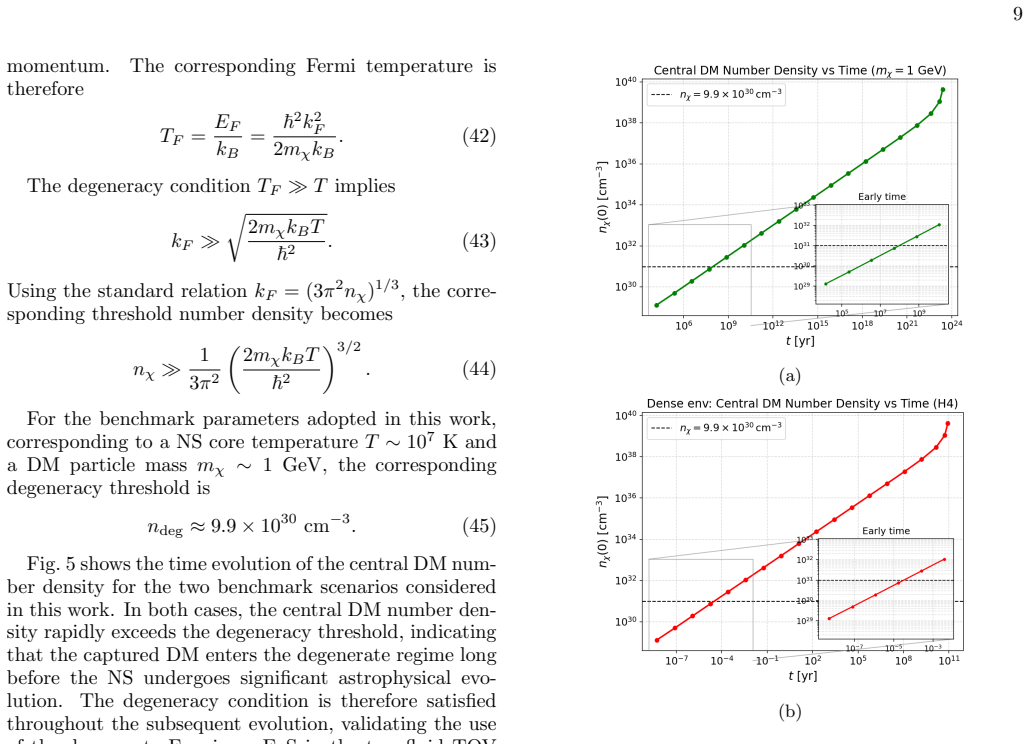
The load-bearing machinery is the quasi-static equilibrium sequence built from the two-fluid TOV equations, where the baryonic and dark components share one spacetime metric and interact only through gravity. A central Fermi momentum $k_{F,c}$ parametrizes each configuration; the dark matter is an ideal zero-temperature degenerate Fermi gas, and the baryon equation of state is a three-layer polytrope anchored at the surface density. The capture rate of Eq. (23), with a spin-independent cross-section $\sigma_{\mathrm{ref}}=1.7\times10^{-45}\,\mathrm{cm}^2$, is recomputed for each equilibrium using the relativistic metric, and the time step is set by $\Delta t\simeq\Delta N_\chi/C_{\mathrm{cap}}$. This closes the loop between accumulation and structure: as dark matter is captured, the metric deepens, which changes the capture rate and the stellar radius, compactness, Love number $k_2$, and tidal deformability $\Lambda$.
What would settle it
Recompute the Hubble-time accumulation with the cross-section set to the largest value allowed by current direct-detection limits for 0.1–100 GeV dark matter; if the resulting total mass exceeds $\sim1.4484\,M_\odot$ by more than a small factor, or the tidal shift reaches $|\Delta\Lambda|\gg10$ in a realistic environment, the paper's no-detectability conclusion fails.
Extended reading notes
Core claim
The paper's central claim is that, even under deliberately optimistic assumptions, capture-driven accumulation of non-annihilating (asymmetric) fermionic dark matter in a cold, non-rotating neutron star cannot produce observable gravitational-wave signatures. Using a three-layer polytropic equation of state for baryons, a zero-temperature degenerate Fermi gas for the dark component, and the coupled two-fluid Tolman–Oppenheimer–Volkoff equations, the authors evolve the star through a sequence of hydrostatic equilibria connected by the capture rate. With a canonical Galactic halo ($\rho_{\mathrm{halo}}=0.3\,\mathrm{GeV}/\mathrm{cm}^3$) the tidal response barely changes over a Hubble time; in the maximized scenario—a dark-matter spike with $\rho_{\mathrm{halo}}=2.2\times10^9\,M_\odot/\mathrm{pc}^3$ and $v_{\mathrm{ns}}=30\,\mathrm{km/s}$—the total mass reaches at most $M_{\mathrm{tot,max}}\approx1.4484\,M_\odot$, the compactness rises by a few tens of percent, and the tidal observables shift by $|\Delta k_2|\sim10^{-2}$ and $|\Delta\Lambda|\sim10^1$. The stars remain on the stable TOV branch, so dark-matter accumulation does not trigger collapse. The conclusion is that asymmetric dark matter alone, via capture, is unlikely to be detectable in current or near-future gravitational-wave observations of neutron stars.
Load-bearing premise
The calculation's upper-bound conclusion rests on fixing the dark-matter–nucleon scattering cross-section at $\sigma_{\mathrm{ref}}=1.7\times10^{-45}\,\mathrm{cm}^2$; if the true cross-section for light asymmetric dark matter is larger, the accumulated mass and tidal shifts grow, and the paper does not explore that.
Editorial extensions
If this is right
- Even after a full Hubble time under a dense galactic-center spike, the accumulated dark matter adds at most about $1.4\times10^{-3}\,M_\odot$ to a $\sim1.45\,M_\odot$ neutron star, so the dark component is always gravitationally subdominant.
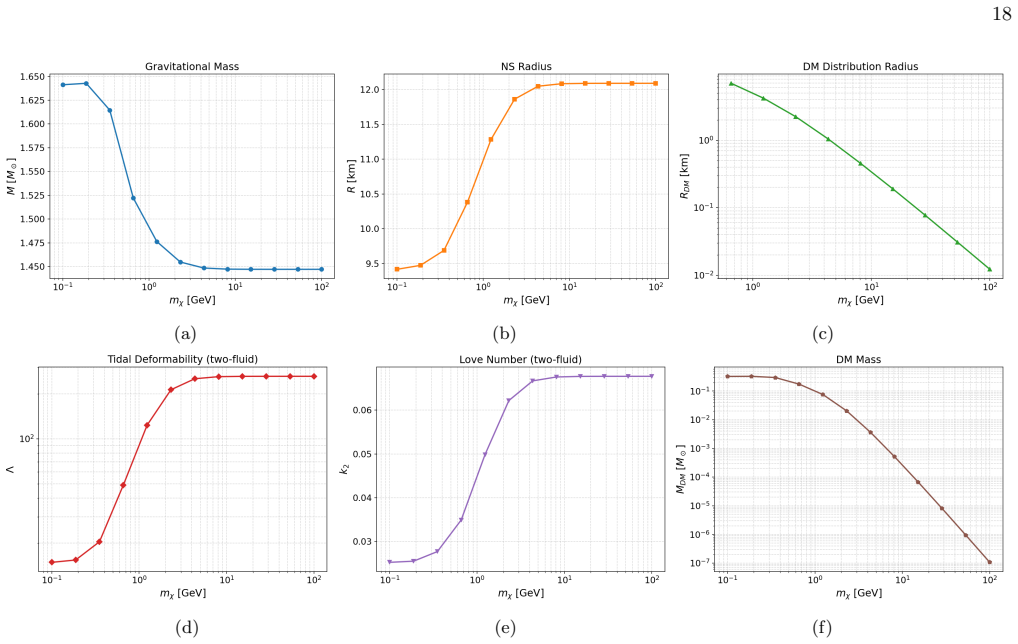
- Dark-matter accumulation systematically raises compactness while lowering the Love number and tidal deformability; the largest shifts are $|\Delta k_2|\sim10^{-2}$ and $|\Delta\Lambda|\sim10^1$, and they occur only in the extreme scenario.
- For realistic Galactic or cluster dark-matter densities, changes in $k_2$ and $\Lambda$ are negligible over a Hubble time, so current LIGO/Virgo/KAGRA-era measurements cannot distinguish captured asymmetric dark matter.
- More compact neutron stars capture slightly faster, but the resulting mass-ratio drift in a binary is too small to matter over astrophysical timescales.
- All configurations reached remain on the stable branch ($dM_{\mathrm{tot}}/d\rho_c>0$); dark-matter accumulation does not drive neutron stars toward collapse.
Reading between the lines
- Editorial inference: the upper-bound conclusion is conditional on the reference cross-section; if sub-GeV asymmetric dark matter interacts with nucleons at the current experimental ceiling, the accumulated mass and tidal shifts could be larger than quoted, reversing the detectability conclusion.
- Editorial inference: the model neglects dark-matter self-interactions and rotation; a condensed bosonic core or an amplified central density could produce stronger tidal signatures, though the paper does not explore those routes.
- Editorial inference: a targeted search for tidal-deformability differences between neutron stars in high-density environments, such as near the Galactic center, and field neutron stars would provide a direct test; future detectors with improved tidal sensitivity may reach $|\Delta\Lambda|\sim10$.
Editorial analysis
A structured set of objections, weighed in public.
Referee Report
Summary. The paper develops a self-consistent framework for the time-dependent accumulation of asymmetric fermionic dark matter (ADM) in non-rotating neutron stars (NSs). It couples a three-layer piecewise polytropic baryonic EoS to a degenerate Fermi gas DM EoS through the two-fluid Tolman–Oppenheimer–Volkoff equations, and reconstructs the long-term evolution using a capture rate formalism. The authors study canonical Galactic and extreme DM-spike environments, and compute the resulting changes in compactness, Love number, and tidal deformability. Their central claim, stated in the abstract and Sec. V, is that capture-driven ADM accumulation is unlikely to produce detectable gravitational-wave signatures even under deliberately optimistic conditions, with the maximized scenario yielding M_tot,max ≈ 1.4484 M_sun (Eq. 39), |Δk2| ~ 10^-2, and |ΔΛ| ~ 10 (Eqs. 60, 66).
Significance. If the quantitative conclusions hold, this is a valuable null result: it would establish that ADM capture alone cannot produce observable tidal signatures in current or near-future gravitational-wave detectors, and it provides a concrete framework that others can extend. The paper is also careful to present a stability analysis and to explore dependence on the EoS and initial compactness. However, the significance is currently undermined by two load-bearing problems: the 'conservative upper bound' is not scanned over the DM-baryon cross-section, and the paper contains internal numerical contradictions (Eq. 39 vs. Table III, and the compactness increase vs. the reported tidal shift). Until these are resolved, the main conclusion cannot be considered quantitatively established.
major comments (2)
- [Sec. III B 2, Eqs. (23)-(24), (68)] The claimed 'conservative upper bound' is conditional on an unjustified choice of the DM-baryon cross-section. For the adopted n=0 case, the capture rate is proportional to sigma_ref = 1.7 x 10^-45 cm^2 via Eq. (24), and Eq. (23) makes the accumulated mass linear in this cross-section. The paper never varies sigma_ref over the 0.1-100 GeV DM mass range, nor does it cite constraints showing that this value is the maximum allowed for asymmetric DM. Since Eq. (68) and the accumulated mass scale linearly with the capture rate, a cross-section one to two orders of magnitude larger — still allowed for light ADM by direct-detection limits — would increase M_chi, the compactness shift, and |Delta Lambda| in Eq. (66) by the same factor until saturation. The conclusion that capture-driven ADM produces negligible gravitational-wave signatures is therefore not a conservative upper bound as stated; it is a bound for a particular particle-physics assumption. The authors should either scan over sigma_ref or fold the largest cross-section allowed by current constraints for each m_chi into the maximized scenario.
- [Sec. III B 2, Eq. (39); Table III; Sec. IV A, Eqs. (48), (59), (66)] The paper's key quantitative claims are internally inconsistent. For the baseline H4 model with M_ns = 1.447 M_sun and R_ns = 12.091 km, Eq. (39) gives M_tot,max = 1.4484 M_sun, implying M_chi = 0.0014 M_sun. Yet Table III, first row, reports for the same initial configuration M_tot(t_H) = 1.458 M_sun, implying M_chi = 0.011 M_sun. These two values cannot both be correct for the same maximized scenario. Furthermore, Sec. IV A states that the compactness increases by 25-30% in the maximized scenario. With only a sub-percent mass increase, Eq. (48) then requires a radius decrease of roughly 20%, which is a dramatic structural change; and since Lambda ~ k2 C^-5 (Eq. 59), a 25-30% increase in C alone changes Lambda by a factor of (1.25)^5 ≈ 3, giving |Delta Lambda| of several hundred for typical Lambda ~ 500, not the |Delta Lambda| ~ 10 quoted in Eq. (66). At least one of these reported numbers is wrong, and the manuscript must be corrected to present a self-consistent set of predictions.
minor comments (5)
- [Sec. III A (around Eq. (19) and Fig. 1)] The paragraph 'From these solutions, we obtain the DM density profiles and the corresponding characteristic radius R_DM ...' is repeated verbatim three times; the duplicates should be removed.
- [Sec. II (after Eq. (12))] The text reads 'radii R ~ 10-13 km', which is ambiguous; it should be written as 'R ~ 10 to 13 km' or 'R ~ 10-13 km' with an en dash, to avoid being read as 10^-13 km.
- [Eq. (49)] There is a punctuation error: 'where, Lambda_i = ...' should be 'where Lambda_i = ...'.
- [Sec. IV C, Table II and Sec. II baseline] The relationship between the baseline H4 model (M = 1.447 M_sun, R = 12.09 km) used in Secs. II-III and the H4 row in Table II (M = 1.951 M_sun, R = 13.438 km) is confusing; the text explains different normalizations, but it would help to explicitly state which model is used in each figure and equation to avoid apparent contradictions.
- [References] Reference [2] is incomplete in the provided text, missing the author names; and Ref. [13] would benefit from a journal reference if one exists.
Circularity Check
No circularity: the long-term evolution is derived by integrating an external capture-rate formalism through quasi-static two-fluid TOV equilibria, with no fitted parameter or self-citation chain forcing the conclusions.
full rationale
The derivation chain is self-contained against standard external inputs. The NS structure uses the piecewise polytropic EoS from Ref. [17] and the standard TOV equations; the DM component uses the degenerate Fermi gas EoS from Ref. [24]; the capture rate in Eq. (23) is taken from Refs. [3,15,16]; and the time evolution is reconstructed by integrating dN_chi/dt = C_cap while mapping the accumulated particle number onto a sequence of two-fluid TOV equilibria, with Delta t = Delta N_chi / C_cap. No parameter is fitted to observational data to produce the quoted upper bounds, and the authors do not cite their own prior work as load-bearing evidence. The central result, M_tot,max ~ 1.4484 M_sun, follows from integrating the chosen inputs rather than being assumed. Two limitations should be flagged, but they are correctness risks rather than circularity. First, the 'conservative upper bound' is not maximized over the DM-baryon cross-section: Eq. (24) fixes sigma_ref = 1.7e-45 cm^2, and the paper does not show that this value is the largest cross-section allowed for 0.1-100 GeV asymmetric dark matter; if the true cross-section is larger, the accumulated mass and tidal shifts grow. Second, Sec. IV A reports a 25%-30% increase in compactness in the maximized scenario, while Sec. IV B quotes |Delta Lambda| ~ 10 despite Eq. (59) giving Lambda proportional to k2 C^-5, which would imply a much larger Delta Lambda for such a compactness change; one of these numbers is internally inconsistent. Neither issue makes the derivation equivalent to its inputs by construction, so the circularity score is 0.
Assumptions & free parameters
free parameters (5)
- Reference DM-baryon cross-section sigma_ref =
1.7e-45 cm^2
- Extreme ambient DM density rho_halo =
2.2e9 M_sun/pc^3
- NS velocity in maximized scenario v_ns =
30 km/s
- Central baryon density rho_c =
1.05e15 g/cm^3
- NS core temperature T_c =
1e7 K
assumptions (6)
- domain assumption Two-fluid TOV equations with independent conservation of each fluid.
- domain assumption Quasi-static evolution due to timescale separation.
- domain assumption Rapid thermalization and zero-temperature degenerate Fermi gas EoS for DM.
- domain assumption Asymmetric dark matter with negligible annihilation.
- domain assumption Neglect of Pauli blocking in the capture rate.
- domain assumption Piecewise polytropic EoS represents neutron star matter.
Cite this review
Pith. "Pith review of Capture Driven Evolution of Asymmetric Dark Matter in Non-rotating Neutron Stars." pith.science (2026). https://pith.science/paper/VGL6VAN2
@misc{pith2026260807729,
  author       = {Pith},
  title        = {Pith review of: Capture Driven Evolution of Asymmetric Dark Matter in Non-rotating Neutron Stars},
  year         = {2026},
  howpublished = {\url{https://pith.science/paper/VGL6VAN2}},
  note         = {Machine review of arXiv:2608.07729}
}
read the original abstract
We develop a self-consistent framework that connects dark matter capture to the long term accumulation and structural evolution of neutron stars, allowing us to quantify the impact of capture driven asymmetric dark matter on gravitational wave observables over astrophysical timescales. We model cold, non-rotating neutron stars using a three layer polytropic EoS coupled to a dark matter component through the two fluid Tolman Oppenheimer Volkoff equations, and reconstruct the long term evolution using a time dependent dark matter capture formalism. By exploring a wide range of astrophysical conditions, including extreme environments designed to maximize the capture efficiency, we derive conservative upper bounds on the effects of dark matter accumulation over a Hubble time. Even under these deliberately optimistic assumptions, the accumulated dark matter component remains subdominant and induces limited structural modifications. In particular, dark matter accumulation increases the stellar compactness while suppressing the Love number and tidal deformability. Significant evolution occurs only in extreme Galactic center like environments over Hubble time scales, whereas for realistic Galactic or cluster dark matter densities the corresponding deviations remain negligible. We therefore conclude that capture driven dark matter accumulation is unlikely to produce detectable signatures in current or near future gravitational wave observations of neutron stars.
Figures


Figures from the paper (11 more)



Reference graph
Works this paper leans on
-
[1]
This strong separation of timescales justifies the quasi-static approximation
Static Dark Matter Configurations Because DM capture occurs over astrophysical timescales, whereas the internal dynamical timescale of the NS is extremely short, τdyn ∼1/ √ρ∼10 −4 −10 −3 s,(18) the stellar structure remains close to hydrostatic equilib- rium throughout the accumulation process [25, 26]. This strong separation of timescales justifies the q...
-
[2]
Time Evolution To reconstruct the time evolution of the DM core, we first determine the accumulated DM particle number from the capture rate through dNχ(t) dt =C cap(t).(29) As discussed in Subsubsec. III A 1, we construct a se- quence of equilibrium two fluid TOV solutions parame- terized by the central Fermi momentumk F,c. For each value ofk F,c, the co...
-
[3]
Maximized Capture Scenario To estimate the maximum DM accumulation achiev- able within a Hubble time, we consider an intentionally extreme astrophysical environment designed to maximize the capture rate in Eq. (23). The purpose of this setup is not to model a typical NS environment, but rather to establish a conservative upper bound on the structural modi...
-
[4]
Degeneracy Threshold The two fluid TOV framework describes the accumu- lated DM component using a degenerate fermionic EoS. It is therefore important to verify that the captured DM indeed enters the degenerate regime under the astrophys- ical conditions considered here. We therefore estimate the density threshold at which the Fermi temperature exceeds the...
-
[5]
C. Kouvaris, Phys. Rev. D77, 023006 (2008), 0708.2362. [2] G. Bertone and M. Fairbairn, Physical Review 18 (a) (b) (c) (d) (e) (f) FIG. 17. Dependence of NS and DM properties on the DM particle massm χ over the range 0.1−100 GeV. (a) the total stellar massM tot, (b) the NS radiusR ns, (c) the DM distribution radiusR DM, (d) the tidal deformability Λ, (e) ...
arXiv 2008
-
[6]
C. Kouvaris and P. Tinyakov, Physical Review D—Particles, Fields, Gravitation, and Cosmology82, 063531 (2010)
work page 2010
-
[7]
K.-L. Leung, M.-c. Chu, and L.-M. Lin, Phys. Rev. D 105, 123010 (2022), 2207.02433
arXiv 2022
-
[8]
Hinderer, The Astrophysical Journal677, 1216 (2008)
T. Hinderer, The Astrophysical Journal677, 1216 (2008)
2008
Show all 42 references
- [9]
- [10]
-
[11]
B. P. Abbott, R. Abbott, T. D. Abbott, F. Acernese, K. Ackley, C. Adams, T. Adams, P. Addesso, R. X. Ad- hikari, V. B. Adya, et al., Physical review letters119, 161101 (2017)
2017
-
[12]
B. P. Abbott, R. Abbott, T. Abbott, F. Acernese, K. Ackley, C. Adams, T. Adams, P. Addesso, R. X. Ad- hikari, V. B. Adya, et al., Physical review letters121, 161101 (2018)
2018
-
[13]
Abbott et al
R. Abbott et al. (LIGO Scientific, KAGRA, VIRGO), Astrophys. J. Lett.915, L5 (2021), 2106.15163
2021 arXiv
-
[14]
Radice, S
D. Radice, S. Bernuzzi, and A. Perego, Ann. Rev. Nucl. Part. Sci.70, 95 (2020), 2002.03863
2020 arXiv
-
[15]
S. C. Leung, M. C. Chu, and L. M. Lin, Phys. Rev. D 84, 107301 (2011), 1111.1787
2011 arXiv
- [16]
-
[17]
Ellis, G
J. Ellis, G. H¨ utsi, K. Kannike, L. Marzola, M. Raidal, and V. Vaskonen, Physical Review D97, 123007 (2018)
2018
-
[18]
N. F. Bell, G. Busoni, S. Robles, and M. Virgato, Jour- nal of Cosmology and Astroparticle Physics2020, 028 (2020)
2020
-
[19]
Giorgio, R
B. Giorgio, R. Sandra, V. Michael, et al., JCAP4(2024)
2024
-
[20]
J. S. Read, B. D. Lackey, B. J. Owen, and J. L. Friedman, Physical Review D—Particles, Fields, Gravitation, and Cosmology79, 124032 (2009)
2009
-
[21]
M. V. Beznogov, M. Fortin, P. Haensel, D. G. Yakovlev, and J. L. Zdunik, Mon. Not. Roy. Astron. Soc.463, 1307 (2016), 1608.08091
2016 arXiv
-
[22]
M. V. Beznogov, A. Y. Potekhin, and D. G. Yakovlev, Phys. Rept.919, 1 (2021), 2103.12422
2021 arXiv
-
[23]
A. R. Choudhuri and S. Konar, Mon. Not. Roy. Astron. Soc.332, 933 (2002), astro-ph/0108229
2002 arXiv
-
[24]
A. Y. Potekhin, A. F. Fantina, N. Chamel, J. M. Pear- son, and S. Goriely, Astron. Astrophys.560, A48 (2013), 1310.0049
2013 arXiv
-
[25]
S. De, D. Finstad, J. M. Lattimer, D. A. Brown, E. Berger, and C. M. Biwer, Physical review letters121, 091102 (2018)
2018
-
[26]
J. M. Lattimer and M. Prakash, The Astrophysical Jour- nal550, 426 (2001)
2001
-
[27]
Panotopoulos and I
G. Panotopoulos and I. Lopes, Physical Review D96, 083004 (2017)
2017
-
[28]
S. L. Shapiro and S. A. Teukolsky, Black holes, white dwarfs and neutron stars: the physics of compact objects (John Wiley & Sons, 2024)
2024
-
[29]
N. K. Glendenning, Compact stars: Nuclear physics, 19 particle physics and general relativity (Springer Science & Business Media, 2012)
2012
-
[30]
K. M. Zurek, Physics Reports537, 91 (2014)
2014
-
[31]
D. E. Kaplan, M. A. Luty, and K. M. Zurek, Phys. Rev. D79, 115016 (2009), 0901.4117
2009 arXiv
-
[32]
Petraki and R
K. Petraki and R. R. Volkas, Int. J. Mod. Phys. A28, 1330028 (2013), 1305.4939
2013 arXiv
-
[33]
Shen, G.-W
Z.-Q. Shen, G.-W. Yuan, C.-Z. Jiang, Y.-L. S. Tsai, Q. Yuan, and Y.-Z. Fan, Monthly Notices of the Royal Astronomical Society527, 3196 (2024)
2024
-
[34]
Hobbs, D
G. Hobbs, D. Lorimer, A. Lyne, and M. Kramer, Monthly Notices of the Royal Astronomical Society360, 974 (2005)
2005
-
[35]
Faucher-Giguere and V
C.-A. Faucher-Giguere and V. M. Kaspi, The Astrophys- ical Journal643, 332 (2006)
2006
- [36]
-
[37]
Chandrasekhar, Physical Review Letters12, 114 (1964)
S. Chandrasekhar, Physical Review Letters12, 114 (1964)
1964
-
[38]
Goldman and S
I. Goldman and S. Nussinov, Phys. Rev. D40, 3221 (1989)
1989
-
[39]
Bramante and T
J. Bramante and T. Linden, Physical Review Letters 113, 191301 (2014)
2014
-
[40]
Bramante, Physical review letters115, 141301 (2015)
J. Bramante, Physical review letters115, 141301 (2015)
2015
-
[41]
Bramante, T
J. Bramante, T. Linden, and Y.-D. Tsai, Phys. Rev. D 97, 055016 (2018), 1706.00001
2018 arXiv
-
[42]
Robles, D
S. Robles, D. Vatsyayan, and G. Busoni (2025), 2507.22881
2025
Reviewed August 11, 2026 · model on record in the stance chip above.
Discussion (0). Continue with ORCID to comment.