Probing lepton flavor mixing in W_R searches with machine learning at the LHC
Pith reviewed 2026-06-28 09:15 UTC · model grok-4.3
The pith
A deep neural network improves sensitivity to right-handed W bosons and heavy neutrinos by incorporating lepton flavor mixing in LHC searches.
A machine-rendered reading of the paper's core claim, the machinery that carries it, and where it could break.
Core claim
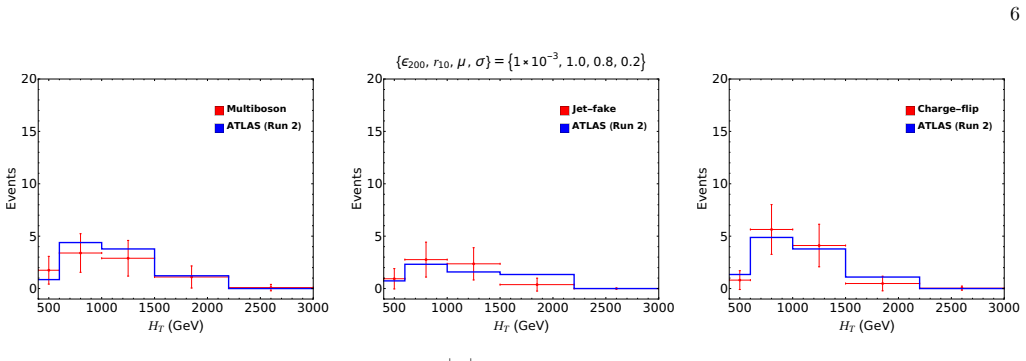
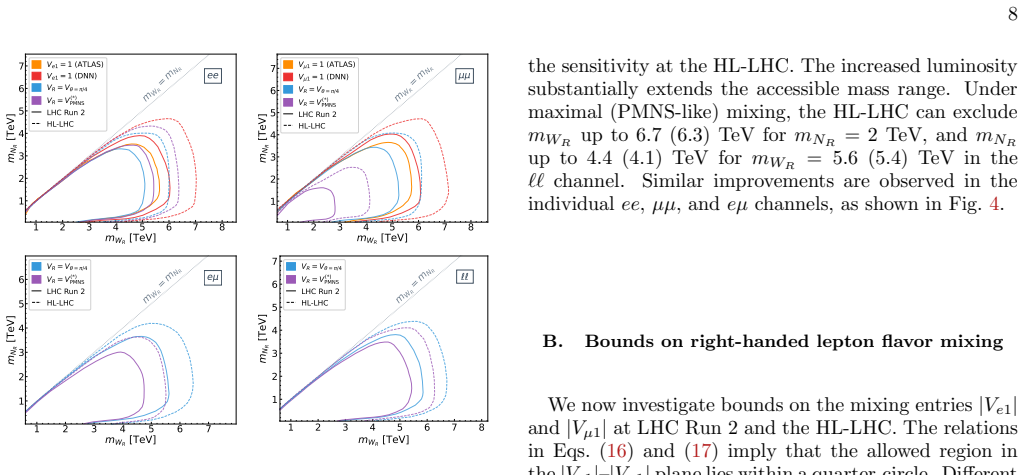
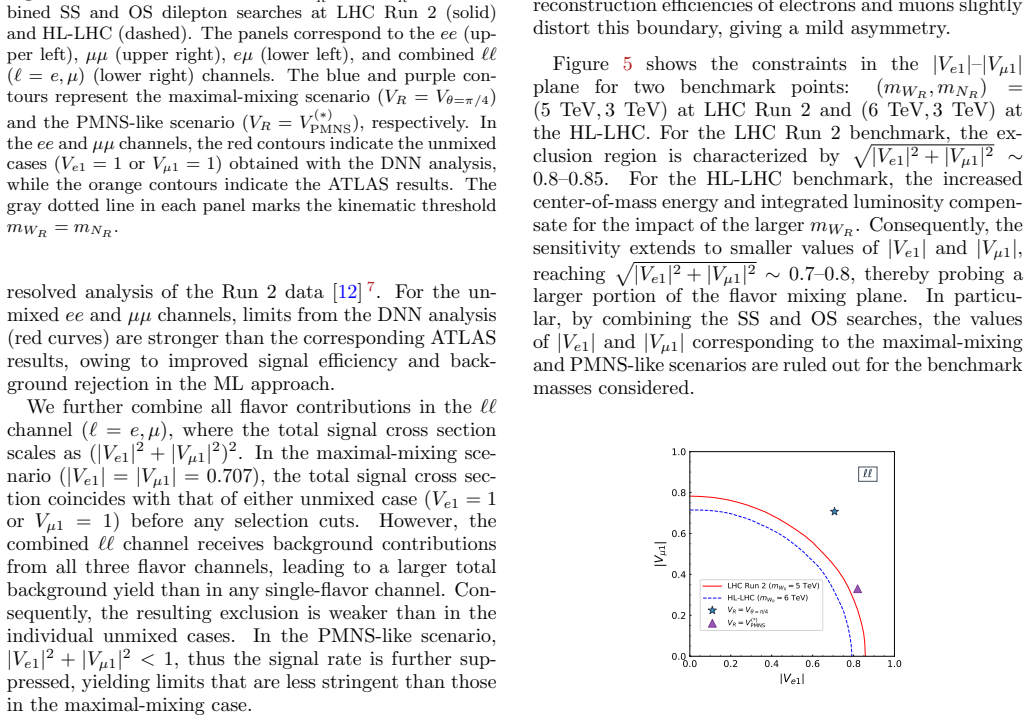
In the unmixed scenario the DNN improves expected significance over ATLAS cut-based analyses, producing stronger exclusion limits; the combined dilepton analysis at the HL-LHC excludes m_WR up to 6.7 TeV and m_NR up to 4.4 TeV under maximal mixing (6.3 TeV and 4.1 TeV under PMNS-like mixing), while Run 2 already rules out sizable regions of the |V_e1|–|V_μ1| plane.
What carries the argument
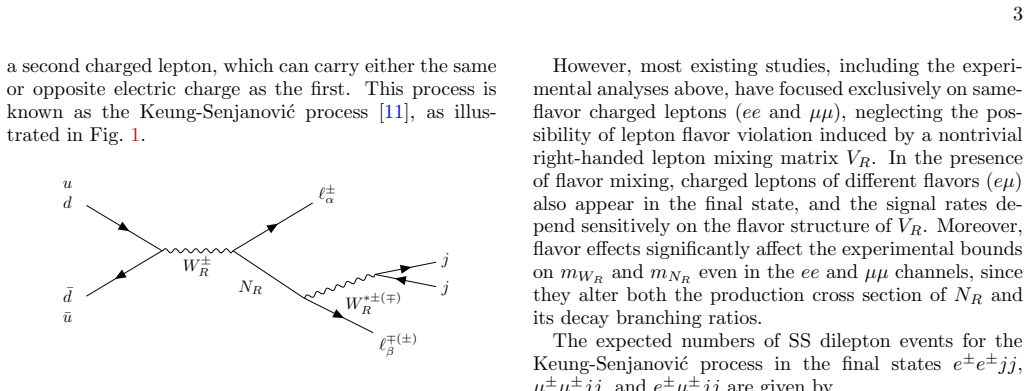
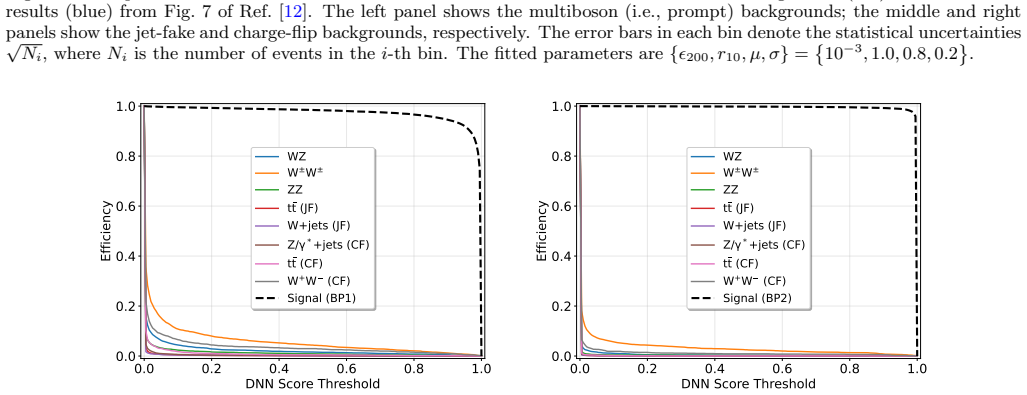
A deep neural network classifier trained on kinematic features of the dilepton-plus-jets final state from the Keung-Senjanović process to separate signal under three lepton-flavor-mixing benchmarks from Standard Model backgrounds.
If this is right
- LHC Run 2 data already excludes large fractions of the electron-muon mixing plane for the heavy neutrino.
- HL-LHC running will reach smaller mixing values and can rule out both maximal and PMNS-like patterns.
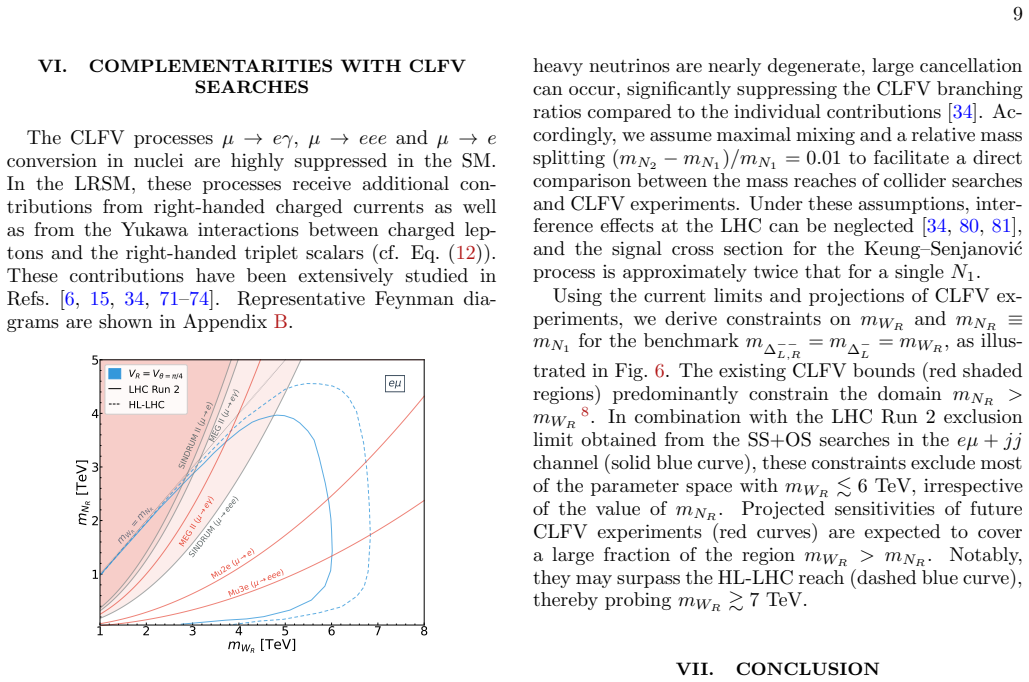
- Future charged-lepton-flavor-violation experiments can probe overlapping or stronger regions of the same mixing parameter space.
Where Pith is reading between the lines
- If the reported DNN performance persists with real data, comparable networks could be applied to other beyond-Standard-Model signatures that depend on flavor structures.
- Refinements in background modeling or additional input features could push the mass reach beyond the values quoted for the HL-LHC.
Load-bearing premise
The simulated background shapes, parton showers, and detector responses used to train and validate the neural network accurately describe real LHC data.
What would settle it
An observed distribution of DNN output scores in signal regions that deviates from the predicted background-plus-signal template by an amount large enough to remove the claimed exclusion reach on m_WR and m_NR.
Figures
read the original abstract
Right-handed lepton flavor mixing in the left-right symmetric model directly affects the production and decay of heavy Majorana neutrinos $N_R$, yet its impact on collider searches remains less explored. Using a deep neural network (DNN), we analyze the Keung-Senjanovi\'c process $pp \to W_R \to \ell_\alpha N_R \to \ell_\alpha \ell_\beta jj$ with $\ell_{\alpha,\beta}=e,\mu$ at LHC Run~2 and the HL-LHC, considering both same-sign and opposite-sign dilepton channels. We adopt three benchmark mixing scenarios: unmixed, maximal-mixing, and PMNS-like. In the unmixed scenario, the DNN improves the expected significance over the cut-based analyses performed by ATLAS, leading to stronger exclusion limits. For the combined $\ell\ell$ analysis, the HL-LHC can exclude $m_{W_R}$ and $m_{N_R}$ up to $6.7$ ($6.3$)~TeV and $4.4$ ($4.1$)~TeV, respectively, under maximal (PMNS-like) mixing. LHC Run~2 already excludes a significant portion of the $|V_{e1}|\text{--}|V_{\mu1}|$ plane, and the HL-LHC will probe even smaller mixing values, possibly ruling out both the maximal and PMNS-like patterns. Finally, we investigate complementarities with low-energy charged lepton flavor violation processes, where future searches can overlap with or exceed the LHC reach.
Editorial analysis
A structured set of objections, weighed in public.
Referee Report
Summary. The paper applies a deep neural network to the Keung-Senjanović process pp → W_R → ℓ_α N_R → ℓ_α ℓ_β jj (ℓ = e, μ) in the left-right symmetric model, incorporating three lepton-flavor-mixing benchmarks (unmixed, maximal, PMNS-like). It reports that the DNN improves expected significance relative to ATLAS cut-based analyses in the unmixed case and projects HL-LHC combined-ℓℓ exclusion reaches of m_WR up to 6.7 (6.3) TeV and m_NR up to 4.4 (4.1) TeV under maximal (PMNS-like) mixing; Run-2 data already constrain part of the |V_e1|–|V_μ1| plane.
Significance. If the simulation-based results hold, the work supplies concrete, quantitative projections that illustrate how machine-learning classifiers can extend the LHC reach for heavy right-handed gauge bosons and Majorana neutrinos while accounting for flavor-mixing effects, and it maps the complementarity with low-energy CLFV searches. The explicit numerical limits and the three-scenario comparison constitute a useful reference for experimental planning.
major comments (1)
- [results / methods (implied by abstract)] The headline improvement in expected significance and the HL-LHC exclusion contours (abstract and results section) are obtained exclusively from DNN scores evaluated on Monte Carlo samples for signal and background. No systematic variations of parton-shower tunes, hadronization parameters, or fast-detector response are reported, nor is a data-driven validation of the background modeling described; this assumption directly underpins the quoted 6.7 TeV and 4.4 TeV reaches and must be quantified before the numerical claims can be considered robust.
minor comments (2)
- [model / benchmarks] Clarify the precise definition of the three mixing benchmarks (unmixed, maximal, PMNS-like) with explicit values or ranges for |V_e1| and |V_μ1| in a dedicated subsection or table.
- [analysis] Specify the DNN architecture, training/validation split, and any regularization or early-stopping criteria used to avoid over-training on the MC samples.
Simulated Author's Rebuttal
We thank the referee for the careful review and the constructive comment on the robustness of our projected limits. We address the major comment below.
read point-by-point responses
-
Referee: The headline improvement in expected significance and the HL-LHC exclusion contours (abstract and results section) are obtained exclusively from DNN scores evaluated on Monte Carlo samples for signal and background. No systematic variations of parton-shower tunes, hadronization parameters, or fast-detector response are reported, nor is a data-driven validation of the background modeling described; this assumption directly underpins the quoted 6.7 TeV and 4.4 TeV reaches and must be quantified before the numerical claims can be considered robust.
Authors: We agree that the quoted exclusion reaches rely on Monte Carlo samples without explicit systematic variations or data-driven background validation. This is a phenomenological projection study whose primary aim is to quantify the improvement of the DNN classifier relative to cut-based methods and to explore flavor-mixing effects. A full experimental analysis would require those elements. In the revised manuscript we will add a dedicated paragraph discussing the expected size of parton-shower and hadronization uncertainties (based on standard tune variations) and will explicitly state that the numerical limits are indicative projections rather than final experimental results. We will also clarify that data-driven validation lies outside the scope of this theoretical work. revision: yes
Circularity Check
No significant circularity; limits derived from independent MC simulations
full rationale
The paper trains a DNN on Monte Carlo samples of signal (W_R, N_R) and background processes generated from theoretical models, then computes expected significances and HL-LHC exclusion contours from the DNN output score distributions on those same simulations. This is the standard simulation-based limit-setting procedure and does not reduce any reported limit or significance to a quantity fitted from the target data by construction. No equations equate the final contours to inputs via self-definition, no load-bearing self-citations justify uniqueness theorems, and no ansatz is smuggled in. The chain remains self-contained against external benchmarks such as ATLAS cut-based results.
Axiom & Free-Parameter Ledger
free parameters (1)
- mixing parameters |Ve1|, |Vμ1|
axioms (1)
- domain assumption Standard parton distribution functions, parton showering, and detector simulation accurately model the Keung-Senjanović signal and SM backgrounds at 13 TeV.
invented entities (1)
-
right-handed W boson (WR) and heavy Majorana neutrino (NR)
no independent evidence
Reference graph
Works this paper leans on
-
[1]
Projected sensitivities of future CLFV experiments (red curves) are expected to cover a large fraction of the regionm WR > m NR
In combination with the LHC Run 2 exclusion limit obtained from the SS+OS searches in theeµ+jj channel (solid blue curve), these constraints exclude most of the parameter space withm WR ≲6 TeV, irrespective of the value ofm NR. Projected sensitivities of future CLFV experiments (red curves) are expected to cover a large fraction of the regionm WR > m NR. ...
2000
-
[2]
J. C. Pati and A. Salam, Phys. Rev. D10, 275 (1974), [Erratum: Phys.Rev.D 11, 703–703 (1975)]
1974
-
[3]
R. N. Mohapatra and J. C. Pati, Phys. Rev. D11, 2558 (1975)
1975
-
[4]
Senjanovic and R
G. Senjanovic and R. N. Mohapatra, Phys. Rev. D12, 1502 (1975)
1975
-
[5]
Senjanovic, Nucl
G. Senjanovic, Nucl. Phys. B153, 334 (1979)
1979
-
[6]
R. N. Mohapatra and G. Senjanovic, Phys. Rev. Lett. 44, 912 (1980)
1980
-
[7]
R. N. Mohapatra and G. Senjanovic, Phys. Rev. D23, 165 (1981)
1981
-
[8]
Minkowski, Phys
P. Minkowski, Phys. Lett. B67, 421 (1977)
1977
-
[9]
M. Gell-Mann, P. Ramond, and R. Slansky, Conf. Proc. C790927, 315 (1979), arXiv:1306.4669 [hep-th]
Pith/arXiv arXiv 1979
-
[10]
Yanagida, Conf
T. Yanagida, Conf. Proc. C7902131, 95 (1979)
1979
-
[11]
S. L. Glashow, NATO Sci. Ser. B61, 687 (1980)
1980
-
[12]
Keung and G
W.-Y. Keung and G. Senjanovic, Phys. Rev. Lett.50, 1427 (1983)
1983
-
[13]
G. Aadet al.(ATLAS), Eur. Phys. J. C83, 1164 (2023), arXiv:2304.09553 [hep-ex]
arXiv 2023
-
[14]
Tumasyanet al.(CMS), JHEP04, 047 (2022), arXiv:2112.03949 [hep-ex]
A. Tumasyanet al.(CMS), JHEP04, 047 (2022), arXiv:2112.03949 [hep-ex]
arXiv 2022
-
[15]
M. Nemevsek, G. Senjanovic, and V. Tello, Phys. Rev. Lett.110, 151802 (2013), arXiv:1211.2837 [hep-ph]
Pith/arXiv arXiv 2013
-
[16]
J. Barry and W. Rodejohann, JHEP09, 153 (2013), arXiv:1303.6324 [hep-ph]
Pith/arXiv arXiv 2013
-
[17]
P. S. Bhupal Dev, S. Goswami, and M. Mitra, Phys. Rev. D91, 113004 (2015), arXiv:1405.1399 [hep-ph]
Pith/arXiv arXiv 2015
-
[18]
G. Senjanovi´ c and V. Tello, Phys. Rev. Lett.119, 201803 (2017), arXiv:1612.05503 [hep-ph]
Pith/arXiv arXiv 2017
-
[19]
G. Senjanovic and V. Tello, Phys. Rev. D100, 115031 (2019), arXiv:1812.03790 [hep-ph]
arXiv 2019
-
[20]
G. Senjanovic and V. Tello, Int. J. Mod. Phys. A38, 2350067 (2023), arXiv:2004.04036 [hep-ph]. 14
arXiv 2023
-
[21]
X. Zhang, J.-H. Yu, and B.-Q. Ma, Nucl. Phys. B976, 115670 (2022), arXiv:2008.06433 [hep-ph]
arXiv 2022
- [22]
-
[23]
Leptogenesis from the Dirac CP-violating phase in the minimal left-right symmetric model,
X. Chen and X. Zhang, “Leptogenesis from the Dirac CP-violating phase in the minimal left-right symmetric model,” (2026), arXiv:2603.03874 [hep-ph]
arXiv 2026
-
[24]
Right-Handed Leptonic Mixing and En- hancement Band in Left-Right Symmetry,
V. Tello, “Right-Handed Leptonic Mixing and En- hancement Band in Left-Right Symmetry,” (2026), arXiv:2603.19462 [hep-ph]
Pith/arXiv arXiv 2026
-
[25]
A. M. Sirunyanet al.(CMS), JHEP01, 122 (2019), arXiv:1806.10905 [hep-ex]
Pith/arXiv arXiv 2019
-
[26]
Hayrapetyanet al.(CMS), JHEP03, 105 (2024), arXiv:2312.07484 [hep-ex]
A. Hayrapetyanet al.(CMS), JHEP03, 105 (2024), arXiv:2312.07484 [hep-ex]
arXiv 2024
-
[27]
G. Aadet al.(ATLAS), Phys. Lett. B856, 138865 (2024), arXiv:2403.15016 [hep-ex]
arXiv 2024
-
[28]
Hayrapetyanet al.(CMS), JHEP06, 183 (2024), arXiv:2403.04584 [hep-ex]
A. Hayrapetyanet al.(CMS), JHEP06, 183 (2024), arXiv:2403.04584 [hep-ex]
arXiv 2024
-
[29]
Hayrapetyanet al.(CMS), JHEP02, 036 (2025), arXiv:2407.10717 [hep-ex]
A. Hayrapetyanet al.(CMS), JHEP02, 036 (2025), arXiv:2407.10717 [hep-ex]
arXiv 2025
-
[30]
Aadet al.(ATLAS), JHEP07, 196 (2025), arXiv:2503.16213 [hep-ex]
G. Aadet al.(ATLAS), JHEP07, 196 (2025), arXiv:2503.16213 [hep-ex]
arXiv 2025
-
[31]
G. Aadet al.(ATLAS), Eur. Phys. J. C72, 2056 (2012), arXiv:1203.5420 [hep-ex]
Pith/arXiv arXiv 2056
-
[32]
Aadet al.(ATLAS), JHEP07, 162 (2015), arXiv:1506.06020 [hep-ex]
G. Aadet al.(ATLAS), JHEP07, 162 (2015), arXiv:1506.06020 [hep-ex]
Pith/arXiv arXiv 2015
-
[33]
Aaboudet al.(ATLAS), JHEP01, 016 (2019), arXiv:1809.11105 [hep-ex]
M. Aaboudet al.(ATLAS), JHEP01, 016 (2019), arXiv:1809.11105 [hep-ex]
Pith/arXiv arXiv 2019
-
[34]
M. Aaboudet al.(ATLAS), Phys. Lett. B798, 134942 (2019), arXiv:1904.12679 [hep-ex]
arXiv 2019
-
[35]
S. P. Das, F. F. Deppisch, O. Kittel, and J. W. F. Valle, Phys. Rev. D86, 055006 (2012), arXiv:1206.0256 [hep- ph]
Pith/arXiv arXiv 2012
-
[36]
Machine Learning in the Search for New Fundamental Physics,
G. Karagiorgi, G. Kasieczka, S. Kravitz, B. Nachman, and D. Shih, “Machine Learning in the Search for New Fundamental Physics,” (2021), arXiv:2112.03769 [hep- ph]
arXiv 2021
-
[37]
M. Abdughani, J. Ren, L. Wu, J. M. Yang, and J. Zhao, Commun. Theor. Phys.71, 955 (2019), arXiv:1905.06047 [hep-ph]
arXiv 2019
-
[38]
LeCun, Y
Y. LeCun, Y. Bengio, and G. Hinton, Nature521, 436 (2015)
2015
-
[39]
P. Baldi, P. Sadowski, and D. Whiteson, Nature Com- mun.5, 4308 (2014), arXiv:1402.4735 [hep-ph]
Pith/arXiv arXiv 2014
-
[40]
L. de Oliveira, M. Kagan, L. Mackey, B. Nachman, and A. Schwartzman, JHEP07, 069 (2016), arXiv:1511.05190 [hep-ph]
Pith/arXiv arXiv 2016
-
[41]
Heavy neutrino mixing prospects at hadron colliders: a machine learning study,
S.-Y. Chen, Y.-P. Jiao, S.-Y. Wang, Q.-S. Yan, H.-H. Zhang, and Y. Zhang, “Heavy neutrino mixing prospects at hadron colliders: a machine learning study,” (2025), arXiv:2504.12141 [hep-ph]
arXiv 2025
-
[42]
J. Kriewald, M. Nemevˇ sek, and F. Nesti, Eur. Phys. J. C84, 1306 (2024), arXiv:2403.07756 [hep-ph]
arXiv 2024
-
[43]
J. de Vries, G. Li, M. J. Ramsey-Musolf, and J. C. Vasquez, JHEP11, 056 (2022), arXiv:2209.03031 [hep- ph]
arXiv 2022
-
[44]
G. Li, Y.-Y. Li, S. Lu, and Y.-L. Zhou, “Sub-GeV Right- Handed Neutrino as a Probe of Neutrino Mass Gen- eration in the Minimal Left-Right Symmetric Model,” (2025), arXiv:2508.15609 [hep-ph]
arXiv 2025
-
[45]
G. Li, M. Ramsey-Musolf, and J. C. Vasquez, Phys. Rev. Lett.126, 151801 (2021), arXiv:2009.01257 [hep-ph]
arXiv 2021
-
[46]
M. J. Ramsey-Musolf and J. C. Vasquez, Phys. Lett. B 815, 136136 (2021), arXiv:2012.02799 [hep-ph]
arXiv 2021
-
[47]
G. Senjanovi´ c and V. Tello, Phys. Rev. Lett.114, 071801 (2015), arXiv:1408.3835 [hep-ph]
Pith/arXiv arXiv 2015
-
[48]
A. Maiezza, M. Nemevsek, F. Nesti, and G. Senjanovic, Phys. Rev. D82, 055022 (2010), arXiv:1005.5160 [hep- ph]
Pith/arXiv arXiv 2010
-
[49]
M. Nemevˇ sek, F. Nesti, and G. Popara, Phys. Rev. D 97, 115018 (2018), arXiv:1801.05813 [hep-ph]
Pith/arXiv arXiv 2018
-
[50]
J. C. Helo, M. Hirsch, and S. Kovalenko, Phys. Rev. D89, 073005 (2014), [Erratum: Phys.Rev.D 93, 099902 (2016)], arXiv:1312.2900 [hep-ph]
Pith/arXiv arXiv 2014
-
[51]
J. C. Vasquez, JHEP05, 176 (2016), arXiv:1411.5824 [hep-ph]
Pith/arXiv arXiv 2016
-
[52]
J. Alwall, R. Frederix, S. Frixione, V. Hirschi, F. Maltoni, O. Mattelaer, H. S. Shao, T. Stelzer, P. Torrielli, and M. Zaro, JHEP07, 079 (2014), arXiv:1405.0301 [hep- ph]
Pith/arXiv arXiv 2014
-
[53]
A. Buckley, J. Ferrando, S. Lloyd, K. Nordstr¨ om, B. Page, M. R¨ ufenacht, M. Sch¨ onherr, and G. Watt, Eur. Phys. J. C75, 132 (2015), arXiv:1412.7420 [hep- ph]
Pith/arXiv arXiv 2015
-
[54]
T. Sj¨ ostrand, S. Ask, J. R. Christiansen, R. Corke, N. De- sai, P. Ilten, S. Mrenna, S. Prestel, C. O. Rasmussen, and P. Z. Skands, Comput. Phys. Commun.191, 159 (2015), arXiv:1410.3012 [hep-ph]
Pith/arXiv arXiv 2015
-
[55]
J. de Favereau, C. Delaere, P. Demin, A. Giammanco, V. Lemaˆ ıtre, A. Mertens, and M. Selvaggi (DELPHES 3), JHEP02, 057 (2014), arXiv:1307.6346 [hep-ex]
Pith/arXiv arXiv 2014
-
[56]
A. M. Sirunyanet al.(CMS), Eur. Phys. J. C77, 578 (2017), arXiv:1704.07323 [hep-ex]
Pith/arXiv arXiv 2017
-
[57]
M. Aaboudet al.(ATLAS), Eur. Phys. J. C78, 199 (2018), arXiv:1710.09748 [hep-ex]
Pith/arXiv arXiv 2018
-
[58]
T. Peng, M. J. Ramsey-Musolf, and P. Winslow, Phys. Rev. D93, 093002 (2016), arXiv:1508.04444 [hep-ph]
Pith/arXiv arXiv 2016
-
[59]
J. Harz, M. J. Ramsey-Musolf, T. Shen, and S. U. Quiroga, Phys. Rev. D110, 035024 (2024), arXiv:2106.10838 [hep-ph]
arXiv 2024
-
[60]
D. Curtin, J. Galloway, and J. G. Wacker, Phys. Rev. D 88, 093006 (2013), arXiv:1306.5695 [hep-ph]
Pith/arXiv arXiv 2013
-
[61]
E. Izaguirre and B. Shuve, Phys. Rev. D91, 093010 (2015), arXiv:1504.02470 [hep-ph]
Pith/arXiv arXiv 2015
-
[62]
M. Nemevˇ sek, F. Nesti, and J. C. Vasquez, JHEP04, 114 (2017), arXiv:1612.06840 [hep-ph]
Pith/arXiv arXiv 2017
-
[63]
C. O. Dib, C. S. Kim, K. Wang, and J. Zhang, Phys. Rev. D94, 013005 (2016), arXiv:1605.01123 [hep-ph]
Pith/arXiv arXiv 2016
-
[64]
C. O. Dib, C. S. Kim, and K. Wang, Phys. Rev. D95, 115020 (2017), arXiv:1703.01934 [hep-ph]
Pith/arXiv arXiv 2017
-
[65]
Muˇ skinja,Search for new physics processes with same sign leptons in the final state with the ATLAS detector, Ph.D
M. Muˇ skinja,Search for new physics processes with same sign leptons in the final state with the ATLAS detector, Ph.D. thesis, Ljubljana U. (2019)
2019
-
[66]
D. Guest, K. Cranmer, and D. Whiteson, Ann. Rev. Nucl. Part. Sci.68, 161 (2018), arXiv:1806.11484 [hep- ex]
Pith/arXiv arXiv 2018
-
[67]
G. Cowan, K. Cranmer, E. Gross, and O. Vitells, Eur. Phys. J. C71, 1554 (2011), [Erratum: Eur.Phys.J.C 73, 2501 (2013)], arXiv:1007.1727 [physics.data-an]
Pith/arXiv arXiv 2011
-
[68]
P. N. Bhattiprolu, S. P. Martin, and J. D. Wells, Eur. Phys. J. C81, 123 (2021), arXiv:2009.07249 [physics.data-an]
arXiv 2021
-
[69]
I. Esteban, M. C. Gonzalez-Garcia, M. Maltoni, I. Martinez-Soler, J. P. Pinheiro, and T. Schwetz, JHEP 12, 216 (2024), arXiv:2410.05380 [hep-ph]
Pith/arXiv arXiv 2024
-
[70]
First measurement of reactor neutrino oscillations at JUNO,
A. Abuslemeet al.(JUNO), “First measurement of reactor neutrino oscillations at JUNO,” (2025), arXiv:2511.14593 [hep-ex]. 15
arXiv 2025
-
[71]
I. Esteban, M. C. Gonzalez-Garcia, M. Maltoni, I. Martinez-Soler, J. P. Pinheiro, and T. Schwetz, JHEP 04, 089 (2026), arXiv:2601.09791 [hep-ph]
Pith/arXiv arXiv 2026
-
[72]
V. Cirigliano, A. Kurylov, M. J. Ramsey-Musolf, and P. Vogel, Phys. Rev. D70, 075007 (2004), arXiv:hep- ph/0404233
arXiv 2004
-
[73]
F. F. Deppisch, T. E. Gonzalo, S. Patra, N. Sahu, and U. Sarkar, Phys. Rev. D91, 015018 (2015), arXiv:1410.6427 [hep-ph]
Pith/arXiv arXiv 2015
-
[74]
G. Bambhaniya, P. S. B. Dev, S. Goswami, and M. Mi- tra, JHEP04, 046 (2016), arXiv:1512.00440 [hep-ph]
Pith/arXiv arXiv 2016
-
[75]
D. Borah and A. Dasgupta, JHEP07, 022 (2016), arXiv:1606.00378 [hep-ph]
Pith/arXiv arXiv 2016
-
[76]
K. Afanacievet al.(MEG II), Eur. Phys. J. C85, 1177 (2025), [Erratum: Eur.Phys.J.C 85, 1317 (2025)], arXiv:2504.15711 [hep-ex]
arXiv 2025
-
[77]
Bellgardtet al.(SINDRUM), Nucl
U. Bellgardtet al.(SINDRUM), Nucl. Phys. B299, 1 (1988)
1988
-
[78]
W. H. Bertlet al.(SINDRUM II), Eur. Phys. J. C47, 337 (2006)
2006
-
[79]
K. Arndtet al.(Mu3e), Nucl. Instrum. Meth. A1014, 165679 (2021), arXiv:2009.11690 [physics.ins-det]
arXiv 2021
-
[80]
Abdiet al.(Mu2e), Universe9, 54 (2023), arXiv:2210.11380 [hep-ex]
F. Abdiet al.(Mu2e), Universe9, 54 (2023), arXiv:2210.11380 [hep-ex]
arXiv 2023
discussion (0)
Sign in with ORCID, Apple, or X to comment. Anyone can read and Pith papers without signing in.