REVIEW 3 major objections 6 minor 39 references
Nonzero temperature dynamics of a repulsive two-component Fermi gas
T0 review · 3 major / 6 minor · reviewed 2026-08-14 · deepseek-v4-flash
Pith's one-line read Finite-temperature Hartree-Fock simulations with Monte Carlo initial-state sampling reproduce the measured temperature shift of the ferromagnetic transition in a repulsive two-component Fermi gas.
desk verdict A cheap finite-T extension of TDHF produces a real prediction for the T-shift of (kFa)_cr, but the 'quantitative agreement' claim leans on an experimental anchor at zero temperature. read the letter →
The pith
A machine-rendered reading of the paper's core claim, the machinery that carries it, and where it could break.
The reading
What carries the argument
The load-bearing object is the set of time-dependent Hartree-Fock equations for the spatial parts of the two spin components' atomic orbitals, with the contact interaction renormalized so that the energy reproduces the low-density expansion $E/N\varepsilon_F = 3/5 + (2/3\pi)(k_F a) + \dots$. Temperature is injected only through the initial state: trap orbitals are occupied according to the Fermi-Dirac distribution with fixed chemical potential, and a Monte Carlo loop draws many-body configurations from this grand canonical ensemble. Each configuration is then evolved with the zero-temperature equations, and observables such as the separation between spin clouds are averaged over ten samples. This division is what lets a zero-temperature dynamical code account for finite-temperature initial conditions.
What would settle it
Measure the spin-dipole frequency and the critical repulsion at $T/T_F \gtrsim 0.6$ in the same harmonic trap geometry and compare with the simulation; a systematic deviation in $(k_F a)_\mathrm{cr}$ or in the damping peak would indicate that the zero-temperature evolution misses thermal or collisional effects that the method assumes are negligible.
Extended reading notes
Core claim
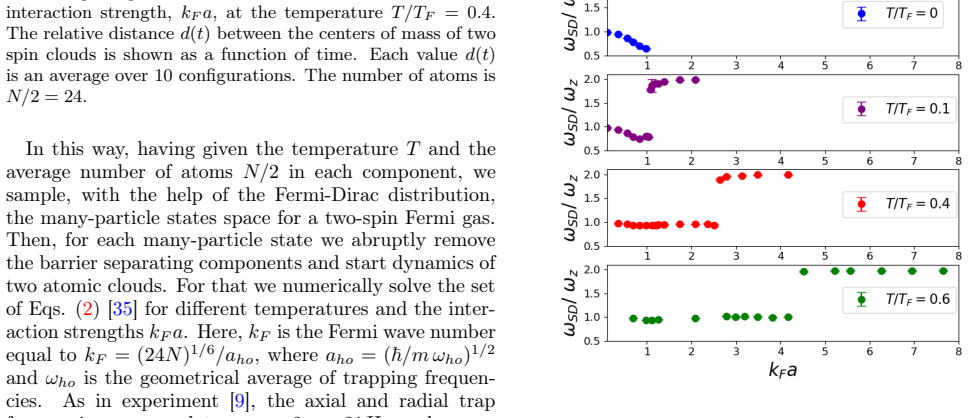
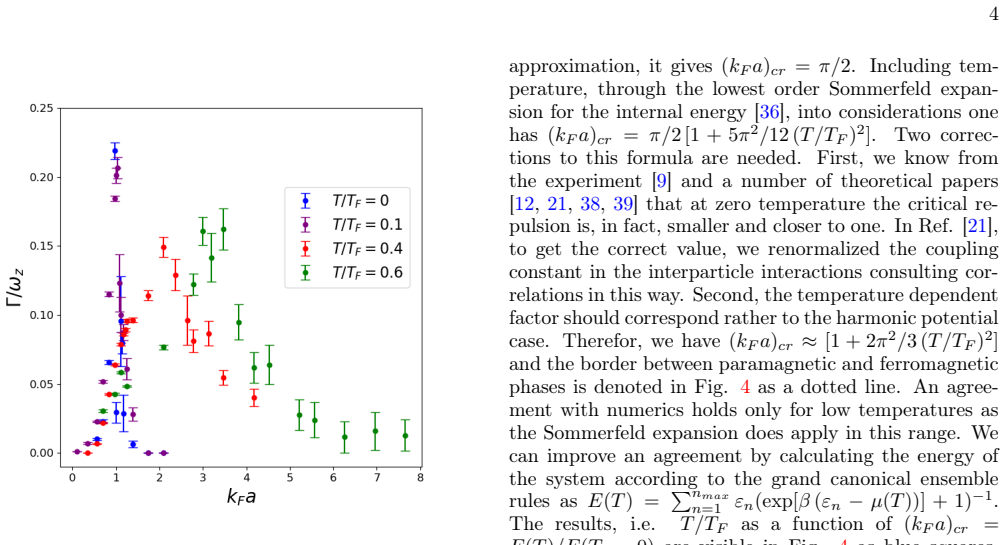
On its own terms, the paper claims that the temperature dependence of the itinerant-ferromagnetic transition in a repulsive two-component Fermi gas is quantitative. In the simulations, the spin-dipole frequency softens as repulsion grows and then jumps upward when the two spin components stop passing through each other; the repulsion at which this jump occurs, $(k_F a)_\mathrm{cr}$, rises with temperature. This matches the experimental observation that metastable ferromagnetic domains appear only at stronger repulsion when the gas is hotter. The authors also report that damping of spin-dipole oscillations peaks near the transition and that the critical repulsion is essentially independent of the particle number, so a 48-atom simulation can locate a phase boundary relevant to much larger clouds.
Load-bearing premise
All temperature effects are placed in the initial Fermi-Dirac-sampled configuration, while the subsequent dynamics are treated at zero temperature with no thermal fluctuations or collisions; if those neglected processes matter during the window in which the clouds overlap, the quantitative agreement with experiment could be coincidental.
Editorial extensions
If this is right
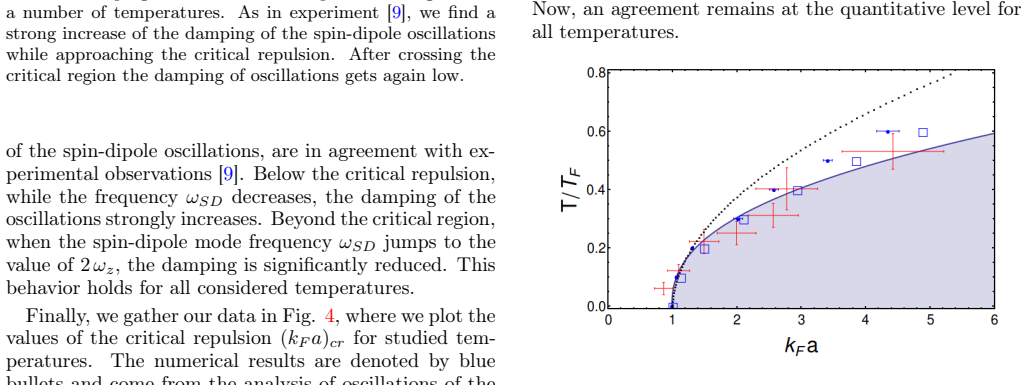
- At higher temperature the critical repulsion $(k_F a)_\mathrm{cr}$ is larger, so a hotter gas requires stronger repulsion to form immiscible ferromagnetic domains.
- The spin-dipole mode softens less at higher temperature, meaning the mode frequency stays closer to the trap frequency before the transition.
- Damping of the spin-dipole oscillations rises sharply as the critical repulsion is approached and falls again beyond it, at every temperature studied.
- Because $(k_F a)_\mathrm{cr}$ does not depend on particle number in the simulations, the phase boundary extracted from small trapped samples should carry over to the larger clouds used in experiments.
Reading between the lines
- A testable extension follows from where the method puts its thermal input: if thermal fluctuations during the collision dynamics matter, the predicted $(k_F a)_\mathrm{cr}$ should drift away from experimental values as temperature rises; measuring at $T/T_F \gtrsim 0.6$ would expose this.
- The same sampling-plus-mean-field pipeline could be applied to imbalanced spin populations or to two-dimensional Fermi gases, where the low-density expansion and the finite-temperature shift both change; the paper does not explore these cases.
- The success of the energy estimate based on the ideal-gas grand canonical ensemble suggests that the domain wall between spin components contributes little to the energetics at the transition, a statement the paper supports only indirectly and that could be checked by resolving the density profile at criticality.
Signed reviews
Editorial analysis
A structured set of objections, weighed in public.
Referee Report
Summary. This paper studies the spin-dipole dynamics of a trapped, balanced two-component Fermi gas with short-range repulsive interactions at nonzero temperature. The authors use the time-dependent Hartree-Fock (TDHF) equations with a renormalized contact interaction that reproduces the low-density expansion (Eq. 3) through third order, and they extend the method to finite T by populating the initially separated, non-interacting trap orbitals according to the Fermi-Dirac distribution via a Monte Carlo sampling of many-body configurations. From the time evolution of the relative cloud separation at N=48, they extract the spin-dipole frequency and damping rate as functions of kFa for temperatures up to T/TF = 0.4, identify the critical repulsion (kFa)cr where the spin-dipole mode jumps to approximately 2 omega_z, and compare it with the experiment of Valtolina et al. [9]. They also present analytic Stoner/Sommerfeld curves based on the ideal-gas harmonic-trap energy. The central claim is that the critical repulsion increases with temperature and that the numerical results agree quantitatively with experiment.
Significance. If the result holds, this is a useful and inexpensive route to finite-temperature phase boundaries in repulsive Fermi gases. The interaction renormalization is anchored to a known low-density expansion rather than fitted to the phase boundary; the initial-state sampling is exact for the separated non-interacting clouds; and the analytic Stoner curve provides a nearly parameter-free benchmark. The prediction that (kFa)cr increases with T is falsifiable and consistent with the experimental data of Ref. [9]. The main caveats are that the analytic curves are anchored at T=0 to known/experimental values and that the finite-T sampling-plus-zero-T TDHF protocol lacks independent validation. With those points addressed, this would be a solid contribution to the itinerant-ferromagnetism literature.
major comments (3)
- [Sec. 'To understand this universal behavior' and Fig. 4] The analytic curves in Fig. 4 are not parameter-free in absolute normalization. The text states (kFa)cr ≈ [1 + 2π^2/3 (T/TF)^2], which omits the zero-temperature prefactor; the dotted line and blue squares must inherit their T=0 position from experiment [9] and Ref. [21]. Moreover, the blue squares use the ideal-gas harmonic-trap energy E(T), not the interacting TDHF energy. Therefore the 'quantitative agreement' of these analytic curves is really a prediction of the dimensionless temperature shift, not of the absolute critical repulsion. The abstract and conclusions should be reworded to make this distinction explicit.
- [Sec. 'To extend our analysis by including temperature effects...' and Eq. (2)] Temperature enters the numerics only through the Fermi-Dirac sampling of the initially separated, non-interacting cloud; the subsequent evolution uses the zero-temperature TDHF equation (2), which contains no temperature, no thermal fluctuations, and no collisional relaxation. No convergence study in the number of sampled configurations is reported, and no independent validation of this grand-canonical-sampling/zero-T-TDHF prescription is given. Because the finite-temperature blue bullets in Fig. 4 are the core numerical evidence, the quantitative agreement claim is not yet supported by a fully validated method. Please add convergence checks and a benchmark test, or explicitly state the collisionless approximation and its expected validity window.
- [Sec. 'Finally, we gather our data in Fig. 4'] The comparison to experiment assumes that (kFa)cr is independent of particle number, supported only by Ref. [21] at zero temperature. Since the experiment uses a much larger sample than N=48 and the temperature shift itself could depend on N, the authors should either verify the N-independence at the temperatures considered or add a clear caveat. This assumption is load-bearing for the central quantitative claim.
minor comments (6)
- [Abstract] The phrase 'Monte Carlo technique based sampling' should be reworded to 'Monte Carlo-based sampling' or 'Monte Carlo sampling'.
- [Throughout] There are several occurrences of 'Therefor' that should read 'Therefore'.
- [Sec. 'To extend our analysis...'] The replacement expression for gn± in Eqs. (2) is typeset ambiguously; write it as an explicit equation clearly separating n_+ and n_-.
- [Figs. 2-4] The figures do not show uncertainties on the fitted spin-dipole frequencies, damping rates, or extracted critical values. For a quantitative comparison, please report statistical errors or state whether the horizontal bars in Fig. 4 include the dispersion of the critical values.
- [Fig. 4] The solid line is described as a power-law fit, but the fitting function and parameters are not given; specify them or remove the fit.
- [Sec. 'To understand this universal behavior'] The sentence 'the temperature dependent factor should correspond rather to the harmonic potential case' is vague; please state explicitly that the denominator is the ideal-gas harmonic-trap energy E(T)/E(0).
Circularity Check
The temperature trend is genuinely computed, but the analytic phase-boundary line in Fig. 4 is anchored at T=0 to the same experiment it is compared with; the independent TDHF results are not circular.
-
fitted input called prediction
[Section 'To understand this universal behavior...' (paragraph preceding Fig. 4)]
"First, we know from the experiment [9] and a number of theoretical papers [12, 21, 38, 39] that at zero temperature the critical repulsion is, in fact, smaller and closer to one. In Ref. [21], to get the correct value, we renormalized the coupling constant in the interparticle interactions consulting correlations in this way. Second, the temperature dependent factor should correspond rather to the harmonic potential case. Therefor, we have (kFa)cr≈ [1 + 2π^2/3 (T/T_F)^2] and the border between paramagnetic and ferromagnetic phases is denoted in Fig. 4 as a dotted line."
The analytic dotted line is constructed by normalizing (kFa)cr to about 1 at T=0 using the same experiment [9] whose data (red crosses in Fig. 4) are then compared with the line. Thus the absolute position of this theoretical boundary at low temperature is not independently predicted; it is set by the very data being compared. The genuinely predictive content is only the temperature-dependent factor 1 + 2π^2/3 (T/T_F)^2, derived from Sommerfeld expansion of the ideal trapped gas. The numerical blue bullets and the blue squares from the grand-canonical energy do not use this experimental anchor, so the central finite-temperature result of the paper remains independent. The circularity is partial and transparent, not a hidden fit to the entire dataset.
full rationale
Apart from the analytic curve's T=0 normalization, the paper's derivation chain is self-contained. The finite-temperature critical repulsion is obtained in three ways: (i) time-dependent Hartree-Fock simulations with Monte Carlo Fermi-Dirac sampling of initial states, which involve no fitted parameters; (ii) a grand-canonical ideal-gas energy ratio E(T)/E(0), also parameter-free; and (iii) the Sommerfeld-expansion dotted line. Only the dotted line inherits its T=0 value from experiment [9]; the blue bullets and blue squares do not. The renormalized coupling constants are imported from the authors' prior Ref. [21], but they are justified by the external low-density expansion of Eq. (3), not by the experiment being compared, so this self-citation carries independent content. The size-independence claim based on Ref. [21] is a supportive extrapolation, not the load-bearing step for the temperature dependence. Overall, the new result — the increase of (kFa)cr with temperature — is computed rather than fitted, and the quantitative agreement of the numerical simulations with experiment is a genuine comparison. The 3-point score reflects the partially circular construction of the analytic phase boundary without undermining the independent numerical result.
Assumptions & free parameters
free parameters (2)
- Hard-sphere third-order coefficient 0.23 in the energy expansion =
0.23 (hard-sphere value, Ref. [31])
- Zero-temperature critical repulsion anchor (kFa)cr(0) =
1 (approximately)
assumptions (6)
- domain assumption Single Slater determinant (atomic-orbital) ansatz for the many-body wavefunction
- domain assumption Contact-potential interaction renormalized locally to reproduce the low-density energy expansion
- domain assumption The energy expansion Eq. (3) with hard-sphere third-order coefficient is accurate enough at kFa near 1
- domain assumption Initial separated clouds form an ideal gas, so grand canonical Fermi-Dirac sampling is exact at t = 0
- ad hoc to paper Stoner identification (kFa)cr = E(T)/E(0) with the ideal-gas harmonic-trap energy
- domain assumption Particle-number independence of (kFa)cr
Cite this review
Pith. "Pith review of Nonzero temperature dynamics of a repulsive two-component Fermi gas." pith.science (2026). https://pith.science/paper/VI7CEVZS
@misc{pith2026190808367,
  author       = {Pith},
  title        = {Pith review of: Nonzero temperature dynamics of a repulsive two-component Fermi gas},
  year         = {2026},
  howpublished = {\url{https://pith.science/paper/VI7CEVZS}},
  note         = {Machine review of arXiv:1908.08367}
}
read the original abstract
We study spin-dipole oscillations of a binary fermionic mixture at nonzero temperatures. We apply the atomic-orbital method combined with the Monte Carlo technique based sampling to probe finite temperatures. Our results agree quantitatively with recent experiment, G. Valtolina et al., Nat. Phys. 13, 704 (2017), showing the appearance of the ferromagnetic phase at stronger repulsion between components when the temperature is increased.
Figures

Figures from the paper (1 more)
Reference graph
Works this paper leans on
-
[9]
G. Valtolina, F. Scazza, A. Amico, A. Burchianti, A. Re- cati, T. Enss, M. Inguscio, M. Zaccanti, and G. Roati, Nat. Phys. 13, 704 (2017)
work page 2017
-
[21]
P. T. Grochowski, T. Karpiuk, M. Brewczyk, and K. Rz¸ ażewski, Phys. Rev. Lett.119, 215303 (2017)
work page 2017
- [1]
- [2]
- [3]
-
[4]
X. Du, L. Luo, B. Clancy, and J. E. Thomas, Phys. Rev. Lett. 101, 150401 (2008)
work page 2008
- [5]
- [6]
Show all 39 references
-
[7]
Sanner, E
C. Sanner, E. J. Su, W. Huang, A. Keshet, J. Gillen, and W. Ketterle, Phys. Rev. Lett.108, 240404 (2012)
2012
-
[8]
Lee, M.-S
Y.-R. Lee, M.-S. Heo, J.-H. Choi, T. T. Wang, C. A. Christensen, T.M.Rvachov, andW.Ketterle, Phys.Rev. A 85, 063615 (2012)
2012
-
[10]
C. Chin, R. Grimm, P. Julienne, and E. Tiesinga, Rev. Mod. Phys. 82, 1225 (2010)
2010
-
[11]
Amico, F
A. Amico, F. Scazza, G. Valtolina, P. Tavares, W. Ket- terle, M. Inguscio, G. Roati, and M. Zaccanti, Phys. Rev. Lett. 121, 253602 (2018)
2018
-
[12]
Pilati, G
S. Pilati, G. Bertaina, S. Giorgini, and M. Troyer, Phys. Rev. Lett. 105, 030405 (2010)
2010
-
[13]
Massignan and G
P. Massignan and G. M. Bruun, Eur. Phys. J. D65, 83 (2011)
2011
-
[14]
Chang, M
S.-Y. Chang, M. Randeria, and N. Trivedi, Proc. Natl. Acad. Sci. 108, 51 (2011)
2011
-
[15]
Pekker, M
D. Pekker, M. Babadi, R. Sensarma, N. Zinner, L. Pollet, M. W. Zwierlein, and E. Demler, Phys. Rev. Lett.106, 050402 (2011)
2011
-
[16]
Massignan, M
P. Massignan, M. Zaccanti, and G. M. Bruun, Reports Prog. Phys. 77, 034401 (2014)
2014
-
[17]
Trappe, P
M.-I. Trappe, P. T. Grochowski, M. Brewczyk, and K. Rz¸ ażewski, Phys. Rev. A93, 023612 (2016)
2016
-
[18]
Karpiuk, M
T. Karpiuk, M. Brewczyk, and K. Rz¸ ażewski, Phys. Rev. A 69, 043603 (2004)
2004
-
[19]
Karpiuk, M
T. Karpiuk, M. Brewczyk, S. Ospelkaus-Schwarzer, K. Bongs, M. Gajda, and K. Rzążewski, Phys. Rev. Lett. 93, 100401 (2004)
2004
-
[20]
Karpiuk, M
T. Karpiuk, M. Brewczyk, and K. Rzążewski, Phys. Rev. A 73, 053602 (2006)
2006
-
[22]
Bertaina, E
G. Bertaina, E. Fratini, S. Giorgini, and P. Pieri, Phys. Rev. Lett. 110, 115303 (2013)
2013
-
[23]
V. R. Pandharipande, Nucl. Phys. A 174, 641 (1971); 178, 123 (1971)
1971
-
[24]
V. R. Pandharipande and H. A. Bethe, Phys. Rev. C7, 1312 (1973)
1973
-
[25]
Cowell, H
S. Cowell, H. Heiselberg, L. E. Mazets, J. Morales, V. R. Pandharipande, and C. J. Pethick, Phys. Rev. Lett.88, 210403 (2002)
2002
-
[26]
Z.-Q. Yu, S. Zhang, and H. Zhai, Phys. Rev. A 83, 041603(R) (2011)
2011
-
[27]
A. L. Fetter and J. D. Walecka, Quantum Theory of Many-Particle Systems (Dover, New York, 2003)
2003
-
[28]
Baker Jr., Rev
G. Baker Jr., Rev. Mod. Phys.43, 479 (1971)
1971
-
[29]
Huang and C
K. Huang and C. N. Yang, Phys. Rev.105, 767 (1957)
1957
-
[30]
T. D. Lee and C. N. Yang, Phys. Rev.105, 1119 (1957)
1957
-
[31]
DeDominicis and P
C. DeDominicis and P. C. Martin, Phys. Rev.105, 1417 (1957)
1957
-
[32]
Navon, S
N. Navon, S. Nascimbène, F. Chevy, C. Salomon, Science 328, 729 (2010)
2010
-
[33]
von Stecher and C
J. von Stecher and C. Greene, Phys. Rev. A75, 022716 (2007)
2007
-
[34]
D. A. Butts and D. S. Rokhsar, Phys. Rev. A55, 4346 (1997)
1997
-
[35]
Gawryluk, T
K. Gawryluk, T. Karpiuk, M. Gajda, K. Rz¸ ażewski, and M. Brewczyk, Int. J. Comput. Math,95, 2143 (2018)
2018
-
[36]
Huang, Statistical Mechanics (Wiley, Delhi, 2014)
K. Huang, Statistical Mechanics (Wiley, Delhi, 2014)
2014
-
[37]
Zwerger, Science325, 1507 (2009)
W. Zwerger, Science325, 1507 (2009)
2009
-
[38]
G. J. Conduit, A. G. Green, and B. D. Simons, Phys. Rev. Lett. 103, 207201 (2009)
2009
-
[39]
He, X.-J
L. He, X.-J. Liu, X.-G. Huang, and H. Hu, Phys. Rev. A 93, 063629 (2016)
2016
Reviewed August 14, 2026 · model on record in the stance chip above.
Discussion (0). Continue with ORCID to comment.