REVIEW 3 major objections 5 minor 32 references
Unconventional topological Hall effect in high-topological-number skyrmion crystals
T0 review · 3 major / 5 minor · reviewed 2026-08-14 · deepseek-v4-flash
Pith's one-line read This paper claims that high-Q skyrmion crystals show Hall steps of (1/Q) e²/h per band, not e²/h.
desk verdict A promising low-energy prediction for high-Q skyrmion Hall effect, but the universal 'all bands' claim is impossible in the finite model and must be retracted. read the letter →
The pith
A machine-rendered reading of the paper's core claim, the machinery that carries it, and where it could break.
The reading
What carries the argument
The central machinery is the strong-Hund's-coupling double-exchange model on a giant unit cell. Each skyrmion is discretized as a sublattice of atoms (5x5 for Q=2, $9\times 9$ for Q=3), and the effective spinless hopping amplitude between neighboring sites is the spin overlap $t_{ij}^{\mathrm{eff}} = t\langle\chi_i|\chi_j\rangle$, which carries the phase information of the skyrmion texture. Exact diagonalization of the resulting $k$-space matrix gives the band structure, and the Berry phase (Chern number) of each band is computed by integrating the Berry curvature over the Brillouin zone. The zero-temperature Hall conductivity is the sum of the Berry phases of all occupied bands, so the claim reduces to the band-grouping rule: every Q consecutive bands have total Berry phase 1.
What would settle it
Recalculate the Chern numbers of the thirty lowest bands for the Q=3 square-lattice skyrmion with a finer discretization, for example $13\times 13$ atoms per skyrmion, using the same profile; if the two band groups that violate the 1/Q rule do not move toward a total Berry phase of 1 (and a per-band average of $1/Q$), the central claim is false. An experimental alternative is to measure the topological Hall conductivity of a Q=2 skyrmion crystal and check whether the average step per filled band equals $e^2/(2h)$ rather than $e^2/h$.
Extended reading notes
Core claim
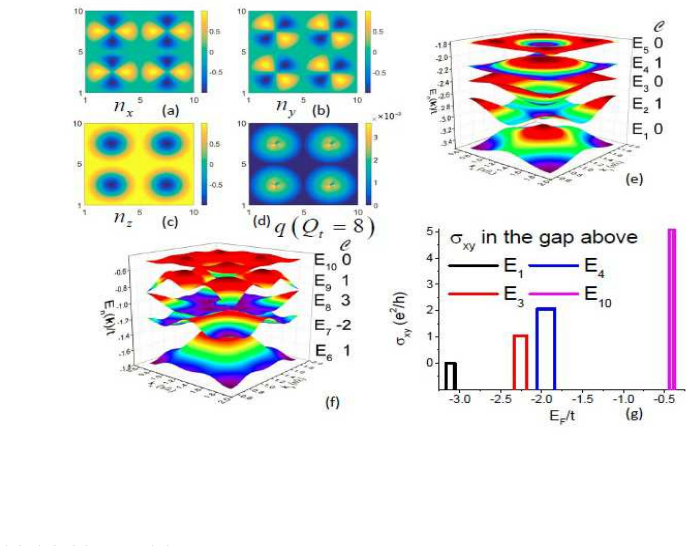
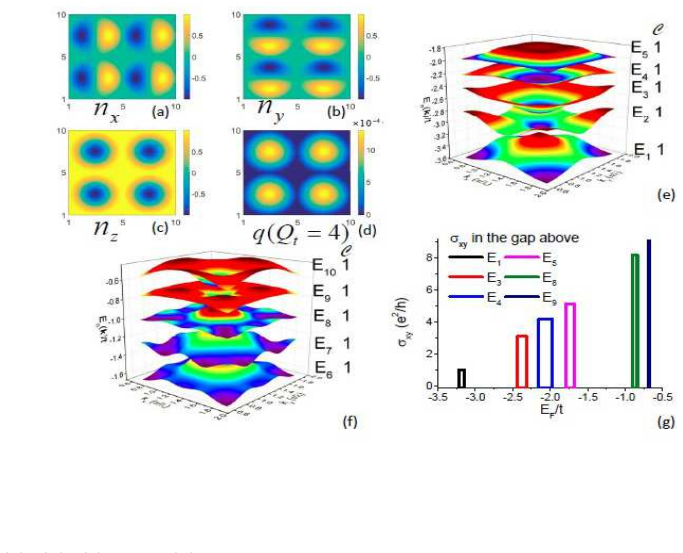
For square-lattice skyrmion crystals with per-skyrmion topological number Q=2 or Q=3, in the strong Hund coupling limit, the zero-temperature topological Hall conductivity is quantized at integer multiples of $e^2/h$ whenever the Fermi energy lies in an energy gap, and the bands are organized into groups of Q consecutive bands whose total Berry phase is unity. As a result, the average Berry phase per band is $1/Q$, in contrast to the conventional Q=1 skyrmion crystal where each band carries a Berry phase of 1. The paper presents numerical Chern numbers for the bands: in the Q=2 case the lowest ten bands average to 1/2, and in the Q=3 case, apart from two band groups that deviate and are attributed to the coarse $9\times 9$ discretization, the 30 lowest bands average to 1/3. The authors interpret this as a reciprocal relation: the skyrmion number Q is a real-space winding, while the Berry phase C is a momentum-space winding, and the two are reciprocals.
Load-bearing premise
The load-bearing premise is that a small discrete atomic lattice (5x5 for Q=2, $9\times 9$ for Q=3) with the chosen skyrmion profile faithfully represents the continuum emergent magnetic field; the paper's own Q=3 data show two band groups violating the 1/Q rule and blame the coarse grid, but no convergence study is given.
Editorial extensions
If this is right
- If the 1/Q rule holds, high-Q skyrmion crystals should display Hall plateaus whose step heights per band are fractional multiples of $e^2/h$, specifically $(1/Q)e^2/h$ on average.
- The total Hall conductivity in any gap remains an integer multiple of $e^2/h$, so the effect is a redistribution of Chern number among bands, not a fractional quantum Hall state.
- The Q=1 skyrmion crystal becomes the special case in which the real-space number and the momentum-space number coincide, which is why the conventional result of unity per band is a degenerate instance of the same rule.
- For Q=3, the two deviant band groups in the table mean that the rule is not exact at the $9\times 9$ discretization; the authors' claim implies that finer discretization would push those groups toward total Berry phase 1.
Reading between the lines
- If the average step size $1/Q$ survives continuum extrapolation, measuring the Hall plateau spacing in a skyrmion crystal would give a direct electrical readout of the real-space skyrmion number Q, including cases where Q is otherwise hard to determine.
- Following the known triangular-lattice Q=1 result, where crystal topology doubles the step to $2e^2/h$, a triangular lattice of Q=2 skyrmions might show average steps of $(2/Q)e^2/h$ below the van Hove singularity; this is an extension the paper does not compute.
- The rule is derived in the strong Hund coupling limit; weaker coupling is expected to smear the plateaus, so the crossover from quantized $1/Q$ steps to unquantized Hall response is a natural next calculation that could sharpen the regime where the prediction applies.
Signed reviews
Editorial analysis
A structured set of objections, weighed in public.
Referee Report
Summary. This paper studies the topological Hall effect in square-lattice skyrmion crystals whose individual skyrmions carry topological number Q=2 or Q=3, in the strong Hund's-coupling limit. The authors diagonalize a tight-binding model on a lattice with giant unit cells (5x5 atoms for Q=2 and 9x9 for Q=3), compute the band Chern numbers, and evaluate the zero-temperature Hall conductivity from the Kubo formula. Their central claim is that, unlike the conventional Q=1 case where each band contributes one quantum e^2/h, for high-Q skyrmions each band contributes on average 1/Q e^2/h, so that sequential Q bands form a group with total Berry phase unity. They attribute this to a 'reciprocality' between the real-space skyrmion number and the momentum-space Berry phase.
Significance. If the result holds for the low-energy part of the spectrum, it would be an interesting extension of the topological Hall effect in skyrmion crystals and could serve as a signature of high-topological-number skyrmions. The paper uses a standard exact-diagonalization method, computes the Hall conductivity directly from the Kubo formula with no fitted parameters, and reports the band Chern numbers explicitly. These are strengths. However, the central claim as stated in the abstract and conclusions is not supported by the mathematical structure of the model, and the Q=3 numerical evidence is incomplete because no convergence study is provided.
major comments (3)
- [Abstract and Sec. IV (Conclusions)] The claim that every Q sequential bands contribute a total Berry phase of unity, without a low-energy qualifier, is inconsistent with the vanishing sum of all band Chern numbers. For any finite-dimensional Bloch Hamiltonian, the sum of Chern numbers over all bands is zero. For Q=2 with 25 bands, the sequential-pair rule over the lowest 24 bands gives +12, forcing the 25th band to have C=-12, which lies outside the claimed range [-3,+3]. For Q=3, Table I shows that the first 30 bands sum to +10, so the remaining 51 bands must sum to -10 and their average Chern number is about -0.2, not +1/3. Thus the universal rule cannot hold for the full band structure; it can at most hold for low-energy groups, and the paper must state this qualification explicitly and address the compensating high-energy Chern numbers.
- [Sec. III, Table I and surrounding discussion] The Q=3 data show two of ten band groups violating the 1/3 rule: E7-E9 has average Chern number 2/3 and E16-E18 has average 0. The authors attribute these deviations to the coarse 9x9 grid, but they do not provide a convergence study, error estimates, or a continuum extrapolation. The text mentions a comparison among 9x9, 5x5, and 4x4 sublattices, but no quantitative results are shown. Without such evidence, the deviations cannot be dismissed as discretization artifacts, and the claimed 1/Q rule is not verified for Q=3.
- [Sec. II (Model) and Sec. III (Numerical results)] The discrete skyrmion profile Theta(r)=pi(1-r/lambda) for r<lambda and Theta=0 for r>lambda has a kink at the skyrmion boundary, which produces a singular emergent magnetic field in the continuum. The 5x5 (Q=2) and 9x9 (Q=3) discretizations may not faithfully represent this field, especially for high Q where the spin texture varies more rapidly. Since the central conclusion depends on the resolution of the discretization, a systematic study with increasing unit-cell size and an extrapolation to the continuum limit is needed to substantiate the claim.
minor comments (5)
- [Sec. III, text near Figs. 1 and 2] The sentence 'The Berry phase of a single band varies between 0 and 1 for all the bands except a 3 for E8 and a -2 for E7, which averages to be 1/Q' is unclear because only the lowest ten bands are displayed; please specify the band range and define the averaging procedure.
- [Abstract and Sec. IV] The term 'reciprocality' is not standard and the explanation that the momentum-space Berry phase is the reciprocal of the real-space topological number is heuristic; either provide a derivation or present it as a conjecture.
- [Introduction, Ref. [6]] The text refers to the 'seminal work of Hamamoto and Nagaosa', but Ref. [6] has three authors (Hamamoto, Ezawa, and Nagaosa); the citation should be corrected.
- [Fig. 3 and Sec. II] The sublattice labels A to Y and the transfer integrals such as t_BA and t_UA are not defined in the text; a short explanation or a table of the labels would improve reproducibility.
- [Sec. II, Eq. (10)] The notation in Eq. (10) is ambiguous: the integration measure dk_x dk_y and the domain Omega are used without specifying the normalization relative to the Brillouin zone, and the prefactor -i/2pi could be confused with the definition in Eq. (8).
Circularity Check
No circularity: the 1/Q rule is an output of exact diagonalization and Chern-number sums, not an input or fitted parameter.
full rationale
The paper derives Hall conductivities from a fixed double-exchange tight-binding model, Eq. (4), with the skyrmion profile and Q as inputs, and computes σxy via the Kubo formula, Eq. (10), as the sum of band Chern numbers. The claimed 1/Q-per-band behavior is read off the resulting Chern numbers (Figs. 1-2 and Table I); it is not imposed in the Hamiltonian, fitted to the Hall data, or obtained by renaming an input. The attribution of the rule to 'reciprocality' between real-space and momentum-space topology is an after-the-fact interpretation, not a load-bearing derivation step, and no cited prior result by the authors is used to force the conclusion; the Q=1 benchmark is external (Ref. 6). The paper's admitted Q=3 deviations and lack of continuum extrapolation are correctness/robustness limitations, not circularity, because the disputed rule is still an output rather than an input. The separate concern that the unqualified 'all bands' average conflicts with the vanishing total Chern number of a finite lattice is a mathematical consistency critique of the claim, not a circular-reasoning pattern under the specified checklist.
Assumptions & free parameters
free parameters (2)
- Skyrmion radius lambda =
2.5a
- Atoms per skyrmion (unit cell size) =
5x5 for Q=2, 9x9 for Q=3
assumptions (5)
- domain assumption Strong Hund coupling limit J >> t forces electron spin to align with the local spin texture.
- domain assumption Skyrmion spin profile Theta(r)=pi(1-r/lambda) for r<lambda, Theta(r)=0 for r>lambda, and Phi(phi)=Q phi + gamma.
- domain assumption A square lattice of identical skyrmions with one skyrmion per 5x5 or 9x9 atom unit cell.
- standard math The Kubo formula for zero-temperature Hall conductivity equals the total Chern number of occupied bands.
- standard math The Chern number computed by integrating Berry curvature over the Brillouin zone is gauge invariant and quantized.
Cite this review
Pith. "Pith review of Unconventional topological Hall effect in high-topological-number skyrmion crystals." pith.science (2026). https://pith.science/paper/VIAMPRJB
@misc{pith2026190805772,
  author       = {Pith},
  title        = {Pith review of: Unconventional topological Hall effect in high-topological-number skyrmion crystals},
  year         = {2026},
  howpublished = {\url{https://pith.science/paper/VIAMPRJB}},
  note         = {Machine review of arXiv:1908.05772}
}
abstract
Skyrmions with the topological number $Q$ equal an integer larger than 1 are called high-topological-number skyrmions or high-$Q$ skyrmions. In this work, we theoretically study the topological Hall effect in square-lattice high-$Q$ skyrmion crystals (SkX) with $Q=2$ and $Q=3$. As a result of the emergent magnetic field, Landau-level-like electronic band structure gives rise to quantized Hall conductivity when the Fermi energy is within the gaps between adjacent single band or multiple bands intertwined. We found that different from conventional ($Q=1$) SkX the Hall quantization number increases by $1/Q$ in average when the elevating Fermi energy crosses each band. We attribute the result to the fact that the Berry phase ${\cal{C}}$ is measured in the momentum space and the topological number of a single skyrmion $Q$ is measured in the real space. The reciprocality does not affect the conventional SkX because $Q=1=1/Q$.
Figures

Reference graph
Works this paper leans on
-
[1]
T. H. R. Skyrme, Proc. R. Soc. London Ser. A 260, 127 (1961)
work page 1961
-
[2]
Nagaosa and Y
N. Nagaosa and Y. Tokura, Nat. Nanotechnol. 8, 899 (2013)
2013
-
[3]
u hlbauer, B. Binz, F. Jonietz, C. Pfleiderer, A. Rosch, A. Neubauer, R. Georgii, and P. B\
S. M\" u hlbauer, B. Binz, F. Jonietz, C. Pfleiderer, A. Rosch, A. Neubauer, R. Georgii, and P. B\" o ni, Science 323, 915 (2009)
work page 2009
-
[4]
S. Seki, X. Z. Yu, S. Ishiwata, and Y. Tokura, Science 336, 198 (2012)
2012
-
[5]
u nzer, A. Neubauer, T. Adams, S. M\
W. M\" u nzer, A. Neubauer, T. Adams, S. M\" u hlbauer, C. Franz, F. Jonietz, R. Georgii, P. B\" o ni, B. Pedersen, M. Schmidt, A. Rosch, and C. Pfleiderer, Phys. Rev. B 81, 041203 (2010)
work page 2010
- [6]
-
[7]
B. G\" o bel, A. Mook, J. Henk, and I. Mertig, Phys. Rev. B 95, 094413 (2017)
work page 2017
- [8]
Show all 32 references
-
[9]
Hayami and Y
S. Hayami and Y. Motome, Phys. Rev. B 99, 094420 (2019)
2019
-
[10]
Ozawa, S
R. Ozawa, S. Hayami, and Y. Motome, Phys. Rev. Lett. 118, 147205 (2017)
2017
-
[11]
E. G. Galkina, E. V. Kirichenko, B. A. Ivanov, and V. A. Stephanovich, Phys. Rev. B 79, 134439 (2009)
2009
-
[12]
Zhang, M
X. Zhang, M. Ezawa, and Y. Zhou, Sci. Rep. 5, 9400 (2015)
2015
-
[13]
X. Xing, P. W. T. Pong, and Y. Zhou, Phys. Rev. B 94, 054408 (2016)
2016
-
[14]
Zhou and M
Y. Zhou and M. Ezawa, Nat. Commun. 5, 4652 (2014)
2014
-
[15]
Sampaio, V
J. Sampaio, V. Cros, S. Rohart, A. Thiaville, and A. Fert, Nat. Nanotechnol. 8, 839 (2013)
2013
-
[16]
Romming, C
N. Romming, C. Hanneken, M. Menzel, J. E. Bickel, B. Wolter, K. V. Bergmann, A. Kubetzka, and R. Wiesendanger, Science 341, 636 (2013)
2013
-
[17]
Tchoe and J
Y. Tchoe and J. H. Han, Phys. Rev. B 85, 174416 (2012)
2012
-
[18]
Iwasaki, M
J. Iwasaki, M. Mochizuki, and N. Nagaosa, Nat. Nanotechnol. 8, 742 (2013)
2013
-
[19]
S.-Z. Lin, C. D. Batista, C. Reichhardt, and A. Saxena, Phys. Rev. Lett. 112, 187203 (2014)
2014
-
[20]
K. M. D. Hals and A. Brataas, Phys. Rev. B 89, 064426 (2014)
2014
-
[21]
J. Li, A. Tan, K.W. Moon, A. Doran, M.A. Marcus, A.T. Young, E. Arenholz, S. Ma, R.F. Yang, C. Hwang, and Z.Q. Qiu, Nat. Commun. 5, 4704 (2014)
2014
-
[22]
Everschor, M
K. Everschor, M. Garst, B. Binz, F. Jonietz, S. M\" u hlbauer, C. Pfleiderer, and A. Rosch, Phys. Rev. B 86, 054432 (2012)
2012
-
[23]
Heinze, K
S. Heinze, K. V. Bergmann, M. Menzel, J. Brede, A. Kubetzka, R. Wiesendanger, G. Bihlmayer, and S. Bl\" u gel, Nat. Phys. 7, 713 (2011)
2011
-
[24]
Neubauer, C
A. Neubauer, C. Pfleiderer, B. Binz, A. Rosch, R. Ritz, P. G. Niklowitz, and P. B\" o ni, Phys. Rev. Lett. 102, 186602 (2009)
2009
-
[25]
Schulz, R
T. Schulz, R. Ritz, A. Bauer, M. Halder, M. Wagner, C. Franz, C. Pfleiderer, K. Everschor, M. Garst, and A. Rosch, Nat. Phys. 8, 301 (2012)
2012
-
[26]
G\" o bel, A
B. G\" o bel, A. Mook, J. Henk, and I. Mertig, Phys. Rev. B 99, 060406(R) (2019)
2019
-
[27]
G\" o bel, A
B. G\" o bel, A. Mook, J. Henk, and I. Mertig, Phys. Rev. B 96, 060406(R) (2017)
2017
-
[28]
K. S. Denisov, I. V. Rozhansky, N. S. Averkiev, and E. L\" a hderanta, Sci. Rep. 7, 17204 (2017)
2017
-
[29]
K. S. Denisov, I. V. Rozhansky, N. S. Averkiev, and E. L\" a hderanta, Phys. Rev. B 98, 195439 (2018)
2018
-
[30]
Nakazawa, M
K. Nakazawa, M. Bibes, and H. Kohno, J. Phys. Soc. Jpn. 87, 033705 (2018)
2018
-
[31]
Nakazawa and H
K. Nakazawa and H. Kohno, Phys. Rev. B 99, 174425 (2019)
2019
-
[32]
D. J. Thouless, M. Kohmoto, M. P. Nightingale, and M. den Nijs, Phys. Rev. Lett. 49, 405 (1982). references figure [ht] [height=10cm, width=14cm] Fig1.eps (a) (b) (c), and (d) Top views of the magnetization distributions n_x , n_y , and n_z of the high-topological-number SkX, ...
1982
Reviewed August 14, 2026 · model on record in the stance chip above.
Discussion (0). Continue with ORCID to comment.