REVIEW 5 major objections 5 minor 132 references
Bi-semantic Chemical Embedder for Joint Representation Learning of SMILES and Natural Language
T0 review · 5 major / 5 minor · reviewed 2026-08-15 · deepseek-v4-flash
Pith's one-line read CheMatE, a single encoder trained on SMILES-annotated scientific text, ranks first on both molecular-property and scientific-language benchmarks and is the only chemistry-specialized model in the top statistical group on both panels.
desk verdict Useful model and corpus, but the 'no trade-off' claim rests on non-standard random splits that need to be redone with scaffold and document-level splits. read the letter →
The pith
A machine-rendered reading of the paper's core claim, the machinery that carries it, and where it could break.
The reading
What carries the argument
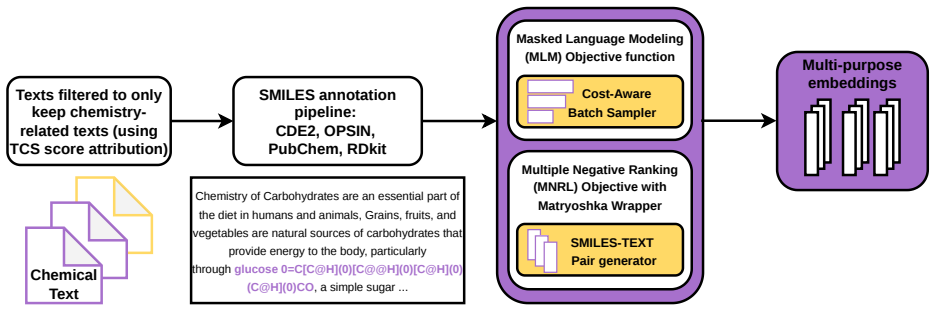
The load-bearing object is the SMILES-injected document: ordinary scientific text in which every chemical entity that can be resolved is immediately followed by its canonical SMILES, so that structure tokens and prose tokens share one sequence. The MLM objective then binds the two semantics directly, forcing the model to predict masked SMILES from surrounding prose and masked prose from surrounding SMILES. The second mechanism is the contrastive stage, which builds synthetic triples by anchoring on one canonical SMILES and scoring text segments by the maximum Tanimoto similarity of their contained molecules' Morgan fingerprints, then optimizes a Matryoshka-weighted Multiple Negative Ranking Loss across embedding dimensions from 768 down to 64, so truncated embeddings stay useful. A supporting mechanism, the BalancedTokenBatchSampler, constructs every batch under three simultaneous caps — raw token budget, padded-token memory, and quadratic cost ceiling — which is what makes stable 8,192-token training feasible on a corpus whose documents range from short abstracts to full articles with hundreds of SMILES each.
What would settle it
Screen the 14.4-million-document pre-training corpus against the seventeen scientific-language benchmarks with exact and near-duplicate matching (for example, 8-gram overlap with PubMedQA, SciCite, and ArXiv Categories), remove or mask every overlapping document, and re-run the frozen-embedding NLP panel: CheMatE's mean rank of 3.2 and its top-group membership surviving decontamination would support the claim, while a collapse toward the untrained ModernBERT backbone would indicate leakage. A complementary probe is a SMILES-to-text retrieval experiment, which tests whether the contrastive stage created genuine cross-modal alignment in the shared embedding space.
Extended reading notes
Core claim
Put in the terms the authors use, the discovery is that SMILES need not be a separate modality: it can be woven into scientific prose and learned together with it, producing one encoder whose frozen embeddings are at the top of both molecular and language benchmarks. CheMatE is a ModernBERT-base model first trained with masked language modeling on 14.4 million documents (21.9 billion tokens) in which each detected chemical entity is immediately followed by its canonical SMILES string, so the model must reconstruct structural tokens from prose context and prose tokens from structural context within a single 8,192-token sequence. A second stage refines those embeddings with a Matryoshka Multiple Negative Ranking loss on synthetic triples whose positive and negative text segments are chosen by Tanimoto similarity of their Morgan fingerprints to an anchor SMILES. Under a frozen-embedding, linear-probe protocol across 48 datasets, CheMatE belongs to the best-performing statistical group on 43 of 48 datasets (30 of 31 SMILES, 13 of 17 NLP), holds the lowest mean rank on both modality panels, and is the only chemistry-specialized encoder in the top Nemenyi group on both. The ablation that carries the argument: removing the contrastive stage drops the bi-semantic score from 86.7% to 55.5%, showing the second stage, not the backbone, is what creates the joint representation.
Load-bearing premise
The evaluation assumes the benchmark texts were not present in pre-training: CheMatE was trained on billions of tokens from the same web and scientific sources as its language benchmarks, and the paper reports no overlap check, so if benchmark passages appear in training, the NLP rankings could reflect memorization rather than transferable representation quality.
Editorial extensions
If this is right
- One frozen encoder can now serve both molecular property prediction and scientific text understanding, so a practitioner no longer has to choose between a chemistry-specialist model that forgets language and a general model that underperforms on structure.
- The contrastive stage is the ingredient that matters most: dropping it cuts the bi-semantic score from 86.7% to 55.5%, a larger effect than swapping the backbone, so future builders should spend effort on pair generation rather than architecture.
- Annotating existing scientific corpora with SMILES at chemical mentions appears to be a workable substitute for pre-training from scratch on bare molecular strings, lowering the data cost of chemistry-aware encoders.
- Because the Matryoshka objective supervises embeddings down to 64 dimensions, the same model can serve applications that need compact vectors, such as large-scale similarity search over both molecules and texts.
Reading between the lines
- A direct test the paper does not run would settle the cross-modal claim: a retrieval probe that embeds a molecule's SMILES and asks the frozen encoder to return the passage discussing it; the contrastive objective should make this work, and its failure would reveal that the gains come from per-task linear probes rather than shared-space alignment.
- Because the annotation pipeline resolves names through OPSIN and PubChem, the corpus is skewed toward well-known, resolvable compounds; one could test whether CheMatE's property-prediction gains concentrate on common scaffolds and fade on novel or underspecified chemistry.
- The NLP evidence base is thinner than the claim: 17 datasets, with CheMatE statistically tied with SciBERT and ChEmbed on that panel, so 'no trade-off' is established on these benchmarks rather than as a general property of bi-semantic training.
- No decontamination analysis is reported between the 14.4-million-document pre-training corpus and the NLP benchmarks, so the language-side rankings carry a leakage risk the SMILES panel does not; an overlap screen is the cheapest way to raise confidence in the no-trade-off conclusion.
Signed reviews
Editorial analysis
A structured set of objections, weighed in public.
Referee Report
Summary. The paper introduces CheMatE, a ModernBERT-base encoder that is continuously pre-trained with masked language modeling on a curated corpus of 14.4 million SMILES-annotated scientific documents, followed by a Matryoshka contrastive stage using Multiple Negative Ranking Loss on algorithmically constructed SMILES-text pairs. The authors claim that a single frozen encoder can simultaneously provide state-of-the-art embeddings for molecular property prediction and scientific natural language tasks, without the modality trade-off exhibited by eleven baselines. Evaluation is performed on 48 datasets (26 classification, 22 regression) with 20-fold cross-validation, and models are compared via Friedman/Nemenyi critical-difference diagrams, Tukey HSD analyses, and a custom 'Bi-semantic Score' metric. The paper also contributes the SMILES annotation pipeline, the BalancedTokenBatchSampler for efficient long-context training, and open-sourced code and model weights.
Significance. If the central claim holds, this is a substantial contribution: a single encoder with strong frozen embeddings across both chemical and scientific-language tasks, supported by a large curated corpus and a reproducible training pipeline. The statistical methodology is comparatively thorough for this literature (20-fold CV, omnibus tests, post-hoc equivalences), and the release of code, data pipeline, and checkpoints is a concrete asset for the community. However, the headline result depends on the evaluation protocol: random cross-validation splits and the absence of a decontamination analysis leave the 'no modality trade-off' claim weaker than the text suggests. The absence of any direct cross-modal evaluation task also leaves the 'bi-semantic alignment' claim partially unsupported. These issues are fixable with additional experiments, so a major revision is appropriate.
major comments (5)
- [Section 3, Appendix A.1 (Table 2)] The molecular property prediction benchmarks (BACE, HIV, ESOL, FreeSolv, Lipophilicity, QM9, and the Polaris/TDC sets) are evaluated with random StratifiedKFold/KFold splits, as stated in Table 2's caption and Section 3. This is not the standard protocol for MoleculeNet and related benchmarks, where scaffold splits are conventionally used to prevent near-duplicate molecular structures from appearing in both train and test. Because the paper's central claim is that CheMatE is the only chemistry-specialized model in the top Nemenyi equivalence group on the SMILES panel, the rankings must be re-established under scaffold splits (or a similarly structure-aware split) before the claim is credible. Please re-run the SMILES experiments with scaffold splits and report whether the rank ordering and Nemenyi equivalence groups are preserved.
- [Section 3, Table 2 (NLP benchmarks)] The scientific NLP benchmarks (PubMedQA, SciCite, ArXiv Categories, SciRepEval Field of Study, etc.) are evaluated with random folds, but the splitting unit is not specified. If the folds are at sentence or paragraph level, passages from the same source document can appear in both train and test, inflating linear-probe accuracy and affecting the Nemenyi rankings. The standard practice for these datasets is document- or publication-level splitting. Please specify the splitting unit and re-run the NLP experiments with document-level folds, reporting the resulting mean ranks and equivalence groups.
- [Section 2.1, Section 3] No decontamination or overlap analysis is reported between the pre-training corpus (14.4 million documents from FineWeb-Edu and ChemPile, 21.9B tokens) and the evaluation benchmarks, several of which (PubMedQA, SciCite, ArXiv Categories, WikipediaChemFields) draw on the same scientific literature sources. If benchmark texts or near-duplicates appear in the pre-training corpus, the frozen-embedding NLP scores may partly reflect memorization rather than representation quality. Please report overlap statistics (e.g., n-gram or embedding-based contamination checks) or perform a decontamination pass and re-report the affected NLP results.
- [Section 2.2.2, Section 2.2.3] The contrastive training procedure is described inconsistently. Section 2.2.2 states that the model is trained 'for a single epoch on a 20k subset of anchor-positive pairs,' while Section 2.2.3 states that the synthetic pair dataset was filtered to 19,638 pairs and the model was 'trained for 3 epochs at LR=2e-5,' and then adds that the released checkpoint corresponds to the end of the first contrastive epoch. These statements conflict on both the number of pairs and the number of epochs. Please clarify the exact training duration, the number of pairs, and which checkpoint was used for the reported evaluations, since this affects reproducibility of the main results.
- [Section 3, Section 1 (contribution iv)] The paper claims a 'bi-semantic' model that jointly represents molecular structure and natural language, but all reported evaluations are unimodal: SMILES-only property prediction and text-only classification/regression. There is no direct cross-modal task (e.g., molecule-to-text retrieval, SMILES-text entailment, or zero-shot molecule captioning) that requires the model to align the two modalities. Without such a task, the improvement from the contrastive stage could reflect better unimodal embedding geometry rather than genuine alignment of the two semantics. Please add at least one cross-modal retrieval or ranking benchmark (e.g., based on Text2Mol or a similar SMILES-description dataset) to validate the central bi-semantic claim.
minor comments (5)
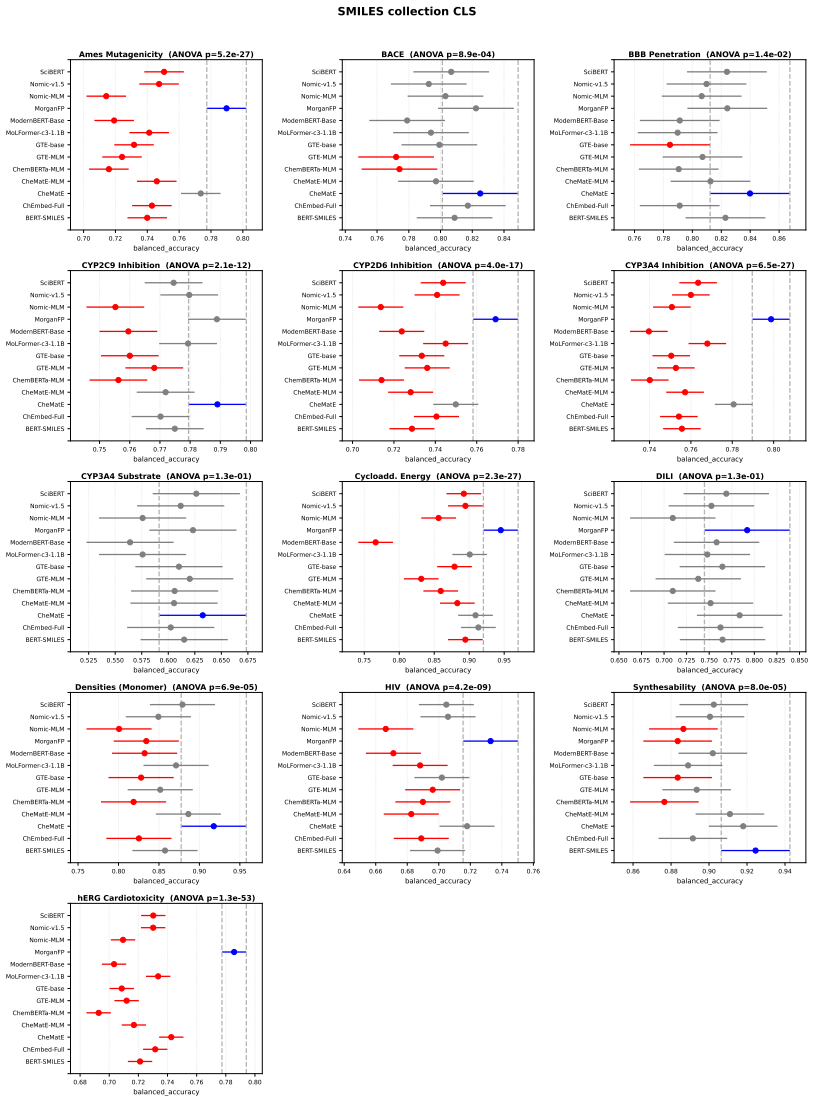
- [Figure 5 caption] The caption states 'using balanced accuracy over 20 CV folds,' but the panels plot R² for regression datasets; the caption should be corrected to refer to R².
- [Abstract, Section 2.1.1, Figure 2] The token count for the education/web subset is reported as 10.4B in the abstract, 10.41B in Section 2.1.1, and 10.48B in Figure 2; please reconcile these numbers.
- [Algorithm 2] The line 'anchors∗∼SMILES(c0)' uses a plural variable name for a single anchor; rename to 'anchor' for consistency with the rest of the algorithm and the text.
- [Table 1] The custom 'Bi-semantic Score (%)' metric is a single aggregate number with no uncertainty or sensitivity analysis; consider reporting per-modality scores with confidence intervals or showing the score's dependence on the weight assigned to each modality.
- [Section A.4] The baseline description for GTE-base-v1.5 says it is the base sentence encoder, but the model card and pooling details are not described in as much detail as for other baselines; please state the exact checkpoint and pooling rule used.
Circularity Check
No significant circularity; the central claims are empirical evaluations on external benchmarks, and the training-signal choices are explicit rather than definitions of the outcomes.
full rationale
The paper makes no claim that any quantity is derived from another by construction. The central claims (lowest mean rank on SMILES and NLP panels, membership in the top Nemenyi equivalence group on both panels, and an 86.7% bi-semantic score) are empirical statements over 48 external benchmark datasets using frozen-embedding linear probes; the benchmark labels are not used in pretraining, so the evaluation is self-contained. The contrastive stage (Algorithm 2) constructs positive and negative pairs from Morgan/Tanimoto similarity, but this is a training-signal choice rather than a fitted prediction: the model is not evaluated on Morgan similarity, and the ablation comparing CheMatE with CheMatE-MLM is an experimental attribution, not a derivation. The TCS filter (Equation 1) is fully specified in the paper, so the citation to Bran et al. [2026], despite overlapping authors, is not load-bearing; the same holds for ChemPile, which is used as a data source. Concerns about random rather than scaffold/document splits and possible pretraining contamination are correctness and protocol risks, not circularity, because they do not make any claimed result an input by definition.
Assumptions & free parameters
free parameters (4)
- TCS word weights w_k =
estimated from two labeled corpora
- Contrastive positive and negative thresholds (tau+, tau-) =
not reported
- Anchor SMILES length filter =
>= 64 characters
- Matryoshka dimension set and weights =
768, 512, 256, 128, 64; default weights w_k
assumptions (4)
- domain assumption ModernBERT-base provides a suitable initialization for chemical-bi-semantic learning.
- domain assumption RDKit-canonicalized SMILES inserted by the annotation pipeline are chemically accurate enough for training.
- domain assumption Morgan/Tanimoto similarity over fragments is a valid proxy for semantic relatedness between text segments.
- domain assumption A linear probe on frozen embeddings measures representation quality.
Cite this review
Pith. "Pith review of Bi-semantic Chemical Embedder for Joint Representation Learning of SMILES and Natural Language." pith.science (2026). https://pith.science/paper/VIBTUCNG
@misc{pith2026260803855,
  author       = {Pith},
  title        = {Pith review of: Bi-semantic Chemical Embedder for Joint Representation Learning of SMILES and Natural Language},
  year         = {2026},
  howpublished = {\url{https://pith.science/paper/VIBTUCNG}},
  note         = {Machine review of arXiv:2608.03855}
}
read the original abstract
Transformer models have revolutionized natural language processing (NLP), and text-based molecular representations like SMILES have successfully extended these architectures to chemistry. However, domain-adaptive pre-training often causes models to overfit to chemical syntax, catastrophically forgetting their foundational semantic capabilities. To address this challenge, we introduce CheMatE, a chemistry-oriented embedding model that jointly captures molecular structure and domain-specific natural language within the same representation space. Built on a ModernBERT backbone, CheMatE learns bi-semantic representations through a two-stage training procedure: continued masked language modeling (MLM) followed by a Matryoshka contrastive learning stage via Multiple Negative Ranking Loss (MNRL). First, we train the model using MLM on a novel, large-scale corpus of SMILES-annotated, long-context scientific documents that were constructed and curated from FineWeb and ChemPile (comprising 10.4B and 11.5B tokens, respectively). Subsequently, the model undergoes contrastive learning using a synthetic dataset of SMILES-text pairs algorithmically derived from our original training corpus. This design exposes the model to SMILES-enriched scientific literature, enabling bi-semantic understanding. We evaluate CheMatE across a range of downstream tasks covering molecular property prediction and scientific language understanding. Our results demonstrate that coupling our custom-curated datasets with this sequential training strategy yields robust, highly transferable representations. By effectively unifying structural and contextual signals within a single text-based framework, CheMatE achieves competitive performance across both specialized chemistry models and general-purpose language model baselines.
Figures


Figures from the paper (5 more)



Reference graph
Works this paper leans on
-
[1]
2020 , booktitle = Oakland, keywords =
Sushant Dinesh and Nathan Burow and Dongyan Xu and Mathias Payer , title =. 2020 , booktitle = Oakland, keywords =
2020
-
[2]
and Chau, Siu Lun and Burwood, Ryan P
Sin, Joshua W. and Chau, Siu Lun and Burwood, Ryan P. and P\". Highly parallel optimisation of chemical reactions through automation and machine intelligence , volume =. Nature Communications , publisher =. 2025 , month =. doi:10.1038/s41467-025-61803-0 , number =
-
[3]
and Kaiser, Lukasz and Polosukhin, Illia , month = aug, year =
Vaswani, Ashish and Shazeer, Noam and Parmar, Niki and Uszkoreit, Jakob and Jones, Llion and Gomez, Aidan N. and Kaiser, Lukasz and Polosukhin, Illia , month = aug, year =. Attention. doi:10.48550/arXiv.1706.03762 , abstract =
-
[4]
doi:10.48550/arXiv.1810.04805 , abstract =
Devlin, Jacob and Chang, Ming-Wei and Lee, Kenton and Toutanova, Kristina , month = may, year =. doi:10.48550/arXiv.1810.04805 , abstract =
-
[5]
doi:10.48550/arXiv.1903.10676 , abstract =
Beltagy, Iz and Lo, Kyle and Cohan, Arman , month = sep, year =. doi:10.48550/arXiv.1903.10676 , abstract =
-
[6]
Warner, Benjamin and Chaffin, Antoine and Clavié, Benjamin and Weller, Orion and Hallström, Oskar and Taghadouini, Said and Gallagher, Alexis and Biswas, Raja and Ladhak, Faisal and Aarsen, Tom and Cooper, Nathan and Adams, Griffin and Howard, Jeremy and Poli, Iacopo , month = dec, year =. Smarter,. doi:10.48550/arXiv.2412.13663 , abstract =
-
[7]
Turner, Richard E. , month = feb, year =. An. doi:10.48550/arXiv.2304.10557 , abstract =
-
[8]
Journal of Chemical Information and Computer Sciences , author =. 1988 , note =. doi:10.1021/ci00057a005 , number =
Show all 132 references
- [9]
-
[10]
Nature Machine Intelligence , author =
Molecular set representation learning , volume =. Nature Machine Intelligence , author =. 2024 , note =. doi:10.1038/s42256-024-00856-0 , abstract =
2024 doi
-
[11]
Superlinear , author =
Representation. Superlinear , author =
- [12]
- [13]
-
[14]
IBM Research , month = feb, year =
An. IBM Research , month = feb, year =
- [15]
- [16]
- [17]
-
[18]
ACS Central Science , author =
Molecular. ACS Central Science , author =. 2019 , note =. doi:10.1021/acscentsci.9b00576 , abstract =
2019 doi
-
[19]
Google for Developers , file =
Retrieval. Google for Developers , file =
- [20]
-
[21]
Chemical Science , author =
Assessment of fine-tuned large language models for real-world chemistry and material science applications , volume =. Chemical Science , author =. 2025 , note =. doi:10.1039/D4SC04401K , language =
2025 doi
- [22]
-
[24]
Ranković, Bojana and Schwaller, Philippe , month = dec, year =
-
[25]
CHIMIA , author =
Bayesian. CHIMIA , author =. 2023 , note =. doi:10.2533/chimia.2023.31 , abstract =
2023 doi
-
[26]
arXiv.org , author =
The. arXiv.org , author =. 2015 , file =
2015
-
[27]
, volume =
Neural networks and physical systems with emergent collective computational abilities. , volume =. Proceedings of the National Academy of Sciences , author =. 1982 , note =. doi:10.1073/pnas.79.8.2554 , abstract =
1982 doi
-
[28]
Graph neural networks for materials science and chemistry
-
[29]
Results in Engineering , author =
The impact of artificial intelligence on research efficiency , volume =. Results in Engineering , author =. 2025 , keywords =. doi:10.1016/j.rineng.2025.104743 , abstract =
2025
-
[30]
Journal of Cheminformatics , author =
Towards a. Journal of Cheminformatics , author =. 2012 , keywords =. doi:10.1186/1758-2946-4-22 , abstract =
2012 doi
- [31]
-
[32]
Revisiting
Li, Hongyu and Ding, Liang and Fang, Meng and Tao, Dacheng , editor =. Revisiting. Findings of the. 2024 , pages =. doi:10.18653/v1/2024.findings-emnlp.249 , abstract =
2024 doi
-
[33]
How does the task complexity of masked pretraining objectives affect downstream performance? , url =
Yamaguchi, Atsuki and Ozaki, Hiroaki and Morishita, Terufumi and Morio, Gaku and Sogawa, Yasuhiro , month = may, year =. How does the task complexity of masked pretraining objectives affect downstream performance? , url =. doi:10.48550/arXiv.2305.10992 , abstract =
- [34]
- [35]
-
[36]
Journal of Cheminformatics , author =
Improving chemical reaction yield prediction using pre-trained graph neural networks , volume =. Journal of Cheminformatics , author =. 2024 , keywords =. doi:10.1186/s13321-024-00818-z , abstract =
2024 doi
-
[37]
Bran, Andres M. and Xie, Tong and Pranesh, Shai and Meng, Jeffrey and Nguyen, Xuan Vu and Goumaz, Jeremy and Segura, David Ming and Xu, Ruizhi and Zhou, Dongzhan and Zhang, Wenjie and Hoex, Bram and Schwaller, Philippe , urldate =. 2026 , eprinttype =. doi:10.48550/arXiv.2512....
2026 doi
-
[38]
Burns, Jackson , month = jun, year =
-
[39]
Journal of Cheminformatics , author =
An open source chemical structure curation pipeline using. Journal of Cheminformatics , author =. 2020 , keywords =. doi:10.1186/s13321-020-00456-1 , abstract =
2020 doi
- [40]
- [41]
- [42]
- [43]
-
[44]
and Jette, Morris A
Yoo, Andy B. and Jette, Morris A. and Grondona, Mark , editor =. Job. 2003 , doi =
2003
- [45]
- [46]
- [47]
- [48]
-
[49]
mean\_absolute\_error , url =
-
[50]
scikit-learn , file =
r2\_score , url =. scikit-learn , file =
-
[51]
k-means++:
Arthur, David and Vassilvitskii, Sergei , file =. k-means++:
-
[52]
Rosenberg, Andrew and Hirschberg, Julia , editor =. V-. Proceedings of the 2007. 2007 , pages =
2007
-
[53]
arXiv.org , author =
Theoretical. arXiv.org , author =. 2021 , file =
2021
-
[54]
Machine Learning , author =
Random. Machine Learning , author =. 2001 , keywords =. doi:10.1023/A:1010933404324 , abstract =
2001 doi
-
[55]
Proceedings of the 22nd
Chen, Tianqi and Guestrin, Carlos , month = aug, year =. Proceedings of the 22nd. doi:10.1145/2939672.2939785 , abstract =
-
[56]
The Journal of Physical Chemistry Letters , author =
Bayesian. The Journal of Physical Chemistry Letters , author =. 2025 , note =. doi:10.1021/acs.jpclett.5c00592 , abstract =
2025 doi
-
[57]
Griffiths, Ryan-Rhys and Klarner, Leo and Moss, Henry and Ravuri, Aditya and Truong, Sang and Stanton, Samuel and Tom, Gary and Rankovic, Bojana and Du, Yuanqi and Jamasb, Arian and Deshwal, Aryan and Schwartz, Julius and Tripp, Austin and Kell, Gregory and Frieder, Simon and ...
-
[58]
Current Opinion in Chemical Engineering , author =
Audacity of huge: overcoming challenges of data scarcity and data quality for machine learning in computational materials discovery , volume =. Current Opinion in Chemical Engineering , author =. 2022 , pages =. doi:10.1016/j.coche.2021.100778 , abstract =
2022
-
[59]
Chemical Research in Toxicology , author =
Effects of. Chemical Research in Toxicology , author =. 2022 , note =. doi:10.1021/acs.chemrestox.2c00189 , abstract =
2022 doi
-
[60]
Classification, other data distributions,
- [61]
- [62]
-
[63]
and Shen, Yelong and Wallis, Phillip and Allen-Zhu, Zeyuan and Li, Yuanzhi and Wang, Shean and Wang, Lu and Chen, Weizhu , month = oct, year =
Hu, Edward J. and Shen, Yelong and Wallis, Phillip and Allen-Zhu, Zeyuan and Li, Yuanzhi and Wang, Shean and Wang, Lu and Chen, Weizhu , month = oct, year =. doi:10.48550/arXiv.2106.09685 , abstract =
- [64]
-
[65]
Gaussian processes for classification -
Martin Krasser , url =. Gaussian processes for classification -
- [66]
-
[67]
Bastos, Leonardo S. and O. Diagnostics for. Technometrics , volume =. 2009 , doi =
2009
-
[68]
Probabilistic forecasts, calibration and sharpness , abstract =
Gneiting, Tilmann and Balabdaoui, Fadoua and Raftery, Adrian E , file =. Probabilistic forecasts, calibration and sharpness , abstract =
-
[69]
Andres and Ryan, Louise M
Houseman, E. Andres and Ryan, Louise M. and Coull, Brent A. , title =. Journal of the American Statistical Association , volume =. 2004 , doi =
2004
- [70]
-
[71]
Improving
Radford, Alec and Narasimhan, Karthik and Salimans, Tim and Sutskever, Ilya , file =. Improving
-
[72]
arXiv.org , author =
Retrosynthetic reaction prediction using neural sequence-to-sequence models , url =. arXiv.org , author =. 2017 , file =
2017
-
[73]
ACS Central Science , author =
Automatic. ACS Central Science , author =. 2018 , note =. doi:10.1021/acscentsci.7b00572 , abstract =
2018 doi
-
[74]
Chemical Science , author =
“. Chemical Science , author =. 2018 , note =. doi:10.1039/C8SC02339E , abstract =
2018 doi
-
[75]
and Nair, Vishnu H
Schwaller, Philippe and Probst, Daniel and Vaucher, Alain C. and Nair, Vishnu H. and Kreutter, David and Laino, Teodoro and Reymond, Jean-Louis , month = dec, year =. Mapping the. doi:10.26434/chemrxiv.9897365.v4 , abstract =
-
[76]
WIREs Computational Molecular Science , author =
Machine intelligence for chemical reaction space , volume =. WIREs Computational Molecular Science , author =. 2022 , note =. doi:10.1002/wcms.1604 , abstract =
2022 doi
-
[77]
Digital Discovery , author =
14 examples of how. Digital Discovery , author =. 2023 , note =. doi:10.1039/D3DD00113J , language =
2023 doi
-
[78]
Digital Discovery , author =
Accelerated chemical science with. Digital Discovery , author =. 2024 , note =. doi:10.1039/D3DD00213F , language =
2024 doi
-
[79]
arXiv.org , author =
A. arXiv.org , author =. 2024 , file =
2024
-
[80]
arXiv.org , author =
Survey on. arXiv.org , author =. 2025 , file =
2025
-
[81]
2020 , pages =
Bioinformatics , author =. 2020 , pages =. doi:10.1093/bioinformatics/btz682 , abstract =
2020 doi
- [82]
-
[83]
and Nair, Vishnu H
Schwaller, Philippe and Probst, Daniel and Vaucher, Alain C. and Nair, Vishnu H. and Laino, Teodoro and Reymond, Jean-Louis , month = dec, year =. Data-. doi:10.26434/chemrxiv.9897365.v2 , abstract =
- [84]
-
[85]
and Wang, Jialei , year =
Frazier, Peter I. and Wang, Jialei , year =. Bayesian optimization for materials design , volume =. doi:10.1007/978-3-319-23871-5_3 , note =
-
[86]
Chemical Engineering Journal , author =
Machine learning meets continuous flow chemistry:. Chemical Engineering Journal , author =. 2018 , keywords =. doi:10.1016/j.cej.2018.07.031 , abstract =
2018 doi
- [87]
- [88]
- [89]
-
[90]
doi:10.48550/arXiv.2407.19669 , abstract =
Zhang, Xin and Zhang, Yanzhao and Long, Dingkun and Xie, Wen and Dai, Ziqi and Tang, Jialong and Lin, Huan and Yang, Baosong and Xie, Pengjun and Huang, Fei and Zhang, Meishan and Li, Wenjie and Zhang, Min , month = oct, year =. doi:10.48550/arXiv.2407.19669 , abstract =
-
[91]
2026 , note =
Digital Discovery , author =. 2026 , note =. doi:10.1039/D5DD00348B , abstract =
2026 doi
-
[92]
Miguel and Rance, Dean and Polavieja, Gonzalo G
Jouary, Adrien and Mata, J. Miguel and Rance, Dean and Polavieja, Gonzalo G. de and Machens, Christian K. and Orger, Michael , month = jul, year =. Bridging scales between chemical space and behavioral phenotype , url =
- [93]
-
[94]
Journal of Machine Learning Research , author =
Statistical. Journal of Machine Learning Research , author =. 2006 , pages =
2006
-
[95]
Journal of Chemical Information and Modeling , author =
Practically. Journal of Chemical Information and Modeling , author =. 2025 , note =. doi:10.1021/acs.jcim.5c01609 , abstract =
2025 doi
-
[96]
Journal of Biomedical Informatics , author =
Development of a benchmark corpus to support the automatic extraction of drug-related adverse effects from medical case reports , volume =. Journal of Biomedical Informatics , author =. 2012 , keywords =. doi:10.1016/j.jbi.2012.04.008 , abstract =
2012 doi
-
[97]
2022 , file =
arXiv.org , author =. 2022 , file =
2022
-
[98]
and Leskovec, Jure and Coley, Connor W
Huang, Kexin and Fu, Tianfan and Gao, Wenhao and Zhao, Yue and Roohani, Yusuf H. and Leskovec, Jure and Coley, Connor W. and Xiao, Cao and Sun, Jimeng and Zitnik, Marinka , month = jun, year =. Therapeutics
- [99]
-
[100]
Nature Machine Intelligence , author =
A call for an industry-led initiative to critically assess machine learning for real-world drug discovery , volume =. Nature Machine Intelligence , author =. 2024 , note =. doi:10.1038/s42256-024-00911-w , language =
2024 doi
-
[101]
Journal of Molecular Modeling , author =
Generative chemistry: drug discovery with deep learning generative models , volume =. Journal of Molecular Modeling , author =. 2021 , note =. doi:10.1007/s00894-021-04674-8 , abstract =
2021 doi
-
[102]
Accounts of Chemical Research , author =
Machine. Accounts of Chemical Research , author =. 2018 , note =. doi:10.1021/acs.accounts.8b00087 , abstract =
2018 doi
-
[103]
Nature Machine Intelligence , author =
Leveraging large language models for predictive chemistry , volume =. Nature Machine Intelligence , author =. 2024 , note =. doi:10.1038/s42256-023-00788-1 , abstract =
2024 doi
-
[104]
Large language models as uncertainty-calibrated optimizers for experimental discovery , url =
Ranković, Bojana and Griffiths, Ryan-Rhys and Schwaller, Philippe , month = nov, year =. Large language models as uncertainty-calibrated optimizers for experimental discovery , url =. doi:10.48550/arXiv.2504.06265 , abstract =
-
[105]
Molecules , author =
Modeling. Molecules , author =. 2020 , note =. doi:10.3390/molecules25010044 , abstract =
2020 doi
-
[106]
arXiv.org , author =
Learning. arXiv.org , author =. 2021 , file =
2021
-
[107]
Proceedings of the 2021
Edwards, Carl and Zhai, ChengXiang and Ji, Heng , editor =. Proceedings of the 2021. 2021 , pages =. doi:10.18653/v1/2021.emnlp-main.47 , abstract =
2021 doi
-
[108]
Long Document Classification From Local Word Glimpses via Recurrent Attention Learning , year=
He, Jun and Wang, Liqun and Liu, Liu and Feng, Jiao and Wu, Hao , journal=. Long Document Classification From Local Word Glimpses via Recurrent Attention Learning , year=
- [109]
-
[110]
BMC Bioinformatics , author =
Extraction of relations between genes and diseases from text and large-scale data analysis: implications for translational research , volume =. BMC Bioinformatics , author =. 2015 , keywords =. doi:10.1186/s12859-015-0472-9 , abstract =
2015 doi
- [111]
-
[112]
Bioinformatics , author =
Automatic semantic classification of scientific literature according to the hallmarks of cancer , volume =. Bioinformatics , author =. 2016 , pages =. doi:10.1093/bioinformatics/btv585 , abstract =
2016 doi
-
[113]
Scientific Data , author =
Quantum chemistry structures and properties of 134 kilo molecules , volume =. Scientific Data , author =. 2014 , note =. doi:10.1038/sdata.2014.22 , abstract =
2014 doi
-
[114]
Proceedings of the 10th
Wang, Sheng and Guo, Yuzhi and Wang, Yuhong and Sun, Hongmao and Huang, Junzhou , month = sep, year =. Proceedings of the 10th. doi:10.1145/3307339.3342186 , abstract =
- [115]
-
[116]
Molecular representation learning with language models and domain-relevant auxiliary tasks , url =
Fabian, Benedek and Edlich, Thomas and Gaspar, Héléna and Segler, Marwin and Meyers, Joshua and Fiscato, Marco and Ahmed, Mohamed , month = nov, year =. Molecular representation learning with language models and domain-relevant auxiliary tasks , url =. doi:10.48550/arXiv.2011....
-
[117]
Machine Learning: Science and Technology , author =
Chemformer: a pre-trained transformer for computational chemistry , volume =. Machine Learning: Science and Technology , author =. 2022 , note =. doi:10.1088/2632-2153/ac3ffb , abstract =
2022 doi
- [118]
- [119]
-
[120]
Unifying
Christofidellis, Dimitrios and Giannone, Giorgio and Born, Jannis and Winther, Ole and Laino, Teodoro and Manica, Matteo , month = may, year =. Unifying
-
[121]
Journal of the American Statistical Association , author =
The. Journal of the American Statistical Association , author =. 1937 , note =. doi:10.1080/01621459.1937.10503522 , number =
1937
-
[122]
Penedo, Guilherme and Kydlíček, Hynek and allal, Loubna Ben and Lozhkov, Anton and Mitchell, Margaret and Raffel, Colin and Werra, Leandro Von and Wolf, Thomas , month = oct, year =. The
-
[123]
2025 , pages =
Nucleic Acids Research , author =. 2025 , pages =. doi:10.1093/nar/gkae1059 , abstract =
2025 doi
-
[124]
doi:10.48550/arXiv.2505.12534 , abstract =
Mirza, Adrian and Alampara, Nawaf and Ríos-García, Martiño and Abdelalim, Mohamed and Butler, Jack and Connolly, Bethany and Dogan, Tunca and Nezhurina, Marianna and Şen, Bünyamin and Tirunagari, Santosh and Worrall, Mark and Young, Adamo and Schwaller, Philippe and Pieler, Mi...
-
[125]
and Cole, Jacqueline M
Swain, Matthew C. and Cole, Jacqueline M. , month = oct, year =. Journal of Chemical Information and Modeling , publisher =. doi:10.1021/acs.jcim.6b00207 , abstract =
-
[126]
and Isazawa, Taketomo and Elliott, Stephen R
Mavračić, Juraj and Court, Callum J. and Isazawa, Taketomo and Elliott, Stephen R. and Cole, Jacqueline M. , month = sep, year =. Journal of Chemical Information and Modeling , publisher =. doi:10.1021/acs.jcim.1c00446 , abstract =
-
[127]
and Corbett, Peter T
Lowe, Daniel M. and Corbett, Peter T. and Murray-Rust, Peter and Glen, Robert C. , month = mar, year =. Chemical. Journal of Chemical Information and Modeling , publisher =. doi:10.1021/ci100384d , abstract =
-
[128]
Matryoshka
Kusupati, Aditya and Bhatt, Gantavya and Rege, Aniket and Wallingford, Matthew and Sinha, Aditya and Ramanujan, Vivek and Howard-Snyder, William and Chen, Kaifeng and Kakade, Sham and Jain, Prateek and Farhadi, Ali , month = feb, year =. Matryoshka. doi:10.48550/arXiv.2205.131...
-
[129]
Extended-
Rogers, David and Hahn, Mathew , month = may, year =. Extended-. Journal of Chemical Information and Modeling , publisher =. doi:10.1021/ci100050t , abstract =
-
[130]
Zenodo , year=
rdkit/rdkit: 2025\_03\_1 (Q1 2025) Release , author=. Zenodo , year=
2025
- [131]
- [132]
-
[133]
, year =
Tukey, John W. , year =. Comparing. Biometrics , publisher =. doi:10.2307/3001913 , abstract =
Reviewed August 15, 2026 · model on record in the stance chip above.
Discussion (0). Continue with ORCID to comment.