REVIEW 5 major objections 6 minor 54 references
MSGM: A Multi-Scale Spatiotemporal Graph Mamba for EEG Emotion Recognition
T0 review · 5 major / 6 minor · reviewed 2026-08-06 · deepseek-v4-flash
Pith's one-line read One MSST-Mamba layer on multi-window rPSD features and global-local graphs is claimed to lead subject-independent EEG emotion classification on SEED and THU-EP, match the best F1 on FACED, and run in 151 ms on an edge GPU.
desk verdict Sensible architecture, plausible numbers, but the evaluation protocol is under-specified enough that the SOTA claim is conditional, not proven. read the letter →
The pith
A machine-rendered reading of the paper's core claim, the machinery that carries it, and where it could break.
The reading
What carries the argument
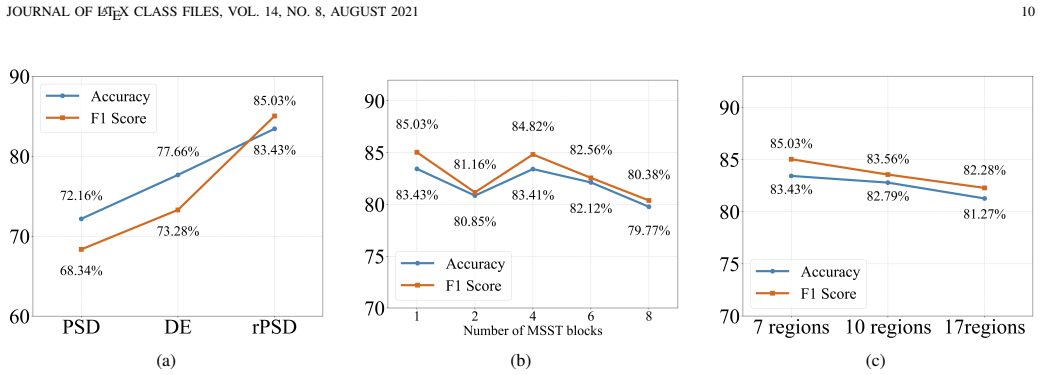
The core is the MSST-Mamba module, one block that wraps Mamba's selective state-space model in a residual connection with RMSNorm. Before it, Temporal Multi-Scale Feature Extraction segments raw EEG into overlapping 20-second windows and further into k sub-window lengths, producing rPSD tensors across seven frequency bands; Spatial Multi-Scale Prior Information Initialization constructs, at each scale, a global graph (edge weights from a Gaussian kernel over features, thresholded by Pearson correlation and Manhattan distance) and a local graph (same weights restricted to scalp regions), duplicated to feed shallow and deep ChebyNet encoders; Spatiotemporal Feature Adaptive Fusion averages the GCN outputs with a linear base embedding to produce global and local tokens per scale. The MambaBlock then processes the token sequence with a selective scan, keeping linear complexity in sequence length, and a linear classifier maps the mean-pooled, normalized tokens to positive/negative logits. The single-block setting is what the paper presents as sufficient, and the ablation identifies Mamba and fusion as the components whose removal costs the most accuracy.
What would settle it
Run the published EmT code on SEED under MSGM's exact binary positive/negative leave-one-subject-out protocol and check whether the reported 80.20% accuracy is reproduced under that protocol; if the number comes from three-class SEED, the claimed margin is an artifact of the label scheme.
Extended reading notes
Core claim
On its own terms, the paper establishes that a multi-scale spatiotemporal graph architecture with Mamba's selective state-space model can perform subject-independent EEG emotion classification with one MSST-Mamba layer. On SEED it reports 83.43% accuracy and 85.03% F1, ahead of EmT's 80.20% and 82.10%; on THU-EP it reports 62.39% accuracy and 73.28% F1, ahead of BiDANN and EmT; on FACED it reports 63.17% accuracy and 76.01% F1, with the paper noting that BiDANN's accuracy is 63.36% while MSGM's F1 is higher. The architecture encodes each time window as rPSD node features, builds a global graph from Pearson correlation and Manhattan distance thresholds and a local graph restricted to scalp regions, applies shallow and deep ChebyNet encoders to duplicated global and local graphs, and combines the results with a linear token embedding before one Mamba block reads the sequence. The paper argues this combination is what makes a single layer sufficient, and the ablation study supports that each module contributes, with the Mamba block and spatiotemporal fusion causing the largest drops when removed.
Load-bearing premise
The state-of-the-art comparison assumes all three datasets—and the imported baseline numbers—use the same binary positive/negative labeling, with SEED's neutral trials folded in the same way; if the baselines were scored under their original three-class protocol, the margins in Table I would not be comparable.
Editorial extensions
If this is right
- If the results reproduce, cross-subject EEG emotion classification can be done with a single Mamba layer, so the field's scaling assumption that deeper is better does not hold for this task.
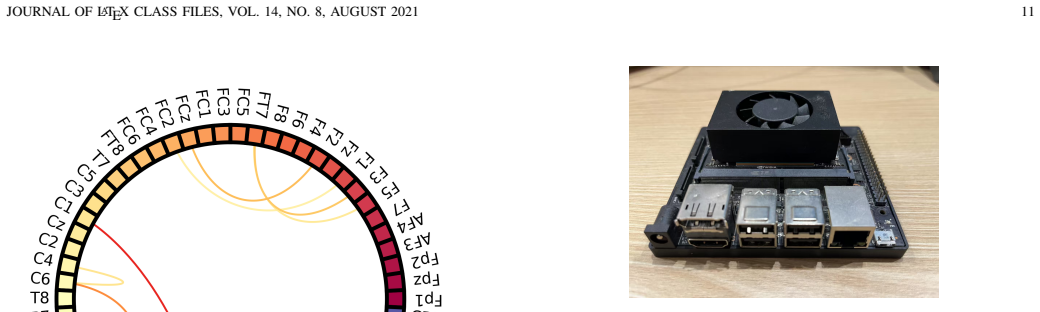
- The 349K-parameter, 151-millisecond Jetson profile means real-time edge deployment is feasible for the binary positive/negative setting, not just server GPUs.
- The ablations imply that rPSD features and the global-local graph split are the accuracy drivers, so future models can reuse these components even if they replace Mamba.
- On FACED, accuracy parity with BiDANN while winning F1 suggests the method's advantage is in balanced classification, not raw accuracy.
Reading between the lines
- The design's effectiveness with one block suggests the multi-window rPSD front-end may be doing most of the representational work; a controlled test replacing the Mamba block with a linear projection or simple pooling would isolate whether the SSM or the tokenization drives the gain.
- The reported superiority of rPSD over differential entropy within this pipeline may not transfer to architectures designed around DE, so comparing MSGM's front-end with DE features under the same protocol would show whether the feature choice or the graph structure is essential.
- If the binary-protocol ambiguity is resolved and the SEED margin survives, the same multi-scale graph front-end could be applied to other EEG decoding tasks such as vigilance or motor imagery, since nothing in the method is emotion-specific except the neuroanatomical priors.
- The FACED accuracy gap with BiDANN implies that a fair claim for that dataset would be 'comparable accuracy with higher F1', and readers should expect the headline 'surpasses' to be dataset-dependent.
Editorial analysis
A structured set of objections, weighed in public.
Referee Report
Summary. The paper proposes MSGM, a Multi-Scale Spatiotemporal Graph Mamba for EEG emotion recognition. The architecture combines multi-window temporal segmentation with rPSD features, global and local graph construction with neuroanatomical priors, multi-depth ChebyNet encoders, and a single MSST-Mamba block, and is evaluated in subject-independent settings on SEED, THU-EP, and FACED. The authors report accuracy and F1 scores on all three datasets, ablation studies on the main components, hyperparameter sensitivity analyses on SEED, and an edge-device deployment on the NVIDIA Jetson Xavier NX. The headline claim is that with one MSST-Mamba layer, MSGM surpasses leading methods on all three datasets while achieving millisecond-level inference.
Significance. If the empirical results withstand scrutiny, MSGM would be a practically useful contribution to EEG-based affective computing, combining a biologically motivated multi-scale graph representation with a linear-complexity Mamba backbone and demonstrating real-time feasibility on an embedded platform. The paper includes several strengths: a detailed architecture description, ablations of each module, a comparison of feature types and MSST block counts, parameter-count and inference-time comparisons with EmT, and a real deployment measurement. However, the current evaluation has unresolved protocol issues that directly affect the central 'surpasses leading methods' claim, specifically the undefined binarization of SEED, the imported EmT baseline comparison, the post-hoc selection of design choices on SEED, and the FACED result where the reported BiDANN accuracy is higher. These issues place the primary claim on weaker ground than the abstract suggests.
major comments (5)
- [Section IV-C] The binary label protocol for SEED is not specified. The text states 'we classify emotions binarily into positive and negative categories' and explains the valence-3.0 threshold only for THU-EP and FACED. SEED uses three labels (positive, neutral, negative), and the paper never states whether neutral trials are dropped, merged, or relabeled. Because Table I imports the EmT results (*) and the protocol is introduced as 'consistent with the approach in EmT,' this ambiguity is load-bearing: if EmT's reported accuracy was produced under the original three-class SEED protocol, then MSGM's 83.43% on a binary task is not directly comparable to EmT's 80.20%. The manuscript must report the exact SEED label mapping, per-fold class counts, and the source and protocol of the EmT numbers used in Table I.
- [Abstract and Table I / Section V-A] The claim that MSGM 'surpasses leading methods in the field on the SEED, THU-EP, and FACED datasets' is contradicted by the paper's own Table I: on FACED, BiDANN achieves 63.36% accuracy versus MSGM's 63.17%. Section V-A explicitly concedes this, but the abstract and conclusion do not qualify the statement. This is an internal inconsistency in the central claim. The wording should be revised to state the actual ranking, e.g., best on SEED and THU-EP, and comparable on FACED in terms of F1.
- [Section III-A-1] The multi-scale temporal segmentation parameters are never specified. The text defines first-level segmentation with l = 20 sec and s = 4 sec, but the second-level windows are described only generically as l'_k and s'_k, with no concrete values and no statement of the number of scales k or the window/hop combinations used in the experiments. Without these values, the proposed method is not reproducible, and the reader cannot assess what 'multi-scale' actually means in the reported results. Please provide the full list of window lengths and hop steps, including how these were chosen.
- [Section V-C] The design decisions justified by the SEED sensitivity analyses—rPSD features, a single MSST-Mamba block, and a 7-region graph partition—are presented as final model choices, but no corresponding analysis is shown for THU-EP or FACED. Since the protocol uses SEED to determine these hyperparameters and then applies them to all datasets, the reported gains are partially a result of selection on the SEED test set. To strengthen the claim that the architecture is generally superior, report the sensitivity of the choices on at least one additional dataset, or describe a validation-based selection procedure that does not use test-set performance.
- [Table I and Section V-A] The accuracy and F1 differences between MSGM and the closest baselines are reported without any statistical significance test. For example, on SEED the difference to EmT is 83.43±11.42 vs 80.20±11.50, and on THU-EP MSGM's 62.39±3.13 vs BiDANN's 61.44±5.51 have overlapping standard deviations across folds. The paper's 'surpasses' claims would be much more convincing if accompanied by paired significance tests (e.g., a Wilcoxon signed-rank test over the per-fold results) or at least a statement of the number of folds where MSGM is strictly better. Without this, the observed margins may not be reliable evidence of a real improvement.
minor comments (6)
- [Section IV-A] The text says 'we conducted comprehensive experiments utilizing five publicly available datasets' but then lists only three (SEED, THU-EP, FACED). This appears to be a typo; please correct it to 'three'.
- [Equation (2) and surrounding text] The text defines the Manhattan distance d_{i,j,k} = ||u_i,k - u_j,k||_1, but the Gaussian kernel in Eq. (2) uses the Euclidean norm in the exponent. Please clarify which distance is actually used for the kernel weight, and make the notation consistent.
- [Table I] In the FACED column for RGNN, the F1 score is reported as '72.27 ± 72.16', which appears to be a typographical error; the standard deviation is implausibly large and likely should be something like 7.22.
- [Section V-D and Section I] Section V-D reports an inference time of 151.0 ms on the Jetson Xavier NX, while the introduction states 'inference times below 151 ms'. Please make these statements consistent, for example by reporting 151 ms as a representative or worst-case value.
- [Equation (7)] The variable m is used both as the layer index in Eq. (7) and as the total number of MSSTBlock layers in the surrounding text. Use a distinct symbol (e.g., i for the index and M for the total) to avoid confusion.
- [Section III-B, Eq. (3)] The local graph adjacency definition w_{ij}^{L,k} is clear, but Figure 2 is not referenced in the main text at the point where local regions are introduced; consider moving the citation of Figure 2 earlier for readability.
Circularity Check
No circularity found: MSGM's claims are empirical benchmark results, not a derivation that reduces to its inputs.
full rationale
The paper reports a new neural architecture and evaluates it on three public EEG datasets under a subject-independent protocol. The central claim is an empirical performance comparison, not a derivation from first principles, so there is no chain of equations in which an output is equivalent to an input by construction. The only imported result is EmT (reference [50]), which is an external baseline from other authors, so it is not a self-citation. The stated protocol is 'consistent with the approach in EmT,' but matching an external baseline's protocol is not circular; whether the protocols actually match across all three datasets (e.g., how SEED's neutral class is handled in the binary positive/negative setup) is a correctness and comparability concern, not a circularity of reasoning. Likewise, the choice of rPSD features, a single MSST-Mamba layer, and the 7-region partitioning is justified by ablation and sensitivity experiments on SEED; that is empirical model selection and a possible selection-bias or overfitting concern, but it does not make the reported results equivalent to the fitted choices by definition. The FACED result where BiDANN has slightly higher accuracy (63.36% vs. 63.17%) is a factual comparison that the paper acknowledges; it weakens the 'surpasses' claim but is not circular. In summary, no load-bearing step reduces to its own input, and no self-citation chain is used to force a conclusion, so the circularity score is 0.
Assumptions & free parameters
free parameters (6)
- Temporal window lengths and hop steps =
not specified in paper
- Graph edge thresholds kappa_theta and d_theta =
75th percentile PCC, 25th percentile Manhattan distance
- Gaussian kernel bandwidth sigma =
(mu_d + sigma_d) / 2 of pairwise distances
- Number of brain regions for local graphs =
7 regions
- Binary valence threshold =
3.0
- Number of MSST-Mamba layers =
1
assumptions (6)
- domain assumption EEG signals contain reliable discriminative information about emotional state.
- domain assumption Relative power spectral density across seven fixed frequency bands is a sufficient feature representation.
- domain assumption A 7-region scalp partition matches functional brain organization for emotion.
- standard math Chebyshev polynomial graph convolutions (ChebyNet) are a valid spectral graph operator.
- standard math Mamba selective state-space models capture long-range temporal dependencies at linear complexity.
- ad hoc to paper Binary positive/negative labels derived from a 3.0 valence threshold preserve the emotion recognition task.
Cite this review
Pith. "Pith review of MSGM: A Multi-Scale Spatiotemporal Graph Mamba for EEG Emotion Recognition." pith.science (2026). https://pith.science/paper/VIQ7YUJ7
@misc{pith2026250715914,
  author       = {Pith},
  title        = {Pith review of: MSGM: A Multi-Scale Spatiotemporal Graph Mamba for EEG Emotion Recognition},
  year         = {2026},
  howpublished = {\url{https://pith.science/paper/VIQ7YUJ7}},
  note         = {Machine review of arXiv:2507.15914}
}
read the original abstract
EEG-based emotion recognition struggles with capturing multi-scale spatiotemporal dynamics and ensuring computational efficiency for real-time applications. Existing methods often oversimplify temporal granularity and spatial hierarchies, limiting accuracy. To overcome these challenges, we propose the Multi-Scale Spatiotemporal Graph Mamba (MSGM), a novel framework integrating multi-window temporal segmentation, bimodal spatial graph modeling, and efficient fusion via the Mamba architecture. By segmenting EEG signals across diverse temporal scales and constructing global-local graphs with neuroanatomical priors, MSGM effectively captures fine-grained emotional fluctuations and hierarchical brain connectivity. A multi-depth Graph Convolutional Network (GCN) and token embedding fusion module, paired with Mamba's state-space modeling, enable dynamic spatiotemporal interaction at linear complexity. Notably, with just one MSST-Mamba layer, MSGM surpasses leading methods in the field on the SEED, THU-EP, and FACED datasets, outperforming baselines in subject-independent emotion classification while achieving robust accuracy and millisecond-level inference on the NVIDIA Jetson Xavier NX.
Figures


Figures from the paper (3 more)


Reference graph
Works this paper leans on
-
[1]
Time–frequency representation and convolu- tional neural network-based emotion recognition,
S. K. Khare and V . Bajaj, “Time–frequency representation and convolu- tional neural network-based emotion recognition,” IEEE Transactions on Neural Networks and Learning Systems , vol. 32, no. 7, pp. 2901–2909, 2021
work page 2021
-
[2]
Eeg-based emotion recognition using multi-scale dynamic cnn and gated transformer,
Z. Cheng, X. Bu, Q. Wang, T. Yang, and J. Tu, “Eeg-based emotion recognition using multi-scale dynamic cnn and gated transformer,” Scientific Reports, vol. 14, Dec 2024. [Online]. Available: https://doi.org/10.1038/s41598-024-82705-z
-
[3]
J. Guo et al., “A transformer based neural network for emotion recog- nition and visualizations of crucial eeg channels,” Physica A: Statistical Mechanics and its Applications , vol. 603, p. 127700, 2022
work page 2022
-
[4]
Emotion recognition in eeg signals using deep learning methods: A review,
M. Jafari et al., “Emotion recognition in eeg signals using deep learning methods: A review,” Comput Biol Med , vol. 165, p. 107450, 2023
work page 2023
-
[5]
J. Xiao, W. Ding, D. Zhang, Y . Ma, Y . Wang, Z. Shao, and J. Wang, “Multi-periodicity dependency transformer based on spectrum offset for radio frequency fingerprint identification,” Measurement, 2025
work page 2025
-
[6]
E. Vafaei and M. Hosseini, “Transformers in eeg analysis: A review of architectures and applications in motor imagery, seizure, and emotion classification,” Sensors, vol. 25, no. 5, p. 1293, 2025. [Online]. Available: https://doi.org/10.3390/s25051293
-
[7]
Emotion classification based on transformer and cnn for eeg spatial–temporal feature learning,
X. Yao, T. Li, P. Ding, F. Wang, L. Zhao, A. Gong, W. Nan, and Y . Fu, “Emotion classification based on transformer and cnn for eeg spatial–temporal feature learning,” Brain Sci. , vol. 14, no. 3, p. 268,
-
[9]
Review on emotion recognition based on electroencephalography,
H. Liu, Y . Zhang, Y . Li, and X. Kong, “Review on emotion recognition based on electroencephalography,” Frontiers in Computational Neuro- science, vol. 15, p. 758212, 2021
work page 2021
Show all 54 references
-
[10]
Multi-source eeg emotion recognition via dynamic contrastive domain adaptation,
Y . Xiao, Y . Zhang, X. Peng, S. Han, X. Zheng, D. Fang, and X. Chen, “Multi-source eeg emotion recognition via dynamic contrastive domain adaptation,” arXiv preprint arXiv:2408.10235 , 2024
2024 arXiv
-
[11]
A comparative study of wavelet families for schizophrenia detection,
E. Sathiya, T. D. Rao, and T. S. Kumar, “A comparative study of wavelet families for schizophrenia detection,” Frontiers in Human Neuroscience, vol. 18, 2024. [Online]. Available: https://www.frontiersin.org/journals/ human-neuroscience/articles/10.3389/fnhum.2024.1463819
2024
-
[12]
Integration of stationary wavelet transform on a dynamic partial reconfiguration for recognition of pre-ictal gamma oscillations,
N. Jmail, M. Zaghdoud, A. Hadriche, T. Frikha, C. Ben Amar, and C. B ´enar, “Integration of stationary wavelet transform on a dynamic partial reconfiguration for recognition of pre-ictal gamma oscillations,” Heliyon, vol. 4, no. 2, p. e00530, mar 2018. [Online]. Available: htt...
2018 doi
-
[13]
Eeg emotion recognition using dynamical graph convolutional neural networks,
T. Song, W. Zheng, P. Song, and Z. Cui, “Eeg emotion recognition using dynamical graph convolutional neural networks,” IEEE Transactions on Affective Computing, vol. 11, no. 3, pp. 532–541, July-September 2020, manuscript received 10 Oct. 2017; revised 28 Jan. 2018; accepted 2...
2020
-
[14]
Analysis of eeg signals and facial expressions for continuous emotion detection,
M. Soleymani, S. Asghari-Esfeden, Y . Fu, and M. Pantic, “Analysis of eeg signals and facial expressions for continuous emotion detection,” IEEE Transactions on Affective Computing , vol. 7, no. 1, pp. 17–28, 2016
2016
-
[15]
Bridge graph attention based graph convolution network with multi-scale transformer for eeg emotion recognition,
H. Yan, K. Guo, X. Xing, and X. Xu, “Bridge graph attention based graph convolution network with multi-scale transformer for eeg emotion recognition,” IEEE Transactions on Affective Computing , 2024
2024
-
[16]
Masa- tcn: Multi-anchor space-aware temporal convolutional neural networks for continuous and discrete eeg emotion recognition,
Y . Ding, N. Robinson, S. Zhang, Q. Zeng, and C. Guan, “Masa- tcn: Multi-anchor space-aware temporal convolutional neural networks for continuous and discrete eeg emotion recognition,” arXiv preprint arXiv:2308.16207, 2023
2023 arXiv
-
[17]
Hierarchi- cal spatiotemporal electroencephalogram feature learning and emotion recognition with attention-based antagonism neural network,
P. Zhang, C. Min, K. Zhang, W. Xue, and J. Chen, “Hierarchi- cal spatiotemporal electroencephalogram feature learning and emotion recognition with attention-based antagonism neural network,” Frontiers in Neuroscience, vol. 15, p. 738167, dec 2021, eCollection 2021
2021
-
[18]
Hierarchical dynamic graph convolutional network with interpretability for eeg-based emotion recog- nition,
M. Ye, C. L. P. Chen, and T. Zhang, “Hierarchical dynamic graph convolutional network with interpretability for eeg-based emotion recog- nition,” IEEE Transactions on Neural Networks and Learning Systems , pp. 1–12, 2022. JOURNAL OF LATEX CLASS FILES, VOL. 14, NO. 8, AUGUST 2021 13
2022
-
[19]
Lggnet: Learning from local-global-graph representations for brain–computer in- terface,
Y . Ding, N. Robinson, C. Tong, Q. Zeng, and C. Guan, “Lggnet: Learning from local-global-graph representations for brain–computer in- terface,” IEEE Transactions on Neural Networks and Learning Systems , vol. 35, no. 7, pp. 9773–9786, 2024
2024
-
[20]
Adaptive hierarchical graph convolutional network for eeg emotion recognition,
Y . Xue, W. Zheng, Y . Zong, H. Chang, and X. Jiang, “Adaptive hierarchical graph convolutional network for eeg emotion recognition,” in 2022 International Joint Conference on Neural Networks (IJCNN) , 2022, pp. 1–8
2022
-
[21]
A two-stage efficient 3-d cnn framework for eeg based emotion recognition,
N. B. Ye Qiao, Mohammed Alnemari, “A two-stage efficient 3-d cnn framework for eeg based emotion recognition,” arXiv preprint arXiv:2208.00883, 2022
2022 arXiv
-
[22]
Development and validation of an eeg-based real-time emotion recog- nition system using edge ai computing platform with convolutional neural network system-on-chip design,
W.-C. Fang, K.-Y . Wang, N. Fahier, Y .-L. Ho, and Y .-D. Huang, “Development and validation of an eeg-based real-time emotion recog- nition system using edge ai computing platform with convolutional neural network system-on-chip design,” IEEE Journal on Emerging and Selected ...
2019
-
[23]
Mamba: Linear-time sequence modeling with selective state spaces,
A. Gu and T. Dao, “Mamba: Linear-time sequence modeling with selective state spaces,” arXiv preprint arXiv:2312.00752 , 2023
2023 arXiv
-
[24]
Multi-scale spatiotemporal representa- tion learning for eeg-based emotion recognition,
X. Zhou and X. Peng, “Multi-scale spatiotemporal representa- tion learning for eeg-based emotion recognition,” arXiv preprint arXiv:2409.07589, 2024
2024 arXiv
-
[25]
Global context mambav- ision for eeg-based emotion recognition,
H. Wang, L. Xu, Y . Yu, W. Ding, and Y . Xu, “Global context mambav- ision for eeg-based emotion recognition,” pp. 1–5, 2025
2025
-
[26]
Investigating critical frequency bands and channels for eeg-based emotion recognition with deep neural networks,
W.-L. Zheng and B.-L. Lu, “Investigating critical frequency bands and channels for eeg-based emotion recognition with deep neural networks,” IEEE Transactions on Autonomous Mental Development , vol. 7, no. 3, pp. 162–175, 2015
2015
-
[27]
Similar brains blend emotion in similar ways: Neural representations of individual difference in emotion profiles,
X. Hu, F. Wang, and D. Zhang, “Similar brains blend emotion in similar ways: Neural representations of individual difference in emotion profiles,” Neuroimage, vol. 247, p. 118819, 2022
2022
-
[28]
A large finer-grained affective computing eeg dataset,
J. Chen, X. Wang, C. Huang, X. Hu, X. Shen, and D. Zhang, “A large finer-grained affective computing eeg dataset,” Scientific Data , vol. 10, p. 740, 2023. [Online]. Available: https://doi.org/10.1038/ s41597-023-02650-w
2023
-
[29]
Eeg emotion recognition using dynamical graph convolutional neural networks,
T. Song, W. Zheng, P. Song, and Z. Cui, “Eeg emotion recognition using dynamical graph convolutional neural networks,” IEEE Transactions on Affective Computing, vol. 11, no. 3, pp. 532–541, 2020
2020
-
[30]
Chebynet: Boosting neural network fitting and efficiency through chebyshev polynomial layer connections,
Y . Xin, J. Zhang, Z. Zheng, Y . Wang, W. Dai, C. Li, J. Zou, and H. Xiong, “Chebynet: Boosting neural network fitting and efficiency through chebyshev polynomial layer connections,” 2024. [Online]. Available: https://openreview.net/forum?id=17U3nlco2r
2024
-
[31]
Eeg-based emotion recognition using regularized graph neural networks,
P. Zhong, D. Wang, and C. Miao, “Eeg-based emotion recognition using regularized graph neural networks,” IEEE Transactions on Affective Computing, vol. 13, no. 3, pp. 1290–1301, 2020
2020
-
[32]
A bi- hemisphere domain adversarial neural network model for eeg emotion recognition,
Y . Li, W. Zheng, Y . Zong, Z. Cui, T. Zhang, and X. Zhou, “A bi- hemisphere domain adversarial neural network model for eeg emotion recognition,” IEEE Transactions on Affective Computing , vol. 12, no. 2, pp. 494–504, 2021
2021
-
[33]
A comprehensive survey on eeg-based emotion recognition: A graph-based perspective,
C. Lu, X. Zhou, Y . Ding, Z. Kun, W. Ziyu, J. Yinglu, and Y . Kun, “A comprehensive survey on eeg-based emotion recognition: A graph-based perspective,” arXiv, 2024. [Online]. Available: https: //arxiv.org/abs/2408.06027
2024 arXiv
-
[34]
Gcb-net: Graph convolu- tional broad network and its application in emotion recognition,
T. Zhang, X. Wang, X. Xu, and C. P. Chen, “Gcb-net: Graph convolu- tional broad network and its application in emotion recognition,” IEEE Transactions on Affective Computing, vol. 13, no. 1, pp. 379–388, 2019
2019
-
[35]
Timesnet: Temporal 2d-variation modeling for general time series analysis,
H. Wu, T. Hu, Y . Liu, H. Zhou, J. Wang, and M. Long, “Timesnet: Temporal 2d-variation modeling for general time series analysis,” arXiv, 2023. [Online]. Available: https://arxiv.org/abs/2210.02186
2023 arXiv
-
[36]
Linking attention-based multiscale cnn with dynamical gcn for driving fatigue detection,
H. Wang, L. Xu, A. Bezerianos, C. Chen, and Z. Zhang, “Linking attention-based multiscale cnn with dynamical gcn for driving fatigue detection,” IEEE Transactions on Instrumentation and Measurement , vol. 70, pp. 1–11, 2020
2020
-
[37]
Pathformer: Multi-scale transformers with adaptive pathways for time series forecasting,
P. Chen, Y . Zhang, Y . Cheng, Y . Shu, Y . Wang, Q. Wen, B. Yang, and C. Guo, “Pathformer: Multi-scale transformers with adaptive pathways for time series forecasting,” arXiv preprint arXiv:2402.05956 , 2024
2024 arXiv
-
[38]
Visual-to-eeg cross-modal knowledge distillation for continuous emotion recognition,
S. Zhang, C. Tang, and C. Guan, “Visual-to-eeg cross-modal knowledge distillation for continuous emotion recognition,” Pattern Recognition, vol. 130, p. 108833, 2022. [Online]. Available: https: //www.sciencedirect.com/science/article/pii/S0031320322003144
2022
-
[39]
A deep multi-source adaptation transfer network for cross-subject electroencephalogram emo- tion recognition,
F. Wang, W. Zhang, Z. Xu, J. Ping, and H. Chu, “A deep multi-source adaptation transfer network for cross-subject electroencephalogram emo- tion recognition,” Neural Computing and Applications , 2021, published online: 16 January 2021
2021
-
[40]
Panchromatic ikonos image classification using wavelet based features,
W. Y . Yan, A. Shaker, and W. Zou, “Panchromatic ikonos image classification using wavelet based features,” in 2009 IEEE Toronto International Conference Science and Technology for Humanity (TIC- STH), 2009, pp. 456–461
2009
-
[41]
Eeg conformer: Convolutional transformer for eeg decoding and visualization,
Y . Song, Q. Zheng, B. Liu, and X. Gao, “Eeg conformer: Convolutional transformer for eeg decoding and visualization,” IEEE Transactions on Neural Systems and Rehabilitation Engineering , dec 2023. [Online]. Available: https://doi.org/10.1109/TNSRE.2022.3230250
2023
-
[42]
Astdf-net: attention- based spatial-temporal dual-stream fusion network for eeg-based emo- tion recognition,
P. Gong, Z. Jia, P. Wang, Y . Zhou, and D. Zhang, “Astdf-net: attention- based spatial-temporal dual-stream fusion network for eeg-based emo- tion recognition,” in Proceedings of the 31st ACM international confer- ence on multimedia , 2023, pp. 883–892
2023
-
[43]
Eeg-based emotion recognition using spatial-temporal graph convolutional lstm with attention mechanism,
L. Feng, C. Chen, M. Zhao, H. Deng, and Y . Zhang, “Eeg-based emotion recognition using spatial-temporal graph convolutional lstm with attention mechanism,” IEEE Journal of Biomedical and Health Informatics, vol. 26, no. 11, pp. 5406–5417, nov 2022. [Online]. Available: https:...
2022
-
[44]
A multimodal database for affect recognition and implicit tagging,
M. Soleymani, J. Lichtenauer, T. Pun, and M. Pantic, “A multimodal database for affect recognition and implicit tagging,” IEEE transactions on affective computing , vol. 3, no. 1, pp. 42–55, 2011
2011
-
[45]
Pgcn: Pyramidal graph convolutional network for eeg emotion recognition,
M. Jin, E. Zhu, C. Du, H. He, and J. Li, “Pgcn: Pyramidal graph convolutional network for eeg emotion recognition,” feb 2023, submitted on 6 Feb 2023 (v1), last revised 24 Feb 2023 (v1). [Online]. Available: https://arxiv.org/abs/2302.02520
2023 arXiv
-
[46]
Tsception: Capturing temporal dynamics and spatial asymmetry from eeg for emo- tion recognition,
Y . Ding, N. Robinson, S. Zhang, Q. Zeng, and C. Guan, “Tsception: Capturing temporal dynamics and spatial asymmetry from eeg for emo- tion recognition,” IEEE Transactions on Affective Computing , vol. 14, no. 3, pp. 2238–2250, 2022
2022
-
[47]
Analysis of eeg signals and facial expressions for continuous emotion detection,
M. Soleymani, S. Asghari-Esfeden, Y . Fu, and M. Pantic, “Analysis of eeg signals and facial expressions for continuous emotion detection,” IEEE Transactions on Affective Computing , pp. 1–13, 2016, extended version of previously published work [11]; Database: MAHNOB-HCI (http...
2016
-
[48]
Visual-to-eeg cross-modal knowledge distillation for continuous emotion recognition,
S. Zhang, C. Tang, and C. Guan, “Visual-to-eeg cross-modal knowledge distillation for continuous emotion recognition,” Pattern Recognition, vol. 130, p. 108833, 2022. [Online]. Available: https: //www.elsevier.com/locate/patcog
2022
-
[49]
A deep multi-source adaptation transfer network for cross-subject electroencephalogram emo- tion recognition,
F. Wang, W. Zhang, Z. Xu, J. Ping, and H. Chu, “A deep multi-source adaptation transfer network for cross-subject electroencephalogram emo- tion recognition,” Neural Computing and Applications , vol. 33, pp. 9061–9073, 2021
2021
-
[50]
Emt: A novel transformer for generalized cross-subject eeg emotion recognition,
Y . Ding, C. Tong, S. Zhang, M. Jiang, Y . Li, K. J. Lim, and C. Guan, “Emt: A novel transformer for generalized cross-subject eeg emotion recognition,” IEEE Transactions on Neural Networks and Learning Systems, vol. 36, no. 6, pp. 10 381–10 393, 2025
2025
-
[51]
Emotions recognition using eeg signals: A survey,
S. M. Alarcao and M. J. Fonseca, “Emotions recognition using eeg signals: A survey,” IEEE transactions on affective computing , vol. 10, no. 3, pp. 374–393, 2017
2017
-
[52]
Variational instance-adaptive graph for eeg emotion recognition,
T. Song, S. Liu, W. Zheng, Y . Zong, Z. Cui, Y . Li, and X. Zhou, “Variational instance-adaptive graph for eeg emotion recognition,” IEEE Trans. Affect. Comput., vol. 14, no. 1, p. 343–356, Jan. 2023. [Online]. Available: https://doi.org/10.1109/TAFFC.2021.3064940
2023
-
[53]
Frontal eeg-based multi-level attention states recognition using dynamic complexity and extreme gradient boosting,
W. Wan, X. Cui, Z. Gao, and Z. Gu, “Frontal eeg-based multi-level attention states recognition using dynamic complexity and extreme gradient boosting,” Frontiers in Human Neuroscience , vol. 15, p. 673756, jun 2021. [Online]. Available: https://doi.org/10.3389/fnhum. 2021.673756
2021
-
[54]
Electroencephalogram profiles for emotion identification over the brain regions using spectral, entropy and temporal biomarkers,
N. K. Al-Qazzaz, M. K. Sabir, S. H. B. M. Ali, S. A. Ahmad, and K. Grammer, “Electroencephalogram profiles for emotion identification over the brain regions using spectral, entropy and temporal biomarkers,” Sensors, vol. 20, no. 1, p. 59, dec 2019. [Online]. Available: https:/...
2019 doi
-
[2024]
Available: https://doi.org/10.3390/brainsci14030268
[Online]. Available: https://doi.org/10.3390/brainsci14030268
Reviewed August 6, 2026 · model on record in the stance chip above.
Discussion (0). Sign in to comment.