REVIEW 4 major objections 5 minor 14 references
Soliton solutions of the nonlinear Schr\"odinger equation with defect conditions
T0 review · 4 major / 5 minor · reviewed 2026-08-14 · deepseek-v4-flash
Pith's one-line read This paper constructs N-soliton solutions for the focusing NLS equation on two half-lines joined by integrable defect conditions, and proves each soliton crosses the defect independently with an explicit position and phase shift.
desk verdict A promising N-soliton transmission formula for a jump defect, but the proof of the key theorem collapses on a dimensional error and needs a direct verification. read the letter →
The pith
A machine-rendered reading of the paper's core claim, the machinery that carries it, and where it could break.
The reading
What carries the argument
The load-bearing object is the localized defect matrix $G_0(t,0,\lambda)=2\lambda\mathbf{1}+G^{(0)}$, whose off-diagonal entries are $-i(\tilde u^{[0]}-u^{[0]})$ and its conjugate and whose diagonal entries are $\alpha\pm i\sqrt{\beta^2-|\tilde u^{[0]}-u^{[0]}|^2}$ and $\alpha\mp i\sqrt{\beta^2-|\tilde u^{[0]}-u^{[0]}|^2}$, together with its kernel vector at $\lambda_0=(-\alpha\pm i\beta)/2$. The argument rests on the pairing condition $\tilde\psi_j|_{x=0}=G_0(t,0,\lambda_j)\psi_j|_{x=0}$ and on the commutativity identity $\tilde D^{[N]}G_0=G_N D^{[N]}$ at $x=0$, which transfers the defect form from the seed to the dressed solutions. For the transmission formula, the asymptotic defect matrix $B_\infty(\lambda)=(2\lambda+\alpha)\mathbf{1}\pm i\beta\sigma_3$ conjugates the scattering matrix, $\tilde A(\lambda)=B_\infty(\lambda)A(\lambda)B_\infty(\lambda)^{-1}$, and that conjugation produces the multiplicative weight acting on each norming constant.
What would settle it
One concrete check: take a nonzero seed pair satisfying the defect conditions, choose a one-soliton spectral parameter $\lambda_1$, compute $\psi_1$ on the right, evaluate $G_0(t,0,\lambda_1)\psi_1(t,0)$, and test whether this boundary data extends to a global solution of the left half-line Lax system; if it never does, the dressing construction has content only for the zero seed. Alternatively, numerically solve the two half-line NLS with defect conditions for a one-soliton initial datum and compare the transmitted soliton's position and phase with the formulas in Corollary 5.1.
Extended reading notes
Core claim
For the zero seed $u^{[0]}=\tilde u^{[0]}=0$, the paper constructs, for any finite $N$, exact $N$-soliton solutions $u^{[N]}$ on the right half-line and $\tilde u^{[N]}$ on the left half-line that together satisfy the defect conditions at $x=0$. The proof works by pairing each Lax-pair solution $\psi_j$ on the right with a solution $\tilde\psi_j$ on the left through the localized defect matrix $G_0(t,0,\lambda)$, and showing that the two $N$-fold Darboux matrices can be interchanged with $G_0$ at the defect. Corollary 5.1 then identifies how the scattering data change: the norming constant $C_j$ is multiplied by $(2\lambda_j+\alpha\mp i\beta)/(2\lambda_j+\alpha\pm i\beta)$, so each soliton is transmitted independently, with position shift $\tilde x_j-x_j=\frac{1}{2\eta_j}\log\left|\frac{2\lambda_j+\alpha-i\beta}{2\lambda_j+\alpha+i\beta}\right|$ and phase shift $\tilde\varphi_j-\varphi_j=\arg\left(\frac{2\lambda_j+\alpha-i\beta}{2\lambda_j+\alpha+i\beta}\right)$, where $\lambda_j=\xi_j+i\eta_j$ is the soliton's spectral parameter and $\alpha,\beta$ are the defect parameters, up to the chosen sign in the defect conditions.
Load-bearing premise
For nonzero seed solutions, the proof assumes that for every spectral parameter $\lambda_j$ there is a solution $\tilde\psi_j$ of the left half-line Lax system whose value at $x=0$ is exactly $G_0(t,0,\lambda_j)\psi_j|_{x=0}$; the paper notes it is a priori unclear that such a pairing exists.
Editorial extensions
If this is right
- For the zero-seed case, the construction yields explicit $N$-soliton solutions on both half-lines that satisfy the defect conditions for arbitrary $N$.
- Each soliton passes through the defect with its amplitude $2\eta_j$ unchanged; only its position and phase are shifted by the stated ratio.
- In the limit $\beta\to 0$, the shift factor tends to $1$, so the defect effect disappears; in the limit $|\beta|\to\infty$, the position shift tends to $0$ and the phase shift tends to $\pi$, an inversion of the soliton shape.
- The dressing method works for a time-dependent boundary matrix and transfers from one half-line to a simple star-graph geometry.
Reading between the lines
- An implication not explored in the paper: if the required pairing $\tilde\psi_j|_{x=0}=G_0(t,0,\lambda_j)\psi_j|_{x=0}$ exists for generic nonzero seeds, the same construction would produce defect-condition solitons on nonzero backgrounds; the paper leaves that existence question open.
- The explicit multiplicative weight $(2\lambda_j+\alpha\mp i\beta)/(2\lambda_j+\alpha\pm i\beta)$ suggests a measurable scattering phase: numerical evolution of a one-soliton through the defect should reproduce the position and phase shifts directly from the PDE, without invoking Darboux transformations.
- The same dressing-the-boundary route is likely to apply to other integrable defects with a known localized Bäcklund matrix, such as sine-Gordon defects, and would give a unified derivation of independent transmission there.
Signed reviews
Editorial analysis
A structured set of objections, weighed in public.
Referee Report
Summary. This paper studies the focusing nonlinear Schr\"odinger (NLS) equation on two half-lines joined at x=0 by integrable defect conditions of Corrigan--Zambon type. The author proposes a Darboux/dressing construction that, starting from seed solutions on each half-line, produces N-soliton solutions which still satisfy the defect conditions (\"dressing the boundary\"). For the zero seed, explicit N-soliton solutions are written down via the standard Darboux dressing, and the paper claims to prove that each soliton is transmitted through the defect independently with explicit position and phase shifts. The main results are Proposition 4.2 (dressing preserves the defect conditions) and Corollary 5.1 (independent transmission).
Significance. If valid, the results would prove in full generality the conjecture of Corrigan and Zambon that an arbitrary number of solitons are transmitted independently through the jump defect, and would extend Zhang's \"dressing the boundary\" method to a two-half-line, time-dependent boundary setting. The zero-seed pairing vector construction and the scattering-matrix derivation of the transmission shifts are explicit and, conditional on the missing step, the shift formula is clean and falsifiable. However, the proof of the central dressing theorem contains a linear-algebra error that is load-bearing for the claimed generality.
major comments (4)
- [Section 4.2, proof of Proposition 4.2, paragraph after Eq. (4.10)] The proof of the key equality \tilde D[N] G0 = G_N D[N] at x=0 asserts that the (2N+2)x(2N+2) matrix with columns {\psi0, \phi0, ..., \psiN, \phiN} is invertible, because otherwise a nontrivial linear combination of these vectors would vanish. This is dimensionally impossible: each \psi_j and \phi_j is a vector in C^2, so for N\ge 1 the 2N+2 columns are necessarily linearly dependent. Therefore the argument that C(\lambda)=L(\lambda)-R(\lambda) vanishes cannot be concluded from the stated equations, and the proof does not establish that the dressed fields satisfy the defect conditions.
- [Section 3.1, near Eq. (3.4)] The statement that distinct \lambda_j are sufficient for the linear independence of the corresponding column solutions is false as written; two solutions of the Lax system at different \lambda can be proportional at a fixed (t,x), and the later invertibility claim in Proposition 4.2 relies on this false statement. A correct independence argument must use the full x- and t-dependence of \psi_j, for example through Wronskians or analyticity, or must be replaced by a direct verification in the zero-seed case.
- [Section 4.2, assumption (4.5)] The general dressing theorem is conditional on the existence of paired solutions \tilde\psi_j satisfying \tilde\psi_j|_{x=0} = G_0(t,0,\lambda_j)\psi_j|_{x=0}. The author explicitly writes that \"it is a priori not clear, whether there exists a solution \tilde\psi_1 at \lambda=\lambda_1 ... satisfying (4.5)\". Since Proposition 4.2 is stated for general seeds, this hypothesis needs either a proof under the stated assumptions or an explicit restriction of the theorem; as it stands the proposition is an existence result conditional on an unverified assumption.
- [Section 5.1 / Corollary 5.1] The construction of the N-soliton solutions and their defect-preserving property is justified by invoking Proposition 4.2 (\"This is enough to apply Proposition 4.2\"). Because the proof of that proposition is invalid, the independent-transmission statement in Corollary 5.1 inherits the gap unless a direct verification that the explicitly constructed u[N] and \tilde u[N] satisfy (4.3) is supplied for N\ge 2. Such a check would also bypass the problematic invertibility argument.
minor comments (5)
- [Abstract] The opening sentence \"A recent development ... motivated to reconsider solutions ...\" is grammatically incomplete; please revise.
- [Section 3.2] There is a duplicated phrase: \"we denote the denote the defect matrix\" should read \"we denote the defect matrix\".
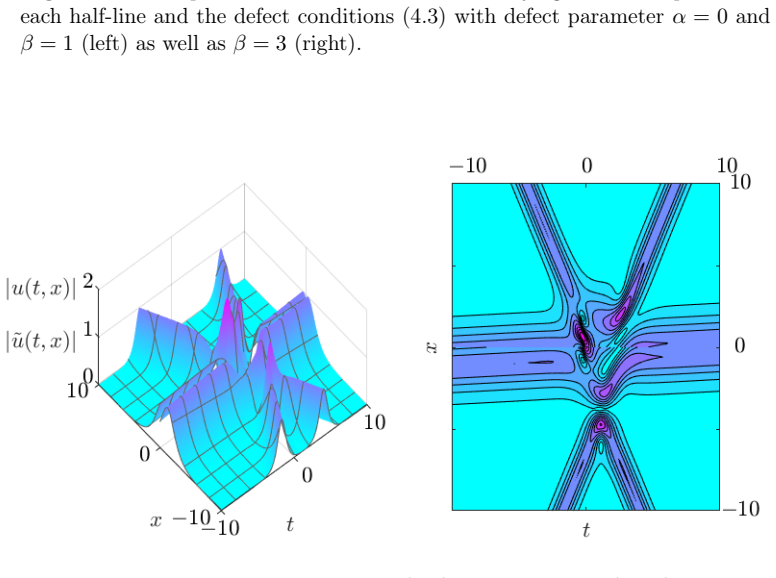
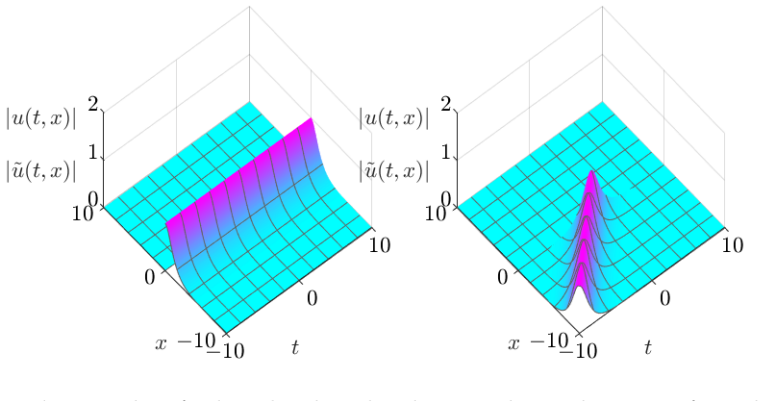
- [Figures 4 and 5] The captions of Figures 4 and 5 are identical; please differentiate them or combine the figures.
- [Section 2, after Eq. (2.7)] The definition of x_1 in the paragraph after (2.7) is ambiguous; adding parentheses around log|C_1|/(2\eta) would clarify the formula.
- [References] Reference [13] lacks volume and page information; please complete the bibliographic details.
Circularity Check
No significant circularity: the transmission shifts are derived from scattering-data dressing, with defect and soliton parameters as genuine inputs.
full rationale
The central claims are not circular. The inputs are the defect parameters α, β, the soliton spectral parameters λ_j, and the zero seed solutions; the outputs are the half-line N-soliton solutions and the shifts x̃_j − x_j, φ̃_j − φ_j. The shift formulas in Corollary 5.1 follow from the scattering-data transformation (5.2), Ã = B∞ A B∞⁻¹, which is derived from the Bäcklund/dressing relation on the full line. No constant is fitted to the shifts: the norming constants C_j encode the soliton positions and phases, and the ratio C̃_j/C_j is computed from B∞ and λ_j, not chosen to match a target. The paper has no author self-citations; references to [5], [6], [10], and [13] provide standard Darboux/scattering facts or the original conjecture, and the independent-transmission claim is not imported from them. The paper explicitly acknowledges that existence of a solution ψ̃_j satisfying (4.5) is not a priori clear for generic seeds; that is a domain-of-validity limitation, not a circular reduction, and in the zero-seed application the pairings are constructed explicitly. The skeptic's objection about the (2N+2)×(2N+2) invertibility claim in the proof of Proposition 4.2 is a mathematical correctness issue, since 2N+2 vectors in C² cannot be linearly independent, but it is not a circularity: the conclusion is not equivalent to an input by construction.
Assumptions & free parameters
free parameters (4)
- defect parameter alpha
- defect parameter beta
- soliton spectral parameters lambda_j
- norming constants C_j (positions x_j and phases phi_j)
assumptions (6)
- standard math Standard inverse scattering transform for the focusing NLS equation: existence of Jost solutions, scattering matrix, Riemann-Hilbert problem (Section 2, [1]).
- domain assumption The defect conditions (4.3) are integrable, with infinitely many conserved quantities (proved in [3] and [5]).
- domain assumption The localized defect matrix G0 has a kernel vector at lambda0 = (-alpha +/- i beta)/2 and can be written as a one-fold dressing matrix when beta != 0 (Remark 3.2).
- ad hoc to paper Existence of paired solutions psi~_j of the undressed Lax system on the negative half-line satisfying psi~_j|_{x=0} = G0(t,0,lambda_j) psi_j|_{x=0} (Eq. 4.5).
- domain assumption The spectral sign in front of the square root of G_N can be read off from the t -> infinity limit of the kernel vectors (Lemma 3.5 and part (c) of Prop 4.2).
- standard math Lemma 3.3: the Volterra-type weighted estimates used in Proposition 3.4 (the proof is 'Analogously to the proof in [6]').
Cite this review
Pith. "Pith review of Soliton solutions of the nonlinear Schr\"odinger equation with defect conditions." pith.science (2026). https://pith.science/paper/VJ5U73YS
@misc{pith2026190805101,
  author       = {Pith},
  title        = {Pith review of: Soliton solutions of the nonlinear Schr\"odinger equation with defect conditions},
  year         = {2026},
  howpublished = {\url{https://pith.science/paper/VJ5U73YS}},
  note         = {Machine review of arXiv:1908.05101}
}
abstract
A recent development in the derivation of soliton solutions for initial-boundary value problems through Darboux transformations, motivated to reconsider solutions to the nonlinear Schr\"odinger (NLS) equation on two half-lines connected via integrable defect conditions. Thereby, the Darboux transformation to construct soliton solutions is applied, while preserving the spectral boundary constraint with a time-dependent defect matrix. In this particular model, $N$-soliton solutions vanishing at infinity are constructed. Further, it is proven that solitons are transmitted through the defect independently of one another.
Figures


Figures from the paper (3 more)

Reference graph
Works this paper leans on
-
[1]
M. J. Ablowitz, B. Prinari, and A. D. Trubatch.Discrete and continuous nonlinear Schrödinger systems, volume 302. Cambridge University Press, 2004
work page 2004
-
[2]
G. Biondini and G. Hwang. Solitons, boundary value problems and a nonlinear method of images. Journal of Physics A: Mathematical and Theoretical, 42(20), 2009
work page 2009
-
[3]
V. Caudrelier. On a systematic approach to defects in classical integrable field the- ories. International Journal of Geometric Methods in Modern Physics, 5(07):1085– 1108, 2008
work page 2008
-
[4]
V. Caudrelier. On the inverse scattering method for integrable PDEs on a star graph. Communications in Mathematical Physics, 338, 09 2014
work page 2014
-
[5]
E. Corrigan and C. Zambon. Jump-defects in the nonlinear Schrödinger model and other non-relativistic field theories.Nonlinearity, 19(6):1447, 2006
work page 2006
-
[6]
P. Deift and J. Park. Long-time asymptotics for solutions of the NLS equation with a delta potential and even initial data.International Mathematics Research Notices, 2011(24):5505–5624, 2011. 34
work page 2011
-
[7]
A. S. Fokas and A. R. Its. The linearization of the initial-boundary value problem of the nonlinear Schrödinger equation. SIAM Journal on Mathematical Analysis, 27(3):738–764, 1996
work page 1996
-
[8]
A. S. Fokas, A. R. Its, and L.-Y. Sung. The nonlinear Schrödinger equation on the half-line. Nonlinearity, 18:1771, 05 2005
work page 2005
Show all 14 references
-
[9]
A. S. Fokas and B. Pelloni.Unified transform for boundary value problems: Appli- cations and advances. SIAM, 2014
2014
-
[10]
C. Gu, A. Hu, and Z. Zhou.Darboux transformations in integrable systems: theory and their applications to geometry, volume 26. Springer Science & Business Media, 2006
2006
-
[11]
V. B. Matveev and M. A. Salle.Darboux Transformations and Solitons. Springer- Verlag, Berlin, 1991
1991
-
[12]
C. Zambon. The classical nonlinear Schrödinger model with a new integrable bound- ary. Journal of High Energy Physics, 2014(8):36, 2014
2014
-
[13]
C. Zhang. Dressing the boundary: On soliton solutions of the nonlinear Schrödinger equation on the half-line.Studies in Applied Mathematics, 2018
2018
-
[14]
Zhang, Q
C. Zhang, Q. Cheng, and D.-J. Zhang. Soliton solutions of the sine-Gordon equation on the half line.Applied Mathematics Letters, 86:64–69, 2018. 35
2018
Reviewed August 14, 2026 · model on record in the stance chip above.
Discussion (0). Continue with ORCID to comment.