REVIEW 3 major objections 5 minor 94 references
ConfigTron: Tackling network diversity with heterogeneous configurations
T0 review · 3 major / 5 minor · reviewed 2026-08-14 · deepseek-v4-flash
Pith's one-line read ConfigTron shows that per-connection TCP and HTTP configuration tuning cuts median page load times by up to 19% in simulation and 8–10% in a live deployment.
desk verdict A solid systems paper with a real live-deployment result; the headline 19% comes from a simulator that reads its own testbed-built oracle, so treat the sim numbers as upper bounds, not measured gains. read the letter →
The pith
A machine-rendered reading of the paper's core claim, the machinery that carries it, and where it could break.
The reading
What carries the argument
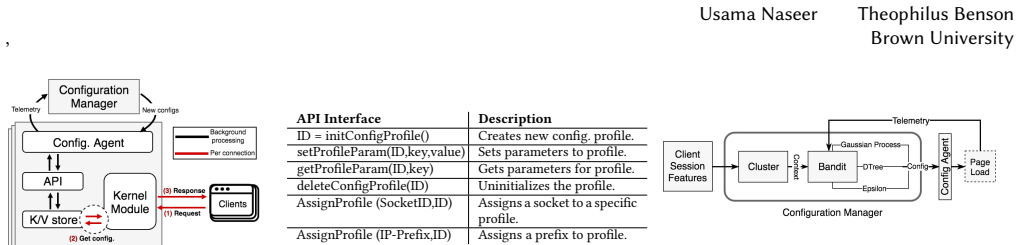
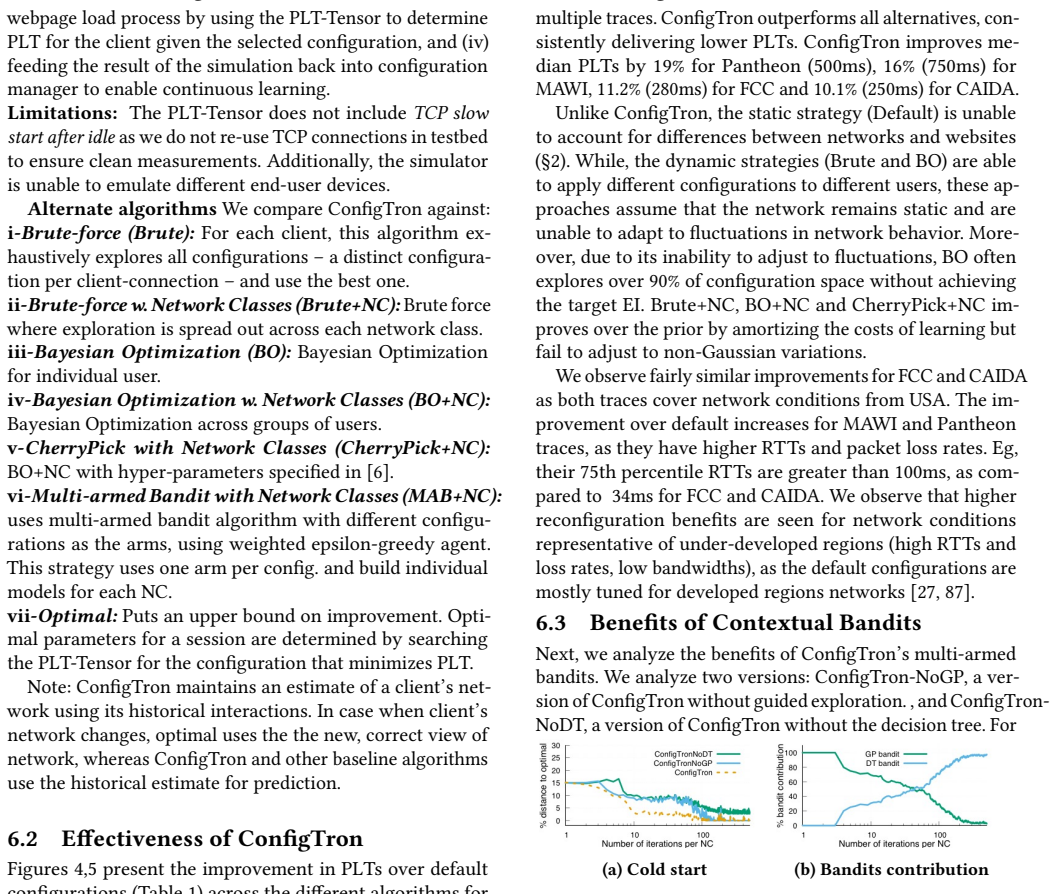
The load-bearing mechanism is the contextual multi-armed bandit ensemble: a Gaussian-process arm performs directed exploration to quickly find a good configuration, an epsilon-greedy arm randomly re-samples old points to handle non-stationary conditions and non-Gaussian noise, and a decision-tree arm exploits accumulated data to predict the best configuration. Clients are grouped into network classes via k-means clustering, and the learning process is bootstrapped with Latin Hypercube Sampling. The whole pipeline is trained and evaluated against the PLT-Tensor, a precomputed lookup table mapping each {network condition, configuration, website} triple to a measured page load time; the simulator computes a client's PLT by looking up this tensor, and the learned decision tree is converted into key-value rules that edge servers consult in real time.
What would settle it
Measure real page load times for matched {network condition, configuration, website} triples on production edge servers and compare them with the PLT-Tensor's predictions; if the tensor is systematically off, or if a live A/B test against defaults fails to reproduce the 8–10% median improvement, the central claim collapses.
Extended reading notes
Core claim
The central claim is that a one-size-fits-all configuration of the web-serving stack leaves substantial performance on the table, and that a data-driven system can recover it. ConfigTron learns, for each group of similar clients and each website, which combination of congestion-control algorithm, initial congestion window, TCP settings, and HTTP version minimizes page load time. It does this online with a contextual multi-armed bandit that clusters clients into network classes, explores with a Gaussian-process arm and an epsilon-greedy arm, and exploits with a decision tree. The paper reports median page-load-time reductions of up to 19% (about 750 ms) in trace-driven simulation and 8–10% in a live deployment spread across roughly 100K page loads, with larger gains in the tail and in high-RTT, high-loss networks representative of developing regions. In the authors' telling, even modest median gains translate into meaningful revenue for content providers.
Load-bearing premise
ConfigTron's simulation gains rest on the PLT-Tensor, a table of page load times built once in a testbed, correctly predicting what real browsers on real devices would experience across 16 million simulated sessions.
Editorial extensions
If this is right
- CDNs can deploy per-connection configuration without client-side changes: the Configuration Manager pushes decision-tree rules as key-value maps, and the edge agent applies them at connection setup, avoiding startup delay.
- The largest wins appear on high-RTT, high-loss, low-bandwidth paths typical of developing regions, where defaults tuned for developed-region networks are most mismatched.
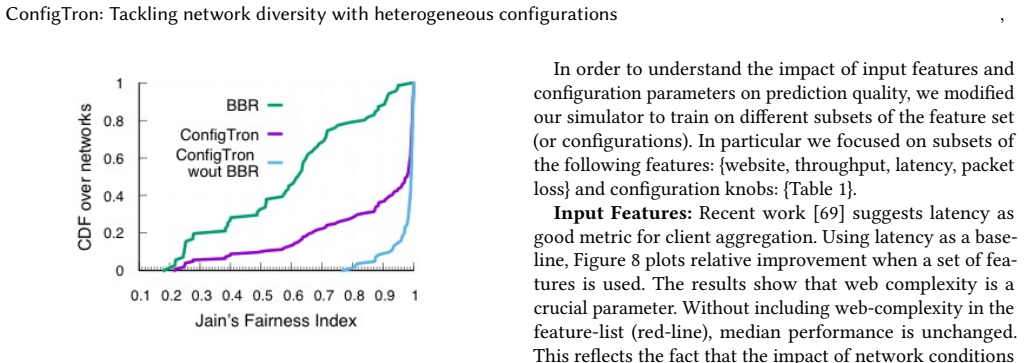
- ConfigTron's top configurations remain largely fair to Cubic traffic (Jain index above 0.95 in more than half of tested cases), and removing BBR from the candidate set pushes fairness above 0.95 for more than 90% of cases.
- The same learning loop extends naturally to newer transports like QUIC and BBR, which expose more configuration parameters and therefore strengthen the case for automated, per-connection tuning.
Reading between the lines
- The simulated 19% headline is probably an upper bound: because the simulator looks up PLT from a testbed-built tensor and omits device heterogeneity, browser rendering, and TCP slow-start-after-idle, the live 8–10% median figure is the more reliable estimate for real deployments.
- The paper's own Pantheon analysis, showing that no congestion control is optimal for more than 25% of networks, implies that protocol innovation alone will not close the tuning gap; selecting among protocols is itself a first-class optimization axis.
- A testable extension would be to replace the PLT-Tensor lookup with a lightweight online model trained on real production traffic, then check whether ConfigTron's convergence behavior and gains survive outside the testbed's network-condition distribution.
Signed reviews
Editorial analysis
A structured set of objections, weighed in public.
Referee Report
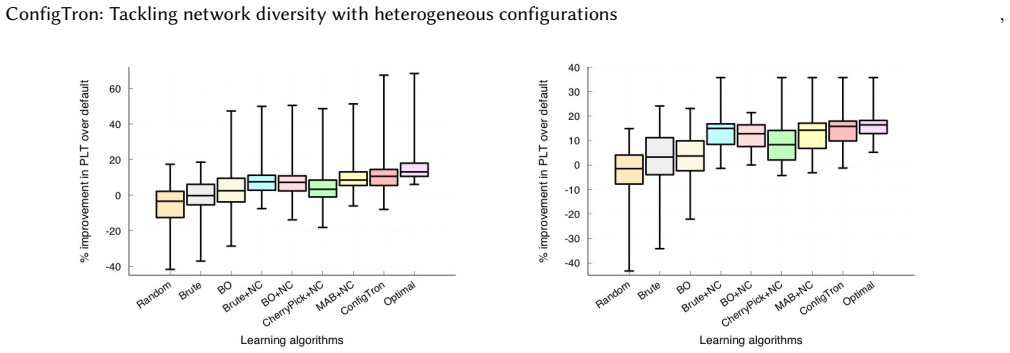
Summary. The paper argues that the one-size-fits-all configuration of web-serving protocol stacks is suboptimal and presents ConfigTron, a data-driven framework that selects per-connection TCP and HTTP configurations using a contextual multi-armed bandit ensemble with a decision-tree exploitation arm. The system includes a kernel-module-based ConfigTron-API for fine-grained reconfiguration, a centralized Configuration Manager, and a push-based Configuration Agent. The authors evaluate ConfigTron in two ways: large-scale trace-driven simulations using a precomputed PLT-Tensor that maps network conditions, configurations, and websites to page load times, and a live deployment on AWS with globally distributed Speedchecker clients. They report median PLT improvements of up to 19% (Pantheon), 16% (MAWI), 11.2% (FCC), and 10.1% (CAIDA) in simulation, and 8-10% median and 43% 95th-percentile improvements in the live deployment. The paper also includes an empirical study of configuration heterogeneity across CSPs and regions, a fairness analysis, and a discussion of design choices.
Significance. If the central claims hold, ConfigTron is a valuable contribution to network-stack configuration tuning: it provides a concrete architecture for fine-grained per-connection control, a learning algorithm combining guided and stochastic exploration, and live-deployment evidence that tuning can improve end-user page load times. The live deployment, in particular, is a meaningful validation because it measures real page loads against a control group, and the oracle baseline used in simulation is conservatively given perfect network knowledge. The empirical study of configuration heterogeneity (Table 2) is also a useful measurement contribution. However, the headline simulation numbers are undermined by a circular evaluation methodology (the PLT-Tensor is both the training signal and the ground truth), and the paper lacks sensitivity analysis for several key hyperparameters. The qualitative conclusion that heterogeneous tuning helps survives, but the quantitative strength of the claim is not yet established.
major comments (3)
- [6.1 (Simulator and Limitations) and 6.2 (Effectiveness)]
- [4 (Algorithm) and 5 (Prototype)]
- [6.2 (Effectiveness) and Figures 4-9]
minor comments (5)
- [6.4.3 (Microbenchmarks)]
- [6.6 (Critical Features and Parameters)]
- [2.2 (Implications of Configuration Tuning)]
- [6.7 (Live Deployment)]
- [4.1.1 (Prediction with Machine Learning)]
Circularity Check
No significant circularity: ConfigTron's learning algorithm is evaluated against an externally measured PLT-Tensor with a live-deployment check, and no prediction reduces to its fitted inputs by construction.
full rationale
The paper's derivation chain is not circular. The PLT-Tensor is built from physical testbed measurements: for each {network condition, configuration, website} triple, webpages are loaded with a real browser and the median PLT is recorded (§6.1, 'Optimal Configurations'). ConfigTron's contextual bandit and decision tree do not receive the tensor's optimal labels; they must explore configurations and receive PLT rewards through the simulator's lookup. The simulation then reports PLT improvements by reading the same tensor, so the simulated gains are upper bounds on the fidelity of the testbed's PLT model rather than independent protocol-stack validation. This is a benchmark limitation, not a constructed circularity: the predicted quantity (which configuration is best) is not definitionally equal to the fitted input (the tensor), and the learner has no direct access to the argmin. The live deployment in §6.7 provides an external, tensor-independent evaluation showing 8-10% median gains, which corroborates the qualitative claim. The only self-citations are tooling or background references (e.g., [61] InspectorGadget for active probing, [2] for mobile-device measurements) and are not load-bearing for the central claim. No equation is shown to reduce to its own inputs, no fitted parameter is renamed as a prediction, and no uniqueness theorem or prior result by the same authors is invoked to force the design. Therefore the paper is self-contained with respect to its claimed derivation, and the circularity score is 0.
Assumptions & free parameters
free parameters (7)
- EI threshold =
5%
- GP init_sample =
4
- GP min_sample_tested =
7
- Decision tree min samples leaf =
80
- Decision tree min samples split =
2
- Number of network classes k =
not specified
- Epsilon degree of randomness =
not specified
assumptions (6)
- domain assumption Users with very similar network conditions will require identical optimal configurations.
- domain assumption Network conditions are non-stationary and change every few minutes.
- domain assumption The PLT-Tensor built from testbed emulation is a faithful model of f(c,n,w) for all simulated sessions.
- domain assumption Testbed-emulated network conditions drawn from CAIDA, MAWI, FCC, and Pantheon are representative of the real Internet conditions faced by CDN users.
- domain assumption Page load time is the appropriate performance metric and captures end-user QoE.
- domain assumption Latin Hypercube Sampling improves GP bootstrapping relative to random or domain-specific sampling.
Cite this review
Pith. "Pith review of ConfigTron: Tackling network diversity with heterogeneous configurations." pith.science (2026). https://pith.science/paper/VJIQ3E3U
@misc{pith2026190804518,
  author       = {Pith},
  title        = {Pith review of: ConfigTron: Tackling network diversity with heterogeneous configurations},
  year         = {2026},
  howpublished = {\url{https://pith.science/paper/VJIQ3E3U}},
  note         = {Machine review of arXiv:1908.04518}
}
read the original abstract
The web serving protocol stack is constantly changing and evolving to tackle technological shifts in networking infrastructure and website complexity. As a result of this evolution, the web serving stack includes a plethora of protocols and configuration parameters that enable the web serving stack to address a variety of realistic network conditions. Yet, today, most content providers have adopted a "one-size-fits-all" approach to configuring the networking stack of their user facing web servers (or at best employ moderate tuning), despite the significant diversity in end-user networks and devices. In this paper, we revisit this problem and ask a more fundamental question: Are there benefits to tuning the network stack? If so, what system design choices and algorithmic ensembles are required to enable modern content provider to dynamically and flexibly tune their protocol stacks. We demonstrate through substantial empirical evidence that this "one-size-fits-all" approach results in sub-optimal performance and argue for a novel framework that extends existing CDN architectures to provide programmatic control over the configuration options of the CDN serving stack. We designed ConfigTron a data-driven framework that leverages data from all connections to identify their network characteristics and learn the optimal configuration parameters to improve end-user performance. ConfigTron uses contextual multi-arm bandit-based learning algorithm to find optimal configurations in minimal time, enabling a content providers to systematically explore heterogeneous configurations while improving end-user page load time by as much as 19% (upto 750ms) on median.
Figures

Figures from the paper (4 more)


Reference graph
Works this paper leans on
-
[1]
Adams, R. P., and MacKay, D. J. Bayesian online changepoint detec- tion. arXiv preprint arXiv:0710.3742 (2007)
arXiv 2007
-
[2]
L., Qazi, Z
Ahmad, S., Haamid, A. L., Qazi, Z. A., Zhou, Z., Benson, T., and Qazi, I. A. A view from the other side: Understanding mobile phone characteristics in the developing world. InProceedings of the 2016 ACM on Internet Measurement Conference (2016), ACM, pp. 319–325
2016
-
[3]
Tcp optimizations
Akamai. Tcp optimizations. https://developer.akamai.com/legacy/ learn/Optimization/TCP_Optimizations.html
-
[4]
S., Govindan, R., Rao, S., Chen, J., Katz-Bassett, E., Ribeiro, B., Zhan, J., and Zhang, H
Akhtar, Z., Nam, Y. S., Govindan, R., Rao, S., Chen, J., Katz-Bassett, E., Ribeiro, B., Zhan, J., and Zhang, H. Oboe: auto-tuning video abr algorithms to network conditions. InProceedings of the 2018 Conference of the ACM Special Interest Group on Data Communication (2018), ACM, pp. 44–58
2018
-
[5]
Overclock- ing the yahoo!: Cdn for faster web page loads
Al-Fares, M., Elmeleegy, K., Reed, B., and Gashinsky, I. Overclock- ing the yahoo!: Cdn for faster web page loads. In Proceedings of the 2011 ACM SIGCOMM conference on Internet measurement conference (2011), ACM, pp. 569–584
2011
-
[6]
H., Chen, J., Venkataraman, S., Yu, M., and Zhang, M
Alipourfard, O., Liu, H. H., Chen, J., Venkataraman, S., Yu, M., and Zhang, M. Cherrypick: Adaptively unearthing the best cloud configurations for big data analytics. In NSDI (2017), pp. 469–482
2017
-
[7]
Apache benchmark
Apache. Apache benchmark. https://httpd.apache.org/docs/2.4/ programs/ab.html
-
[8]
Archive, M. W. G. T. Packet traces from wide backbone 12/1/17 to 12/7/17. http://mawi.wide.ad.jp/mawi/
Show all 94 references
-
[9]
S., and Seshan, S
Balakrishnan, H., Rahul, H. S., and Seshan, S. An integrated con- gestion management architecture for internet hosts. ACM SIGCOMM Computer Communication Review 29 , 4 (1999), 175–187
1999
-
[10]
Balakrishnan, H., Stemm, M., Seshan, S., and Katz, R. H. Analyz- ing stability in wide-area network performance. ACM SIGMETRICS Performance Evaluation Review 25 , 1 (1997), 2–12
1997
-
[11]
Towards automatic parameter tuning of stream processing systems
Bilal, M., and Canini, M. Towards automatic parameter tuning of stream processing systems. In Proceedings of the 2017 Symposium on Cloud Computing (New York, NY, USA, 2017), SoCC ’17, ACM, pp. 189– 200
2017
-
[12]
Tcp-bpf: Programmatically tuning tcp behavior through bpf
Brakmo, L. Tcp-bpf: Programmatically tuning tcp behavior through bpf. NetDev 2.2 (2017)
2017
-
[13]
G., Wong, G
Bridges, P. G., Wong, G. T., Hiltunen, M., Schlichting, R. D., and Barrick, M. J. A configurable and extensible transport protocol. IEEE/ACM Transactions on Networking 15 , 6 (2007), 1254–1265
2007
-
[14]
M., and De Freitas, N
Brochu, E., Cora, V. M., and De Freitas, N. A tutorial on bayesian optimization of expensive cost functions, with application to active user modeling and hierarchical reinforcement learning. arXiv preprint arXiv:1012.2599 (2010)
2010 arXiv
-
[15]
Analysis of RouteViews BGP data: pol- icy atoms
Broido, A., and claffy, k. Analysis of RouteViews BGP data: pol- icy atoms. In Network Resource Data Management Workshop (Santa Barbara, CA, May 2001)
2001
-
[16]
Speed matters for google web search, 2009
Brutlag, J. Speed matters for google web search, 2009
2009
-
[17]
V., and Sekar, V
Butkiewicz, M., Madhyastha, H. V., and Sekar, V. Understanding website complexity: measurements, metrics, and implications. In Pro- ceedings of the 2011 ACM SIGCOMM conference on Internet measurement conference (2011), ACM, pp. 313–328
2011
-
[18]
V., and Sekar, V
Butkiewicz, M., W ang, D., Wu, Z., Madhyastha, H. V., and Sekar, V. Klotski: Reprioritizing web content to improve user experience on mobile devices. In NSDI (2015), vol. 1, pp. 2–3
2015
-
[19]
The caida ucsd anonymized internet traces 2016 dataset
CAIDA. The caida ucsd anonymized internet traces 2016 dataset. http://www.caida.org/data/passive/passive_2016_dataset.xml
2016
-
[20]
S., Yeganeh, S
Cardwell, N., Cheng, Y., Gunn, C. S., Yeganeh, S. H., et al. Bbr: congestion-based congestion control. Communications of the ACM 60 , 2 (2017), 58–66
2017
-
[21]
T., Phan, L
Chen, A., Sriraman, A., V aidya, T., Zhang, Y., Haeberlen, A., Loo, 13 , Usama Naseer Theophilus Benson Brown University B. T., Phan, L. T. X., Sherr, M., Shields, C., and Zhou, W. Dispersing asymmetric ddos attacks with splitstack. In HotNets (2016), pp. 197– 203
2016
-
[22]
Dean, J., and Barroso, L. A. The tail at scale. Communications of the ACM 56 (2013), 74–80
2013
-
[23]
Dynamo: amazon’s highly available key-value store
DeCandia, G., Hastorun, D., Jampani, M., Kakulapati, G., Laksh- man, A., Pilchin, A., Sivasubramanian, S., Vosshall, P., and Vo- gels, W. Dynamo: amazon’s highly available key-value store. In ACM SIGOPS operating systems review (2007), vol. 41, ACM, pp. 205–220
2007
-
[24]
B., and Schapira, M
Dong, M., Li, Q., Zarchy, D., Godfrey, P. B., and Schapira, M. Pcc: Re-architecting congestion control for consistent high performance. In NSDI (2015), vol. 1, p. 2
2015
-
[25]
Pcc vivace: Online-learning congestion con- trol
Dong, M., Meng, T., Zarchy, D., Arslan, E., Gilad, Y., Godfrey, B., and Schapira, M. Pcc vivace: Online-learning congestion con- trol. In 15th{USENIX} Symposium on Networked Systems Design and Implementation ({NSDI} 18). USENIX Association (2018)
2018
-
[26]
Tuning database configuration parameters with ituned
Duan, S., Thummala, V., and Babu, S. Tuning database configuration parameters with ituned. Proceedings of the VLDB Endowment 2, 1 (2009), 1246–1257
2009
-
[27]
An argument for increasing tcp’s initial congestion window
Dukkipati, N., Refice, T., Cheng, Y., Chu, J., Herbert, T., Agarwal, A., Jain, A., and Sutin, N. An argument for increasing tcp’s initial congestion window. Computer Communication Review 40 , 3 (2010), 26–33
2010
-
[28]
The lwip tcp/ip stack
Dunkels, A., et al. The lwip tcp/ip stack. lwIP–A LightWeight TCP/IP Stack (2004)
2004
-
[29]
A generic hash table
Edge, J. A generic hash table
-
[30]
Erman, J., Gopalakrishnan, V., Jana, R., and Ramakrishnan, K. K. Towards a spdyâĂŹier mobile web? IEEE/ACM Transactions on Net- working 23, 6 (2015), 2010–2023
2015
-
[31]
Aquila (internet deployment by drone)
Facebook. Aquila (internet deployment by drone). https://code. facebook.com/posts/268598690180189
-
[32]
Network connection class
Facebook. Network connection class. https://github.com/facebook/ network-connection-class
-
[33]
Advanced tcp optimizations
Fastly. Advanced tcp optimizations. https://docs.fastly.com/guides/ live-streaming/configuration-guidelines-for-live-streaming
-
[34]
Measuring fixed broadband report - 2016
FCC. Measuring fixed broadband report - 2016. https://www. fcc.gov/reports-research/reports/measuring-broadband-america/ measuring-fixed-broadband-report-2016
2016
-
[35]
Open vSwitch
foundation, L. Open vSwitch
-
[36]
R., Kusner, M
Gardner, J. R., Kusner, M. J., Xu, Z. E., Weinberger, K. Q., and Cunningham, J. P. Bayesian optimization with inequality constraints. In ICML (2014), pp. 937–945
2014
-
[37]
H., and Ganjali, Y
Ghobadi, M., Yeganeh, S. H., and Ganjali, Y. Rethinking end-to-end congestion control in software-defined networks. In Proceedings of the 11th ACM Workshop on Hot Topics in networks (2012), ACM, pp. 61–66
2012
-
[38]
Quic, a multiplexed stream transport over udp
Google. Quic, a multiplexed stream transport over udp. https://www. chromium.org/quic
-
[39]
Guide, T. L. K. M. P. Character Device Drivers
-
[40]
B., and Babu, S
Herodotou, H., Lim, H., Luo, G., Borisov, N., Dong, L., Cetin, F. B., and Babu, S. Starfish: A self-tuning system for big data analytics. In Cidr (2011), vol. 11, pp. 261–272
2011
-
[41]
Experimental evaluation of bbr congestion control
Hock, M., Bless, R., and Zitterbart, M. Experimental evaluation of bbr congestion control. In Network Protocols (ICNP), 2017 IEEE 25th International Conference on (2017), IEEE, pp. 1–10
2017
-
[42]
H., Godfrey, P., Schapira, M., and Tamar, A
Jay, N., Rotman, N. H., Godfrey, P., Schapira, M., and Tamar, A. Internet congestion control via deep reinforcement learning. arXiv preprint arXiv:1810.03259 (2018)
2018 arXiv
-
[43]
A., Jeong, H., Ihm, S., Han, D., and Park, K
Jeong, E., Woo, S., Jamshed, M. A., Jeong, H., Ihm, S., Han, D., and Park, K. mtcp: a highly scalable user-level tcp stack for multicore systems. In NSDI (2014), pp. 489–502
2014
-
[44]
Cfa: A practical prediction system for video qoe optimization
Jiang, J., Sekar, V., Milner, H., Shepherd, D., Stoica, I., and Zhang, H. Cfa: A practical prediction system for video qoe optimization. In NSDI (2016), pp. 137–150
2016
-
[45]
Pytheas: Enabling data-driven quality of experience optimization using group-based exploration-exploitation
Jiang, J., Sun, S., Sekar, V., and Zhang, H. Pytheas: Enabling data-driven quality of experience optimization using group-based exploration-exploitation. In 14th USENIX Symposium on Networked Systems Design and Implementation (NSDI 17) (Boston, MA, 2017), USENIX Association, p...
2017
-
[46]
Tcp performance in mobile ad hoc networks connected to the internet.REVISTA CIENTÍFICA PERIÓDICA- TELECOMUNICAÇÕES 10, 1 (2007), 22–29
Karlsson, J., and Kassler, A. Tcp performance in mobile ad hoc networks connected to the internet.REVISTA CIENTÍFICA PERIÓDICA- TELECOMUNICAÇÕES 10, 1 (2007), 22–29
2007
-
[47]
Identifying and aggregating homogeneous ipv4 /24 blocks with hobbit
Lee, Y., and Spring, N. Identifying and aggregating homogeneous ipv4 /24 blocks with hobbit. In Proceedings of the 2016 Internet Measurement Conference (New York, NY, USA, 2016), IMC ’16, ACM, pp. 151–165
2016
-
[48]
Efficient tuning of online systems using Bayesian optimization
Letham, B., Karrer, B., Ottoni, G., and Bakshy, E. Efficient tuning of online systems using Bayesian optimization
-
[49]
include/linux/hashtable.h
Levin, S. include/linux/hashtable.h. https://github.com/torvalds/linux/ blob/master/include/linux/hashtable.h
-
[50]
R., and Meleis, W
Li, W., Zhou, F., Chowdhury, K. R., and Meleis, W. M.Qtcp: Adaptive congestion control with reinforcement learning. IEEE Transactions on Network Science and Engineering (2018)
2018
-
[51]
L., Liang, M
Li, Z. L., Liang, M. C.-J., He, W., Zhu, L., Dai, W., Jiang, J., and Sun, G. Metis: Robustly tuning tail latencies of cloud systems. InATC (USENIX Annual Technical Conference) (July 2018), USENIX
2018
-
[52]
H., Viswanathan, R., Calder, M., Akella, A., Mahajan, R., Padhye, J., and Zhang, M
Liu, H. H., Viswanathan, R., Calder, M., Akella, A., Mahajan, R., Padhye, J., and Zhang, M. Efficiently delivering online services over integrated infrastructure. In NSDI (2016), vol. 1, p. 1
2016
-
[53]
Balloon powered internet
Loon, P. Balloon powered internet. https://x.company/loon/
-
[54]
Speedchecker
Ltd., S. Speedchecker
-
[55]
A., and Bustamante, F
Lu, D., Qiao, Y., Dinda, P. A., and Bustamante, F. E. Character- izing and predicting tcp throughput on the wide area network. In Distributed Computing Systems, 2005. ICDCS 2005. Proceedings. 25th IEEE International Conference on (2005), IEEE, pp. 414–424
2005
-
[56]
Neural adaptive video streaming with pensieve
Mao, H., Netravali, R., and Alizadeh, M. Neural adaptive video streaming with pensieve. In Proceedings of the Conference of the ACM Special Interest Group on Data Communication (2017), ACM, pp. 197– 210
2017
-
[57]
D., Beckman, R
McKay, M. D., Beckman, R. J., and Conover, W. J. Comparison of three methods for selecting values of input variables in the analysis of output from a computer code. Technometrics 21, 2 (1979), 239–245
1979
-
[58]
Mike Belshe, R. P. Spdy protocol. https://tools.ietf.org/id/ draft-mbelshe-httpbis-spdy-00.txt
-
[59]
Network Information API, 2018
Mozilla. Network Information API, 2018
2018
-
[60]
K., Naylor, D., Jiang, J., Han, D., Seshan, S., and Zhang, H
Mukerjee, M. K., Naylor, D., Jiang, J., Han, D., Seshan, S., and Zhang, H. Practical, real-time centralized control for cdn-based live video delivery. ACM SIGCOMM Computer Communication Review 45 , 4 (2015), 311–324
2015
-
[61]
Inspectorgadget: Inferring network pro- tocol configuration for web services
Naseer, U., and Benson, T. Inspectorgadget: Inferring network pro- tocol configuration for web services. In 2018 IEEE 38th International Conference on Distributed Computing Systems (ICDCS) (July 2018), pp. 1624–1629
2018
-
[62]
An in-depth study of mobile browser performance
Nejati, J., and Balasubramanian, A. An in-depth study of mobile browser performance. In Proceedings of the 25th International Con- ference on World Wide Web (2016), International World Wide Web Conferences Steering Committee, pp. 1305–1315
2016
-
[63]
Polaris: Faster page loads using fine-grained dependency tracking
Netravali, R., Goyal, A., Mickens, J., and Balakrishnan, H. Polaris: Faster page loads using fine-grained dependency tracking. In 13th USENIX Symposium on Networked Systems Design and Implementation (NSDI 16) (2016), USENIX Association
2016
-
[64]
Tcp wise: One initial congestion window is not enough
Nie, X., Zhao, Y., Chen, G., Sui, K., Chen, Y., Pei, D., Zhang, M., and Zhang, J. Tcp wise: One initial congestion window is not enough. In Performance Computing and Communications Conference (IPCCC), 2017 IEEE 36th International (2017), IEEE, pp. 1–8
2017
-
[65]
Reducing 14 ConfigTron: Tackling network diversity with heterogeneous configurations , web latency through dynamically setting tcp initial window with reinforcement learning
Nie, X., Zhao, Y., Pei, D., Chen, G., Sui, K., and Zhang, J. Reducing 14 ConfigTron: Tackling network diversity with heterogeneous configurations , web latency through dynamically setting tcp initial window with reinforcement learning
-
[66]
of Sheffield, M. L. G. U. GPyOpt
-
[67]
Bing and google agree: Slow pages lose users
oreilly.com. Bing and google agree: Slow pages lose users. http: //radar.oreilly.com/2009/06/bing-and-google-agree-slow-pag.html
2009
-
[68]
E., and Cantú-Paz, E
Pelikan, M., Goldberg, D. E., and Cantú-Paz, E. Boa: The bayesian optimization algorithm. In Proceedings of the 1st Annual Conference on Genetic and Evolutionary Computation-Volume 1 (1999), Morgan Kaufmann Publishers Inc., pp. 525–532
1999
-
[69]
Ap-atoms: A high-accuracy data-driven client aggregation for global load balancing
Pi, Y., Jamin, S., Danzig, P., and Shaha, J. Ap-atoms: A high-accuracy data-driven client aggregation for global load balancing. IEEE/ACM Transactions on Networking 26, 6 (2018), 2748–2761
2018
-
[70]
picoTCP. picotcp. http://www.picotcp.com/
-
[71]
Ruamviboonsuk, V., Netravali, R., Uluyol, M., and Madhyastha, H. V. Vroom: Accelerating the mobile web with server-aided depen- dency resolution. In Proceedings of the Conference of the ACM Special Interest Group on Data Communication (2017), ACM, pp. 390–403
2017
-
[72]
Iroko: A framework to prototype reinforcement learning for data center traffic control
Ruffy, F., Przystupa, M., and Beschastnikh, I. Iroko: A framework to prototype reinforcement learning for data center traffic control. arXiv preprint arXiv:1812.09975 (2018)
2018 arXiv
-
[73]
Large-scale scanning of tcp’s initial window
Rüth, J., Bormann, C., and Hohlfeld, O. Large-scale scanning of tcp’s initial window. In Proceedings of the 2017 Internet Measurement Conference (2017), ACM, pp. 304–310
2017
-
[74]
An empirical view on content provider fairness
Rüth, J., Kunze, I., and Hohlfeld, O. An empirical view on content provider fairness. arXiv preprint arXiv:1905.07152 (2019)
2019 arXiv
-
[75]
Congestion-control throwdown
Schapira, M., and Winstein, K. Congestion-control throwdown. In Proceedings of the 16th ACM Workshop on Hot Topics in Networks (2017), ACM, pp. 122–128
2017
-
[76]
Decision Trees
scikit learn.org. Decision Trees
-
[77]
V., Krishnamurthy, S
Singh, S., Madhyastha, H. V., Krishnamurthy, S. V., and Govindan, R. Flexiweb: Network-aware compaction for accelerating mobile web transfers. In Proceedings of the 21st Annual International Conference on Mobile Computing and Networking (2015), ACM, pp. 604–616
2015
-
[78]
Large sample properties of simulations using latin hypercube sampling
Stein, M. Large sample properties of simulations using latin hypercube sampling. Technometrics 29, 2 (1987), 143–151
1987
-
[79]
Raptor: Routing attacks on privacy in tor
Sun, Y., Edmundson, A., V anbever, L., Li, O., Rexford, J., Chiang, M., and Mittal, P. Raptor: Routing attacks on privacy in tor
-
[80]
Cs2p: Improving video bitrate selection and adaptation with data-driven throughput prediction
Sun, Y., Yin, X., Jiang, J., Sekar, V., Lin, F., W ang, N., Liu, T., and Sinopoli, B. Cs2p: Improving video bitrate selection and adaptation with data-driven throughput prediction. In Proceedings of the 2016 ACM SIGCOMM Conference (2016), ACM, pp. 272–285
2016
-
[81]
Home network or access link? locating last-mile downstream throughput bottlenecks
Sundaresan, S., Feamster, N., and Teixeira, R. Home network or access link? locating last-mile downstream throughput bottlenecks. In International Conference on Passive and Active Network Measurement (2016), Springer, pp. 111–123
2016
-
[82]
Beyond socket options: making the linux tcp stack truly extensible
Tran, V.-H., and Bonaventure, O. Beyond socket options: making the linux tcp stack truly extensible. arXiv preprint arXiv:1901.01863 (2019)
2019 arXiv
-
[83]
A., and Uhlig, S
Turkovic, B., Kuipers, F. A., and Uhlig, S. Interactions between congestion control algorithms. network 3, 17
-
[84]
On the stationarity of tcp bulk data transfers
Urvoy-Keller, G. On the stationarity of tcp bulk data transfers. In International Workshop on Passive and Active Network Measurement (2005), Springer, pp. 27–40
2005
-
[85]
J., and Zhang, B
V an Aken, D., Pavlo, A., Gordon, G. J., and Zhang, B. Automatic database management system tuning through large-scale machine learning. In Proceedings of the 2017 ACM International Conference on Management of Data (2017), ACM, pp. 1009–1024
2017
-
[86]
S., Balasubramanian, A., Krishnamurthy, A., and Wetherall, D
W ang, X. S., Balasubramanian, A., Krishnamurthy, A., and Wetherall, D. Demystifying page load performance with wprof. In NSDI (2013), pp. 473–485
2013
-
[87]
S., Balasubramanian, A., Krishnamurthy, A., and Wetherall, D
W ang, X. S., Balasubramanian, A., Krishnamurthy, A., and Wetherall, D. How speedy is spdy? In NSDI (2014), pp. 387–399
2014
-
[88]
S., Krishnamurthy, A., and Wetherall, D
W ang, X. S., Krishnamurthy, A., and Wetherall, D. Speeding up web page loads with shandian. In NSDI (2016), pp. 109–122
2016
-
[89]
Tcp ex machina: computer- generated congestion control
Winstein, K., and Balakrishnan, H. Tcp ex machina: computer- generated congestion control. In ACM SIGCOMM Computer Commu- nication Review (2013), vol. 43, ACM, pp. 123–134
2013
-
[90]
Y., Ma, J., Hill, G
Y an, F. Y., Ma, J., Hill, G. D., Raghavan, D., W ahby, R. S., Levis, P., and Winstein, K. Pantheon: the training ground for internet congestion- control research. In 2018 USENIX Annual Technical Conference (USENIX ATC 18) (Boston, MA, 2018), USENIX Association, pp. 731–743
2018
-
[91]
Tcp con- gestion avoidance algorithm identification
Y ang, P., Shao, J., Luo, W., Xu, L., Deogun, J., and Lu, Y. Tcp con- gestion avoidance algorithm identification. IEEE/ACM Transactions on Networking (TON) 22, 4 (2014), 1311–1324
2014
-
[92]
ZeroMQ. Zeromq. http://zeromq.org/
-
[93]
On the constancy of internet path properties
Zhang, Y., and Duffield, N. On the constancy of internet path properties. In Proceedings of the 1st ACM SIGCOMM Workshop on Internet Measurement (2001), ACM, pp. 197–211
2001
-
[94]
Bestconfig: tapping the performance potential of systems via automatic configuration tuning
Zhu, Y., Liu, J., Guo, M., Bao, Y., Ma, W., Liu, Z., Song, K., and Y ang, Y. Bestconfig: tapping the performance potential of systems via automatic configuration tuning. In Proceedings of the 2017 Symposium on Cloud Computing (2017), ACM, pp. 338–350. 15
2017
Reviewed August 14, 2026 · model on record in the stance chip above.
Discussion (0). Continue with ORCID to comment.