REVIEW 3 major objections 4 minor 30 references
GIFT: Geometry-Invariant Fine-Tuning for Non-Lambertian Monocular Depth Estimation
T0 review · 3 major / 4 minor · reviewed 2026-08-04 · deepseek-v4-flash
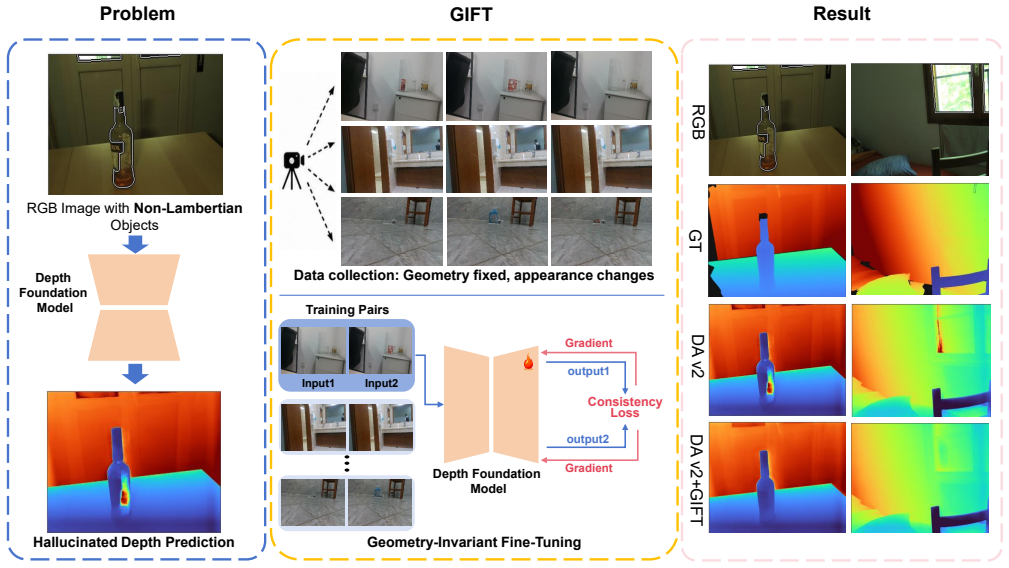
Pith's one-line read A depth-label-free fine-tuning procedure that exploits the geometry invariance of mirrors and glass across appearance-changing photo groups can suppress non-Lambertian depth hallucinations while preserving general depth estimation.
desk verdict Smart label-free fine-tuning idea with real Booster gains, but the evidence doesn't yet separate true geometry recovery from over-smoothing. read the letter →
The pith
A machine-rendered reading of the paper's core claim, the machinery that carries it, and where it could break.
The reading
What carries the argument
The central mechanism is the geometry-invariance principle: a non-Lambertian surface's physical depth is invariant across interventions that change only its reflected or transmitted appearance. GIFT operationalizes this as a complete-group geometry-consistency loss — the normalized masked L1 distance between depth predictions for all valid image pairs in an intervention group, restricted to the common target-region mask — combined with a frozen-model self-distillation loss that anchors the adapted prediction to the pretrained model outside the target region. The consistency loss alone is degenerate (any group-shared prediction, including constant depth, minimizes it); the self-distillation t
What would settle it
A controlled experiment where the physical surface depth is known and the reflected or transmitted content is varied across groups: if the geometry-invariance loss decreases GCE while the target-region error against physical ground truth stays flat or worsens, then invariance alone is not sufficient to recover true non-Lambertian depth. One concrete version would train GIFT on a mirror whose every reflection is a shallow room while the mirror itself is meters away, and check whether the adapted model predicts the shallow room depth throughout the mirror region.
Extended reading notes
Core claim
The central discovery is that the geometry invariance of a physical surface under controlled appearance changes provides a free self-supervision signal for non-Lambertian depth. Concretely, by capturing groups of RGB images in which the camera and target geometry are fixed and only the reflected or transmitted content varies, and by fine-tuning a pretrained monocular depth model with a complete-group masked L1 consistency loss on the target region plus self-distillation against the frozen base model outside it, the model learns to suppress appearance-dependent depth hallucinations. The paper reports that this reduces transparent-or-mirror (ToM) RMSE by 37.7% on the Booster benchmark for Dept
Load-bearing premise
The load-bearing premise is that pushing target-region depth predictions to be consistent across appearance changes will move them toward the true physical surface rather than toward any other appearance-invariant depth (such as a constant plane); the loss alone does not distinguish these, and the paper relies on the pretrained prior and its Booster results to show the desired behavior.
Editorial extensions
If this is right
- Mirror and transparent-object depth error is reduced on both GIFT-I and the independent Booster benchmark, with ToM RMSE falling by up to 37.7% for one backbone and 18.2% for another.
- General depth capability is largely retained: all-region RMSE decreases for all three adapted backbones on Booster, and removing self-distillation causes prediction collapse.
- The framework adapts depth foundation models without measured depth labels, using only grouped RGB captures and manually annotated target masks.
- The introduced geometry-consistency error (GCE) provides a depth-GT-free way to evaluate invariance and partially indicates non-Lambertian depth quality.
Reading between the lines
- This invariance principle could generalize to other appearance-changing but geometry-fixed phenomena, such as lighting or shadow changes on diffuse surfaces, offering a broader self-supervision signal for depth adaptation.
- Because the consistency loss alone permits any group-shared prediction, the final accuracy is bounded by the pretrained prior; models with weaker priors may need extra supervision to reach the true surface, as the paper's smaller gains on one of its three backbones illustrate.
- A testable extension is to apply GIFT to metric-depth models and check whether the invariance adaptation shifts metric calibration, since the loss is evaluated after affine alignment and does not directly constrain metric scale.
Editorial analysis
A structured set of objections, weighed in public.
Referee Report
Summary. The paper introduces GIFT, a depth-label-free fine-tuning framework for reducing non-Lambertian depth hallucinations in monocular depth foundation models. GIFT collects groups of RGB images in which the camera pose and target geometry are fixed while the reflected or transmitted appearance changes. The method fine-tunes a pretrained model with a complete-group geometry-consistency loss (Eq. 3) and a frozen-model self-distillation loss outside the target region (Eq. 5), using rank-8 LoRA and an efficient snapshot-and-replay group-wise optimization. The authors construct the GIFT-I dataset and evaluate on a GIFT-I validation split with proxy references and on the independent Booster benchmark with stereo ground truth. They report ToM RMSE reductions for VGGT-1B and DA V2-Large on Booster, mixed ToM results for Metric3D V2-Giant, and All-region RMSE decreases for all three backbones.
Significance. If the claimed results hold, GIFT would be a practical and low-cost method for adapting depth foundation models to mirrors and transparent objects without measured depth labels, which is a genuinely useful contribution given the unreliability of conventional sensors on such surfaces. The paper is honest about its limitations, provides a concrete algorithm, and includes an independent real-world benchmark. However, the central claim that the method recovers physical surface depth rather than merely suppressing appearance-dependent variation is not yet fully established: the loss is underdetermined in the target region, and the independent evidence, while supportive, lacks statistical detail and does not directly rule out over-smoothing as the main mechanism.
major comments (3)
- [Method, Eqs. (3)-(6); Supplementary Sec. C.1] Eq. (3) is minimized by any group-shared target prediction, and Eq. (5) constrains only non-target pixels, so target-region adaptation has no direct supervision toward the physical surface. The supplementary zero-shot analysis (Fig. S4) confirms that longer adaptation produces 'smoother, less appearance-sensitive surface predictions' and concedes that 'a more conservative prediction is not necessarily uniformly better.' Under the affine alignment of Eq. (8), flattening the target prediction can reduce ToM RMSE/MAE relative to a hallucinated outlier without recovering true surface shape. This is a load-bearing ambiguity for the central claim. I ask for direct evidence on shape fidelity: target-region local gradient or surface-normal errors, per-pixel signed error maps, and a flat/constant-depth baseline under the same alignment protocol on Booster.
- [Experiments, Booster benchmark, Table 2] The independent Booster evaluation is the main non-circular support for the method, but the protocol is underspecified: the 'balanced subset' of 38 scenes and 228 images, with 188 images containing ToM pixels, is not described, and no subset-selection criterion, seed, or repeated runs are given. No error bars are reported. With only 38 scenes and model-dependent ToM results (Metric3D V2-Giant: ToM RMSE +4.8% in Table 2), I cannot assess statistical robustness. Please provide the exact selection procedure, per-scene breakdown, and variability across multiple runs or subset resamples.
- [Method, Eq. (5) and Table 1] The GIFT-I proxy evaluation is partly self-referential: the proxy reference is generated by the same frozen backbone that supplies the self-distillation targets in Eq. (5), so improvements on GIFT-I could reflect convergence toward the frozen model's surface-treated prediction rather than generalizable non-Lambertian recovery. The paper restricts GIFT-I to before-after comparisons, which is appropriate, but the claim for physical-depth recovery therefore rests mainly on Booster. This should be stated explicitly in the main text and the Booster analysis should be strengthened accordingly.
minor comments (4)
- [Figure 6] The figure shows the λd=0 collapse run and 'Other Region RMSE' but the axes are not clearly labeled; please add explicit x-axis (epoch?) and y-axis units, and indicate that the collapsed run is shown only for illustration.
- [Experimental Setup, Datasets] The Booster subset selection is described as 'balanced' but the balancing criterion is not defined. Please specify whether balancing is by object class, scene type, or another factor.
- [Table 3] The ablation selects checkpoints by minimum GCE, but GCE is a consistency metric that may favor smoothing. The choice of λc:λd=1:1 is justified by GIFT-I proxy ToM RMSE without using Booster; please make this selection protocol explicit in the main text.
- [Qualitative figures] Figure 4 and Fig. S3 label the reference as 'GT' for both datasets. The supplementary clarifies that on GIFT-I this is a proxy reference, not measured ground truth; the main text should carry the same caveat in the figure caption.
Circularity Check
No significant circularity: GIFT's objective is self-supervised and Booster provides independent support; the acknowledged GIFT-I proxy is non-load-bearing.
full rationale
The derivation chain is self-contained. GIFT optimizes Eq. (6), a combination of cross-appearance target-region consistency (Eq. 3) and frozen-model self-distillation outside the target (Eq. 5); neither term injects measured depth or a target-region label, and no fitted parameter is later renamed as a prediction. The GIFT-I validation proxy is generated by the frozen backbone (Suppl. A.2: 'The GIFT-I reference is therefore model-derived rather than measured ground truth'), but the paper explicitly restricts it to within-backbone before-after comparison and does not use Booster for model selection ('without using Booster for selection'). The central quantitative support is the independent Booster stereo ground truth, where ToM RMSE decreases for VGGT-1B and DA V2-Large and All-region RMSE decreases for all three backbones. The acknowledged underdetermination of consistency alone (collapse to constant depth, Fig. 6) is addressed by self-distillation and is a robustness concern, not an equation-level circularity. The supplementary admission that 'a more conservative prediction is not necessarily uniformly better' (Fig. S4) is a correctness/detail-retention caveat, not a circular step. No load-bearing self-citation or imported uniqueness theorem appears. Hence no circular step is exhibited.
Assumptions & free parameters
free parameters (4)
- Loss weights lambda_c, lambda_d =
1:1 (selected from {1:1, 1:1.5, 1:2, 2:1})
- LoRA rank r =
8
- Learning rate / epochs =
2e-5 / 50
- Registration thresholds =
20 px displacement, 90% inliers, 2 px reprojection
assumptions (5)
- domain assumption The physical geometry of a non-Lambertian surface is invariant under changes in reflected or transmitted content.
- domain assumption The frozen base model's predictions outside the target region are sufficiently accurate to anchor the adapted model and prevent collapse.
- ad hoc to paper Optimization of the geometry-invariance objective, with the frozen prior, yields the physical surface depth rather than a degenerate shared depth.
- domain assumption The surface-treated reference image (spray paint or frosted film) provides a valid proxy for physical depth when processed by the frozen base model.
- domain assumption Homography registration is sufficient to align images within a group after filtering.
Cite this review
Pith. "Pith review of GIFT: Geometry-Invariant Fine-Tuning for Non-Lambertian Monocular Depth Estimation." pith.science (2026). https://pith.science/paper/VJOQCS7A
@misc{pith2026260802068,
  author       = {Pith},
  title        = {Pith review of: GIFT: Geometry-Invariant Fine-Tuning for Non-Lambertian Monocular Depth Estimation},
  year         = {2026},
  howpublished = {\url{https://pith.science/paper/VJOQCS7A}},
  note         = {Machine review of arXiv:2608.02068}
}
read the original abstract
Monocular depth foundation models, benefiting from large-scale synthetic training data, have demonstrated strong generalization. However, they often hallucinate depth on non-Lambertian surfaces, estimating reflected content in mirrors or transmitted content behind glass rather than the physical surface itself. Adapting these models with real-world data is challenging because conventional depth sensors are also unreliable in such regions. We observe that while the appearance of a non-Lambertian surface varies with its reflected or transmitted environment, its underlying geometry remains unchanged. Based on this observation, we propose GIFT (Geometry-Invariant Fine-Tuning), a parameter-efficient post-training framework that requires no measured depth labels. We collect groups of RGB images under controlled appearance changes while keeping the camera and target geometry fixed. GIFT exploits geometric invariance across these observations to suppress non-Lambertian depth hallucinations while retaining general depth estimation capability. We further construct a controlled benchmark that evaluates non-Lambertian depth recovery, robustness to appearance changes, and performance retention in other regions. Experiments on our benchmark and an independent real-world dataset demonstrate that GIFT improves depth prediction for mirrors and transparent objects while largely preserving the base model's performance, providing a practical and low-cost approach for adapting monocular depth foundation models to non-Lambertian scenes.
Figures


Figures from the paper (4 more)


Reference graph
Works this paper leans on
-
[1]
R.; and Koltun, V
Bochkovskiy, A.; Delaunoy, A.; Germain, H.; Santos, M.; Zhou, Y.; Richter, S. R.; and Koltun, V. 2025. Depth Pro: Sharp Monocular Metric Depth in Less Than a Second . In International Conference on Learning Representations (ICLR)
2025
-
[2]
Cheng, Y.; Gao, X.; Zhang, S.; Zeng, C.; Zha, F.; Sun, L.; and Yang, C. 2026. Rethinking Transparent Object Grasping: Depth Completion With Monocular Depth Estimation and Instance Mask. IEEE Robotics and Automation Letters, 11(5): 5510--5517
2026
-
[3]
Costanzino, A.; Zama Ramirez , P.; Poggi, M.; Tosi, F.; Mattoccia, S.; and Di Stefano , L. 2023. Learning Depth Estimation for Transparent and Mirror Surfaces . In Proceedings of the IEEE/CVF International Conference on Computer Vision (ICCV), 9244--9255
2023
-
[4]
Fan, X.; Chen, Z.; Pan, M.; Deng, A.; and Yang, H. 2025 a . Self-Supervised Learning for Transparent Object Depth Completion Using Depth from Non-Transparent Objects. In 2025 IEEE International Conference on Multimedia and Expo (ICME), 1--6
2025
-
[5]
Fan, X.; Ye, C.; Deng, A.; Wu, X.; Pan, M.; Luo, S.; and Yang, H. 2025 b . TDCNet : Transparent Objects Depth Completion With CNN -Transformer Dual-Branch Parallel Network. IEEE Sensors Journal, 25(19): 36629--36641
2025
-
[6]
Fu, X.; Yin, W.; Hu, M.; Wang, K.; Ma, Y.; Tan, P.; Shen, S.; Lin, D.; and Long, X. 2024. GeoWizard : Unleashing the Diffusion Priors for 3D Geometry Estimation from a Single Image . In Computer Vision -- ECCV 2024, 241--258
2024
-
[7]
J.; Shen, Y.; Wallis, P.; Allen-Zhu, Z.; Li, Y.; Wang, S.; Wang, L.; and Chen, W
Hu, E. J.; Shen, Y.; Wallis, P.; Allen-Zhu, Z.; Li, Y.; Wang, S.; Wang, L.; and Chen, W. 2022. LoRA : Low-Rank Adaptation of Large Language Models . In International Conference on Learning Representations (ICLR)
2022
-
[8]
Hu, M.; Yin, W.; Zhang, C.; Cai, Z.; Long, X.; Chen, H.; Wang, K.; Yu, G.; Shen, C.; and Shen, S. 2024. Metric3D v2: A Versatile Monocular Geometric Foundation Model for Zero-Shot Metric Depth and Surface Normal Estimation . IEEE Transactions on Pattern Analysis and Machine Intelligence, 46(12): 10579--10596
2024
Show all 30 references
-
[9]
Jiang, J.; Cao, G.; Deng, J.; Do, T.-T.; and Luo, S. 2024. Robotic Perception of Transparent Objects: A Review . IEEE Transactions on Artificial Intelligence, 5(6): 2547--2567
2024
-
[10]
Jiang, J.; Cao, G.; Do, T.-T.; and Luo, S. 2022. A4T : Hierarchical Affordance Detection for Transparent Objects Depth Reconstruction and Manipulation . IEEE Robotics and Automation Letters, 7(4): 9826--9833
2022
-
[11]
C.; and Schindler, K
Ke, B.; Obukhov, A.; Huang, S.; Metzger, N.; Daudt, R. C.; and Schindler, K. 2024. Repurposing Diffusion-Based Image Generators for Monocular Depth Estimation . In Proceedings of the IEEE/CVF Conference on Computer Vision and Pattern Recognition (CVPR), 9492--9502
2024
-
[12]
Liang, Y.; Deng, B.; Liu, W.; Qin, J.; and He, S. 2023. Monocular Depth Estimation for Glass Walls with Context: A New Dataset and Method . IEEE Transactions on Pattern Analysis and Machine Intelligence, 45(12): 15081--15097
2023
-
[13]
H.; Chen, D
Lin, H.; Chen, S.; Liew, J. H.; Chen, D. Y.; Li, Z.; Shi, G.; Feng, J.; and Kang, B. 2026. Depth Anything 3: Recovering the Visual Space from Any Views . In International Conference on Learning Representations (ICLR)
2026
-
[14]
Piccinelli, L.; Yang, Y.-H.; Sakaridis, C.; Segu, M.; Li, S.; Van Gool, L.; and Yu, F. 2024. UniDepth : Universal Monocular Metric Depth Estimation . In Proceedings of the IEEE/CVF Conference on Computer Vision and Pattern Recognition (CVPR), 10106--10116
2024
-
[15]
Ranftl, R.; Bochkovskiy, A.; and Koltun, V. 2021. Vision Transformers for Dense Prediction . In Proceedings of the IEEE/CVF International Conference on Computer Vision (ICCV), 12179--12188
2021
-
[16]
Ranftl, R.; Lasinger, K.; Hafner, D.; Schindler, K.; and Koltun, V. 2022. Towards Robust Monocular Depth Estimation: Mixing Datasets for Zero-Shot Cross-Dataset Transfer . IEEE Transactions on Pattern Analysis and Machine Intelligence, 44(3): 1623--1637
2022
-
[17]
S.; Moore, M.; Pan, M.; Nagaraja, G.; Lee, J.; Zeng, A.; and Song, S
Sajjan, S. S.; Moore, M.; Pan, M.; Nagaraja, G.; Lee, J.; Zeng, A.; and Song, S. 2020. ClearGrasp: 3D Shape Estimation of Transparent Objects for Manipulation . In IEEE International Conference on Robotics and Automation (ICRA), 3634--3642
2020
-
[18]
Shi, X.; Dikov, G.; Reitmayr, G.; Kim, T.-K.; and Ghafoorian, M. 2023. 3D Distillation: Improving Self-Supervised Monocular Depth Estimation on Reflective Surfaces . In Proceedings of the IEEE/CVF International Conference on Computer Vision (ICCV), 9133--9143
2023
-
[19]
X.; and Savva, M
Tan, J.; Lin, W.; Chang, A. X.; and Savva, M. 2021. Mirror3D : Depth Refinement for Mirror Surfaces . In Proceedings of the IEEE/CVF Conference on Computer Vision and Pattern Recognition (CVPR), 15990--15999
2021
-
[20]
Tosi, F.; Zama Ramirez , P.; and Poggi, M. 2024. Diffusion Models for Monocular Depth Estimation: Overcoming Challenging Conditions . In Computer Vision -- ECCV 2024, 236--257
2024
-
[21]
Wang, J.; Chen, M.; Karaev, N.; Vedaldi, A.; Rupprecht, C.; and Novotny, D. 2025 a . VGGT : Visual Geometry Grounded Transformer . In Proceedings of the IEEE/CVF Conference on Computer Vision and Pattern Recognition (CVPR), 5294--5306
2025
-
[22]
Wang, R.; Xu, S.; Dong, Y.; Deng, Y.; Xiang, J.; Lv, Z.; Sun, G.; Tong, X.; and Yang, J. 2025 b . MoGe -2: Accurate Monocular Geometry with Metric Scale and Sharp Details . In Advances in Neural Information Processing Systems
2025
-
[23]
Wang, X.; He, Y.; Shi, J.; Lu, J.; Yang, Y.; Jiang, Y.; and Jiang, C. 2026. SeeClear : Reliable Transparent Object Depth Estimation via Generative Opacification . arXiv preprint arXiv:2603.19547
2026
-
[24]
Wen, H.; Zuo, Y.; Subramanian, V.; Chen, P.; and Deng, J. 2025. Seeing and Seeing Through the Glass: Real and Synthetic Data for Multi-Layer Depth Estimation . In Proceedings of the IEEE/CVF International Conference on Computer Vision (ICCV), 6715--6725
2025
-
[25]
Xu, S.; Wei, S.; Wei, Q.; Geng, Z.; Li, H.; Shen, L.; Sun, Q.; Han, S.; Ma, B.; Li, B.; Ye, C.; Zheng, Y.; Wang, N.; Zhang, S.; and Zhao, H. 2025. Diffusion Knows Transparency: Repurposing Video Diffusion for Transparent Object Depth and Normal Estimation. arXiv:2512.23705
2025
-
[26]
Yang, L.; Kang, B.; Huang, Z.; Xu, X.; Feng, J.; and Zhao, H. 2024 a . Depth Anything: Unleashing the Power of Large-Scale Unlabeled Data . In Proceedings of the IEEE/CVF Conference on Computer Vision and Pattern Recognition (CVPR), 10371--10381
2024
-
[27]
Yang, L.; Kang, B.; Huang, Z.; Zhao, Z.; Xu, X.; Feng, J.; and Zhao, H. 2024 b . Depth Anything V2 . In Advances in Neural Information Processing Systems, volume 37, 21875--21911
2024
-
[28]
Yin, W.; Zhang, C.; Chen, H.; Cai, Z.; Yu, G.; Wang, K.; Chen, X.; and Shen, C. 2023. Metric3D : Towards Zero-Shot Metric 3D Prediction from a Single Image . In Proceedings of the IEEE/CVF International Conference on Computer Vision (ICCV), 9043--9053
2023
-
[29]
Zama Ramirez , P.; Costanzino, A.; Tosi, F.; Poggi, M.; Salti, S.; Mattoccia, S.; and Di Stefano , L. 2024. Booster: A Benchmark for Depth from Images of Specular and Transparent Surfaces . IEEE Transactions on Pattern Analysis and Machine Intelligence, 46(1): 85--102
2024
-
[30]
Zhang, J.; Li, J.; Huang, Y.; Wang, Y.; Zheng, J.; Shen, L.; and Cao, Z. 2025. Towards Robust Monocular Depth Estimation in Non-Lambertian Surfaces. In Computer Vision -- ECCV 2024 Workshops, volume 15623 of Lecture Notes in Computer Science, 175--189. Springer
2025
Reviewed August 4, 2026 · model on record in the stance chip above.
Discussion (0). Sign in to comment.