REVIEW 2 major objections 4 minor 72 references
Topology-ferrimagnetism intertwining via weak interactions in Lieb lattices
T0 review · 2 major / 4 minor · reviewed 2026-08-06 · deepseek-v4-flash
Pith's one-line read In a spin-orbit-coupled Lieb lattice at half-filling, weak interactions are sufficient to produce a ground state that is simultaneously topological (Chern number and Bott index both -1) and ferrimagnetic with staggered spin order.
desk verdict Careful numerics and a concrete Raman-lattice proposal for a field-induced ferrimagnetic Chern insulator in a Lieb lattice, but the 'spontaneous' part of the claim is not supported by the evidence shown. read the letter →
The pith
A machine-rendered reading of the paper's core claim, the machinery that carries it, and where it could break.
The reading
What carries the argument
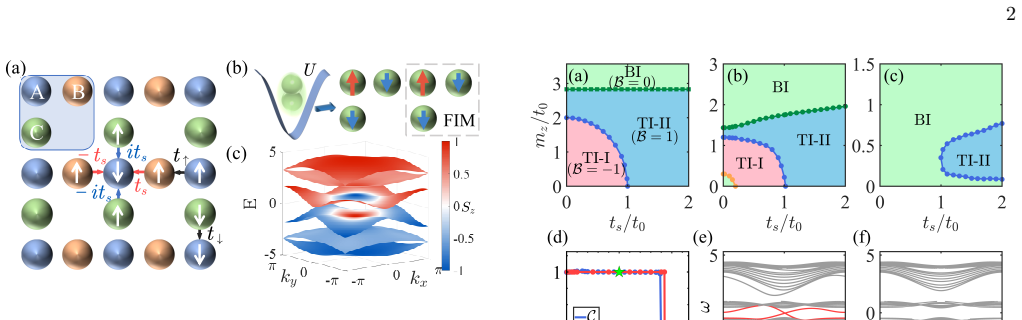
The load-bearing object is the Lieb lattice itself: a bipartite three-sublattice (A, B, C) lattice with a flat band, whose Lieb-theorem guarantee of infinitesimal-$U$ ferrimagnetism is combined with spin-orbit coupling (spin-flip hopping $t_s$, with $t_\uparrow = -t_\downarrow = t_0$) to create band inversion. Interaction effects are carried by the local DMFT self-energy, decomposed as an effective Zeeman field plus a chemical-potential shift; the Bott index is computed from the topological Hamiltonian $H_{\text{topo}} = H_0 + \Sigma(\omega\to 0)$, while the HF Chern number comes from Berry curvature of occupied bands. The spin structure factor $S_q$ identifies the magnetic orders, and for strong $U$ an effective spin-exchange model (Heisenberg plus Dzyaloshinskii-Moriya and Zeeman terms) explains the phase competition.
What would settle it
A determinant quantum Monte Carlo calculation or ultracold-atom measurement at half-filling with $U=0.5t_0$, $t_s=0.1t_0$, and small $m_z$ would falsify the paper if it found no staggered spin structure factor peak at $q=(\pm\pi,\pm\pi)$ or if the Chern and Bott indices vanished while the spectral gap stayed open.
Extended reading notes
Core claim
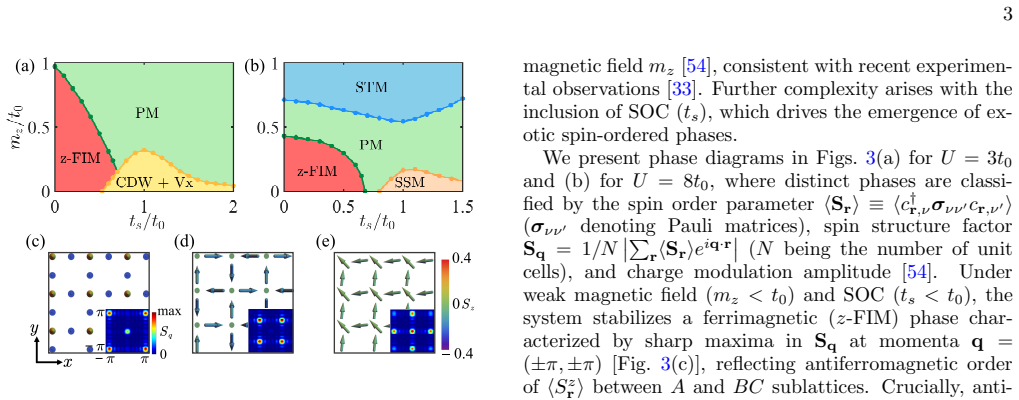
The central claim is that in the two-dimensional spin-orbit-coupled Lieb Hubbard model at half-filling, weak on-site interactions ($U/t_0<1$) suffice to stabilize a magnetic topological insulator: the ground state has nonzero topological invariants (Chern number $C=-1$ from Hartree-Fock, Bott index $B=-1$ from DMFT) and long-range ferrimagnetic order, with a staggered spin texture between the A and BC sublattices. The coexistence is enabled by the flat band of the Lieb lattice, where infinitesimal perturbations strongly alter band properties, and by the interaction self-energy acting as an effective Zeeman field, which modifies topology instead of destroying it. The paper supports this with DMFT and Hartree-Fock phase diagrams, spectral functions showing edge states, and an effective spin-exchange model in the strong-coupling limit.
Load-bearing premise
The paper assumes that Lieb's theorem, which guarantees infinitesimal-$U$ ferrimagnetism for the spin-conserving Hubbard model, still applies after adding spin-orbit coupling ($t_\uparrow=-t_\downarrow$ and spin-flip hopping $t_s$) that lies outside the theorem's hypotheses.
Editorial extensions
If this is right
- At weak interaction strengths ($U/t_0<1$), the topological ferrimagnetic state is generic, occupying extensive regions of the phase diagram for $m_z<t_0$ and $t_s<t_0$.
- The Lieb lattice retains topological phases up to $U=8t_0$ at strong spin-orbit coupling, in contrast to square-lattice systems where weak interactions destroy topology.
- The coexistence is observable in principle: edge spectral weight spans the bulk gap under open boundaries and vanishes under periodic boundaries, consistent with the nonzero Bott and Chern invariants.
- A concrete experimental implementation using three standing-wave pairs and Raman couplings on $^{40}$K atoms yields $t_s\approx 0.09t_0$, within the predicted coexistence regime.
Reading between the lines
- The paper relies on Lieb's theorem for a model with $t_\uparrow=-t_\downarrow$ and spin-flip hopping $t_s$, which lies outside the theorem's original hypotheses; a rigorous small-$U$ extension would turn the numerical coexistence into a proven property.
- Because the Bott index here is computed through the topological Hamiltonian with a DMFT self-energy, the same pipeline could probe topological ferrimagnetism in disordered or finite Lieb lattices, where momentum-space Chern numbers are ill-defined.
- The predicted phase implies a concrete experimental protocol: cool $^{40}$K fermions in the proposed Raman lattice, measure the spin structure factor at $q=(\pm\pi,\pm\pi)$ and the Chern number via band tomography, and scan $U$ across the weak-to-moderate regime to map the coexistence region.
Editorial analysis
A structured set of objections, weighed in public.
Referee Report
Summary. The paper studies a two-dimensional Lieb-lattice Hubbard model with spin-conserving hoppings of opposite signs (t_up = -t_down = t0), spin-flip hopping t_s, on-site interaction U, and a Zeeman field m_z at half-filling. Using real-space dynamical mean-field theory (DMFT) and Hartree-Fock (HF) approximations, the authors compute topological phase diagrams (Chern number and Bott index) and magnetic phase diagrams. Their central claim is that weak interactions suffice to produce a ground state that simultaneously carries nontrivial topology (C = -1 or Bott index B = -1) and long-range ferrimagnetic order, and they propose a concrete ultracold-atom Raman-lattice implementation.
Significance. If the central claim is fully supported, this would be a valuable result: it identifies a flat-band mechanism by which topology and symmetry-breaking magnetic order can coexist at weak coupling, without invoking strong correlations, and it provides an experimentally testable ultracold-atom scheme. The paper has notable strengths: the DMFT is benchmarked against quantum Monte Carlo and experimental data in the no-SOC limit; finite-size and bath-size convergence are checked; the HF and DMFT results are cross-consistent; and the experimental section is detailed and parameter-specific. The main scientific risk is that the evidence presented for spontaneous ferrimagnetic order at finite spin-orbit coupling is not conclusive; the coexistence itself at finite m_z and t_s appears robust, but the 'spontaneous' part of the claim needs an additional limiting procedure or an explicit citation of existing finite-t_s extrapolation data.
major comments (2)
- [Intertwined emergence of magnetism and topology; Fig. 4(a)] The divergence of S^z_tot/m_z in Fig. 4(a) is computed along the path m_z = t_s, so the limit m_z -> 0 simultaneously sends t_s -> 0. This recovers the SOC-free Lieb-Hubbard limit, where Lieb's theorem already guarantees a nonzero spin response; it does not establish spontaneous z-FIM order at finite t_s, i.e. in the regime where the Chern/Bott index is nonzero in Fig. 4(b). Please either present S^z_tot/m_z as a function of m_z at fixed t_s > 0, or explicitly cite and interpret the finite-t_s intercept in SM Fig. S2(b) (U = 8t0, t_s = 0.5t0) and provide analogous weak-U data. Without such an extrapolation, the spontaneous-symmetry-breaking component of the headline claim is supported only in the topologically trivial t_s -> 0 limit.
- [Model and method; sentence invoking Lieb's theorem] The statement that 'Lieb's theorem rigorously establishes that an infinitesimal interaction strength induces a ground state with nonzero spin per unit cell' is made in the context of the Hamiltonian of Eq. (1), which includes t_up = -t_down and spin-flip hopping t_s. These terms violate the hypotheses of Lieb's theorem, which applies to the SU(2)-symmetric Hubbard model on a bipartite lattice; the theorem can at most anchor the t_s = 0 limit. This limitation should be stated explicitly, because the 'weak interactions suffice' narrative otherwise appears to inherit theorem-level certainty that the SOC model does not provide. The finite-SOC burden should rest on the numerical data.
minor comments (4)
- [SM Sec. II, Eq. (S6)] The basis vector is written as {c_{k,A,↑}, c_{k,B,↑}, c_{k,C,↑}, c_{k,A,↓}, c_{k,B,↓}, c_{k,B,↓}}^T; the last entry should be c_{k,C,↓}.
- [SM Sec. VII, Eq. (S31)] The expression for M_2 contains a repeated factor cos(k0y - αL/2) sin(k0y - αL/2); the second term should be sin(k0x - αL/2) cos(k0y - αL/2) (or the equivalent symmetric form) to be consistent with the final result M_2 = iM02 sin(k0x) cos(k0y).
- [Eq. (1)] The spin-flip hopping term as written is not manifestly Hermitian; since the hopping phases along opposite directions are ±1 and ±i, the notation should state explicitly whether the sum over ⟨r,r'⟩ already includes both directions or whether a Hermitian conjugate is implied.
- [Main text after Eq. (1)] The phrase 'tν (ts) presents the nearest-neighbor...' should read 'represents'.
Circularity Check
No significant circularity: all topological invariants and magnetic order parameters are computed directly from the model, with no fitted parameters and no load-bearing self-citation chain.
full rationale
The paper's central results are phase diagrams and order parameters obtained directly from Hamiltonian (1) via DMFT and Hartree-Fock. No parameter is fitted to the target coexistence state, and the two numerical methods cross-check each other and are validated against external QMC and experimental data in Fig. S1. The Bott index and Chern number are computed from standard definitions in SM Sec. IV, citing independent references; Refs [51] and [58] are methodological self-citations for DMFT and Bott-index techniques and are not load-bearing for the paper's physical claim. Lieb's theorem is external mathematics, so the paper's invocation of it is an independent anchor; the fact that the SOC terms violate its hypotheses is a scope limitation, not a circular reduction. The divergence of S_z_tot/m_z in Fig. 4(a) is a standard finite-field signature of spontaneous ferrimagnetic order, and while fixing m_z = t_s means the extrapolation limit also turns off SOC and therefore does not by itself prove spontaneous order at finite t_s, this is an inference gap rather than an equation-level equivalence between input and output. No specific reduction of the form 'X is defined in terms of Y' or 'fitted parameter renamed as prediction' can be quoted from the paper, so no circularity step is identified.
Assumptions & free parameters
assumptions (4)
- domain assumption Lieb's theorem for the Hubbard model on bipartite lattices is applied to the spin-orbit-coupled model.
- domain assumption The topological Hamiltonian H_topo = H0 + Sigma(omega -> 0) with the DMFT local self-energy correctly yields the interacting Bott index.
- domain assumption DMFT with a finite bath (nbath = 5) and local self-energy is a faithful approximation for the 2D Lieb lattice.
- domain assumption The experimental Raman potentials realize the tight-binding model with only nearest-neighbor spin-flip hopping and no onsite spin flips.
Cite this review
Pith. "Pith review of Topology-ferrimagnetism intertwining via weak interactions in Lieb lattices." pith.science (2026). https://pith.science/paper/VK3MBSOP
@misc{pith2026250700291,
  author       = {Pith},
  title        = {Pith review of: Topology-ferrimagnetism intertwining via weak interactions in Lieb lattices},
  year         = {2026},
  howpublished = {\url{https://pith.science/paper/VK3MBSOP}},
  note         = {Machine review of arXiv:2507.00291}
}
read the original abstract
A common wisdom about quantum many-body systems is that emergent phases typically fall into either the Landau-Ginzburg paradigm or topological classifications. Experimentally realizing the intertwined emergence of spontaneous symmetry breaking and topological order remains challenging. Here, we present an experimentally accessible platform for studying magnetic topological states in a spin-orbit-coupled Lieb lattice. Remarkably, we observe the coexistence of topological characteristics, quantified by the Chern number and Bott index, with spontaneous symmetry-breaking orders, such as ferrimagnetism, in the many-body ground states. Computational analyses combining dynamical mean-field theory and Hartree-Fock approximations reveal a pronounced parameter regime where magnetic topological insulators emerge even under weak interactions. This unconventional phenomenon originates from the Lieb lattice's unique band structure, which facilitates the synergy between interaction-driven symmetry breaking and spin-orbit coupling induced band inversion. Crucially, spin polarization and spin winding co-emerge as inherently coupled phenomena due to their shared origin in the same interacting, spinful atoms. We further propose a specific experimental implementation scheme for ultracold atoms, utilizing currently available Raman lattice techniques. Our findings pave the way for exploring the interplay between symmetry-broken states and topological order in strongly correlated systems.
Figures

Figures from the paper (1 more)

Reference graph
Works this paper leans on
-
[45]
W.-F. Tsai, C. Fang, H. Yao, and J. Hu, Interaction- driven topological and nematic phases on the lieb lattice, New J. Phys. 17, 055016 (2015)
work page 2015
-
[1]
Sachdev, Quantum phase transitions, Phys
S. Sachdev, Quantum phase transitions, Phys. World 12, 33 (1999)
1999
-
[2]
Dombre, Symmetry breaking in condensed matter physics, Advances in Natural Sciences 1, p.3 (2000)
T. Dombre, Symmetry breaking in condensed matter physics, Advances in Natural Sciences 1, p.3 (2000)
work page 2000
-
[3]
J. F. Annett, Superconductivity, superfluids and conden- sates, Oxford University Press , 5 (2004)
work page 2004
-
[4]
Qi and S.-C
X.-L. Qi and S.-C. Zhang, Topological insulators and su- perconductors, Rev. Mod. Phys. 83, 1057 (2011)
2011
-
[5]
M. Z. Hasan and C. L. Kane, Colloquium: Topological insulators, Rev. Mod. Phys. 82, 3045 (2010)
2010
- [6]
- [7]
Show all 72 references
-
[8]
B. A. Bernevig, C. Felser, and H. Beidenkopf, Progress and prospects in magnetic topological materials, Nature 603, 41 (2022)
2022
-
[9]
J. Li, Y. Li, S. Du, Z. Wang, B.-L. Gu, S.-C. Zhang, K. He, W. Duan, and Y. Xu, Intrinsic magnetic topolog- ical insulators in van der waals layered mnbi2te4-family materials, Sci. Adv 5, eaaw5685 (2019)
2019
-
[10]
M. M. Otrokov, I. I. Klimovskikh, H. Bentmann, D. Es- tyunin, A. Zeugner, Z. S. Aliev, S. Gaß, A. Wolter, A. Ko- roleva, A. M. Shikin, et al., Prediction and observation of an antiferromagnetic topological insulator, Nature 576, 416 (2019)
2019
-
[11]
Serlin, C
M. Serlin, C. Tschirhart, H. Polshyn, Y. Zhang, J. Zhu, K. Watanabe, T. Taniguchi, L. Balents, and A. Young, Intrinsic quantized anomalous hall effect in a moir´ e het- erostructure, Science 367, 900 (2020)
2020
-
[12]
Lewenstein, A
M. Lewenstein, A. Sanpera, V. Ahufinger, B. Damski, A. Sen(De), and U. Sen, Ultracold atomic gases in op- tical lattices: mimicking condensed matter physics and beyond, Adv. Phys. 56, 243–379 (2007)
2007
-
[13]
Bloch, J
I. Bloch, J. Dalibard, and W. Zwerger, Many-body physics with ultracold gases, Rev. Mod. Phys. 80, 885 (2008)
2008
-
[14]
Esslinger, Fermi-hubbard physics with atoms in an optical lattice, Annu
T. Esslinger, Fermi-hubbard physics with atoms in an optical lattice, Annu. Rev. Condens. Matter Phys. 1, 129–152 (2010)
2010
-
[15]
Dutta, M
O. Dutta, M. Gajda, P. Hauke, M. Lewenstein, D.- S. L¨ uhmann, B. A. Malomed, T. Sowi´ nski, and J. Za- krzewski, Non-standard hubbard models in optical lat- tices: a review, Rep. Prog. Phys. 78, 066001 (2015)
2015
-
[16]
Dalibard, F
J. Dalibard, F. Gerbier, G. Juzeli¯ unas, and P. ¨Ohberg, Colloquium: Artificial gauge potentials for neutral atoms, Rev. Mod. Phys. 83, 1523 (2011)
2011
-
[17]
N. R. Cooper, J. Dalibard, and I. B. Spielman, Topo- logical bands for ultracold atoms, Rev. Mod. Phys. 91, 015005 (2019)
2019
-
[18]
Mazurenko, C
A. Mazurenko, C. S. Chiu, G. Ji, M. F. Parsons, M. Kan´ asz-Nagy, R. Schmidt, F. Grusdt, E. Demler, D. Greif, and M. Greiner, A cold-atom fermi–hubbard antiferromagnet, Nature 545, 462 (2017)
2017
-
[19]
Shao, Y.-X
H.-J. Shao, Y.-X. Wang, D.-Z. Zhu, Y.-S. Zhu, H.-N. Sun, S.-Y. Chen, C. Zhang, Z.-J. Fan, Y. Deng, X.-C. Yao, et al., Antiferromagnetic phase transition in a 3d fermionic hubbard model, Nature 632, 267 (2024)
2024
-
[20]
Y.-J. Lin, K. Jim´ enez-Garc ´ ıa, and I. B. Spielman, Spin– orbit-coupled bose–einstein condensates, Nature 471, 83 (2011)
2011
-
[21]
Wang, Z.-Q
P. Wang, Z.-Q. Yu, Z. Fu, J. Miao, L. Huang, S. Chai, H. Zhai, and J. Zhang, Spin-orbit coupled degenerate fermi gases, Phys. Rev. Lett. 109, 095301 (2012)
2012
-
[22]
L. W. Cheuk, A. T. Sommer, Z. Hadzibabic, T. Yefsah, 6 W. S. Bakr, and M. W. Zwierlein, Spin-injection spec- troscopy of a spin-orbit coupled fermi gas, Phys. Rev. Lett. 109, 095302 (2012)
2012
-
[23]
Jotzu, M
G. Jotzu, M. Messer, R. Desbuquois, M. Lebrat, T. Uehlinger, D. Greif, and T. Esslinger, Experimental realization of the topological haldane model with ultra- cold fermions, Nature 515, 237–240 (2014)
2014
-
[24]
Z. Wu, L. Zhang, W. Sun, X.-T. Xu, B.-Z. Wang, S.-C. Ji, Y. Deng, S. Chen, X.-J. Liu, and J.-W. Pan, Realization of two-dimensional spin-orbit coupling for bose-einstein condensates, Science 354, 83 (2016)
2016
-
[25]
Kolkowitz, S
S. Kolkowitz, S. L. Bromley, T. Bothwell, M. L. Wall, G. E. Marti, A. P. Koller, X. Zhang, A. M. Rey, and J. Ye, Spin–orbit-coupled fermions in an optical lattice clock, Nature 542, 66–70 (2016)
2016
-
[26]
Huang, Z
L. Huang, Z. Meng, P. Wang, P. Peng, S.-L. Zhang, L. Chen, D. Li, Q. Zhou, and J. Zhang, Experimental realization of two-dimensional synthetic spin–orbit cou- pling in ultracold fermi gases, Nat. Phys. 12, 540 (2016)
2016
-
[27]
L. F. Livi, G. Cappellini, M. Diem, L. Franchi, C. Clivati, M. Frittelli, F. Levi, D. Calonico, J. Catani, M. Inguscio, and L. Fallani, Synthetic dimensions and spin-orbit cou- pling with an optical clock transition, Phys. Rev. Lett. 117, 220401 (2016)
2016
-
[28]
Sun, B.-Z
W. Sun, B.-Z. Wang, X.-T. Xu, C.-R. Yi, L. Zhang, Z. Wu, Y. Deng, X.-J. Liu, S. Chen, and J.-W. Pan, Highly controllable and robust 2d spin-orbit coupling for quantum gases, Phys. Rev. Lett. 121, 150401 (2018)
2018
-
[29]
B. Song, L. Zhang, C. He, T. F. J. Poon, E. Ha- jiyev, S. Zhang, X.-J. Liu, and G.-B. Jo, Observation of symmetry-protected topological band with ultracold fermions, Sci. Adv. 4, eaao4748 (2018)
2018
-
[30]
Tarnowski, F
M. Tarnowski, F. N. ¨Unal, N. Fl¨ aschner, B. S. Rem, A. Eckardt, K. Sengstock, and C. Weitenberg, Measuring topology from dynamics by obtaining the chern number from a linking number, Nat. Commun. 10, 1728 (2019)
2019
-
[31]
Wintersperger, C
K. Wintersperger, C. Braun, F. N. ¨Unal, A. Eckardt, M. D. Liberto, N. Goldman, I. Bloch, and M. Aidels- burger, Realization of an anomalous floquet topological system with ultracold atoms, Nat. Phys. 16, 1058–1063 (2020)
2020
-
[32]
Liang, Y.-D
M.-C. Liang, Y.-D. Wei, L. Zhang, X.-J. Wang, H. Zhang, W.-W. Wang, W. Qi, X.-J. Liu, and X. Zhang, Realiza- tion of qi-wu-zhang model in spin-orbit-coupled ultracold fermions, Phys. Rev. Res. 5, L012006 (2023)
2023
-
[33]
Lebrat, A
M. Lebrat, A. Kale, L. H. Kendrick, M. Xu, Y. Gang, A. Nikolaenko, S. Sachdev, and M. Greiner, Ferrimag- netism of ultracold fermions in a multi-band hubbard system, arXiv preprint arXiv:2404.17555 (2025)
2025 arXiv
-
[34]
E. H. Lieb, Two theorems on the hubbard model, Phys. Rev. Lett. 62, 1927 (1989)
1989
-
[35]
Nguyen and M.-T
H.-S. Nguyen and M.-T. Tran, Dynamical mean-field theory for flat-band ferromagnetism, Phys. Rev. B 94, 125106 (2016)
2016
-
[36]
T. I. Vanhala, T. Siro, L. Liang, M. Troyer, A. Harju, and P. T¨ orm¨ a, Topological phase transitions in the re- pulsively interacting haldane-hubbard model, Phys. Rev. Lett. 116, 225305 (2016)
2016
-
[37]
Jiang, S
K. Jiang, S. Zhou, X. Dai, and Z. Wang, Antiferromag- netic chern insulators in noncentrosymmetric systems, Phys. Rev. Lett. 120, 157205 (2018)
2018
-
[38]
Ebrahimkhas, M
M. Ebrahimkhas, M. Hafez-Torbati, and W. Hofstetter, Lattice symmetry and emergence of antiferromagnetic quantum hall states, Phys. Rev. B 103, 155108 (2021)
2021
-
[39]
Ebrahimkhas, G
M. Ebrahimkhas, G. S. Uhrig, W. Hofstetter, and M. Hafez-Torbati, Antiferromagnetic chern insulator in centrosymmetric systems, Phys. Rev. B 106, 205107 (2022)
2022
-
[41]
B. Song, C. He, S. Niu, L. Zhang, Z. Ren, X.-J. Liu, and G.-B. Jo, Observation of nodal-line semimetal with ultracold fermions in an optical lattice, Nat. Phys. 15, 911 (2019)
2019
-
[42]
Flannigan, L
S. Flannigan, L. Madail, R. G. Dias, and A. J. Daley, Hubbard models and state preparation in an optical lieb lattice, New J. Phys. 23, 083014 (2021)
2021
-
[43]
B. Cui, X. Zheng, J. Wang, D. Liu, S. Xie, and B. Huang, Realization of lieb lattice in covalent-organic frameworks with tunable topology and magnetism, Nat. Commun. 11, 66 (2020)
2020
-
[44]
K. Noda, K. Inaba, and M. Yamashita, Flat-band fer- romagnetism in the multilayer lieb optical lattice, Phys. Rev. A 90, 043624 (2014)
2014
-
[46]
Jiang, M
W. Jiang, M. Kang, H. Huang, H. Xu, T. Low, and F. Liu, Topological band evolution between lieb and kagome lattices, Phys. Rev. B 99, 125131 (2019)
2019
-
[47]
Banerjee and A
S. Banerjee and A. Saxena, Higher chern numbers in mul- tilayer lieb lattices ( N ≥2): Topological transitions and quadratic band crossing lines, Phys. Rev. B 103, 235125 (2021)
2021
-
[48]
Georges, G
A. Georges, G. Kotliar, W. Krauth, and M. J. Rozen- berg, Dynamical mean-field theory of strongly correlated fermion systems and the limit of infinite dimensions, Rev. Mod. Phys. 68, 13 (1996)
1996
-
[49]
R. W. Helmes, T. A. Costi, and A. Rosch, Mott transition of fermionic atoms in a three-dimensional optical trap, Phys. Rev. Lett. 100, 056403 (2008)
2008
-
[50]
Snoek, I
M. Snoek, I. Titvinidze, C. T˝ oke, K. Byczuk, and W. Hof- stetter, Antiferromagnetic order of strongly interacting fermions in a trap: real-space dynamical mean-field anal- ysis, New J. Phys. 10, 093008 (2008)
2008
-
[51]
J. Wu, H. Tan, R. Cao, J. Yuan, and Y. Li, Orbital phases of p-band ultracold fermions in a frustrated triangular lattice, Phys. Rev. A 110, 043319 (2024)
2024
-
[52]
P. Das, V. Leeb, J. Knolle, and M. Knap, Realizing al- termagnetism in fermi-hubbard models with ultracold atoms, Phys. Rev. Lett. 132, 263402 (2024)
2024
-
[53]
R. Soni, A. B. Sanyal, N. Kaushal, S. Okamoto, A. Moreo, and E. Dagotto, Multitude of topological phase transitions in bipartite dice and lieb lattices with inter- acting electrons and rashba coupling, Phys. Rev. B 104, 235115 (2021)
2021
-
[54]
See Supplemental Materials for additional details about dynamical mean-field theory, self-consistent Hartree- Fock method, effective spin model, topological invariant, magnetic order parameter, self-energy analysise, and ex- perimental proposal
-
[55]
Shindou, J.-i
R. Shindou, J.-i. Ohe, R. Matsumoto, S. Murakami, and E. Saitoh, Chiral spin-wave edge modes in dipolar mag- netic thin films, Phys. Rev. B 87, 174402 (2013). 7
2013
-
[56]
X. S. Wang, H. W. Zhang, and X. R. Wang, Topological magnonics: A paradigm for spin-wave manipulation and device design, Phys. Rev. Appl. 9, 024029 (2018)
2018
-
[57]
Shindou, R
R. Shindou, R. Matsumoto, S. Murakami, and J.-i. Ohe, Topological chiral magnonic edge mode in a magnonic crystal, Phys. Rev. B 87, 174427 (2013)
2013
-
[58]
J. Han, X. Wang, H. Tan, R. Cao, J. Dai, Y. Li, and J. Yuan, Interaction-induced topological transition in spin-orbit coupled ultracold bosons, Sci. China Phys. Mech. Astron. 66, 293012 (2023)
2023
-
[59]
X. S. Wang, A. Brataas, and R. E. Troncoso, Bosonic bott index and disorder-induced topological transitions of magnons, Phys. Rev. Lett. 125, 217202 (2020)
2020
-
[60]
Huang and F
H. Huang and F. Liu, Theory of spin bott index for quan- tum spin hall states in nonperiodic systems, Phys. Rev. B 98, 125130 (2018)
2018
-
[61]
S´ en´ echal, D
D. S´ en´ echal, D. Perez, and M. Pioro-Ladri` ere, Spectral weight of the hubbard model through cluster perturba- tion theory, Phys. Rev. Lett. 84, 522 (2000)
2000
-
[62]
Ozfidan, J
I. Ozfidan, J. Han, and J. Maciejko, Gapless helical super- conductivity on the surface of a three-dimensional topo- logical insulator, Phys. Rev. B 94, 214510 (2016)
2016
-
[63]
Vasi´ c, A
I. Vasi´ c, A. Petrescu, K. Le Hur, and W. Hofstetter, Chiral bosonic phases on the haldane honeycomb lattice, Phys. Rev. B 91, 094502 (2015)
2015
-
[64]
Rachel, Interacting topological insulators: a review, Rep
S. Rachel, Interacting topological insulators: a review, Rep. Prog. Phys. 81, 116501 (2018)
2018
-
[65]
Cocks, P
D. Cocks, P. P. Orth, S. Rachel, M. Buchhold, K. Le Hur, and W. Hofstetter, Time-reversal-invariant hofstadter- hubbard model with ultracold fermions, Phys. Rev. Lett. 109, 205303 (2012)
2012
-
[66]
H. Park, J. Cai, E. Anderson, X.-W. Zhang, X. Liu, W. Holtzmann, W. Li, C. Wang, C. Hu, Y. Zhao, et al., Ferromagnetism and topology of the higher flat band in a fractional chern insulator, Nat. Phys. 21, 549 (2025)
2025
-
[67]
Y. Fang, A. E. Ruckenstein, E. Dagotto, and S. Schmitt- Rink, Holes in the infinite-u hubbard model: Instability of the nagaoka state, Phys. Rev. B 40, 7406 (1989)
1989
-
[68]
Aichhorn, M
M. Aichhorn, M. Daghofer, H. G. Evertz, and W. von der Linden, Low-temperature lanczos method for strongly correlated systems, Phys. Rev. B 67, 161103 (2003)
2003
-
[69]
Titvinidze, A
I. Titvinidze, A. Schwabe, N. Rother, and M. Potthoff, Dynamical mean-field theory of indirect magnetic ex- change, Phys. Rev. B 86, 075141 (2012)
2012
-
[70]
Pinheiro, G
F. Pinheiro, G. M. Bruun, J.-P. Martikainen, and J. Lar- son, xyz quantum heisenberg models with p-orbital bosons, Phys. Rev. Lett. 111, 205302 (2013)
2013
-
[71]
K¨ ubler, F
M. K¨ ubler, F. T. Sant’Ana, F. E. A. d. Santos, and A. Pelster, Improving mean-field theory for bosons in op- tical lattices via degenerate perturbation theory, Phys. Rev. A 99, 063603 (2019)
2019
-
[72]
Wang and B
Z. Wang and B. Yan, Topological hamiltonian as an exact tool for topological invariants, J. Phys.: Condens. Matter 25, 155601 (2013). 8 Supplemental Materials CONTENTS I. Dynamical Mean-Field Theory 8 II. Hartree-Fock method in the weakly interacting regime 10 III. Effective s...
2013
-
[73]
Here, the transition matrix elements αD1 ≡ ⟨J = 1/2||er||J ′ = 1 /2⟩, αD2 ≡ ⟨J = 1 /2||er||J ′ = 3 /2⟩ and αD2 ≈ √ 2αD1
From the data of dipole matrix elements of 40K, we can obtain the spin-independent optical potentials V↑ = V↓ = h V1x cos2 k0x − αL 2 + V1y cos2 k0y − αL 2 i + V2x cos2 k0x 2 − π 4 − αL 2 + V2y cos2 k0y 2 + π 4 − αL 2 + V3 h sin k0x − αL 2 + sin k0y − αL 2 i2 , (S29) 17 where ...
Reviewed August 6, 2026 · model on record in the stance chip above.
Discussion (0). Continue with ORCID to comment.