REVIEW 3 major objections 5 minor 64 references
First-principles study of the charge ordered phase in $\kappa$-D$_3$(Cat-EDT-TTF/ST)$_2$: Stability of $\pi$-electron deuterium coupled ordering in hydrogen-bonded molecular conductors
T0 review · 3 major / 5 minor · reviewed 2026-08-14 · deepseek-v4-flash
Pith's one-line read A screened hybrid functional stabilizes the charge-ordered crystal that GGA misses.
desk verdict A useful DFT benchmark for a coupled D/CO phase: HSE06 reproduces the experimental LT geometry while GGA does not, but the 'stability' claim is weaker than the protocol supports because the cell is fixed and relaxations start from the LT structure. read the letter →
The pith
A machine-rendered reading of the paper's core claim, the machinery that carries it, and where it could break.
The reading
What carries the argument
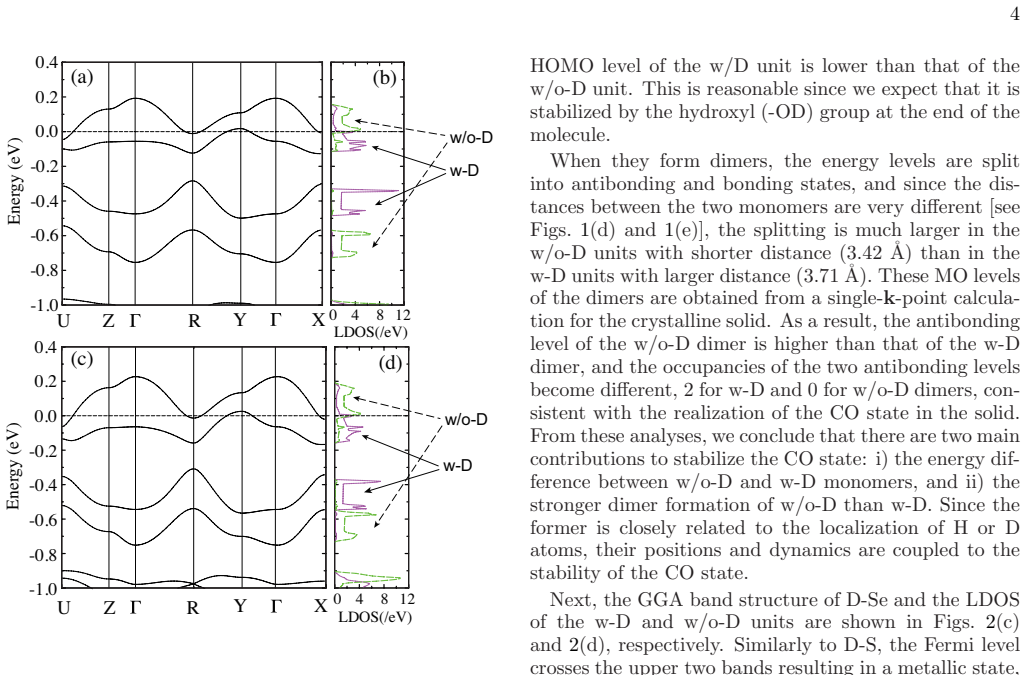
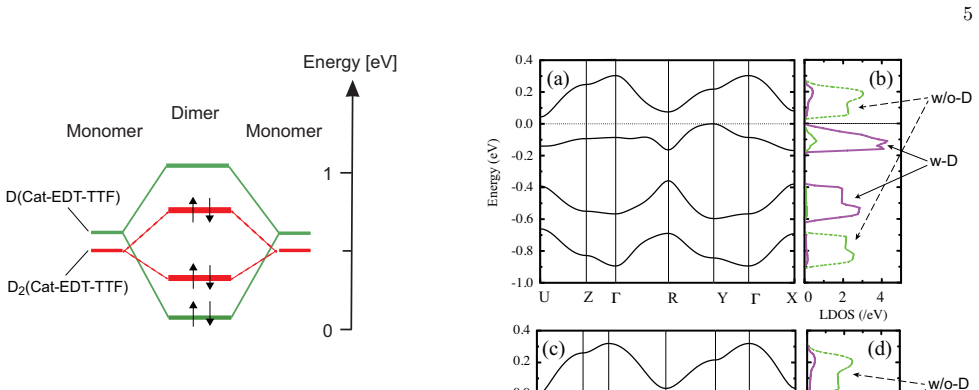
The load-bearing object is the coupled order parameter formed by the off-center deuterium position in the O–D···O hydrogen bond and the charge disproportionation between the two types of dimers. The computational switch that makes the argument work is the fraction of exact exchange in HSE06, which localizes the π wavefunctions enough to stabilize the charge imbalance and the associated molecular distortions. The paper's explanatory device is a dimer molecular-orbital diagram: the deuterium-bearing monomer sits lower in HOMO energy, and the deuterium-free dimer has a shorter inter-monomer distance, so its antibonding level is pushed above the deuterium-bearing dimer's, emptying one level and filling the other.
What would settle it
Take the optimized HSE06 potential-energy surface for the shared deuterium atom and recompute it with deuterium zero-point motion included, for example by path-integral or multicomponent DFT on the same crystal; if the double-well profile flattens into a single well, the classical HSE06 stabilization of the charge-ordered phase would not survive quantum treatment.
Extended reading notes
Core claim
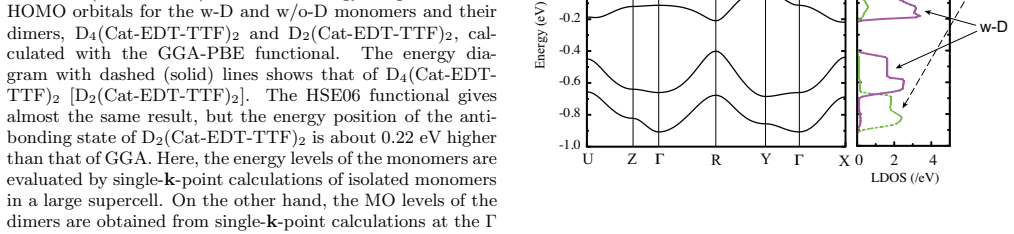
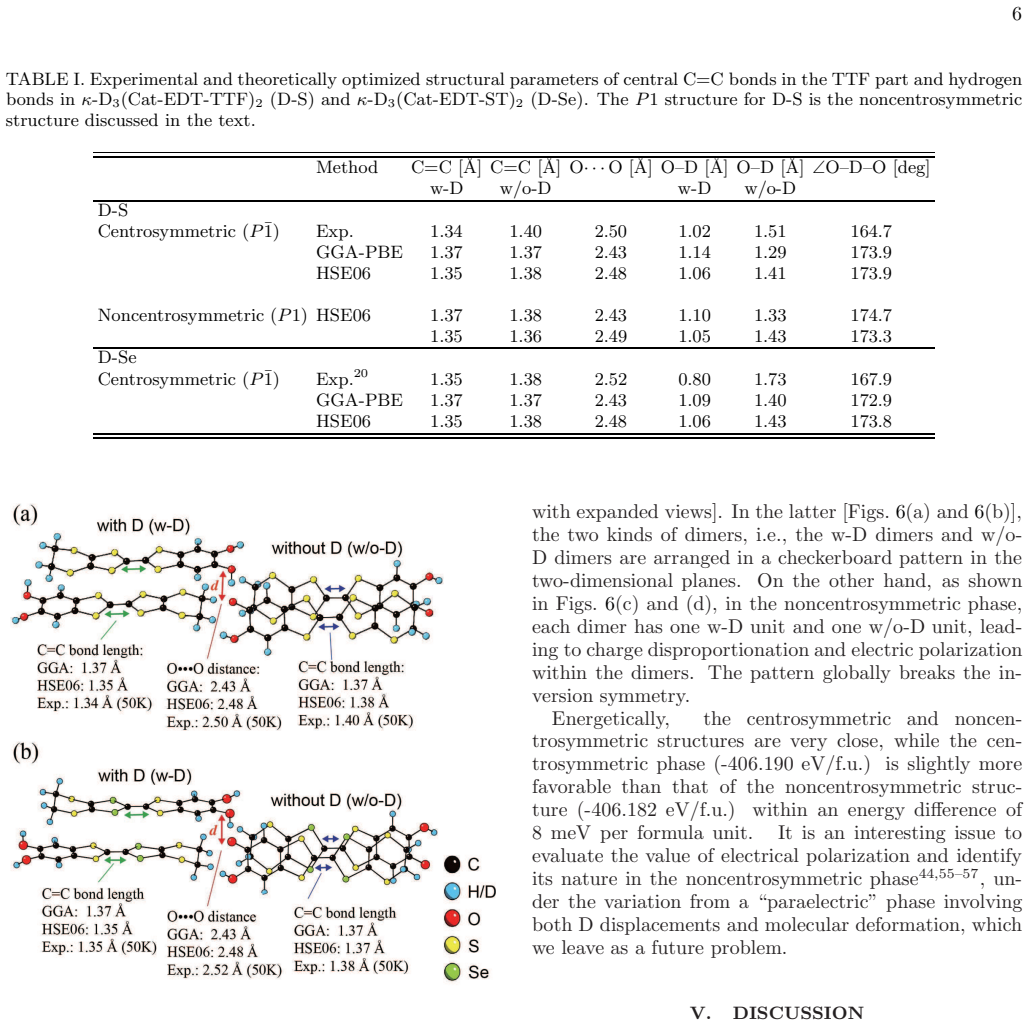
Starting from the measured low-temperature P-1 structure of κ-D3(Cat-EDT-TTF)2 and its selenium analog, structural relaxation with GGA-PBE returns to a symmetric, high-temperature-like geometry with essentially no charge disproportionation between the two molecular units. Relaxation with HSE06 instead settles near the measured geometry, reproducing central C=C bond lengths of 1.35 Å and 1.38 Å for the deuterium-bearing and deuterium-free units. HSE06 also opens a 0.04 eV indirect gap in the sulfur compound, while the selenium compound remains semi-metallic, in contrast to experiment. Using the HSE06 landscape, the paper constructs a noncentrosymmetric P1 structure by reversing the deuterium displacement pattern on half the hydrogen bonds; this phase optimizes to a stable structure only 8 meV per formula unit above the centrosymmetric ground state. The stabilization is attributed to two comparable effects: the lower HOMO energy of the monomer carrying the deuterium and the stronger dimerization of the deuterium-free units.
Load-bearing premise
The calculations treat the shared deuterium as a classical point charge, so any nuclear quantum motion that might explain why only deuterated samples order is left out.
Editorial extensions
If this is right
- HSE06 structural optimization can be used quantitatively for charge-ordered phases in this family of molecular conductors, including bond lengths that Raman measurements probe.
- The predicted noncentrosymmetric P1 phase, only 8 meV per formula unit above the observed phase, is a concrete candidate to search for under pressure or with altered deuteration patterns.
- The molecular-orbital energy differences provide first-principles parameters for effective models of coupled deuterium–π-electron order, filling a gap left by models that neglect the inter-monomer distance asymmetry.
- The 0.04 eV gap in the sulfur compound matches its insulating behavior, while the semi-metallic result for the selenium compound marks a specific quantitative limit of HSE06 for this family.
Reading between the lines
- Beyond the paper: because the experimental transition occurs only in deuterated samples, the classical-HSE06 success on deuterated compounds suggests the functional may be capturing an enthalpy landscape that nuclear quantum motion then selects between; a quantum-nuclear calculation on the same surface would test this directly.
- Beyond the paper: the 8 meV per formula unit separation between the two phases is close to the accuracy limits of the method, so a measured electric polarization or dielectric anomaly in the selenium compound could discriminate between the centrosymmetric and noncentrosymmetric arrangements.
- Beyond the paper: if zero-point motion shifts the shared deuterium toward the center of the hydrogen bond, then the HSE06 double-well picture may over-stabilize charge order; path-integral or multicomponent DFT calculations could reveal whether the classical result is an artifact or the dominant physics.
Signed reviews
Editorial analysis
A structured set of objections, weighed in public.
Referee Report
Summary. This paper investigates the low-temperature charge-ordered (CO) phase of the hydrogen-bonded molecular conductors κ-D3(Cat-EDT-TTF)2 and κ-D3(Cat-EDT-ST)2 using GGA-PBE and HSE06 calculations. The authors fix the lattice constants to the experimental values and relax the internal coordinates. They find that GGA-PBE relaxations starting from the experimental P-1 structure lose the CO distortion, while HSE06 retains it and reproduces the central C=C bond length asymmetry and hydrogen-bond geometry. They also construct a noncentrosymmetric P1 phase by reversing the D displacements and find it lies 8 meV/f.u. above the centrosymmetric phase. The paper concludes that HSE06 is highly accurate for the CO structure and that GGA fails to stabilize it.
Significance. If the central comparison is accepted, the paper provides a useful methodological benchmark: it shows that the standard HSE06 hybrid functional, used without parameter fitting, can preserve a charge-ordered distortion that GGA-PBE destroys, and it yields a concrete prediction of a close-lying ferroelectric-like CO phase that could be investigated experimentally. The authors also explicitly report a numerical check with HSE06-D3 and clearly state the limitations of the fixed-lattice protocol and of the classical treatment of D nuclei. However, because the relaxations begin from the experimental low-temperature geometry and never relax the cell, the paper overstates the thermodynamic stability of the CO phase; the significance of the results is correspondingly that of a conditional structural benchmark rather than a definitive stability calculation.
major comments (3)
- [Secs. III and IV B] The central stability conclusion rests on structural relaxations that start from the experimental low-temperature P-1 structure and hold lattice constants fixed to the experimental LT cell, as stated in Sec. III ('we use the experimental lattice parameters throughout this paper') and Sec. IV B (the initial state is 'the experimental structures of the D localized phase'). This protocol tests whether the experimental internal distortion survives internal-coordinate relaxation, but it does not test whether the CO phase is a stable minimum on the HSE06 potential-energy surface, because the high-temperature C2/c phase is never used as a starting point and the cell is not relaxed. Since the D ordering is coupled to the O···O hydrogen-bond distance, pinning the LT cell can itself stabilize the distorted internal coordinates, and the apparent GGA/HSE06 difference may be partly a boundary-condition effect. The abstract and Sec. IV B use the language 'structural stability of the CO phase,' which is stronger than the evidence. I ask the authors to either rephrase the stability claim as 'the CO internal distortion is preserved under HSE06 relaxation at the experimental lattice' or add full cell-plus-internal relaxations from both the C2/c and P-1 starting points.
- [Sec. IV B (energy difference between P-1 and P1)] The predicted noncentrosymmetric P1 phase is reported to lie only 8 meV per formula unit above the centrosymmetric phase, with no convergence tests or error estimates for this energy difference, and with no analysis of the dependence on k-point sampling, plane-wave cutoff, or exact-exchange integration grid. Given that HSE06 total-energy errors for competing molecular packings can readily exceed this scale, the Summary's statement that a 'stable' noncentrosymmetric CO phase was found is not justified by the reported data. Please report convergence tests for the energy difference and either compute it with an independent method (e.g., different k-point mesh or HSE06-D3) or explicitly present it as a tentative near-degeneracy.
- [Sec. III (classical treatment of D nuclei)] The calculation treats H/D as classical point charges and does not distinguish H from D, as stated in Sec. III: 'the present study does not consider the quantum effects of H or D atoms.' This is load-bearing for the paper's title claim about deuterium-coupled ordering, because the experimental phenomenology is isotope-specific (only the deuterated samples undergo the CO transition), and the authors cite multicomponent DFT studies showing that nuclear quantum motion can change the hydrogen-bond potential from double-well to single-well. The HSE06 classical-nucleus relaxation therefore cannot exclude the possibility that the CO structure is stabilized by neglecting zero-point motion, and it cannot address why H and D behave differently. The authors acknowledge this limitation, but it should be stated in the abstract and conclusions as a condition on the stability claim.
minor comments (5)
- [Sec. III] There is a typo in the phrase 'van dar Waals interactions'; it should read 'van der Waals interactions.'
- [Sec. I] The compound name appears as 'ethylenedithiote-tetrathiafulvalene'; the standard spelling is 'ethylenedithio-tetrathiafulvalene.'
- [Sec. V] The HSE06 result for D-Se is semimetallic while experiments show insulating behavior; this qualification is stated in the Discussion, but it should also appear in the Summary so that the accuracy claim for HSE06 is not overgeneralized.
- [Sec. VI and VII] In the Summary, 'We also proposed possible patterns' should be 'We also propose possible patterns'; in the Acknowledgements, 'One the authors' should be 'One of the authors.'
- [General] The optimized atomic coordinates for the HSE06 P-1 and P1 structures are not provided as supplemental data; making them available would significantly improve reproducibility and allow other groups to test the 8 meV energy difference.
Circularity Check
No significant circularity: the HSE06 functional is used with standard parameters and benchmarked against external experimental structures; neither the CO-structure reproduction nor the predicted noncentrosymmetric phase reduces to a fit or to self-citation.
full rationale
The paper's central claim is that HSE06, with its standard 25% exact exchange and 0.2 Å−1 range-separation parameter, preserves the experimentally observed low-temperature charge-ordered internal geometry under relaxation, while GGA-PBE relaxes the same starting structure toward the symmetric high-temperature phase. This is a functional benchmark against external experimental structural data, not a circular construction: no parameter is fitted to the CO structure, the energy differences, or the predicted P1 phase. The noncentrosymmetric P1 structure is a genuine prediction obtained by reversing the D displacements in the initial state and then relaxing, and its 8 meV/f.u. energy separation is reported as a computed result rather than imposed. Citations to the authors' earlier work (Ref. 16) provide context about prior H-S calculations and a shallow potential-energy surface; they are not load-bearing for the HSE06-vs-GGA comparison, which is carried out with standard functionals and checked against experimental C=C and O–D bond lengths. The paper explicitly discloses its main limitations in Sec. III: it uses experimental lattice parameters throughout and treats H/D nuclei classically, so the 'stability' statement concerns local structural relaxation at fixed experimental cell rather than a global phase diagram. These are important caveats to the strength of the conclusion, but they do not make the derived structures equivalent to the inputs by construction. No equation or fitted parameter reduces the prediction to the input, so the derivation chain is self-contained. The appropriate circularity score is therefore 0.
Assumptions & free parameters
assumptions (3)
- domain assumption HSE06 exchange-correlation functional accurately describes the energetics and structure of strongly correlated molecular conductors.
- domain assumption Nuclei, including deuterium, can be treated as classical point charges within the Born-Oppenheimer approximation.
- domain assumption The experimental lattice parameters are fixed throughout the structural optimization.
Cite this review
Pith. "Pith review of First-principles study of the charge ordered phase in $\kappa$-D$_3$(Cat-EDT-TTF/ST)$_2$: Stability of $\pi$-electron deuterium coupled ordering in hydrogen-bonded molecular conductors." pith.science (2026). https://pith.science/paper/VKBBCTAW
@misc{pith2026190802580,
  author       = {Pith},
  title        = {Pith review of: First-principles study of the charge ordered phase in $\kappa$-D$_3$(Cat-EDT-TTF/ST)$_2$: Stability of $\pi$-electron deuterium coupled ordering in hydrogen-bonded molecular conductors},
  year         = {2026},
  howpublished = {\url{https://pith.science/paper/VKBBCTAW}},
  note         = {Machine review of arXiv:1908.02580}
}
abstract
We study the electronic and structural properties of the low-temperature ordered phase of hydrogen-bonded molecular conductors, $\kappa$-D$_3$(Cat-EDT-TTF)$_2$ and its selenium-substituted analog $\kappa$-D$_3$(Cat-EDT-ST)$_2$, by means of first-principles density functional theory~(DFT) calculations. In these compounds, the charge ordering in the $\pi$-electron system is coupled with the ordering of the displacements in the deuteriums forming the hydrogen-bond, equally shared by two oxygens in the high-temperature phase. While the structural optimization within the standard DFT method based on the generalized gradient approximation fails to reproduce the structural stability of the charge-ordered (CO) phase, we show that a hybrid functional of Heyd, Scuseria, and Ernzerhof can reproduce structural characters of the CO phase, owing to the more localized nature of the wave functions. Furthermore, using the ability of the hybrid functional to predict the electronic and structural properties, we find a stable noncentrosymmetric CO phase with another pattern of deuterium ordering.
Figures

Figures from the paper (3 more)

Reference graph
Works this paper leans on
-
[1]
author author K. Terakura , author T. Oguchi , author A. R. \ Williams , \ and\ author J. K\"ubler ,\ 10.1103/PhysRevB.30.4734 journal journal Phys. Rev. B \ volume 30 ,\ pages 4734 ( year 1984 ) NoStop
-
[2]
author author T. Miyazaki \ and\ author T. Ohno ,\ @noop journal journal Phys. Rev. B \ volume 59 ,\ pages R5269 ( year 1999 ) NoStop
work page 1999
-
[3]
author author K. Nakamura , author Y. Yoshimoto , author T. Kosugi , author R. Arita , \ and\ author M. Imada ,\ @noop journal journal J. Phys. Soc. Jpn \ volume 78 ,\ pages 083710 ( year 2009 ) NoStop
work page 2009
-
[4]
author author K. Yamauchi , author T. Fukushima , \ and\ author S. Picozzi ,\ 10.1103/PhysRevB.79.212404 journal journal Phys. Rev. B \ volume 79 ,\ pages 212404 ( year 2009 ) NoStop
-
[5]
author author K. Yoshimi , author H. Seo , author S. Ishibashi , \ and\ author S. E. \ Brown ,\ 10.1103/PhysRevLett.108.096402 journal journal Phys. Rev. Lett. \ volume 108 ,\ pages 096402 ( year 2012 ) NoStop
-
[6]
author author A. C. \ Jacko , author H. Feldner , author E. Rose , author F. Lissner , author M. Dressel , author R. Valent\' , \ and\ author H. O. \ Jeschke ,\ @noop journal journal Phys. Rev. B \ volume 87 ,\ pages 155139 ( year 2013 ) NoStop
work page 2013
-
[7]
author author H. Yamakawa , author T. Miyamoto , author T. Morimoto , author H. Yada , author Y. Kinoshita , author M. Sotome , author N. Kida , author K. Yamamoto , author K. Iwano , author Y. Matsumoto , author S. Watanabe , author Y. Shimoi , author M. Suda , author H. M. \ Yamamoto , author H. Mori , \ and\ author H. Okamoto ,\ @noop journal journal S...
work page 2016
-
[8]
author author N. Katoh , author T. Miyazaki , \ and\ author T. Ohno ,\ 10.1103/PhysRevB.59.R12723 journal journal Phys. Rev. B \ volume 59 ,\ pages R12723 ( year 1999 ) NoStop
Show all 64 references
-
[9]
author author V. I. \ Anisimov , author I. S. \ Elfimov , author N. Hamada , \ and\ author K. Terakura ,\ 10.1103/PhysRevB.54.4387 journal journal Phys. Rev. B \ volume 54 ,\ pages 4387 ( year 1996 ) NoStop
1996 doi
-
[10]
\ Jeng , author G
author author H.-T. \ Jeng , author G. Y. \ Guo , \ and\ author D. J. \ Huang ,\ 10.1103/PhysRevLett.93.156403 journal journal Phys. Rev. Lett. \ volume 93 ,\ pages 156403 ( year 2004 ) NoStop
2004 doi
-
[11]
author author A. S. \ Botana , author V. Pardo , author W. E. \ Pickett , \ and\ author M. R. \ Norman ,\ @noop journal journal Phys. Rev. B \ volume 94 ,\ pages 081105(R) ( year 2016 ) NoStop
2016
-
[12]
Seo , author C
author author H. Seo , author C. Hotta , \ and\ author H. Fukuyama ,\ @noop journal journal Chem. Rev. \ volume 104 ,\ pages 5005 ( year 2004 ) NoStop
2004
-
[13]
Kamo , author A
author author H. Kamo , author A. Ueda , author T. Isono , author K. Takahashi , \ and\ author H. Mori ,\ @noop journal journal Tetrahedron Lett. \ volume 53 ,\ pages 4385 ( year 2012 ) NoStop
2012
-
[14]
Isono , author H
author author T. Isono , author H. Kamo , author A. Ueda , author K. Takahashi , author A. Nakao , author R. Kumai , author H. Nakao , author K. Kobayashi , author Y. Murakami , \ and\ author H. Mori ,\ @noop journal journal Nat. Commun. \ volume 4 ,\ pages 1344 ( year 2013 ) NoStop
2013
-
[15]
Isono , author H
author author T. Isono , author H. Kamo , author A. Ueda , author K. Takahashi , author M. Kimata , author H. Tajima , author S. Tsuchiya , author T. Terashima , author S. Uji , \ and\ author H. Mori ,\ @noop journal journal Phys. Rev. Lett. \ volume 112 ,\ pages 177201 ( year...
2014
-
[16]
Tsumuraya , author H
author author T. Tsumuraya , author H. Seo , author R. Kato , \ and\ author T. Miyazaki ,\ @noop journal journal Phys. Rev. B \ volume 92 ,\ pages 035102 ( year 2015 ) NoStop
2015
-
[17]
Kino \ and\ author H
author author H. Kino \ and\ author H. Fukuyama ,\ @noop journal journal J. Phys. Soc. Jpn. \ volume 65 ,\ pages 2158 ( year 1996 ) NoStop
1996
-
[18]
Shimozawa , author K
author author M. Shimozawa , author K. Hashimoto , author A. Ueda , author Y. Suzuki , author K. Sugii , author S. Yamada , author Y. Imai , author R. Kobayashi , author K. Itoh , author S. Iguchi , author M. Naka , author S. Ishihara , author H. Mori , author T. Sasaki , \ an...
-
[19]
Ueda , author S
author author A. Ueda , author S. Yamada , author T. Isono , author H. Kamo , author A. Nakao , author R. Kumai , author H. Nakao , author Y. Murakami , author K. Yamamoto , author Y. Nishio , \ and\ author H. Mori ,\ @noop journal journal J. Am. Chem. Soc. \ volume 136 ,\ pag...
2014
-
[20]
Ueda , author A
author author A. Ueda , author A. Hatakeyama , author M. Enomoto , author R. Kumai , author Y. Murakami , \ and\ author H. Mori ,\ @noop journal journal Chem. Eur. J. \ volume 21 ,\ pages 15020 ( year 2015 ) NoStop
2015
-
[21]
Ueda , author K
author author A. Ueda , author K. Kishimoto , author Y. Sunairi , author J. Yoshida , author H. Yamakawa , author T. Miyamoto , author T. Terashige , author H. Okamoto , \ and\ author H. Mori ,\ @noop journal journal J. Phys. Soc. Jpn. \ volume 88 ,\ pages 034710 ( year 2019 ) NoStop
2019
-
[22]
Yamashita , author Y
author author S. Yamashita , author Y. Nakazawa , author A. Ueda , \ and\ author H. Mori ,\ https://link.aps.org/doi/10.1103/PhysRevB.95.184425 journal journal Phys. Rev. B \ volume 95 ,\ pages 184425 ( year 2017 ) NoStop
2017 doi
-
[23]
Naka \ and\ author S
author author M. Naka \ and\ author S. Ishihara ,\ 10.1103/PhysRevB.97.245110 journal journal Phys. Rev. B \ volume 97 ,\ pages 245110 ( year 2018 ) NoStop
2018 doi
-
[24]
author author J. P. \ Perdew , author K. Burke , \ and\ author M. Ernzerhof ,\ 10.1103/PhysRevLett.77.3865 journal journal Phys. Rev. Lett. \ volume 77 ,\ pages 3865 ( year 1996 ) NoStop
1996 doi
-
[25]
Heyd , author G
author author J. Heyd , author G. E. \ Scuseria , \ and\ author M. Ernzerhof ,\ @noop journal journal J. Chem. Phys. \ volume 118 ,\ pages 8207 ( year 2003 ) NoStop
2003
-
[26]
Heyd \ and\ author G
author author J. Heyd \ and\ author G. E. \ Scuseria ,\ @noop journal journal J. Chem. Phys. \ volume 121 ,\ pages 1187 ( year 2004 ) NoStop
2004
-
[27]
Heyd , author J
author author J. Heyd , author J. E. \ Peralta , author G. E. \ Scuseria , \ and\ author R. L. \ Martin ,\ 10.1063/1.2085170 journal journal J. Chem. Phys. \ volume 123 ,\ pages 174101 ( year 2005 ) NoStop
2005 doi
-
[28]
Heyd , author G
author author J. Heyd , author G. E. \ Scuseria , \ and\ author M. Ernzerhof ,\ 10.1063/1.2204597 journal journal J. Chem. Phys. \ volume 124 ,\ pages 219906 ( year 2006 ) NoStop
2006 doi
-
[29]
Giovannetti , author S
author author G. Giovannetti , author S. Kumar , author A. Stroppa , author J. van den Brink , \ and\ author S. Picozzi ,\ @noop journal journal Phys. Rev. Lett. \ volume 103 ,\ pages 266401 ( year 2009 ) NoStop
2009
-
[30]
Fonari , author C
author author A. Fonari , author C. Sutton , author J.-L. \ Br\'edas , \ and\ author V. Coropceanu ,\ @noop journal journal Phys. Rev. B \ volume 90 ,\ pages 165205 ( year 2014 ) NoStop
2014
-
[31]
Wimmer , author H
author author E. Wimmer , author H. Krakauer , author M. Weinert , \ and\ author A. J. \ Freeman ,\ 10.1103/PhysRevB.24.864 journal journal Phys. Rev. B \ volume 24 ,\ pages 864 ( year 1981 ) NoStop
1981 doi
-
[32]
author author D. D. \ Koellng \ and\ author G. O. \ Arbman ,\ @noop journal journal J. Phys. F: Metal Phys. \ volume 5 ,\ pages 2041 ( year 1975 ) NoStop
1975
-
[33]
Weinert ,\ @noop journal journal J
author author M. Weinert ,\ @noop journal journal J. Math. Phys. \ volume 22 ,\ pages 2433 ( year 1981 ) NoStop
1981
-
[34]
Tsumuraya , author J.-H
author author T. Tsumuraya , author J.-H. \ Song , \ and\ author A. J. \ Freeman ,\ @noop journal journal Phys. Rev. B \ volume 86 ,\ pages 075114 ( year 2012 ) NoStop
2012
-
[35]
Vanderbilt ,\ 10.1103/PhysRevB.41.7892 journal journal Phys
author author D. Vanderbilt ,\ 10.1103/PhysRevB.41.7892 journal journal Phys. Rev. B \ volume 41 ,\ pages 7892 ( year 1990 ) NoStop
1990 doi
-
[36]
Kresse \ and\ author J
author author G. Kresse \ and\ author J. Furthm\"uller ,\ 10.1103/PhysRevB.54.11169 journal journal Phys. Rev. B \ volume 54 ,\ pages 11169 ( year 1996 ) NoStop
1996 doi
-
[37]
Kresse \ and\ author D
author author G. Kresse \ and\ author D. Joubert ,\ @noop journal journal Phys. Rev. B \ volume 59 ,\ pages 1758 ( year 1999 ) NoStop
1999
-
[38]
Paier , author M
author author J. Paier , author M. Marsman , author K. Hummer , author G. Kresse , author I. C. \ Gerber , \ and\ author J. G. \ \'A ngy \'a n ,\ @noop journal journal J. Chem. Phys. \ volume 124 ,\ pages 154709 ( year 2006 ) NoStop
2006
-
[39]
Chen , author Y
author author P. Chen , author Y. H. \ Chan , author X. Y. \ Fang , author Y. Zhang , author M. Y. \ Chou , author S. K. \ Mo , author Z. Hussain , author A. V. \ Fedorov , \ and\ author T. C. \ Chiang ,\ https://doi.org/10.1038/ncomms9943 journal journal Nat. Commun. \ volume...
-
[40]
Hellgren , author J
author author M. Hellgren , author J. Baima , author R. Bianco , author M. Calandra , author F. Mauri , \ and\ author L. Wirtz ,\ @noop journal journal Phys. Rev. Lett. \ volume 119 ,\ pages 176401 ( year 2017 ) NoStop
2017
-
[41]
Foyevtsova , author A
author author K. Foyevtsova , author A. Khazraie , author I. Elfimov , \ and\ author G. A. \ Sawatzky ,\ @noop journal journal Phys. Rev. B \ volume 91 ,\ pages 121114(R) ( year 2015 ) NoStop
2015
-
[42]
Smolyanyuk , author L
author author A. Smolyanyuk , author L. Boeri , \ and\ author C. Franchini ,\ @noop journal journal Phys. Rev. B \ volume 96 ,\ pages 035103 ( year 2017 ) NoStop
2017
-
[43]
Ishii , author N
author author F. Ishii , author N. Nagaosa , author Y. Tokura , \ and\ author K. Terakura ,\ @noop journal journal Phys. Rev. B \ volume 73 ,\ pages 212105 ( year 2006 ) NoStop
2006
-
[44]
Horiuchi , author Y
author author S. Horiuchi , author Y. Tokunaga , author G. Giovannetti , author S. Picozzi , author H. Itoh , author R. Shimano , author R. Kumai , \ and\ author Y. Tokura ,\ @noop journal journal Nature \ volume 463 ,\ pages 789 ( year 2010 ) NoStop
2010
-
[45]
Ishibashi , author S
author author S. Ishibashi , author S. Horiuchi , \ and\ author R. Kumai ,\ @noop journal journal Phys. Rev. B \ volume 97 ,\ pages 184102 ( year 2018 ) NoStop
2018
-
[46]
@noop note We have checked that the optimized internal coordinates for the experimental lattice parameters considering van dar Waals dispersion corrections (HSE06-D3) Grimme_vdW_Disp_2010, GrimmeDampingD3, HSE_D3_Moellmann2014 are almost the same with those by HSE06. For examp...
-
[47]
@noop note BEDT-TTF = Bis(ethylenedithio)tetrathiafulvalene, X = anion molecule or atom NoStop
-
[48]
Naka \ and\ author S
author author M. Naka \ and\ author S. Ishihara ,\ 10.1143/JPSJ.79.063707 journal journal J. Phys. Soc. Jpn. \ volume 79 ,\ pages 063707 ( year 2010 ) NoStop
2010 doi
-
[49]
Abdel-Jawad , author I
author author M. Abdel-Jawad , author I. Terasaki , author T. Sasaki , author N. Yoneyama , author N. Kobayashi , author Y. Uesu , \ and\ author C. Hotta ,\ 10.1103/PhysRevB.82.125119 journal journal Phys. Rev. B \ volume 82 ,\ pages 125119 ( year 2010 ) NoStop
-
[50]
Gomi , author T
author author H. Gomi , author T. Imai , author A. Takahashi , \ and\ author M. Aihara ,\ 10.1103/PhysRevB.82.035101 journal journal Phys. Rev. B \ volume 82 ,\ pages 035101 ( year 2010 ) NoStop
2010 doi
-
[51]
Naka \ and\ author S
author author M. Naka \ and\ author S. Ishihara ,\ @noop journal journal J. Phys. Soc. Jpn. \ volume 82 ,\ pages 023701 ( year 2013 ) NoStop
2013
-
[52]
Gomi , author M
author author H. Gomi , author M. Ikenaga , author Y. Hiragi , author D. Segawa , author A. Takahashi , author T. J. \ Inagaki , \ and\ author M. Aihara ,\ @noop journal journal Phys. Rev. B \ volume 87 ,\ pages 195126 ( year 2013 ) NoStop
2013
-
[53]
Gati , author J
author author E. Gati , author J. K. H. \ Fischer , author P. Lunkenheimer , author D. Zielke , author S. K\"ohler , author F. Kolb , author H.-A. K. \ von Nidda , author S. M. \ Winter , author H. Schubert , author J. A. \ Schlueter , author H. O. \ Jeschke , author R. Valent...
-
[54]
Hassan , author S
author author N. Hassan , author S. Cunningham , author M. Mourigal , author E. I. \ Zhilyaeva , author S. A. \ Torunova , author R. N. \ Lyubovskaya , author J. A. \ Schlueter , \ and\ author N. Drichko ,\ @noop journal journal Science \ volume 360 ,\ pages 1101 ( year 2018 ) NoStop
2018
-
[55]
author author R. D. \ King-Smith \ and\ author D. Vanderbilt ,\ https://link.aps.org/doi/10.1103/PhysRevB.47.1651 journal journal Phys. Rev. B \ volume 47 ,\ pages 1651 ( year 1993 ) NoStop
1993 doi
-
[56]
Resta ,\ 10.1103/RevModPhys.66.899 journal journal Rev
author author R. Resta ,\ 10.1103/RevModPhys.66.899 journal journal Rev. Mod. Phys. \ volume 66 ,\ pages 899 ( year 1994 ) NoStop
1994 doi
-
[57]
Ishibashi , author K
author author S. Ishibashi , author K. Terakura , \ and\ author S. Horiuchi ,\ @noop journal journal J. Phys. Soc. Jpn. \ volume 79 ,\ pages 043703 ( year 2010 ) NoStop
2010
-
[58]
Yue , author K
author author Y. Yue , author K. Yamamoto , author M. Uruichi , author C. Nakano , author K. Yakushi , author S. Yamada , author T. Hiejima , \ and\ author A. Kawamoto ,\ 10.1103/PhysRevB.82.075134 journal journal Phys. Rev. B \ volume 82 ,\ pages 075134 ( year 2010 ) NoStop
-
[59]
Tsumuraya , author T
author author T. Tsumuraya , author T. Shishidou , \ and\ author T. Oguchi ,\ @noop journal journal J. Phys.: Condens. Matter \ volume 21 ,\ pages 185501 ( year 2009 ) NoStop
2009
-
[60]
Yamamoto , author Y
author author K. Yamamoto , author Y. Kanematsu , author U. Nagashima , author A. Ueda , author H. Mori , \ and\ author M. Tachikawa ,\ 10.1039/C6CP05414E journal journal Phys. Chem. Chem. Phys. \ volume 18 ,\ pages 29673 ( year 2016 ) NoStop
-
[61]
Yamamoto , author Y
author author K. Yamamoto , author Y. Kanematsu , author U. Nagashima , author A. Ueda , author H. Mori , \ and\ author M. Tachikawa ,\ https://doi.org/10.1016/j.cplett.2017.02.073 journal journal Chem. Phys. Lett. \ volume 674 ,\ pages 168 ( year 2017 ) NoStop
2017 doi
-
[62]
Grimme , author J
author author S. Grimme , author J. Antony , author S. Ehrlich , \ and\ author H. Krieg ,\ @noop journal journal J. Chem. Phys. \ volume 132 ,\ pages 154104 ( year 2010 ) NoStop
2010
-
[63]
Grimme , author S
author author S. Grimme , author S. Ehrlich , \ and\ author L. Goerigk ,\ @noop journal journal J. Comput. Chem. \ volume 32 ,\ pages 1456 ( year 2011 ) NoStop
2011
-
[64]
Moellmann \ and\ author S
author author J. Moellmann \ and\ author S. Grimme ,\ @noop journal journal J. Phys. Chem. C \ volume 118 ,\ pages 7615 ( year 2014 ) NoStop
2014
Reviewed August 14, 2026 · model on record in the stance chip above.
Discussion (0). Continue with ORCID to comment.