REVIEW 4 major objections 5 minor 101 references
Phase-Space Approach to Wannier Pairing and Bogoliubov Orbitals in Square-Octagon Lattices
T0 review · 4 major / 5 minor · reviewed 2026-08-10 · deepseek-v4-flash
Pith's one-line read A phase-space lattice model claims to bypass Wannier obstructions and to fix a superconductor's pairing symmetry by the symmetry of a single compact Wannier orbital, with only that orbital fractionalizing into two Bogoliubov orbitals per…
desk verdict A re-labeling of tight-binding in an irrep basis with an unsupported 'obstruction-free' claim, but a plausible though under-specified RPA study of Lu2Fe3Si5. read the letter →
The pith
A machine-rendered reading of the paper's core claim, the machinery that carries it, and where it could break.
The reading
What carries the argument
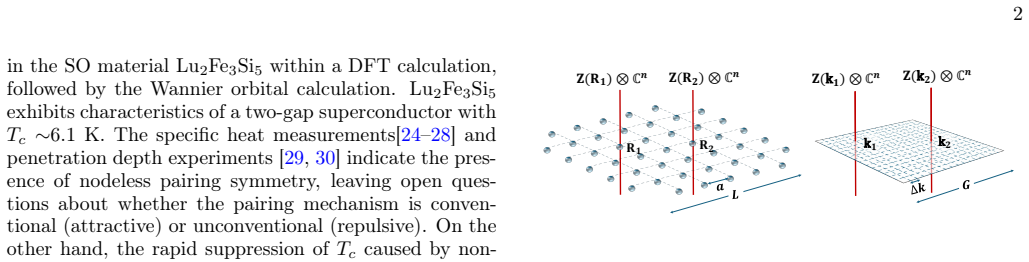
The load-bearing construction is the phase-space basis $\Psi(k,r) = Z(k)\otimes W(r)\otimes X$, in which the Bloch phase vector $Z(k)$ (plane waves on the lattice) carries the momentum dependence, and the Wannier orbitals $W(r)$ and spinors $X$ are simple product factors that can be taken as delta functions. The argument runs entirely on the irreducible-representation decomposition of $Z(k)$ into basis functions $z_\nu(k)$ of the point group: the BdG Hamiltonian is block-diagonal in these irreps, with each block $H_\nu = \begin{pmatrix} t_\nu & \Delta_\nu \\ \Delta_\nu^* & -t_\nu \end{pmatrix}$, and the gap equation reduces to an eigenvalue equation $\int \Gamma_{\bar{\nu}}^{\bar{\nu}}(k_{1,2}) z_{\bar{\nu}}(k_2) = -\lambda z_{\bar{\nu}}(k_1)$ in the pairing channel $\bar{\nu}$. That structure delivers the paper's central observation: the pairing irrep $\bar{\nu}$ 'fractionalizes' into a pair of Bogoliubov orbitals within the unit cell, while all other irreps remain unchanged.
What would settle it
Find a superconductor whose leading pairing symmetry, computed with the paper's phase-space gap equation, does not match the symmetry of the compact Wannier orbital of the Fermi-level bands — for example, a clean d-wave superconductor whose Fermi-level Wannier functions are all s-wave — and the central claim is disproved.
Extended reading notes
Core claim
On its own terms, the paper establishes that a phase-space product-state basis $\Psi(k,r) = Z(k) \otimes W(r) \otimes X$ — where $Z(k)$ is the Bloch phase vector, $W(r)$ the Wannier orbital spinor, and $X$ the spin spinor — provides an obstruction-free starting point for low-energy lattice models: Wannier obstructions, topology, correlations, and entanglement are encoded in the Hamiltonian tensors rather than in the basis states. Within this basis, the Bogoliubov–de Gennes Hamiltonian separates into irreducible representations $z_\nu(k)$ of the point group, and the self-consistent gap equation becomes an eigenvalue problem in each irrep channel. The central physical result is that only the Wannier orbital whose irrep matches the pairing order parameter fractionalizes, splitting into two Bogoliubov orbitals per unit cell, while every other orbital remains a single intact orbital; consequently, the pairing symmetry of a superconductor is dictated by the compact Wannier orbital irrep at the Fermi level. The paper's validation on the square-octagon flat-band model yields analytical pairing solutions whose symmetry changes with the Fermi-surface nesting wavevector, and its DFT-based application to Lu2Fe3Si5 predicts coexisting nodeless $s^{\pm}$ and nodal $s_{z^2}$ pairing gaps.
Load-bearing premise
The load-bearing premise is that the product state $Z(k) \otimes W(r) \otimes X$, with Wannier orbitals treated as point-like delta functions, is a complete enough basis for the low-energy Hilbert space that all topology, correlation, and entanglement can be pushed into the Hamiltonian; the paper itself concedes that gauge obstructions for the Bogoliubov orbitals remain unresolved.
Editorial extensions
If this is right
- Pairing symmetry in a superconductor can be read off the compact Wannier orbital irrep of the Fermi-level bands, so a symmetry analysis of the band structure constrains the pairing channel before solving any gap equation.
- The BdG Hamiltonian becomes local in phase space — defined at each momentum and on each real-space bond — so Bogoliubov quasiparticles have well-defined local (Wannier-like) orbitals, at least in the normal-state basis.
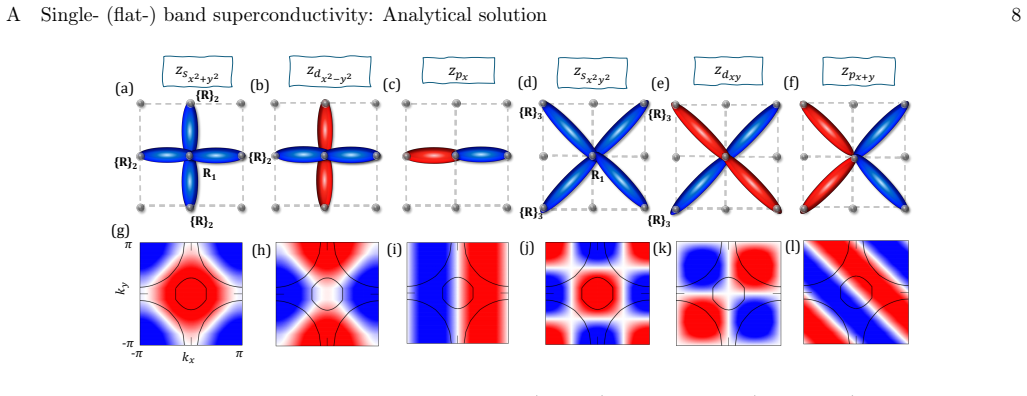
- In the flat-band square-octagon model, the leading pairing channel is determined by the Fermi-surface nesting wavevector: $d_{x^2-y^2}$ for hole doping, $p_{x/y}$ for electron doping, with $s_{x^2y^2}$ and $d_{xy}$ channels near half-filling.
- For Lu2Fe3Si5, the framework predicts coexisting nodeless $s^{\pm}$ pairing between two bands and nodal $s_{z^2}$ pairing on a third band, a state whose multiple magnetic resonance peaks should be observable by inelastic neutron scattering.
- Because the formalism is general, the same phase-space construction applies to density-wave order, spin liquids, and fractional quantum Hall states by assigning statistics and braiding phases to the Bloch vector space.
Reading between the lines
- If the irrep-dictates-pairing rule is generic, it offers a diagnostic: compare a material's leading RPA pairing eigenvalue with the point-group irrep of its compact Wannier orbitals; any mismatch would send the calculation back to the basis construction rather than to the interaction vertex.
- The paper leaves the gauge obstruction for Bogoliubov orbitals unresolved (Section IIF), so the 'obstruction-free' claim should be read as applying to the normal-state Wannier basis; topological or strongly entangled quasiparticle states may still require Wilson-line or gauge-field corrections.
- A testable extension is to apply the phase-space gap equation to a known d-wave superconductor such as a cuprate to see whether the leading pairing channel still matches the compact Wannier orbital irrep, or whether the cuprate's orbital content forces a different channel.
Editorial analysis
A structured set of objections, weighed in public.
Referee Report
Summary. The paper introduces a phase-space formalism in which single-particle states are written as product states Z(k) ⊗ W(r) ⊗ X, with the Bloch phase vector Z(k), Wannier orbital spinor W(r), and spinor X. The authors claim that this construction bypasses the usual Wannier obstructions of topological and correlated systems, because all topology and correlations are moved into the Hamiltonian. They apply the formalism to derive a phase-space BdG equation, to solve analytically a flat-band pairing problem on a square-octagon lattice, and to compute spin-fluctuation-mediated pairing in Lu2Fe3Si5 using DFT and RPA. The main reported results are that pairing symmetry is dictated by the Wannier orbital irrep, that a flat-band model yields dx2-y2, px/y, sx2y2, dxy, and px±y pairings depending on the hopping parameter regime, and that Lu2Fe3Si5 exhibits coexisting nodeless s± and nodal sz2 pairing symmetries.
Significance. If correct, the proposed phase-space framework would constitute a general method for constructing low-energy lattice models without Wannier obstructions, with broad implications for topological and correlated systems. The paper contains a substantial amount of formalism: the phase-space representation of one- and two-body operators, a derivation of the RPA interaction vertex, a parity-structured gap equation, and a DFT-based analysis of a real material. The DFT/RPA part for Lu2Fe3Si5 is a conventional calculation and may be of interest to the superconductivity community. However, the central claim of an obstruction-free construction is not supported: the paper does not demonstrate that the product-state basis can represent topologically obstructed bands with exponentially localized orbitals, and its own Sec. IIF concedes that gauge obstructions in Bogoliubov Wannier orbitals remain unresolved. The analytical flat-band results are preselected by the choice of hopping parameters rather than predicted by the framework. As a result, the significance of the new formalism is currently not established.
major comments (4)
- [Sec. IIA, Eq. (3) and Sec. IIF] The central claim that the product-state basis Ψ(k,r)=Z(k)⊗W(r)⊗X bypasses Wannier obstructions is not established. A Wannier obstruction is a property of the low-energy eigenstate subspace, not of the basis used to expand the Hamiltonian; re-expressing an H(k) in a complete site basis does not remove the obstruction. The paper's own Sec. IIF states that 'there may arise obstructions in gauge fixing in the Wannier orbitals of Bogoliubov ... we do not pursue this endeavor,' which directly contradicts the abstract's 'obstruction-free lattice model'.
- [Sec. IIIA, Table I and Eq. (23)] The analytical pairing symmetries in cases (i)-(vi) are preselected by the hand-chosen hopping patterns. Each case sets all tν except one to zero, so the corresponding zν is the only possible pairing form factor; Eq. (23) then merely evaluates Γ on that preselected zν. Thus the reported conclusion that 'local Wannier orbital symmetry primarily determines the pairing symmetry' is a kinematic consequence of the parameter choice rather than a predictive outcome of the framework.
- [Sec. IIIA, Fig. 5 and Sec. III C] The flat-band model from Ref. [57] is described as having a topological flat band, yet the effective model is said to have a single Wannier orbital per unit cell with purely real short-range hoppings on a dual square lattice. A single-band tight-binding Hamiltonian with real short-range hoppings has zero Chern number, so if the flat band carries a nonzero Chern number, it cannot be represented by exponentially localized Wannier orbitals of the assumed form. The paper does not provide a construction that captures the Chern number, and therefore this example does not demonstrate a bypass of the Wannier obstruction; it instead illustrates the obstruction that the formalism is supposed to circumvent.
- [Sec. IIIA and Sec. IV] The claim that 'only the Wannier orbital sharing the same symmetry as the pairing order parameter undergoes fractionalization, splitting into two Bogoliubov orbitals per unit cell' appears to be a restatement of the fact that the BdG Hamiltonian is block-diagonal in the irreps basis when the pairing field is written in a single irrep. The paper does not provide a non-trivial physical mechanism or a test that distinguishes this statement from a conventional irrep decomposition, so it does not support the advertised insight that local symmetry dictates the pairing.
minor comments (5)
- [Sec. IIIA] The sentence 'Achieving t′_i ≠ 0 while t_i = 0 in challenging unless unless the system is in the flat-band limit' contains a typo ('in' should be 'is') and a duplicated 'unless'.
- [Sec. IIIA, Eq. (20)] The notation tν=¯ν is confusing: the overline is introduced for the pairing irrep but used also as a subscript for the hopping irrep; this should be clarified.
- [Table I] The definition of tR and t′_R is not fully specified: it is unclear whether these are real-space hopping amplitudes or irrep coefficients, and the relation to the tν in Eq. (22) should be stated explicitly.
- [Sec. IIID] The RPA calculation for Lu2Fe3Si5 does not list the values of U, U′, J, J′ or the k-mesh used for the pairing eigenvalue equation; without these parameters the numerical results are not reproducible.
- [Sec. IIA] The notation ΨRns(k,r) is introduced in Eq. (2) but the subscript R is subsequently dropped without comment; this makes it difficult to track the dependence on the unit-cell index throughout the formalism.
Circularity Check
Analytical pairing table is preselected: hoppings are zeroed to a single irrep, and Eq. (23) returns that same irrep as the pairing symmetry; the broader obstruction-free claim is deferred, not derived.
-
self definitional
[Sec. IIIA, Eq. (23), Table I, cases (i)-(vi)]
"We focus on specific points in the tight-binding parameter space where tν=¯ν ̸= ϵ and tν̸=¯ν = 0 ... only one irrep zν contributes, simplifying the analytical solution of the SC gap equation in Eq. (19). In the irreps space, the gap equation takes a reduced form: ∫_k2 Γ¯ν¯ν(k1,2)z¯ν(k2) = −λz¯ν(k1). Δ¯ν drops out from both sides. ... (ii) Next, consider t1 = −t2 = t3 = −t4 = ϵ, which gives the only non-zero irrep is tdx2−y2 = ϵ ... This gives a Δdx2−y2 spin singlet pairing."
At these special points the Hamiltonian contains exactly one hopping irrep z_{\bar{\nu}}; because Eq. (23) has z_{\bar{\nu}} as its only possible eigenvector (Δ_{\bar{\nu}} cancels), the reported pairing symmetry is the same irrep that was put in by zeroing all other t_ν. Table I and cases (ii)-(vi) list, e.g., t_{dx2-y2}=ε ⇒ Δ_{dx2-y2} and t'_{dxy}=ε ⇒ Δ_{dxy}. The calculation only tests whether the preselected z_{\bar{\nu}} changes sign across the nesting vector; it never compares competing irreps. The 'prediction' is thus the input irrep renamed as an output, not a derivation of pairing symmetry from the phase-space framework.
full rationale
The paper contains one genuine reduction-by-construction: in Sec. IIIA the analytical 'prediction' of pairing symmetry is obtained by first setting all hopping irreps except one to zero; Eq. (23) then has that same irrep as its only eigenvector, so cases (i)-(vi) output the preselected irrep. This is the main circular step and supports the score of 6. The DFT/RPA calculation for Lu2Fe3Si5 is more substantive: it diagonalizes Γ over several symmetry-allowed channels, so identifying s± and sz2 there is not forced by a single input irrep. However, the broader 'obstruction-free lattice model' claim is not established by the derivation: the paper concedes in Sec. IIF that 'there may arise obstructions in gauge fixing in the Wannier orbitals of Bogoliubov ... we do not pursue this endeavor', and the trivial-product-basis construction moves the obstruction into the Hamiltonian rather than removing it. Those are limitations and correctness risks rather than additional circular steps.
Assumptions & free parameters
free parameters (4)
- Nearest-neighbor and next-nearest-neighbor hoppings ti, t'i =
chosen by hand (e.g., t1=-t2=t3=-t4=ϵ, t'i=0)
- Hubbard U, U', J, J' for Lu2Fe3Si5 RPA =
not reported
- Chemical potential μ for the flat-band model =
0.045, 0.04, 0.03 (Fig. 5)
- U_eff for Fe 3d in DFT+U =
4.0 eV
assumptions (5)
- domain assumption The product state Z(k) ⊗ W(r) ⊗ X with W(r) taken as delta-function orbitals forms a complete basis for the low-energy Hilbert space.
- ad hoc to paper The vector bundle Z(k) over the BZ can be treated as trivial, with all topology moved into the Hamiltonian.
- domain assumption RPA provides a valid effective pairing interaction for intermediate-to-weak coupling.
- domain assumption Spin fluctuations are the dominant pairing glue, with no competing phonon or charge channel needed.
- domain assumption The Bloch phase basis can be truncated to a finite number of nearest-neighbor shells for the pairing calculation.
Cite this review
Pith. "Pith review of Phase-Space Approach to Wannier Pairing and Bogoliubov Orbitals in Square-Octagon Lattices." pith.science (2026). https://pith.science/paper/VKKRXAP4
@misc{pith2026241220054,
  author       = {Pith},
  title        = {Pith review of: Phase-Space Approach to Wannier Pairing and Bogoliubov Orbitals in Square-Octagon Lattices},
  year         = {2026},
  howpublished = {\url{https://pith.science/paper/VKKRXAP4}},
  note         = {Machine review of arXiv:2412.20054}
}
abstract
Low-energy lattice models are the cornerstone for studying many-body physics and interactions between the system and measurement fields. A key challenge is identifying appropriate quasiparticle states that canonically transform between momentum and real space while retaining the correlation, entanglement, and geometric properties - generally called the Wannier obstruction. Here, we introduce a phase-space approach to bypass these obstructions. Instead of treating the phase space as a manifold, we embed a real space through a Bloch vector space at each momentum. Orbital and spin states are introduced through product states with the Bloch vector, while quantum statistics, correlations, topology, and entanglements are inherited from the Hamiltonian. We apply this framework to explore the unconventional pairing symmetry and the Bogoliubov-de Gennes (BdG) equation in phase space. Our findings demonstrate that while superconductivity exhibits global coherence, the local Wannier orbital symmetry primarily determines the pairing symmetry. We analytically solve the spin-fluctuation-mediated pairing symmetry on the phase space by engineering a flat band with artificial gauge fields. We validate the model on the square-octagon superconductor Lu$_2$Fe$_3$Si$_5$ using density functional theory (DFT), revealing the coexistence of nodeless $s^{\pm}$ and nodal $s_{z^2}$ pairing symmetries. This phase-space framework provides a robust, obstruction-free lattice model for complex many-body systems and their exotic excitations.
Figures


Figures from the paper (8 more)


Reference graph
Works this paper leans on
-
[57]
Oddershede, Polarization propagator calculations (Academic Press, 1978) pp
J. Oddershede, Polarization propagator calculations (Academic Press, 1978) pp. 275–352
work page 1978
-
[1]
Multi-band non-interaction Hamiltonian We consider a case of three spinless orbitals in a square lattice, and compare the Hamiltonian formal- ism of the traditional Wannier orbital model versus our phase space orbital model in Fig. 8. We con- sider a dx2−y2 orbital is at the site center r1 = (0 , 0) and px,y orbitals sitting at the Wyckoff positionr2,3 = ...
-
[2]
For a single orbital case, we can expand Eqs
Single band mean-field Hamiltonians Next, we consider the examples of single band mean- field Hamiltonian in the density wave and superconduct- ing states and represent them in the Bloch basis. For a single orbital case, we can expand Eqs. (B6), (22) as follows in the Bloch phases as H Ω(k) = t¯ν Ω¯νz¯ν(Q) Ω† ¯νz† ¯ν(Q) t¯νz¯ν(Q) z¯ν(k) + X ν̸=¯ν tν 0 0 t...
-
[3]
A multigap BdG equation In the main text, the DFT-derived numerical simula- tion predicted a coexistence ofs± pairing symmetries in bands 1 and 2 andsz2 − symmetry in band 3. As-wave pairing corresponds to onsite pairing, belonging to thez0 irreps, while the sz2 symmetry arises from the nearest- neighbor-pairing along the z−direction, which belongs to the...
-
[4]
A. A. Soluyanov and D. Vanderbilt, Wannier representa- tion of z2 topological insulators, Phys. Rev. B83, 035108 (2011)
2011
-
[5]
Y.-L. Wu, N. Regnault, and B. A. Bernevig, Gauge-fixed wannier wave functions for fractional topological insula- tors, Phys. Rev. B86, 085129 (2012)
2012
-
[6]
Marzari, A
N. Marzari, A. A. Mostofi, J. R. Yates, I. Souza, and D. Vanderbilt, Maximally localized wannier functions: Theory and applications, Rev. Mod. Phys. 84, 1419 (2012)
2012
-
[7]
Marzari and D
N. Marzari and D. Vanderbilt, Maximally localized gen- eralized wannier functions for composite energy bands, 21 FIG. 11. (a-d) Wannier functions calculated using random projections via the selected columns of the density matrix (SCDM) method [95, 96]. (e-h) The Fermi surface reproduced from the Wannier functions. Phys. Rev. B56, 12847 (1997)
1997
Show all 101 references
-
[8]
I.Souza, N.Marzari,andD.Vanderbilt,Maximallylocal- ized wannier functions for entangled energy bands, Phys. Rev. B65, 035109 (2001)
2001
-
[9]
H. C. Po, H. Watanabe, and A. Vishwanath, Fragile topologyand wannierobstructions,Phys.Rev.Lett. 121, 126402 (2018)
2018
-
[10]
V. I. Anisimov, D. E. Kondakov, A. V. Kozhevnikov, I. A. Nekrasov, Z. V. Pchelkina, J. W. Allen, S.-K. Mo, H.-D. Kim, P. Metcalf, S. Suga, A. Sekiyama, G. Keller, I. Leonov, X. Ren, and D. Vollhardt, Full orbital calcu- lation scheme for materials with strongly correlated elec...
2005
-
[11]
G. W. Winkler, A. A. Soluyanov, and M. Troyer, Smooth gauge and wannier functions for topological band struc- tures in arbitrary dimensions, Phys. Rev. B93, 035453 (2016)
2016
-
[12]
Gresch, G
D. Gresch, G. Autès, O. V. Yazyev, M. Troyer, D. Van- derbilt, B. A. Bernevig, and A. A. Soluyanov, Z2pack: Numerical implementation of hybrid wannier centers for identifying topological materials, Phys. Rev. B95, 075146 (2017)
2017
-
[13]
H. D. Cornean and D. Monaco, On the construction of wannier functions in topological insulators: the 3d case, Annales Henri Poincaré18, 3863 (2017)
2017
-
[14]
Vollhardt, Dynamical mean-field theory of strongly correlated electron systems (2020)
D. Vollhardt, Dynamical mean-field theory of strongly correlated electron systems (2020)
2020
-
[15]
Boyack, L
R. Boyack, L. Delacrétaz, É. Dupuis, and W. Witczak- Krempa, Conformal field theories in a magnetic field, Phys. Rev. Res.6, 043093 (2024)
2024
-
[16]
Lechermann, A
F. Lechermann, A. Georges, A. Poteryaev, S. Bier- mann, M. Posternak, A. Yamasaki, and O. K. Ander- sen, Dynamical mean-field theory using wannier func- tions: A flexible route to electronic structure calculations of strongly correlated materials, Phys. Rev. B74, 125120 (2006)
2006
-
[17]
T. Das, R. S. Markiewicz, and A. Bansil, Intermedi- ate coupling model of the cuprates, Adv. Phys.63, 151 (2014)
2014
-
[18]
Freimuth, S
F. Freimuth, S. Blügel, and Y. Mokrousov, Construction of wannier functions from the spectral moments of cor- related electron systems (2023), arXiv:2301.04734 [cond- mat.str-el]
2023 arXiv
-
[19]
Qi, Generic Wave-Function Description of Frac- tional Quantum Anomalous Hall States and Fractional Topological Insulators, Phys
X.-L. Qi, Generic Wave-Function Description of Frac- tional Quantum Anomalous Hall States and Fractional Topological Insulators, Phys. Rev. Lett. 107, 126803 (2011), 1105.4298
2011 arXiv
-
[20]
Nakagawa, R.-J
M. Nakagawa, R.-J. Slager, S. Higashikawa, and T. Oka, Wannier representation of Floquet topological states, Phys. Rev. B101, 075108 (2020), 1903.12197
2020 arXiv
-
[21]
Read, Compactly supported Wannier functions and algebraic K-theory, Phys
N. Read, Compactly supported Wannier functions and algebraic K-theory, Phys. Rev. B 95, 115309 (2017), 1608.04696
2017 arXiv
-
[22]
Schindler, B
F. Schindler, B. Bradlyn, M. H. Fischer, and T. Neu- pert, Pairing Obstructions in Topological Superconduc- tors, Phys. Rev. Lett.124, 247001 (2020), 2001.02682
2020 arXiv
-
[23]
T. B. Wahl, H.-H. Tu, N. Schuch, and J. I. Cirac, Pro- jected Entangled-Pair States Can Describe Chiral Topo- logical States, Phys. Rev. Lett. 111, 236805 (2013), 1308.0316
2013 arXiv
-
[24]
Nakajima, H
Y. Nakajima, H. Hidaka, T. Nakagawa, T. Tamegai, T. Nishizaki, T. Sasaki, and N. Kobayashi, Two-band superconductivity featuring different anisotropies in the ternary iron silicide Lu2Fe3Si5, Phys. Rev. B85, 174524 (2012)
2012
-
[25]
Machida, S
Y. Machida, S. Sakai, K. Izawa, H. Okuyama, and T. Watanabe, Enhanced Quasiparticle Heat Conduction in the Multigap Superconductor Lu2Fe3Si5, Phys. Rev. Lett. 106, 107002 (2011)
2011
-
[26]
Gupta and B
V. Gupta and B. Bradlyn, Wannier-function methods for topological modes in one-dimensional photonic crystals, Phys. Rev. A105, 053521 (2022)
2022
-
[27]
Q. Li, J. Dong, P. J. Ledwith, and E. Khalaf, Con- straints on real space representations of chern bands (2024), arXiv:2407.02561 [cond-mat.str-el]
2024 arXiv
-
[28]
H.Wang, R.Shi, Z.Liu,andJ.Wang,Orbitaldescription of landau levels (2024), arXiv:2411.13071 [cond-mat.mes- hall]
2024
-
[29]
P. K. Biswas, G. Balakrishnan, D. M. Paul, M. R. Lees, and A. D. Hillier, Two-gap superconductivity in Lu2Fe3Si5: A transverse-field muon spin rotation study, Phys. Rev. B83, 054517 (2011)
2011
-
[30]
R. T. Gordon, M. D. Vannette, C. Martin, Y. Nakajima, T. Tamegai, and R. Prozorov, Two-gap superconductiv- ity seen in penetration-depth measurements of Lu2 Fe3 Si5 single crystals, Phys. Rev. B78, 024514 (2008)
2008
-
[31]
Tamegai, Y
T. Tamegai, Y. Nakajima, T. Nakagawa, G. J. Li, and H. Harima, Two-gap superconductivity in R 2 Fe 3 Si 5 ( R = Lu and Sc), J. Phys. Conf. Ser.150, 052264 (2009)
2009
-
[32]
Nakajima, T
Y. Nakajima, T. Nakagawa, T. Tamegai, and H. Harima, Specific-heat evidence for two-gap superconductivity in the ternary-iron silicide Lu2Fe3Si5, Phys. Rev. Lett.100, 157001 (2008)
2008
-
[33]
C. B. Vining, R. N. Shelton, H. F. Braun, and M. Peliz- zone, Low-temperature heat capacity of superconducting ternary iron silicides, Phys. Rev. B27, 2800 (1983)
1983
-
[34]
Sasame, T
H. Sasame, T. Masubuchi, K. Takase, Y. Takano, and T. Watanabe, Superconducting properties of Lu 2 Fe 3 Si 5 with non-magnetic impurities, J. Phys. Conf. Ser. 150, 052226 (2009)
2009
-
[35]
A. E. Karkin, M. R. Yangirov, Y. N. Akshentsev, and B. N. Goshchitskii, Superconductivity in iron silicide Lu2Fe3Si 5 probed by radiation-induced disordering, Phys. Rev. B84, 054541 (2011)
2011
-
[36]
Hidaka, Y
H. Hidaka, Y. Nakajima, and T. Tamegai, Impurity ef- fects in two-gap superconductor Lu2Fe3Si5, Phys. C Su- percond. its Appl.470, S619 (2010)
2010
-
[37]
Watanabe, H
T. Watanabe, H. Sasame, H. Okuyama, K. Takase, and Y. Takano, Disorder-sensitive superconductivity in the doped iron silicide superconductor (Lu1-x Rx) 2 Fe3 Si5 22 (R=Sc, Y, and Dy), Phys. Rev. B80, 100502 (2009)
2009
-
[38]
Hidaka, Y
H. Hidaka, Y. Nakajima, and T. Tamegai, Non-magnetic impurity effect in two-gap superconductor Lu2Fe3Si5, Phys. C Supercond.469, 999 (2009)
2009
-
[39]
Ramires, Nonunitary superconductivity in complex quantum materials, J
A. Ramires, Nonunitary superconductivity in complex quantum materials, J. Phys. Condens. Matter34, 304001 (2022), 2202.12178
2022 arXiv
-
[40]
K. B. Yogendra, G. Baskaran, and T. Das, Fractional wannier orbitals and tight-binding gauge fields in kitaev honeycomb superlattices with flat majorana bands, Phys. Rev. X , (Accepted) (2025)
2025
-
[41]
H. F. Braun, Superconductivity of rare earth-iron sili- cides, Phys. Lett. A75, 386 (1980)
1980
-
[42]
Sakuma, Symmetry-adapted Wannier functions in the maximal localization procedure, Phys
R. Sakuma, Symmetry-adapted Wannier functions in the maximal localization procedure, Phys. Rev. B87, 235109 (2013), 1306.0032
2013 arXiv
-
[43]
Kang and O
J. Kang and O. Vafek, Symmetry, Maximally Localized Wannier States, and a Low-Energy Model for Twisted Bilayer Graphene Narrow Bands, Phys. Rev. X8, 031088 (2018), 1805.04918
2018 arXiv
-
[44]
Kohn and J
W. Kohn and J. M. Luttinger, New mechanism for su- perconductivity, Phys. Rev. Lett.15, 524 (1965)
1965
-
[45]
A. V. Chubukov, Kohn-luttinger effect and the instability of a two-dimensional repulsive fermi liquid at t=0, Phys. Rev. B48, 1097 (1993)
1993
-
[46]
Kanamori, Electron Correlation and Ferromagnetism of Transition Metals, Prog
J. Kanamori, Electron Correlation and Ferromagnetism of Transition Metals, Prog. Theor. Phys.30, 275 (1963)
1963
-
[47]
Georges, L
A. Georges, L. de’ Medici, and J. Mravlje, Strong Cor- relations from Hund’s Coupling, Annu. Rev. Condens. Matter Phys.4, 137 (2013)
2013
-
[48]
Das and K
T. Das and K. Dolui, Superconducting dome in MoS2 and TiSe2 generated by quasiparticle-phonon coupling, Phys. Rev. B91, 094510 (2015), 1411.3096
2015 arXiv
-
[49]
Pines, Emergent behavior in strongly correlated elec- tron systems, Reports Prog
D. Pines, Emergent behavior in strongly correlated elec- tron systems, Reports Prog. Phys. 79, 092501 (2016), 1601.05891
2016 arXiv
-
[50]
Gell-Mann and K
M. Gell-Mann and K. A. Brueckner, Correlation Energy of an Electron Gas at High Density, Phys. Rev.106, 364 (1957)
1957
-
[51]
D. J. Scalapino, A common thread: The pairing inter- action for unconventional superconductors, Rev. Mod. Phys. 84, 1383 (2012)
2012
-
[52]
Pines and D
D. Pines and D. Bohm, A Collective Description of Elec- tron Interactions: II. Collective vs Individual Particle Aspects of the Interactions, Phys. Rev.85, 338 (1952)
1952
-
[53]
Bohm and D
D. Bohm and D. Pines, A collective description of elec- tron interactions: III. Coulomb interactions in a degen- erate electron gas, Phys. Rev.92, 609 (1953)
1953
-
[54]
For the Cooper (Bell) pair case, such excitations are called the Bogoliubov/Majorana (spinon) states. In what follows, we express the Bogoliubov orbitals as su- perpositions of single-particle spinors for particles and hole states, Φ(k, r) = [Ψ( k, r) ⊕ Ψ∗(−k, r)] = [ Z(k) ⊗ W...
2021
-
[55]
Das, J.-X
T. Das, J.-X. Zhu, and M. J. Graf, Local suppression of the superfluid density of PuCoGa5 by strong onsite disorder, Phys. Rev. B84, 134510 (2011)
2011
-
[56]
A. D. McLACHLAN and M. A. BALL, Time-Dependent Hartree—Fock Theory for Molecules, Rev. Mod. Phys. 36, 844 (1964)
1964
-
[58]
Szabo and N
A. Szabo and N. S. Ostlund, The correlation energy in the random phase approximation: Intermolecular forces between closed-shell systems, J. Chem. Phys.67, 4351 (1977)
1977
-
[59]
Adhikary and T
P. Adhikary and T. Das, Prediction of f-wave pairing symmetry in YBa2Cu3 O6+x cuprates, Phys. Rev. B 101, 214517 (2020), 2002.07382
2020 arXiv
-
[60]
D. J. Thouless, M. Kohmoto, M. P. Nightingale, and M. den Nijs, Quantized Hall Conductance in a Two- Dimensional Periodic Potential, Phys. Rev. Lett.49, 405 (1982)
1982
-
[61]
D.Sticlet, C.Bena,andP.Simon,SpinandMajoranaPo- larization in Topological Superconducting Wires, Phys. Rev. Lett.108, 096802 (2012), 1109.5697
2012 arXiv
-
[62]
Pal, Nontrivial topological flat bands in a diamond- octagon lattice geometry, Phys
B. Pal, Nontrivial topological flat bands in a diamond- octagon lattice geometry, Phys. Rev. B 98, 245116 (2018)
2018
-
[63]
S. M. Nie, Z. Song, H. Weng, and Z. Fang, Quantum spin Hall effect in two-dimensional transition-metal dichalco- genide haeckelites, Phys. Rev. B91, 235434 (2015)
2015
-
[64]
Bao, H.-S
A. Bao, H.-S. Tao, H.-D. Liu, X. Zhang, and W.-M. Liu, Quantum magnetic phase transition in square-octagon lattice, Sci. Rep.4, 6918 (2015)
2015
-
[65]
I. I. Mazin, D. J. Singh, M. D. Johannes, and M. H. Du, Unconventional Superconductivity with a Sign Reversal in the Order Parameter of LaFeAsO1-xFx, Phys. Rev. Lett. 101, 057003 (2008)
2008
-
[66]
Zhu and C
J.-X. Zhu and C. S. Ting, Quasiparticle states at ad- wave vortex core in high-Tc superconductors: Induction of local spin density wave order, Phys. Rev. Lett.87, 147002 (2001)
2001
-
[67]
Q. Han, Z. D. Wang, L.-y. Zhang, and X.-G. Li, Elec- tronic structure of the vortex lattice of d−, d + is−, and dx2−y2 +idxy-wave superconductors, Phys. Rev. B 65, 064527 (2002)
2002
-
[68]
D. L. Bergman, C. Wu, and L. Balents, Band touching from real-space topology in frustrated hopping models, Phys. Rev. B78, 125104 (2008), 0803.3628
2008 arXiv
-
[69]
Chubukov, Pairing mechanism in fe-based supercon- ductors, Annu
A. Chubukov, Pairing mechanism in fe-based supercon- ductors, Annu. Rev. Condens. Matter Phys.3, 57 (2012)
2012
-
[70]
Tinkham, Introduction to Superconductivity , Dover Books on Physics Series (Dover Publications, 2004)
M. Tinkham, Introduction to Superconductivity , Dover Books on Physics Series (Dover Publications, 2004)
2004
-
[71]
Das and A
T. Das and A. V. Balatsky, Testing the sign-changing superconducting gap in iron-based superconductors with quasiparticle interference and neutron scattering, J. Con- dens. Matter Phys.24, 182201 (2012)
2012
-
[72]
Das, J.-X
T. Das, J.-X. Zhu, and M. J. Graf, Theory of nodal s±- wave pairing symmetry in the pu-based 115 superconduc- tor family, Sci. Rep.5, 8632 (2015)
2015
-
[73]
A. M. Black-Schaffer and C. Honerkamp, Chiral d-wave superconductivity in doped graphene, Journal of Physics: Condensed Matter26, 423201 (2014)
2014
-
[74]
S. Ray, J. Jung, and T. Das, Wannier pairs in super- conducting twisted bilayer graphene and related systems, Phys. Rev. B99, 134515 (2019), 1804.09674
2019 arXiv
-
[75]
Saha-Dasgupta, Orbital-selective superconductivity in a two-band model of infinite-layer nickelates, Phys
P.Adhikary, S.Bandyopadhyay, T.Das, I.Dasgupta,and T. Saha-Dasgupta, Orbital-selective superconductivity in a two-band model of infinite-layer nickelates, Phys. Rev. B 102, 1 (2020)
2020
-
[76]
Sigrist and K
M. Sigrist and K. Ueda, Phenomenological theory of un- conventional superconductivity, Rev. Mod. Phys.63, 239 (1991)
1991
-
[77]
Mandal, A
M. Mandal, A. Kataria, C. Patra, D. Singh, P. K. Biswas, A. D. Hillier, T. Das, and R. P. Singh, Time-reversal symmetry breaking in frustrated superconductor Re2Hf, Phys. Rev. B105, 094513 (2022)
2022
-
[78]
P. Neha, P. K. Biswas, T. Das, and S. Patnaik, Time- reversal symmetry breaking in topological superconduc- 23 tor sr0.1bi2se3, Phys. Rev. Mater.3, 074201 (2019)
2019
-
[79]
Pizzi, V
G. Pizzi, V. Vitale, R. Arita, S. Blügel, F. Freimuth, G. Géranton, M. Gibertini, D. Gresch, C. Johnson, T. Koretsune, J. Ibañez-Azpiroz, H. Lee, J.-M. Lihm, D. Marchand, A. Marrazzo, Y. Mokrousov, J. I. Mustafa, Y. Nohara, Y. Nomura, L. Paulatto, S. Poncé, T. Pon- weiser, J. ...
2020
-
[80]
Das, Pairing symmetries of several iron-based super- conductor families and some similarities with cuprates and heavy-fermions, EPJ Web Conf.23, 00014 (2012)
T. Das, Pairing symmetries of several iron-based super- conductor families and some similarities with cuprates and heavy-fermions, EPJ Web Conf.23, 00014 (2012)
2012
-
[81]
Das and A
T. Das and A. V. Balatsky, Two energy scales in the magnetic resonance spectrum of electron and hole doped pnictide superconductors, Phys. Rev. Lett.106, 10.1103/PhysRevLett.106.157004 (2011)
2011 doi
-
[82]
Zhou, W.-Q
Y. Zhou, W.-Q. Chen, and F.-C. Zhang, Symmetry of superconducting states with two orbitals on a tetragonal lattice: Application to LaFeAsO1-xFx, Phys. Rev. B78, 064514 (2008), 0806.0712
2008 arXiv
-
[83]
J. W. Venderbos, L. Savary, J. Ruhman, P. A. Lee, and L. Fu, Pairing States of Spin- 3/2 Fermions: Symmetry- Enforced Topological Gap Functions, Phys. Rev. X8, 011029 (2018), 1709.04487
2018 arXiv
-
[84]
P. M. R. Brydon, L. Wang, M. Weinert, and D. F. Agterberg, Pairing of j=3 /2 Fermions in Half-Heusler Superconductors, Phys. Rev. Lett.116, 177001 (2016), 1603.03376
2016 arXiv
-
[85]
Kresse and J
G. Kresse and J. Furthmüller, Efficiency of ab-initio total energy calculations for metals and semiconductors using a plane-wave basis set, Comput. Mater. Sci.6, 15 (1996)
1996
-
[86]
Linder and A
J. Linder and A. V. Balatsky, Odd-frequency su- perconductivity, Rev. Mod. Phys. 91, 045005 (2019), 1709.03986
2019 arXiv
-
[87]
H. G. Suh, Y. Yu, T. Shishidou, M. Weinert, P. M. R. Brydon, and D. F. Agterberg, Superconductivity of anomalous pseudospin in nonsymmorphic materials, Phys. Rev. Res.5, 033204 (2023)
2023
-
[88]
Basak, T
S. Basak, T. Das, H. Lin, M. Z. Hasan, R. S. Markiewicz, and A. Bansil, Coexisting pseudogap, charge-transfer- gap, and mott-gap energy scales in the resonant inelastic x-ray scattering spectra of electron-doped cuprate super- conductors, Phys. Rev. B85, 075104 (2012)
2012
-
[89]
Kresse and J
G. Kresse and J. Furthmüller, Efficient iterative schemes for ab initio total-energy calculations using a plane-wave basis set, Phys. Rev. B54, 11169 (1996)
1996
-
[90]
S. L. Dudarev, G. A. Botton, S. Y. Savrasov, C. J. Humphreys, and A. P. Sutton, Electron-energy-loss spec- traandthestructuralstabilityofnickeloxide: Anlsda+u study, Phys. Rev. B57, 1505 (1998)
1998
-
[91]
J. P. Perdew, K. Burke, and M. Ernzerhof, Generalized gradient approximation made simple, Phys. Rev. Lett. 77, 3865 (1996)
1996
-
[92]
P. E. Blöchl, Projector augmented-wave method, Phys. Rev. B50, 17953 (1994)
1994
-
[93]
Kresse and D
G. Kresse and D. Joubert, From ultrasoft pseudopoten- tials to the projector augmented-wave method, Phys. Rev. B59, 1758 (1999)
1999
-
[94]
H. J. Monkhorst and J. D. Pack, Special points for brillouin-zoneintegrations,Phys.Rev.B 13,5188(1976)
1976
-
[95]
Damle, L
A. Damle, L. Lin, and L. Ying, Compressed represen- tation of kohn–sham orbitals via selected columns of the density matrix, J. Chem. Theory Comput.11, 1463 (2015)
2015
-
[96]
Y. Guo, Y. Zhao, S. Zhou, and J. Zhao, Oxidation be- havior of layered Fe n GeTe 2 ( n = 3, 4, 5) and Cr 2 Ge 2 Te 6 governed by interlayer coupling, Nanoscale14, 11452 (2022)
2022
-
[97]
K.MommaandF.Izumi,VESTA3forthree-dimensional visualization of crystal, volumetric and morphology data, J. Appl. Crystallogr.44, 1272 (2011)
2011
-
[98]
Winiarski and M
M. Winiarski and M. Samsel-Czekała, The electronic structure of rare-earth iron silicide R2Fe3Si5 supercon- ductors, Solid State Sci.26, 134 (2013)
2013
-
[99]
Samsel-Czekała and M
M. Samsel-Czekała and M. Winiarski, Electronic struc- ture and Fermi surface of iron-based superconductors R2Fe3Si5 (R = Lu;Y;Sc) from first principles, Inter- metallics 31, 186 (2012)
2012
-
[101]
Damle and L
A. Damle and L. Lin, Disentanglement via entanglement: A unified method for wannier localization, Multiscale Modeling and Simulation16, 1392 (2018)
2018
-
[125]
Both hole-like bands are degenerate at the high- symmetry point A of the BZ, where they form a dome
cross the Fermi level, among which bands 122 and 123 are electron-like, and the remaining ones are hole- like. Both hole-like bands are degenerate at the high- symmetry point A of the BZ, where they form a dome. This portion of the band diagram is dominated by the Fe 3dz2 orbi...
Reviewed August 10, 2026 · model on record in the stance chip above.
Discussion (0). Continue with ORCID to comment.