REVIEW 3 major objections 5 minor 1 cited by
Connecting the Dots: Document-level Neural Relation Extraction with Edge-oriented Graphs
T0 review · 3 major / 5 minor · reviewed 2026-08-14 · deepseek-v4-flash
Pith's one-line read The paper claims that document-level relation extraction is better served by representing entity pairs as paths of edges in a heterogeneous graph and learning those edge representations iteratively, rather than classifying from pooled…
desk verdict A solid edge-oriented graph method for document-level RE, with honest ablations; the CDR SOTA claim is plausible but rests on an unverified training-data condition. read the letter →
The pith
A machine-rendered reading of the paper's core claim, the machinery that carries it, and where it could break.
The reading
What carries the argument
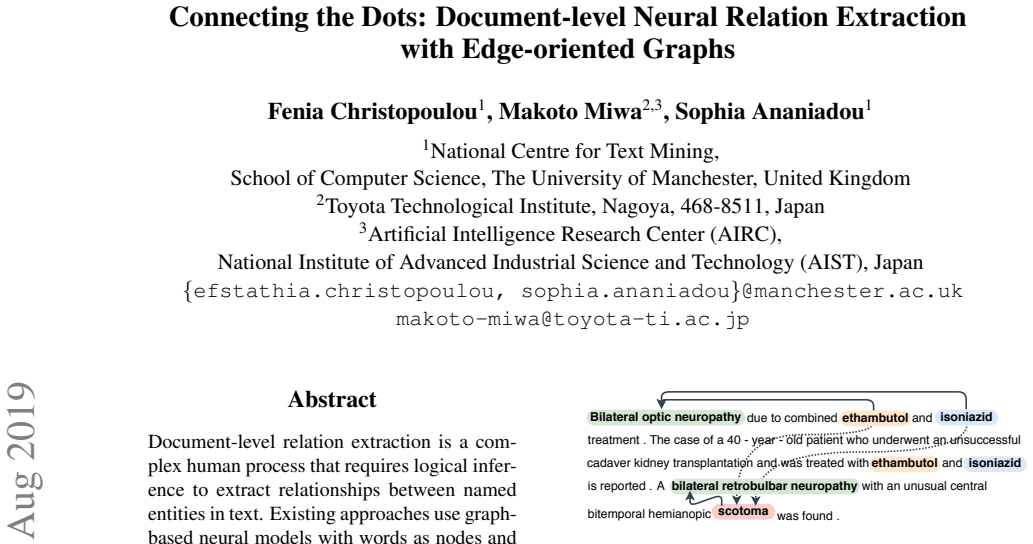
The load-bearing object is a heterogeneous document graph with three node types, namely mention nodes (averaged word embeddings of each entity mention), entity nodes (averaged mention embeddings), and sentence nodes (averaged word embeddings of each sentence), and five heuristic edge types: mention-mention within a sentence, mention-sentence, mention-entity, entity-sentence, and all sentence-sentence connections. Edge representations are vectors formed by concatenating node representations plus context and distance embeddings, then projected to a common dimension. The inference mechanism combines adjacent edge vectors with a modified bilinear transformation $f(e_{ik}, e_{kj}) = \sigma(e_{ik} \odot (W e_{kj}))$ and interpolates them with the original edge through a scalar $\beta$; after $N$ iterations an entity-to-entity edge of length up to $2^N$ emerges and is fed to a softmax classifier. This machinery lets the model discover relation paths such as entity-sentence-entity for intra-sentence pairs and entity-sentence-sentence-entity for inter-sentence pairs without any syntactic parser.
What would settle it
Replace only the sentence-node construction in the model, keeping every edge rule and the inference mechanism fixed, with sentence representations from a pretrained transformer, and compare inter-sentence F1 on CDR. If improved sentence nodes do not move inter-sentence F1 while the SS-edge ablation still collapses it, the edge-propagation design rather than sentence averaging is the binding constraint; if F1 rises substantially, the averaged-BiLSTM sentence node is the weak link the paper's ablation did not isolate.
Extended reading notes
Core claim
The central claim is that an entity pair's relation is best represented as a unique edge path in a document graph rather than as a function of two node representations. The model therefore deliberately leaves direct entity-to-entity edges absent and reconstructs them through intermediate mention, entity, and sentence nodes using a two-step edge-update rule: a gated bilinear combination of adjacent edges followed by a linear interpolation with the original edge, repeated for a fixed number of iterations. The resulting entity-to-entity edge is classified by softmax. The paper reports that this edge-oriented design outperforms both a fully connected graph and a no-inference node-concatenation baseline, with the largest gains on inter-sentence pairs, and that sentence-to-sentence edges are the critical channel: removing them collapses inter-sentence F1 from 46.68 to 1.59 on the CDR development set.
Load-bearing premise
The whole approach rests on the assumption that a document graph built from a few fixed, heuristic connections, especially sentence nodes formed by averaging all words in a sentence and edges linking every sentence to every other, preserves enough of the document's cross-sentence evidence for the iterative edge inference to recover relations; if averaging a sentence loses what links its mentions to mentions in other sentences, inter-sentence extraction fails.
Editorial extensions
If this is right
- Inter-sentence relation extraction is not solved by reading the whole document into one representation; explicit sentence-to-sentence edges carry the cross-sentence signal, and removing them leaves inter-sentence F1 near zero.
- Document-level graph context improves intra-sentence relation detection, since the model beats its sentence-only variant by about 3 F1 points on intra-sentence pairs, suggesting cross-sentence evidence is complementary even for same-sentence pairs.
- Direct and indirect sentence edges behave differently: using only direct neighboring sentence edges requires more inference steps and loses about 18 F1 points on inter-sentence pairs at the best setting, implying that skipping intermediate sentences can help.
- The approach does not need syntactic dependency tools, only entity linking and sentence splitting, making it portable to domains where parsers are unavailable.
- Inter-sentence performance degrades with sentence distance and with long chains of single-mention entities, so the iterative edge-inference mechanism has a limited effective range.
Reading between the lines
- If the edge-path view is right, the same architecture should transfer to other document-level tasks that require linking distributed evidence, such as claim verification or cross-sentence coreference resolution, provided a comparable heterogeneous graph can be constructed.
- The near-total dependence on sentence nodes suggests a targeted stress test: replacing averaged BiLSTM sentence nodes with stronger contextual encoders while keeping every edge rule fixed should improve inter-sentence F1 if the bottleneck is lossy sentence compression, and should not if the bottleneck lies in edge propagation itself.
- One could make the adjacency learnable rather than heuristic, letting the model choose which sentence pairs to connect, and expect the direct-versus-indirect edge distinction to emerge from data since the paper shows the two behave differently.
- The paper's error analysis points to unlinked synonyms and unresolved coreference as failure modes, so resolving those before graph construction should directly improve inter-sentence recall.
Signed reviews
Editorial analysis
A structured set of objections, weighed in public.
Referee Report
Summary. The paper presents EoG, an edge-oriented graph neural model for document-level relation extraction. The model constructs a document graph with entity, mention, and sentence nodes, connects them with five heuristic edge types (MM, MS, ME, SS, ES), and applies an iterative inference mechanism that propagates information along edge paths to synthesize entity-to-entity representations, which are then classified by a softmax layer. Experiments on two biomedical datasets, CDR and GDA, report state-of-the-art performance on CDR (63.6% overall F1 and 50.9% inter-sentence F1), and ablations show that the partially connected graph, the sentence nodes, and the edge enhancements contribute to the results.
Significance. The edge-oriented formulation is a meaningful departure from node-centric graph models and is well motivated by the need for pair-specific representations in documents with multiple entity mentions. The model is syntax-free, which broadens its applicability, and the authors release source code, which supports reproducibility. The ablation analysis is well designed and informative: Table 4 shows that removing SS edges collapses inter-sentence F1 from 46.68 to 1.59 on the CDR development set, demonstrating the centrality of the sentence-to-sentence inference path, and the observed improvement in intra-sentence relations from document-level context is a notable finding. The error analysis in Section 5, including the discussion of conjunction errors and coreference issues, is also useful. The main weakness is that the headline comparison with prior work is not yet fully substantiated, as detailed in the major comments.
major comments (3)
- [§4, Table 1; Appendix A] The claim that EoG outperforms the state-of-the-art on CDR by 1.3 points is not yet supported by a matched comparison. Appendix A states that the authors merge the CDR train and development sets and retrain on the union for test evaluation, but the paper does not establish that the cited baselines (Gu et al. 2017, Verga et al. 2018, Nguyen and Verspoor 2018) were trained under the same condition. If those baselines used only the 500-document training split, EoG would have received twice as much training data, which alone could explain the reported gap. Please state the training-data condition for every baseline in Table 1, or rerun the baselines under the same protocol, and adjust the SOTA claim accordingly.
- [§4; Appendix B] Only a single run is reported (Appendix B mentions a fixed initialization seed), and no significance tests are provided. On the CDR test set, the number of candidate entity pairs is roughly 5,200, so a 1.3-point F1 difference is within plausible sampling error. Please report multiple seeds with mean and standard deviation and, where possible, a paired significance test for the comparison with the strongest baseline.
- [Appendix A; Appendix B] The retraining protocol after merging the CDR development set into the training set is underspecified. The authors state that the development set was used to identify the stopping epoch and to tune the number of inference iterations, but after merging there is no development set for early stopping. It is unclear how the final model on the union was trained (for example, with a fixed number of epochs, with early stopping on a separate validation split, or by some other rule). This should be specified for reproducibility.
minor comments (5)
- [§2.4] The sentence 'This implies that entities can be associated through an edge path of minimum length equal to 3^2' appears to contain a typo; the minimum length for an inter-sentence path is 3 (E-S-S-E), not 9.
- [§2.4, Eq. (3)] The operation is described as a 'modified bilinear transformation,' but the formula σ(e_ik ⊙ (W e_kj)) is an element-wise product with a linear transformation, not a bilinear form; please adjust the terminology.
- [§3.1] 'We further split the training set into a 80/20 percentage split as training and development sets' should be rephrased for readability.
- [§5] 'learning patters' should be 'learning patterns'.
- [Table 1] The presentation of methods below the double line is confusing; the text says methods below the line take advantage of additional training data or external tools, but the relationship of these rows to the head-to-head comparison with EoG is not explicit. Consider annotating each row with the data condition used.
Circularity Check
No circular derivation: edge representations are built from input text and evaluated on external benchmarks; the self-citations are non-load-bearing method reuse.
full rationale
The derivation chain in Sections 2.3-2.5 is self-contained. Node representations are averages of input word embeddings (Section 2.3.1), edge representations are concatenations of node representations, attention context, and distance embeddings (Eqs. 1-2), and entity-to-entity edges are produced by the iterative combination of existing edges (Eqs. 3-4) without access to the target relation labels. The label enters only in the final softmax classifier (Eq. 5), which is ordinary supervised training. No parameter is fitted to a subset and then renamed as a prediction, and no predicted quantity is defined in terms of the target output. The model is evaluated against the held-out CDR and GDA test sets (Tables 1-2) with ablations (Tables 3-5), so the central claim is externally benchmarked. The paper does reuse the authors' own two-step inference mechanism (Christopoulou et al., 2018), but that is method reuse, not load-bearing evidence: the inference step is ablated (EoG vs. EoG(NoInf)) and is not justified by the citation alone. Appendix A's statement that the CDR train and development sets were merged ('We select to merge the train and development sets and re-train our model on their entire union for evaluation on the test set') raises a potential baseline-comparison fairness issue if some Table 1 baselines were not trained under the same data condition, but this is an experimental-design concern, not circularity. Under the hard rule requiring a specific reduction by construction, no circular step is identified; the score reflects only the presence of a minor, non-load-bearing self-citation.
Assumptions & free parameters
free parameters (2)
- Inference iterations N =
CDR: 8 (EoG), 2 (Full), 4 (Sent); GDA: 16 (EoG/Full), 8 (Sent)
- Interpolation weight beta =
0.8
assumptions (3)
- domain assumption Heuristic document graph edges encode relation evidence.
- domain assumption Sentence node as averaged BiLSTM output preserves enough information for cross-sentence inference.
- domain assumption Multi-instance learning with a maximum assumption for merging mention-level predictions is appropriate for document-level RE.
Cite this review
Pith. "Pith review of Connecting the Dots: Document-level Neural Relation Extraction with Edge-oriented Graphs." pith.science (2026). https://pith.science/paper/VL2OCKJH
@misc{pith2026190900228,
  author       = {Pith},
  title        = {Pith review of: Connecting the Dots: Document-level Neural Relation Extraction with Edge-oriented Graphs},
  year         = {2026},
  howpublished = {\url{https://pith.science/paper/VL2OCKJH}},
  note         = {Machine review of arXiv:1909.00228}
}
read the original abstract
Document-level relation extraction is a complex human process that requires logical inference to extract relationships between named entities in text. Existing approaches use graph-based neural models with words as nodes and edges as relations between them, to encode relations across sentences. These models are node-based, i.e., they form pair representations based solely on the two target node representations. However, entity relations can be better expressed through unique edge representations formed as paths between nodes. We thus propose an edge-oriented graph neural model for document-level relation extraction. The model utilises different types of nodes and edges to create a document-level graph. An inference mechanism on the graph edges enables to learn intra- and inter-sentence relations using multi-instance learning internally. Experiments on two document-level biomedical datasets for chemical-disease and gene-disease associations show the usefulness of the proposed edge-oriented approach.
Figures


Figures from the paper (1 more)

Forward citations
Cited by 1 Pith paper
-
Multi-Relation Extraction in Entity Pairs using Global Context
A BERT input format that appends the head and tail entity names after the document is claimed to beat all prior document-level relation extraction systems, but the reported gains rest on misaligned evaluation protocols.
Reference graph
Works this paper leans on
-
[1]
URL: " 'urlintro :=
ENTRY address author booktitle chapter edition editor howpublished institution journal key month note number organization pages publisher school series title type volume year eprint doi pubmed url lastchecked label extra.label sort.label short.list INTEGERS output.state before.all mid.sentence after.sentence after.block STRINGS urlintro eprinturl eprintpr...
-
[2]
write newline
" write newline "" before.all 'output.state := FUNCTION n.dashify 't := "" t empty not t #1 #1 substring "-" = t #1 #2 substring "--" = not "--" * t #2 global.max substring 't := t #1 #1 substring "-" = "-" * t #2 global.max substring 't := while if t #1 #1 substring * t #2 global.max substring 't := if while FUNCTION word.in bbl.in capitalize " " * FUNCT...
-
[3]
Michele Banko, Michael J Cafarella, Stephen Soderland, Matt Broadhead, and Oren Etzioni. 2007. Open information extraction from the web. In Proceedings of the International Joint Conference on Artifical Intelligence, pages 2670--2676. Morgan Kaufmann Publishers Inc
work page 2007
-
[4]
Karsten M Borgwardt and Hans-Peter Kriegel. 2005. Shortest-path kernels on graphs. In Proceedings of the IEEE International Conference on Data Mining, pages 74--81. IEEE Computer Society
work page 2005
-
[5]
Billy Chiu, Gamal Crichton, Anna Korhonen, and Sampo Pyysalo. 2016. How to train good word embeddings for biomedical nlp. In Proceedings of the B io NLP workshop , pages 166--174
work page 2016
-
[6]
Fenia Christopoulou, Makoto Miwa, and Sophia Ananiadou. 2018. A walk-based model on entity graphs for relation extraction. In Proceedings of the Annual Meeting of the Association for Computational Linguistics (Volume 2), pages 81--88. Association for Computational Linguistics
work page 2018
-
[7]
Jinghang Gu, Longhua Qian, and Guodong Zhou. 2016. Chemical-induced disease relation extraction with various linguistic features. Database
work page 2016
-
[8]
Jinghang Gu, Fuqing Sun, Longhua Qian, and Guodong Zhou. 2017. Chemical-induced disease relation extraction via convolutional neural network. Database
work page 2017
Show all 46 references
-
[9]
Pankaj Gupta, Subburam Rajaram, Hinrich Schütze, and Thomas Runkler. 2019. Neural relation extraction within and across sentence boundaries. In Proceedings of the AAAI Conference on Artificial Intelligence, volume 33, pages 6513--6520
2019
-
[10]
Sepp Hochreiter and J \"u rgen Schmidhuber. 1997. Long short-term memory. Neural computation, 9(8):1735--1780
1997
-
[11]
Robin Jia, Cliff Wong, and Hoifung Poon. 2019. Document-level n-ary relation extraction with multiscale representation learning. In Proceedings of the Conference of the North A merican Chapter of the Association for Computational Linguistics: Human Language Technologies (Volum...
2019
-
[12]
Xiaotian Jiang, Quan Wang, Peng Li, and Bin Wang. 2016. Relation extraction with multi-instance multi-label convolutional neural networks. In Proceedings of the International Conference on Computational Linguistics: Technical Papers, pages 1471--1480. The COLING Organizing Committee
2016
-
[13]
Diederik P Kingma and Jimmy Ba. 2015. Adam: A method for stochastic optimization. In Proceedings of the International Conference on Learning Representations
2015
-
[14]
Haodi Li, Ming Yang, Qingcai Chen, Buzhou Tang, Xiaolong Wang, and Jun Yan. 2018. Chemical-induced disease extraction via recurrent piecewise convolutional neural networks. BMC medical informatics and decision making, 18(2):60
2018
-
[15]
Jiao Li, Yueping Sun, Robin J Johnson, Daniela Sciaky, Chih-Hsuan Wei, Robert Leaman, Allan Peter Davis, Carolyn J Mattingly, Thomas C Wiegers, and Zhiyong Lu. 2016 a . Biocreative v cdr task corpus: a resource for chemical disease relation extraction. Database
2016
-
[16]
Zhiheng Li, Zhihao Yang, Hongfei Lin, Jian Wang, Yingyi Gui, Yin Zhang, and Lei Wang. 2016 b . CID extractor: A chemical-induced disease relation extraction system for biomedical literature. In IEEE International Conference on Bioinformatics and Biomedicine, pages 994--1001. IEEE
2016
-
[17]
Yankai Lin, Shiqi Shen, Zhiyuan Liu, Huanbo Luan, and Maosong Sun. 2016. Neural relation extraction with selective attention over instances. In Proceedings of the Annual Meeting of the Association for Computational Linguistics (Volume 1), pages 2124--2133
2016
-
[18]
Yi Luan, Dave Wadden, Luheng He, Amy Shah, Mari Ostendorf, and Hannaneh Hajishirzi. 2019. A general framework for information extraction using dynamic span graphs. In Proceedings of the Conference of the North A merican Chapter of the Association for Computational Linguistics:...
2019
-
[19]
Mike Mintz, Steven Bills, Rion Snow, and Dan Jurafsky. 2009. Distant supervision for relation extraction without labeled data. In Proceedings of the Joint Conference of the Annual Meeting of the ACL and the 4th International Joint Conference on Natural Language Processing of t...
2009
-
[20]
Makoto Miwa and Mohit Bansal. 2016. End-to-end relation extraction using LSTM s on sequences and tree structures. In Proceedings of the Annual Meeting of the Association for Computational Linguistics (Volume 1), pages 1105--1116. Association for Computational Linguistics
2016
-
[21]
Dat Quoc Nguyen and Karin Verspoor. 2018. Convolutional neural networks for chemical-disease relation extraction are improved with character-based word embeddings. In Proceedings of the B io NLP workshop , pages 129--136. Association for Computational Linguistics
2018
-
[22]
Thien Huu Nguyen and Ralph Grishman. 2015. Relation extraction: Perspective from convolutional neural networks. In Proceedings of the Workshop on Vector Space Modeling for Natural Language Processing, pages 39--48
2015
-
[23]
Nagesh C Panyam, Karin Verspoor, Trevor Cohn, and Kotagiri Ramamohanarao. 2018. Exploiting graph kernels for high performance biomedical relation extraction. Journal of biomedical semantics, 9(1):7
2018
-
[24]
Adam Paszke, Sam Gross, Soumith Chintala, Gregory Chanan, Edward Yang, Zachary DeVito, Zeming Lin, Alban Desmaison, Luca Antiga, and Adam Lerer. 2017. Automatic differentiation in pytorch. In NIPS-W
2017
-
[25]
Nanyun Peng, Hoifung Poon, Chris Quirk, Kristina Toutanova, and Wen-tau Yih. 2017. Cross-sentence n-ary relation extraction with graph lstms. Transactions of the Association for Computational Linguistics, 5:101--115
2017
-
[26]
Yifan Peng, Chih-Hsuan Wei, and Zhiyong Lu. 2016. Improving chemical disease relation extraction with rich features and weakly labeled data. Journal of cheminformatics, 8(1):53
2016
-
[27]
Jeffrey Pennington, Richard Socher, and Christopher D Manning. 2014. Glove: Global vectors for word representation. In Proceedings of the Empirical Methods in Natural Language Processing, pages 1532--1543. Association for Computational Linguistics
2014
-
[28]
Janet Pi \ n ero, \`A lex Bravo, N \'u ria Queralt-Rosinach, Alba Guti \'e rrez-Sacrist \'a n, Jordi Deu-Pons, Emilio Centeno, Javier Garc \' a-Garc \' a, Ferran Sanz, and Laura I Furlong. 2016. Disgenet: a comprehensive platform integrating information on human disease-associ...
2016
-
[29]
Chris Quirk and Hoifung Poon. 2017. Distant supervision for relation extraction beyond the sentence boundary. In Proceedings of the Conference of the European Chapter of the Association for Computational Linguistics (Volume 1), pages 1171--1182. Association for Computational L...
2017
-
[30]
Sebastian Riedel, Limin Yao, and Andrew McCallum. 2010. Modeling relations and their mentions without labeled text. In Joint European Conference on Machine Learning and Knowledge Discovery in Databases, pages 148--163. Springer
2010
-
[31]
Mike Schuster and Kuldip K Paliwal. 1997. Bidirectional recurrent neural networks. IEEE Transactions on Signal Processing, 45(11):2673--2681
1997
-
[32]
Wei Shen, Jianyong Wang, and Jiawei Han. 2014. Entity linking with a knowledge base: Issues, techniques, and solutions. IEEE Transactions on Knowledge and Data Engineering, 27(2):443--460
2014
-
[33]
Gaurav Singh and Parminder Bhatia. 2019. Relation extraction using explicit context conditioning. In Proceedings of the Conference of the North A merican Chapter of the Association for Computational Linguistics: Human Language Technologies, Volume 1 (Long and Short Papers) , p...
2019
-
[34]
Linfeng Song, Yue Zhang, Zhiguo Wang, and Daniel Gildea. 2018. N-ary relation extraction using graph-state lstm. In Proceedings of the Conference on Empirical Methods in Natural Language Processing, pages 2226--2235. Association for Computational Linguistics
2018
-
[35]
Shikhar Vashishth, Rishabh Joshi, Sai Suman Prayaga, Chiranjib Bhattacharyya, and Partha Talukdar. 2018. Reside: Improving distantly-supervised neural relation extraction using side information. In Proceedings of the Conference on Empirical Methods in Natural Language Processi...
2018
-
[36]
Patrick Verga, Emma Strubell, and Andrew McCallum. 2018. Simultaneously self-attending to all mentions for full-abstract biological relation extraction. In Proceedings of the Conference of the North American Chapter of the Association for Computational Linguistics: Human Langu...
2018
-
[37]
Linlin Wang, Zhu Cao, Gerard de Melo, and Zhiyuan Liu. 2016. Relation classification via multi-level attention CNN s. In Proceedings of the Annual Meeting of the Association for Computational Linguistics (Volume 1), pages 1298--1307. Association for Computational Linguistics
2016
-
[38]
Ye Wu, Ruibang Luo, Henry CM Leung, Hing-Fung Ting, and Tak-Wah Lam. 2019. Renet: A deep learning approach for extracting gene-disease associations from literature. In International Conference on Research in Computational Molecular Biology, pages 272--284. Springer
2019
-
[39]
Yan Xu, Lili Mou, Ge Li, Yunchuan Chen, Hao Peng, and Zhi Jin. 2015. Classifying relations via long short term memory networks along shortest dependency paths. In Proceedings of Conference on Empirical Methods in Natural Language Processing, pages 1785--1794. Association for C...
2015
-
[40]
Daojian Zeng, Kang Liu, Yubo Chen, and Jun Zhao. 2015. Distant supervision for relation extraction via piecewise convolutional neural networks. In Proceedings of the Conference on Empirical Methods in Natural Language Processing, pages 1753--1762
2015
-
[41]
Daojian Zeng, Kang Liu, Siwei Lai, Guangyou Zhou, and Jun Zhao. 2014. Relation classification via convolutional deep neural network. In Proceedings of the International Conference on Computational Linguistics: Technical Papers, pages 2335--2344. Dublin City University and Asso...
2014
-
[42]
Wenyuan Zeng, Yankai Lin, Zhiyuan Liu, and Maosong Sun. 2017. Incorporating relation paths in neural relation extraction. In Proceedings of the Conference on Empirical Methods in Natural Language Processing, pages 1768--1777. Association for Computational Linguistics
2017
-
[43]
Yuhao Zhang, Peng Qi, and Christopher D Manning. 2018. Graph convolution over pruned dependency trees improves relation extraction. In Proceedings of the Conference on Empirical Methods in Natural Language Processing, pages 2205--2215. Association for Computational Linguistics
2018
-
[44]
Wei Zheng, Hongfei Lin, Zhiheng Li, Xiaoxia Liu, Zhengguang Li, Bo Xu, Yijia Zhang, Zhihao Yang, and Jian Wang. 2018. An effective neural model extracting document level chemical-induced disease relations from biomedical literature. Journal of biomedical informatics, 83:1--9
2018
-
[45]
Huiwei Zhou, Huijie Deng, Long Chen, Yunlong Yang, Chen Jia, and Degen Huang. 2016. Exploiting syntactic and semantics information for chemical--disease relation extraction. Database
2016
-
[46]
Peng Zhou, Jiaming Xu, Zhenyu Qi, Hongyun Bao, Zhineng Chen, and Bo Xu. 2018. Distant supervision for relation extraction with hierarchical selective attention. Neural Networks, 108:240--247
2018
Reviewed August 14, 2026 · model on record in the stance chip above.
Discussion (0). Continue with ORCID to comment.