REVIEW 3 major objections 5 minor 202 references
Edge-Optimized Deep Learning & Pattern Recognition Techniques for Non-Intrusive Load Monitoring of Energy Time Series
T0 review · 3 major / 5 minor · reviewed 2026-08-15 · deepseek-v4-flash
Pith's one-line read Pruning before training finds subnetworks of 5% of the parameters that match full NILM model accuracy, a new Greek 10-second dataset fills the Mediterranean data gap, and a graph-based encoder beats sequential baselines on washing machines.
desk verdict Plegma dataset is a solid regional contribution; the GCN result is invalid as NILM due to test-time leakage, and pruning claims rest on in-sample threshold selection. read the letter →
The pith
A machine-rendered reading of the paper's core claim, the machinery that carries it, and where it could break.
The reading
What carries the argument
The argument runs on two mechanisms. The first is iterative magnitude pruning before training, in the lottery-ticket style: the network is trained for a single epoch, the weights with the smallest L1 norm below a threshold $p_t$ are masked out via a binary mask $\mu \in \{0,1\}^N$ so that $\hat{w} = \mu \odot w$, and the surviving weights are reset to their initial values $w_0$; repeating this for a few rounds $R \ll K$ yields a sparse subnetwork that is then fully trained. This is what lets the scheme claim compute savings in both the training and the inference phase, since the expensive full model is never trained. The second is the entropy-based graph construction for the GCN encoder: aggregate windows are assigned to clusters according to the sample entropy of the target appliance's consumption windows, cluster means seed the node embeddings, Markov-chain transition probabilities between clusters define the directed edge weights, and stacked graph convolutional layers propagate information across nodes before a transformer decoder produces the appliance signal.
What would settle it
Train the GCN-encoder model on UK-DALE houses 1, 3, 4, and 5, then evaluate on house 2 without computing cluster assignments from house 2's appliance-level signal, for instance by reusing the training clusters or clustering the aggregate alone. If the washing-machine F1 collapses from the reported 0.7805 toward the CNN baseline of 0.7261, the claim's test-time dependence on knowing the appliance's entropy is confirmed as load-bearing; if the F1 holds, the graph encoder generalizes without that oracle.
Extended reading notes
Core claim
The thesis's central claim is that the two obstacles standing between NILM research and real deployment, missing data for Mediterranean consumption patterns and the high compute cost of deep disaggregation models, are both removable. On the data side, it presents the Plegma dataset: a year-long, 10-second-resolution record of aggregate and appliance-level power from 13 Greek households, roughly 218 million readings, covering air conditioners (18 units) and electric water boilers (12 units) that rarely appear in other public datasets, alongside environmental and sociodemographic metadata. On the compute side, it argues that iterative L1-magnitude pruning performed before full training, with surviving weights reset to their initialization, isolates subnetworks containing 5% of the original parameters whose disaggregation performance matches the full model on the UK-DALE benchmark, and that the same idea in structured and dependency-graph form cuts model size up to 90% when evaluated on Plegma. It further claims that a sequence-to-sequence model with a graph convolutional encoder and a transformer decoder is the first graph-based NILM, recovering multi-state appliances like the washing machine better than CNN, LSTM, and GRU baselines (F1 0.7805 versus 0.7261 for the CNN baseline).
Load-bearing premise
The load-bearing premise, disclosed by the thesis itself, is that the graph encoder knows the target appliance's consumption entropy on the test data; in a genuine deployment, where the appliance signal is exactly what is being inferred, that information is not available and the graph cannot be built.
Editorial extensions
If this is right
- Training NILM models on the edge becomes plausible: if subnetworks found before training match full models, the resource-heavy full model never has to be trained centrally, and the reported 5% parameter subnetworks match full-model performance on UK-DALE.
- The Plegma dataset gives researchers a Mediterranean benchmark with 10-second granularity, enabling NILM evaluation on air conditioners and electric water boilers and comparisons of cross-region transfer against UK-DALE and REFIT.
- Structured and dependency-graph pruning variants, validated on Plegma, reach up to 90% model-size reduction and a 10x compute saving, a level suited to Raspberry-Pi-class devices.
- For multi-state appliances such as washing machines, graph-based encoding with a transformer decoder beats sequential baselines on activation detection, with F1 of 0.7805 compared with 0.7261 for the CNN baseline.
Reading between the lines
- The mask-reset pruning recipe is demonstrated on one CNN architecture; a direct extension is testing whether the same schedule holds for transformer or GCN backbones, whose per-layer sparsity tolerances likely differ.
- Plegma's combination of UK-DALE-comparable granularity and Mediterranean appliance mix makes a cross-dataset transfer experiment the natural next test: train on UK-DALE, test on Plegma, and quantify how much air-conditioner and boiler patterns degrade models that never saw them.
- The disclosed test-time-entropy limitation suggests a concrete fix the thesis does not pursue: learning the cluster assignment from the aggregate signal alone, which would make the graph encoder truly non-intrusive.
- The questionnaire metadata (occupancy, income, heating type) enables conditioning disaggregation on household context, a direction the dataset opens but the thesis leaves unexplored.
Signed reviews
Editorial analysis
A structured set of objections, weighed in public.
Referee Report
Summary. This PhD dissertation combines an interoperable IoT data-collection framework and a new residential energy dataset, the Plegma Dataset from Greece, with a set of deep-learning contributions for non-intrusive load monitoring (NILM). The dataset chapter reports 13 households, 10-second aggregate and appliance-level measurements, roughly 218 million readings, environmental data, and sociodemographic/building metadata, together with explicit cleaning rules (Algorithms 1-2). The modeling chapters claim three advances: a GCN-encoder/transformer-decoder as the first graph-based NILM model, an iterative pre-training pruning scheme ('OPT-NILM') that finds subnetworks matching full-model performance at up to 95% sparsity, and structured dependency-graph pruning evaluated on the Plegma dataset. The pruning chapters report large complexity reductions on UK-DALE and Plegma, while the GCN chapter reports improved washing-machine F1 over CNN/LSTM/GRU baselines.
Significance. If the dataset contribution stands, it is genuinely useful: Plegma is, as claimed, one of the first public 10-second residential datasets from Greece and the Mediterranean, with underrepresented appliances such as air conditioners and electric water boilers, and the chapter is careful about missing data (6.86% NaN, 0.82% issue flags) and about reproducible preprocessing. The pruning chapters address a real deployment bottleneck and the before-training pruning idea is worth pursuing. However, the significance of the modeling claims is currently conditional: the GCN result is not a valid NILM result as evaluated, because it uses test-time appliance entropy, and the pruning 'optimal threshold' is selected on the same test-house curves used for the final reported numbers. These are load-bearing issues, not presentation details.
major comments (3)
- [§4.3.3 and §4.1] The GCN encoder constructs graph nodes by assigning aggregate windows to clusters 'based on the entropy metric of the corresponding appliance's consumption windows' (§4.3.3). At inference in the NILM setting defined by Eq. (4.1), only the aggregate x(t) is observed, so the target appliance's entropy is not available; §4.1 concedes that the approach 'could only be used to disaggregate known datasets.' Consequently, the washing-machine comparison in Table 4.2 (F1 0.7805 vs 0.7261 for CNN) is obtained with access to ground-truth appliance information and is not a valid non-intrusive disaggregation result. The claimed advantage over sequential baselines therefore does not support the contribution as stated; a leakage-free variant (e.g., clustering on aggregate-only features or a state estimator trained without test labels) would be needed.
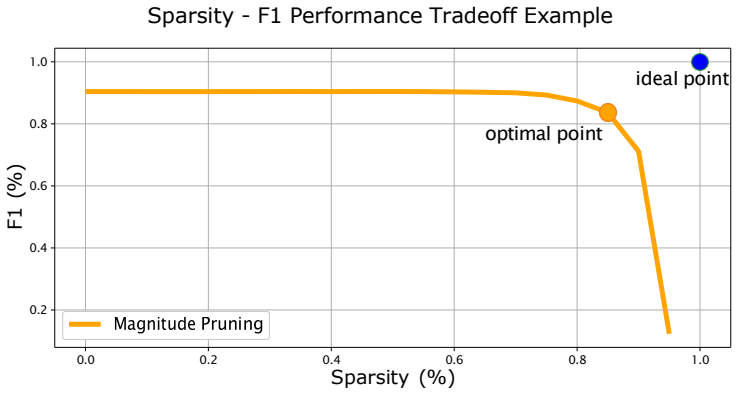
- [§5.3.1, Eq. (5.4); §8.4.3] The optimal pruning threshold p̂t is selected by minimizing the distance in Eq. (5.3) over the 'F1 score - MACs' curves, and the experimental setup states that models are trained on houses 1,3,4,5 and tested on house 2. As presented, the F1-MAC curves in Fig. 5.1 are the performance-degradation curves on which the final results in Figs. 5.2-5.3 and Table 6.1 are reported, so p̂t is an in-sample selection rather than an independent model-selection choice. The same issue appears in Chapter 8, where Eq. (8.10) sets Pthr = Popt from the test-house curves in Fig. 8.1. Please use a validation-house split for threshold selection and report test results only for the final threshold, or explicitly label the reported numbers as oracle-selected.
- [§5.3.1, Eq. (5.3)] The proposed trade-off metric mixes the F1 score, which lies in [0,1], with raw MAC counts, which in Fig. 5.1 are of order 10^6. As printed, Eq. (5.3) is dist = sqrt((1-F1)^2 + (0-MACs(pt))^2); without a normalization factor for MACs, the distance is dominated by the MAC term, so the 'optimal' threshold is essentially the most aggressive sparsity that keeps F1 above zero. Please specify the scaling (e.g., normalize MACs by the baseline model's MACs) and state the exact form used to produce the reported thresholds; the current formula also appears to contain a typo (missing closing parenthesis).
minor comments (5)
- [§3.4, Table 3.6] The table titled 'Monitored appliances in each house' actually reports aggregate consumption, sub-metered consumption, and the percentage of sub-metered consumption; the title appears to be copied from Table 3.3 and should be corrected.
- [§4.4.2, Eq. (4.10)] The MRE and MAE definitions are corrupted in the typesetting; as printed, MRE lacks an explicit summation/division structure and the MAE expression is incomplete. Please provide clean equations.
- [§1.4 and §3.1] The Plegma dataset is cited as [9] in Chapter 1 but as [10] in Chapter 3; please harmonize the citation numbering throughout the thesis.
- [§3.4, Table 3.7] The fridge row reports the number of activations as 'continuous' in a column labeled 'Total number of appliance activations'; please clarify how 'continuous' is defined and whether it is used in downstream analyses.
- [§4.4.3, Table 4.1] Table 4.1 reports F1 = 0.00000 for kettle and microwave; the text explains that the model is unsuited to short-duration devices, but reporting precision and recall or activation-level detection metrics would make the failure mode more informative.
Circularity Check
The pruning 'optimal threshold' is selected from the same test performance curves on which final results are reported, and the GCN encoder requires the target appliance's entropy at test time despite NILM being defined from the aggregate alone.
-
self definitional
[Sec. 4.1, Sec. 4.3.3, Eq. (4.1)]
"The goal of energy disaggregation is to solve the inverse problem and determine the individual consumption ym of appliance m based exclusively on the measurement of the aggregate signal. ... these windows are being assigned to specific clusters based on the entropy metric of the corresponding appliance's consumption windows. ... our approach could only be used to disaggregate known datasets as it provides the limitation of knowing the entropy of the appliance's signal even on the testing data."
The paper formulates NILM as recovering the appliance signal ym solely from the aggregate signal xagg, but the encoder's graph construction is defined by the entropy of the target appliance's own consumption windows. The clusters that form the graph nodes, the Markov transition weights, and hence the GCN embeddings are all built from the very signal the model is supposed to predict. The reported washing-machine advantage in Table 4.2 is therefore measured with the ground-truth appliance signal available at test time, so the claimed disaggregation result is not derived from the aggregate input alone; the target is built into the encoder by construction.
-
fitted input called prediction
[Sec. 5.3.1 Eqs. (5.3)-(5.4); results in Sec. 5.3.2]
"First the Euclidean distance for all pt is calculated given an 'F1 score - MACs' diagram as: dist(F1, MACs(pt)) = sqrt((1 - F1)^2 + (0 - MACs(pt))^2) ... p_hat_t = arg min_{pt in (0,0.95)} dist(F1, MACs(pt)). ... The pruning thresholds were set equal to the p_hat_t of the proposed approach: 95% for the kettle, 80% for the dishwasher, 85% for the fridge and 60% for the washing machine."
The 'optimal pruning threshold' is chosen by minimizing a distance to perfect F1, using F1 values computed from the same test-house performance curves on which the final results are reported. The headline compression claims (95% parameter reduction with negligible degradation) are thus in-sample selections: the threshold is fitted to the test F1 curve and the subsequently reported F1 at that threshold is the same quantity used in the selection rule. The comparison between pre-training and after-training pruning is also evaluated at per-method in-sample-optimal thresholds, so the claimed performance advantage is partly an artifact of each method being scored at its own test-set-selected operating point rather than at an independently fixed sparsity level.
full rationale
The dataset chapter is self-contained against external benchmarks and is not circular: the Plegma dataset is a new measurement campaign with documented hardware, pre-processing, and FAIR hosting, and its uniqueness claims are falsifiable external facts. The GCN chapter, however, contains a load-bearing self-definitional step: the graph encoder needs the entropy of the target appliance's consumption windows even on test data, which contradicts the paper's own Eq. (4.1) definition of disaggregation as recovering ym from the aggregate alone. The paper explicitly admits this limitation, yet the reported superiority over CNN/LSTM/GRU is presented as a NILM result. The pruning chapters select the pruning threshold via Eq. (5.4) from F1 values on the same test curves later used as the reported result; this is a fitted selection criterion renamed as an 'optimal pruning threshold' and then re-reported as independent performance. Chapters 7 and 8 reuse the same Eq. (5.4) selection mechanism, so the issue propagates. I did not count the author's self-citations as circular: they are normal bibliographic markers, and no machine-checked or externally verified 'uniqueness theorem' is invoked to forbid alternatives. The non-finding portions (dataset, hardware architecture) remain independent evidence. Overall, the central predictive claims for the GCN architecture and for the optimal-threshold pruning results reduce in part to their own inputs, giving a partial circularity score of 6.
Assumptions & free parameters
free parameters (4)
- Per-appliance pruning threshold p̂t (Ch. 5), p̂opt (Ch. 6), ŝ (Ch. 7-8) =
95% (kettle), 80% (dishwasher), 85% (fridge), 60% (washing machine); per-layer ratios in Ch. 7-8 not itemized
- Number of graph clusters (operational states) N for the GCN encoder =
not reported
- Ideal-point scale in the trade-off metric (Eq. 5.3) =
(F1=1, MACs=0) with unscaled axes
- GCN layers and transformer layers (Ch. 4) =
8 GCN layers, 2 transformer layers
assumptions (5)
- domain assumption Aggregate power is the sum of appliance contributions plus noise (Eq. 4.1, Eq. 5.1, Eq. 6.1)
- domain assumption Randomly initialized NILM networks contain sparse subnetworks that reach full-network accuracy when trained (lottery ticket hypothesis)
- ad hoc to paper Appliance operational-state entropy is available at test time for the disaggregated appliance
- standard math Markov property: the next appliance state depends only on the current state
- standard math GCN message passing (Kipf-Welling layers, Eq. 4.6-4.7) produces representations useful for regression decoding
Cite this review
Pith. "Pith review of Edge-Optimized Deep Learning & Pattern Recognition Techniques for Non-Intrusive Load Monitoring of Energy Time Series." pith.science (2026). https://pith.science/paper/VL6L4JU7
@misc{pith2026250506289,
  author       = {Pith},
  title        = {Pith review of: Edge-Optimized Deep Learning & Pattern Recognition Techniques for Non-Intrusive Load Monitoring of Energy Time Series},
  year         = {2026},
  howpublished = {\url{https://pith.science/paper/VL6L4JU7}},
  note         = {Machine review of arXiv:2505.06289}
}
read the original abstract
The growing global energy demand and the urgent need for sustainability call for innovative ways to boost energy efficiency. While advanced energy-saving systems exist, they often fall short without user engagement. Providing feedback on energy consumption behavior is key to promoting sustainable practices. Non-Intrusive Load Monitoring (NILM) offers a promising solution by disaggregating total household energy usage, recorded by a central smart meter, into appliance-level data. This empowers users to optimize consumption. Advances in AI, IoT, and smart meter adoption have further enhanced NILM's potential. Despite this promise, real-world NILM deployment faces major challenges. First, existing datasets mainly represent regions like the USA and UK, leaving places like the Mediterranean underrepresented. This limits understanding of regional consumption patterns, such as heavy use of air conditioners and electric water heaters. Second, deep learning models used in NILM require high computational power, often relying on cloud services. This increases costs, raises privacy concerns, and limits scalability, especially for households with poor connectivity. This thesis tackles these issues with key contributions. It presents an interoperable data collection framework and introduces the Plegma Dataset, focused on underrepresented Mediterranean energy patterns. It also explores advanced deep neural networks and model compression techniques for efficient edge deployment. By bridging theoretical advances with practical needs, this work aims to make NILM scalable, efficient, and adaptable for global energy sustainability.
Figures


Figures from the paper (11 more)




Reference graph
Works this paper leans on
-
[1]
Aeotec home energy meter
Aeotec (2023). Aeotec home energy meter. https://aeotec.com/products/ aeotec-home-energy-meter
2023
-
[2]
and Bons, M
Ahmed, S. and Bons, M. (2020). Edge Computed NILM: A Phone-Based Implementation Using MobileNet Compressed by Tensorflow Lite, page 44–48. ACM, New York, NY, USA
2020
-
[3]
Ai, S., Chakravorty, A., and Rong, C. (2019). Household power demand prediction using evolutionary ensemble neural network pool with multiple network structures. Sensors, 19(3):721
2019
-
[4]
A., and Martins, J
Akbari, S., Lopes, R. A., and Martins, J. (2024). The potential of residential load flexibility: An approach for assessing operational flexibility. International Journal of Electrical Power Energy Systems, 158:109918
2024
-
[5]
M., Shahjalal, M., Rahman, M
Alam, M. M., Shahjalal, M., Rahman, M. H., Nurcahyanto, H., Prihatno, A. T., Kim, Y., and Jang, Y. M. (2022). An energy and leakage current monitoring system for abnormality detection in electrical appliances. Scientific Reports, 12(1):18520
2022
-
[6]
Alsalemi, A., Himeur, Y., Bensaali, F., Amira, A., Sardianos, C., Varlamis, I., and Dimitrakopou- los, G. (2020). Achieving domestic energy efficiency using micro -moments and intelligent recommendations. IEEE Access, 8:15047–15055
2020
-
[7]
-F., Timplalexis, C., Krinidis, S., Ioannidis, D., and Tzovaras, D
Angelis, G. -F., Timplalexis, C., Krinidis, S., Ioannidis, D., and Tzovaras, D. (2022). Nilm applications: Literature review of learning approaches, recent developments and challenges. Energy and Buildings, 261:111951
2022
-
[8]
Anwar, S., Hwang, K., and Sung, W. (2017). Structured pruning of deep convolutional neural networks. ACM Journal on Emerging Technologies in Computing Systems (JETC), 13(3):1–18
2017
Show all 202 references
-
[9]
Athanasoulias, S., Guasselli, F., Doulamis, N., Doulamis, A., Ipiotis, N., Katsari, A., Stankovic, L., and Stankovic, V. (2024a). The plegma dataset: Domestic appliance -level and aggregate electricity demand with metadata from greece. Scientific Data, 11(1):376
2024
-
[10]
Athanasoulias, S., Katsari, A., Murray, D., Guasseli, F., Doulamis, A., Doulamis, N., Ipiotis, N., Stankovic, L., and Stankovic, V. (2023a). University of Strathclyde, PURE. https://doi.org/10. 15129/3b01a6c6-2efd-424a-b8b8-5fe7fa445ded
2023
-
[11]
Athanasoulias, S., Katsari, A., Savvakis, M., Kalogridis, S., and Ipiotis, N. (2023b). An interoperable and cost-effective iot-based framework for household energy monitoring and analysis. In Proceedings of the 16th International Conference on PErvasive Technologies Related to...
2023
-
[12]
Athanasoulias, S., Sykiotis, S., Kaselimi, M., Doulamis, A., Doulamis, N., and Ipiotis, N. (2023c). Opt-nilm: An iterative prior-to-full-training pruning approach for cost-effective user side energy disaggregation. IEEE Transactions on Consumer Electronics, pages 1–1
2023
-
[13]
Athanasoulias, S., Sykiotis, S., Kaselimi, M., Doulamis, A., Doulamis, N., and Ipiotis, N. (2024b). Opt-nilm: An iterative prior-to-full-training pruning approach for cost-effective user side energy disaggregation. IEEE Transactions on Consumer Electronics, 70(1):4435–4446
2024
-
[14]
Athanasoulias, S., Sykiotis, S., Kaselimi, M., Protopapadakis, E., and Ipiotis, N. (2022). A first approach using graph neural networks on non-intrusive-load-monitoring. In Proceedings of the 15th International Conference on PErvasive Technologies Related to Assistive Environm...
2022
-
[15]
Athanasoulias, S., Sykiotis, S., Temenos, N., Doulamis, A., and Doulamis, N. (2024c). A pre- training pruning strategy for enabling lightweight non-intrusive load monitoring on edge devices. In 2024 IEEE International Conference on Acoustics, Speech, and Signal Processing Work...
2024
-
[16]
Athanasoulias, S., Temenos, N., Doulamis, N., Doulamis, A., Kokos, I., and Ipiotis, N. (2024d). Towards edge-computed nilm: Insights from a mediterranean use case. In 2024 3rd International Conference on Energy Transition in the Mediterranean Area (SyNERGY MED), pages 1–5
2024
-
[17]
Azarian, K., Bhalgat, Y., Lee, J., and Blankevoort, T. (2020). Learned threshold pruning. arXiv preprint arXiv:2003.00075, 1
2020 arXiv
-
[18]
Bakalos, N., Voulodimos, A., Doulamis, N., Doulamis, A., Ostfeld, A., Salomons, E., Caubet, J., Jimenez, V., and Li, P. (2019). Protecting water infrastructure from cyber and physical threats: Using multimodal data fusion and adaptive deep learning to monitor critical systems....
2019
-
[19]
Barber, J., Cuayáhuitl, H., Zhong, M., and Luan, W. (2020). Lightweight NILM Employing Pruned Sequence-to-Point Learning, volume 1, page 11–15. Association for Computing Machinery, New York, NY, USA
2020
-
[20]
Bastings, J., Titov, I., Aziz, W., Marcheggiani, D., and Sima’an, K. (2017). Graph convolutional encoders for syntax-aware neural machine translation. arXiv preprint arXiv:1704.04675
2017 arXiv
-
[21]
Batic, D., Stankovic, V., and Stankovic, L. (2024). Toward transparent load disaggregation—a framework for quantitative evaluation of explainability using explainable ai. IEEE Transactions on Consumer Electronics, 70(1):4345–4356
2024
-
[22]
Batic, D., Tanoni, G., Stankovic, L., Stankovic, V., and Principi, E. (2023). Improving knowledge distillation for non-intrusive load monitoring through explainability guided learning. In ICASSP 2023 - 2023 IEEE International Conference on Acoustics, Speech and Signal Processi...
2023
-
[23]
Batra, N., Kukunuri, R., Pandey, A., Malakar, R., Kumar, R., Krystalakos, O., Zhong, M., Meira, P., and Parson, O. (2019). Towards reproducible state -of-the-art energy disaggregation. In Proceedings of the 6th ACM Int Conf on Systems for Energy -Efficient Buildings, Cities, a...
2019
-
[24]
M., Gutierrez-Villalobos, J
Bautista-Villalon, M. M., Gutierrez-Villalobos, J. M., and Rivas -Araiza, E. (2018). Iot-based system to monitor and control household lighting and appliance power consumption and water demand. In 2018 7th International Conference on Renewable Energy Research and Applications ...
2018
-
[25]
Beckel, C., Kleiminger, W., Cicchetti, R., Staake, T., and Santini, S. (2014). The eco data set and the performance of non-intrusive load monitoring algorithms. In Proceedings of the 1st ACM conference on embedded systems for energy-efficient buildings, pages 80–89
2014
-
[26]
Bengio, Y., Lecun, Y., and Hinton, G. (2021). Deep learning for ai. Communications of the ACM, 64(7):58–65
2021
-
[27]
and Plungklang, B
Biansoongnern, S. and Plungklang, B. (2016). Non-intrusive appliances load monitoring (nilm) for energy conservation in household with low sampling rate. Procedia Computer Science, 86:172– 175
2016
-
[28]
and Lewis, A
Brandon, G. and Lewis, A. (1999). Reducing household energy consumption: A qualitative and quantitative field study. Journal of Environmental Psychology, 19(1):75–85
1999
-
[29]
Buddhahai, B., Wongseree, W., and Rakkwamsuk, P. (2020). An energy prediction approach for a nonintrusive load monitoring in home appliances. IEEE Transactions on Consumer Electronics, 66(1):96–105
2020
-
[30]
Cai, W., Wang, L., Li, L., Xie, J., Jia, S., Zhang, X., Jiang, Z., and Lai, K.-h. (2022). A review on methods of energy performance improvement towards sustainable manufacturing from perspectives of energy monitoring, evaluation, optimization and benchmarking. Renewable and Su...
2022
-
[31]
Carrie Armel, K., Gupta, A., Shrimali, G., and Albert, A. (2013). Is disaggregation the holy grail of energy efficiency? the case of electricity. Energy Policy, 52:213–234. Special Section: Transition Pathways to a Low Carbon Economy
2013
-
[32]
A., Camarda, C., Macii, E., and Patti, E
Castangia, M., Sappa, R., Girmay, A. A., Camarda, C., Macii, E., and Patti, E. (2022). Anomaly detection on household appliances based on variational autoencoders. Sustainable Energy, Grids and Networks, 32:100823
2022
-
[33]
M., and Pelillo, M
Castellano, G., Fanelli, A. M., and Pelillo, M. (1997). An iterative pruning algorithm for feedforward neural networks. IEEE transactions on Neural networks, 8(3):519–531
1997
-
[34]
Çavdar, ˙I. H. and Faryad, V. (2019). New design of a supervised energy disaggregation model based on the deep neural network for a smart grid. Energies, 12(7):1217
2019
-
[35]
Chadoulos, S., Koutsopoulos, I., and Polyzos, G. C. (2021). One model fits all: Individualized household energy demand forecasting with a single deep learning model. In Proceedings of the Twelfth ACM International Conference on Future Energy Systems, e-Energy ’21, page 466–474...
2021
-
[36]
Chalmers, C., Hurst, W., Mackay, M., and Fergus, P. (2016). Smart monitoring: an intelligent system to facilitate health care across an ageing population. In EMERGING 2016: The Eighth International Conference on Emerging Networks and Systems Intelligence, pages 34–39. IARIA XPS Press
2016
-
[37]
Chavan, D. R. and More, D. S. (2022). A systematic review on low-resolution nilm: Datasets, algorithms, and challenges. Electronic Systems and Intelligent Computing: Proceedings of ESIC 2021, pages 101–120. 117
2022
-
[38]
R., More, D
Chavan, D. R., More, D. S., and Khot, A. M. (2022). Iedl: Indian energy dataset with low frequency for nilm. Energy Reports, 8:701–709
2022
-
[39]
Chavat, J., Nesmachnow, S., Graneri, J., and Alvez, G. (2022). Ecd-uy, detailed household electricity consumption dataset of Uruguay. Scientific Data, 9(1):21
2022
-
[40]
M., Yu, X., and Jalili, M
Chen, Z., Amani, A. M., Yu, X., and Jalili, M. (2023). Control and optimisation of power grids using smart meter data: A review. Sensors, 23(4):2118
2023
-
[41]
Cheng, Y., Wang, D., Zhou, P., and Zhang, T. (2017). A Survey of Model Compression and Acceleration for Deep Neural Networks. IEEE Signal Processing Magazine, 35
2017
-
[42]
Commission, E., for Energy, D.-G., Alaton, C., and Tounquet, F. (2020). Benchmarking smart metering deployment in the EU-28 – Final report. Publications Office
2020
-
[43]
Fit for 55: Delivering the eu’s 2030 climate target on the way to climate neutrality
Council of the European Union (2024). Fit for 55: Delivering the eu’s 2030 climate target on the way to climate neutrality. Accessed: 2024-11-19
2024
-
[44]
P., and Parizi, R
Dabbagh, M., Lee, S. P., and Parizi, R. M. (2016). Functional and non-functional requirements prioritization: empirical evaluation of ipa, ahp-based, and ham-based approaches. Soft computing, 20:4497–4520
2016
-
[45]
K., Zohourian, A., Truong, K
Dadkhah, S., Mahdikhani, H., Danso, P. K., Zohourian, A., Truong, K. A., and Ghorbani, A. A. (2022). Towards the development of a realistic multidimensional iot profiling dataset. In 2022 19th Annual International Conference on Privacy, Security & Trust (PST), pages 1–11. IEEE
2022
-
[46]
Danbatta, S. J. and Varol, A. (2019). Comparison of zigbee, z-wave, wi-fi, and bluetooth wireless technologies used in home automation. In 2019 7th International Symposium on Digital Forensics and Security (ISDFS), pages 1–5
2019
-
[47]
Deese, A. S. and Daum, J. (2018). Application of zigbee-based internet of things technology to demand response in smart grids. IFAC-PapersOnLine, 51(28):43–48. 10th IFAC Symposium on Control of Power and Energy Systems CPES 2018
2018
-
[48]
Dey, B., Basak, S., and Bhattacharyya, B. (2023). Demand-side-management-based bi-level intelligent optimal approach for cost-centric energy management of a microgrid system. Arabian Journal for Science and Engineering, pages 1–12
2023
-
[49]
and Cheng, X
Dinculeana˘, D. and Cheng, X. (2019). Vulnerabilities and limitations of mqtt protocol used between iot devices. Applied Sciences, 9(5):848
2019
-
[50]
and Cheng, X
Dinculeana˘, D. and Cheng, X. (2019). Vulnerabilities and limitations of mqtt protocol used between IoT devices. Applied Sciences, 9(5)
2019
-
[51]
Doulamis, A. D. and Doulamis, N. D. (2004). Generalized nonlinear relevance feedback for interactive content-based retrieval and organization. IEEE transactions on circuits and systems for video technology, 14(5):656–671
2004
-
[52]
D., Doulamis, A
Doulamis, N. D., Doulamis, A. D., and Varvarigos, E. (2018). Virtual associations of prosumers for smart energy networks under a renewable split market. IEEE Transactions on Smart Grid , 9(6):6069–6083
2018
-
[53]
Elmaz, F., Eyckerman, R., Casteels, W., Latré, S., and Hellinckx, P. (2021). Cnn-lstm architecture for predictive indoor temperature modeling. Building and Environment, 206:108327. 118
2021
-
[54]
Guidelines on open access to scientific publications and research data in horizon 2020
European Commission (2020). Guidelines on open access to scientific publications and research data in horizon 2020. European Commission Research & Innovation
2020
-
[55]
Eurostat news: Energy statistics update - june 2024
Eurostat (2024). Eurostat news: Energy statistics update - june 2024. Accessed: 2024-11-19
2024
-
[56]
Fan, C., Li, J., Zhang, T., Ao, X., Wu, F., Meng, Y., and Sun, X. (2021). Layer-wise Model Pruning based on Mutual Information. In EMNLP2021, pages 3079–3090
2021
-
[57]
B., and Wang, X
Fang, G., Ma, X., Song, M., Mi, M. B., and Wang, X. (2023). Depgraph: Towards any structural pruning. Proceedings of the IEEE/CVF Conference on Computer Vision and Pattern Recognition, pages 16091–16101
2023
-
[58]
Filip, A. et al. (2011). Blued: A fully labeled public dataset for event-based nonintrusive load monitoring research. In 2nd workshop on data mining applications in sustainability (SustKDD), volume 2012
2011
-
[59]
Fischer, C. (2008). Feedback on household electricity consumption: a tool for saving energy? Energy efficiency, 1(1):79–104
2008
-
[60]
and Carbin, M
Frankle, J. and Carbin, M. (2018). The lottery ticket hypothesis: Finding sparse, trainable neural networks. arXiv preprint arXiv:1803.03635
2018 arXiv
-
[61]
Ghorbani, F., Ahmadi, A., Kia, M., Rahman, Q., and Delrobaei, M. (2023). A decision-aware ambient assisted living system with IoT embedded device for in-home monitoring of older adults. Sensors, 23(5):2673
2023
-
[62]
Glória, A., Cercas, F., and Souto, N. (2017). Design and implementation of an iot gateway to create smart environments. Procedia Computer Science , 109:568 –575. 8th International Conference on Ambient Systems, Networks and Technologies, ANT-2017 and the 7th International Conf...
2017
-
[63]
and Kumar, M
Gopinath, R. and Kumar, M. (2023). Deepedge-nilm: A case study of non -intrusive load monitoring edge device in commercial building. Energy and Buildings, 294:113226
2023
-
[64]
Han, B., Zahraoui, Y., Mubin, M., Mekhilef, S., Seyedmahmoudian, M., and Stojcevski, A. (2023). Home energy management systems: A review of the concept, architecture, and scheduling strategies. IEEE Access
2023
-
[65]
Han, J., Choi, C.-s., Park, W.-k., Lee, I., and Kim, S.-h. (2014). Smart home energy management system including renewable energy based on zigbee and plc. IEEE Transactions on Consumer Electronics, 60(2):198–202
2014
-
[66]
Han, S., Pool, J., Tran, J., and Dally, W. J. (2015). Learning both weights and connections for efficient neural networks. In Proceedings of the 28th International Conference on Neural Information Processing Systems - Volume 1, NIPS’15, page 1135–1143, Cambridge, MA, USA. MIT Press
2015
-
[67]
Hargreaves, T., Nye, M., and Burgess, J. (2010). Making energy visible: A qualitative field study of how householders interact with feedback from smart energy monitors. Energy policy, 38(10):6111–6119
2010
-
[68]
Hart, G. W. (1992). Nonintrusive appliance load monitoring. Proceedings of the IEEE , 80(12):1870–1891. 119
1992
-
[69]
Hawkins, J. (2017). Special report : Can we copy the brain? IEEE Spectrum, 54(6):34–71
2017
-
[70]
Hebrail, G. E. R. and Barard, A. E. R. (2006). Individual household electric power consumption data set (ihepcds). https://archive.ics.uci.edu/ml/datasets/Individual+household+electric+ power+consumption
2006
-
[71]
Hernandez, A., Nieto, R., Fuentes, D., and Urena, J. (2020). Design of a SoC Architecture for the Edge Computing of NILM Techniques. In 2020 XXXV Conference on Design of Circuits and Integrated Systems (DCIS), pages 1–6. IEEE
2020
-
[72]
and Roy, R
Herring, H. and Roy, R. (2007). Technological innovation, energy efficient design and the rebound effect. Technovation, 27(4):194–203
2007
-
[73]
Hesselink, L. X. and Chappin, E. J. (2019). Adoption of energy efficient technologies by households – barriers, policies and agent -based modelling studies. Renewable and Sustainable Energy Reviews, 99:29–41
2019
-
[74]
Himeur, Y., Alsalemi, A., Bensaali, F., and Amira, A. (2020). Building power consumption datasets: Survey, taxonomy and future directions. Energy and Buildings, 227:110404
2020
-
[75]
and Schmidhuber, J
Hochreiter, S. and Schmidhuber, J. (1997). Long short-term memory. Neural computation , 9(8):1735–1780
1997
-
[76]
H., Oreszczyn, T., Ridley, I., Group, W
Hong, S. H., Oreszczyn, T., Ridley, I., Group, W. F. S., et al. (2006). The impact of energy efficient refurbishment on the space heating fuel consumption in english dwellings. Energy and buildings, 38(10):1171–1181
2006
-
[77]
Horyachyy, O. (2017). Comparison of wireless communication technologies used in a smart home: Analysis of wireless sensor node based on arduino in home automation scenario. In Master of Science in Electrical Engineering with emphasis on Telecommunication Systems Faculty of Com...
2017
-
[78]
H., Tsolakis, A., Alagumalai, A., Mahian, O., Lam, S
Hosseini, S. H., Tsolakis, A., Alagumalai, A., Mahian, O., Lam, S. S., Pan, J., Peng, W., Tabatabaei, M., and Aghbashlo, M. (2023). Use of hydrogen in dual-fuel diesel engines. Progress in Energy and Combustion Science, 98:101100
2023
-
[79]
Huber, P., Calatroni, A., Rumsch, A., and Paice, A. (2021). Review on deep neural networks applied to low-frequency nilm. Energies, 14(9):2390
2021
-
[80]
C., Park, J., and Shon, J
Hwang, H. C., Park, J., and Shon, J. G. (2016). Design and implementation of a reliable message transmission system based on mqtt protocol in IoT. Wireless Personal Communications, 91(4):1765–1777
2016
-
[81]
Electricity 2024 - executive summary
International Energy Agency (IEA) (2024). Electricity 2024 - executive summary. Accessed: 2024-11-19
2024
-
[82]
K., Malik, F
Iqbal, H. K., Malik, F. H., Muhammad, A., Qureshi, M. A., Abbasi, M. N., and Chishti, A. R. (2021). A critical review of state-of-the-art non-intrusive load monitoring datasets. Electric Power Systems Research, 192:106921
2021
-
[83]
James, G., Witten, D., Hastie, T., Tibshirani, R., and Taylor, J. (2023). Resampling methods. In An Introduction to Statistical Learning: with Applications in Python, pages 201–228. Springer. 120
2023
-
[84]
B., and Yan, G
Jiao, R., Li, C., Xun, G., Zhang, T., Gupta, B. B., and Yan, G. (2023). A context-aware multi- event identification method for non-intrusive load monitoring. IEEE Transactions on Consumer Electronics, pages 1–1
2023
-
[85]
Jones, J. S. (2022). Europe’s smart electricity meter penetration reaches 56%. https://www. smart-energy.com/
2022
-
[86]
Kane, T., Cockbill, S., May, A., Mitchell, V., Wilson, C., Dimitriou, V., Liao, J., Murray, D., Stankovic, V., Stankovic, L., et al. (2015). Supporting retrofit decisions using smart metering data: A multi-disciplinary approach. In Energy use in buildings. ECEEE
2015
-
[87]
Kaselimi, M., Doulamis, N., Doulamis, A., Voulodimos, A., and Protopapadakis, E. (2019). Bayesian-optimized bidirectional lstm regression model for nilm. In ICASSP 2019 - 2019 IEEE (ICASSP), pages 2747–2751
2019
-
[88]
Kaselimi, M., Doulamis, N., Voulodimos, A., Doulamis, A., and Protopapadakis, E. (2021a). Energan++: A generative adversarial gated recurrent network for robust energy disaggregation. IEEE Open Journal of Signal Processing, 2:1–16
2021
-
[89]
Kaselimi, M., Doulamis, N., Voulodimos, A., Protopapadakis, E., and Doulamis, A. (2020a). Context aware energy disaggregation using adaptive bidirectional lstm models. IEEE Transactions on Smart Grid, 11(4):3054–3067
2020
-
[90]
Kaselimi, M., Protopapadakis, E., Voulodimos, A., Doulamis, N., and Doulamis, A. (2022). Towards trustworthy energy disaggregation: A review of challenges, methods, and perspectives for non-intrusive load monitoring. Sensors, 22(15)
2022
-
[91]
Kaselimi, M., Voulodimos, A., Doulamis, N., Doulamis, A., and Protopapadakis, E. (2021b). A robust to noise adversarial recurrent model for non-intrusive load monitoring. In ICASSP 2021 - 2021 IEEE International Conference on Acoustics, Speech and Signal Processing (ICASSP), p...
2021
-
[92]
Kaselimi, M., Voulodimos, A., Protopapadakis, E., Doulamis, N., and Doulamis, A. (2020b). Energan: A generative adversarial network for energy disaggregation. In ICASSP 2020 - 2020 IEEE International Conference on Acoustics, Speech and Signal Processing (ICASSP) , pages 1578–1582
2020
-
[93]
S., Wong, J., and Chua, K
Kee, K.-K., Lim, Y. S., Wong, J., and Chua, K. H. (2019). Non-intrusive load monitoring (nilm) – a recent review with cloud computing. In 2019 IEEE International Conference on Smart Instrumentation, Measurement and Application (ICSIMA), pages 1–6
2019
-
[94]
and Knottenbelt, W
Kelly, J. and Knottenbelt, W. (2015a). The UK -DALE dataset, domestic appliance -level electricity demand and whole-house demand from five UK homes. Scientific Data, 2
2015
-
[95]
and Knottenbelt, W
Kelly, J. and Knottenbelt, W. (2015b). The uk-dale dataset, domestic appliance-level electricity demand and whole-house demand from five uk homes. Scientific data, 2(1):1–14
2015
-
[96]
Khajenasiri, I., Estebsari, A., Verhelst, M., and Gielen, G. (2017). A review on internet of things solutions for intelligent energy control in buildings for smart city applications. Energy Procedia, 111:770–779
2017
-
[97]
A., Sajjad, I
Khan, M. A., Sajjad, I. A., Tahir, M., and Haseeb, A. (2022). Iot application for energy management in smart homes. Engineering Proceedings, 20(1):43. 121
2022
-
[98]
and Cho, S.-B
Kim, T.-Y. and Cho, S.-B. (2018). Predicting the household power consumption using cnn-lstm hybrid networks. In Yin, H., Camacho, D., Novais, P., and Tallón -Ballesteros, A. J., editors, Intelligent Data Engineering and Automated Learning – IDEAL 2018, pages 481 –490, Cham. Sp...
2018
-
[99]
Kipf, T. N. and Welling, M. (2016). Semi-supervised classification with graph convolutional networks. arXiv preprint arXiv:1609.02907
2016 arXiv
-
[100]
Barriers to energy efficiency adoption in low - income communities
Kleinman Center for Energy Policy (2024). Barriers to energy efficiency adoption in low - income communities. Accessed: 2024-11-19
2024
-
[101]
Klemenjak, C., Reinhardt, A., Pereira, L., Makonin, S., Bergés, M., and Elmenreich, W. (2019). Electricity consumption data sets: Pitfalls and opportunities. In Proceedings of the 6th ACM international conference on systems for energy-efficient buildings, cities, and transport...
2019
-
[102]
and Johnson, M
Kolter, J. and Johnson, M. (2011). REDD: A Public Data Set for Energy Disaggregation Research. In IN SUSTKDD, volume 25
2011
-
[103]
C., and Karybali, I
Kotsilitis, S., Kalligeros, E., Marcoulaki, E. C., and Karybali, I. G. (2023). An efficient lightweight event detection algorithm for on-site non-intrusive load monitoring. IEEE Transactions on Instrumentation and Measurement, 72:1–13
2023
-
[104]
and Movellan, J
Kruschke, J. and Movellan, J. (1991). Benefits of gain: speeded learning and minimal hidden layers in back -propagation networks. IEEE Transactions on Systems, Man, and Cybernetics , 21(1):273–280
1991
-
[105]
Kukunuri, R., Aglawe, A., Chauhan, J., Bhagtani, K., Patil, R., Walia, S., and Batra, N. (2020). Edgenilm: Towards nilm on edge devices. In Proceedings of the 7th ACM International Conference on Systems for Energy-Efficient Buildings, Cities, and Transportation, BuildSys ’20, ...
2020
-
[106]
S., Kumudham, R., Kumar, D
Kumar, P. S., Kumudham, R., Kumar, D. R., Dhamodharan, M., and Vetrivel, S. (2022). Smart home automation using raspberry pi 4. In AIP Conference Proceedings , volume 2461 of AIP Conference Proceedings, page 020012. AIP Publishing LLC
2022
-
[107]
LeCun, Y., Bengio, Y., and Hinton, G. (2015). Deep learning. nature, 521(7553):436–444
2015
-
[108]
Lee, Y.-L., Tsung, P.-K., and Wu, M. (2018). Techology trend of edge ai. In 2018 International Symposium on VLSI Design, Automation and Test (VLSI -DAT), pages 1 –2, Ambassador Hotel, Hsinchu, Taiwan. IEEE
2018
-
[109]
Li, H., Kadav, A., Durdanovic, I., Samet, H., and Graf, H. P. (2016). Pruning filters for efficient convnets. arXiv preprint arXiv:1608.08710
2016 arXiv
-
[110]
and Yang, B
Liebgott, F. and Yang, B. (2017). Active learning with cross-dataset validation in event-based non-intrusive load monitoring. In 2017 25th European Signal Processing Conference (EUSIPCO), pages 296–300
2017
-
[111]
Linh An, P. m. and Kim, T. (2018). A study of the z-wave protocol: Implementing your own smart home gateway. In 2018 3rd International Conference on Computer and Communication Systems (ICCCS), pages 411–415. 122
2018
-
[112]
R., Taksinwarajan, D., and Seneviratne, S
Liou, J.-C., Jain, S., Singh, S. R., Taksinwarajan, D., and Seneviratne, S. (2020). Side-channel information leaks of z-wave smart home iot devices: Demo abstract. In Proceedings of the 18th Conference on Embedded Networked Sensor Systems, pages 637–638
2020
-
[113]
Liu, Z., Li, J., Shen, Z., Huang, G., Yan, S., and Zhang, C. (2017). Learning efficient convolutional networks through network slimming. In ICCV 2017, pages 2736–2744
2017
-
[114]
Lloyd, S. (1982). Least squares quantization in pcm. IEEE transactions on information theory, 28(2):129–137
1982
-
[115]
Lopes, M., Antunes, C., and Martins, N. (2012). Energy behaviours as promoters of energy efficiency: A 21st century review. Renewable and Sustainable Energy Reviews, 16(6):4095–4104
2012
-
[116]
Lu, C., Li, S., and Lu, Z. (2022). Building energy prediction using artificial neural networks: A literature survey. Energy and Buildings, 262:111718
2022
-
[117]
Machlev, R., Malka, A., Perl, M., Levron, Y., and Belikov, J. (2022). Explaining the decisions of deep learning models for load disaggregation (nilm) based on xai. In 2022 IEEE Power Energy Society General Meeting (PESGM), pages 1–5
2022
-
[118]
V., and Popowich, F
Makonin, S., Ellert, B., Bajic´, I. V., and Popowich, F. (2016). Electricity, water, and natural gas consumption of a residential house in Canada from 2012 to 2014. Scientific data, 3(1):1–12
2016
-
[119]
V., Gill, B., and Bartram, L
Makonin, S., Popowich, F., Bajic´, I. V., Gill, B., and Bartram, L. (2015). Exploiting hmm sparsity to perform online real-time nilm. IEEE Transactions on smart grid, 7(6):2575–2585
2015
-
[120]
Marcheggiani, D., Bastings, J., and Titov, I. (2018). Exploiting semantics in neural machine translation with graph convolutional networks. arXiv preprint arXiv:1804.08313
2018 arXiv
-
[121]
Electricity demand in europe: Growing or going? Accessed: 2024-11-19
McKinsey Company (2024). Electricity demand in europe: Growing or going? Accessed: 2024-11-19
2024
-
[122]
Monacchi, A., Egarter, D., Elmenreich, W., D’Alessandro, S., and Tonello, A. M. (2014). Greend: An energy consumption dataset of households in Italy and Austria. In 2014 IEEE International Conference on Smart Grid Communications (SmartGridComm) , pages 511 –516. IEEE
2014
-
[123]
Monarch, R. M. (2021). Human-in-the-Loop Machine Learning: Active learning and annota- tion for human-centered AI. Simon and Schuster
2021
-
[124]
Murray, D., Liao, J., Stankovic, L., and Stankovic, V. (2016). Understanding usage patterns of electric kettle and energy saving potential. Applied Energy, 171:231–242
2016
-
[125]
Murray, D., Stankovic, L., and Stankovic, V. (2017a). An electrical load measurements dataset of United Kingdom households from a two-year longitudinal study. Scientific data, 4(1):1–12
2017
-
[126]
Murray, D., Stankovic, L., and Stankovic, V. (2017b). An electrical load measurements dataset of united kingdom households from a two-year longitudinal study. Scientific Data, 4:160122
2017
-
[127]
Murray, D., Stankovic, L., and Stankovic, V. (2020). Explainable nilm networks. In Proceedings of the 5th International Workshop on Non-Intrusive Load Monitoring, NILM’20, page 64–69, New York, NY, USA. Association for Computing Machinery. 123
2020
-
[128]
Murray, D., Stankovic, L., Stankovic, V., and Espinoza-Orias, N. (2018). Appliance electrical consumption modelling at scale using smart meter data. Journal of Cleaner Production, 187:237– 249
2018
-
[129]
Murray, D., Stankovic, L., Stankovic, V., Lulic, S., and Sladojevic, S. (2019). Transferability of neural network approaches for low -rate energy disaggregation. In ICASSP 2019-2019 IEEE International Conference on Acoustics, Speech and Signal Processing (ICASSP), pages 8330–8...
2019
-
[130]
Nebey, A. H. (2024). Recent advancement in demand side energy management system for optimal energy utilization. Energy Reports, 11:5422–5435
2024
-
[131]
A., Colantuono, G., and Georges, J.-P
Ortiz, P., Kubler, S., Éric Rondeau, McConky, K., Shukhobodskiy, A. A., Colantuono, G., and Georges, J.-P. (2022). Greenhouse gas emission reduction in residential buildings: A lightweight model to be deployed on edge devices. Journal of Cleaner Production, 368:133092
2022
-
[132]
and Socolow, R
Pacala, S. and Socolow, R. (2004). Stabilization wedges: solving the climate problem for the next 50 years with current technologies. science, 305(5686):968–972
2004
-
[133]
G., Christoforidis, G
Papageorgiou, P. G., Christoforidis, G. C., and Bouhouras, A. S. (2025). Nilm in high frequency domain: A critical review on recent trends and practical challenges. Renewable and Sustainable Energy Reviews, 213:115497
2025
-
[134]
Pau, G., Collotta, M., Ruano, A., and Qin, J. (2017). Smart home energy management. Energies, 10(3)
2017
-
[135]
Pereira, L., Costa, D., and Ribeiro, M. (2022). A residential labeled dataset for smart meter data analytics. Scientific Data, 9(1):134
2022
-
[136]
and Nunes, N
Pereira, L. and Nunes, N. (2018). Performance evaluation in non -intrusive load monitor - ing: Datasets, metrics, and tools —a review. Wiley Interdisciplinary Reviews: data mining and knowledge discovery, 8(6):e1265
2018
-
[137]
Porteiro, R., Hernandez-Callejo, L., and Nesmachnow, S. (2022). Electricity demand forecast- ing in industrial and residential facilities using ensemble machine learning. Revista Facultad de Ingeniera Universidad de Antioquia, 350(102):9–25
2022
-
[138]
Pullinger, M., Kilgour, J., Goddard, N., Berliner, N., Webb, L., Dzikovska, M., Lovell, H., Mann, J., Sutton, C., Webb, J., et al. (2021). The ideal household energy dataset, electricity, gas, contextual sensor data and survey data for 255 UK homes. Scientific Data, 8(1):146
2021
-
[139]
Rafiq, H., Zhang, H., Li, H., and Ochani, M. K. (2018). Regularized lstm based deep learning model: First step towards real -time non -intrusive load monitoring. 2018 IEEE International Conference on Smart Energy Grid Engineering (SEGE), pages 234–239
2018
-
[140]
Ramadan, R., Huang, Q., Bamisile, O., and Zalhaf, A. S. (2022). Intelligent home energy management using internet of things platform based on nilm technique. Sustainable Energy, Grids and Networks, 31:100785
2022
-
[141]
Rashid, A. B. and Kausik, M. A. K. (2024). Ai revolutionizing industries worldwide: A comprehensive overview of its diverse applications. Hybrid Advances, 7:100277
2024
-
[142]
Rashid, H., Singh, P., Stankovic, V., and Stankovic, L. (2019). Can non -intrusive load monitoring be used for identifying an appliance’s anomalous behaviour? Applied energy, 238:796– 805. 124
2019
-
[143]
Raspberry pi 4
Raspberry (2023). Raspberry pi 4. https://www.raspberrypi.com/products/ raspberry-pi-4-model-b/
2023
-
[144]
Rathnayaka, A. J. D., Potdar, V. M., and Kuruppu, S. J. (2011). Evaluation of wireless home automation technologies. In 5th IEEE International Conference on Digital Ecosystems and Technologies (IEEE DEST 2011), pages 76–81
2011
-
[145]
M., Raza, M
Rind, Y. M., Raza, M. H., Zubair, M., Mehmood, M. Q., and Massoud, Y. (2023). Smart energy meters for smart grids, an internet of things perspective. Energies, 16(4)
2023
-
[146]
and Casella, G
Robert, C. and Casella, G. (2011). A short history of markov chain monte carlo: Subjective recollections from incomplete data. Statistical Science, 26(1):102–115
2011
-
[147]
and Caird, S
Roy, R. and Caird, S. (2006). Designing low and zero carbon products and systems–adoption, effective use and innovation. The Open University
2006
-
[148]
Ruano, A., Hernandez, A., Ureña, J., Ruano, M., and Garcia, J. (2019). Nilm techniques for intelligent home energy management and ambient assisted living: A review. Energies, 12(11)
2019
-
[149]
and Jiao, Z
Shi, R. and Jiao, Z. (2023). Individual household demand response potential evaluation and identification based on machine learning algorithms. Energy, 266:126505
2023
-
[150]
and Surantha, N
Simadiputra, V. and Surantha, N. (2021). Rasefiberry: Secure and efficient raspberry-pi based gateway for smarthome IoT architecture. Bulletin of Electrical Engineering and Informatics , 10(2):1035–1045
2021
-
[151]
M., and Harijyothi, M
Sivapriyan, R., Rao, K. M., and Harijyothi, M. (2020). Literature review of iot based home automation system. In 2020 Fourth International Conference on Inventive Systems and Control (ICISC), pages 101–105
2020
-
[152]
and Makwana, A
Soni, D. and Makwana, A. (2017). A survey on mqtt: a protocol of internet of things (iot). In International conference on telecommunication, power analysis and computing techniques (ICTPACT-2017), volume 20, pages 173–177
2017
-
[153]
Srinivas, S., Subramanya, A., and Babu, R. V. (2017). Training sparse neural networks. In 2017 IEEE Conference on Computer Vision and Pattern Recognition Workshops (CVPRW), pages 455–462
2017
-
[154]
G., and Kadhe, S
Srinivasarengan, K., Goutam, Y., Chandra, M. G., and Kadhe, S. (2013a). A framework for nilm using bayesian inference. In 2013 Conference on Innovative Mobile and Internet Services , pages 427–432. IEEE
2013
-
[155]
G., and Kadhe, S
Srinivasarengan, K., Goutam, Y., Chandra, M. G., and Kadhe, S. (2013b). A framework for non intrusive load monitoring using bayesian inference. In 2013 Seventh International Conference on Innovative Mobile and Internet Services in Ubiquitous Computing, pages 427–432. IEEE
2013
-
[156]
Stankovic, L., Stankovic, V., Liao, J., and Wilson, C. (2016). Measuring the energy intensity of domestic activities from smart meter data. Applied Energy, 183:1565–1580
2016
-
[157]
Global electricity consumption from 1980 to 2023
Statista (2024). Global electricity consumption from 1980 to 2023. Accessed: 2024-11-19
2024
-
[158]
Sun, Y., Zheng, L., Wang, Q., Ye, X., Huang, Y., Yao, P., Liao, X., and Jin, H. (2022). Accelerating sparse deep neural network inference using gpu tensor cores. In 2022 IEEE High Performance Extreme Computing Conference (HPEC), pages 1–7. 125
2022
-
[159]
Sutskever, I., Vinyals, O., and Le, Q. V. (2014). Sequence to sequence learning with neural networks. Advances in neural information processing systems, 27
2014
-
[160]
Sykiotis, S., Athanasoulias, S., Kaselimi, M., Doulamis, A., Doulamis, N., Stankovic, L., and Stankovic, V. (2023). Performance -aware nilm model optimization for edge deployment. IEEE Transactions on Green Communications and Networking, pages 1–1
2023
-
[161]
Sykiotis, S., Kaselimi, M., Doulamis, A., and Doulamis, N. (2022). Electricity: An efficient transformer for nilm. Sensors, 22(8)
2022
-
[162]
Tabanelli, E., Brunelli, D., Acquaviva, A., and Benini, L. (2022). Trimming Feature Extraction and Inference for MCU -based Edge NILM: A Systematic Approach. IEEE Transactions on Industrial Informatics, 18(2):943–952
2022
-
[163]
Tabanelli, E., Brunelli, D., and Benini, L. (2020). A feature reduction strategy for enabling lightweight non -intrusive load monitoring on edge devices. In 2020 IEEE 29th International Symposium on Industrial Electronics (ISIE), pages 805–810. IEEE
2020
-
[164]
Tiwari, G., Sharma, A., Sahotra, A., and Kapoor, R. (2020). English-hindi neural machine translation-lstm seq2seq and convs2s. In 2020 International Conference on Communication and Signal Processing (ICCSP), pages 871–875. IEEE
2020
-
[165]
Todic, T., Stankovic, V., and Stankovic, L. (2023). An active learning framework for the low-frequency non-intrusive load monitoring problem. Applied Energy, 341:121078
2023
-
[166]
Trotta, G., Hansen, A., Aagaard, L., and Gram -Hanssen, K. (2023). SURVEY QUESTION- NAIRE ON HOUSEHOLDS’ USE OF SMART HOME TECHNOLOGY AND THEIR TIME OF USE OF ELECTRIC APPLIANCES. Institut for Byggeri, By og Miljø (BUILD), Aalborg Universitet
2023
-
[167]
DECC, UK government
UK Government (2023). DECC, UK government. smart metering equipment technical specifications: Version 2. https://www.gov.uk/government/publications/ smart-metering-implementation-programme-technical-specifications. Accessed: 2023- 05-22
2023
-
[168]
Ullah, M., Javaid, N., Khan, I., Mahmood, A., and Farooq, M. (2013). Residential energy consumption controlling techniques to enable autonomous demand side management in future smart grid communications. In 2013 Eighth International Conference on Broadband and Wireless Computi...
2013
-
[169]
Energy Information Administration (EIA) (2013)
U.S. Energy Information Administration (EIA) (2013). International energy outlook 2013. Accessed: 2024-11-19
2013
-
[170]
S., Reyes Lua, A., and Prasad, V
Uttama Nambi, A. S., Reyes Lua, A., and Prasad, V. R. (2015). Loced: Location-aware energy disaggregation framework. In Proceedings of the 2nd acm international conference on embedded systems for energy-efficient built environments, pages 45–54
2015
-
[171]
and Ameen, S
Vadera, S. and Ameen, S. (2022). Methods for pruning deep neural networks. IEEE Access, 10:63280–63300
2022
-
[172]
N., Kaiser, Ł., and Polosukhin, I
Vaswani, A., Shazeer, N., Parmar, N., Uszkoreit, J., Jones, L., Gomez, A. N., Kaiser, Ł., and Polosukhin, I. (2017). Attention is all you need. Advances in neural information processing systems, 30
2017
-
[173]
Vázquez-Canteli, J. R. and Nagy, Z. (2019). Reinforcement learning for demand response: A review of algorithms and modeling techniques. Applied energy, 235:1072–1089. 126
2019
-
[174]
Vitiello, S., Andreadou, N., Ardelean, M., and Fulli, G. (2022). Smart metering roll-out in Europe: Where do we stand? cost benefit analyses in the clean energy package and research trends in the green deal. Energies, 15(7)
2022
-
[175]
Völker, B., Reinhardt, A., Faustine, A., and Pereira, L. (2021). Watt’s up at home? smart meter data analytics from a consumer-centric perspective. Energies, 14(3)
2021
-
[176]
Wang, L., Mao, S., and Nelms, R. M. (2022). Transformer for nilm: Complexity reduction and transferability. IEEE Internet of Things Journal, 9(19):18987–18997
2022
-
[177]
Wang, P., Ye, F., and Chen, X. (2018). A smart home gateway platform for data collection and awareness. IEEE Communications Magazine, 56(9):87–93
2018
-
[178]
Wang, Y., Chen, Q., Hong, T., and Kang, C. (2019). Review of smart meter data analytics: Applications, methodologies, and challenges. IEEE Transactions on Smart Grid, 10(3):3125–3148
2019
-
[179]
Wang, Z. (2020). SparseRT: Accelerating Unstructured Sparsity on GPUs for Deep Learning Inference. PACT ’20, page 31–42, New York, NY, USA. ACM
2020
-
[180]
Wen, Z., O’Neill, D., and Maei, H. (2015). Optimal demand response using device -based reinforcement learning. IEEE Transactions on Smart Grid, 6(5):2312–2324
2015
-
[181]
D., Dumontier, M., Aalbersberg, I
Wilkinson, M. D., Dumontier, M., Aalbersberg, I. J., Appleton, G., Axton, M., Baak, A., Blomberg, N., Boiten, J.-W., da Silva Santos, L. B., Bourne, P. E., et al. (2016). The fair guiding principles for scientific data management and stewardship. Scientific Data, 3(1):160018
2016
-
[182]
Wu, Z., Wang, C., Peng, W., Liu, W., and Zhang, H. (2021). Non-intrusive load monitoring using factorial hidden markov model based on adaptive density peak clustering. Energy and Buildings, 244:111025
2021
-
[183]
C., Yang, T., and Zomaya, A
Xia, C., Li, W., Chang, X., Delicato, F. C., Yang, T., and Zomaya, A. Y. (2018). Edge-based energy management for smart homes. In IEEE, pages 849–856. IEEE
2018
-
[184]
S., et al
Xu, M., Li, L., Wong, D., Liu, Q., Chao, L. S., et al. (2020). Document graph for neural machine translation. arXiv preprint arXiv:2012.03477
2020 arXiv
-
[185]
Xu, Q., Liu, Y., and Luan, K. (2022). Edge-Based NILM System with MDMR Filter -Based Feature Selection. In 2022 IEEE 5th International Electrical and Energy Conference (CIEEC) , pages 5015–5020. IEEE
2022
-
[186]
B., Mardini, W., and Khalil, A
Yassein, M. B., Mardini, W., and Khalil, A. (2016). Smart homes automation using z -wave protocol. In 2016 International Conference on Engineering MIS (ICEMIS), pages 1–6
2016
-
[187]
Yu, H., Jiang, Z., Li, Y., Zhou, J., Wang, K., Cheng, Z., and Gu, Q. (2019). A multi-objective non-intrusive load monitoring method based on deep learning. In IOP Conference Series: Materials Science and Engineering, volume 486, page 012110. IOP Publishing
2019
-
[188]
Yuan, J., Jin, R., Wang, L., and Wang, T. (2024). A non-intrusive load identification method based on dual-branch attention gru fusion network. IEEE Transactions on Instrumentation and Measurement
2024
-
[189]
R., Jorde, D., and Jacobsen, H
Yue, Z., Witzig, C. R., Jorde, D., and Jacobsen, H. -A. (2020). Bert4nilm: A bidirectional transformer model for non -intrusive load monitoring. In Proceedings of the 5th International Workshop on Non -Intrusive Load Monitoring , NILM’20, page 89 –93, New York, NY, USA. Associ...
2020
-
[190]
Zboˇril, J., Hujnˇák, O., and Malinka, K. (2023). Iot gateways network communication analysis. In 2023 International Conference on Information Networking (ICOIN), pages 334–339. IEEE
2023
-
[191]
Zhang, C., Zhong, M., Wang, Z., Goddard, N., and Sutton, C. (2018). Sequence-to-point learn- ing with neural networks for non-intrusive load monitoring. In Proceedings of the Thirty-Second AAAI Conference on Artificial Intelligence and Thirtieth Innovative Applications of Arti...
2018
-
[192]
Zhang, Y., Tang, G., Huang, Q., Wang, Y., Wu, K., Yu, K., and Shao, X. (2023). Fednilm: Applying federated learning to nilm applications at the edge. IEEE Transactions on Green Communications and Networking, 7(2):857–868
2023
-
[193]
Zhang, Y., Yang, G., and Ma, S. (2019). Non-intrusive load monitoring based on convolutional neural network with differential input. Procedia CIRP, 83:670–674. 11th CIRP
2019
-
[194]
Zhao, B., He, K., Stankovic, L., and Stankovic, V. (2018). Improving event-based non-intrusive load monitoring using graph signal processing. IEEE Access, 6:53944–53959
2018
-
[195]
Zhou, J., Cui, G., Hu, S., Zhang, Z., Yang, C., Liu, Z., Wang, L., Li, C., and Sun, M. (2020). Graph neural networks: A review of methods and applications. AI Open, 1:57–81
2020
-
[196]
and Zhang, L
Zhou, S. and Zhang, L. (2018). Smart home electricity demand forecasting system based on edge computing. In 2018 IEEE 9th International Conference on Software Engineering and Service Science (ICSESS), pages 164–167
2018
-
[197]
Zhuang, Y.-t., Wu, F., Chen, C., and Pan, Y. -h. (2017). Challenges and opportunities: from big data to knowledge in ai 2.0. Frontiers of Information Technology & Electronic Engineering, 18:3–14
2017
-
[198]
A., Suryanarayanan, S., Roche, R., Earle, L., Christensen, D., Bauleo, P., and Zimmerle, D
Zipperer, A., Aloise-Young, P. A., Suryanarayanan, S., Roche, R., Earle, L., Christensen, D., Bauleo, P., and Zimmerle, D. (2013). Electric energy management in the smart home: Perspectives on enabling technologies and consumer behavior. Proceedings of the IEEE, 101(11):2397–2408
2013
-
[199]
A., and Rajasegarar, S
Zoha, A., Gluhak, A., Imran, M. A., and Rajasegarar, S. (2012). Non-intrusive load monitoring approaches for disaggregated energy sensing: A survey. Sensors, 12(12):16838–16866
2012
-
[200]
Z-wave daughter card
ZWave (2023). Z-wave daughter card. https://z-wave.me/products/razberry/slide-2
2023
-
[201]
C., and Guerrero, J
Çimen, H., Çetinkaya, N., Vasquez, J. C., and Guerrero, J. M. (2021). A microgrid energy man- agement system based on non-intrusive load monitoring via multitask learning. IEEE Transactions on Smart Grid, 12(2):977–987
2021
-
[202]
Žitnik, S., Jankovic´, M., Petrovcˇicˇ, K., and Bajec, M. (2016). Architecture of standard-based, interoperable and extensible iot platform. In 2016 24th Telecommunications Forum (TELFOR) , pages 1–4
2016
Reviewed August 15, 2026 · model on record in the stance chip above.
Discussion (0). Continue with ORCID to comment.