REVIEW 4 major objections 4 minor 18 references
Observations Meet Actions: Learning Control-Sufficient Representations for Robust Policy Generalization
T0 review · 4 major / 4 minor · reviewed 2026-08-15 · deepseek-v4-flash
Pith's one-line read This paper establishes that context-based reinforcement learning splits cleanly into an inference objective and a control objective, and that a zero information residual between a compressed code and the latent context exactly marks when…
desk verdict Promising conceptual framing, but the central residual optimality theorem is false as stated and the experiments don't justify the headline claims. read the letter →
The pith
A machine-rendered reading of the paper's core claim, the machinery that carries it, and where it could break.
The reading
What carries the argument
The central object is the information residual $\Delta I = I(C;\tau) - I(C;Z)$, decomposed into a processing gap (context information lost when the full trajectory is truncated to a $k$-step window), an encoder gap (context information discarded when the window is compressed into $Z$), and a replay gap (bias from estimating mutual information on stale off-policy data). Theorem 2 uses $\Delta I$ as a certificate: under the chain $C \to \tau \to Z$, zero residual is necessary and sufficient for a $Z$-conditioned policy to match the context-aware optimum. The algorithmic machinery is a contextual ELBO whose two terms separate the policy term $J_Z(\theta)$ from the encoder term, with the encoder trained by a variational information bottleneck loss $\beta I(Z;O) - I(C;Z)$ using InfoNCE estimates, while the outer policy loop runs maximum-entropy RL on the augmented state $(s,z)$.
What would settle it
Run a two-context control task where the two contexts are indistinguishable in the first $k$ observations but produce different rewards only after step $k+1$; the window assumption then fails, so Theorem 2 predicts the best $Z$-conditioned policy must fall short of $J^*$, and if BCPO still attains $J^*$, the equivalence claim is false. A direct check of the Markov assumption is to train BCPO, fit a predictor of $s_{t+1}$ from $(s_t,a_t,z_t)$, and compare against a predictor that also uses $s_{t-1}$; if the latter is significantly better, $(s,z)$ is not Markov and equation (4.4) should be violated, which can be tested by comparing $Q^*_Z$ with $E[Q^* \mid Z]$ on collected trajectories.
Extended reading notes
Core claim
The central claim is that in a contextual MDP with a hidden episode-level context $C$, an encoder $q_\phi(z|O)$ compressing a $k$-step observation window should be judged not by how well it names the context but by whether it lets a policy act optimally. The paper proves a strict hierarchy: strong control sufficiency—pointwise equality $Q^*_Z(s,a,z) = Q^*(s,a,c)$ whenever the code can arise from that context—implies observation sufficiency, but the converse fails, as shown by a one-step bandit where an observation-sufficient code cannot reach the context-optimal return. Theorems then show that if the observation window is lossless, an encoder–policy pair that is both observation sufficient and weakly control sufficient is automatically strongly control sufficient; in pure optimization form, the entire performance gap is captured by the information residual $\Delta I = I(C;\tau) - I(C;Z)$, and $\Delta I = 0$ is equivalent to the $Z$-conditioned policy attaining $J^*$.
Load-bearing premise
The whole chain collapses if the augmented state $(s,z)$ is not Markov—that is, if knowing the current state plus the code still leaves out information about how the future depends on the past—because Proposition 2 and Theorem 2 depend on this assumption, and the paper does not prove that a stochastic nonlinear encoder of a fixed window yields a sufficient statistic.
Editorial extensions
If this is right
- If the information residual is driven to zero, the latent-conditioned policy is guaranteed to match the context-aware optimum, so residual minimization can replace trial-and-error tuning of context encoders.
- The decomposition into processing, encoder, and replay gaps gives a concrete monitoring rule: an encoder mutual information below Fano's bound signals that the observation window is too short, and clipped importance weights keep the replay gap bounded.
- Because strong control sufficiency implies observation sufficiency but not conversely, algorithms that only reconstruct the context can be optimal at inference yet fail at control, which explains the collapse of point-estimate context predictors in the experiments.
- Annealing the bottleneck weight from small to large should trade early exploration for final stability in any context-based policy learner built on this objective, not just BCPO.
- A fixed $k$-step window with a bottlenecked encoder can reach the context-aware optimum whenever the context is revealed within that window, and should degrade smoothly outside the training distribution rather than abruptly collapsing.
Reading between the lines
- Editorial extension: because the proof of zero-residual optimality assumes the augmented state $(s,z)$ is Markov, the practical guarantee is conditional on the encoder being a sufficient statistic for future dynamics; a cheap way to test this in a new task is to compare one-step prediction error with and without the previous state and flag when the gap is large.
- Editorial extension: exact zero residual is unattainable with variational estimators, so the theorem is best read as an ordering principle—among encoders with similar retained return, prefer the one with smaller residual—rather than as a numerically checkable equality.
- Editorial extension: the window length $k$ should be treated as an object to tune through the residual rather than a fixed hyperparameter; on tasks where the processing gap stays large, the failure mode is identifiable before policy collapse by monitoring the empirical encoder mutual information against Fano's lower bound.
Signed reviews
Editorial analysis
A structured set of objections, weighed in public.
Referee Report
Summary. The paper proposes a framework for contextual reinforcement learning with hidden, episode-level contexts. It defines observation sufficiency (I(C;O)=I(C;Z)) and two notions of control sufficiency, establishes a hierarchy between them, and derives a contextual ELBO whose gap term is the information residual ΔI = I(C;τ) − I(C;Z). Theorem 2 claims that ΔI = 0 is equivalent to the optimal Z-conditioned policy attaining the context-aware optimum J*. The paper then introduces BCPO, which alternates a variational information-bottleneck encoder update with an SAC policy update, and reports experiments on six continuous-control benchmarks with mass-scaled physics parameters.
Significance. If correct, the paper would contribute a useful information-theoretic certificate for when a learned context representation is sufficient for optimal control, as well as a clean decomposition of the residual into processing, encoder, and replay gaps. The conceptual distinction between observation sufficiency and control sufficiency, Lemma 2's hierarchy, the Fano-based sharpness lemma, and the replay-gap bound are valuable ideas. The authors also provide open-source code and an ablation of the IB annealing schedule. However, the central theoretical equivalence is false as stated, the ELBO derivation contains an unjustified step, and the empirical dominance claim is contradicted by the paper's own Table 2. These issues are load-bearing for the paper's main claims.
major comments (4)
- [Section 4.4, Theorem 2] The converse direction (⇐) of Theorem 2 is false as stated. Consider a two-context MDP with C={c1,c2} uniform, horizon T=2, a single action a1 that gives reward 1 at the first step in both contexts, and transitions P(s2=x|s1,a1,c1)=1, P(s2=y|s1,a1,c2)=1. Take a constant encoder Z, so I(C;Z)=0. The trajectory τ includes s2, which is a deterministic function of C, so I(C;τ)=1 bit and ΔI=1>0. Yet the only Z-conditioned policy chooses a1 and attains J*=1, so max_θ JZ(θ)=J*. This contradicts the claimed equivalence. The proof's assertion that ΔI>0 forces some z to mix contexts with differing Q⋆ values fails because the two contexts have identical optimal Q-functions at the decision state. Thus the residual is not a tight optimality certificate, and the algorithmic claim that minimizing the encoder gap closes the optimality gap is not supported.
- [Section 4.4, Proposition 3] The ELBO decomposition is not derived correctly. In the proof, the term Eq[log p(τ|c) − log qθ(τ|c,z)] is asserted to equal α Σ_t Eq[H(πθ(·|s_t,z))] − I(C;τ). The displayed identity log[p(τ|c)/qθ(τ|c,z)] = Σ_t log[π(a_t|s_t,c)/πθ(a_t|s_t,z)] only holds if p(τ|c) contains the same transition kernel as qθ and some context-conditioned action policy, but even then the expectation of Σ_t log π(a_t|s_t,c) is a conditional entropy or cross-entropy term, not −I(C;τ). No definition of p(τ|c) is supplied that makes this step valid. Since ΔI is defined through this derivation and is used in Theorem 2 and the subsequent gap decomposition, the central optimization objective is not justified.
- [Section 4.2, Proposition 2] The proof of Proposition 2 infers from J(πθ)=J⋆ that Vπθ(s,c)=V⋆(s,c) and Qπθ(s,a,c)=Q⋆(s,a,c) for every (s,a,c). Equality of expected returns over the initial-state distribution does not imply per-state value equality unless a coverage condition or a uniqueness argument for optimal policies is supplied; neither is given. The proof then uses this per-state equality to conclude the Q-function alignment (4.4). In addition, Assumption 2 requires the augmented state (s,z) to be Markov, but in BCPO z is a stochastic nonlinear function of a fixed k-step observation window, and the paper does not establish that (s,z) is Markov for the learned encoder-policy pair. Because Proposition 2 is used in Theorem 1 and in the converse of Theorem 2, the value-alignment results are not established under the actual algorithm.
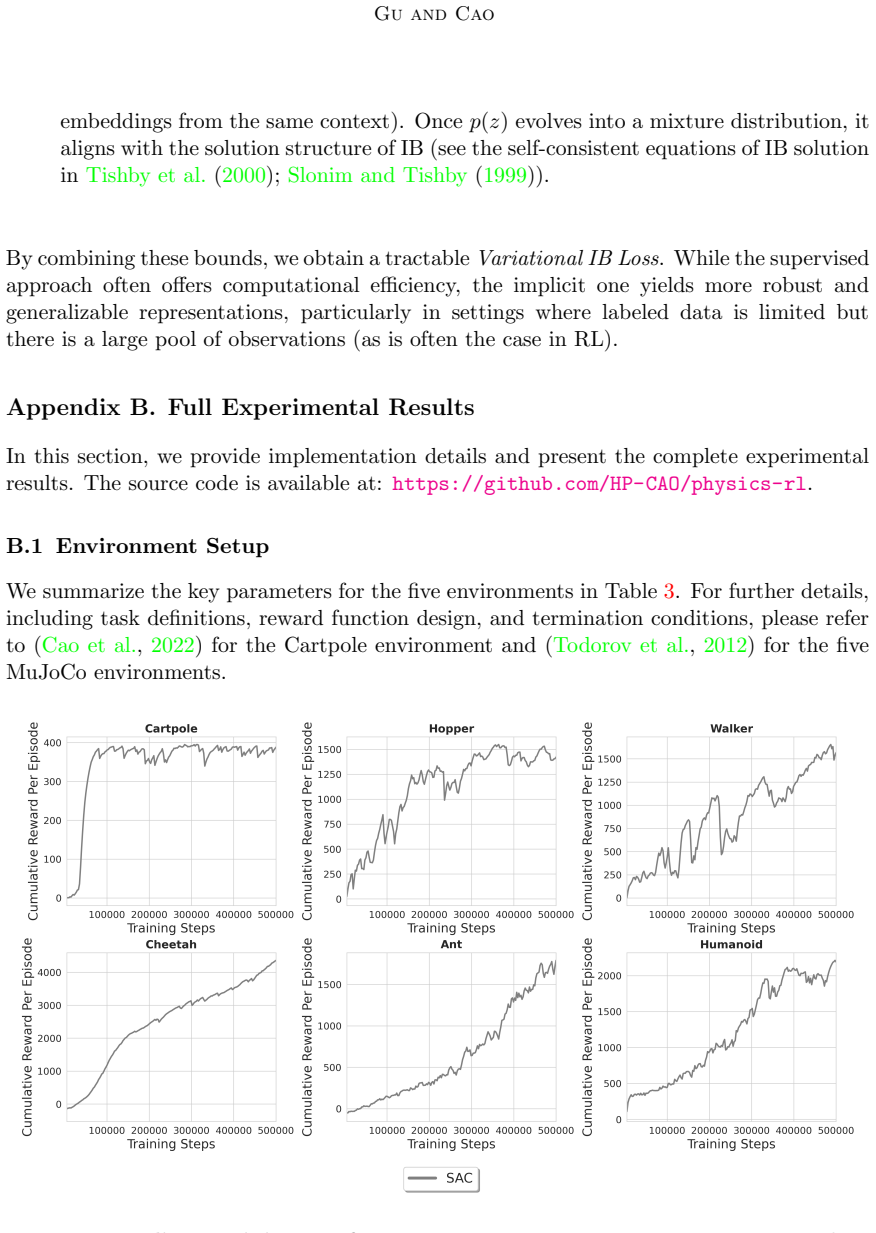
- [Section 7.2, Table 2] The text states that BCPO 'dominates five of the six benchmarks and a close second on the two easiest tasks,' but Table 2 contradicts this. BCPO is best only on Cheetah, Ant, and Humanoid. On CartPole it is third (365.18 vs. ObsAug 418.77 and DR 383.56), on Hopper it is third (1233.72 vs. ObsAug 1477.30 and DR 1266.34), and on Walker it is fourth (1652.02 vs. SPaCE 1762.86, ObsAug 1742.24, and DR 1715.50). These numbers directly contradict the dominance claim that forms the paper's central empirical validation.
minor comments (4)
- [Section 4.3] In the first bullet, 'windon' should be 'window'.
- [Section 7.3] The phrase 'a fact predicted by Lem. 3.3' references no Lemma 3.3 in the manuscript; it should reference Proposition 5 or the replay-gap bound.
- [Section 2.1] Setting γ=1 without explicitly assuming a finite horizon can make expected returns unbounded; the paper later uses a finite horizon T in Eq. (2.1), so the finite-horizon setting should be stated when γ=1 is introduced.
- [Tables 2 and 6] The uncertainty is reported as 'mean ± coefficient of variation'; since the coefficient of variation is a dimensionless ratio, adding it to the mean is not standard. Clarify whether the reported quantity is the standard deviation or the CV.
Circularity Check
No circularity: the derivation chain is definition-plus-theorem based, and BCPO is validated against external benchmarks.
full rationale
Observation sufficiency (Def. 1) and control sufficiency (Defs. 2-3) are defined independently, and the paper connects them through Proposition 2, Theorem 1, and the ELBO of Proposition 3 rather than by identifying one with the other. The information residual Delta-I is derived, not assumed, and Theorem 2 is a substantive equivalence claim; even if its converse is mathematically questionable, that is a correctness or rigor defect, not a circular reduction of an output to an input. BCPO's empirical claims are tested against external baselines (DR, RR, SPaCE, SPDRL, PEARL, MSE, ObsAug) on MuJoCo and CartPole, so the algorithm's success is not forced by the paper's definitions. Self-citations (e.g., Cao et al. 2022 for the CartPole environment and Mao et al. 2023 in the introduction) are not load-bearing. The paper also explicitly lists limitations (variational MI estimators, fixed episode-level contexts), and no load-bearing premise depends on a self-citation chain or a uniqueness theorem imported from the authors' prior work.
Assumptions & free parameters
free parameters (5)
- IB weight annealing schedule β =
1e-4 to 0.1
- Window length k =
10
- Code dimension =
2/4/4/4/15/30 per task
- Number of context clusters / InfoNCE negatives =
8/4 contexts, 7/3 negatives
- Entropy temperature α =
0.1
assumptions (5)
- domain assumption Assumption 1: The length-k processing window O has Bayes error Pe(O) ≤ δ for predicting context C.
- ad hoc to paper Assumption 2: The augmented state (s,z) is Markov for the encoder-policy pair.
- domain assumption Control-as-inference: optimality variable p(o=1|s,a) ∝ exp(r(s,a)).
- ad hoc to paper The evidence uses a trajectory model p(τ|c) with a context-conditioned policy, and the variational distribution q(c,z,τ)=p(c)qφ(z|c)qθ(τ|c,z).
- domain assumption InfoNCE with K negatives is used as a lower bound on I(C;Z), treated as approximately exact.
Cite this review
Pith. "Pith review of Observations Meet Actions: Learning Control-Sufficient Representations for Robust Policy Generalization." pith.science (2026). https://pith.science/paper/VLADR4IF
@misc{pith2026250719437,
  author       = {Pith},
  title        = {Pith review of: Observations Meet Actions: Learning Control-Sufficient Representations for Robust Policy Generalization},
  year         = {2026},
  howpublished = {\url{https://pith.science/paper/VLADR4IF}},
  note         = {Machine review of arXiv:2507.19437}
}
read the original abstract
Capturing latent variations ("contexts") is key to deploying reinforcement-learning (RL) agents beyond their training regime. We recast context-based RL as a dual inference-control problem and formally characterize two properties and their hierarchy: observation sufficiency (preserving all predictive information) and control sufficiency (retaining decision-making relevant information). Exploiting this dichotomy, we derive a contextual evidence lower bound(ELBO)-style objective that cleanly separates representation learning from policy learning and optimizes it with Bottlenecked Contextual Policy Optimization (BCPO), an algorithm that places a variational information-bottleneck encoder in front of any off-policy policy learner. On standard continuous-control benchmarks with shifting physical parameters, BCPO matches or surpasses other baselines while using fewer samples and retaining performance far outside the training regime. The framework unifies theory, diagnostics, and practice for context-based RL.
Figures


Figures from the paper (4 more)



Reference graph
Works this paper leans on
-
[1]
Deep variational information bottleneck
Alexander A Alemi, Ian Fischer, Joshua V Dillon, and Kevin Murphy. Deep variational information bottleneck. arXiv preprint arXiv:1612.00410 ,
-
[9]
Continuous control with deep reinforcement learning
Timothy P Lillicrap, Jonathan J Hunt, Alexander Pritzel, Nicolas Heess, Tom Erez, Yuval Tassa, David Silver, and Daan Wierstra. Continuous control with deep reinforcement learning. arXiv preprint arXiv:1509.02971 ,
-
[11]
Sim-to-real transfer of robotic control with dynamics randomization
Xue Bin Peng, Marcin Andrychowicz, Wojciech Zaremba, and Pieter Abbeel. Sim-to-real transfer of robotic control with dynamics randomization. In 2018 IEEE international conference on robotics and automation (ICRA) , pages 3803–3810. IEEE,
work page 2018
-
[18]
A study on overfitting in deep reinforcement learning
43 Gu and Cao Chiyuan Zhang, Oriol Vinyals, Remi Munos, and Samy Bengio. A study on overfitting in deep reinforcement learning. arXiv preprint arXiv:1804.06893 ,
-
[1960]
Auto-encoding variational bayes
Diederik P Kingma and Max Welling. Auto-encoding variational bayes. arXiv preprint arXiv:1312.6114,
-
[1968]
Learning vision-guided quadrupedal locomotion end-to-end with cross-modal transformers
Ruihan Yang, Minghao Zhang, Nicklas Hansen, Huazhe Xu, and Xiaolong Wang. Learning vision-guided quadrupedal locomotion end-to-end with cross-modal transformers. arXiv preprint arXiv:2107.03996,
-
[1998]
The information bottleneck method
Naftali Tishby, Fernando C Pereira, and William Bialek. The information bottleneck method. arXiv preprint physics/0004057 ,
-
[2000]
Domain randomization for transferring deep neural networks from simulation to the real world
Josh Tobin, Rachel Fong, Alex Ray, Jonas Schneider, Wojciech Zaremba, and Pieter Abbeel. Domain randomization for transferring deep neural networks from simulation to the real world. In 2017 IEEE/RSJ international conference on intelligent robots and systems (IROS), pages 23–30. IEEE,
work page 2017
Show all 18 references
-
[2004]
Mine: mutual information neural estimation
Mohamed Ishmael Belghazi, Aristide Baratin, Sai Rajeswar, Sherjil Ozair, Yoshua Bengio, Aaron Courville, and R Devon Hjelm. Mine: mutual information neural estimation. arXiv preprint arXiv:1801.04062,
-
[2012]
Walter Murray Wonham
doi: 10.1109/IROS.2012.6386109. Walter Murray Wonham. On the separation theorem of stochastic control. SIAM Journal on Control, 6(2):312–326,
2012
-
[2013]
Stochastic latent actor- critic: Deep reinforcement learning with a latent variable model
Alex X Lee, Anusha Nagabandi, Pieter Abbeel, and Sergey Levine. Stochastic latent actor- critic: Deep reinforcement learning with a latent variable model. Advances in Neural Information Processing Systems, 33:741–752, 2020a. Kimin Lee, Younggyo Seo, Seunghyun Lee, Honglak Lee,...
-
[2015]
Generalization in reinforcement learning by soft data augmentation
Nicklas Hansen and Xiaolong Wang. Generalization in reinforcement learning by soft data augmentation. In 2021 IEEE International Conference on Robotics and Automation (ICRA), pages 13611–13617. IEEE,
2021
-
[2016]
Representation learning with contrastive predictive coding
Aaron van den Oord, Yazhe Li, and Oriol Vinyals. Representation learning with contrastive predictive coding. arXiv preprint arXiv:1807.03748 ,
-
[2017]
Mujoco: A physics engine for model-based control
Emanuel Todorov, Tom Erez, and Yuval Tassa. Mujoco: A physics engine for model-based control. In 2012 IEEE/RSJ International Conference on Intelligent Robots and Systems , pages 5026–5033,
2012
-
[2018]
Danijar Hafner, Jurgis Pasukonis, Jimmy Ba, and Timothy Lillicrap
URL https://proceedings.mlr.press/v80/ haarnoja18b.html. Danijar Hafner, Jurgis Pasukonis, Jimmy Ba, and Timothy Lillicrap. Mastering diverse domains through world models. arXiv preprint arXiv:2301.04104 ,
-
[2019]
Eligibility traces for off-policy policy evaluation
Doina Precup, Richard S Sutton, and Satinder Singh. Eligibility traces for off-policy policy evaluation. In ICML, volume 2000, pages 759–766. Citeseer,
2000
-
[2020]
Rma: Rapid motor adap- tation for legged robots
Ashish Kumar, Zipeng Fu, Deepak Pathak, and Jitendra Malik. Rma: Rapid motor adap- tation for legged robots. arXiv preprint arXiv:2107.04034 ,
-
[2023]
Contextual markov decision processes
Assaf Hallak, Dotan Di Castro, and Shie Mannor. Contextual markov decision processes. arXiv preprint arXiv:1502.02259 ,
Reviewed August 15, 2026 · model on record in the stance chip above.
Discussion (0). Continue with ORCID to comment.