REVIEW 4 minor 42 references
Efficient $G_0W_0$ and BSE calculations of heterostructures within an all-electron framework
T0 review · 0 major / 4 minor · reviewed 2026-08-06 · deepseek-v4-flash
Pith's one-line read The expansion-and-addition screening method, ported to the mixed-product basis of (L)APW all-electron codes, reproduces exact $G_0W_0$ and BSE results for weakly bound heterostructures at a fraction of the polarizability cost.
desk verdict A careful, well-validated extension of EAS to all-electron (L)APW with clear derivation; the boundary assumptions are honestly stated, so the paper deserves peer review. read the letter →
The pith
A machine-rendered reading of the paper's core claim, the machinery that carries it, and where it could break.
The reading
What carries the argument
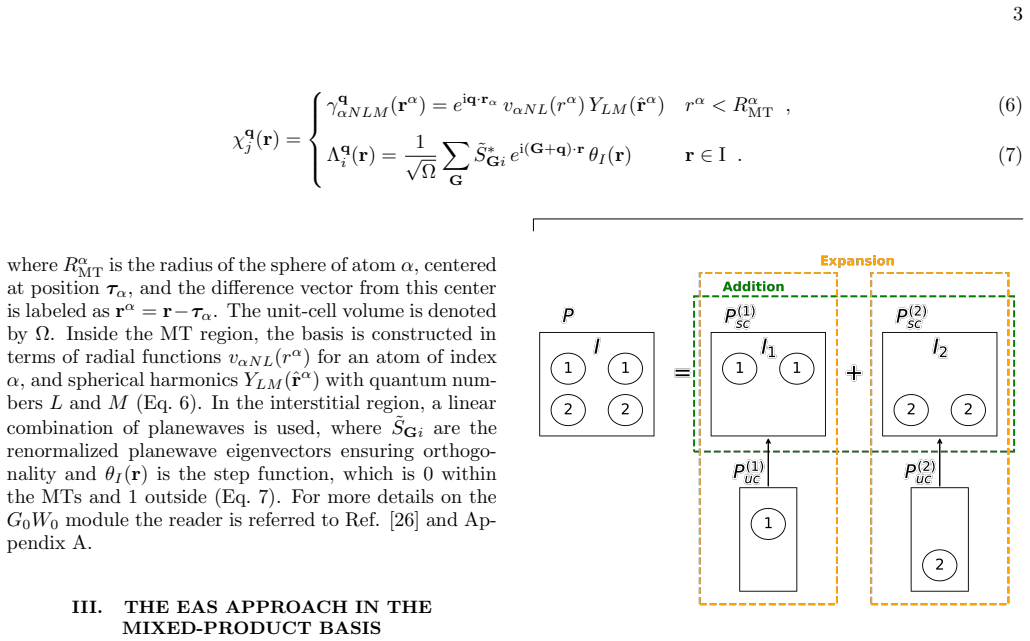
The machinery is the EAS identity $P^{HS}=P^1+P^2$ together with two basis-aware steps. In the expansion step, a polarizability computed in a component's smallest unit cell is folded into the heterostructure supercell using the mapping of reciprocal vectors; in the addition step, the two expanded polarizabilities are superposed by transforming each into the heterostructure's basis via overlap matrices $C^\mu_{aA}$. The mixed-product basis makes this nontrivial: inside muffin-tin spheres it consists of radial functions times spherical harmonics, while in the interstitial region it consists of orthonormalized planewave combinations. The paper shows how each block of the polarizability matrix—muffin-tin, interstitial, and mixed—must be transformed separately, and how the disjointness of the two muffin-tin regions simplifies the addition to a small set of block expressions.
What would settle it
Take a heterostructure whose geometry is optimized after stacking and compute the exact polarizability matrix blocks; compare them with the EAS sum $P^1+P^2$ and with exact $G_0W_0$ gaps. If the difference in fundamental gaps exceeds the roughly $0.04$ eV seen here, the additivity premise fails.
Extended reading notes
Core claim
The central claim is that the expansion-and-addition screening (EAS) ansatz—$P^{HS}=P^1+P^2$, with each component polarizability first folded from its primitive cell to the heterostructure supercell—can be implemented exactly in the mixed-product basis used by all-electron (L)APW codes. The paper derives the required transformations blockwise: muffin-tin matrix elements are folded through a real-to-reciprocal-space sum, interstitial elements through the planewave mapping $\mathbf{q}_{uc}+\mathbf{G}_{uc}=\mathbf{q}+\mathbf{G}$, and mixed blocks by applying the corresponding transformation to rows or columns. For the addition step, the component polarizabilities are transformed into the heterostructure basis with overlap matrices $C^\mu_{aA}=\langle\chi^\mu_a|\chi_A\rangle$, using the fact that muffin-tin spheres of different components are disjoint and their radial functions are assumed identical. The same additive screening is used for the electron-hole interaction in BSE as for $W$ in $G_0W_0$. On bilayer WSe$_2$ and pyridine@MoS$_2$, the method reproduces the exact quasi-particle and optical spectra: fundamental gaps of 2.39 vs 2.41 eV and 2.32 vs 2.36 eV, and optical gaps of 2.63 vs 2.64 eV and 2.00 vs 2.02 eV.
Load-bearing premise
The whole construction rests on the assumption that a heterostructure's polarizability is exactly the sum of its two components' polarizabilities, with atoms sitting at exact replica positions and identical atom-centered basis functions used in both calculations.
Editorial extensions
If this is right
- The polarizability step for pyridine@MoS$_2$ drops from 3511 to 1545 CPU hours in $G_0W_0$ and from 9462 to 2962 CPU hours in BSE, so weakly bound interfaces with large supercells become tractable in all-electron reference calculations.
- Optical absorption spectra inherit the screening from the same additive construction, so BSE exciton physics, not just quasi-particle gaps, is reproduced to within tens of meV.
- Because the expansion step is exact only for exact replicas, one primitive-cell polarizability can be reused for many heterostructures containing the same unrelaxed component, amortizing the cost across a family of interfaces.
- All-electron benchmarks can now target heterostructures too large for direct $G_0W_0$ or BSE reference runs, giving pseudopotential and planewave results a more demanding comparison point.
Reading between the lines
- A natural stress test would be a heterostructure that is relaxed after stacking or binds more strongly; there the exact-replica and additivity assumptions weaken, so the tens-of-meV agreement should degrade, and quantifying this would map the method's validity boundary.
- Since only the polarizability is accelerated, the self-energy and BSE Hamiltonian still dominate; combining EAS with low-rank factorization of those steps could bring total wall-time reductions far beyond the 25–46% reported here.
- The block structure of the addition step should extend recursively to three or more components, so multilayer stacks and multi-molecule hybrid interfaces could reuse the same component polarizabilities without additional screening calculations.
Signed reviews
Editorial analysis
A structured set of objections, weighed in public.
Referee Report
Summary. The paper extends the expansion-and-addition screening (EAS) method, previously developed in a planewave representation, to the mixed-product basis used in the all-electron (L)APW method. It derives the basis transformations for both the expansion step (folding a component's polarizability from its unit cell to a supercell) and the addition step (superposing the polarizabilities of two components), and implements them in the G0W0 and BSE modules of the exciting code. The method is validated on bilayer WSe2 and pyridine@MoS2 against exact reference calculations, showing quasi-particle gap differences of at most 0.04 eV and optical-gap differences of at most 0.02 eV, with reductions in total runtime of about 25% for G0W0 and 46% for BSE.
Significance. If the reported accuracy holds, this is a valuable contribution: it transfers the EAS idea to an all-electron framework, where the mixed-product basis makes the addition and expansion steps nontrivial, and it provides a way to reduce the O(N^4) polarizability cost for weakly bound heterostructures. The paper is commendable for deriving the transformation matrices in Appendix B, for validating against independent exact calculations, and for explicitly stating the exact-replica condition for the expansion step. The main limitation is that the demonstrated accuracy covers the weakly bound, unrelaxed (or replica-exact) regime; the authors acknowledge this, and it does not undermine the stated central claim.
minor comments (4)
- [IV B / Table I] The sentence 'This results in a total runtime of 2962 CPU hours, corresponding to a reduction of almost 70% of the computational time' refers only to the polarizability step; the total BSE runtime is reduced by 46% (7661 vs 14161 CPU hours). Please reword to avoid implying a 70% total reduction.
- [V] The final sentence of the Conclusions is broader than the validated regime: 'heterostructures much larger than those considered so far' invites application to relaxed geometries, for which the expansion step is not exact. Please add a caveat or soften the sentence.
- [III A] The derivation of the MT-MT expansion formula, Eq. (9), is very terse; the origin of the prefactor N_sc/N_uc and the phase factor in the second equality is not self-evident. Please expand the derivation or provide a reference.
- [IV A] There are minor typos: 'the the exact calculation' should be 'the exact calculation' and 'the obtained result show' should be 'the obtained results show'.
Circularity Check
No significant circularity: the EAS extension is an approximation validated against independent exact reference calculations, with no fitted parameters or self-referential definitions.
full rationale
The paper's central claim is that the additive ansatz P_HS = P1 + P2 can be transported from planewave to (L)APW mixed-product basis through expansion and addition transformations. The derivation in Sections III A and III B is self-contained: Eq. 9 maps unit-cell polarizability to supercell by a real-to-reciprocal-space folding, Eq. 12 transforms between mixed-product and planewave representations, and Eq. 14 defines the addition via overlap matrices C. These are not defined in terms of the target G0W0/BSE results. The additive ansatz itself is an approximation, explicitly delimited in Section IV B by the statement that 'the expansion step is only exact if the supercell is an exact replica of the unit cell,' not a definition of the heterostructure polarizability. The validation uses exact reference calculations that are independent of the EAS workflow, and no fitted input is renamed as a prediction; the quantitative agreement (2.39 vs 2.41 eV and 2.32 vs 2.36 eV) is a genuine comparison. The only mild concern is the assumption that radial functions are identical between component and heterostructure (Section III B), but this is a modeling approximation, not a circular reduction. Self-citations, such as Refs. [9], [19], [26], [31], and [32], provide background or prior data and are not load-bearing for the derivation. Consequently, there is no circular step to report.
Assumptions & free parameters
assumptions (3)
- domain assumption The polarizability of the heterostructure equals the sum of the individual component polarizabilities, P = P1 + P2.
- domain assumption The radial functions in the muffin-tin spheres of the individual components are the same as those in the heterostructure.
- domain assumption The supercell is an exact replica of the unit cell for each component (no geometry relaxation).
Cite this review
Pith. "Pith review of Efficient $G_0W_0$ and BSE calculations of heterostructures within an all-electron framework." pith.science (2026). https://pith.science/paper/VLAO7XC3
@misc{pith2026250717960,
  author       = {Pith},
  title        = {Pith review of: Efficient $G_0W_0$ and BSE calculations of heterostructures within an all-electron framework},
  year         = {2026},
  howpublished = {\url{https://pith.science/paper/VLAO7XC3}},
  note         = {Machine review of arXiv:2507.17960}
}
abstract
The combination of two-dimensional materials into heterostructures offers new opportunities for the design of optoelectronic devices with tunable properties. However, computing electronic and optical properties of such systems using state-of-the-art methodology is challenging due to their large unit cells. This is in particular so for highly-precise all-electron calculations within the framework of many-body perturbation theory, which come with high computational costs. Here, we extend an approach that allows for the efficient calculation of the non-interacting polarizability, previously developed for planewave basis sets, to the (linearized) augmented planewave (L)APW method. This approach is based on an additive ansatz, which computes and superposes the polarizabilities of the individual components in their respective unit cells. We implement this formalism in the $G_0W_0$ module of the exciting code and implement an analogous approach for BSE calculations. This allows the calculation of highly-precise optical spectra at low cost. So-obtained results of the quasi-particle band structure and optical spectra are demonstrated for bilayer WSe$_2$ and pyridine@MoS$_2$ in comparison with exact reference calculations.
Figures


Reference graph
Works this paper leans on
-
[1]
P. Wang, C. Jia, Y. Huang, and X. Duan, Matter 4, 552 (2021)
work page 2021
-
[2]
A. Molina-S´ anchez, K. Hummer, and L. Wirtz, Surf. Sci. Rep. 70, 554 (2015)
work page 2015
-
[3]
G. Wang, A. Chernikov, M. M. Glazov, T. F. Heinz, X. Marie, T. Amand, and B. Urbaszek, Rev. Mod. Phys. 90, 021001 (2018)
2018
-
[4]
T. Devakul, V. Cr´ epel, Y. Zhang, and L. Fu, Nat. Com- mun. 12, 6730 (2021)
work page 2021
- [5]
- [6]
- [7]
-
[8]
O. T. Hofmann, E. Zojer, L. H¨ ormann, A. Jeindl, and R. J. Maurer, Phys. Chem. Chem. Phys. 23, 8132 (2021)
work page 2021
Show all 42 references
-
[9]
Gonzalez Oliva, B
I. Gonzalez Oliva, B. Maurer, B. Alex, S. Tillack, M. Schebek, and C. Draxl, Phys. Status Solidi A 221, 2300170 (2024)
2024
-
[10]
Liu, ACS Nano 19, 5861 (2025)
Z.-F. Liu, ACS Nano 19, 5861 (2025)
2025
-
[11]
Benson and N
O. Benson and N. Koch, Phys. Status Solidi A 221, 2300939 (2024)
2024
-
[12]
F. Xuan, Y. Chen, and S. Y. Quek, Journal of Chemical Theory and Computation 15, 3824 (2019)
2019
-
[13]
Z. F. Liu, F. H. D. Jornada, S. G. Louie, and J. B. Neaton, Journal of Chemical Theory and Computation 15, 4218 (2019)
2019
-
[14]
Adeniran and Z
O. Adeniran and Z. F. Liu, J. Chem. Phys. 155, 214702 (2021)
2021
-
[15]
Frimpong and Z
J. Frimpong and Z. F. Liu, J. Phys. Chem. Lett. 15, 2133 (2024)
2024
-
[16]
Palummo, A
M. Palummo, A. N. D’Auria, J. C. Grossman, and G. Ci- cero, J. Phys. Condens. Matter. 31, 235701 (2019)
2019
-
[17]
Wang and B
K. Wang and B. Paulus, Phys. Chem. Chem. Phys. 22, 11936 (2020)
2020
-
[18]
Wang and B
K. Wang and B. Paulus, J. Phys. Chem. C 125, 19544 (2021)
2021
-
[19]
Gonzalez Oliva, F
I. Gonzalez Oliva, F. Caruso, P. Pavone, and C. Draxl, Phys. Rev. Mater. 6, 054004 (2022)
2022
-
[20]
M. S. Hybertsen and S. G. Louie, Phys. Rev. Lett. 55, 1418 (1985)
1985
-
[21]
M. S. Hybertsen and S. G. Louie, Phys. Rev. B 34, 5390 (1986)
1986
-
[22]
P. Liu, M. Kaltak, J. c. v. Klimeˇ s, and G. Kresse, Phys. Rev. B 94, 165109 (2016)
2016
-
[23]
Duchemin and X
I. Duchemin and X. Blase, J. Chem. Theory Comput. 17, 2383 (2021)
2021
-
[24]
Neuhauser, Y
D. Neuhauser, Y. Gao, C. Arntsen, C. Karshenas, E. Ra- bani, and R. Baer, Phys. Rev. Lett. 113, 076402 (2014)
2014
-
[25]
Jiang, R
H. Jiang, R. I. G´ omez-Abal, X. Z. Li, C. Meisen- bichler, C. Ambrosch-Draxl, and M. Scheffler, Com- put. Phys. Commun. 184, 348 (2013)
2013
-
[26]
Nabok, A
D. Nabok, A. Gulans, and C. Draxl, Phys. Rev. B 94, 035118 (2016)
2016
-
[27]
X. Ren, P. Rinke, V. Blum, J. Wieferink, A. Tkatchenko, A. Sanfilippo, K. Reuter, and M. Scheffler, New Journal of Physics 14, 053020 (2012)
2012
-
[28]
Lejaeghere, G
K. Lejaeghere, G. Bihlmayer, T. Bj¨ orkman, P. Blaha, S. Bl¨ ugel, V. Blum, D. Caliste, I. E. Castelli, S. J. Clark, A. D. Corso, S. de Gironcoli, T. Deutsch, J. K. Dewhurst, I. D. Marco, C. Draxl, M. Du lak, O. Eriks- son, J. A. Flores-Livas, K. F. Garrity, L. Genovese, P. Gi...
2016
-
[29]
Azizi, F
M. Azizi, F. A. Delesma, M. Giantomassi, D. Zavickis, M. Kuisma, K. Thyghesen, D. Golze, A. Buccheri, M.-Y. Zhang, P. Rinke, C. Draxl, A. Gulans, and X. Gonze, Computational Materials Science 250, 113655 (2025)
2025
-
[30]
D. J. Singh and L. Nordstr¨ om, Planewaves, Pseudopotentials, and the LAPW Method (Springer New York, NY, 2005)
2005
-
[31]
Gulans, S
A. Gulans, S. Kontur, C. Meisenbichler, D. Nabok, P. Pavone, S. Rigamonti, S. Sagmeister, U. Werner, and C. Draxl, J. Phys. Condens. Matter. 26, 363202 (2014)
2014
-
[32]
Vorwerk, B
C. Vorwerk, B. Aurich, C. Cocchi, and C. Draxl, Elec- tron. Struct. 1, 037001 (2019). 11
2019
-
[33]
Rohlfing and S
M. Rohlfing and S. G. Louie, Phys. Rev. B 62, 4927 (2000)
2000
-
[34]
Friedrich, S
C. Friedrich, S. Bl¨ ugel, and A. Schindlmayr, Phys. Rev. B 81, 125102 (2010)
2010
-
[35]
J. He, K. Hummer, and C. Franchini, Phys. Rev. B 89, 075409 (2014)
2014
-
[36]
Tkatchenko and M
A. Tkatchenko and M. Scheffler, Phys. Rev. Lett. 102, 073005 (2009)
2009
-
[37]
Tkatchenko, L
A. Tkatchenko, L. Romaner, O. T. Hofmann, E. Zojer, C. Ambrosch-Draxl, and M. Scheffler, MRS Bulletin 35, 435 (2010)
2010
-
[38]
Rodrigues Pela, C
R. Rodrigues Pela, C. Vona, S. Lubeck, B. Alex, I. Gon- zalez Oliva, and C. Draxl, npj Comput. Mater. 10, 77 (2024)
2024
-
[39]
Haastrup, M
S. Haastrup, M. Strange, M. Pandey, T. Deilmann, P. S. Schmidt, N. F. Hinsche, M. N. Gjerding, D. Torelli, P. M. Larsen, A. C. Riis-Jensen, J. Gath, K. W. Jacobsen, J. J. Mortensen, T. Olsen, and K. S. Thygesen, 2D Materials 5, 042002 (2018)
2018
-
[40]
M. N. Gjerding, A. Taghizadeh, A. Rasmussen, S. Ali, F. Bertoldo, T. Deilmann, N. R. Knøsgaard, M. Kruse, A. H. Larsen, S. Manti, T. G. Pedersen, U. Petralanda, T. Skovhus, M. K. Svendsen, J. J. Mortensen, T. Olsen, and K. S. Thygesen, 2D Materials 8, 044002 (2021)
2021
-
[41]
CPU hours are defined as the number of processors used multiplied by the number of wall-time hours needed for the calculation
-
[42]
Henneke, L
F. Henneke, L. Lin, C. Vorwerk, C. Draxl, R. Klein, and C. Yang, Comm. App. Math. Comp. Sci. 15, 89 (2020)
2020
Reviewed August 6, 2026 · model on record in the stance chip above.
Discussion (0). Continue with ORCID to comment.