REVIEW 1 major objections 4 minor 58 references
Rate-Utility Frontiers for Language Encodings: Comparing Tokens, Bytes, and Pixels Under Controlled Linguistic Content
T0 review · 1 major / 4 minor · reviewed 2026-08-01 · deepseek-v4-flash
Pith's one-line read This paper argues that when the same sentences and the same latent capacity are given to all three, no encoding wins across tasks: pixels hold onto written form, bytes keep cross-lingual alignment, and tokens best preserve topic information
desk verdict Controlled comparison of token/byte/pixel encodings that mostly delivers, but the token advantage in topic classification looks confounded by parameter count. read the letter →
The pith
A machine-rendered reading of the paper's core claim, the machinery that carries it, and where it could break.
The reading
What carries the argument
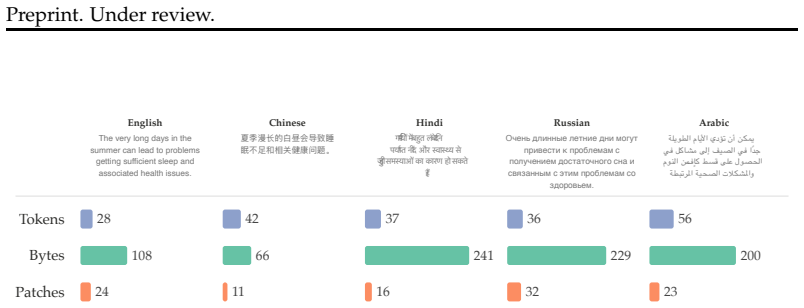
The rate-utility frontier itself. A single learned query compresses the encoder output into one vector of width D; sweeping D from 256 down to 1, while content stays parallel and identical across languages, traces how much of each utility survives compression. This separates the number of input positions (source rate), the latent capacity granted downstream, and the task-relevant information that remains.
What would settle it
Train the same three encodings at substantially larger scale and document length on parallel data and evaluate the same three utilities through the same bottleneck. If one encoding then wins on all three tasks at a single bottleneck width, the 'no encoding dominates' claim fails; alternatively, if byte alignment advantages vanish in same-script regimes at scale, the specific ranking does not generalize.
Extended reading notes
Core claim
Under controlled content and controlled capacity, tokens, bytes, and pixels trace crossing rate-utility frontiers rather than a single order of merit. Pixels reconstruct the surface of a sentence most compactly (near-perfect retrieval down to a latent width of 48 in multilingual regimes); bytes align translations across languages most reliably, especially when languages share a script; tokens dominate topic classification in every regime, aided by their dense meaning-bearing units. The frontiers cross because each encoding stores information in a different way: pixels spend capacity on visual detail, bytes on exact character structure, tokens on lexical identity.
Load-bearing premise
The frontiers are measured with small models trained from scratch on 701 parallel sentences per language; the paper's claim that these rankings reflect how the encodings behave in large pretrained systems rests on an assumption the authors state explicitly in the appendix: scale, data mixture, tokenizer training, and hardware optimality 'may shift the frontiers.'
Editorial extensions
If this is right
- Encoding choice should be tuned per task rather than treated as a fixed preprocessing step.
- For multilingual retrieval and sentence alignment, byte encodings deserve stronger consideration, especially within a shared script.
- For encoder-style classification, subword tokens remain the strongest default among the three tested.
- Pixels are a compute-cheap, compact input interface for surface-sensitive and dense-script applications, but they spend their capacity on visual detail rather than meaning.
- Compute accounting changes the practical verdict: the byte advantage in alignment is cheap within a script (1.4–1.6× token FLOPs) but expensive across scripts (4.2×), where it nearly disappears.
Reading between the lines
- If these frontiers hold at scale, token-centric pretraining may be systematically sacrificing cross-lingual alignment; hybrid byte-token or byte-aware architectures are a natural next test.
- A testable extension: training pixel encoders with an auxiliary objective that ties visual form to token or semantic meaning could lift their near-floor performance on topic classification without losing surface preservation.
- The Chinese case suggests script properties (morpheme density, character-to-meaning mapping) predict which encoding wins; one could build a script-characteristic-based selector for encoding choice.
- The 'short inputs can discard useful meaning' result implies that average sequence length or tokenizer fertility is an incomplete proxy for comparing encodings; utility must be measured, not inferred from rate.
Editorial analysis
A structured set of objections, weighed in public.
Referee Report
Summary. The paper proposes a controlled comparison of three input encodings—subword tokens, UTF-8 bytes, and rendered pixel patches—on parallel SIB-200 sentences across five language regimes (monolingual English/Chinese, Latin-5, Cyrillic-5, Multiscript-5). A shared Transformer encoder compresses every encoding through a single-query bottleneck of width D swept from 256 down to 1, so that downstream representational capacity is fixed while content is held constant. The paper measures source rates, form preservation (self-retrieval), cross-lingual retrieval, topic classification, and training FLOPs. The main empirical claim is that no encoding dominates: pixels preserve surface form best, bytes preserve cross-lingual alignment best (especially in same-script regimes), and tokens support topic classification best; these rankings are not explained by source length alone. The paper includes compute accounting, five-seed averaging, validation-based checkpoint selection, and a zero-padding FLOP robustness check.
Significance. The controlled parallel-corpus bottleneck design is a valuable contribution: it separates source rate from post-encoding capacity and provides a template for comparing representations that differ in both sequence length and unit type. The compute accounting is unusually careful, and the paper ships code. If the rankings hold, the practical conclusion—encoding choice should be task-, language-, and capacity-dependent rather than a fixed preprocessing default—is well supported and would be useful to the field. The main caveat is that the topic-classification pillar of the central claim is vulnerable to a parameter-count confound (Table 4), which the paper discloses but does not control for.
major comments (1)
- [§4.4, Table 4, §3.3] The topic-classification result that anchors the central claim ('tokens support topic prediction best') may reflect parameter allocation rather than an intrinsic property of subword encoding. At D=256, token models in Latin-5, Cyrillic-5, and Multiscript-5 have 13.8M parameters versus 5.6M (bytes) and 5.9M (pixels); 8.2M of this difference is the 32,000-entry embedding table. Bottleneck width D is held fixed, but total front-end capacity is not. With only 701 training sentences per language, the extra embedding capacity can memorize topic-correlated vocabulary, and the reported token margin (macro-F1 0.46–0.50 vs 0.26–0.30 for bytes at D=256) is exactly where such a capacity advantage would be easiest to exploit. Appendix A acknowledges that the small dataset does not punish large vocabularies, but it does not address this parameter asymmetry as a threat to the topic ranking. Please add
minor comments (4)
- [Table 4] The 'Token Vocabulary' column is ambiguous: for English it reports 11,653 and for Chinese 4,265, while 32,000 is the SentencePiece vocabulary size. Please clarify whether these are the numbers of distinct observed tokens in the training data or the effective vocabulary sizes after pruning, and note the discrepancy in the caption.
- [§4.2] The text says bytes overtake 'below about D=10' in Latin-5 and Cyrillic-5; at D=8 the byte lead is 0.34 vs 0.30 for pixels. Since this is used to support the 'capacity regime' argument, consider marking the crossing point directly in Figure 3, and report whether the crossing is consistent across seeds.
- [Appendix A] The limitation 'the token models are not strongly punished for large vocabularies' is useful, but it should be tied explicitly to the parameter-count asymmetry in Table 4; otherwise the reader may not connect it to the topic-classification confound.
- [Abstract / §4.4] The sentence 'Tokens dominate every regime' is stated without the scope qualifier; consider 'dominate in the tested regimes' given the small-data caveats in Appendix A.
Circularity Check
No significant circularity: the paper is an empirical rate-utility comparison against an external benchmark, with no fitted parameter defined in terms of the claimed rankings.
full rationale
The central claims are measured outcomes of models trained and evaluated on SIB-200, an external human-translated benchmark. The bottleneck width D is a controlled variable, and no parameter is fitted to the target rankings: tokenizers are trained on Bible text, checkpoints are selected on validation, and all reported numbers are test-set results. The token/byte/pixel rankings are therefore empirical findings, not algebraic consequences of the setup. Self-citations (Rust et al. 2023 for the patch projection; Kesen et al. 2025 for multilingual pixel pretraining) supply standard methods and prior context; they are not used as a uniqueness theorem or as the sole justification for the conclusions, so they are not load-bearing in a circular sense. The form-preservation probe does operationalize 'surface form' as each encoding's own adapter output, which is a construct-validity limitation rather than a circular reduction: the winner is not analytically forced, and the paper's own account attributes the pixel advantage to distinctive image structure and shorter input sequences. The larger embedding tables of token models are a potential capacity confound for the topic-classification ranking, but the paper discloses parameter counts, and the ranking is not an algebraic transform of those counts; this is a correctness/generalization concern, not circularity. Appendix A explicitly concedes that scale, data mixture, and hardware may shift the frontiers, further confirming that the authors do not present the results as deriving from the control definitions alone.
Assumptions & free parameters
free parameters (4)
- SentencePiece vocabulary size =
32,000
- Pixel rendering geometry =
36x32 patches, font size 16, max height 36
- Encoder hidden size and depth =
256 hidden, 6 layers, 4 heads
- Early stopping patience and minimum epochs =
30 epochs patience, 30 minimum
assumptions (5)
- domain assumption SIB-200 is a faithful human-parallel dataset; each sentence has the same meaning and topic label across languages.
- domain assumption A single-learned-query bottleneck of width D fixes downstream representational capacity identically for all encodings.
- domain assumption InfoNCE self-retrieval, contrastive cross-lingual retrieval, and linear topic probes measure surface form, alignment, and semantic prediction respectively.
- domain assumption Per-regime SentencePiece on parallel Bible text, raw UTF-8 bytes, and grayscale Noto patches are representative token/byte/pixel encodings.
- domain assumption Models trained from scratch on 701 sentences per language reveal encoding properties that persist at pretraining scale.
Cite this review
Pith. "Pith review of Rate-Utility Frontiers for Language Encodings: Comparing Tokens, Bytes, and Pixels Under Controlled Linguistic Content." pith.science (2026). https://pith.science/paper/VLJ5Y4F3
@misc{pith2026260716117,
  author       = {Pith},
  title        = {Pith review of: Rate-Utility Frontiers for Language Encodings: Comparing Tokens, Bytes, and Pixels Under Controlled Linguistic Content},
  year         = {2026},
  howpublished = {\url{https://pith.science/paper/VLJ5Y4F3}},
  note         = {Machine review of arXiv:2607.16117}
}
read the original abstract
Language models encode text as subword tokens, raw bytes, or rendered pixels, but these encodings are usually compared under modeling constraints that expose different amounts of linguistic content to models across different languages. We instead ask what each encoding preserves when both the content and the downstream capacity are controlled. Using verified parallel sentences across thirteen languages and five scripts, we compare tokens, bytes, and pixels through a shared bottleneck whose width is swept to trace rate-utility frontiers. This separates three quantities that are often conflated: the number of input positions an encoding creates, the latent capacity available after encoding, and the task-relevant information that survives compression. We evaluate three utilities: surface form preservation, cross-lingual sentence alignment, and topic classification. No encoding dominates across tasks or capacity regimes. Pixels preserve surface form best, bytes preserve cross-lingual alignment best, especially in same-script multilingual settings, and tokens support topic prediction best. These performances are not explained by sequence length alone. Short inputs can discard useful meaning, while long inputs can preserve information that compresses well. Choosing an encoding is therefore not a fixed preference for tokens, bytes, or pixels, but a rate-utility tradeoff that depends on the task, language mix, capacity regime, and compute budget.
Figures


Figures from the paper (7 more)


Reference graph
Works this paper leans on
-
[1]
Alabi, Yanke Mao, Haonan Gao, and En-Shiun Annie Lee
David Ifeoluwa Adelani, Hannah Liu, Xiaoyu Shen, Nikita Vassilyev, Jesujoba O. Alabi, Yanke Mao, Haonan Gao, and En-Shiun Annie Lee. SIB -200: A simple, inclusive, and big evaluation dataset for topic classification in 200+ languages and dialects. In Yvette Graham and Matthew Purver (eds.), Proceedings of the 18th Conference of the European Chapter of the...
2024
-
[2]
Do all languages cost the same? tokenization in the era of commercial language models
Orevaoghene Ahia, Sachin Kumar, Hila Gonen, Jungo Kasai, David Mortensen, Noah Smith, and Yulia Tsvetkov. Do all languages cost the same? tokenization in the era of commercial language models. In Houda Bouamor, Juan Pino, and Kalika Bali (eds.), Proceedings of the 2023 Conference on Empirical Methods in Natural Language Processing, pp.\ 9904--9923, Singap...
-
[3]
Massively multilingual sentence embeddings for zero-shot cross-lingual transfer and beyond
Mikel Artetxe and Holger Schwenk. Massively multilingual sentence embeddings for zero-shot cross-lingual transfer and beyond. Transactions of the Association for Computational Linguistics, 7: 0 597--610, 2019. doi:10.1162/tacl_a_00288. URL https://aclanthology.org/Q19-1038/
-
[4]
Ehsaneddin Asgari, Yassine El Kheir, and Mohammad Ali Sadraei Javaheri. Morphbpe: A morpho-aware tokenizer bridging linguistic complexity for efficient llm training across morphologies, 2025. URL https://arxiv.org/abs/2502.00894
arXiv 2025
-
[5]
Iz Beltagy, Matthew E. Peters, and Arman Cohan. Longformer: The long-document transformer, 2020. URL https://arxiv.org/abs/2004.05150
arXiv 2020
-
[6]
A massively parallel corpus: the bible in 100 languages
Christos Christodouloupoulos and Mark Steedman. A massively parallel corpus: the bible in 100 languages. Lang. Resour. Eval., 49 0 (2): 0 375–395, June 2015. ISSN 1574-020X. doi:10.1007/s10579-014-9287-y. URL https://doi.org/10.1007/s10579-014-9287-y
-
[7]
Clark, Dan Garrette, Iulia Turc, and John Wieting
Jonathan H. Clark, Dan Garrette, Iulia Turc, and John Wieting. Canine: Pre-training an efficient tokenization-free encoder for language representation. Transactions of the Association for Computational Linguistics, 10: 0 73--91, 2022. doi:10.1162/tacl_a_00448. URL https://aclanthology.org/2022.tacl-1.5/
-
[8]
BERT : Pre-training of deep bidirectional transformers for language understanding
Jacob Devlin, Ming-Wei Chang, Kenton Lee, and Kristina Toutanova. BERT : Pre-training of deep bidirectional transformers for language understanding. In Jill Burstein, Christy Doran, and Thamar Solorio (eds.), Proceedings of the 2019 Conference of the North A merican Chapter of the Association for Computational Linguistics: Human Language Technologies, Vol...
doi:10.18653/v1/ 2019
Show all 58 references
-
[9]
Multiscale byte language models -- a hierarchical architecture for causal million-length sequence modeling
Eric Egli, Matteo Manica, and Jannis Born. Multiscale byte language models -- a hierarchical architecture for causal million-length sequence modeling. In ICML 2025 Workshop on Long-Context Foundation Models, 2025. URL https://openreview.net/forum?id=2r7YTSdWYD
2025
-
[10]
O mer Veysel C a g atan, Akash Kundu, Martin Bernstorff, Shitao Xiao, Akshita Sukhlecha, Bhavish Pahwa, Rafa Po \'s wiata, Kranthi Kiran GV, Shawon Ashraf, Daniel Auras, Bj \
Kenneth Enevoldsen, Isaac Chung, Imene Kerboua, M \'a rton Kardos, Ashwin Mathur, David Stap, Jay Gala, Wissam Siblini, Dominik Krzemi \'n ski, Genta Indra Winata, Saba Sturua, Saiteja Utpala, Mathieu Ciancone, Marion Schaeffer, Diganta Misra, Shreeya Dhakal, Jonathan Rystr m,...
2025
-
[11]
Glm-5: from vibe coding to agentic engineering, 2026
GLM-5-Team, :, Aohan Zeng, Xin Lv, Zhenyu Hou, Zhengxiao Du, Qinkai Zheng, Bin Chen, Da Yin, Chendi Ge, Chenghua Huang, Chengxing Xie, Chenzheng Zhu, Congfeng Yin, Cunxiang Wang, Gengzheng Pan, Hao Zeng, Haoke Zhang, Haoran Wang, Huilong Chen, Jiajie Zhang, Jian Jiao, Jiaqi Gu...
2026 arXiv
-
[12]
Aaron Grattafiori, Abhimanyu Dubey, Abhinav Jauhri, Abhinav Pandey, Abhishek Kadian, Ahmad Al-Dahle, Aiesha Letman, Akhil Mathur, Alan Schelten, Alex Vaughan, Amy Yang, Angela Fan, Anirudh Goyal, Anthony Hartshorn, Aobo Yang, Archi Mitra, Archie Sravankumar, Artem Korenev, Art...
2024 arXiv
-
[13]
Bitext mining using distilled sentence representations for low-resource languages
Kevin Heffernan, Onur C elebi, and Holger Schwenk. Bitext mining using distilled sentence representations for low-resource languages. In Yoav Goldberg, Zornitsa Kozareva, and Yue Zhang (eds.), Findings of the Association for Computational Linguistics: EMNLP 2022, pp.\ 2101--21...
2022 doi
-
[14]
HTML Bible Index -- Ukrainian
HTML Bible . HTML Bible Index -- Ukrainian . https://www.htmlbible.com/sacrednamebiblecom/ukrainian/index.htm, 2026. Accessed: 2026-05
2026
-
[15]
Perceiver: General perception with iterative attention
Andrew Jaegle, Felix Gimeno, Andy Brock, Oriol Vinyals, Andrew Zisserman, and Joao Carreira. Perceiver: General perception with iterative attention. In Marina Meila and Tong Zhang (eds.), Proceedings of the 38th International Conference on Machine Learning, volume 139 of Proce...
2021
-
[16]
Ticls: Tightly coupled language text spotter
Leeje Jang, Yijun Lin, Yao-Yi Chiang, and Jerod Weinman. Ticls: Tightly coupled language text spotter. In Proceedings of the IEEE/CVF Winter Conference on Applications of Computer Vision (WACV), pp.\ 3730--3740, March 2026
2026
-
[17]
Lotz, Ingo Ziegler, Phillip Rust, and Desmond Elliott
Ilker Kesen, Jonas F. Lotz, Ingo Ziegler, Phillip Rust, and Desmond Elliott. Multilingual pretraining for pixel language models. In Christos Christodoulopoulos, Tanmoy Chakraborty, Carolyn Rose, and Violet Peng (eds.), Proceedings of the 2025 Conference on Empirical Methods in...
2025 doi
-
[18]
Supervised contrastive learning
Prannay Khosla, Piotr Teterwak, Chen Wang, Aaron Sarna, Yonglong Tian, Phillip Isola, Aaron Maschinot, Ce Liu, and Dilip Krishnan. Supervised contrastive learning. In H. Larochelle, M. Ranzato, R. Hadsell, M.F. Balcan, and H. Lin (eds.), Advances in Neural Information Processi...
2020
-
[19]
Ocr-free document understanding transformer
Geewook Kim, Teakgyu Hong, Moonbin Yim, JeongYeon Nam, Jinyoung Park, Jinyeong Yim, Wonseok Hwang, Sangdoo Yun, Dongyoon Han, and Seunghyun Park. Ocr-free document understanding transformer. In Computer Vision – ECCV 2022: 17th European Conference, Tel Aviv, Israel, October 23...
2022 doi
-
[20]
Adam: A method for stochastic optimization
Diederik P Kingma and Jimmy Ba. Adam: A method for stochastic optimization. In International Conference on Learning Representations (ICLR), 2015
2015
-
[21]
E uroparl: A parallel corpus for statistical machine translation
Philipp Koehn. E uroparl: A parallel corpus for statistical machine translation. In Proceedings of Machine Translation Summit X: Papers, pp.\ 79--86, Phuket, Thailand, September 13-15 2005. URL https://aclanthology.org/2005.mtsummit-papers.11/
2005
-
[22]
Subword regularization: Improving neural network translation models with multiple subword candidates
Taku Kudo. Subword regularization: Improving neural network translation models with multiple subword candidates. In Iryna Gurevych and Yusuke Miyao (eds.), Proceedings of the 56th Annual Meeting of the Association for Computational Linguistics (Volume 1: Long Papers), pp.\ 66-...
2018 doi
-
[23]
S entence P iece: A simple and language independent subword tokenizer and detokenizer for neural text processing
Taku Kudo and John Richardson. S entence P iece: A simple and language independent subword tokenizer and detokenizer for neural text processing. In Eduardo Blanco and Wei Lu (eds.), Proceedings of the 2018 Conference on Empirical Methods in Natural Language Processing: System ...
2018 doi
-
[24]
P ix2 S truct: Screenshot parsing as pretraining for visual language understanding
Kenton Lee, Mandar Joshi, Iulia Raluca Turc, Hexiang Hu, Fangyu Liu, Julian Martin Eisenschlos, Urvashi Khandelwal, Peter Shaw, Ming-Wei Chang, and Kristina Toutanova. P ix2 S truct: Screenshot parsing as pretraining for visual language understanding. In Andreas Krause, Emma B...
2023
-
[25]
Trocr: transformer-based optical character recognition with pre-trained models
Minghao Li, Tengchao Lv, Jingye Chen, Lei Cui, Yijuan Lu, Dinei Florencio, Cha Zhang, Zhoujun Li, and Furu Wei. Trocr: transformer-based optical character recognition with pre-trained models. In Proceedings of the Thirty-Seventh AAAI Conference on Artificial Intelligence and T...
2023
-
[26]
Tokenization impacts multilingual language modeling: Assessing vocabulary allocation and overlap across languages
Tomasz Limisiewicz, Ji r \'i Balhar, and David Mare c ek. Tokenization impacts multilingual language modeling: Assessing vocabulary allocation and overlap across languages. In Anna Rogers, Jordan Boyd-Graber, and Naoaki Okazaki (eds.), Findings of the Association for Computati...
2023 doi
-
[27]
Character-aware models improve visual text rendering
Rosanne Liu, Dan Garrette, Chitwan Saharia, William Chan, Adam Roberts, Sharan Narang, Irina Blok, Rj Mical, Mohammad Norouzi, and Noah Constant. Character-aware models improve visual text rendering. In Anna Rogers, Jordan Boyd-Graber, and Naoaki Okazaki (eds.), Proceedings of...
2023 doi
-
[28]
Glyph-byt5: A customized text encoder for accurate visual text rendering
Zeyu Liu, Weicong Liang, Zhanhao Liang, Chong Luo, Ji Li, Gao Huang, and Yuhui Yuan. Glyph-byt5: A customized text encoder for accurate visual text rendering. In Computer Vision – ECCV 2024: 18th European Conference, Milan, Italy, September 29–October 4, 2024, Proceedings, Par...
2024 doi
-
[29]
Decoupled weight decay regularization
Ilya Loshchilov and Frank Hutter. Decoupled weight decay regularization. In International Conference on Learning Representations, 2019. URL https://openreview.net/forum?id=Bkg6RiCqY7
2019
-
[30]
Beyond fertility: STRR as a metric for multilingual tokenization evaluation
Mir Tafseer Nayeem, Sawsan Alqahtani, Md Tahmid Rahman Laskar, Tasnim Mohiuddin, and M Saiful Bari. Beyond fertility: STRR as a metric for multilingual tokenization evaluation. In NeurIPS 2025 Workshop on Evaluating the Evolving LLM Lifecycle: Benchmarks, Emergent Abilities, a...
2025
-
[31]
Hierarchical autoregressive transformers: Combining byte- and word-level processing for robust, adaptable language models
Pit Neitemeier, Bj \"o rn Deiseroth, Constantin Eichenberg, and Lukas Balles. Hierarchical autoregressive transformers: Combining byte- and word-level processing for robust, adaptable language models. In The Thirteenth International Conference on Learning Representations, 2025...
2025
-
[32]
NLLB Team , Marta R. Costa-jussà, James Cross, Onur Çelebi, Maha Elbayad, Kenneth Heafield, Kevin Heffernan, Elahe Kalbassi, Janice Lam, Daniel Licht, Jean Maillard, Anna Sun, Skyler Wang, Guillaume Wenzek, Al Youngblood, Bapi Akula, Loic Barrault, Gabriel Mejia Gonzalez, Pran...
2022 arXiv
-
[33]
Byte latent transformer: Patches scale better than tokens
Artidoro Pagnoni, Ramakanth Pasunuru, Pedro Rodriguez, John Nguyen, Benjamin Muller, Margaret Li, Chunting Zhou, Lili Yu, Jason E Weston, Luke Zettlemoyer, Gargi Ghosh, Mike Lewis, Ari Holtzman, and Srini Iyer. Byte latent transformer: Patches scale better than tokens. In Wanx...
2025
-
[34]
Language model tokenizers introduce unfairness between languages
Aleksandar Petrov, Emanuele La Malfa, Philip Torr, and Adel Bibi. Language model tokenizers introduce unfairness between languages. In A. Oh, T. Naumann, A. Globerson, K. Saenko, M. Hardt, and S. Levine (eds.), Advances in Neural Information Processing Systems, volume 36, pp.\...
2023
-
[35]
Language Models are Unsupervised Multitask Learners , 2019
Alec Radford, Jeffrey Wu, Rewon Child, David Luan, Dario Amodei, and Ilya Sutskever. Language Models are Unsupervised Multitask Learners , 2019. URL https://cdn.openai.com/better-language-models/language_models_are_unsupervised_multitask_learners.pdf
2019
-
[36]
Learning transferable visual models from natural language supervision
Alec Radford, Jong Wook Kim, Chris Hallacy, Aditya Ramesh, Gabriel Goh, Sandhini Agarwal, Girish Sastry, Amanda Askell, Pamela Mishkin, Jack Clark, Gretchen Krueger, and Ilya Sutskever. Learning transferable visual models from natural language supervision. In Marina Meila and ...
2021
-
[37]
When every token counts: Optimal segmentation for low-resource language models
Bharath Raj S, Garvit Suri, Vikrant Dewangan, and Raghav Sonavane. When every token counts: Optimal segmentation for low-resource language models. In Hansi Hettiarachchi, Tharindu Ranasinghe, Paul Rayson, Ruslan Mitkov, Mohamed Gaber, Damith Premasiri, Fiona Anting Tan, and La...
2025
-
[38]
Making monolingual sentence embeddings multilingual using knowledge distillation
Nils Reimers and Iryna Gurevych. Making monolingual sentence embeddings multilingual using knowledge distillation. In Bonnie Webber, Trevor Cohn, Yulan He, and Yang Liu (eds.), Proceedings of the 2020 Conference on Empirical Methods in Natural Language Processing (EMNLP), pp.\...
2020 doi
-
[39]
How good is your tokenizer? on the monolingual performance of multilingual language models
Phillip Rust, Jonas Pfeiffer, Ivan Vuli \'c , Sebastian Ruder, and Iryna Gurevych. How good is your tokenizer? on the monolingual performance of multilingual language models. In Chengqing Zong, Fei Xia, Wenjie Li, and Roberto Navigli (eds.), Proceedings of the 59th Annual Meet...
2021
-
[40]
Lotz, Emanuele Bugliarello, Elizabeth Salesky, Miryam de Lhoneux, and Desmond Elliott
Phillip Rust, Jonas F. Lotz, Emanuele Bugliarello, Elizabeth Salesky, Miryam de Lhoneux, and Desmond Elliott. Language modelling with pixels. In The Eleventh International Conference on Learning Representations, 2023. URL https://openreview.net/forum?id=FkSp8VW8RjH
2023
-
[41]
Robust open-vocabulary translation from visual text representations
Elizabeth Salesky, David Etter, and Matt Post. Robust open-vocabulary translation from visual text representations. In Marie-Francine Moens, Xuanjing Huang, Lucia Specia, and Scott Wen-tau Yih (eds.), Proceedings of the 2021 Conference on Empirical Methods in Natural Language ...
2021 doi
-
[42]
Neural machine translation of rare words with subword units
Rico Sennrich, Barry Haddow, and Alexandra Birch. Neural machine translation of rare words with subword units. In Katrin Erk and Noah A. Smith (eds.), Proceedings of the 54th Annual Meeting of the Association for Computational Linguistics (Volume 1: Long Papers), pp.\ 1715--17...
2016 doi
-
[43]
Dropout: A simple way to prevent neural networks from overfitting
Nitish Srivastava, Geoffrey Hinton, Alex Krizhevsky, Ilya Sutskever, and Ruslan Salakhutdinov. Dropout: A simple way to prevent neural networks from overfitting. Journal of Machine Learning Research, 15 0 (56): 0 1929--1958, 2014. URL http://jmlr.org/papers/v15/srivastava14a.html
1929
-
[44]
Roformer: Enhanced transformer with rotary position embedding
Jianlin Su, Murtadha Ahmed, Yu Lu, Shengfeng Pan, Wen Bo, and Yunfeng Liu. Roformer: Enhanced transformer with rotary position embedding. Neurocomput., 568 0 (C), February 2024. ISSN 0925-2312. doi:10.1016/j.neucom.2023.127063. URL https://doi.org/10.1016/j.neucom.2023.127063
2024
-
[45]
Tran, Sebastian Ruder, Jai Gupta, Hyung Won Chung, Dara Bahri, Zhen Qin, Simon Baumgartner, Cong Yu, and Donald Metzler
Yi Tay, Vinh Q. Tran, Sebastian Ruder, Jai Gupta, Hyung Won Chung, Dara Bahri, Zhen Qin, Simon Baumgartner, Cong Yu, and Donald Metzler. Charformer: Fast character transformers via gradient-based subword tokenization. In International Conference on Learning Representations, 20...
2022
-
[46]
Representation learning with contrastive predictive coding, 2019
Aaron van den Oord, Yazhe Li, and Oriol Vinyals. Representation learning with contrastive predictive coding, 2019. URL https://arxiv.org/abs/1807.03748
2019 arXiv
-
[47]
Attention is all you need
Ashish Vaswani, Noam Shazeer, Niki Parmar, Jakob Uszkoreit, Llion Jones, Aidan N Gomez, ukasz Kaiser, and Illia Polosukhin. Attention is all you need. In I. Guyon, U. Von Luxburg, S. Bengio, H. Wallach, R. Fergus, S. Vishwanathan, and R. Garnett (eds.), Advances in Neural Info...
2017
-
[48]
Error patterns in historical ocr: A comparative analysis of trocr and a vision-language model, 2026
Ari Vesalainen, Eetu Mäkelä, Laura Ruotsalainen, and Mikko Tolonen. Error patterns in historical ocr: A comparative analysis of trocr and a vision-language model, 2026. URL https://arxiv.org/abs/2602.14524
2026
-
[49]
Alex Wang, Amanpreet Singh, Julian Michael, Felix Hill, Omer Levy, and Samuel R. Bowman. GLUE : A multi-task benchmark and analysis platform for natural language understanding. In Tal Linzen, Grzegorz Chrupa a, and Afra Alishahi (eds.), Proceedings of the 2018 EMNLP Workshop B...
2018 doi
-
[50]
The Holy Bible international: Text and audio bibles
Wordproject . The Holy Bible international: Text and audio bibles. https://www.wordproject.org/, 2026. Accessed: 2026-05
2026
-
[51]
On layer normalization in the transformer architecture
Ruibin Xiong, Yunchang Yang, Di He, Kai Zheng, Shuxin Zheng, Chen Xing, Huishuai Zhang, Yanyan Lan, Liwei Wang, and Tieyan Liu. On layer normalization in the transformer architecture. In Hal Daumé III and Aarti Singh (eds.), Proceedings of the 37th International Conference on ...
2020
-
[52]
B y T 5: Towards a token-free future with pre-trained byte-to-byte models
Linting Xue, Aditya Barua, Noah Constant, Rami Al-Rfou, Sharan Narang, Mihir Kale, Adam Roberts, and Colin Raffel. B y T 5: Towards a token-free future with pre-trained byte-to-byte models. Transactions of the Association for Computational Linguistics, 10: 0 291--306, 2022. do...
2022 doi
-
[53]
Qwen3 technical report, 2025
An Yang, Anfeng Li, Baosong Yang, Beichen Zhang, Binyuan Hui, Bo Zheng, Bowen Yu, Chang Gao, Chengen Huang, Chenxu Lv, Chujie Zheng, Dayiheng Liu, Fan Zhou, Fei Huang, Feng Hu, Hao Ge, Haoran Wei, Huan Lin, Jialong Tang, Jian Yang, Jianhong Tu, Jianwei Zhang, Jianxin Yang, Jia...
2025 arXiv
-
[54]
Megabyte: Predicting million-byte sequences with multiscale transformers
LILI Yu, Daniel Simig, Colin Flaherty, Armen Aghajanyan, Luke Zettlemoyer, and Mike Lewis. Megabyte: Predicting million-byte sequences with multiscale transformers. In A. Oh, T. Naumann, A. Globerson, K. Saenko, M. Hardt, and S. Levine (eds.), Advances in Neural Information Pr...
2023
-
[55]
Big bird: Transformers for longer sequences
Manzil Zaheer, Guru Guruganesh, Kumar Avinava Dubey, Joshua Ainslie, Chris Alberti, Santiago Ontanon, Philip Pham, Anirudh Ravula, Qifan Wang, Li Yang, and Amr Ahmed. Big bird: Transformers for longer sequences. In H. Larochelle, M. Ranzato, R. Hadsell, M.F. Balcan, and H. Lin...
2020
-
[56]
Root mean square layer normalization
Biao Zhang and Rico Sennrich. Root mean square layer normalization. In H. Wallach, H. Larochelle, A. Beygelzimer, F. d Alch\' e -Buc, E. Fox, and R. Garnett (eds.), Advances in Neural Information Processing Systems, volume 32. Curran Associates, Inc., 2019. URL https://proceed...
2019
-
[57]
MIRACL : A multilingual retrieval dataset covering 18 diverse languages
Xinyu Zhang, Nandan Thakur, Odunayo Ogundepo, Ehsan Kamalloo, David Alfonso-Hermelo, Xiaoguang Li, Qun Liu, Mehdi Rezagholizadeh, and Jimmy Lin. MIRACL : A multilingual retrieval dataset covering 18 diverse languages. Transactions of the Association for Computational Linguisti...
2023 doi
-
[58]
The U nited N ations parallel corpus v1.0
Micha Ziemski, Marcin Junczys-Dowmunt, and Bruno Pouliquen. The U nited N ations parallel corpus v1.0. In Nicoletta Calzolari, Khalid Choukri, Thierry Declerck, Sara Goggi, Marko Grobelnik, Bente Maegaard, Joseph Mariani, Helene Mazo, Asuncion Moreno, Jan Odijk, and Stelios Pi...
2016
Reviewed August 1, 2026 · model on record in the stance chip above.
Discussion (0). Continue with ORCID to comment.