REVIEW 5 minor 77 references
Hamiltonian flocks: Time-Reversal Symmetry and its consequences
T0 review · 0 major / 5 minor · reviewed 2026-07-13 · grok-4.5
Pith's one-line read Hamiltonian flocks obey a generalized time-reversal symmetry that yields a mixed position-polarity fluctuation-dissipation theorem and zero entropy production.
desk verdict Clean derivation of generalized TRS for Hamiltonian flocks: mixed FDT, Onsager-Casimir, and a concrete warning that naïve entropy production is spurious. read the letter →
The pith
A machine-rendered reading of the paper's core claim, the machinery that carries it, and where it could break.
The reading
What carries the argument
The generalized time-reversal map T (r_t → r_−t, θ_t → θ_−t + π so s → −s, v_0 → −v_0) that leaves the Martin-Siggia-Rose-Janssen-De Dominicis action of the Langevin dynamics invariant and thereby generates the mixed FDT and zero entropy production.
What would settle it
Compute the entropy-production rate from the ratio of forward and reverse path probabilities under the spin-flipping map; if the rate is nonzero, or if the mixed position-spin FDT fails in the co-moving frame, the claimed generalized symmetry is false.
Extended reading notes
Core claim
The model is invariant under the generalized time reversal that sends positions to their time-reversed counterparts, spins to their negatives, and the imposed bath velocity to its negative. That invariance leaves the dynamical action unchanged, yields the connected FDT relating every pair of position and spin correlators and responses, produces Onsager-Casimir reciprocity because spin is odd, and forces the entropy production rate to vanish identically. The naïve reversal that keeps spins unchanged produces a nonzero spurious production rate.
Load-bearing premise
The friction and noise terms obtained from the linear bath-oscillator construction correctly realize the canonical ensemble that also fixes the center-of-mass velocity.
Editorial extensions
If this is right
- Position mean-square displacements obey the ordinary Einstein relation once displacements are measured in the frame moving at the bath velocity.
- Long-time angular diffusion is controlled by an effective friction that depends on the spin-velocity coupling K, not the bare rotational friction alone.
- When a nonzero global velocity is present the spins feel an effective confining potential and exhibit Kramers barrier-crossing dynamics before diffusing.
- Entropy-production measurements that ignore spin-oddness under time reversal will report a false distance from equilibrium.
- Any polar system whose Galilean invariance is broken may admit an analogous generalized reversal that restores an equilibrium FDT.
Reading between the lines
- The same construction may allow classes of active polar models to be rewritten as higher-dimensional non-Galilean Hamiltonian systems, giving access to equilibrium sampling tools.
- Experimental estimates of extractable work in living or synthetic active matter could change once hidden polarity degrees of freedom are restored to the time-reversal map.
- The overdamped limit with a tachostat still preserves the Boltzmann measure for the angles, so the mixed FDT survives even when inertia is dropped.
Editorial analysis
A structured set of objections, weighed in public.
Referee Report
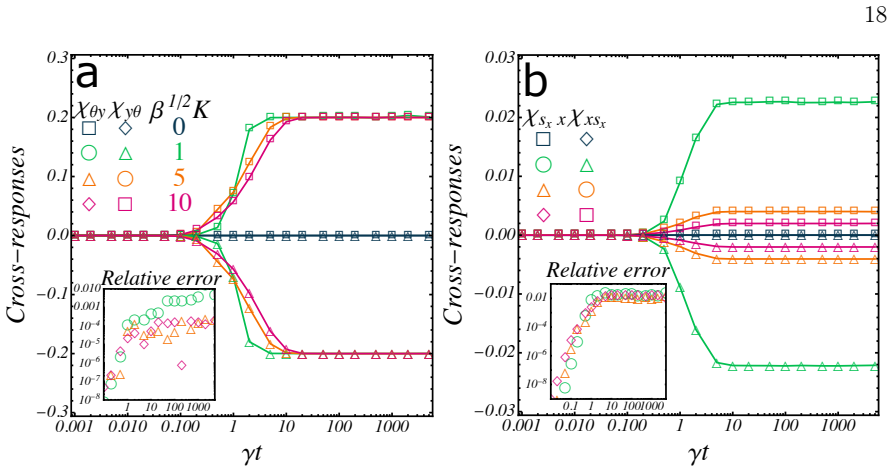
Summary. The paper studies Hamiltonian flocks: conservative, non-Galilean polar liquids with spin-velocity coupling K that can exhibit collective motion without activity. After deriving Langevin dynamics (with a tachostat fixing center-of-mass velocity v0) via a Zwanzig-Mori construction, the authors construct the MSRJD action and show it is invariant under a generalized time-reversal map that reverses positions, flips spins (theta to theta+pi), and reverses v0. This symmetry yields mixed fluctuation-dissipation relations Ra,b(tau)=-beta partial_tau C^c_a,b(tau) for a,b in {r,s}, Onsager-Casimir reciprocity (because spin is odd under T), vanishing entropy production under the correct reversal, and a spurious nonzero production rate under the naive spin-preserving reversal. Angular dynamics are shown to be rich, with an effective long-time rotational diffusion constant and Kramers-type confinement when Kv0 is nonzero. Analytic predictions for MSDs/MSADs and overdamped limits are checked against single-particle Langevin simulations.
Significance. If correct, the work supplies a clean equilibrium baseline for systems that look active because they break Galilean invariance. The mixed FDT, Onsager-Casimir relations, and the explicit demonstration that naive TRS produces a spurious entropy production rate are concrete, falsifiable diagnostics that active-matter studies can use when only partial observables are available. Strengths include the fully explicit path-integral construction (Appendices B.2-B.6), the dual Zwanzig-Mori derivations that both collapse to the same white-noise Langevin equations, closed-form MSAD expressions (including the self-consistent DR and the Kramers picture), and direct numerical checks of the FDT and angular diffusion. The cautionary message about mis-diagnosing distance to equilibrium is timely and well-supported by the calculation.
minor comments (5)
- Figures 1-3 and 6-7 would benefit from explicit parameter boxes (beta, K, v0, gamma) in every panel; some insets are hard to read at print size.
- Notation for the co-moving connected correlator C^c is introduced late; a short definition table or early equation would help readers who jump to the FDT summary.
- Appendix C's recursive expansion for DR is useful; a short numerical comparison of D^(0)_R versus the fully self-consistent root for a few kappa values would make the validity range more transparent.
- A few typos remain (e.g., 'time-reveralsymmetry', 'na\"ive' spacing, and occasional missing spaces around equations). A light copy-edit pass would clean them.
- The discussion of possible mappings of active systems onto higher-dimensional non-Galilean Hamiltonians is intriguing but brief; one or two concrete pointers to existing non-reciprocal-to-Hamiltonian constructions would strengthen the outlook.
Circularity Check
No significant circularity: FDT, Onsager-Casimir, and zero entropy production follow algebraically from an explicitly constructed generalized TRS of the MSRJD action; self-citations supply model context only.
-
self citation load bearing
[Introduction / Sec. 2 (model definition) and Discussion]
"In Hamiltonian flocks, conservative yet non-Galilean models of polar liquids, previous work reported collective motion without the activity that usually underlies it. ... Hamiltonian flocks have blurred the line between equilibrium systems and active ones [38-41, 43, 44, 73]."
The paper's premise that the model is equilibrium (canonical measure with tachostat) rests partly on the authors' own prior characterizations. This is ordinary self-citation for model context and is not load-bearing for the new TRS/FDT derivation, which is self-contained in Appendices A-B; it therefore contributes only a minor score increment.
full rationale
The central claims are derived, not assumed or fitted. Appendix A obtains the Langevin equations (3)-(4) from two independent Zwanzig-Mori linear couplings (angles and spins) that both collapse to the same white-noise form; the friction/noise are therefore fixed by the bath construction rather than tuned to force an FDT. Appendix B.2 then exhibits an explicit transformation T (r_t o r_{-t}, heta_t o heta_{-t}+ heta, v_0 o -v_0, with the corresponding response-field shifts) under which both the deterministic and dissipative pieces of the action are invariant and the initial-condition term recovers the tachostat-augmented canonical weight. The mixed FDT R_{a,b}( au)=-eta heta_ au C^c_{a,b}( au) for a,b heta {r,s}, the Onsager-Casimir sign flip for the crossed responses, and the identically vanishing entropy production (B.82) are then algebraic consequences of that invariance; the naïve (spin-preserving) reversal produces a nonzero spurious rate by construction of the incomplete map. Model parameters K, heta, v_0 enter as free inputs of the Hamiltonian, not as quantities adjusted to data. Self-citations ([38-44]) supply earlier equilibrium characterizations of the same non-Galilean model and do not close a logical loop that forces the present TRS or FDT results. The single minor self-citation load is therefore non-load-bearing, yielding score 1.
Assumptions & free parameters
free parameters (3)
- spin-velocity coupling K
- translational and rotational frictions γt, γr
- imposed center-of-mass velocity v0
assumptions (4)
- domain assumption Zwanzig-Mori linear coupling of independent harmonic oscillators to particle positions/angles (or spins) yields, after integrating out the bath and taking the white-noise limit, the stated Langevin equations with additive friction and noise that satisfy the fluctuation-dissipation relation at the si
- ad hoc to paper The correct time-reversal map multiplies every spin by −1 (equivalently θ → θ + π) and reverses the bath velocity v0 → −v0.
- standard math Path-integral (MSRJD / Onsager-Machlup) representation of the Langevin dynamics and the usual rules for extracting response and correlation functions from the action.
- domain assumption In the co-moving frame the single-time averages become stationary, so connected correlators may be used and time-translation invariance holds.
Cite this review
Pith. "Pith review of Hamiltonian flocks: Time-Reversal Symmetry and its consequences." pith.science (2026). https://pith.science/paper/VLRFXGAF
@misc{pith2026260402914,
  author       = {Pith},
  title        = {Pith review of: Hamiltonian flocks: Time-Reversal Symmetry and its consequences},
  year         = {2026},
  howpublished = {\url{https://pith.science/paper/VLRFXGAF}},
  note         = {Machine review of arXiv:2604.02914}
}
read the original abstract
The fluctuation-dissipation theorem is a hallmark of equilibrium systems that stems from their time-reversal symmetry. In many non-equilibrium systems, in particular active ones, extensions and explicit violations of this theorem are used to assess their ''distance'' to equilibrium. In Hamiltonian flocks, conservative yet non-Galilean models of polar liquids, previous work reported collective motion without the activity that usually underlies it. In this paper, we show that this model obeys a generalized time-reversal symmetry that yields a fluctuation-dissipation theorem that mixes position and polarity degrees of freedom. Due to the oddness of spin under time reversal, the system also obeys Onsager-Casimir reciprocity rather than standard Onsager relations. The coupling also induces rich spin orientation dynamics, including a non-trivial diffusion constant at long times. Finally, we show that considering the na\"ive time-reversal operation rather than the generalized one that leaves the system invariant leads to a spurious entropy production rate, that could be wrongly interpreted as a distance to equilibrium. Our findings suggest looking for possible extensions of time-reversal symmetry in active-looking systems, which may lead to yet unknown generalizations of the fluctuation-dissipation theorem.
Figures


Figures from the paper (5 more)


Reference graph
Works this paper leans on
-
[1]
swim pressure
Introduction Play a movie of Brownian particles backwards, and you will not be able to tell the difference with the original movie from any observable. This is because their dynamics are invariant under time reversal – a property shared with all systems in thermodynamic equilibrium. This time-reversal symmetry (TRS) is associated to conservation laws obey...
-
[2]
tachostat
Model We consider a Hamiltonian flock model. ForNparticles ind= 2dimensions, following the dimensionless rewriting of Refs. [38–40] to set masses and moments of inertia to unity, it is described by the Hamiltonian H= NX i=1 p2 i 2 + ω2 i 2 −Kp i·si + 1 2 X k̸=i [U(r ik)−J(r ik)s i·sk],(1) where each particle is characterized by its positionr i ∈R 2, its p...
-
[3]
self-interaction
Discussion We have derived FDT equations that apply to particles following non-Galilean dynamics and thus obeying an extended time-reversal symmetry. We have shown that these FDT equations, in spite of the introduction of a tachostat in non-Galilean dynamics, are very similar to the standard ones, differing only by the need to work in the co- moving frame...
-
[4]
thesis The University of Tokyo
Murashita Y 2021Fluctuation Theorems under Divergent Entropy Production and their Applications for Fundamental Problems in Statistical PhysicsPh.D. thesis The University of Tokyo
-
[5]
Fodor É, Nardini C, Cates M E, Tailleur J, Visco P and Van Wijland F 2016 Physical Review Letters117038103
2016
-
[6]
Pigolotti S, Neri I, Roldán É and Jülicher F 2017Physical Review Letters119 140604
-
[7]
Mandal D, Klymko K and DeWeese M R 2017Physical Review Letters119258001
-
[8]
Nardini C, Fodor E, Tjhung E, van Wijland F, Tailleur J and Cates M E 2017 Physical Review X7021007
2017
Show all 77 references
-
[9]
Shankar S and Marchetti C M 2018Physical Review E98020604(R)
-
[10]
Caprini L, Marconi U M B, Puglisi A and Vulpiani A 2019Journal of Statistical Mechanics: Theory and Experiment2019053203
-
[11]
Dabelow L, Bo S and Eichhorn R 2019Physical Review X921009
-
[12]
Borthne Ø L, Fodor É and Cates M E 2020New Journal of Physics22123012
-
[13]
Chiarantoni P, Cagnetta F, Corberi F, Gonnella G and Suma A 2020Journal of Physics A: Mathematical and Theoretical5336LT02
-
[14]
Caprini L 2021Journal of Statistical Mechanics: Theory and Experiment2021 063202
-
[15]
Caprini L, Puglisi A and Sarracino A 2021Symmetry1381
-
[16]
Cengio S D, Levis D and Pagonabarraga I 2021Journal of Statistical Mechanics: Theory and Experiment2021043201
-
[17]
Markovich T, Fodor É, Tjhung E and Cates M E 2021Physical Review X11021057
-
[18]
Skinner D J and Dunkel J 2021Physical Review Letters127198101
-
[19]
RoS,GuoB,ShihA,PhanTV,AustinRH,LevineD,ChaikinPMandMartiniani S 2022Physical Review Letters129220601
-
[20]
Caprini L, Marconi U M B, Puglisi A and Löwen H 2023Journal of Chemical Physics159041102
-
[21]
Semeraro M, Gonnella G, Suma A and Zamparo M 2023Physical Review Letters 131158302
-
[22]
Boffi N M and Vanden-Eijnden E 2024Proceedings of the National Academy of Sciences of the United States of America121e2318106121
-
[23]
Agranov T, Jack R L, Cates M E and Fodor É 2025New Journal of Physics27 104602
-
[24]
Ferretti F, Giardina I, Grigera T, Pisegna G and Veca M 2025Physical Review Research7L032006
-
[25]
Johnsrud M K and Golestanian R 2025Physical Review Research7L032053 REFERENCES64
-
[26]
Anand S, Ma X, Guo S, Martiniani S and Cheng X 2024Proceedings of the National Academy of Sciences121e2411608121
-
[27]
Knight J, Kaveh F and Pruessner G 2025Arxiv Preprintarxiv:2507.22199
-
[28]
Metzger J, Ro S and Tailleur J 2025Arxiv Preprint2503.11902
-
[29]
Bore S L, Schindler M, Lam K D N T, Bertin É and Dauchot O 2016Journal of Statistical Mechanics: Theory and Experiment2016033305
-
[30]
Casiulis M, Tarzia M, Cugliandolo L F and Dauchot O 2020Journal of Statistical Mechanics: Theory and Experiment2020013209
-
[31]
Casiulis M, Tarzia M, Cugliandolo L F and Dauchot O 2020Physical Review Letters 124198001
-
[32]
Casiulis M 2019Study of a non-Galilean Hamiltonian liquid: collective motion without activityPhd thesis Sorbonne Université
-
[33]
Tasaki H 2020Physical Review Letters125220601
-
[34]
Bhattacharya A, Horbach J and Karmakar S 2025Physical Review E111015429
-
[35]
Chen L and Davis L K 2026Arxiv Preprint2602.11104
-
[36]
Takatori S C, Yan W and Brady J F 2014Physical Review Letters113028103
-
[37]
Bissinger T and Fuchs M 2023Journal of Chemical Physics158044902
-
[38]
Diu B, Guthmann C, Lederer D and Roulet B 1996Physique Statistique(Hermann)
-
[39]
Caravelli F and Vuffray M 2026Europhysics Letters15321003
-
[40]
Zwanzig R W 1961 Statistical Mechanics of IrreversibilityLectures in Theoretical Physics, Volume IIIed Brittin W E, Downs B W, Downs J and Boulder Summer institute for theoretical Physics (New York; London: Interscience Publishers) pp 106–141
1961
-
[41]
Mori H 1965Progress of Theoretical Physics33423
-
[42]
Martin P C, Siggia E D and Rose H A 1973Physical Review A8423
-
[43]
Janssen H K 1976Zeitschrift for Physik B23377
-
[44]
De Dominicis C 1976Le Journal de Physique Colloques37C1–247
-
[45]
De Dominicis C and Peliti L 1978Physical Review B18353
-
[46]
Arnoulx de Pirey T, Cugliandolo L F, Lecomte V and van Wijland F 2022Advances in Physics711
-
[47]
Aron C, Biroli G and Cugliandolo L F 2010Journal of Statistical Mechanics: Theory and Experiment2010P11018
-
[48]
Aron C, Barci D G, Cugliandolo L F, Arenas Z G and Lozano G S 2016Journal of Statistical Mechanics: Theory and Experiment2016053207
-
[49]
Gomez-Solano J R, Petrosyan A, Ciliberto S, Chetrite R and Gawedzki K 2009 Physical Review Letters103040601
2009
-
[50]
Crisanti A, Puglisi A and Villamaina D 2012Physical Review E85061127
-
[51]
Onsager L 1931Physical Review37405 REFERENCES65
-
[52]
Onsager L 1931Physical Review382266
-
[53]
Casimir H B 1945Reviews of Modern Physics17343
-
[54]
Cugliandolo L, Kurchan J and Parisi G 1994Journal de Physique I41641
-
[55]
Pottier N 2003Physica A: Statistical Mechanics and its Applications317371
-
[56]
Fily Y and Marchetti M C 2012Physical Review Letters108235702
-
[57]
Festa R and D’Agliano E G 1978Physica A90A229
-
[58]
Risken H 1989The Fokker-Planck Equation(Berlin Heidelberg: Springer-Verlag)
-
[59]
Benenti G, Casati G, Saito K and Whitney R S 2017Physics Reports6941–124
-
[60]
Onsager L and Machlup S 1953Physical Review911505
-
[61]
Seifert U 2005Physical Review Letters95040602
-
[62]
5: Statistical Physics, Part I3rd ed (Pergamon Press)
Landau L D and Lifshitz E M 1980Course of Theoretical Physics Vol. 5: Statistical Physics, Part I3rd ed (Pergamon Press)
-
[63]
Dieball C and Godec A 2025Journal of Chemical Physics162090901
-
[64]
Casiulis M, Tarzia M, Cugliandolo L F and Dauchot O 2019Journal of Chemical Physics150154501
-
[65]
Shi Y B, Moessner R, Alert R and Bukov M 2026Nature Physics
-
[66]
Ford G W, Kac M and Mazur P 1965Journal of Mathematical Physics6504
-
[67]
Bertotti G, Mayergoyz I D and Serpico C 2009Nonlinear Magnetization Dynamics in Nanosystems(Elsevier Science)
-
[68]
Cugliandolo L F, Déjardin P M M, Lozano G S and Van Wijland F 2015Physical Review E - Statistical, Nonlinear, and Soft Matter Physics91032139
-
[69]
Brown W F J 1963Physical Review51677
-
[70]
Aron C, Barci D G, Cugliandolo L F, Arenas Z G and Lozano G S 2014Journal of Statistical Mechanics: Theory and Experiment2014P09008
-
[71]
dos Santos G, Romá F, Tranchida J, Castedo S, Cugliandolo L F and Bringa E M 2023Physical Review B108134417
-
[72]
Gardiner C 1983Handbook of Stochastic Methods(Berlin: Springer)
-
[73]
Sylvester J 1883The London, Edinburgh, and Dublin Philosophical Magazine and Journal of Science16267
-
[74]
Liverpool T B and Marchetti M C 2003Physical Review Letters90138102
-
[75]
Kurzthaler C, Leitmann S and Franosch T 2016Scientific Reports636702
-
[76]
Zhang G and Yeomans J M 2023Physical Review Letters13038202
-
[77]
Kahn H and Marshall A W 1953Journal of Operations Research Society of America 1263–278
Reviewed July 13, 2026 · model on record in the stance chip above.
Discussion (0). Continue with ORCID to comment.