Change Impact Recommendation for JavaScript: Lessons from History and Runtime Analysis
Pith reviewed 2026-06-26 13:53 UTC · model grok-4.3
The pith
Combining history-based and dynamic analysis improves change impact recommendations for JavaScript by capturing complementary signals.
A machine-rendered reading of the paper's core claim, the machinery that carries it, and where it could break.
Core claim
Evaluation on ten open-source Node.js applications using expert-curated reference sets reveals only 22 percent overlap between candidates from history-based and dynamic analyses at broader inspection budgets. Dynamic analysis generally yields higher precision, yet history-based analysis identifies additional relevant candidates missed by dependency analysis. These results indicate that practical change impact recommendation in JavaScript benefits from combining runtime and evolutionary signals.
What carries the argument
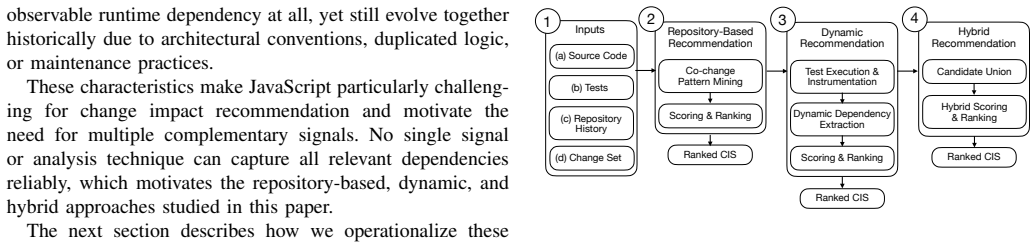
The Caprese framework that implements and combines a history-based co-change pattern mining approach with a dynamic dependency-based approach.
If this is right
- History-based and dynamic analyses identify largely distinct sets of impact candidates.
- Dynamic analysis produces recommendations with higher precision than history-based analysis alone.
- History-based analysis recovers relevant candidates that dynamic dependency analysis misses.
- Hybrid techniques are required to cover the full set of relevant inspection candidates.
Where Pith is reading between the lines
- Similar combinations of evolutionary and runtime signals could be tested in other dynamic languages such as Python.
- Future tools might automatically weight or merge the two signals without requiring new expert-curated ground truth for every project.
Load-bearing premise
The expert-curated reference inspection sets accurately and completely capture all relevant change impacts for the evaluated changes.
What would settle it
An observed change for which the hybrid technique misses a relevant impact that later testing or debugging confirms, or for which the reference set is shown to omit a true impact.
Figures

read the original abstract
Understanding the downstream effects of code changes is essential for software maintenance, debugging, and regression testing. This task is particularly challenging for JavaScript applications, where dynamic language features such as callbacks, events, asynchronous execution, and shared mutable state make dependencies difficult to infer precisely. Existing change impact recommendation approaches rely primarily on either dependency-based analysis or repository mining. Dependency-based techniques, particularly dynamic analysis, capture runtime interactions from observed execution but may miss relationships not exercised during analysis. In contrast, history-based techniques uncover evolutionary coupling from past changes but often introduce imprecise recommendations due to noisy co-change patterns. To investigate the strengths and limitations of these approaches in JavaScript, we engineer and evaluate three recommendation techniques: a history-based approach using co-change pattern mining, a dynamic dependency-based approach, and a hybrid approach combining both signals. We implement these techniques in a unified framework, Caprese, and evaluate them on 10 open-source Node.js applications using expert-curated reference inspection sets. Our results reveal low overlap between candidates identified by history-based and dynamic analyses, with only 22% overlap at broader inspection budgets, indicating that the two approaches capture complementary impact signals. Dynamic analysis generally yields higher precision, while history-based analysis identifies additional relevant candidates missed by dependency analysis. These findings suggest that practical change impact recommendation in JavaScript benefits from combining runtime and evolutionary signals, as no single technique sufficiently captures all relevant inspection candidates.
Editorial analysis
A structured set of objections, weighed in public.
Referee Report
Summary. The paper evaluates three change impact recommendation techniques for JavaScript (history-based co-change mining, dynamic dependency analysis, and a hybrid) implemented in the Caprese framework. On 10 open-source Node.js applications using expert-curated reference inspection sets, it reports only 22% overlap between history-based and dynamic candidates at broader budgets, higher precision for dynamic analysis, and additional relevant candidates from history, concluding that practical recommendation benefits from combining runtime and evolutionary signals since no single technique captures all impacts.
Significance. If the reference sets are shown to be reliable and complete, the work provides useful empirical evidence that history-based and dynamic signals are complementary for JavaScript change impact analysis, with potential implications for improving maintenance and regression testing tools in dynamic languages.
major comments (1)
- [Abstract] Abstract (and Evaluation section): the central claims of 22% overlap, precision ordering, and the necessity of a hybrid approach rest on the expert-curated reference inspection sets being a complete and unbiased enumeration of relevant impacts. No information is supplied on curation protocol, number of changes examined, number of experts, inter-rater agreement, exclusion criteria, or external validation (e.g., against regressions or test failures). This is load-bearing for the claim that 'no single technique sufficiently captures all relevant inspection candidates.'
minor comments (1)
- [Abstract] Define 'broader inspection budgets' precisely when reporting the 22% overlap figure.
Simulated Author's Rebuttal
We thank the referee for their thorough review and valuable comments on our paper. We address the major comment regarding the reference inspection sets below, and will make revisions to improve the manuscript.
read point-by-point responses
-
Referee: [Abstract] Abstract (and Evaluation section): the central claims of 22% overlap, precision ordering, and the necessity of a hybrid approach rest on the expert-curated reference inspection sets being a complete and unbiased enumeration of relevant impacts. No information is supplied on curation protocol, number of changes examined, number of experts, inter-rater agreement, exclusion criteria, or external validation (e.g., against regressions or test failures). This is load-bearing for the claim that 'no single technique sufficiently captures all relevant inspection candidates.'
Authors: We agree that more details on the curation of the reference sets are needed to support our claims. We will revise the manuscript to include a detailed description of the curation protocol in the Evaluation section. This will cover the process used by the expert curators, the number of changes and applications examined, the number of experts involved, exclusion criteria, and any available validation steps. We will also note the lack of formal inter-rater agreement calculation and external validation as limitations of the study. The abstract will be updated to reflect these clarifications. These changes will strengthen the paper's transparency. revision: yes
Circularity Check
No circularity: empirical evaluation with external ground truth
full rationale
The paper presents an empirical comparison of three change-impact recommendation techniques (history-based co-change mining, dynamic dependency analysis, and their hybrid) evaluated against expert-curated reference sets on 10 Node.js applications. No equations, parameter fitting, or derivations appear; results consist of measured overlap (22%), precision differences, and the observation that the signals are complementary. The central claim rests on observable external data (runtime traces and repository history) rather than any self-referential construction or self-citation chain. The evaluation protocol itself is not derived from the techniques under test, satisfying the criterion for a self-contained empirical study.
Axiom & Free-Parameter Ledger
Reference graph
Works this paper leans on
-
[1]
R. S. Arnold,Software Change Impact Analysis. Washington, DC, USA: IEEE Computer Society Press, 1996
1996
-
[2]
Chianti: A tool for change impact analysis of java programs,
X. Ren, F. Shah, F. Tip, B. G. Ryder, and O. Chesley, “Chianti: A tool for change impact analysis of java programs,” inProceedings of the 19th Annual ACM SIGPLAN Conference on Object-Oriented Programming, Systems, Languages, and Applications, ser. OOPSLA ’04. New York, NY , USA: Association for Computing Machinery, 2004, p. 432–448. [Online]. Available: h...
-
[3]
Integrated impact analysis for managing software changes,
M. Gethers, B. Dit, H. Kagdi, and D. Poshyvanyk, “Integrated impact analysis for managing software changes,”Proceedings - 2012 34th International Conference on Software Engineering (ICSE), pp. 430–440, 2012
2012
-
[4]
Hybrid dom-sensitive change impact analysis for javascript,
S. Alimadadi, A. Mesbah, and K. Pattabiraman, “Hybrid dom-sensitive change impact analysis for javascript,”Leibniz International Proceedings in Informatics, LIPIcs, vol. 37, pp. 321–345, 2015
2015
-
[5]
Understanding javascript event-based interactions,
S. Alimadadi, S. Sequeira, A. Mesbah, and K. Pattabiraman, “Understanding javascript event-based interactions,” p. 367–377, 2014. [Online]. Available: https://doi.org/10.1145/2568225.2568268
-
[6]
Efficient construction of approximate call graphs for javascript ide services,
A. Feldthaus, M. Sch ¨afer, M. Sridharan, J. Dolby, and F. Tip, “Efficient construction of approximate call graphs for javascript ide services,” in Proceedings of the 2013 International Conference on Software Engi- neering, ser. ICSE ’13. IEEE Press, 2013, p. 752–761
2013
-
[7]
Mining software repositories for software change impact analysis: a case study,
L. Hattori, “Mining software repositories for software change impact analysis: a case study,” 2008. [On- line]. Available: https://www.academia.edu/18938696/Mining software repositories for software change impact analysis a case study
arXiv 2008
-
[8]
Sieve: A tool for automatically detecting variations across program versions,
M. K. Ramanathan, A. Grama, and S. Jagannathan, “Sieve: A tool for automatically detecting variations across program versions,” in Proceedings of the International Conference on Automated Software Engineering (ASE). IEEE, 2006, pp. 241–252
2006
-
[9]
Crossing the boundaries while analyzing heterogeneous component-based software systems,
A. R. Yazdanshenas and L. Moonen, “Crossing the boundaries while analyzing heterogeneous component-based software systems,” 09 2011, pp. 193–202
2011
-
[10]
Aiding code change under- standing with semantic change impact analysis,
Q. Hanam, A. Mesbah, and R. Holmes, “Aiding code change under- standing with semantic change impact analysis,”Proceedings - 2019 IEEE International Conference on Software Maintenance and Evolution, ICSME 2019, pp. 202–212, 2019
2019
-
[11]
Refining interprocedural change- impact analysis using equivalence relations,
A. Gyori, S. K. Lahiri, and N. Partush, “Refining interprocedural change- impact analysis using equivalence relations,” inProceedings of the 26th ACM SIGSOFT international symposium on software testing and analysis, 2017, pp. 318–328
2017
-
[12]
Predicting change propagation in software systems,
A. E. Hassan and R. C. Holt, “Predicting change propagation in software systems,” inProceedings of the 20th IEEE International Conference on Software Maintenance, ser. ICSM ’04. USA: IEEE Computer Society, 2004, p. 284–293
2004
-
[13]
Mining version histories to guide software changes,
T. Zimmermann, P. Weißgerber, S. Diehl, and A. Zeller, “Mining version histories to guide software changes,”IEEE Transactions on Software Engineering, vol. 31, no. 6, pp. 429–445, jun 2005
2005
-
[14]
Generalizing the analysis of evolutionary coupling for software change impact analysis,
T. Rolfsnes, S. Di Alesio, R. Behjati, L. Moonen, and D. W. Binkley, “Generalizing the analysis of evolutionary coupling for software change impact analysis,”2016 IEEE 23rd International Conference on Software Analysis, vol. 1, no. March, pp. 201–212, 2016
2016
-
[15]
Detecting evolutionary coupling using transitive association rules,
M. A. Islam, M. M. Islam, M. Mondal, B. Roy, C. K. Roy, and K. A. Schneider, “Detecting evolutionary coupling using transitive association rules,” 2018, pp. 113–122
2018
-
[16]
Incremental dynamic impact analysis for evolving software systems,
J. Law and G. Rothermel, “Incremental dynamic impact analysis for evolving software systems,” inProceedings of the 14th International Symposium on Software Reliability Engineering, ser. ISSRE ’03. USA: IEEE Computer Society, 2003, p. 430
2003
-
[17]
Jripples: A tool for program comprehension during incremental change,
J. Buckner, J. Buchta, M. Petrenko, and V . Rajlich, “Jripples: A tool for program comprehension during incremental change,” inProceedings of the 13th International Workshop on Program Comprehension, ser. IWPC ’05. USA: IEEE Computer Society, 2005, p. 149–152. [Online]. Available: https://doi.org/10.1109/WPC.2005.22
-
[18]
Efficient and precise dynamic impact analysis using execute-after sequences,
T. Apiwattanapong, A. Orso, and M. J. Harrold, “Efficient and precise dynamic impact analysis using execute-after sequences,” inProceedings of the 27th International Conference on Software Engineering, ser. ICSE ’05. New York, NY , USA: Association for Computing Machinery, 2005, p. 432–441. [Online]. Available: https://doi.org/10.1145/1062455.1062534
-
[19]
An empirical study of static program slice size,
D. Binkley, N. Gold, and M. Harman, “An empirical study of static program slice size,”ACM Trans. Softw. Eng. Methodol., vol. 16, no. 2, p. 8–es, apr 2007. [Online]. Available: https: //doi.org/10.1145/1217295.1217297
-
[20]
Precise dynamic impact analysis with dependency analysis for object-oriented programs,
L. Huang and Y .-T. Song, “Precise dynamic impact analysis with dependency analysis for object-oriented programs,” in5th ACIS Inter- national Conference on Software Engineering Research, Management & Applications (SERA 2007). IEEE, 2007, pp. 374–384
2007
-
[21]
On the precision and accuracy of impact analysis techniques,
L. Hattori, D. S. Guerrero, J. Figueiredo, J. Brunet, and J. F. Dam ´asio, “On the precision and accuracy of impact analysis techniques,”Seventh IEEE/ACIS International Conference on Computer and Information Science (icis 2008), pp. 513–518, 2008
2008
-
[22]
The hybrid technique for object-oriented software change impact anal- ysis,
M. C. O. Maia, R. A. Bittencourt, J. Figueiredo, and D. S. Guerrero, “The hybrid technique for object-oriented software change impact anal- ysis,”2010 14th European Conference on Software Maintenance and Reengineering, pp. 252–255, 2010
2010
-
[23]
Change impact analysis based on a taxonomy of change types,
X. Sun, B. Li, C. Tao, W. Wen, and S. Zhang, “Change impact analysis based on a taxonomy of change types,” inProceedings - International Computer Software and Applications Conference. IEEE Computer Society, 2010, pp. 373–382
2010
-
[24]
Practical change impact analysis based on static program slicing for industrial software systems,
M. Acharya and B. Robinson, “Practical change impact analysis based on static program slicing for industrial software systems,” inProceedings of the 33rd International Conference on Software Engineering, ser. ICSE ’11. New York, NY , USA: Association for Computing Machinery, 2011, p. 746–755. [Online]. Available: https://doi.org/10.1145/1985793.1985898
-
[25]
A change impact analysis approach for workflow repository management,
G. Oliva, M. A. Gerosa, D. Milojicic, and V . Smith, “A change impact analysis approach for workflow repository management,”Proceedings - IEEE 20th International Conference on Web Services, ICWS 2013, pp. 308–315, 06 2013
2013
-
[26]
Sensa: Sensitivity analysis for quantitative change-impact prediction,
H. Cai, S. Jiang, R. Santelices, Y . Zhang, and Y . Zhang, “Sensa: Sensitivity analysis for quantitative change-impact prediction,” in 2014 IEEE 14th International Working Conference on Source Code Analysis and Manipulation (SCAM). Los Alamitos, CA, USA: IEEE Computer Society, sep 2014, pp. 165–174. [Online]. Available: https://doi.ieeecomputersociety.org...
-
[27]
Diver: Precise dynamic impact analysis using dependence-based trace pruning,
H. Cai and R. Santelices, “Diver: Precise dynamic impact analysis using dependence-based trace pruning,” inProceedings of the 29th ACM/IEEE International Conference on Automated Software Engineering, ser. ASE ’14. New York, NY , USA: Association for Computing Machinery, 2014, p. 343–348. [Online]. Available: https://doi.org/10.1145/2642937.2642950
-
[28]
Static change impact analysis techniques: A comparative study,
X. Sun, B. Li, H. Leung, B. Li, and J. Zhu, “Static change impact analysis techniques: A comparative study,”Journal of Systems and Software, vol. 109, pp. 137–149, 2015
2015
-
[29]
Diapro: Unifying dynamic impact analyses for improved and variable cost-effectiveness,
H. Cai, R. Santelices, and D. Thain, “Diapro: Unifying dynamic impact analyses for improved and variable cost-effectiveness,”ACM Trans. Softw. Eng. Methodol., vol. 25, no. 2, apr 2016. [Online]. Available: https://doi.org/10.1145/2894751
-
[30]
Jcia: A tool for change impact analysis of java ee applications,
L. B. Cuong, V . S. Nguyen, D. A. Nguyen, P. N. Hung, and D. H. V o, “Jcia: A tool for change impact analysis of java ee applications,” Advances in Intelligent Systems and Computing, vol. 672, no. March, pp. 105–114, 2018
2018
-
[31]
Change-aware dynamic program analysis for javascript,
D. K. Murthy and M. Pradel, “Change-aware dynamic program analysis for javascript,” in2018 IEEE International Conference on Software Maintenance and Evolution (ICSME). Los Alamitos, CA, USA: IEEE Computer Society, sep 2018, pp. 127–137. [Online]. Available: https://doi.ieeecomputersociety.org/10.1109/ICSME.2018.00023
-
[32]
Improved computation of change impact analysis in software using all applicable dependencies,
M. Malhotra and J. K. Chhabra, “Improved computation of change impact analysis in software using all applicable dependencies,” inCom- munications in Computer and Information Science, vol. 958. Springer Verlag, 2019, pp. 367–381
2019
-
[33]
Program slicing,
M. Weiser, “Program slicing,”IEEE Transactions on Software Engineer- ing, vol. SE-10, no. 4, pp. 352–357, 1984
1984
-
[34]
Interprocedural slicing using dependence graphs,
S. Horwitz, T. Reps, and D. Binkley, “Interprocedural slicing using dependence graphs,” inProceedings of the ACM SIGPLAN 1988 Conference on Programming Language Design and Implementation, ser. PLDI ’88. New York, NY , USA: Association for Computing Machinery, 1988, p. 35–46. [Online]. Available: https://doi.org/10.1145/ 53990.53994
arXiv 1988
-
[35]
Algorithmic analysis of the impacts of changes to object-oriented software
M. Lee, J. Offutt, and R. Alexander, “Algorithmic analysis of the impacts of changes to object-oriented software.”1996 Proceedings of International Conference on Software Maintenance, pp. 61–70, 01 2000
1996
-
[36]
Determinacy in static analysis for jquery,
E. Andreasen and A. Møller, “Determinacy in static analysis for jquery,” ACM SIGPLAN Notices, vol. 49, pp. 17–31, 12 2014
2014
-
[37]
Analysis of javascript programs: Challenges and research trends,
K. Sun and S. Ryu, “Analysis of javascript programs: Challenges and research trends,”ACM Computing Surveys, vol. 50, no. 4, aug 2017
2017
-
[38]
An analysis of the dynamic behavior of javascript programs,
G. Richards, S. Lebresne, B. Burg, and J. Vitek, “An analysis of the dynamic behavior of javascript programs,”ACM SIGPLAN Notices, vol. 45, pp. 1–12, 05 2010
2010
-
[39]
Understanding asyn- chronous interactions in full-stack javascript,
S. Alimadadi, A. Mesbah, and K. Pattabiraman, “Understanding asyn- chronous interactions in full-stack javascript,”Proceedings - Interna- tional Conference on Software Engineering, vol. 14-22-May-, pp. 1169– 1180, 2016
2016
-
[40]
B. Korel and J. Laski, “Dynamic program slicing,”Information Pro- cessing Letters, vol. 29, no. 3, pp. 155–163, 1988. [Online]. Available: https://www.sciencedirect.com/science/article/pii/0020019088900543
arXiv 1988
-
[41]
Change-patterns mapping: A boosting way for change impact analysis,
Y . Huang, J. Jiang, X. Luo, X. Chen, Z. Zheng, N. Jia, and G. Huang, “Change-patterns mapping: A boosting way for change impact analysis,” IEEE Transactions on Software Engineering, vol. PP, pp. 1–1, 02 2021
2021
-
[42]
Mining version histories to guide software changes,
T. Zimmermann, P. Weisgerber, S. Diehl, and A. Zeller, “Mining version histories to guide software changes,” inProceedings of the 26th International Conference on Software Engineering, ser. ICSE ’04. USA: IEEE Computer Society, 2004, p. 563–572
2004
-
[43]
Impact analysis by mining software and change request repositories,
G. Canfora and L. Cerulo, “Impact analysis by mining software and change request repositories,” inProceedings of the 11th IEEE International Software Metrics Symposium, ser. METRICS ’05. USA: IEEE Computer Society, 2005, p. 29. [Online]. Available: https://doi.org/10.1109/METRICS.2005.28
-
[44]
Fine grained indexing of software repositories to support impact analysis,
——, “Fine grained indexing of software repositories to support impact analysis,” inMSR ’06, 2006
2006
-
[45]
Mining sequences of changed- files from version histories,
H. Kagdi, S. Yusuf, and J. I. Maletic, “Mining sequences of changed- files from version histories,” inProceedings of the 2006 International Workshop on Mining Software Repositories, ser. MSR ’06. New York, NY , USA: Association for Computing Machinery, 2006, p. 47–53. [Online]. Available: https://doi.org/10.1145/1137983.1137996
-
[46]
Towards a more efficient static software change impact analysis method,
M. A. Jashki, R. Zafarani, and E. Bagheri, “Towards a more efficient static software change impact analysis method,”ACM SIGPLAN/SIGSOFT Workshop on Program Analysis for Software Tools and Engineering, pp. 84–90, 2008. [Online]. Available: https://doi.org/10.1145/1512475.1512493
-
[47]
Predicting source code changes by mining change history,
A. Ying, G. Murphy, R. Ng, and M. Chu-Carroll, “Predicting source code changes by mining change history,”IEEE Transactions on Software Engineering, vol. 30, no. 9, pp. 574–586, 2004
2004
-
[48]
Enabling traceability reuse for impact analyses: A feasibility study in a safety context,
M. Borg, O. Gotel, and K. Wnuk, “Enabling traceability reuse for impact analyses: A feasibility study in a safety context,” in2015 IEEE 22nd International Conference on Software Analysis, Evolution, and Reengineering, SANER 2015 - Proceedings, 05 2013
2015
-
[49]
Supporting change impact analysis using a recommendation system: An industrial case study in a safety-critical context,
M. Borg, K. Wnuk, B. Regnell, and P. Runeson, “Supporting change impact analysis using a recommendation system: An industrial case study in a safety-critical context,”IEEE Transactions on Software Engineering, vol. 43, no. 7, pp. 675–700, 2017
2017
-
[50]
Integrating conceptual and logical couplings for change impact analysis in software,
H. H. Kagdi, M. Gethers, and D. Poshyvanyk, “Integrating conceptual and logical couplings for change impact analysis in software,”Empir. Softw. Eng., vol. 18, no. 5, pp. 933–969, 2013. [Online]. Available: https://doi.org/10.1007/s10664-012-9233-9
-
[51]
Impact analysis of change requests on source code based on interaction and commit histories,
M. Zanjani, G. Swartzendruber, and H. Kagdi, “Impact analysis of change requests on source code based on interaction and commit histories,”11th Working Conference on Mining Software Repositories, MSR 2014 - Proceedings, 05 2014
2014
-
[52]
Aggregating association rules to improve change recommendation,
T. Rolfsnes, L. Moonen, S. D. Alesio, R. Behjati, and D. Binkley, “Aggregating association rules to improve change recommendation,” Empirical Software Engineering, vol. 23, no. 2, pp. 987–1035, 2018
2018
-
[53]
On adaptive change recommendation,
L. Moonen, D. Binkley, and S. Pugh, “On adaptive change recommendation,”Journal of Systems and Software, vol. 164, p. 110550, 2020. [Online]. Available: https://www.sciencedirect.com/ science/article/pii/S0164121220300327
2020
-
[54]
Id- correspondence: A measure for detecting evolutionary coupling,
M. Mondal, B. Roy, C. K. Roy, and K. A. Schneider, “Id- correspondence: A measure for detecting evolutionary coupling,” Empirical Software Engineering, vol. 26, no. 1, jan 2021. [Online]. Available: https://doi.org/10.1007/s10664-020-09921-9
-
[55]
Improving change prediction with fine-grained source code mining,
H. Kagdi, “Improving change prediction with fine-grained source code mining,” inProceedings of the Twenty-Second IEEE/ACM International Conference on Automated Software Engineering, ser. ASE ’07. New York, NY , USA: Association for Computing Machinery, 2007, p. 559–562. [Online]. Available: https://doi.org/10.1145/1321631.1321742
-
[56]
A framework for cost-effective dependence-based dynamic impact analysis,
H. Cai and R. A. Santelices, “A framework for cost-effective dependence-based dynamic impact analysis,”22nd IEEE International Conference on Software Analysis, Evolution, and Reengineering, SANER 2015, Montreal, QC, Canada, March 2-6, 2015, pp. 231–240, apr 2015. [Online]. Available: https://doi.org/10.1109/SANER.2015.7081833
-
[57]
Hybrid program dependence approximation for effective dy- namic impact prediction,
H. Cai, “Hybrid program dependence approximation for effective dy- namic impact prediction,”IEEE Transactions on Software Engineering, vol. 44, no. 4, pp. 334–364, 2018
2018
-
[58]
An adaptive approach to impact analysis from change requests to source code,
M. Gethers, H. Kagdi, B. Dit, and D. Poshyvanyk, “An adaptive approach to impact analysis from change requests to source code,” 2011 26th IEEE/ACM International Conference on Automated Software Engineering, ASE 2011, Proceedings, pp. 540–543, 2011
2011
-
[59]
Impactminer: A tool for change impact analysis,
B. Dit, M. Wagner, S. Wen, W. Wang, M. Linares-V ´asquez, D. Poshy- vanyk, and H. Kagdi, “Impactminer: A tool for change impact analysis,” 36th International Conference on Software Engineering, ICSE Compan- ion 2014 - Proceedings, pp. 540–543, 2014
2014
-
[60]
Cmsuggester: Method change suggestion to complement multi-entity edits,
Y . Wang, N. Meng, and H. Zhong, “Cmsuggester: Method change suggestion to complement multi-entity edits,”Lecture Notes in Computer Science (including subseries Lecture Notes in Artificial Intelligence and Lecture Notes in Bioinformatics), vol. 11293 LNCS, pp. 137–153, 2018
2018
-
[61]
An empirical study of multi-entity changes in real bug fixes,
——, “An empirical study of multi-entity changes in real bug fixes,” Proceedings - 2018 IEEE International Conference on Software Main- tenance and Evolution, ICSME 2018, no. 1, pp. 287–298, 2018
2018
-
[62]
Automatic method change suggestion to complement multi-entity edits,
Z. Jiang, Y . Wang, H. Zhong, and N. Meng, “Automatic method change suggestion to complement multi-entity edits,”J. Syst. Softw., vol. 159, no. C, jan 2020. [Online]. Available: https: //doi.org/10.1016/j.jss.2019.110441
-
[63]
Insight into a method co- change pattern to identify highly coupled methods: An empirical study,
M. Mondal, C. K. Roy, and K. A. Schneider, “Insight into a method co- change pattern to identify highly coupled methods: An empirical study,” IEEE International Conference on Program Comprehension, no. 3, pp. 103–112, 2013
2013
-
[64]
In: Proceedings of the 36th International Conference on Software Engineering
S. Negara, M. Codoban, D. Dig, and R. E. Johnson, “Mining fine-grained code changes to detect unknown change patterns,” inProceedings of the 36th International Conference on Software Engineering, ser. ICSE 2014. New York, NY , USA: Association for Computing Machinery, 2014, p. 803–813. [Online]. Available: https://doi.org/10.1145/2568225.2568317
-
[65]
Co-change patterns: A large scale empirical study,
L. L. Silva, M. T. Valente, and M. A. Maia, “Co-change patterns: A large scale empirical study,”Journal of Systems and Software, vol. 152, no. May 2020, pp. 196–214, 2019
2020
-
[66]
A survey and comparison of trajectory classification methods,
H. A. Nguyen, T. N. Nguyen, D. Dig, S. Nguyen, H. Tran, and M. Hilton, “Graph-based mining of in-the-wild, fine-grained, semantic code change patterns,” inProceedings of the 41st International Conference on Software Engineering, ser. ICSE ’19. IEEE Press, 2019, p. 819–830. [Online]. Available: https://doi.org/10.1109/ICSE.2019.00089
-
[67]
Investigating and recommending co-changed entities for javascript programs,
Z. Jiang, H. Zhong, and N. Meng, “Investigating and recommending co-changed entities for javascript programs,”Journal of Systems and Software, vol. 180, p. 111027, 2021. [Online]. Available: https://www.sciencedirect.com/science/article/pii/S0164121221001242
2021
-
[68]
Mining code change patterns from version control commits,
M. Janke and P. M ¨ader, “Mining code change patterns from version control commits,”IEEE Transactions on Software Engineering, vol. PP, pp. 1–1, 06 2020
2020
-
[69]
Learning quick fixes from code repositories,
R. Sousa, G. Soares, R. Gheyi, T. Barik, and L. D’Antoni, “Learning quick fixes from code repositories,” inProceedings of the XXXV Brazilian Symposium on Software Engineering, ser. SBES ’21. New York, NY , USA: Association for Computing Machinery, 2021, p. 74–83. [Online]. Available: https://doi.org/10.1145/3474624.3474650
-
[70]
Graph based mining of code change patterns from version control commits,
M. Janke and P. M ¨ader, “Graph based mining of code change patterns from version control commits,”IEEE Transactions on Software Engi- neering, vol. 48, no. 3, pp. 848–863, 2022
2022
discussion (0)
Sign in with ORCID, Apple, or X to comment. Anyone can read and Pith papers without signing in.