REVIEW 3 major objections 4 minor 1 cited by
Double-strangeness hidden-charm pentaquarks
T0 review · 3 major / 4 minor · reviewed 2026-08-06 · deepseek-v4-flash
Pith's one-line read This paper predicts eight double-strangeness hidden-charm pentaquark states: five negative-parity states below their thresholds and three positive-parity states above, all arising as poles of the coupled-channel amplitude.
desk verdict Solid S=-2 extension of a proven coupled-channel framework, but the paper's own Table V shows three of five flagship negative-parity states vanish at a 10% cutoff reduction, and the summary's 'qualitatively stable' gloss doesn't match that. read the letter →
The pith
A machine-rendered reading of the paper's core claim, the machinery that carries it, and where it could break.
The reading
What carries the argument
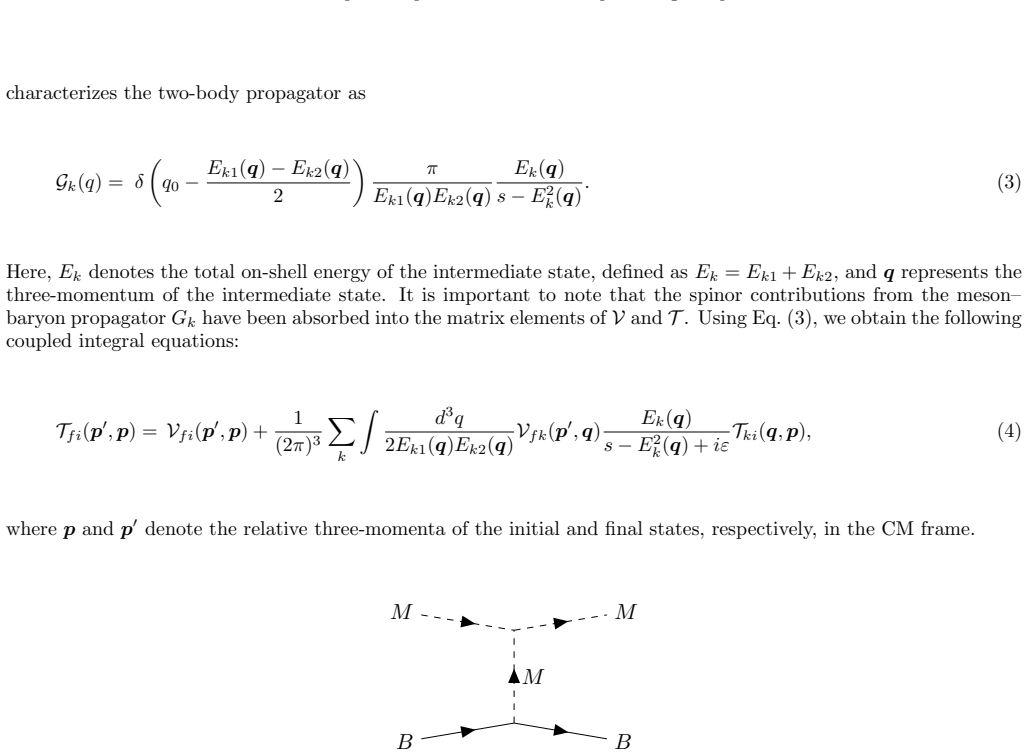
The central object is the coupled-channel $T$-matrix for eleven strangeness $-2$ channels, built from tree-level one-meson-exchange kernels and solved as an integral equation. The four-dimensional Bethe-Salpeter equation is reduced to a three-dimensional form by the Blankenbecler-Sugar scheme, projected onto partial waves with definite parity, and inverted numerically; resonances are identified as poles of $T$ in the complex energy plane. The interaction vertices come from an effective Lagrangian respecting heavy-quark spin symmetry, hidden local symmetry, and flavor $SU(3)$, and each vertex carries a form factor $F(q^2)=((n\Lambda^2-m^2)/(n\Lambda^2-q^2))^n$ whose reduced cutoff $\Lambda_0=\Lambda-m$ is the main free parameter.
What would settle it
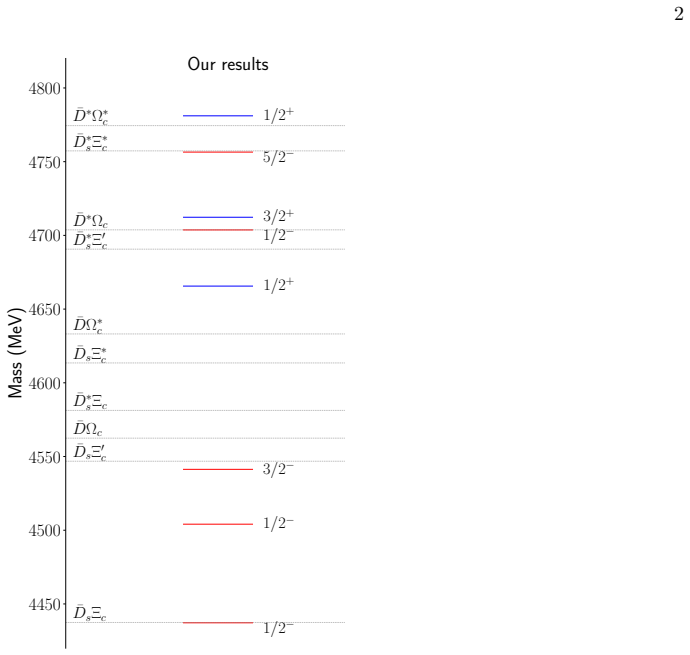
Measure the $J/\psi\,\Xi$ invariant-mass distribution in $\Xi_b$ or $\Lambda_b$ decays with enough statistics to resolve peaks of width down to a few MeV: the model predicts peaks at $4437.2$, $4504.1$, $4541.3$, $4703.7$, and $4756.5$ MeV in the negative-parity channel and broad structures near $4666$, $4712$, and $4781$ MeV; observing none of these would rule out the prediction, as would an independent determination that the relevant cutoff is $630$ MeV, where three of the five negative-parity poles disappear.
Extended reading notes
Core claim
On its own terms, the paper discovers a full spectrum of double-strangeness hidden-charm pentaquarks generated dynamically by meson-baryon interactions. In the negative-parity sector the poles sit at $4437.2-i0.002$, $4504.1-i0.2$, $4541.3-i0.04$, $4703.7-i10.6$, and $4756.5-i1.7$ MeV, with $J^P=1/2^-$, $1/2^-$, $3/2^-$, $1/2^-$, and $5/2^-$; in the positive-parity sector the poles are at $4665.6-i57.8$, $4712.3-i30.8$, and $4781.1-i25.7$ MeV. The negative-parity states lie below their respective thresholds and are narrow, while the positive-parity states lie above threshold and are broad. Coupling strengths to each of the eleven channels are extracted, showing that most states are not single-channel molecules but receive comparable contributions from several channels.
Load-bearing premise
The result hinges on the unmeasured form-factor cutoff $\Lambda_0=\Lambda-m$ being exactly $700$ MeV at every vertex; the paper's own sensitivity table shows that a $10\%$ softer cutoff removes three of the five negative-parity states.
Editorial extensions
If this is right
- The $J/\psi\,\Xi$ invariant-mass spectrum should reveal narrow peaks near $4437$, $4504$, $4541$, and $4757$ MeV and a broader peak near $4704$ MeV if the negative-parity prediction is correct.
- The positive-parity states should appear as broad enhancements near $4666$, $4712$, and $4781$ MeV, with widths of roughly $116$, $62$, and $51$ MeV.
- The existence of $P_{c\bar{c}ss}(4437)$ specifically tests the role of the $\bar D_s\Xi_c$ channel, since a calculation that omitted that channel did not produce the state.
- The negative-parity states sit below their two-body thresholds, so they should appear as narrow structures in decays into the lower $J/\psi\,\Xi$ channel rather than as ordinary above-threshold Breit-Wigner resonances.
Reading between the lines
- If future $S=-2$ scattering data fix the cutoff at a value closer to $630$ MeV, the negative-parity spectrum shrinks to two states, so the number of narrow peaks is a direct experimental measurement of the hadronic cutoff scale.
- Because the positive-parity states are broad and overlap several thresholds, they may be hard to isolate; the nearly stable $P_{c\bar{c}ss}(4437)$ is the cleanest discovery signature.
- The same machinery should generate a triple-strangeness hidden-charm pentaquark spectrum, a direction the authors note is under investigation; the threshold ordering found here suggests those states would lie just below the corresponding charmed-strange thresholds.
Editorial analysis
A structured set of objections, weighed in public.
Referee Report
Summary. The paper extends the authors' off-shell coupled-channel formalism, based on a Bethe-Salpeter equation with the Blankenbecler-Sugar reduction, to the double-strangeness hidden-charm sector. Eleven S = -2 meson-baryon channels are coupled through t-channel meson-exchange kernels derived from a heavy-quark spin symmetry, hidden local symmetry, and SU(3)-flavor effective Lagrangian. Solving the resulting integral equations and searching for poles in the complex energy plane, the authors report five negative-parity P_{c\bar{c}ss} states (J^P = 1/2^-, 3/2^-, 5/2^-) below their relevant thresholds and three positive-parity states (two 1/2^+ and one 3/2^+) above threshold with substantial widths. They also provide coupling strengths to the involved channels and compare with earlier predictions from Refs. [14,15]. A sensitivity study with respect to the reduced cutoff Λ0 = Λ - m is presented in Table V.
Significance. If the predictions were robust, the paper would provide a useful, experimentally testable set of double-strangeness hidden-charm pentaquark candidates in the J/ψΞ channel, and it would extend a consistent framework previously applied to S = 0 and S = -1. The calculations are internally coherent, the formalism is standard, and the authors are transparent about the cutoff sensitivity by including Table V. The main quantitative claim, however, depends on a parameter that is not pinned down by data in this sector, and the paper's own table shows that three of the five negative-parity states disappear as poles under a modest 10% downward variation of Λ0. This makes the central prediction less robust than the abstract and conclusion suggest, although the finding is not circular: the pole positions are genuine outputs rather than fits to S = -2 data.
major comments (3)
- [§III.C, Table V] Table V shows that lowering Λ0 by 10% turns Pc̄css(4437), Pc̄css(4704), and Pc̄css(4757) into cusps, leaving only two of the five negative-parity states as genuine poles. Since Λ0 = Λ - m = 700 MeV in Eq. (43) is carried over from the authors' previous S = 0 and S = -1 studies and is not constrained by any S = -2 data, the abstract's central claim of 'five negative-parity states' is contingent on an unmeasured parameter. The manuscript should either provide a systematic pole-trajectory study over a wider range of Λ0, quantify how often the pole count changes, or explicitly state that only the two remaining states are robust predictions within the present calibration.
- [§IV, Summary and Conclusion] The concluding sentence that the spectrum 'remained qualitatively stable' is not supported by Table V: three of five negative-parity states disappear as poles under a 10% cutoff reduction, and the 3/2^- state moves from 4541.3 MeV to 4323.8 MeV at Λ0 +10%, a shift of more than 200 MeV. This is a qualitative change in the predicted spectrum, not just a modest shift. The conclusion should be reworded to distinguish cutoff-sensitive states from robust ones, or the sensitivity analysis should be expanded to establish stability.
- [§II, Eq. (53)] The paper states that only the diagonal component T_L^{JS} is retained because it 'has the most significant implications' for the production of these pentaquarks. Since the resonance pole search is performed in this truncated basis, the authors should justify that nondiagonal partial-wave components cannot shift pole positions or change the number of poles. Without such a demonstration, the predicted spectrum may be an artifact of this truncation, especially for states with small widths such as Pc̄css(4437).
minor comments (4)
- [Table IV] In the g_{D̄*_s Ξ*_c}(2P_J) row for √s_R = 4781.1 - i25.7 MeV, the entry '-2.00 + 4.24i' should be written as '-2.00 + i4.24' for consistency with all other entries.
- [Table II and Table IV] The notation '2S_J', '4S_J', '4D_J', etc. is not defined in the text. A brief explanation of the spectroscopic notation, especially the meaning of the leading superscript (2S+1) for channels with spin-1/2 and spin-3/2 baryons, would help the reader interpret the coupling strengths.
- [Figure 4 and Figure 6] The vertical axes are labeled 'arb. unit' with different overall scales (×10^7, ×10^6, ×10^5), which makes the relative visibility of narrow and broad states difficult to assess. Adding normalized curves or a consistent scale would improve readability.
- [§III.A] The text says Pc̄css(4541) 'lies below the D̄_s Ξ'_c threshold' and that its small width results from D-wave decay, but the corresponding J/ψΞ 4S_3/2 coupling is listed in Table II. A one-sentence explanation of why the 4S_3/2 decay into J/ψΞ does not dominate the width would be useful.
Circularity Check
No significant circularity: the P_{c\bar{c}ss} spectrum is a genuine output of the coupled-channel equations, not a refitting of the target states.
full rationale
The paper's derivation chain is self-contained in the sense required: the five negative-parity and three positive-parity P_{c\bar{c}ss} states are identified as poles of the T-matrix obtained by solving the coupled-channel Bethe-Salpeter/Blankenbecler-Sugar equations (Eqs. (2)-(4), (46)-(50)), with an effective Lagrangian whose couplings are taken from external determinations ([23], [27], [33]) and from prior model studies. The claimed pole positions and widths are outputs, not inputs: no P_{c\bar{c}ss} datum is fitted, and the abstract's predictions are not defined in terms of themselves. The main parameter that could raise a circularity concern is the reduced cutoff \Lambda_0 = \Lambda - m = 700 MeV, which the text states is applied "as in the previous studies [17,18]" because no S = -2 data exist. This is a self-citation, but it is not circular: the cutoff is calibrated in other strangeness sectors (S = 0, -1) that were compared with LHCb/Belle observations, and the S = -2 pole positions are genuinely sensitive to this parameter (Table V shows three of the five negative-parity states become cusps when \Lambda_0 is reduced by 10%). That sensitivity is a robustness or model-uncertainty issue, not an equivalence-by-construction between an input and a prediction. No equation in the paper reduces to another by construction, and no fitted parameter is renamed as a prediction. Therefore the circularity score is 0.
Assumptions & free parameters
free parameters (2)
- Reduced cutoff Lambda0 = Lambda - m =
700 MeV
- Form-factor exponent n =
Not specified in the text
assumptions (6)
- domain assumption The effective Lagrangian respects heavy-quark spin symmetry, hidden local symmetry, and flavor SU(3) symmetry.
- domain assumption All coupling constants are taken from external experiments, lattice QCD, sum rules, or prior model studies.
- standard math The Blankenbecler-Sugar reduction accurately replaces the four-dimensional Bethe-Salpeter equation.
- ad hoc to paper s-channel pole diagrams and u-channel doubly charmed baryon exchange are negligible.
- ad hoc to paper The off-shell form factor with a universal reduced cutoff is physically adequate.
- ad hoc to paper The diagonal partial-wave component T^{JS}_L dominates the resonance physics.
invented entities (1)
-
Eight predicted Pc̄css pentaquark states: Pc̄css(4437), (4504), (4541), (4704), (4757) with negative parity; Pc̄css(4666), (4712), (4781) with positive parity
independent evidence
Cite this review
Pith. "Pith review of Double-strangeness hidden-charm pentaquarks." pith.science (2026). https://pith.science/paper/VMGR5TC5
@misc{pith2026250623587,
  author       = {Pith},
  title        = {Pith review of: Double-strangeness hidden-charm pentaquarks},
  year         = {2026},
  howpublished = {\url{https://pith.science/paper/VMGR5TC5}},
  note         = {Machine review of arXiv:2506.23587}
}
abstract
We investigate the possible existence of double-strangeness hidden-charm pentaquark states, denoted as $P_{c\bar{c}ss}$, within an off-shell coupled-channel formalism. Eleven meson-baryon channels with total strangeness $S = -2$ are constructed by combining charmed mesons and singly charmed baryons. The two-body scattering amplitudes are derived from an effective Lagrangian that respects heavy-quark spin symmetry, hidden local symmetry, and flavor SU(3) symmetry. The Bethe-Salpeter equation is solved using the Blankenbecler-Sugar reduction scheme, and resonances are identified as poles in the scattering amplitudes on the complex energy plane. We find five negative-parity $P_{c\bar{c}ss}$ states with spins $J = 1/2$, $3/2$, and $5/2$, all located below their relevant thresholds. Three positive-parity states are also found: two with $J = 1/2$ and one with $J = 3/2$, lying above the thresholds with substantial widths. The coupling strengths of each resonance to relevant meson-baryon channels are extracted. The sensitivity of the results to the cutoff parameter $\Lambda_0 = \Lambda - m$ is examined. These results provide theoretical predictions that may assist future experimental searches for $P_{c\bar{c}ss}$ states in the $J/\psi\,\Xi$ channel.
Figures

Figures from the paper (3 more)


Forward citations
Cited by 1 Pith paper
-
Production mechanism of doubly charmed exotic mesons $T_{cc}$
A coupled-channel model generates the Tcc(3875)+ as an isovector DD* molecule and predicts three additional J=1 tetraquark states, including a negative-parity resonance.
Reference graph
Works this paper leans on
-
[1]
R. Aaij et al. (LHCb), Phys. Rev. Lett. 115, 072001 (2015), arXiv:1507.03414 [hep-ex]
arXiv 2015
-
[2]
R. Aaij et al. (LHCb), Phys. Rev. Lett. 122, 222001 (2019), arXiv:1904.03947 [hep-ex]
arXiv 2019
-
[3]
R. Aaij et al. (LHCb), Phys. Rev. Lett. 128, 062001 (2022), arXiv:2108.04720 [hep-ex]
arXiv 2022
-
[4]
A. Esposito, A. Pilloni, and A. D. Polosa, Phys. Rept. 668, 1 (2017), arXiv:1611.07920 [hep-ph]
arXiv 2017
-
[5]
H.-X. Chen, W. Chen, X. Liu, Y.-R. Liu, and S.-L. Zhu, Rept. Prog. Phys. 80, 076201 (2017), arXiv:1609.08928 [hep-ph]
arXiv 2017
-
[6]
L. Meng, B. Wang, G.-J. Wang, and S.-L. Zhu, Phys. Rept. 1019, 1 (2023), arXiv:2204.08716 [hep-ph]
arXiv 2023
-
[7]
H.-X. Chen, W. Chen, X. Liu, Y.-R. Liu, and S.-L. Zhu, Rept. Prog. Phys. 86, 026201 (2023), arXiv:2204.02649 [hep-ph]
arXiv 2023
-
[8]
R. Aaij et al. (LHCb), Phys. Rev. Lett. 131, 031901 (2023), arXiv:2210.10346 [hep-ex]
arXiv 2023
Show all 39 references
- [9]
-
[10]
Hayrapetyan et al
A. Hayrapetyan et al. (CMS), Eur. Phys. J. C 84, 1062 (2024), arXiv:2401.16303 [hep-ex]
2024 arXiv
-
[11]
Aaij et al
R. Aaij et al. (LHCb), (2025), arXiv:2501.12779 [hep-ex]
2025
-
[12]
F.-L. Wang, R. Chen, and X. Liu, Phys. Rev. D 103, 034014 (2021), arXiv:2011.14296 [hep-ph]
2021 arXiv
-
[13]
P. G. Ortega, D. R. Entem, and F. Fernandez, Phys. Lett. B 838, 137747 (2023), arXiv:2210.04465 [hep-ph]
2023 arXiv
-
[14]
J. A. Mars´ e-Valera, V. K. Magas, and A. Ramos, Phys. Rev. Lett. 130, 091903 (2023), arXiv:2210.02792 [hep-ph]
2023 arXiv
-
[15]
L. Roca, J. Song, and E. Oset, Phys. Rev. D 109, 094005 (2024), arXiv:2403.08732 [hep-ph]
2024 arXiv
-
[16]
J. A. Mars´ e-Valera, V. K. Magas, and A. Ramos, Phys. Rev. D 111, 054020 (2025), arXiv:2410.10682 [hep-ph]
2025 arXiv
-
[17]
Clymton, H.-C
S. Clymton, H.-C. Kim, and T. Mart, Phys. Rev. D 110, 094014 (2024), arXiv:2408.04166 [hep-ph]
2024 arXiv
-
[18]
Clymton, H.-C
S. Clymton, H.-C. Kim, and T. Mart, (2025), arXiv:2504.07693 [hep-ph]
2025
-
[19]
Ali et al
A. Ali et al. (GlueX), Phys. Rev. Lett. 123, 072001 (2019), arXiv:1905.10811 [nucl-ex]
2019 arXiv
-
[20]
Blankenbecler and R
R. Blankenbecler and R. Sugar, Phys. Rev. 142, 1051 (1966)
1966
-
[21]
Aaron, R
R. Aaron, R. D. Amado, and J. E. Young, Phys. Rev. 174, 2022 (1968)
1968
-
[22]
Casalbuoni, A
R. Casalbuoni, A. Deandrea, N. Di Bartolomeo, R. Gatto, F. Feruglio, and G. Nardulli, Phys. Rept. 281, 145 (1997), arXiv:hep-ph/9605342
1997 arXiv
-
[23]
Isola, M
C. Isola, M. Ladisa, G. Nardulli, and P. Santorelli, Phys. Rev. D 68, 114001 (2003), arXiv:hep-ph/0307367. 17
2003 arXiv
-
[24]
Kawarabayashi and M
K. Kawarabayashi and M. Suzuki, Phys. Rev. Lett. 16, 255 (1966)
1966
-
[25]
Riazuddin and Fayyazuddin, Phys. Rev. 147, 1071 (1966)
1966
-
[26]
W. A. Bardeen, E. J. Eichten, and C. T. Hill, Phys. Rev. D 68, 054024 (2003), arXiv:hep-ph/0305049
2003 arXiv
- [27]
-
[28]
Yan, H.-Y
T.-M. Yan, H.-Y. Cheng, C.-Y. Cheung, G.-L. Lin, Y. C. Lin, and H.-L. Yu, Phys. Rev. D 46, 1148 (1992), [Erratum: Phys.Rev.D 55, 5851 (1997)]
1992
-
[29]
Chen, Z.-F
R. Chen, Z.-F. Sun, X. Liu, and S.-L. Zhu, Phys. Rev. D 100, 011502 (2019), arXiv:1903.11013 [hep-ph]
2019 arXiv
-
[30]
Dong, F.-K
X.-K. Dong, F.-K. Guo, and B.-S. Zou, Progr. Phys. 41, 65 (2021), arXiv:2101.01021 [hep-ph]
2021 arXiv
-
[31]
Casalbuoni, A
R. Casalbuoni, A. Deandrea, N. Di Bartolomeo, R. Gatto, F. Feruglio, and G. Nardulli, Phys. Lett. B 309, 163 (1993), arXiv:hep-ph/9304280
1993 arXiv
-
[32]
Colangelo, F
P. Colangelo, F. De Fazio, and T. N. Pham, Phys. Rev. D 69, 054023 (2004), arXiv:hep-ph/0310084
2004 arXiv
-
[33]
Shimizu and M
Y. Shimizu and M. Harada, Phys. Rev. D 96, 094012 (2017), arXiv:1708.04743 [hep-ph]
2017 arXiv
-
[34]
H.-C. Kim, J. W. Durso, and K. Holinde, Phys. Rev. C 49, 2355 (1994)
1994
-
[35]
Kim and H.-C
J.-Y. Kim and H.-C. Kim, Phys. Rev. D 97, 114009 (2018), arXiv:1803.04069 [hep-ph]
2018 arXiv
-
[36]
Kim, H.-C
J.-Y. Kim, H.-C. Kim, G.-S. Yang, and M. Oka, Phys. Rev. D 103, 074025 (2021), arXiv:2101.10653 [hep-ph]
2021 arXiv
-
[37]
M. I. Haftel and F. Tabakin, Nucl. Phys. A 158, 1 (1970)
1970
-
[38]
Machleidt, K
R. Machleidt, K. Holinde, and C. Elster, Phys. Rept. 149, 1 (1987)
1987
-
[39]
Clymton and H.-C
S. Clymton and H.-C. Kim, Phys. Rev. D 110, 114002 (2024), arXiv:2409.02420 [hep-ph]
2024 arXiv
Reviewed August 6, 2026 · model on record in the stance chip above.
Discussion (0). Sign in to comment.