Proof of Stake economy under centralized exchanges--a mean field model
Pith reviewed 2026-06-27 14:20 UTC · model grok-4.3
The pith
Centralized trading on exchanges can raise staking participation and spread stakes more evenly in Proof of Stake systems.
A machine-rendered reading of the paper's core claim, the machinery that carries it, and where it could break.
Core claim
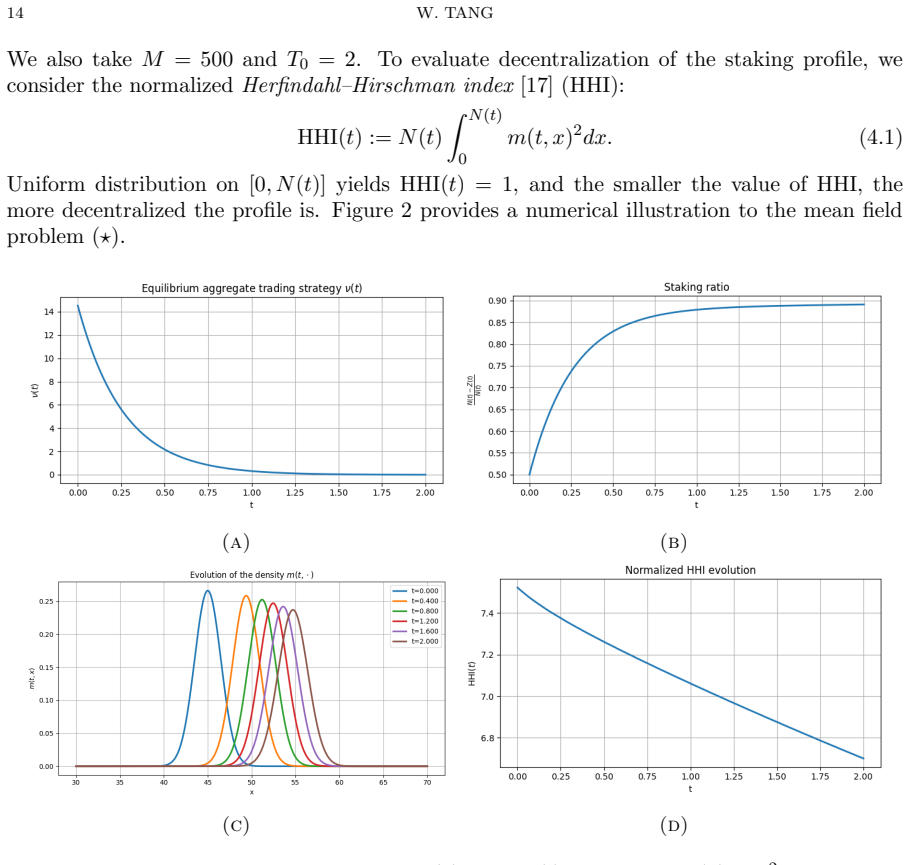
In the equilibrium of the mean-field system, the interaction between staking rewards and price-impact trading produces higher aggregate staking and lower concentration of stakes; the equilibrium staking ratio and concentration profile are further modulated by transaction costs and the token issuance rule.
What carries the argument
The mean-field game that couples each agent's staking allocation with its trading strategy under a price-impact function in continuous time.
If this is right
- Centralized trading activities enhance staking participation through market incentives.
- Centralized trading promotes decentralization of the staking distribution.
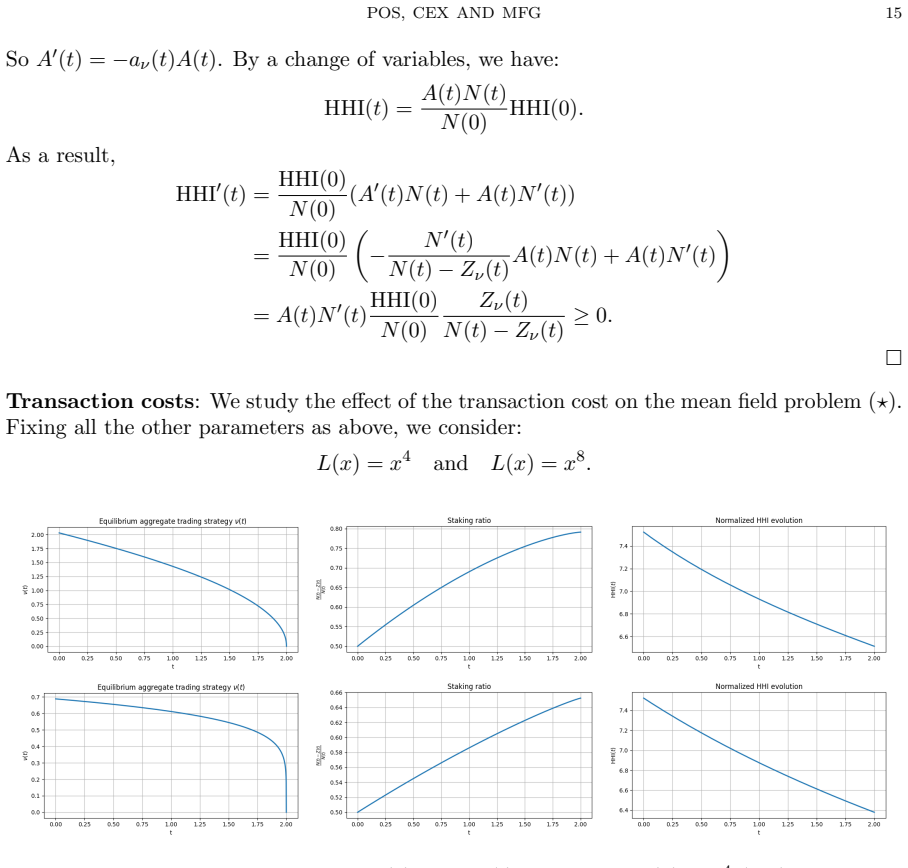
- Transaction costs alter the equilibrium staking ratio and the concentration profile.
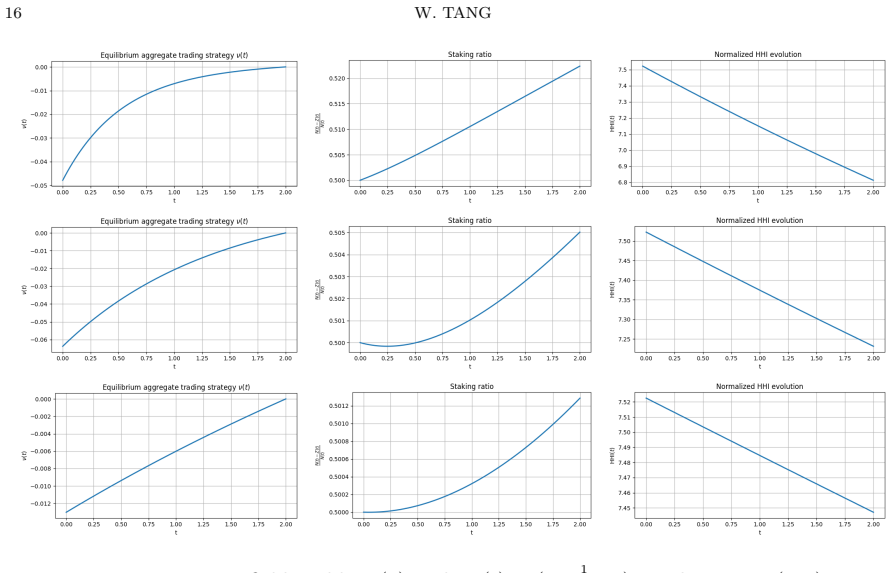
- Token supply mechanisms shape both the level and the distribution of stakes when centralized trading is present.
Where Pith is reading between the lines
- Removing price impact from the model would likely reverse the reported gains in staking and decentralization.
- Exchange-level rules on trading could be used as an indirect lever on blockchain validator distribution.
- The same coupling between staking and centralized trading may appear in other economically weighted consensus protocols.
Load-bearing premise
The mean-field system is locally well-posed under suitable assumptions on the price-impact function, the staking reward structure, and the trader population dynamics.
What would settle it
A simulation of the same mean-field system with the price-impact trading channel removed that yields staking participation and concentration levels comparable to or higher than the baseline case would falsify the claimed enhancement effect.
Figures
read the original abstract
We consider the interaction between centralized trading and decentralized Proof of Stake (PoS) blockchain ecosystems. Motivated by the increasing dominance of centralized exchanges and the institutionalization of crypto markets, we study how trading activities on centralized exchanges affect staking behavior, token allocation, and decentralization within a PoS blockchain. We formulate a continuous-time mean field model, where the miners simultaneously act as validators in the PoS protocol and traders in a centralized market with price impact. Under suitable assumptions, we establish the local well-posedness of the mean field system, and derive a semi-explicit characterization of the equilibrium trading strategy. Numerical results suggest that centralized trading activities may enhance staking participation, and promote decentralization of the staking distribution through market incentives. We also study the effects of transaction costs and token supply mechanisms on the equilibrium staking ratio and concentration profile. These results illustrate how market microstructure and centralized liquidity provision can exert significant influence on decentralized blockchain protocols.
Editorial analysis
A structured set of objections, weighed in public.
Referee Report
Summary. The paper formulates a continuous-time mean-field model in which agents simultaneously stake in a PoS blockchain and trade on a centralized exchange with price impact. It claims local well-posedness of the resulting system under suitable (but unspecified in the abstract) assumptions on the price-impact function, reward structure, and population dynamics; derives a semi-explicit characterization of the equilibrium trading strategy; and presents numerical simulations indicating that centralized trading increases overall staking participation while reducing concentration in the validator distribution. Effects of transaction costs and token-supply rules are also examined numerically.
Significance. If global existence and uniqueness hold on the simulation horizons and the modeling primitives are realistic, the work supplies a quantitative mechanism by which CeFi liquidity provision can influence DeFi decentralization metrics. The mean-field reduction and semi-explicit strategy constitute a technically clean contribution that could be reused in related hybrid-market settings.
major comments (2)
- [§3] §3 (Local well-posedness theorem): Only local-in-time existence is established. The numerical results in §5 integrate the mean-field system over finite but non-infinitesimal time horizons to support the claims of enhanced staking participation and reduced concentration; without a continuation argument, a priori bounds, or global-existence result, it is possible that simulated trajectories exit the existence interval, rendering those market-incentive conclusions unreliable.
- [§5] §5 (Numerical experiments): The reported trajectories are described only qualitatively; no quantitative diagnostics (e.g., maximum existence time, blow-up indicators, or mesh-convergence checks) are supplied to confirm that the observed staking-ratio and Gini-coefficient changes occur inside the interval of guaranteed existence.
minor comments (2)
- [Abstract] Abstract: the phrase “under suitable assumptions” should be replaced by an explicit list of the required conditions on the price-impact function and reward structure so that readers can immediately assess applicability.
- Notation: the distinction between the mean-field measure and its finite-particle approximation is not always typographically clear; consistent use of bold or script fonts would help.
Simulated Author's Rebuttal
We thank the referee for the careful reading and the constructive comments on local well-posedness and numerical validation. We address each point below and will revise the manuscript accordingly.
read point-by-point responses
-
Referee: [§3] §3 (Local well-posedness theorem): Only local-in-time existence is established. The numerical results in §5 integrate the mean-field system over finite but non-infinitesimal time horizons to support the claims of enhanced staking participation and reduced concentration; without a continuation argument, a priori bounds, or global-existence result, it is possible that simulated trajectories exit the existence interval, rendering those market-incentive conclusions unreliable.
Authors: We agree that the theorem provides only local existence. In the revision we will add a priori estimates on the L^∞ and moment norms of the population measure and on the trading controls, derived from the boundedness assumptions on the price-impact function and the reward structure. These bounds will be shown to be uniform on the finite simulation horizons used in §5, thereby guaranteeing that the trajectories remain inside the existence interval. A short continuation argument based on these estimates will also be included. revision: yes
-
Referee: [§5] §5 (Numerical experiments): The reported trajectories are described only qualitatively; no quantitative diagnostics (e.g., maximum existence time, blow-up indicators, or mesh-convergence checks) are supplied to confirm that the observed staking-ratio and Gini-coefficient changes occur inside the interval of guaranteed existence.
Authors: We acknowledge the absence of quantitative diagnostics. The revised §5 will report the a priori existence-time lower bound obtained from the new estimates, together with time-series plots of the monitored norms (sup-norm of the density and L^2 norm of the control) to confirm absence of blow-up. Mesh-convergence tables for the finite-difference scheme will also be added to verify that the reported changes in staking ratio and Gini coefficient are robust. revision: yes
Circularity Check
No circularity: forward derivation from stated primitives
full rationale
The manuscript formulates a continuous-time mean-field model from economic primitives (miners as validators and traders with price impact), establishes local well-posedness under suitable assumptions on the price-impact function and reward structure, and derives a semi-explicit equilibrium trading strategy. Numerical results are obtained by integrating the resulting system. No load-bearing step reduces by construction to a fitted parameter renamed as prediction, a self-citation chain, or an ansatz smuggled via prior work; the derivation chain remains independent of its outputs.
Axiom & Free-Parameter Ledger
axioms (1)
- domain assumption Suitable assumptions exist under which the mean-field system is locally well-posed
Reference graph
Works this paper leans on
-
[1]
Adams, N
H. Adams, N. Zinsmeister, and D. Robinson. Uniswap v2 core. 2020. Available at https://app.uniswap. org/whitepaper.pdf
2020
-
[2]
Adams, N
H. Adams, N. Zinsmeister, M. Salem, R. Keefer, and D. Robinson. Uniswap v3 core. 2021. Available at https://app.uniswap.org/whitepaper-v3.pdf
2021
-
[3]
Almgren and N
R. Almgren and N. Chriss. Optimal execution of portfolio transactions. J. Risk, 3:5–40, 2001
2001
-
[4]
Bertucci, L
C. Bertucci, L. Bertucci, J.-M. Lasry, and P.-L. Lions. A mean field game approach to bitcoin mining. SIAM J. Financ. Math. , 15(3):960–987, 2024
2024
-
[5]
V. Buterin. Toward a 12-second block time. 2014. Available at https://blog.ethereum.org/2014/07/11/ toward-a-12-second-block-time
2014
-
[6]
Capponi, A
A. Capponi, A. Coache, and J. Muhle-Karbe. Optimal trading in automated market makers. 2026. SSRN:6145286
2026
-
[7]
(2021).The Adoption of Blockchain-based Decentralized Exchanges
A. Capponi and R. Jia. The adoption of blockchain-based decentralized exchanges. 2021. arXiv:2103.08842
-
[8]
Capponi and B
A. Capponi and B. Zhu. Optimal exiting for liquidity provision in constant function market makers. 2025
2025
-
[9]
Cartea, F
´A. Cartea, F. Drissi, and M. Monga. Decentralised finance and automated market making: Execution and speculation. J. Econ. Dyn. Control , 177:105134, 2025
2025
-
[10]
J. Chod, N. Trichakis, G. Tsoukalas, H. Aspegren, and M. Weber. On the financing benefits of supply chain transparency and blockchain adoption. Manag. Sci., 66(10):4378–4396, 2020
2020
-
[11]
Donier and J
J. Donier and J. Bonart. A million metaorder analysis of market impact on the Bitcoin. Market Microstruc- ture and Liquidity , 1(02):1550008, 2015
2015
-
[12]
The Merge
Ethereum. The Merge. 2023. Available at https://ethereum.org/roadmap/merge/
2023
-
[13]
ETH supply and issuance
Ethereum Foundation. ETH supply and issuance. 2026. Available at https://ethereum.org/eth/supply/
2026
-
[14]
L. C. Evans. Partial differential equations, volume 19 of Graduate Studies in Mathematics . American Math- ematical Society, 1998
1998
-
[15]
Gatheral and A
J. Gatheral and A. Schied. Optimal trade execution under geometric Brownian motion in the Almgren and Chriss framework. Int. J. Theor. Appl. Finance , 14(3):353–368, 2011
2011
-
[16]
Gu´ eant.The financial mathematics of market liquidity
O. Gu´ eant.The financial mathematics of market liquidity . Chapman & Hall/CRC Financial Mathematics Series. CRC Press, 2016. From optimal execution to market making
2016
-
[17]
A. O. Hirschman. The paternity of an index. Am. Econ. Rev., 54(5), 1964
1964
-
[18]
R. Kamath. Food traceability on blockchain: Walmart’s pork and mango pilots with IBM. The Journal of the British Blockchain Association , 1(1), 2018
2018
-
[19]
A. S. Kyle. Continuous auctions and insider trading. Econometrica, pages 1315–1335, 1985. 18 W. TANG
1985
-
[20]
Ethereum supply explained: inflationary or deflationary? 2026
Leverage Shares. Ethereum supply explained: inflationary or deflationary? 2026. Available at https:// crypto.leverageshares.com/insights/ethereum-supply-explained-inflationary-or-deflationary
2026
-
[21]
Z. Li, A. M. Reppen, and R. Sircar. A mean field games model for cryptocurrency mining. Manag. Sci. , 70(4):2188–2208, 2024
2024
-
[22]
Y. Lim. DEX to CEX volume ratios reach new highs in 2025. 2026. Available at https://www.coingecko. com/research/publications/dex-to-cex-ratio?utm_source=chatgpt.com
2025
- [23]
-
[24]
McGhin, K.-K
T. McGhin, K.-K. R. Choo, C. Z. Liu, and D. He. Blockchain in healthcare applications: Research challenges and opportunities. J. Netw. Comput. Appl. , 135:62–75, 2019
2019
-
[25]
A. R. M´ esz´ aros and C. Mou. Mean field games systems under displacement monotonicity.SIAM J. Math. Anal., 56(1):529–553, 2024
2024
-
[26]
Milionis, C
J. Milionis, C. C. Moallemi, and T. Roughgarden. Automated market making and arbitrage profits in the presence of fees. In ICFCDS, pages 159–171, 2024
2024
-
[27]
J. Milionis, C. C. Moallemi, T. Roughgarden, and A. L. Zhang. Automated market making and loss-versus- rebalancing. 2022. arXiv:2208.06046
-
[28]
Nakamoto
S. Nakamoto. Bitcoin: A peer-to-peer electronic cash system. 2008. Available at https://bitcoin.org/ bitcoin.pdf
2008
-
[29]
J. Peterson, J. Krug, M. Zoltu, A. K. Williams, and S. Alexander. Augur: a decentralized oracle and prediction market platform. 2015. arXiv:1501.01042
-
[30]
An intro to Polymarket – the world’s largest prediction market
Polymarket. An intro to Polymarket – the world’s largest prediction market. 2022. Available at https: //docs.polymarket.com/polymarket-101
2022
-
[31]
Prat and B
J. Prat and B. Walter. An equilibrium model of the market for Bitcoin mining.Journal of Political Economy, 129(8):2415–2452, 2021
2021
-
[32]
Ro¸ su and F
I. Ro¸ su and F. Saleh. Evolution of shares in a proof-of-stake cryptocurrency. Manag. Sci. , 67(2):661–672, 2021
2021
- [33]
-
[34]
W. Tang. Trading and wealth evolution in the proof of stake protocol. In Proof-of-Stake for Blockchain Networks: Fundamentals, Challenges and Approaches , pages 135–161. IET, 2024
2024
-
[35]
Tang and D
W. Tang and D. D. Yao. Trading under the proof-of-stake protocol–a continuous-time control approach. Math. Finance, 33(4):979–1004, 2023
2023
-
[36]
Tanwar, K
S. Tanwar, K. Parekh, and R. Evans. Blockchain-based electronic healthcare record system for healthcare 4.0 applications. J. Inf. Secur. Appl. , 50:102407, 2020
2020
-
[37]
T´ oth, Y
B. T´ oth, Y. Lemperiere, C. Deremble, J. De Lataillade, J. Kockelkoren, and J.-P. Bouchaud. Anomalous price impact and the critical nature of liquidity in financial markets. Phys. Rev. X , 1(2):021006, 2011
2011
-
[38]
Digital Asset Market Clarity Act
United States Senate Committee On Banking, Housing, and Urban Affairs. Digital Asset Market Clarity Act. 2026. Available at https://www.banking.senate.gov/imo/media/doc/ehf26374.pdf
2026
-
[39]
G. Wood. Ethereum: A secure decentralised generalised transaction ledger. 2014. Available at https: //ethereum.github.io/yellowpaper/paper.pdf
2014
-
[40]
P. Y. Zhang and W. Tang. The PoS trading–a mean field model. 2026+. Working paper. (W. Tang) Department of Industrial Engineering and Operations Research, Columbia University, S.W. Mudd Building, 500 W 120th St, New York, NY 10027 Email address: wt2319@columbia.edu
2026
discussion (0)
Sign in with ORCID, Apple, or X to comment. Anyone can read and Pith papers without signing in.