REVIEW 3 major objections 4 minor 13 references
The forced orbital planes of the Plutinos and other resonant KBOs
T0 review · 3 major / 4 minor · reviewed 2026-08-08 · deepseek-v4-flash
Pith's one-line read The debiased mean plane of the observed Plutinos is indistinguishable from the Solar System's invariable plane and clearly separate from the local Laplace plane; the two Kozai-librating subgroups have distinct mean planes.
desk verdict Solid resonant-KBO mean-plane measurements, but the abstract overstates both the g+/g- difference and the invariable-plane consistency. read the letter →
The pith
A machine-rendered reading of the paper's core claim, the machinery that carries it, and where it could break.
The reading
What carries the argument
The load-bearing tool is the SCT25 maximum-likelihood estimator of a debiased mean plane. It assumes the source population's orbital poles follow a von Mises-Fisher distribution (a rotationally symmetric bell-shaped distribution on the unit sphere) about a single mean pole, and that inclination is separable from orbital energy and scalar angular momentum. With those assumptions, the log-likelihood of the observed orbit-normal unit vectors $\hat{\mathbf{J}}_i$ is $\log L = \gamma\,\hat{\mathbf{m}}\cdot \sum_i \hat{\mathbf{J}}_i - \sum_i \log I_0(\gamma \sin\theta_i)$, where $\hat{\mathbf{m}}$ is the mean-plane normal, $\theta_i$ the angle between the object's position vector and $\hat{\mathbf{m}}$, and $I_0$ the modified Bessel function of order zero. The survey's pointing biases cancel between numerator and normalization, leaving only the relative-inclination term; maximizing the likelihood gives the mean plane, and a grid search at fixed $\gamma$ gives the 95% credible region. The physical mechanism under test is the Laplace plane from linear Laplace-Lagrange secular theory, which works for non-resonant populations but has no established analog inside mean motion resonances.
What would settle it
Run a simulated Plutino population with a known forced plane through the real survey selection function and apply the SCT25 estimator: if the recovered mean plane does not fall within its own 95% credible region of the injected plane, the bias-cancellation argument fails. With LSST's expected 11.7-fold increase in Plutino detections the 95% region should shrink by roughly a factor of 3.4, so a future measurement that moves the mean plane away from the invariable plane would also contradict the current claim.
Extended reading notes
Core claim
On its own terms, the paper's central discovery is that the mean orbital plane of the observed Plutinos, corrected for survey bias with the SCT25 method, lies at $i=1.88^\circ$, $\Omega=46.83^\circ$ (J2000) with a 95% credible region of radius $2.04^\circ$. That plane is statistically consistent with the Solar System invariable plane ($P=0.17$) but distinct from Neptune's orbital plane ($P=0.018$) and from the local Laplace plane given by linear Laplace-Lagrange theory ($P\approx0$). The paper further claims that the two von Zeipel-Lidov-Kozai (vZLK)-librating subgroups, whose arguments of perihelion librate about $+90^\circ$ and $-90^\circ$, have mutually different mean planes, separated by $12.27^\circ$ and lying outside each other's 99.7% credible contours, though this result is explicitly flagged as tentative because the method's separability assumption may fail for these subgroups. For the 5:3, 7:4, 2:1, and 5:2 resonances, the measured mean planes are not statistically distinguishable from the local Laplace plane, Neptune's plane, or the invariable plane.
Load-bearing premise
The entire debiased mean-plane measurement rests on the assumption that the source population's orbital orientations are symmetrically clustered around a single pole and are statistically independent of the orbits' sizes, shapes, and how the survey pointed; for the Kozai-librating subgroups, which trade eccentricity for inclination, the paper itself warns this independence is questionable.
Editorial extensions
If this is right
- The Plutino forced plane is not the Laplace plane: the debiased mean plane of the 3:2 resonance population is consistent with the invariable plane, consistent with the idea that the resonance and the nearby $\nu_{18}$ secular resonance warp the local forced plane.
- Kozai libration state is tied to plane orientation: the $g+$ and $g-$ subgroups have mean planes separated by 12.27 degrees, with their ascending nodes separated by 144 degrees measured on the whole population's mean plane.
- The four other measured resonant groups (5:3, 7:4, 2:1, 5:2) show no detectable anomaly: their mean planes are consistent with the local Laplace plane, Neptune's plane, and the invariable plane at roughly the 95% level.
- The intrinsic inclination distributions of resonant KBOs are wider than the apparent ones: the debiased von Mises fits imply Rayleigh widths of about 11 degrees for all Plutinos and 12 to 14 degrees for the two Kozai subgroups.
- A larger sample will settle which reference plane is correct: LSST is expected to detect about 11.7 times as many Plutinos, shrinking the credible region by roughly a factor of 3.4 and making the subgroup separation testable.
Reading between the lines
- Beyond the paper's stated results, the near-180-degree difference in the $g+$ and $g-$ subgroups' nodal longitudes suggests that the two Kozai libration centers couple to opposite orbital-plane orientations; that coupling is absent from existing circular, co-planar secular models and would be a new dynamical prediction to test.
- The paper's simulated Plutino comparison shows a qualitatively similar but much smaller $g+/g-$ plane separation (about 1 degree), so the observed 12-degree separation, if it holds, would imply that real Kozai-librating Plutinos are dynamically special rather than representative of a uniformly filled resonance.
- A testable consequence of the paper's reasoning is that secular-resonance proximity, not resonance occupancy, drives the deviation from the Laplace plane: binning the 5:2 resonant population by semimajor axis or measuring other resonances near $\nu_{18}$ would check this.
- The credible regions are conditional on a fixed concentration parameter, so marginalizing over the concentration parameter would likely widen them; the reported subgroup separation should be read as an optimistic bound until the method is extended.
Editorial analysis
A structured set of objections, weighed in public.
Referee Report
Summary. The paper measures the debiased mean orbital planes of five resonant Kuiper belt populations (the 3:2 Plutinos and the 5:3, 7:4, 2:1, and 5:2 resonances) using the SCT25 maximum-likelihood vMF method, with VM17 and vMF comparisons for the Plutinos. The headline results are that the Plutino mean plane (i = 1.88°, Omega = 46.83°, theta95% = 2.04°) is strongly separated from the local Laplace plane but is found consistent with the invariable plane under the SCT25 method, and that the g+ and g− vZLK-librating Plutino subgroups appear to have mutually inclined mean planes. The paper also reports vMF concentration parameters for the relative inclination distributions and compares the observed Plutino results with a synthetic Plutino population.
Significance. If the Laplace-plane separation is robust, this is an important empirical constraint: resonant populations need not align with the linear secular forced plane, and the Plutinos' proximity to the nu18 secular resonance is a plausible cause. The paper is strong in applying three independent estimators (vMF, SCT25, VM17) to the main sample, in providing code and data, and in explicitly discussing the assumptions and limitations of the SCT25 method. The robust core is the rejection of the Laplace plane, which is consistent across SCT25 and VM17. However, two of the abstract's most prominent statements are less secure: the invariable-plane consistency is method-dependent (VM17 gives P = 0.024), and the high-confidence g+/g− difference is explicitly described in the body as tentative and rests on an assumption the authors themselves flag as questionable for vZLK librators. These issues are fixable by rephrasing and additional analysis, but they are load-bearing for the paper's central claims.
major comments (3)
- [§2, Table 1; §5, Summary item 1] The abstract's claim that the Plutino mean plane is “indistinguishable from the invariable plane” is not method-independent and is contradicted by one of the paper's own estimators. Table 1 gives P = 0.17 for the SCT25 estimate, which is a failure to reject at the 95% level rather than positive evidence for the null; VM17 gives P = 0.024, a 95% rejection; and the vMF estimate gives P = 0.0001. Since Section 5 states that SCT25 and VM17 yield “substantially similar results,” the disagreement on this headline point needs to be resolved or reported. The abstract and Summary item 1 should say “consistent with the invariable plane under the SCT25 method” and should quote the VM17 P-value, or otherwise qualify the word “indistinguishable.”
- [§3, Table 2; §5, Summary item 2] The abstract's “at high statistical confidence” for the g+ and g− mean-plane difference overstates the evidence in Section 3. The 12.27-degree separation and 144-degree node offset are supported only by the statement that each subgroup's mean plane lies outside the other's 99.7% credibility contour; the text immediately notes that “this visual observation is not a statistical comparison of means.” The same paragraph warns that the SCT25 separability assumption may fail for vZLK librators because of eccentricity-inclination exchange. Appendix A strengthens the caution: in the synthetic Plutino population the analogous g+/g− separation is significant at the 95% level but not at the 99.7% level. The Summary's “appear different at the 99.7% level” and the abstract's “high statistical confidence” should be replaced with “tentatively different” or “suggestive,” and the caveat about the SCT25 assumption should accompany the claim in every location, including the abstract.
- [§2, Eqs. (1)–(4)] The SCT25 P-values and credible regions in Tables 1–3 are conditional on the fitted concentration parameter gamma_est; Section 2 acknowledges this and states that marginalizing over gamma was computationally prohibitive. Because gamma_est is estimated from the same sample, the 95% ellipses in Figures 1, 2, and 4 and the P-values in Tables 1–3 understate parametric uncertainty. This is especially relevant for the g± subgroups with n = 71 and 66 and gamma_est = 22.0 and 17.1, where the width of the credible region is the primary basis for the g+/g− claim. The authors should at least provide a sensitivity check on the g+/g− separation as gamma is varied (for example, a profile or approximate marginalization) before using the 99.7% wording in the abstract.
minor comments (4)
- [Abstract; §2] The abstract uses “95% confidence” for the two-degree uncertainty, while Section 2 explicitly adopts “credibility” for the SCT25 conditional posterior; the terminology should be aligned.
- [§3, text near Table 2] The text reports “ecliptic mean inclinations of 5.74 degrees for the g+ subset and 7.17 degrees for the g− subset,” but Table 2 lists the ecliptic inclinations as 6.93 degrees and 7.13 degrees; the quoted numbers are actually the separations from the invariable plane in the same table. Correct the wording or the table.
- [§3, Figure 2] The three credible ellipses in Figure 2 are not individually labeled; the caption and legend should clearly identify which ellipse corresponds to the all-Plutinos, g+, and g− estimates.
- [§3, paragraph after Figure 3] The sentence “It is also widely separated from the Laplace plane” has an unclear antecedent; rephrase to name the mean plane of all Plutinos explicitly.
Circularity Check
No circularity found: the mean-plane estimates are empirical maximum-likelihood measurements, and the reference planes and subgroup definitions are independent of the target results.
full rationale
The paper is an empirical measurement, not a derivation. The central quantities—the SCT25 maximum-likelihood mean plane (q,p) and concentration parameter gamma_est—are estimated from the observed orbital poles via Eq. 1, and the reference planes (local Laplace plane, invariable plane, Neptune's plane) are computed independently from secular theory and known planetary ephemerides. No fitted parameter is renamed as a prediction: the debiased mean plane is the fitted quantity itself, and the comparisons to reference planes are external. The g+ and g- subgroup mean planes are fitted separately from disjoint subsamples defined by their g-libration centers; their mutual separation (12.27 deg) and the Omega_rel = 144 deg offset are consequences of those fits, not inputs. The paper's own caveats—'this visual observation is not a statistical comparison of means' and 'we consider this a tentative result'—flag statistical limitations, not circularity. The SCT25 separability ansatz is a modeling assumption imported from Siraj et al.; while it may be invalid for vZLK librators, that is an assumption-risk, not a circular reduction, because the ansatz does not presuppose the target mean-plane orientation. Self-citations (Matheson et al. 2023; Malhotra and Ito 2025) are used for vMF formulas and g-libration classification, both of which are independently reproducible and do not contain the target result. No equation is identical to another by construction, and no prediction is equivalent to its input. Score 0.
Assumptions & free parameters
free parameters (1)
- vMF concentration parameter gamma_est for each population =
26.4 (all Plutinos), 22.0 (g+), 17.1 (g-), 36.6 (5:3), 53.6 (7:4), 37.2 (2:1), 21.5 (5:2)
assumptions (4)
- domain assumption The source population's inclination distribution is separable from its orbital energy and scalar angular momentum distribution, and the orbital poles are von Mises-Fisher symmetric about a single mean pole.
- ad hoc to paper The vZLK-librating g+ and g- source populations also satisfy the SCT25 separability assumption.
- domain assumption The linear Laplace-Lagrange secular theory Laplace plane is a meaningful reference for resonant populations even though the paper argues it breaks down inside MMRs.
- domain assumption The MMR and g-libration classifications from Volk and Van Laerhoven (2024) and Malhotra and Ito (2025), adopted with a 10 Myr integration, are correct.
Cite this review
Pith. "Pith review of The forced orbital planes of the Plutinos and other resonant KBOs." pith.science (2026). https://pith.science/paper/VMKD3AY3
@misc{pith2026260805457,
  author       = {Pith},
  title        = {Pith review of: The forced orbital planes of the Plutinos and other resonant KBOs},
  year         = {2026},
  howpublished = {\url{https://pith.science/paper/VMKD3AY3}},
  note         = {Machine review of arXiv:2608.05457}
}
read the original abstract
The forced plane of non-resonant minor planets has been understood to be well-estimated by the local Laplace plane given by linear Laplace-Lagrange secular perturbation theory, but there is no extant theory for the forced plane of resonant minor planets. With improved methodology, we revisit our previous measurement of the mean orbital plane of the observed Plutinos, a group of Kuiper belt objects locked in Neptune's 3:2 mean motion resonance. In the J2000 ecliptic-equinox reference frame, the measured mean plane has an inclination of 1.9 degrees and an ascending node at 46.8 degrees longitude, with a 95% confidence of 2 degrees in the plane position; it is well separated from the local Laplace plane but is indistinguishable from the solar system's invariable plane. We also show that, at high statistical confidence, the two dynamical subgroups, the doubly resonant Plutinos whose arguments of perihelion librate about +90 and -90 degrees, have different mean planes from each other. Additionally, we measure the mean planes of four other observed resonant groups in the Kuiper belt: the 5:3, 7:4, 2:1, and 5:2. Although these groups have substantial sample sizes (in the range 56-105), their mean planes are presently not statistically distinguishable from their local Laplace plane, Neptune's plane, and the invariable plane. For all five resonant groups, we also report the best-fit von Mises function for their inclinations. These empirical measurements underscore the need for theoretical analysis to understand the spatial dynamics of resonant populations of minor planets. Such analysis could potentially enable their use for uncovering unmodeled perturbations and/or undiscovered perturbers.
Figures


Figures from the paper (5 more)


Reference graph
Works this paper leans on
-
[7]
Monographs on Environment, Earth and Planets 7, 1–113
The Lidov-Kozai Oscillation and Hugo von Zeipel. Monographs on Environment, Earth and Planets 7, 1–113. doi:10.5047/meep.2019.00701.0001,arXiv:1911.03984. Kurlander, J.A., Bernardinelli, P.H., Schwamb, M.E., Jurić, M., Murtagh, J., Chandler, C.O., Merritt, S.R., Nesvorn`y, D., Vokrouhlick`y, D., Jones, R.L., et al.,
arXiv 2019
-
[14]
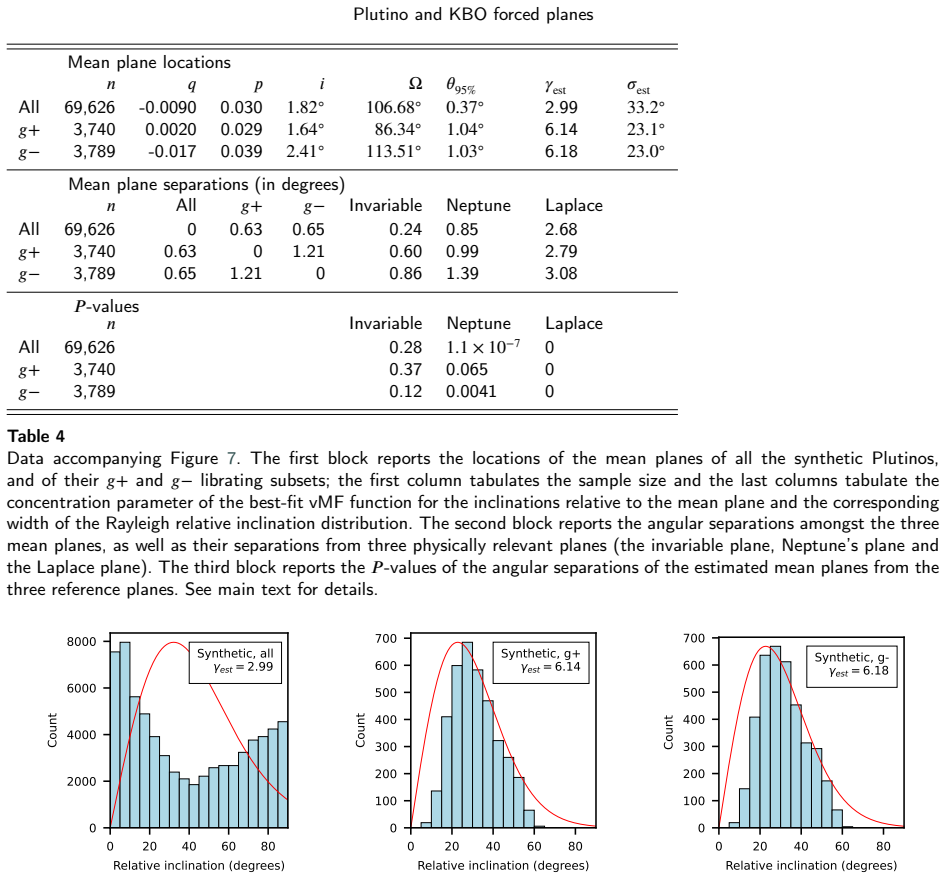
The first block reports the locations of the mean planes of all the synthetic Plutinos, and of their𝑔+and𝑔−librating subsets; the first column tabulates the sample size and the last columns tabulate the concentration parameter of the best-fit vMF function for the inclinations relative to the mean plane and the corresponding width of the Rayleigh relative ...
work page 2000
-
[36]
A. The mean plane of a synthetic Plutino population WewishtocomparethecalculatedmeanplanesoftheobservedPlutinosandtheir𝑔-libratingsubsets,alongwiththe statisticalconfidenceinthosecalculations,toatheoreticalpredictionfortheforcedplane.Thequestionishowtodefine thatprediction.Linearseculartheoryoffersaneasilycalculatedforcedplanelocationforthenominalcentrals...
work page 2025
-
[49]
doi:doi:10.3847/1538-3881/ab24e1. Volk,K.,Malhotra,R.,2017. Thecuriouslywarpedmeanplaneofthekuiperbelt. TheAstronomicalJournal154,62. doi:10.3847/1538-3881/ aa79ff. Volk, K., Van Laerhoven, C.,
-
[99]
Lido: Exploring the stable plutino parameter space
Lawler,S.M.,Comte,M.,Pike,R.E.,Alexandersen,M.,Chen,Y.T.,Collyer,C.,Holman,M.,Kavelaars,J.,Peltier,L.,Semenchuck,C.,2025. Lido: Exploring the stable plutino parameter space. The Planetary Science Journal 6,
work page 2025
-
[143]
The mid-plane of the Main Asteroid Belt
doi:10.3847/1538-3881/ aaab6b,arXiv:1801.08096. Chiang, E., Choi, H.,
-
[350]
Fisher, N.I., Lewis, T., Embleton, B.J.,
doi:doi:10.1088/0004-6256/ 136/1/350. Fisher, N.I., Lewis, T., Embleton, B.J.,
-
[2004]
The Astronomical Journal 127, 2418–2423
The Plane of the Kuiper Belt. The Astronomical Journal 127, 2418–2423. doi:10.1086/382515. Cambioni, S., Malhotra, R.,
Show all 13 references
-
[2008]
The Astronomical Journal 136, 350–357
The Warped Plane of the Classical Kuiper Belt. The Astronomical Journal 136, 350–357. doi:10.1088/0004-6256/ 136/1/350,arXiv:0804.4687. Chiang, E., Choi, H.,
-
[2012]
REBOUND: an open-source multi-purpose N-body code for collisional dynamics. Astron. & Astrophys. 537, A128. doi:10.1051/0004-6361/201118085,arXiv:1110.4876. Siraj,A.,Chyba,C.F.,Tremaine,S.,2025. Measuringthemeanplaneofthedistantkuiperbelt. MonthlyNoticesoftheRoyalAstronomicalS...
2025 arXiv
-
[2019]
TheAstronomicalJournal157,98
astroquery: An AstronomicalWeb-queryingPackageinPython. TheAstronomicalJournal157,98. doi:10.3847/1538-3881/aafc33,arXiv:1901.04520. Gladman, B., Marsden, B.G., VanLaerhoven, C.,
1901 arXiv
-
[2023]
Monthly Notices of the Royal Astronomical Society 522, 937–947
The hamiltonian for von zeipel–lidov–kozai oscillations. Monthly Notices of the Royal Astronomical Society 522, 937–947. VanLaerhoven,C.,Gladman,B.,Volk,K.,Kavelaars,J.,Petit,J.M.,Bannister,M.T.,Alexandersen,M.,Chen,Y.T.,Gwyn,S.D.,2019. Ossos.xiv. the plane of the kuiper belt....
2019
-
[2024]
Research Notes of the AAS 8,
Dynamical classifications of multi-opposition tnos as of 2023 december. Research Notes of the AAS 8,
2023
Reviewed August 8, 2026 · model on record in the stance chip above.
Discussion (0). Continue with ORCID to comment.