REVIEW 5 major objections 5 minor 66 references
ReflectFact: Self-Reflective Agents for Improving Comprehension and Reasoning in Multi-Hop Fact Verification
T0 review · 5 major / 5 minor · reviewed 2026-08-15 · deepseek-v4-flash
Pith's one-line read ReflectFact reports state-of-the-art Macro-F1 of 78.51 on HOVER and 83.76 on EX-FEVER by adding self-reflection checks that catch evidence drift and reasoning flaws before they reach the verdict.
desk verdict Solid incremental agent framework for multi-hop fact verification; the genuinely new EDV check is worth attention, but the RRV mechanism's reliability is asserted rather than measured. read the letter →
The pith
A machine-rendered reading of the paper's core claim, the machinery that carries it, and where it could break.
The reading
What carries the argument
The central object is the self-reflective verification loop defined by Eq. (1): for each instruction-driven reasoning step, the pair of input and output is presented to the LLM as an object to be checked under an explicit 'this is part of a fact-checking task' framing; a 'consistent' verdict accepts the output, and an 'inconsistent' verdict triggers regeneration. Evidence-Drift Verification is the complementary loop for evidence-comprehension steps, comparing an evidence-grounded answer with an evidence-free answer and forcing the model to quote a verbatim evidence span when the two coincide. Together they convert the LLM from a generator into a verifier of its own intermediate reasoning.
What would settle it
Take a set of multi-hop claims from either dataset, corrupt individual reasoning steps with known bias types such as replacing an entity with a co-referring but inconsistent one or shifting a date or location, and run only the verification prompt of Reasoning Reflection Verification on the corrupted steps; if the verifier accepts a large share of corrupted steps as 'consistent,' the reflection mechanism cannot be what drives the reported gains. Alternatively, ablate the regeneration branch by keeping the verification verdict but discarding the regenerated output; if Macro-F1 does not drop, the mechanism's value lies elsewhere.
Extended reading notes
Core claim
On the paper's own terms, the central claim is that post-hoc self-reflection at each intermediate step, rather than better retrieval or bigger models, is what unlocks reliable multi-hop fact verification. ReflectFact reports Macro-F1 of 78.51 on HOVER and 83.76 on EX-FEVER, outperforming the strongest of ten baselines by 3.32 and 2.78 points, and the ablation shows that removing Reasoning Reflection Verification costs more than removing Evidence-Drift Verification, especially on four-hop claims. The two checks are designed to counter specific failure patterns: replacing an implicit entity mention with an entity whose date contradicts the claim's description, and answering from parametric knowledge when the evidence disagrees with it.
Load-bearing premise
The load-bearing premise is that the LLM can be trusted to judge whether its own intermediate reasoning step is consistent: any output the verification prompt calls 'consistent' is accepted as-is, and if the model frequently mislabels flawed steps as consistent, the reflection loop would certify errors instead of catching them.
Editorial extensions
If this is right
- If the reported gains are real, adding the two reflection checks to an existing agent pipeline should improve Macro-F1 without changing the retrieval evidence.
- The benefit grows with reasoning depth: the four-hop HOVER gap over the strongest agent baseline is 3.79 points, so reflection matters most when errors have more chances to propagate.
- The framework is model-agnostic; applying it to a smaller open-weight backbone should give consistent gains over that backbone's direct prompting, as shown for a proprietary and an open-weight model.
- Requiring the model to quote supporting evidence spans when drift is suspected produces explanations that score higher on ROUGE than several dedicated explanation generators, so the check also improves interpretability.
Reading between the lines
- The paper's own error analysis finds that 82.5 percent of remaining errors are factual hallucinations in Semantic Decomposition; since the reflection checks are limited to consistency with the provided evidence, they cannot correct a model's confident fabrication of a fact that is internally coherent, so a natural extension is to add external verification of generated sub-answers.
- The central assumption that LLMs verify better than they generate is testable in isolation: one could measure the consistency check's precision on deliberately corrupted reasoning steps and use that precision to predict when the framework's gain should vanish.
- If the equivalence check in Evidence-Drift Verification is the trigger for re-answering, then the framework's benefit depends on the model having a strong parametric prior; models trained to be more faithful to context might see smaller gains.
Signed reviews
Editorial analysis
A structured set of objections, weighed in public.
Referee Report
Summary. The paper proposes ReflectFact, a self-reflective agent framework for multi-hop fact verification. It constructs an explicit reasoning path through implicit entity resolution, semantic decomposition, and integrative logical reasoning, and augments it with two post-verification mechanisms: Evidence-Drift Verification (EDV) and Reasoning Reflection Verification (RRV). EDV flags cases where an evidence-grounded answer matches the model's parametric answer and forces a re-answer with explicit evidence quotation; RRV checks each reasoning step with the same LLM and regenerates the step if it is flagged inconsistent. Experiments on HOVER and EX-FEVER report Macro-F1 gains over ten baselines, with ablations attributing the largest improvement to RRV, cross-backbone generalization tests on GPT-4o-mini and Qwen3-8B, and an interpretability analysis using ROUGE scores. The paper also includes an error analysis categorizing remaining errors.
Significance. If the results are robust, ReflectFact offers a practical, model-agnostic recipe for improving multi-hop fact verification by adding reflective checks on intermediate reasoning. The framework is transparent, the hop-wise reporting is informative, and the cross-backbone experiments support a generality claim. The paper's main contribution is the two verification mechanisms and the demonstration that they improve accuracy. However, the central mechanism (RRV) rests on an unmeasured assumption about LLM self-verification reliability, and the strongest baseline comparison on EX-FEVER is not backbone-controlled. The contribution is promising but not yet fully established at the journal level.
major comments (5)
- [Reasoning Reflection Verification, Eq. (1)] The claim that LLMs can reliably verify their own intermediate outputs is load-bearing but unsupported. The paper states 'LLMs exhibit stronger verification than generation capabilities' without citation or measurement, and no verifier precision, recall, or correction-success statistics are reported. The ablation in Table 2 shows that removing RRV hurts, but this does not distinguish reliable verification from a beneficial extra regeneration pass. Please report an evaluation of V(x,o) on a labeled sample of intermediate steps: the rate at which the verifier flags genuinely incorrect steps, the rate at which it flags correct steps, and the fraction of regenerated outputs that become correct after flagging.
- [Table 1, EX-FEVER] The claim of outperforming the strongest baseline by 2.78% on EX-FEVER is against ProgramFC (80.98), yet ProgramFC is run with its original backbone (codex and Flan-T5) rather than GPT-4o-mini. The paper's fairness statement only replaces the backbone for agent-based baselines. Since ReflectFact uses GPT-4o-mini, the comparison confounds method with model capacity. Please either re-run ProgramFC with a matched GPT-4o-mini backbone, or report the discrepancy and temper the SOTA claim accordingly.
- [Tables 1-2, Figures 3-4] All results are single-run measurements with no variance estimates or significance tests. Given that the claimed gains over the strongest baselines are 3.32 and 2.78 Macro-F1 points, and that LLM-prompting pipelines can be sensitive to prompt ordering and random seeds, the reader cannot assess whether the improvements are robust. Please add multiple runs (at least three) with standard deviations, or bootstrap confidence intervals, and state the number of runs explicitly.
- [Error Type Analysis, Figure 4] The analysis on 40 sampled errors reports that 82.5% of remaining errors are 'factual hallucination'. This appears to undercut the central claim that RRV catches and corrects reasoning flaws before they propagate: if verification is effective, one would expect many hallucinations to be flagged at intermediate steps. Please clarify whether these hallucinations occur in the final verdict, passed through RRV as 'consistent', or occur in steps not covered by verification. This is essential for interpreting the mechanism and for assessing the reliability of the verifier.
- [Evidence-Drift Verification] The criterion for flagging evidence drift is a≡a_p (grounded answer equals parametric answer). The paper does not report how often EDV triggers, how often the re-answer changes the output, or the precision of this heuristic. Without these measurements, the contribution of EDV is under-specified. Please add a trigger-rate and change-rate analysis, ideally with examples of the drift cases it actually corrects.
minor comments (5)
- [Experiments - Datasets] The evaluation uses the validation set of HOVER (4,000 claims) rather than the test set; this should be stated explicitly and justified, since HOVER provides a test set.
- [Methodology, Figure 2] Figure 2 shows 'k=1 to K' in the Reasoning Reflection Verification loop, but the paper never defines K or the iteration procedure in the main text. Please specify the budget and the stopping criterion.
- [Methodology - Implicit Entity Resolution] The Replace operation mentions 'dynamic sample selection' for demonstrations, but the selection procedure is not described.
- [Related Work] The Related Work section contains a duplicated sentence: 'These methods decompose fact verification into subtasks and execute them through agent workflows' appears twice consecutively.
- [Reasoning Reflection Verification] A citation is needed for the claim that LLMs are better verifiers than generators; the current text presents a contested assertion as a fact, and related self-verification work (e.g., SelfCheckGPT, CRITIC, Self-Refine) is not cited.
Circularity Check
No significant circularity: the paper reports empirical agent-pipeline results on held-out benchmarks, with no fitted parameters, no prediction-by-construction, and no load-bearing self-citation chain.
full rationale
ReflectFact is an empirical pipeline paper rather than a formal derivation. The verification rule in Eq. (1) defines when an agent output is accepted (V(x,o) = 'consistent') or regenerated; it is a control-flow decision, not a fitted estimator, and its effectiveness is judged by Macro-F1 on held-out HOVER validation and EX-FEVER test sets. No parameter is fitted to those labels and then renamed as a prediction, so the fitted-input-called-prediction pattern does not apply. Evidence-Drift Verification defines 'evidence drift' as agreement between the evidence-grounded answer and the parametric-only answer; this is an explicit heuristic, and the paper's final metric measures whether that heuristic helps, rather than assuming the desired conclusion. Reasoning Reflection Verification's premise that 'verification capabilities of LLM typically surpass the generative abilities' is asserted without citation or measurement, which is a genuine fragility and correctness risk, but it is not circular reasoning: the claim is not established by defining the output in terms of the benchmark labels, nor by invoking the authors' own prior results. The ablation study removing EDV and RRV provides honest, independently meaningful comparisons. No self-citation is load-bearing, no uniqueness theorem is imported, and no ansatz is smuggled in via citation. The moderate evaluation-bias concern that the method was designed around observed failure modes on these datasets is a general research-design worry, not a circularity in the ledger sense defined here. Therefore the appropriate circularity score is 0.
Assumptions & free parameters
free parameters (1)
- verification iteration budget K =
unreported
assumptions (4)
- domain assumption LLMs exhibit stronger verification than generation capabilities
- domain assumption Agreement between evidence-free and evidence-grounded answers indicates parametric-knowledge drift
- domain assumption The gold evidence in HOVER and EX-FEVER is complete and sufficient
- domain assumption Removing NEI claims from EX-FEVER yields a valid binary task comparison
Cite this review
Pith. "Pith review of ReflectFact: Self-Reflective Agents for Improving Comprehension and Reasoning in Multi-Hop Fact Verification." pith.science (2026). https://pith.science/paper/VN4EWT4O
@misc{pith2026260812877,
  author       = {Pith},
  title        = {Pith review of: ReflectFact: Self-Reflective Agents for Improving Comprehension and Reasoning in Multi-Hop Fact Verification},
  year         = {2026},
  howpublished = {\url{https://pith.science/paper/VN4EWT4O}},
  note         = {Machine review of arXiv:2608.12877}
}
read the original abstract
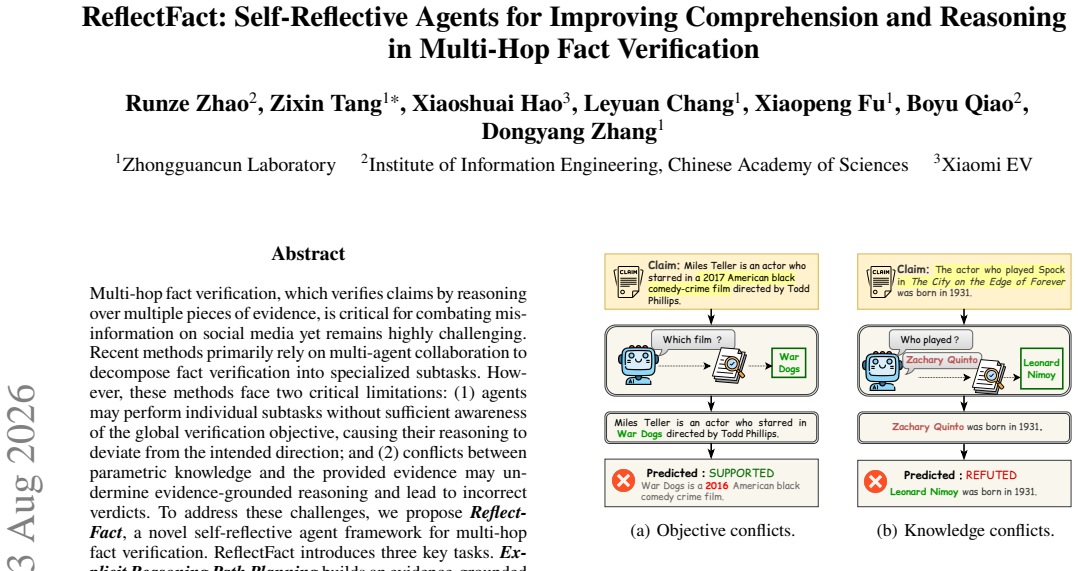
Multi-hop fact verification, which verifies claims by reasoning over multiple pieces of evidence, is critical for combating misinformation on social media yet remains highly challenging. Recent methods primarily rely on multi-agent collaboration to decompose fact verification into specialized subtasks. However, these methods face two critical limitations: (1) agents may perform individual subtasks without sufficient awareness of the global verification objective, causing their reasoning to deviate from the intended direction; and (2) conflicts between parametric knowledge and the provided evidence may undermine evidence-grounded reasoning and lead to incorrect verdicts. To address these challenges, we propose ReflectFact, a novel self-reflective agent framework for multi-hop fact verification. ReflectFact introduces three key tasks. Explicit Reasoning Path Planning builds an evidence-grounded reasoning path by resolving implicit entities, decomposing the claim into sub-questions, and integrating the verified facts into a verdict. Evidence-Drift Verification makes the agent re-answer by quoting the supporting evidence when a grounded answer merely echoes its parametric prior, thereby calibrating evidence deviation to ensure grounded comprehension. Reasoning Reflection Verification re-examines each reasoning step and regenerates it once an inconsistency is detected, correcting reasoning flaws such as location bias and replacement bias through a global task perspective. Subsequently, the agent aggregates validated reasoning chains to yield reliable verdicts. Extensive experiments on HOVER and EX-FEVER demonstrate that ReflectFact effectively remedies the comprehension and reasoning defects of existing methods, achieving state-of-the-art performance and respectively outperforming the strongest baseline by 3.32\% and 2.78\% on the two datasets.
Figures


Figures from the paper (1 more)

Reference graph
Works this paper leans on
-
[1]
, title =
Turing, Alan M. , title =. Mind , volume =
-
[2]
Nature , volume =
Learning Representations by Back-Propagating Errors , author =. Nature , volume =
-
[3]
Proceedings of the 10th European Conference on Artificial Intelligence (ECAI) , pages =
Planning as Satisfiability , author =. Proceedings of the 10th European Conference on Artificial Intelligence (ECAI) , pages =
-
[4]
Artificial Intelligence , volume =
Collaborative Plans for Complex Group Action , author =. Artificial Intelligence , volume =
-
[5]
The Entropy Formula for the
Grisha Perelman , howpublished =. The Entropy Formula for the
-
[6]
Causality , author =
-
[7]
Advances in neural information processing systems , volume=
Chain-of-thought prompting elicits reasoning in large language models , author=. Advances in neural information processing systems , volume=
-
[8]
arXiv preprint arXiv:2011.03088 , year=
HoVer: A dataset for many-hop fact extraction and claim verification , author=. arXiv preprint arXiv:2011.03088 , year=
arXiv 2011
Show all 66 references
-
[9]
arXiv preprint arXiv:2107.02153 , year=
FAVIQ: FAct Verification from Information-seeking Questions , author=. arXiv preprint arXiv:2107.02153 , year=
-
[10]
arXiv preprint arXiv:1806.07687 , year=
Automated fact checking: Task formulations, methods and future directions , author=. arXiv preprint arXiv:1806.07687 , year=
-
[11]
Proceedings of the 43rd international ACM SIGIR conference on research and development in information retrieval , pages=
Brenda: Browser extension for fake news detection , author=. Proceedings of the 43rd international ACM SIGIR conference on research and development in information retrieval , pages=
-
[12]
arXiv preprint arXiv:2310.09754 , year=
EX-FEVER: A Dataset for Multi-hop Explainable Fact Verification , author=. arXiv preprint arXiv:2310.09754 , year=
-
[13]
arXiv preprint arXiv:2310.14508 , year=
EXPLAIN, EDIT, GENERATE: Rationale-Sensitive Counterfactual Data Augmentation for Multi-hop Fact Verification , author=. arXiv preprint arXiv:2310.14508 , year=
-
[14]
arXiv preprint arXiv:2305.12744 , year=
Fact-checking complex claims with program-guided reasoning , author=. arXiv preprint arXiv:2305.12744 , year=
-
[15]
arXiv preprint arXiv:2310.00305 , year=
Towards llm-based fact verification on news claims with a hierarchical step-by-step prompting method , author=. arXiv preprint arXiv:2310.00305 , year=
-
[16]
arXiv preprint arXiv:2212.10511 , year=
When not to trust language models: Investigating effectiveness of parametric and non-parametric memories , author=. arXiv preprint arXiv:2212.10511 , year=
-
[17]
International conference on machine learning , pages=
Blip-2: Bootstrapping language-image pre-training with frozen image encoders and large language models , author=. International conference on machine learning , pages=. 2023 , organization=
2023
-
[18]
arXiv preprint arXiv:2309.11495 , year=
Chain-of-verification reduces hallucination in large language models , author=. arXiv preprint arXiv:2309.11495 , year=
-
[19]
arXiv preprint arXiv:2309.05922 , year=
A survey of hallucination in large foundation models , author=. arXiv preprint arXiv:2309.05922 , year=
-
[20]
arXiv preprint arXiv:2205.11482 , year=
Towards tracing factual knowledge in language models back to the training data , author=. arXiv preprint arXiv:2205.11482 , year=
-
[21]
Advances in Neural Information Processing Systems , volume=
Tree of thoughts: Deliberate problem solving with large language models , author=. Advances in Neural Information Processing Systems , volume=
-
[22]
arXiv preprint arXiv:2110.08387 , year=
Generated knowledge prompting for commonsense reasoning , author=. arXiv preprint arXiv:2110.08387 , year=
-
[23]
Proceedings of the AAAI Conference on Artificial Intelligence , volume=
Exploring faithful rationale for multi-hop fact verification via salience-aware graph learning , author=. Proceedings of the AAAI Conference on Artificial Intelligence , volume=
-
[24]
Joint European Conference on Machine Learning and Knowledge Discovery in Databases , pages=
KESHEM: Knowledge Enabled Short Health Misinformation Detection Framework , author=. Joint European Conference on Machine Learning and Knowledge Discovery in Databases , pages=. 2023 , organization=
2023
-
[25]
arXiv preprint arXiv:2305.12692 , year=
Metaadapt: Domain adaptive few-shot misinformation detection via meta learning , author=. arXiv preprint arXiv:2305.12692 , year=
-
[26]
arXiv preprint arXiv:2103.09535 , year=
Towards few-shot fact-checking via perplexity , author=. arXiv preprint arXiv:2103.09535 , year=
-
[27]
arXiv preprint arXiv:2212.05276 , year=
Natural Logic-guided Autoregressive Multi-hop Document Retrieval for Fact Verification , author=. arXiv preprint arXiv:2212.05276 , year=
-
[28]
Proceedings of the 60th Annual Meeting of the Association for Computational Linguistics (Volume 1: Long Papers) , pages=
Tackling fake news detection by continually improving social context representations using graph neural networks , author=. Proceedings of the 60th Annual Meeting of the Association for Computational Linguistics (Volume 1: Long Papers) , pages=
-
[29]
2023 IEEE International Conference on Multimedia and Expo (ICME) , pages=
Multimodal fake news detection via clip-guided learning , author=. 2023 IEEE International Conference on Multimedia and Expo (ICME) , pages=. 2023 , organization=
2023
-
[30]
arXiv preprint arXiv:2109.06480 , year=
Logic-level evidence retrieval and graph-based verification network for table-based fact verification , author=. arXiv preprint arXiv:2109.06480 , year=
-
[31]
FEVER : a Large-scale Dataset for Fact Extraction and VER ification
Thorne, James and Vlachos, Andreas and Christodoulopoulos, Christos and Mittal, Arpit. FEVER : a Large-scale Dataset for Fact Extraction and VER ification. Proceedings of the 2018 Conference of the North A merican Chapter of the Association for Computational Linguistics: Human...
2018
-
[32]
arXiv preprint arXiv:2106.00950 , year=
A multi-level attention model for evidence-based fact checking , author=. arXiv preprint arXiv:2106.00950 , year=
-
[33]
Fine-grained Fact Verification with Kernel Graph Attention Network
Liu, Zhenghao and Xiong, Chenyan and Sun, Maosong and Liu, Zhiyuan. Fine-grained Fact Verification with Kernel Graph Attention Network. Proceedings of the 58th Annual Meeting of the Association for Computational Linguistics. 2020
2020
-
[34]
Online Social Networks and Media , volume=
Deep active learning for misinformation detection using geometric deep learning , author=. Online Social Networks and Media , volume=. 2023 , publisher=
2023
-
[35]
Reasoning Over Semantic-Level Graph for Fact Checking
Zhong, Wanjun and Xu, Jingjing and Tang, Duyu and Xu, Zenan and Duan, Nan and Zhou, Ming and Wang, Jiahai and Yin, Jian. Reasoning Over Semantic-Level Graph for Fact Checking. Proceedings of the 58th Annual Meeting of the Association for Computational Linguistics. 2020
2020
-
[36]
H otpot QA : A Dataset for Diverse, Explainable Multi-hop Question Answering
Yang, Zhilin and Qi, Peng and Zhang, Saizheng and Bengio, Yoshua and Cohen, William and Salakhutdinov, Ruslan and Manning, Christopher D. H otpot QA : A Dataset for Diverse, Explainable Multi-hop Question Answering. Proceedings of the 2018 Conference on Empirical Methods in Na...
2018
-
[37]
Self-prompted Chain-of-Thought on Large Language Models for Open-domain Multi-hop Reasoning
Wang, Jinyuan and Li, Junlong and Zhao, Hai. Self-prompted Chain-of-Thought on Large Language Models for Open-domain Multi-hop Reasoning. Findings of the Association for Computational Linguistics: EMNLP 2023. 2023
2023
-
[38]
Proceedings of the ACM Web Conference 2023 , pages=
Hierarchy-aware multi-hop question answering over knowledge graphs , author=. Proceedings of the ACM Web Conference 2023 , pages=
2023
-
[39]
Measuring and Narrowing the Compositionality Gap in Language Models
Press, Ofir and Zhang, Muru and Min, Sewon and Schmidt, Ludwig and Smith, Noah and Lewis, Mike. Measuring and Narrowing the Compositionality Gap in Language Models. Findings of the Association for Computational Linguistics: EMNLP 2023. 2023
2023
-
[40]
arXiv preprint arXiv:2210.03350 , year=
Measuring and narrowing the compositionality gap in language models , author=. arXiv preprint arXiv:2210.03350 , year=
-
[41]
and Wang, Sinong and Yih, Wen-tau and Ma, Hao and Khabsa, Madian
Lee, Nayeon and Li, Belinda Z. and Wang, Sinong and Yih, Wen-tau and Ma, Hao and Khabsa, Madian. Language Models as Fact Checkers?. Proceedings of the Third Workshop on Fact Extraction and VERification (FEVER). 2020
2020
-
[42]
arXiv preprint arXiv:2010.09926 , year=
Explainable automated fact-checking for public health claims , author=. arXiv preprint arXiv:2010.09926 , year=
2010 arXiv
-
[43]
arXiv preprint arXiv:2210.11416 , year=
Scaling instruction-finetuned language models , author=. arXiv preprint arXiv:2210.11416 , year=
-
[44]
Advances in neural information processing systems , volume=
Language models are few-shot learners , author=. Advances in neural information processing systems , volume=
-
[45]
2022 , howpublished =
Alexandrainst , title =. 2022 , howpublished =
2022
-
[46]
arXiv preprint arXiv:1810.04805 , year=
Bert: Pre-training of deep bidirectional transformers for language understanding , author=. arXiv preprint arXiv:1810.04805 , year=
-
[47]
Political Analysis , volume=
Less annotating, more classifying: Addressing the data scarcity issue of supervised machine learning with deep transfer learning and BERT-NLI , author=. Political Analysis , volume=. 2024 , publisher=
2024
-
[48]
arXiv preprint arXiv:2311.16452 , year=
Can generalist foundation models outcompete special-purpose tuning? case study in medicine , author=. arXiv preprint arXiv:2311.16452 , year=
-
[49]
Vicuna: An Open-Source Chatbot Impressing GPT-4 with 90\ author =
-
[50]
International Conference on Learning Representations , year=
Answering Complex Open-Domain Questions with Multi-Hop Dense Retrieval , author=. International Conference on Learning Representations , year=
-
[51]
Improving Evidence Retrieval for Automated Explainable Fact-Checking
Samarinas, Chris and Hsu, Wynne and Lee, Mong Li. Improving Evidence Retrieval for Automated Explainable Fact-Checking. Proceedings of the 2021 Conference of the North American Chapter of the Association for Computational Linguistics: Human Language Technologies: Demonstrations. 2021
2021
-
[52]
UKP -Athene: Multi-Sentence Textual Entailment for Claim Verification
Hanselowski, Andreas and Zhang, Hao and Li, Zile and Sorokin, Daniil and Schiller, Benjamin and Schulz, Claudia and Gurevych, Iryna. UKP -Athene: Multi-Sentence Textual Entailment for Claim Verification. Proceedings of the First Workshop on Fact Extraction and VER ification ( ...
2018
-
[53]
Proceedings of the 2025 Conference of the Nations of the Americas Chapter of the Association for Computational Linguistics: Human Language Technologies,
FactCG: Enhancing Fact Checkers with Graph-Based Multi-Hop Data , author=. Proceedings of the 2025 Conference of the Nations of the Americas Chapter of the Association for Computational Linguistics: Human Language Technologies,
2025
-
[54]
Neural Information Processing Systems , year=
Beta Embeddings for Multi-Hop Logical Reasoning in Knowledge Graphs , author=. Neural Information Processing Systems , year=
-
[55]
Thirty-Ninth
Liu, Yuxuan and Sun, Hongda and Guo, Wenya and Xiao, Xinyan and Mao, Cunli and Yu, Zhengtao and Yan, Rui , title =. Thirty-Ninth. 2025 , isbn =
2025
-
[56]
Factcheck-Bench: Fine-Grained Evaluation Benchmark for Automatic Fact-checkers
Wang, Yuxia and Gangi Reddy, Revanth and Mujahid, Zain Muhammad and Arora, Arnav and Rubashevskii, Aleksandr and Geng, Jiahui and Mohammed Afzal, Osama and Pan, Liangming and Borenstein, Nadav and Pillai, Aditya and Augenstein, Isabelle and Gurevych, Iryna and Nakov, Preslav. ...
2024
-
[57]
CHECKWHY : Causal Fact Verification via Argument Structure
Si, Jiasheng and Zhao, Yibo and Zhu, Yingjie and Zhu, Haiyang and Lu, Wenpeng and Zhou, Deyu. CHECKWHY : Causal Fact Verification via Argument Structure. Proceedings of the 62nd Annual Meeting of the Association for Computational Linguistics (Volume 1: Long Papers). 2024
2024
-
[58]
The Eleventh International Conference on Learning Representations , year=
DeBERTaV3: Improving DeBERTa using ELECTRA-Style Pre-Training with Gradient-Disentangled Embedding Sharing , author=. The Eleventh International Conference on Learning Representations , year=
-
[59]
Thirty-Ninth
Cao, Han and Wei, Lingwei and Zhou, Wei and Hu, Songlin , title =. Thirty-Ninth. 2025 , isbn =
2025
-
[60]
Multimodal Fact-Checking with Vision Language Models: A Probing Classifier based Solution with Embedding Strategies
Cekinel, Recep Firat and Karagoz, Pinar and. Multimodal Fact-Checking with Vision Language Models: A Probing Classifier based Solution with Embedding Strategies. Proceedings of the 31st International Conference on Computational Linguistics. 2025
2025
-
[61]
Proceedings of the 63rd Annual Meeting of the Association for Computational Linguistics (Volume 1: Long Papers),
Yingjian Chen and Haoran Liu and Yinhong Liu and Jinxiang Xie and Rui Yang and Han Yuan and Yanran Fu and Peng Yuan Zhou and Qingyu Chen and James Caverlee and Irene Li , title =. Proceedings of the 63rd Annual Meeting of the Association for Computational Linguistics (Volume 1...
2025
-
[62]
arXiv preprint arXiv:2512.22933 , year=
Multimodal Fact-Checking: An Agent-based Approach , author=. arXiv preprint arXiv:2512.22933 , year=
-
[63]
arXiv preprint arXiv:2606.13262 , year=
From Verdict to Process: Agentic Reinforcement Learning for Multi-Stage Fact Verification , author=. arXiv preprint arXiv:2606.13262 , year=
-
[64]
2024 , eprint=
GPT-4o System Card , author=. 2024 , eprint=
2024
-
[65]
Step-by-step fact verification system for medical claims with explainable reasoning , author=. Proceedings of the 2025 Conference of the Nations of the Americas Chapter of the Association for Computational Linguistics: Human Language Technologies (Volume 2: Short Papers) , pages=
2025
-
[66]
arXiv preprint arXiv:2505.09388 , year=
Qwen3 technical report , author=. arXiv preprint arXiv:2505.09388 , year=
Reviewed August 15, 2026 · model on record in the stance chip above.
Discussion (0). Continue with ORCID to comment.