REVIEW 3 major objections 5 minor 63 references
Can Large Language Models Recover Semantic Optimization Opportunities That Compilers Miss?
T0 review · 3 major / 5 minor · reviewed 2026-08-05 · deepseek-v4-flash
Pith's one-line read LLMs can recover compiler-missed optimization semantics and turn them into validated source changes that speed up C/C++ programs.
desk verdict SeGaBench is a genuine step forward in measuring LLM semantic recovery, but its headline rates pass through an uncalibrated human label and an unreleased benchmark. read the letter →
The pith
A machine-rendered reading of the paper's core claim, the machinery that carries it, and where it could break.
The reading
What carries the argument
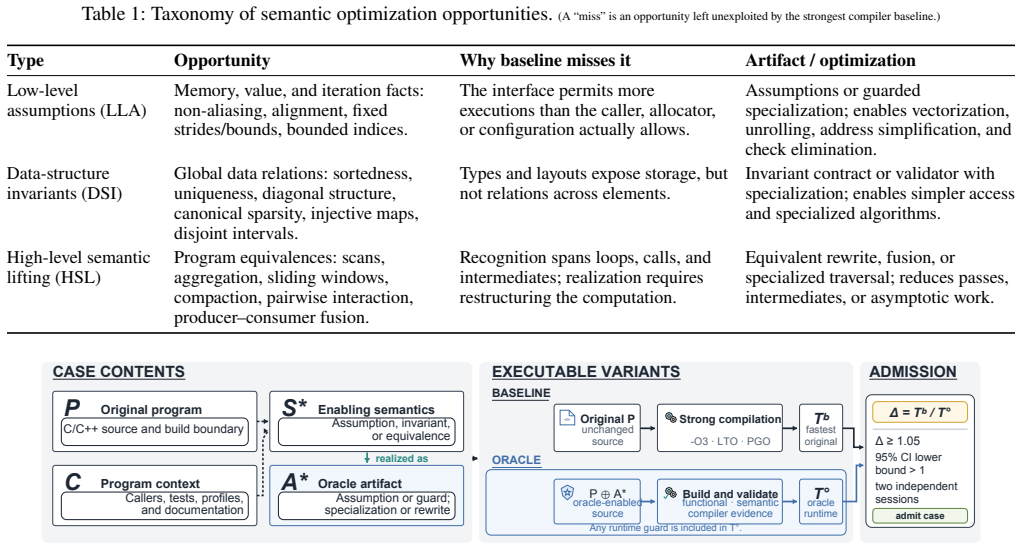
The carrying mechanism is SeGaBench, an executable benchmark whose cases are tuples B_i = (P_i, C_i, S*_i, A*_i, V_i, M_i): original program, context view, hidden enabling semantics, hidden oracle artifact, validators, and a fixed measurement protocol. Its work is to convert an otherwise philosophical question—can an LLM recover semantics the compiler cannot see?—into a falsifiable pipeline with a three-stage metric: RQ1 semantic identification (blinded human review), RQ2 artifact realization (compile, functional and semantic validation), and RQ3 performance realization (speedup and oracle-gap-closed). The contract-preservation condition ∀x∈D, (P⊕A)(x) ≃ P(x), together with the 1.05x admissi
What would settle it
Take the 600 responses of the strongest model and have two independent teams apply the paper's semantic-equivalence rubric without seeing the official labels; if labeling agreement is low or the 95.0% recovery rate drops materially, the first stage of the pipeline is an artifact of the measurement. As a second check, re-measure candidates within 10% of the 1.05x speedup threshold under CPU frequency locking and two measurement sessions, as the oracle admission itself requires, and see how many remain above threshold.
Extended reading notes
Core claim
The central claim is that semantic optimization opportunities are real, enumerable, and recoverable: for every admitted case there is a hidden enabling semantics S* and an oracle artifact A* such that applying A* to the original program P preserves the contract (∀x∈D, (P⊕A*)(x) ≃ P(x)) and beats the strongest compiled baseline by at least 1.05x. The paper reports that a capable LLM, given only P and context C and no feedback from compiler, validators, or profiler, states S* or an equivalent claim with supporting evidence in 95.0% of responses; its artifacts compile and pass functional and semantic validation in 94.8%; and the valid artifacts deliver at least 1.05x speedup in 83.3% of respons
Load-bearing premise
The headline success rates all pass through human reviewers' judgment that a model response really names the hidden optimization fact or something equivalent, and the paper does not report how often independent reviewers would agree on that judgment.
Editorial extensions
If this is right
- A three-stage loop—LLM proposes a semantic claim and artifact, validators check contract preservation, compiler performs downstream optimization—can capture speedups that -O3/LTO/PGO alone leaves unexploited.
- Semantic recovery is model-dependent, not a uniform LLM capability: the strongest model recovers 95.0% of opportunities while weaker models abstain or fail on most cases.
- Sampling five independent responses per case raises case-level performance coverage substantially (82.5% to 93.3% for the strongest model), making multiple proposals a practical way to improve end-to-end success.
- Correct artifacts often close only part of the oracle gap, so a successful proposal is a lower bound on what the semantics enable, not the full opportunity.
- Speedups are larger for low-level assumptions than for data-structure invariants or high-level semantic lifting, and all models see smaller speedups on real-world cases than on synthetic ones.
Reading between the lines
- Beyond the paper: the 50 archetypes are curated and oracle-admitted, so the headline rates likely overstate what the same models would achieve on uncurated production code; a field-sampled or randomly drawn case set would test this transfer.
- Beyond the paper: if contract validation can be made cheap and automatic, compiler pipelines could treat LLM responses as speculative annotations, effectively letting the compiler request the missing assumptions it cannot derive—an architecture implied by the paper's division of labor but not implemented.
- Beyond the paper: candidates near the 1.05x threshold are measured by point estimate on one machine, so a check that re-runs those candidates under the oracle's own two-session, confidence-interval protocol would show how much of the 83.3% end-to-end rate is robust to measurement noise.
Editorial analysis
A structured set of objections, weighed in public.
Referee Report
Summary. The paper introduces SeGaBench, an executable benchmark of 120 C/C++ cases (100 synthetic, 20 source-backed from HPC projects) in which each case has hidden enabling semantics S*, an oracle artifact A*, validators, and a fixed performance protocol. Five LLMs each receive five independent, stateless, single-turn proposals per case, with S*, A*, validators, and profiler feedback hidden. The central empirical claim is that the strongest model, GPT-5.6 Sol, identifies the target semantics in 95.0% of responses, produces correct, contract-preserving artifacts in 94.8% of responses, achieves at least 1.05x speedup in 83.3% of responses, and succeeds on 93.3% of cases with five samples. The authors conclude that LLMs can act as speculative semantic proposers that complement compiler analysis, provided their artifacts are validated and performance-measured. The paper separates semantic identification (RQ1, human-labeled), artifact realization (RQ2, mechanical validators), and performance realization (RQ3, point-estimate speedups).
Significance. If the reported results hold, the paper makes a useful contribution: it operationalizes a genuinely different role for LLMs in compilation, namely recovering optimization-enabling semantics that are absent from the compiler's representation, rather than only tuning passes or generating kernels. The benchmark structure is a strength: hidden oracle artifacts, contract validators, a fixed admission protocol, frozen single-turn responses, and no iterative feedback. The paper also reports diagnostic outcomes (abstention, schema failure, compilation failure, validation failure) that allow model behavior to be separated from benchmark artifacts. The main risk is measurement validity: the headline rates are gated by uncalibrated human semantic labels and by point-estimate performance classifications near a 1.05x threshold. These are fixable with additional reporting rather than fundamental flaws.
major comments (3)
- [Evaluation, RQ1: Semantic Identification] All headline rates pass through the RQ1 label s_r: RecoveryRate = mean(s_r), ArtifactRate_all = mean(s_r*a_r), and ArtifactRate_cond = sum(s_r*a_r)/sum(s_r). The paper reports only that two blinded reviewers judged whether a proposal 'states S* or an equivalent claim' and whether its evidence supports the stated scope, with adjudication of disagreements. No rubric, no examples of accepted equivalent claims, no inter-rater reliability, and no adjudication outcomes are reported. Since GPT-5.6's ArtifactRate_cond is 569/570 and its E2E@1.05 is 500/600, even a small systematic leniency in s_r materially inflates all three headline rates. Please add a coding rubric with concrete examples, per-judge agreement (e.g., Cohen's kappa), and a breakdown of disagreements/adjudications by model and suite.
- [Evaluation, Baselines and Measurement; Discussion/Limitations] Candidate performance uses the point estimate from the fixed candidate measurement protocol on one M4 machine without frequency locking or core-affinity controls, whereas oracle admission requires two independent sessions and a 95% CI lower bound above 1.0. E2E@1.05 is an exact threshold, so the headline 83.3% counts every candidate with point speedup at least 1.05x. The Limitations section names this sensitivity but does not bound it. Please quantify: report the distribution of candidate speedups in the interval [1.0, 1.15], the number of E2E successes within measurement noise of the threshold, and how the E2E rate changes under re-measurement or under a confidence-interval criterion analogous to the oracle admission rule.
- [Taxonomy and Benchmark Design] The paper claims 50 semantic archetypes and states that the synthetic suite contains two instances per archetype, and that the 20 real-world cases represent 20 distinct archetypes. However, Table 1 enumerates only the three high-level types, and no list of the 50 archetypes or case-to-archetype mapping is provided. Without this enumeration, the claimed coverage, the paired construction, and the distinctness of the real-world archetypes cannot be audited. Please include an appendix listing the archetypes, their definitions, and the mapping from each benchmark case to an archetype.
minor comments (5)
- [Evaluation, Admission Protocol] The admission description references 'as described in Section .' with an empty cross-reference; the intended section should be filled in.
- [Table 2] Add binomial 95% confidence intervals for the reported rates. For example, GPT-5.6's E2E@1.05 of 83.3% over 600 requests has a CI of roughly +/- 3%, which is material when comparing the top models.
- [Figure 3] The caption should state the per-box sample sizes. The body mentions that Ternary-Bonsai's DSI median uses only 12 measured artifacts, but the boxplot visually implies comparable support across boxes.
- [References] Several model citations lack stable identifiers or URLs (e.g., Prism ML 2026, OpenAI 2026b). Provide exact model versions, access dates, and persistent URLs for reproducibility.
- [Availability] No artifact availability statement is included. Since SeGaBench is a central contribution, the release location, version, and license should be stated.
Circularity Check
No significant circularity: the paper's headline rates are empirical measurements of LLM outputs against hidden targets, not consequences of the benchmark's construction.
full rationale
The paper is an empirical benchmark/evaluation, not a derivation. The load-bearing claims—95.0% semantic recovery, 94.8% correct artifacts, 83.3% E2E@1.05—are computed from counted model responses, and the target semantics S*, oracle artifact A*, validators, and performance data are explicitly hidden from the model during response generation. The admission protocol requires the oracle artifact to achieve >=1.05x speedup, but this is a case-selection criterion; it does not feed into the model's responses or into the RQ1/RQ2/RQ3 labels in a way that forces the reported outcomes. The RQ1 labels are provided by blinded human reviewers judging whether a proposal states S* or an equivalent claim; this is a measurement-validity concern (no inter-rater reliability or rubric is reported), but it is not circularity in the sense of the paper's results reducing to its inputs by construction. The self-citations (Jiang et al. 2025, 2026) appear only as related-work context and are not load-bearing for the central empirical claim. The paper itself acknowledges limitations—point estimates near the 1.05x threshold, one hardware environment, and reliance on human judgment—which are measurement caveats rather than circular steps. No equation reduces a predicted quantity to a fitted parameter or to the oracle artifact by definition.
Assumptions & free parameters
free parameters (3)
- E2E speedup threshold p =
1.05
- Oracle admission criterion =
at least 1.05x, 95% CI lower bound > 1.0, two sessions
- Repeated-sampling depth k =
5
assumptions (5)
- domain assumption Blinded human review correctly and consistently labels whether an LLM response states S* or an equivalent claim with sufficient evidence
- domain assumption Benchmark validators (functional plus property-specific semantic checks) correctly capture each case's contract D
- domain assumption Oracle artifacts genuinely beat the strongest baseline by at least 1.05x with CI, and this witnesses a realizable opportunity
- domain assumption Point estimates on one M4 machine without frequency locking are adequate to classify candidate speedups against a 1.05x threshold
- domain assumption The synthetic cases isolate one enabling property per case and the 50 archetypes organize the space of compiler-missed opportunities
invented entities (1)
-
SeGaBench
Cite this review
Pith. "Pith review of Can Large Language Models Recover Semantic Optimization Opportunities That Compilers Miss?." pith.science (2026). https://pith.science/paper/VNG6UJI2
@misc{pith2026260803983,
  author       = {Pith},
  title        = {Pith review of: Can Large Language Models Recover Semantic Optimization Opportunities That Compilers Miss?},
  year         = {2026},
  howpublished = {\url{https://pith.science/paper/VNG6UJI2}},
  note         = {Machine review of arXiv:2608.03983}
}
read the original abstract
Optimizing compilers miss profitable transformations when their enabling semantics are absent from the analyzed program representation. We ask whether large language models (LLMs) can recover such semantics from heterogeneous C/C++ context and realize them as validated, contract-preserving artifacts. We introduce SeGaBench, an executable benchmark containing 100 synthetic and 20 source-backed cases spanning low-level assumptions, data-structure invariants, and high-level semantic lifting. Each case includes hidden enabling semantics, an oracle artifact, correctness and semantic validators, and a reproducible performance protocol. We evaluate five LLMs using five independent responses per case. The strongest model produces correct artifacts in 94.8% of responses, achieves at least 1.05x speedup in 83.3%, and obtains a performance success on 93.3% of cases. Nevertheless, correct artifacts often close only part of the oracle gap. These results show that LLMs can complement compiler analysis as speculative semantic proposers, provided that their artifacts are validated and evaluated.
Figures


Reference graph
Works this paper leans on
-
[1]
Communication, Simulation, and Intelligent Agents: Implications of Personal Intelligent Machines for Medical Education
Clancey, William J. Communication, Simulation, and Intelligent Agents: Implications of Personal Intelligent Machines for Medical Education. Proceedings of the Eighth International Joint Conference on Artificial Intelligence (IJCAI-83)
-
[2]
Classification Problem Solving
Clancey, William J. Classification Problem Solving. Proceedings of the Fourth National Conference on Artificial Intelligence
-
[3]
, title =
Robinson, Arthur L. , title =. 1980 , doi =. https://science.sciencemag.org/content/208/4447/1019.full.pdf , journal =
1980
-
[4]
New Ways to Make Microcircuits Smaller---Duplicate Entry
Robinson, Arthur L. New Ways to Make Microcircuits Smaller---Duplicate Entry. Science
-
[5]
Clancey and Glenn Rennels , abstract =
Diane Warner Hasling and William J. Clancey and Glenn Rennels , abstract =. Strategic explanations for a diagnostic consultation system , journal =. 1984 , issn =. doi:https://doi.org/10.1016/S0020-7373(84)80003-6 , url =
-
[6]
and Rennels, Glenn R
Hasling, Diane Warner and Clancey, William J. and Rennels, Glenn R. and Test, Thomas. Strategic Explanations in Consultation---Duplicate. The International Journal of Man-Machine Studies
-
[7]
Poligon: A System for Parallel Problem Solving
Rice, James. Poligon: A System for Parallel Problem Solving
-
[8]
Transfer of Rule-Based Expertise through a Tutorial Dialogue
Clancey, William J. Transfer of Rule-Based Expertise through a Tutorial Dialogue
Show all 63 references
-
[9]
The Engineering of Qualitative Models
Clancey, William J. The Engineering of Qualitative Models
-
[10]
2023 , eprint=
Attention Is All You Need , author=. 2023 , eprint=
2023
-
[11]
Pluto: The 'Other' Red Planet
NASA. Pluto: The 'Other' Red Planet
-
[12]
and Hu, William and R
Ouyang, Anne and Guo, Simon and Arora, Simran and Zhang, Alex L. and Hu, William and R. Proceedings of the 42nd International Conference on Machine Learning , series =. 2025 , url =
2025
-
[13]
2025 , doi =
Chen, Wentao and Zhu, Jiace and Fan, Qi and Ma, Yehan and Zou, An , journal =. 2025 , doi =
2025
-
[14]
2018 , school=
Taking Back Control: Closing the Gap Between C/C++ and Machine Semantics , author=. 2018 , school=
2018
-
[15]
Proceedings of the 42Nd Annual ACM SIGPLAN-SIGACT Symposium on Principles of Programming Languages , pages=
Common compiler optimisations are invalid in the C11 memory model and what we can do about it , author=. Proceedings of the 42Nd Annual ACM SIGPLAN-SIGACT Symposium on Principles of Programming Languages , pages=
-
[16]
The 18th international workshop on compilers for parallel computing (CPC'15) , year=
From data to effects dependence graphs: source-to-source transformations for C , author=. The 18th international workshop on compilers for parallel computing (CPC'15) , year=
-
[17]
2015 IEEE Security and Privacy Workshops , pages=
The correctness-security gap in compiler optimization , author=. 2015 IEEE Security and Privacy Workshops , pages=. 2015 , organization=
2015
-
[18]
2026 , month = jun, type =
Shravan Sheth , title =. 2026 , month = jun, type =
2026
-
[19]
arXiv preprint arXiv:2508.16690 , year=
Iridescent: A framework enabling online system implementation specialization , author=. arXiv preprint arXiv:2508.16690 , year=
-
[20]
International Journal of Research Publication and Reviews , year =
Srujan Vinod Sarode , title =. International Journal of Research Publication and Reviews , year =
-
[21]
2020 , publisher=
Verified Optimizations for Functional Languages , author=. 2020 , publisher=
2020
-
[22]
Advances in Neural Information Processing Systems , volume=
Reasoning compiler: LLM-guided optimizations for efficient model serving , author=. Advances in Neural Information Processing Systems , volume=
-
[23]
arXiv preprint arXiv:2406.06095 , year=
An extension of C++ with memory-centric specifications for HPC to reduce memory footprints and streamline MPI development , author=. arXiv preprint arXiv:2406.06095 , year=
-
[24]
European MPI Users' Group Meeting , pages=
Concepts for designing modern C++ interfaces for MPI , author=. European MPI Users' Group Meeting , pages=. 2025 , organization=
2025
-
[25]
2005 , publisher=
Macroscopic data structure analysis and optimization , author=. 2005 , publisher=
2005
-
[26]
2019 , publisher=
Finding and Exploiting Parallelism with Data-Structure-Aware Static and Dynamic Analysis , author=. 2019 , publisher=
2019
-
[27]
arXiv preprint arXiv:2503.19449 , year=
Vectrans: Enhancing compiler auto-vectorization through llm-assisted code transformations , author=. arXiv preprint arXiv:2503.19449 , year=
-
[28]
Addendum to the proceedings on Object-oriented programming systems, languages and applications (Addendum) , pages=
Keynote address-data abstraction and hierarchy , author=. Addendum to the proceedings on Object-oriented programming systems, languages and applications (Addendum) , pages=
-
[29]
Advances in Engineering Software (1978) , volume=
Data structures for compact sparse matrices representation , author=. Advances in Engineering Software (1978) , volume=. 1989 , publisher=
1978
-
[30]
ACM Computing Surveys , volume =
Gao, Jianhua and Ji, Weixing and Chang, Fangli and Han, Shiyu and Wei, Bingxin and Liu, Zeming and Wang, Yizhuo , title =. ACM Computing Surveys , volume =. 2023 , month = mar, publisher =. doi:10.1145/3571157 , url =
2023 doi
-
[31]
Proceedings of the ACM SIGPLAN Conference on Programming Language Design and Implementation , year =
Paraskevopoulou, Paraskevi and others , title =. Proceedings of the ACM SIGPLAN Conference on Programming Language Design and Implementation , year =
-
[32]
MLIR: Scaling Compiler Infrastructure for Domain Specific Computation , year=
Lattner, Chris and Amini, Mehdi and Bondhugula, Uday and Cohen, Albert and Davis, Andy and Pienaar, Jacques and Riddle, River and Shpeisman, Tatiana and Vasilache, Nicolas and Zinenko, Oleksandr , booktitle=. MLIR: Scaling Compiler Infrastructure for Domain Specific Computatio...
-
[33]
Proceedings of the ACM SIGPLAN 2008 Conference on Programming Language Design and Implementation (PLDI 08), Tucson, AZ (June 2008)
Pluto: A practical and fully automatic polyhedral program optimization system , author=. Proceedings of the ACM SIGPLAN 2008 Conference on Programming Language Design and Implementation (PLDI 08), Tucson, AZ (June 2008). Citeseer , volume=
2008
-
[34]
2025 , url =
Clang Users Manual , author =. 2025 , url =
2025
-
[35]
2013 , institution=
HPCG benchmark technical specification , author=. 2013 , institution=
2013
-
[36]
Computer physics communications , volume=
LAMMPS-a flexible simulation tool for particle-based materials modeling at the atomic, meso, and continuum scales , author=. Computer physics communications , volume=. 2022 , publisher=
2022
-
[37]
2013 , institution=
Lulesh 2.0 updates and changes , author=. 2013 , institution=
2013
-
[38]
Concurrency and Computation: Practice and Experience , volume=
Assessing a mini-application as a performance proxy for a finite element method engineering application , author=. Concurrency and Computation: Practice and Experience , volume=. 2015 , publisher=
2015
-
[39]
Proceedings of the 2024 IEEE/ACM International Workshop on Performance, Portability and Productivity in HPC (P3HPC) , year =
Olga Pearce and Jason Burmark and Rich Hornung and Befikir Bogale and Ian Lumsden and Michael McKinsey and Dewi Yokelson and David Boehme and Stephanie Brink and Michela Taufer and Tom Scogland , title =. Proceedings of the 2024 IEEE/ACM International Workshop on Performance, ...
2024
-
[40]
The Role of Reactor Physics toward a Sustainable Future (PHYSOR) , year=
XSBench-the development and verification of a performance abstraction for Monte Carlo reactor analysis , author=. The Role of Reactor Physics toward a Sustainable Future (PHYSOR) , year=
-
[41]
Proceedings of the ACM SIGPLAN 2000 conference on Programming language design and implementation , pages=
Translation validation for an optimizing compiler , author=. Proceedings of the ACM SIGPLAN 2000 conference on Programming language design and implementation , pages=
2000
-
[42]
GPT-5.4 mini , year =
-
[43]
GPT-5.6 Sol , year =
-
[44]
DeepSeek-V4 Pro Model Card , year =
-
[45]
Llama 3.3 70B Instruct Model Card , year =
-
[46]
Ternary Bonsai 27B , year =
-
[47]
arXiv preprint arXiv:2101.04808 , year=
Mlgo: a machine learning guided compiler optimizations framework , author=. arXiv preprint arXiv:2101.04808 , year=
-
[48]
2022 IEEE/ACM International Symposium on Code Generation and Optimization (CGO) , pages=
Compilergym: Robust, performant compiler optimization environments for ai research , author=. 2022 IEEE/ACM International Symposium on Code Generation and Optimization (CGO) , pages=. 2022 , organization=
2022
-
[49]
arXiv preprint arXiv:2403.14714 , year=
Compiler generated feedback for large language models , author=. arXiv preprint arXiv:2403.14714 , year=
-
[50]
LLM Compiler: Foundation Language Models for Compiler Optimization , booktitle =
Cummins, Chris and Seeker, Volker and Grubisic, Dejan and Rozi. LLM Compiler: Foundation Language Models for Compiler Optimization , booktitle =. 2025 , pages =
2025
-
[51]
ACM Computing Surveys , volume=
A systematic survey of general sparse matrix-matrix multiplication , author=. ACM Computing Surveys , volume=. 2023 , publisher=
2023
-
[52]
Blelloch , title =
Guy E. Blelloch , title =
-
[53]
2017 IEEE/ACM International Symposium on Code Generation and Optimization (CGO) , pages=
Lift: a functional data-parallel IR for high-performance GPU code generation , author=. 2017 IEEE/ACM International Symposium on Code Generation and Optimization (CGO) , pages=. 2017 , organization=
2017
-
[54]
arXiv preprint arXiv:2502.06854 , year=
Can Large Language Models Understand Intermediate Representations in Compilers? , author=. arXiv preprint arXiv:2502.06854 , year=
-
[55]
IEEE transactions on software engineering , volume=
Dynamically discovering likely program invariants to support program evolution , author=. IEEE transactions on software engineering , volume=. 2001 , publisher=
2001
-
[56]
arXiv preprint arXiv:1711.04422 , year=
Souper: A synthesizing superoptimizer , author=. arXiv preprint arXiv:1711.04422 , year=
-
[57]
arXiv preprint arXiv:2306.00229 , year=
Minotaur: A SIMD-oriented synthesizing superoptimizer , author=. arXiv preprint arXiv:2306.00229 , year=
-
[58]
Proceedings of the 42nd ACM SIGPLAN International Conference on Programming Language Design and Implementation , pages=
Alive2: bounded translation validation for LLVM , author=. Proceedings of the 42nd ACM SIGPLAN International Conference on Programming Language Design and Implementation , pages=
-
[59]
Proceedings of the 27th international conference on compiler construction , pages=
Finding missed compiler optimizations by differential testing , author=. Proceedings of the 27th international conference on compiler construction , pages=
-
[60]
Findings of the Association for Computational Linguistics: ACL 2026 , pages=
HintPilot: LLM-based Compiler Hint Synthesis for Code Optimization , author=. Findings of the Association for Computational Linguistics: ACL 2026 , pages=
2026
-
[61]
and Adve, V
Lattner, C. and Adve, V. , booktitle=. LLVM: a compilation framework for lifelong program analysis & transformation , year=
-
[62]
Proceedings of the 30th ACM SIGPLAN Conference on Programming Language Design and Implementation , pages=
Type-based data structure verification , author=. Proceedings of the 30th ACM SIGPLAN Conference on Programming Language Design and Implementation , pages=
-
[63]
arXiv preprint arXiv:2002.11054 , year=
MLIR: A compiler infrastructure for the end of Moore's law , author=. arXiv preprint arXiv:2002.11054 , year=
2002 arXiv
Reviewed August 5, 2026 · model on record in the stance chip above.
Discussion (0). Sign in to comment.