The VLA-COSMOS 3 GHz Large Project: Polarised source counts and catalogue
Pith reviewed 2026-07-03 09:30 UTC · model grok-4.3
The pith
Deepest 3 GHz polarised survey detects 65 sources but no star-forming galaxies.
A machine-rendered reading of the paper's core claim, the machinery that carries it, and where it could break.
Core claim
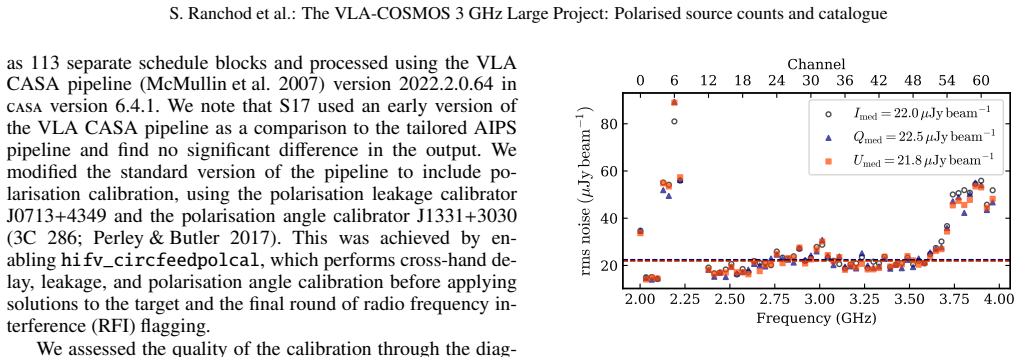
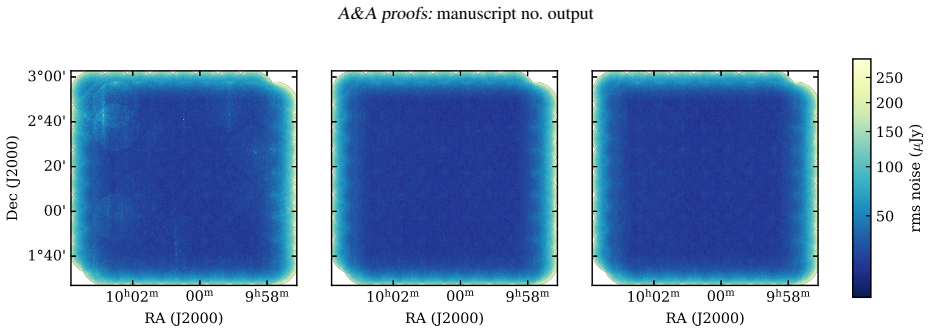
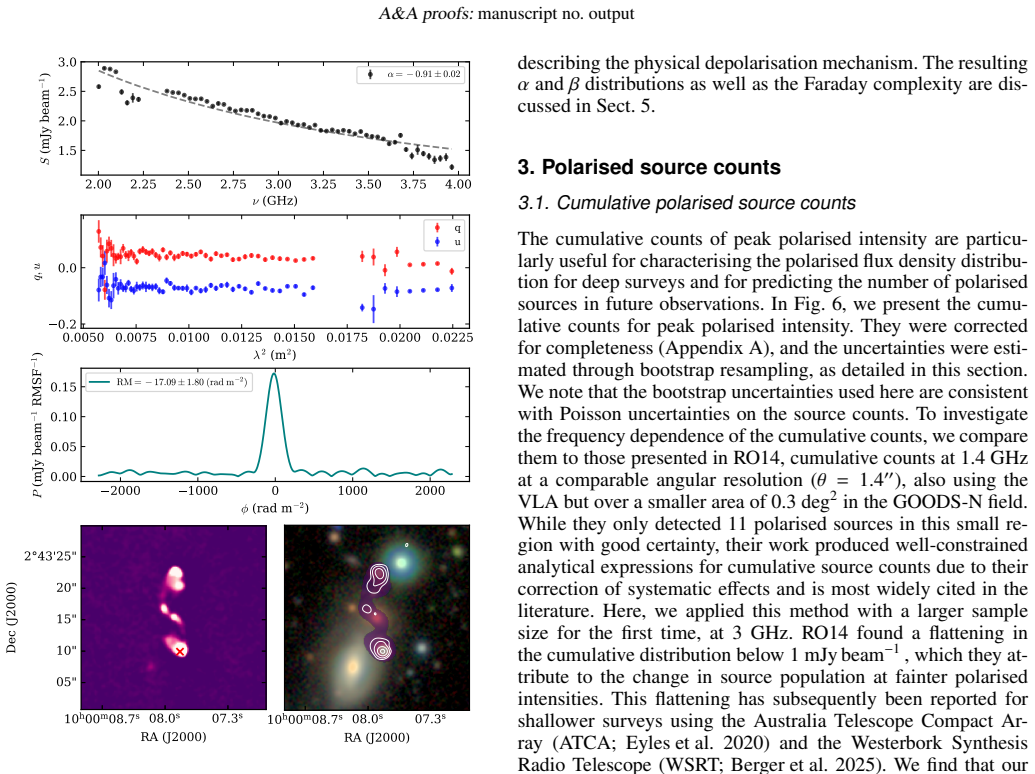
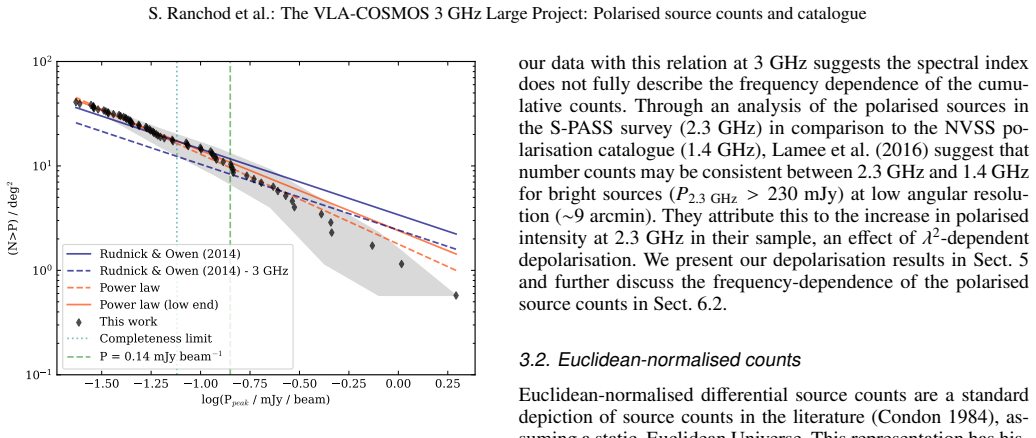
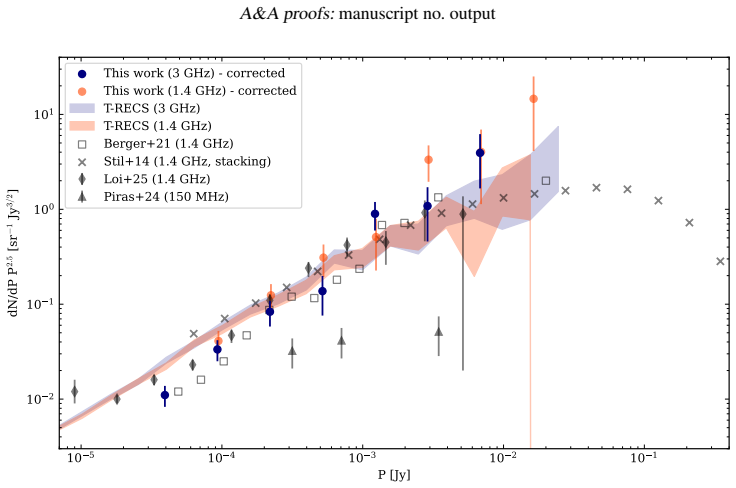
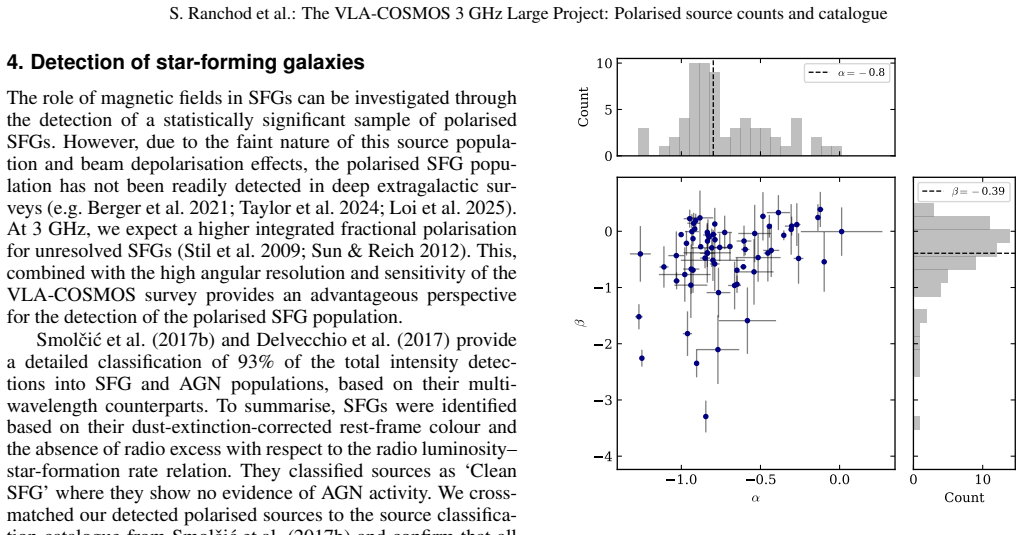
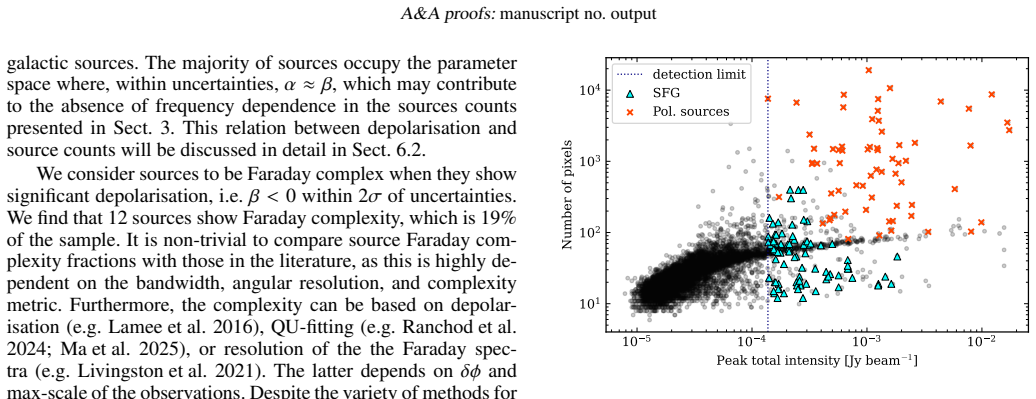
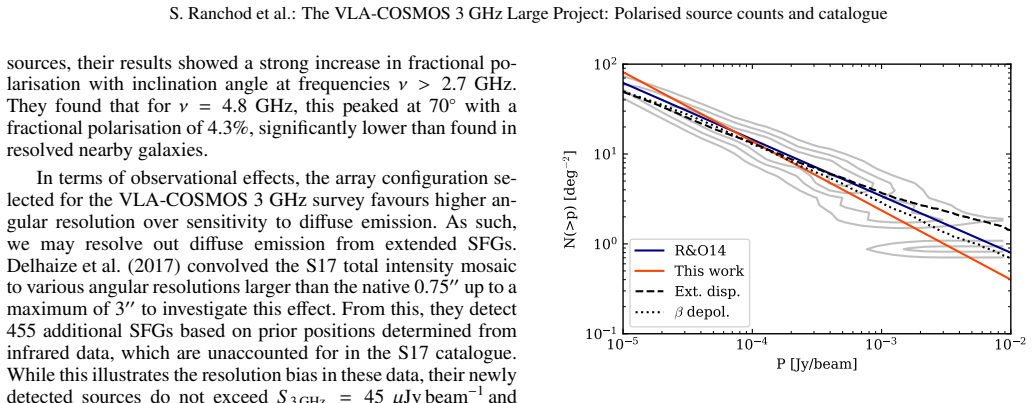
With a sensitivity of 2.6 μJy/beam in Faraday depth, we detect 65 polarised sources (51 deg^{-2}) above our threshold. We find that our cumulative and Euclidean-normalised source counts at 3 GHz are consistent with those in the literature at 1.4 GHz, which we attribute to the combined effect of spectral index and depolarisation in the detected sources. We detect no SFGs in our sample and derive a 2σ upper limit on the density of polarised SFGs of <2.0 deg^{-2}. This implies that significantly deeper observations will be required to readily detect this population in the SKA-era.
What carries the argument
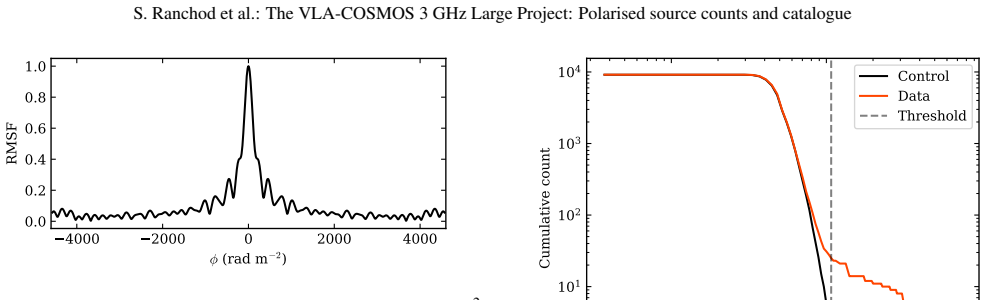
3D rotation measure synthesis on Stokes Q and U maps of pre-selected total-intensity sources, combined with an empirically determined polarisation detection threshold.
If this is right
- Polarised source counts at 3 GHz remain consistent with 1.4 GHz results after accounting for spectral index and depolarisation.
- No star-forming galaxies are detected in polarisation at the achieved sensitivity.
- The 2-sigma upper limit on the surface density of polarised star-forming galaxies is less than 2.0 per square degree.
- Significantly deeper observations will be required to detect the polarised star-forming galaxy population in the SKA era.
Where Pith is reading between the lines
- The non-detection at 3 GHz indicates that depolarisation effects in star-forming galaxies remain strong enough to suppress detectable polarisation even at this frequency.
- Current polarised samples are dominated by AGN rather than star-forming galaxies, setting a benchmark sensitivity target for future instruments.
- Higher-frequency data alone may still be insufficient without corresponding gains in depth to reveal the magnetic-field properties of typical galaxies.
Load-bearing premise
The empirically determined polarisation detection threshold reliably separates real signals from noise, and selecting known total-intensity sources captures essentially all potential polarised emitters without substantial incompleteness at faint levels.
What would settle it
Finding even one polarised star-forming galaxy in the present dataset, or measuring a polarised SFG density above 2 per square degree in a survey of comparable depth and resolution, would falsify the reported upper limit.
Figures
read the original abstract
The exploration of the faint polarised radio source population is essential for interpreting the nature and evolution of magnetic fields in galaxies. While recent studies have provided insight into source counts for the $\mu$Jy polarised source population at 1.4 GHz, higher frequency surveys may be more sensitive to new populations that are depolarised at lower frequencies (i.e. due to internal or external depolarisation effects). We present the deepest polarised source counts at 3 GHz to date, at an angular resolution of $1.5''$. With these relatively higher frequency observations, we aim to probe the faint polarised star-forming galaxy (SFG) population. Furthermore, through spectral modelling, we aim to provide further insight into the frequency evolution of polarised source counts. We processed the polarisation data of the VLA-COSMOS 3 GHz Large Project, one of the deepest high-resolution radio continuum surveys. We produced Stokes Q and U mosaicked channel maps. After selecting known sources in total intensity, we performed 3D rotation measure synthesis and searched for polarised emission using an empirically determined threshold. With a sensitivity of 2.6 $\mu$Jy/beam in Faraday depth, we detect 65 polarised sources (51 deg$^{-2}$) above our threshold. We find that our cumulative and Euclidean-normalised source counts at 3 GHz are consistent with those in the literature at 1.4 GHz, which we attribute to the combined effect of spectral index and depolarisation in the detected sources. We detect no SFGs in our sample and derive a 2$\sigma$ upper limit on the density of polarised SFGs of $<2.0~\mathrm{deg}^{-2}$. This implies that significantly deeper observations will be required to readily detect this population in the SKA-era.
Editorial analysis
A structured set of objections, weighed in public.
Referee Report
Summary. The manuscript presents a polarisation analysis of the VLA-COSMOS 3 GHz Large Project, producing Stokes Q/U mosaics, applying 3D RM synthesis to total-intensity pre-selected sources, and detecting 65 polarised sources (51 deg^{-2}) above an empirically determined 2.6 μJy/beam threshold in Faraday depth. Source counts at 3 GHz are reported as consistent with 1.4 GHz literature after spectral-index and depolarisation effects; no polarised SFGs are found, yielding a 2σ upper limit of <2.0 deg^{-2} on their surface density, with the implication that deeper SKA-era observations will be required.
Significance. If the non-detection and upper limit are robust, the result quantifies the rarity of detectable polarised emission from SFGs at current 3 GHz sensitivities and supplies a concrete benchmark for SKA survey planning. The reported source counts add a higher-frequency anchor point to the polarised population, though their consistency with lower-frequency work is attributed to a combination of spectral index and depolarisation whose separate contributions are not separated in the analysis.
major comments (2)
- [Abstract, §3] Abstract and §3 (data processing / source selection): the polarisation detection threshold is stated as 'empirically determined' at 2.6 μJy/beam, yet no quantitative validation (false-positive rate, Monte Carlo noise realisations, or completeness curves) is supplied. Because the 65 detections and the SFG upper limit rest directly on this threshold, the absence of these diagnostics leaves the reliability of both the count and the <2.0 deg^{-2} limit unverifiable from the text.
- [Abstract, §4] Abstract and §4 (SFG non-detection): the upper limit assumes that every polarised SFG above the threshold would have been captured by the total-intensity pre-selection catalogue. No completeness assessment at the faint end, discussion of possible missed low-surface-brightness SFGs, or test of the pre-selection efficiency is provided; this assumption is load-bearing for the claimed density limit and the SKA-era implication.
minor comments (2)
- [Abstract] The abstract states the sensitivity as 2.6 μJy/beam 'in Faraday depth' without clarifying whether this is the rms in the Faraday spectrum or a peak threshold; a brief parenthetical definition would remove ambiguity.
- [§3] Figure captions and text should explicitly state the exact total-intensity catalogue used for pre-selection (e.g., reference to the VLA-COSMOS 3 GHz catalogue paper) so that readers can assess selection biases.
Simulated Author's Rebuttal
We thank the referee for the constructive comments, which highlight important aspects of our analysis that require clarification and additional support. We respond to each major comment below and indicate where revisions will be made.
read point-by-point responses
-
Referee: [Abstract, §3] Abstract and §3 (data processing / source selection): the polarisation detection threshold is stated as 'empirically determined' at 2.6 μJy/beam, yet no quantitative validation (false-positive rate, Monte Carlo noise realisations, or completeness curves) is supplied. Because the 65 detections and the SFG upper limit rest directly on this threshold, the absence of these diagnostics leaves the reliability of both the count and the <2.0 deg^{-2} limit unverifiable from the text.
Authors: We agree that the manuscript would benefit from explicit quantitative validation of the 2.6 μJy/beam threshold. Although the threshold was derived from the noise properties of the Faraday dispersion function and cross-checked against the distribution of negative peaks, we did not include Monte Carlo realisations or completeness curves in the submitted version. In the revised manuscript we will add these diagnostics, including the false-positive rate estimated from noise-only realisations and a completeness curve versus polarised intensity, so that the reliability of the 65 detections and the upper limit can be directly assessed. revision: yes
-
Referee: [Abstract, §4] Abstract and §4 (SFG non-detection): the upper limit assumes that every polarised SFG above the threshold would have been captured by the total-intensity pre-selection catalogue. No completeness assessment at the faint end, discussion of possible missed low-surface-brightness SFGs, or test of the pre-selection efficiency is provided; this assumption is load-bearing for the claimed density limit and the SKA-era implication.
Authors: The referee correctly notes that the <2.0 deg^{-2} upper limit rests on the assumption that the total-intensity catalogue is complete for any polarised SFGs above our Faraday-space threshold. The VLA-COSMOS 3 GHz total-intensity catalogue is >95 % complete for point sources at the relevant flux densities, but we did not explicitly quantify completeness for low-surface-brightness or extended SFGs in polarisation. In the revision we will add a dedicated paragraph discussing the pre-selection efficiency, citing the total-intensity completeness limits from the parent survey paper, and stating that the upper limit applies strictly to the population that would be detected in total intensity; we will also note the possible impact of any missed diffuse sources as a caveat. revision: yes
Circularity Check
No circularity: direct observational extraction of counts and upper limit from maps
full rationale
The paper processes Stokes Q/U maps, applies 3D RM synthesis to pre-selected total-intensity sources, and counts detections above an empirically set Faraday-depth threshold of 2.6 μJy/beam. The reported 65 sources, zero SFGs, and <2.0 deg^{-2} upper limit are obtained by direct application of this threshold to the data; no equation, fit, or self-citation is invoked that would make the count or limit equivalent to its own inputs by construction. The derivation chain remains data-to-result without tautological reduction.
Axiom & Free-Parameter Ledger
free parameters (1)
- polarised emission detection threshold =
empirically determined
axioms (1)
- standard math Rotation measure synthesis correctly recovers Faraday depth under the assumption of a single thin-screen or simple Faraday structure
Reference graph
Works this paper leans on
-
[1]
Characteristics of polarised radio sources
The Apertif science verification campaign. Characteristics of polarised radio sources. , keywords =. doi:10.1051/0004-6361/202243201 , archivePrefix =. 2203.16925 , primaryClass =
-
[2]
Broadband Radio Polarimetry and Faraday Rotation of 563 Extragalactic Radio Sources
Broadband Radio Polarimetry and Faraday Rotation of 563 Extragalactic Radio Sources. , keywords =. doi:10.1088/0004-637X/815/1/49 , archivePrefix =. 1511.04080 , primaryClass =
work page internal anchor Pith review Pith/arXiv arXiv doi:10.1088/0004-637x/815/1/49
-
[3]
Early Science from POSSUM: Shocks, turbulence, and a massive new reservoir of ionised gas in the Fornax cluster. , keywords =. doi:10.1017/pasa.2021.4 , archivePrefix =. 2102.01702 , primaryClass =
-
[4]
A Wideband Polarization Observation of Hydra A with the Jansky Very Large Array. , keywords =. doi:10.3847/1538-4357/acebc5 , archivePrefix =. 2308.05805 , primaryClass =
-
[5]
Radio galaxies and their magnetic fields out to z <= 3
Radio galaxies and their magnetic fields out to z 3. , keywords =. doi:10.1093/mnras/stu1411 , archivePrefix =. 1404.1638 , primaryClass =
work page internal anchor Pith review Pith/arXiv arXiv doi:10.1093/mnras/stu1411
-
[6]
Magnetic Fields in Spiral Galaxies
Magnetic fields in spiral galaxies. , keywords =. doi:10.1007/s00159-015-0084-4 , archivePrefix =. 1509.04522 , primaryClass =
work page internal anchor Pith review Pith/arXiv arXiv doi:10.1007/s00159-015-0084-4
-
[7]
Faint polarised sources in the Lockman Hole field at 1.4 GHz. , keywords =. doi:10.1051/0004-6361/202040009 , archivePrefix =. 2107.02492 , primaryClass =
-
[8]
Polarisation results from the GOODS-N field with Apertif and polarised source counts. , keywords =. doi:10.1051/0004-6361/202245733 , adsurl =
-
[9]
Bilby: A user-friendly Bayesian inference library for gravitational-wave astronomy
Ashton, Gregory and others. BILBY: A user-friendly Bayesian inference library for gravitational-wave astronomy. Astrophys. J. Suppl. 2019. doi:10.3847/1538-4365/ab06fc. arXiv:1811.02042
work page internal anchor Pith review Pith/arXiv arXiv doi:10.3847/1538-4365/ab06fc 2019
-
[10]
The Tiered Radio Extragalactic Continuum Simulation (T-RECS)
The Tiered Radio Extragalactic Continuum Simulation (T-RECS). , keywords =. doi:10.1093/mnras/sty2603 , archivePrefix =. 1805.05222 , primaryClass =
work page internal anchor Pith review Pith/arXiv arXiv doi:10.1093/mnras/sty2603
-
[11]
Faraday Rotation Measure Synthesis
Faraday rotation measure synthesis. , keywords =. doi:10.1051/0004-6361:20052990 , archivePrefix =. astro-ph/0507349 , primaryClass =
work page internal anchor Pith review Pith/arXiv arXiv doi:10.1051/0004-6361:20052990
-
[12]
High fidelity deconvolution of moderately resolved sources
-
[13]
Rotation Measures of Extragalactic Sources behind the Southern Galactic Plane: New Insights into the Large-Scale Magnetic Field of the Inner Milky Way. , keywords =. doi:10.1086/518499 , archivePrefix =. 0704.0458 , primaryClass =
work page internal anchor Pith review Pith/arXiv arXiv doi:10.1086/518499
-
[14]
, year = 1966, month = jan, volume =
On the depolarization of discrete radio sources by Faraday dispersion. , year = 1966, month = jan, volume =. doi:10.1093/mnras/133.1.67 , adsurl =
-
[15]
Cosmological evolution of radio sources found at 1.4 GHz. , keywords =. doi:10.1086/162382 , adsurl =
-
[16]
, year = 2012, month = sep, volume =
Magnetic Fields in Molecular Clouds. , year = 2012, month = sep, volume =. doi:10.1146/annurev-astro-081811-125514 , adsurl =
-
[17]
The VLA-COSMOS 3 GHz Large Project: The infrared-radio correlation of star-forming galaxies and AGN to z 6. , keywords =. doi:10.1051/0004-6361/201629430 , archivePrefix =. 1703.09723 , primaryClass =
work page internal anchor Pith review Pith/arXiv arXiv doi:10.1051/0004-6361/201629430
-
[18]
The VLA-COSMOS 3~GHz Large Project: AGN and host-galaxy properties out to z$\lesssim$6
The VLA-COSMOS 3 GHz Large Project: AGN and host-galaxy properties out to z 6. , keywords =. doi:10.1051/0004-6361/201629367 , archivePrefix =. 1703.09720 , primaryClass =
work page internal anchor Pith review Pith/arXiv arXiv doi:10.1051/0004-6361/201629367
-
[19]
dynesty: A Dynamic Nested Sampling Package for Estimating Bayesian Posteriors and Evidences
DYNESTY: a dynamic nested sampling package for estimating Bayesian posteriors and evidences. , keywords =. doi:10.1093/mnras/staa278 , archivePrefix =. 1904.02180 , primaryClass =
work page internal anchor Pith review Pith/arXiv arXiv doi:10.1093/mnras/staa278 1904
-
[20]
The XXL Survey. XXXIX. Polarised radio sources in the XXL-South field. , keywords =. doi:10.1051/0004-6361/201936042 , archivePrefix =. 1911.03502 , primaryClass =
-
[21]
Faraday Rotation from Magnesium II Absorbers towards Polarized Background Radio Sources
Faraday Rotation from Magnesium II Absorbers toward Polarized Background Radio Sources. , keywords =. doi:10.1088/0004-637X/795/1/63 , archivePrefix =. 1406.2526 , primaryClass =
work page internal anchor Pith review Pith/arXiv arXiv doi:10.1088/0004-637x/795/1/63
-
[22]
Integrated Polarization of Sources at lambda ~1m and New Rotation Measure Ambiguities
Integrated Polarization of Sources at -0.5ex 1 m and New Rotation Measure Ambiguities. , keywords =. doi:10.1088/0004-6256/141/6/191 , archivePrefix =. 1103.4149 , primaryClass =
work page internal anchor Pith review Pith/arXiv arXiv doi:10.1088/0004-6256/141/6/191
-
[23]
, year = 1974, month = may, volume =
The morphology of extragalactic radio sources of high and low luminosity. , year = 1974, month = may, volume =. doi:10.1093/mnras/167.1.31P , adsurl =
-
[24]
Radio polarization from the inner Galaxy at arcminute resolution
Radio Polarization from the Inner Galaxy at Arcminute Resolution. , keywords =. doi:10.1086/319468 , archivePrefix =. astro-ph/0010518 , primaryClass =
work page internal anchor Pith review Pith/arXiv arXiv doi:10.1086/319468
-
[25]
American Astronomical Society Meeting Abstracts \#215 , year = 2010, series =
Survey Science with ASKAP: Polarization Sky Survey of the Universe's Magnetism (POSSUM). American Astronomical Society Meeting Abstracts \#215 , year = 2010, series =
2010
-
[26]
The Polarisation Sky Survey of the Universe's Magnetism (POSSUM): Science goals and survey description. , keywords =. doi:10.1017/pasa.2025.10031 , archivePrefix =. 2505.08272 , primaryClass =
-
[27]
Detection Thresholds and Bias Correction in Polarized Intensity
Detection Thresholds and Bias Correction in Polarized Intensity. , keywords =. doi:10.1071/AS11027 , archivePrefix =. 1106.5362 , primaryClass =
work page internal anchor Pith review Pith/arXiv arXiv doi:10.1071/as11027
-
[28]
Chandra centres for COSMOS X-ray galaxy groups: differences in stellar properties between central dominant and offset brightest group galaxies. , keywords =. doi:10.1093/mnras/sty3203 , archivePrefix =. 1812.01604 , primaryClass =
-
[29]
The DRAO Planck Deep Fields: the polarization properties of radio galaxies at 1.4 GHz
The DRAO Planck Deep Fields: The Polarization Properties of Radio Galaxies at 1.4 GHz. , keywords =. doi:10.1088/0004-637X/714/2/1689 , archivePrefix =. 1003.4460 , primaryClass =
work page internal anchor Pith review Pith/arXiv arXiv doi:10.1088/0004-637x/714/2/1689
-
[30]
Characterization of polarimetric and total intensity behaviour of a complete sample of PACO radio sources in the radio bands. , keywords =. doi:10.1093/mnras/stx3216 , archivePrefix =. 1711.05373 , primaryClass =
work page internal anchor Pith review Pith/arXiv arXiv doi:10.1093/mnras/stx3216
-
[31]
I., Schawinski, K., Kaviraj, S., et al
Ordered magnetic fields around radio galaxies: evidence for interaction with the environment. , keywords =. doi:10.1111/j.1365-2966.2011.18321.x , archivePrefix =. 1101.1807 , primaryClass =
-
[32]
Comparison of environmental trends in H I gas mass fraction and specific star formation rate
BLOBCAT: software to catalogue flood-filled blobs in radio images of total intensity and linear polarization. , keywords =. doi:10.1111/j.1365-2966.2012.21373.x , archivePrefix =. 1205.5313 , primaryClass =
-
[33]
ATLAS 1.4 GHz Data Release 2 -- II. Properties of the faint polarized sky
ATLAS 1.4 GHz data release 2 - II. Properties of the faint polarized sky. , keywords =. doi:10.1093/mnras/stu500 , archivePrefix =. 1403.5308 , primaryClass =
work page internal anchor Pith review Pith/arXiv arXiv doi:10.1093/mnras/stu500
-
[34]
Magnetism Science with the Square Kilometre Array. Galaxies , keywords =. doi:10.3390/galaxies8030053 , archivePrefix =. 2006.03172 , primaryClass =
-
[35]
The Coevolution of Galaxies and Supermassive Black Holes: Insights from Surveys of the Contemporary Universe. , keywords =. doi:10.1146/annurev-astro-081913-035722 , archivePrefix =. 1403.4620 , primaryClass =
work page internal anchor Pith review Pith/arXiv arXiv doi:10.1146/annurev-astro-081913-035722
-
[36]
Sample variance, source clustering and their influence on the counts of faint radio sources
Sample variance, source clustering and their influence on the counts of faint radio sources. , keywords =. doi:10.1093/mnras/stt843 , archivePrefix =. 1302.2010 , primaryClass =
work page internal anchor Pith review Pith/arXiv arXiv doi:10.1093/mnras/stt843 2010
-
[37]
MIGHTEE: total intensity radio continuum imaging and the COSMOS/XMM-LSS Early Science fields. , keywords =. doi:10.1093/mnras/stab3021 , archivePrefix =. 2110.00347 , primaryClass =
-
[38]
Absolute linear polarization angle calibration using planetary bodies for MeerKAT and JVLA at cm wavelengths , howpublished =
-
[39]
Direction-dependent Corrections in Polarimetric Radio Imaging. I. Characterizing the Effects of the Primary Beam on Full-Stokes Imaging. , keywords =. doi:10.3847/1538-3881/aa77f8 , archivePrefix =. 1706.01501 , primaryClass =
work page internal anchor Pith review Pith/arXiv arXiv doi:10.3847/1538-3881/aa77f8
-
[40]
The magnetized disk-halo transition region of M 51. , keywords =. doi:10.1051/0004-6361/202037847 , archivePrefix =. 2007.00702 , primaryClass =
-
[41]
Magnetic field disorder and Faraday effects on the polarization of extragalactic radio sources
Magnetic Field Disorder and Faraday Effects on the Polarization of Extragalactic Radio Sources. , keywords =. doi:10.3847/0004-637X/829/1/5 , archivePrefix =. 1607.04914 , primaryClass =
work page internal anchor Pith review Pith/arXiv arXiv doi:10.3847/0004-637x/829/1/5
-
[42]
The VLA-COSMOS 3 GHz Large Project: Evolution of Specific Star Formation Rates out to z 5. , keywords =. doi:10.3847/1538-4357/aba044 , archivePrefix =. 2006.13937 , primaryClass =
-
[43]
Heightened Faraday complexity in the inner 1 kpc of the galactic centre. , keywords =. doi:10.1093/mnras/stab253 , archivePrefix =. 2102.01139 , primaryClass =
-
[44]
A radio polarization study of magnetic fields in the Small Magellanic Cloud. , keywords =. doi:10.1093/mnras/stab3375 , archivePrefix =. 2112.04044 , primaryClass =
-
[45]
A close look at the cluster physics through the densest rotation measure grid
The MeerKAT Fornax Survey: IV. A close look at the cluster physics through the densest rotation measure grid. , keywords =. doi:10.1051/0004-6361/202451711 , archivePrefix =. 2501.05519 , primaryClass =
-
[46]
The complex large-scale magnetic fields in the first Galactic quadrant as revealed by the Faraday depth profile disparity. , keywords =. doi:10.1093/mnras/staa2105 , archivePrefix =. 2007.07893 , primaryClass =
-
[47]
A new window into the sub-parsec scale magnetic field in the Milky Way? Unveiling small-scale magneto-ionic structures with Faraday complexity. , keywords =. doi:10.1093/mnras/staf1000 , archivePrefix =. 2506.18968 , primaryClass =
-
[48]
A low-frequency study of linear polarization in radio galaxies. , keywords =. doi:10.1093/mnras/staa3980 , archivePrefix =. 2012.11990 , primaryClass =
-
[49]
A Radio and Optical Polarization Study of the Magnetic Field in the Small Magellanic Cloud
A Radio and Optical Polarization Study of the Magnetic Field in the Small Magellanic Cloud. , keywords =. doi:10.1086/590546 , archivePrefix =. 0807.1532 , primaryClass =
work page internal anchor Pith review Pith/arXiv arXiv doi:10.1086/590546
-
[50]
Source Counts Spanning Eight Decades of Flux Density at 1.4 GHz. , keywords =. doi:10.3847/1538-4357/abdd37 , archivePrefix =. 2101.07827 , primaryClass =
-
[51]
Astronomical Data Analysis Software and Systems XVI , year = 2007, editor =
CASA Architecture and Applications. Astronomical Data Analysis Software and Systems XVI , year = 2007, editor =
2007
-
[52]
Polarization properties of extragalactic radio sources and their contribution to microwave polarization fluctuations. , keywords =. doi:10.1051/0004-6361:20021392 , archivePrefix =. astro-ph/0209502 , primaryClass =
work page internal anchor Pith review Pith/arXiv arXiv doi:10.1051/0004-6361:20021392
-
[53]
PyBDSF: Python Blob Detection and Source Finder
-
[54]
The VLA-COSMOS 3 GHz Large Project: The cosmic star formation history since z~5
The VLA-COSMOS 3 GHz Large Project: Cosmic star formation history since z 5. , keywords =. doi:10.1051/0004-6361/201629436 , archivePrefix =. 1703.09724 , primaryClass =
work page internal anchor Pith review Pith/arXiv arXiv doi:10.1051/0004-6361/201629436
-
[55]
WSClean: an implementation of a fast, generic wide-field imager for radio astronomy
WSCLEAN: an implementation of a fast, generic wide-field imager for radio astronomy. , keywords =. doi:10.1093/mnras/stu1368 , archivePrefix =. 1407.1943 , primaryClass =
work page internal anchor Pith review Pith/arXiv arXiv doi:10.1093/mnras/stu1368 1943
-
[56]
Simulation of the Polarized Sky at 1.4 GHz
Simulation of the Polarized Sky at 1.4 GHz. The role of VLBI in the Golden Age for Radio Astronomy , year = 2008, volume =. doi:10.22323/1.072.0107 , archivePrefix =. 0902.1995 , primaryClass =
work page internal anchor Pith review Pith/arXiv arXiv doi:10.22323/1.072.0107 2008
-
[57]
The Magnetic Field and Polarization Properties of Radio Galaxies in Different Accretion States
The Magnetic Field and Polarization Properties of Radio Galaxies in Different Accretion States. , keywords =. doi:10.1088/0004-637X/806/1/83 , archivePrefix =. 1504.06679 , primaryClass =
work page internal anchor Pith review Pith/arXiv arXiv doi:10.1088/0004-637x/806/1/83
-
[58]
Broadband, radio spectro-polarimetric study of 100 radiative-mode and jet-mode AGN
Broad-band, radio spectro-polarimetric study of 100 radiative-mode and jet-mode AGN. , keywords =. doi:10.1093/mnras/stx1133 , archivePrefix =. 1705.00102 , primaryClass =
work page internal anchor Pith review Pith/arXiv arXiv doi:10.1093/mnras/stx1133
-
[59]
The Faraday Rotation Measure Grid of the LOFAR Two-metre Sky Survey: Data Release 2. , keywords =. doi:10.1093/mnras/stac3820 , archivePrefix =. 2301.07697 , primaryClass =
-
[60]
System set-up and early results
The MPIfR-MeerKAT Galactic Plane Survey - I. System set-up and early results. , keywords =. doi:10.1093/mnras/stad1900 , archivePrefix =. 2303.09231 , primaryClass =
-
[61]
Improved Constraints on the Faraday Rotation toward Eight Fast Radio Bursts Using Dense Grids of Polarized Radio Galaxies. , keywords =. doi:10.3847/1538-4357/adb8e3 , archivePrefix =. 2502.12263 , primaryClass =
-
[62]
Broadband radio spectro-polarimetric observations of high Faraday rotation measure AGN
Broadband radio spectro-polarimetric observations of high-Faraday-rotation-measure AGN. , keywords =. doi:10.1051/0004-6361/201731804 , archivePrefix =. 1801.09731 , primaryClass =
work page internal anchor Pith review Pith/arXiv arXiv doi:10.1051/0004-6361/201731804
-
[63]
Integrated Polarization Properties of 3C48, 3C138, 3C147, and 3C286
Integrated Polarization Properties of 3C48, 3C138, 3C147, and 3C286. , keywords =. doi:10.1088/0067-0049/206/2/16 , archivePrefix =. 1302.6662 , primaryClass =
work page internal anchor Pith review Pith/arXiv arXiv doi:10.1088/0067-0049/206/2/16
-
[64]
An Accurate Flux Density Scale from 50 MHz to 50 GHz
An Accurate Flux Density Scale from 50 MHz to 50 GHz. , keywords =. doi:10.3847/1538-4365/aa6df9 , archivePrefix =. 1609.05940 , primaryClass =
work page internal anchor Pith review Pith/arXiv arXiv doi:10.3847/1538-4365/aa6df9
-
[65]
LOFAR Deep Fields: Probing the sub-mJy regime of polarized extragalactic sources in ELAIS-N1. I. The catalog. , keywords =. doi:10.1051/0004-6361/202349085 , archivePrefix =. 2406.08346 , primaryClass =
-
[66]
RM-Tools: Rotation measure (RM) synthesis and Stokes QU-fitting
-
[67]
The Galactic latitude dependency of Faraday complexity in the S-PASS/ATCA RM catalogue. , keywords =. doi:10.1051/0004-6361/202348993 , archivePrefix =. 2403.13500 , primaryClass =
-
[68]
A first glimpse at the MeerKAT DEEP2 field at S-band. , keywords =. doi:10.1093/mnras/stae2754 , archivePrefix =. 2412.09314 , primaryClass =
-
[69]
Full resolution deconvolution of complex Faraday spectra. , keywords =. doi:10.1093/mnras/stad1090 , archivePrefix =. 2304.02728 , primaryClass =
-
[70]
S-PASS/ATCA: a window on the magnetic universe in the southern hemisphere
S-PASS/ATCA: a window on the magnetic universe in the Southern hemisphere. , keywords =. doi:10.1093/mnras/stz092 , archivePrefix =. 1902.09556 , primaryClass =
work page internal anchor Pith review Pith/arXiv arXiv doi:10.1093/mnras/stz092 1902
-
[71]
A Wideband Polarization Study of Cygnus A with the Jansky Very Large Array. I. The Observations and Data. , keywords =. doi:10.3847/1538-4357/abb80e , archivePrefix =. 2009.06554 , primaryClass =
-
[72]
Direction-dependent Corrections in Polarimetric Radio Imaging. III. A-to-Z Solver-Modeling the Full Jones Antenna Aperture Illumination Pattern. , keywords =. doi:10.3847/1538-3881/ac41c4 , archivePrefix =. 2107.10009 , primaryClass =
-
[73]
The VLA-COSMOS 3 GHz Large Project: Continuum data and source catalog release
The VLA-COSMOS 3 GHz Large Project: Continuum data and source catalog release. , keywords =. 2017a , month = jun, volume =. doi:10.1051/0004-6361/201628704 , archivePrefix =. 1703.09713 , primaryClass =
work page internal anchor Pith review Pith/arXiv arXiv doi:10.1051/0004-6361/201628704
-
[74]
The VLA-COSMOS 3 GHz Large Project: Multiwavelength counterparts and the composition of the faint radio population. , keywords =. 2017b , month = jun, volume =. doi:10.1051/0004-6361/201630223 , archivePrefix =. 1703.09719 , primaryClass =
work page internal anchor Pith review Pith/arXiv arXiv doi:10.1051/0004-6361/201630223
-
[75]
Depolarization and Faraday effects in galaxies. , keywords =. doi:10.1046/j.1365-8711.1998.01782.x , adsurl =
-
[76]
Degree of Polarization and Source Counts of Faint Radio Sources from Stacking Polarized Intensity
Degree of Polarization and Source Counts of Faint Radio Sources from Stacking Polarized Intensity. , keywords =. doi:10.1088/0004-637X/787/2/99 , archivePrefix =. 1404.1859 , primaryClass =
work page internal anchor Pith review Pith/arXiv arXiv doi:10.1088/0004-637x/787/2/99
-
[77]
Polarimetric simulations of universal pressure profile cluster atmospheres
Numerical modelling of the lobes of radio galaxies VI. Polarimetric simulations of universal pressure profile cluster atmospheres. , keywords =. doi:10.1093/mnras/staf610 , adsurl =
-
[78]
The distribution of polarized radio sources $>$15$\mu$Jy in GOODS-N
The Distribution of Polarized Radio Sources >15 Jy in GOODS-N. , keywords =. doi:10.1088/0004-637X/785/1/45 , archivePrefix =. 1402.3637 , primaryClass =
work page internal anchor Pith review Pith/arXiv arXiv doi:10.1088/0004-637x/785/1/45
-
[79]
The Integrated Polarization of Spiral Galaxy Disks
The Integrated Polarization of Spiral Galaxy Disks. , keywords =. doi:10.1088/0004-637X/693/2/1392 , archivePrefix =. 0810.2303 , primaryClass =
work page internal anchor Pith review Pith/arXiv arXiv doi:10.1088/0004-637x/693/2/1392
-
[80]
ATLBS: the Australia Telescope Low-Brightness Survey. , keywords =. doi:10.1111/j.1365-2966.2009.16105.x , archivePrefix =. 0911.4571 , primaryClass =
discussion (0)
Sign in with ORCID, Apple, or X to comment. Anyone can read and Pith papers without signing in.