REVIEW 5 major objections 5 minor 1 cited by
ReactEmbed: A Plug-and-Play Module for Unifying Protein-Molecule Representations Guided by Biochemical Reaction Networks
T0 review · 5 major / 5 minor · reviewed 2026-08-10 · deepseek-v4-flash
Pith's one-line read ReactEmbed claims that a weighted graph of biochemical reaction co-occurrences, used to contrastively align frozen protein and molecule embeddings, yields a unified space where cross-domain predictions work zero-shot, with…
desk verdict Plausible idea, but the evidence is overclaimed and internally inconsistent; the zero-shot BBBP and in vivo claims are not supported. read the letter →
The pith
A machine-rendered reading of the paper's core claim, the machinery that carries it, and where it could break.
The reading
What carries the argument
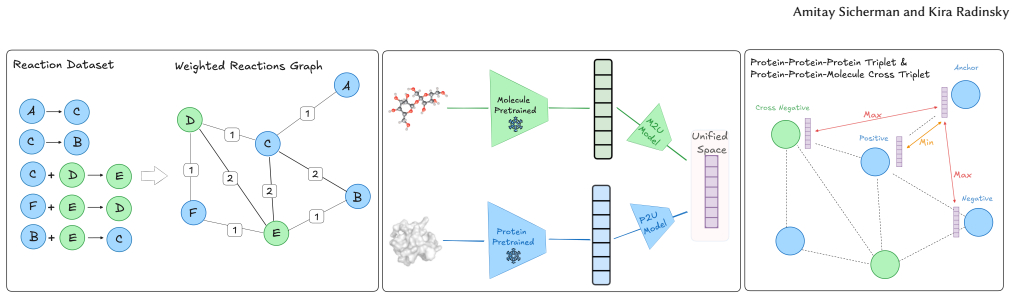
The load-bearing object is the weighted reaction graph $G=(V,E,W)$ with $W(e_i,e_j)=\sum_{r\in R}\mathbb{1}[e_i,e_j\in E_r]$, built by counting how often each pair of proteins and molecules co-occurs in any reaction. Around this graph the method trains two small projections, P2U for proteins and M2U for molecules, on frozen pre-trained embeddings, using a margin-based triplet loss with dual negative sampling: for each positive pair, negatives are drawn both from the anchor's own domain and from the opposite domain. The graph is used only during training; at prediction time each entity is embedded through its own projection alone, which is what makes zero-shot transfer to unseen proteins possible.
What would settle it
A concrete check: shuffle the reaction graph's edge weights while keeping node degrees and the set of connected pairs fixed, retrain ReactEmbed, and measure zero-shot BBBP accuracy on proteins. If accuracy stays high, co-occurrence identities are not carrying the signal; if it collapses, the specific reaction co-occurrence is what the model learned. A complementary direct test is to score known non-BBB-crossing proteins: if they receive permeability scores as high as transferrin, the zero-shot alignment is not tracking barrier penetration.
Extended reading notes
Core claim
The central claim is that co-participation in biochemical reactions is a sufficient source of functional context to align proteins and molecules in a single embedding space. ReactEmbed takes frozen embeddings from existing protein and molecule encoders, projects each domain through a small learned MLP, and trains those projections with a margin triplet loss on a weighted undirected reaction graph; edge weights are simple co-occurrence counts across reactions. After training, a classifier fit on molecular embeddings alone can be applied directly to protein embeddings. The paper reports that this beats per-domain baselines on all eleven evaluated tasks and, in the deployment case, that the zero-shot BBBP classifier ranked transferrin at a predicted 96.23 percent permeability versus 79.96 percent for the bare LNP, with in vivo validation showing a sevenfold increase in brain antibody concentration.
Load-bearing premise
The load-bearing premise is that any two entities appearing together in a reaction are functionally related enough to be drawn together in the embedding space, regardless of whether one is an enzyme, substrate, product, or regulator; the whole alignment inherits this undirected co-occurrence signal.
Editorial extensions
If this is right
- A single unified embedding space means models trained on abundant molecular data can score proteins directly, removing the need for paired protein-molecule training data in tasks like blood-brain barrier permeability.
- Drug-target interaction and protein-protein interaction prediction inherit reaction context, which the paper shows improves results on DrugBank, BindingDB, HumanPPI, and YeastPPI.
- Because the base encoders stay frozen and only small projection heads are trained, the module can be added to existing pipelines without costly retraining of large models.
- Ablation results imply the method tolerates reduced reaction data and label noise up to about 10 percent, and performs similarly when the reaction source is swapped, so the benefit is not tied to one database.
- The transferrin result suggests the zero-shot screen can rank hundreds of candidate proteins for nanoparticle modification, narrowing experimental validation to a few top hits.
Reading between the lines
- Because the graph ignores reaction direction and role, entities that merely co-occur as byproducts or in different functional roles are pulled together; incorporating direction, stoichiometry, or reaction type could make the alignment sharper and is a natural next test.
- The zero-shot recipe should transfer to other sparsely labeled protein properties, such as hERG cardiac toxicity or CYP metabolism, where small-molecule datasets are large but protein-labeled data are scarce.
- The fact that inference ignores the graph means ReactEmbed can score any new protein sequence with no reaction record; one could prospectively test whether top-ranked novel proteins from the full proteome reproduce transferrin-like brain uptake.
- A direct way to isolate the mechanism's cause is to train the same contrastive objective on a graph with randomized co-occurrence edges but an identical degree distribution; if zero-shot BBBP accuracy does not collapse, then the specific reaction identities are not doing the work.
Editorial analysis
A structured set of objections, weighed in public.
Referee Report
Summary. The paper proposes ReactEmbed, a plug-and-play module that takes frozen protein and small-molecule embeddings and projects them into a shared space via two MLPs trained with a margin triplet loss. The training signal is a weighted, undirected graph built from co-occurrence of proteins and molecules in biochemical reactions (Reactome, or PathBank in one ablation). The authors evaluate the resulting embeddings with linear probing on 11 tasks spanning molecular properties, protein properties, protein-protein interactions, and drug-target interactions, and report ablations over data volume, edge types, label noise, and reaction database source. They further claim a real-world deployment in which a KNN classifier trained on molecular BBB permeability labels is applied zero-shot to protein-LNP complexes, and report that transferrin-decorated liposomes achieved a sevenfold increase in brain mAb concentration in vivo.
Significance. The core idea is attractive and potentially useful: reaction co-occurrence is a cheap, broad source of cross-domain supervision, and the module is designed to work with frozen embeddings, which lowers the barrier to adoption. The authors contribute a reaction-pair database and open code, and the task coverage in the benchmark section is broad. However, the present manuscript does not provide sufficient evidence for its central claims. The training algorithm is incomplete for the graph it defines, the benchmark comparisons support only improvement over raw pretrained embeddings rather than state-of-the-art performance, the significance statements are unverifiable, and the zero-shot BBBP and in vivo claims rest on a few sentences with no protocol or reproducibility details. These are not cosmetic issues: they concern the validity and generality of the method itself.
major comments (5)
- [Section 3.1.2, Algorithm 1] Algorithm 1 samples an edge (v1, v2) with probability proportional to W(e) and then says 'W.l.o.g., assume v1∈P, v2∈M' (line 12). This is not without loss of generality: Section 3.1.2 defines the graph with four edge types (P-P, P-M, M-P, M-M), and Equation (1) weights all co-occurring pairs. The paper never states how P-P and M-M edges enter the triplet loss. The ablation in Section 6.2 removes 'intra-domain edges' and reports a consistent performance drop, which confirms that the full model uses those edges; but the algorithm as written cannot be the complete training procedure. The method is therefore under-specified in a load-bearing part of the paper.
- [Section 4.1 vs. Section 3.1.2; Tables 1-2] Several downstream evaluation tasks are the same type of interaction used to build the reaction graph. DrugBank and BindingDB (Section 4.1) are drug-target interaction benchmarks, and the graph edge weights in Equation (1) are exactly a drug-target co-occurrence signal. If pairs from the evaluation splits appear as co-participants in training reactions, the contrastive loss pulls them together directly, so the large gains on DrugBank and BindingDB (Tables 1-2) may reflect leakage rather than a generally improved representation. The paper contains no overlap analysis between the reaction graph and the evaluation splits, and no experiment that holds out all reactions involving test entities. A concrete fix would be to build the graph from reactions that exclude every entity in the evaluation splits; until then the cross-domain benchmark results cannot be interpreted.
- [Section 3.2 (Eqs. 5-6) and Section 7] The zero-shot BBBP claim is not supported by the evidence in the paper. The alignment signal is undirected co-occurrence in arbitrary reactions (Equation 1), which has no known relationship to blood-brain barrier permeability; molecular permeability labels (Eq. 5) are not shown to transfer to proteins (Eq. 6). Section 7.0.2 applies a KNN classifier trained on ~2,000 molecules to 544 proteins, but no protein-level BBBP labels are used to validate the transfer, and the top-scoring proteins include transferrin, whose well-known BBB-related role is an obvious confound for a method evaluation. The in vivo outcome in Section 7.0.3 is a single unquantified sentence ('sevenfold increase') with no protocol, number of animals, controls, variance, or supplementary data, and the laboratory is anonymized. This evidence cannot carry the paper's most striking claim.
- [Section 5, Tables 1-2] The abstract and Section 5 state that ReactEmbed 'consistently surpasses all current state-of-the-art models,' but the only baselines in Tables 1-2 are the frozen, linearly probed embeddings of the same base models (ESM3, GearNet, ProtBert, MolCLR, MolFormer). No published state-of-the-art method is included in any table. For example, the best BBBP AUC in Table 2 is 65.22, which is far below the range typically reported for molecule property prediction systems, so the SOTA claim cannot be assessed and is at best restricted to improvement over raw pretrained embeddings. The benchmark section therefore overstates what the results show.
- [Section 4.3, Section 5, Tables 1-2 captions] The text and table captions claim statistically significant improvements (p < 0.05) and use underlining to mark them, but the paper reports no error bars, no standard deviations, no number of random seeds, and no description of a significance test. A claim of statistical significance requires at least variance over seeds or splits; as written, the significance statements are unverifiable. The authors should either provide the experimental protocol for repeated runs and the test used, or remove the significance claims.
minor comments (5)
- [Section 4.1] PDBBind is listed as a benchmark dataset but never appears in Tables 1-2; either report it or remove the mention.
- [Section 7.0.2 vs. Figure 3] The base LNP formulation is given as 79.96% in the text but as 0.74 in the Figure 3 caption; these numbers need to be reconciled.
- [Table 2, YeastPPI row] For GearNet+MolCLR the reported Δ% is '8.0%' although the AUC decreases by 4.64 points; the sign and formatting are inconsistent.
- [Section 3.1.3] The values of α, the triplet margin m, the MLP hidden sizes, and the number of negatives are never reported, and the sensitivity of the results to these choices is not discussed; the K=20 for the KNN classifier appears only in Section 7.0.2.
- [Section 5 and throughout] There are several typographical and consistency issues: 'Tables 1,2 presents'; the spelling 'MoLFormer' is used inconsistently; references [2] and [3] are duplicates; and Section 7 uses both 'liposomes' and 'LNPs' for the delivery vehicle.
Circularity Check
Drug-target interaction gains reduce to retrieval of reaction-graph training edges; central alignment method remains independent on other benchmarks.
-
fitted input called prediction
[Section 3.1.2 (Eq. 1), Section 3.1.1, Section 4.1]
"W(e_i,e_j) = ∑_{r∈R} ⊮[e_i,e_j∈E_r] (1) ... This graph represents protein-protein interactions, protein-molecule bindings, and molecule-molecule associations, with edge weights reflecting interaction frequencies. ... For molecule-protein interaction prediction, we evaluated three benchmark datasets: DrugBank [32] focused on drug-target interaction prediction, and BindingDB [17] and PDBBind [18], which provide binding affinity measurements."
Positive training edges for the contrastive loss are exactly the co-occurrence pairs of Eq. 1, which the paper itself describes as 'protein-molecule bindings.' The DrugBank, BindingDB, and PDBBind tasks evaluate the same protein-molecule interaction construct. No decontamination step is reported that excludes benchmark interaction pairs from the reaction graph. Therefore, for any benchmark pair that appears as a reaction co-occurrence edge, the contrastive objective has already pulled its embeddings together, and the downstream linear probe can recover the label by proximity to training edges. The reported gains, e.g., DrugBank AUC 78.93 to 85.53, are thus at least partly retrieval of the training input rather than an independent test of interaction prediction.
full rationale
ReactEmbed's training is a legitimate contrastive alignment over an external reaction database, and most benchmarks (FreeSolv, CEP, BetaLactamase, Stability, Fluorescence, GO-CC, HumanPPI, YeastPPI) are not reducible to the graph's edge signal. However, the three molecule-protein interaction benchmarks are the same construct as the graph's stated 'protein-molecule bindings,' so without a reported overlap split the apparent DTI improvements are partially forced by construction. The BBBP zero-shot claim is not circular, since molecular BBBP labels do not define the reaction-graph edges, but the transfer rests on an unstated assumption that reaction co-occurrence aligns the BBB-permeability axis; the in vivo validation is a single sentence with no protocol, replicates, or error bars, and the 'state-of-the-art' claim is weakened because Tables 1-2 compare only against raw pretrained embeddings. No load-bearing self-citations or imported uniqueness theorems are present. Overall, the central alignment method has independent content, but one family of headline predictions reduces to the training edges, giving partial circularity.
Assumptions & free parameters
free parameters (5)
- alpha (loss balance)
- triplet loss margin m
- MLP hidden dimensions and layers
- number of negatives per positive
- K in KNN classifier =
20
assumptions (4)
- domain assumption Co-participation in biochemical reactions defines a shared functional scope, and this is captured by undirected co-occurrence edge weights.
- domain assumption Frozen pre-trained embeddings of proteins and molecules can be aligned into a unified space via MLP projections without destroying domain-specific structure.
- domain assumption Entities with no documented interaction in the reaction database are valid true negatives.
- ad hoc to paper Molecular BBB permeability labels transfer to protein-LNP complexes through the aligned embedding space.
Cite this review
Pith. "Pith review of ReactEmbed: A Plug-and-Play Module for Unifying Protein-Molecule Representations Guided by Biochemical Reaction Networks." pith.science (2026). https://pith.science/paper/VOGJ5S5U
@misc{pith2026250118278,
  author       = {Pith},
  title        = {Pith review of: ReactEmbed: A Plug-and-Play Module for Unifying Protein-Molecule Representations Guided by Biochemical Reaction Networks},
  year         = {2026},
  howpublished = {\url{https://pith.science/paper/VOGJ5S5U}},
  note         = {Machine review of arXiv:2501.18278}
}
read the original abstract
State-of-the-art models represent proteins and molecules in separate embedding manifolds, limiting the modeling of systemic biological processes. We introduce ReactEmbed, a lightweight, plug-and-play module that bridges this gap. ReactEmbed leverages biochemical reaction networks as a source of functional context, based on the principle that co-participation in reactions defines a shared functional scope. The module aligns frozen embeddings from models like ESM-3 and MolFormer into a unified space using a weighted reaction graph and a specialized sampling strategy. This process enriches unimodal embeddings and enables strong performance on cross-domain benchmarks. ReactEmbed offers a practical method to unify biological representations without costly retraining. The code and database are available for open use\footnote{https://github.com/amitaysicherman/ReactEmbeded}.
Figures


Forward citations
Cited by 1 Pith paper
-
Docking-Aware Attention: Dynamic Protein Representations through Molecular Context Integration
Enzymatic reaction prediction improves when the enzyme representation is built from docking interaction scores and learned attention, rather than from a static protein embedding.
Reference graph
Works this paper leans on
-
[1]
Nadav Brandes, Dan Ofer, Yam Peleg, Nadav Rappoport, and Michal Linial. 2021. ProteinBERT: A universal deep-learning model of protein sequence and function. Bioinformatics 38 (2021), 2102–2110
2021
-
[3]
Seyone Chithrananda, Gabriel Grand, and Bharath Ramsundar. 2020. ChemBERTa: large-scale self-supervised pretraining for molecular property prediction. arXiv preprint arXiv:2010.09885 (2020)
arXiv 2020
-
[4]
Gene Ontology Consortium. 2019. The gene ontology resource: 20 years and still GOing strong. Nucleic acids research 47, D1 (2019), D330–D338
work page 2019
-
[5]
Jacob Devlin, Ming-Wei Chang, Kenton Lee, and Kristina Toutanova. 2018. BERT: Pre-training of Deep Bidirectional Transformers for Language Understanding. arXiv preprint arXiv:1810.04805 (2018)
arXiv 2018
-
[6]
David K Duvenaud, Dougal Maclaurin, Jorge Iparraguirre, Rafael Bombarell, Timothy Hirzel, Alán Aspuru-Guzik, and Ryan P Adams. 2015. Convolutional networks on graphs for learning molecular fingerprints. In Advances in neural information processing systems. 2224–2232
work page 2015
-
[7]
Ahmed Elnaggar, Michael Heinzinger, Christian Dallago, Ghalia Rehawi, Yu Wang, Llion Jones, Tom Gibbs, Tamas Feher, Christoph Angerer, Martin Steineg- ger, et al. 2021. Prottrans: Toward understanding the language of life through self-supervised learning. IEEE transactions on pattern analysis and machine intelligence 44, 10 (2021), 7112–7127
work page 2021
-
[8]
Hehe Fan, Zhangyang Wang, Yi Yang, and Mohan Kankanhalli. 2023. Continuous- Discrete Convolution for Geometry-Sequence Modeling in Proteins.ICLR (2023)
2023
-
[9]
Justin Gilmer, Samuel S Schoenholz, Patrick F Riley, Oriol Vinyals, and George E Dahl. 2017. Neural message passing for quantum chemistry. In International conference on machine learning . PMLR, 1263–1272
2017
Show all 35 references
-
[10]
Vanessa E Gray, Ronald J Hause, Jens Luebeck, Jay Shendure, and Douglas M Fowler. 2018. Quantitative missense variant effect prediction using large-scale mutagenesis data. Cell systems 6, 1 (2018), 116–124
2018
-
[11]
Yanzhi Guo, Lezheng Yu, Zhining Wen, and Menglong Li. 2008. Using support vector machine combined with auto covariance to predict protein–protein inter- actions from protein sequences. Nucleic acids research 36, 9 (2008), 3025–3030
2008
-
[12]
Tomas Hayes, Roshan Rao, Halil Akin, Nicholas J Sofroniew, Deniz Oktay, Zeming Lin, Robert Verkuil, Vincent Q Tran, Jonathan Deaton, Marius Wiggert, et al
-
[13]
Pedro Hermosilla, Marco Schäfer, Matěj Lang, Gloria Fackelmann, Pere Pau Vázquez, Barbora Kozlíková, Michael Krone, Tobias Ritschel, and Timo Ropinski
-
[14]
Bowen Jing, Stephan Eismann, Patricia Suriana, Raphael JL Townshend, and Ron Dror. 2020. Learning from protein structure with geometric vector perceptrons. arXiv preprint arXiv:2009.01411 (2020)
2020 arXiv
-
[15]
John Jumper, Richard Evans, Alexander Pritzel, Tim Green, Michael Figurnov, Olaf Ronneberger, Kathryn Tunyasuvunakool, Russ Bates, Augustin Žídek, Anna Potapenko, et al. 2021. Highly accurate protein structure prediction with Al- phaFold. nature 596, 7873 (2021), 583–589
2021
-
[16]
Zeming Lin, Halil Akin, Roshan Rao, Brian Hie, Zhongkai Zhu, Wenting Lu, Nikita Smetanin, Robert Verkuil, Ori Kabeli, Yaniv Shmueli, et al. 2023. Evolutionary- scale prediction of atomic-level protein structure with a language model. Science 379, 6637 (2023), 1123–1130
2023
-
[17]
Tiqing Liu, Yuhmei Lin, Xin Wen, Robert N Jorissen, and Michael K Gilson. 2007. BindingDB: a web-accessible database of experimentally determined protein– ligand binding affinities. Nucleic acids research 35, suppl_1 (2007), D198–D201
2007
-
[18]
Zhihai Liu, Minyi Su, Li Han, Jie Liu, Qifan Yang, Yan Li, and Renxiao Wang. 2017. Forging the basis for developing protein–ligand interaction scoring functions. Accounts of chemical research 50, 2 (2017), 302–309
2017
-
[19]
Gecioni Loch-Neckel, Ana Teresa Matos, Ana Rita Vaz, and Dora Brites. 2022. Challenges in the development of drug delivery systems based on small extracel- lular vesicles for therapy of brain diseases. Frontiers in Pharmacology 13 (2022), 839790
2022
-
[20]
Steven A Lopez, Edward O Pyzer-Knapp, Gregor N Simm, Trevor Lutzow, Kewei Li, Laszlo R Seress, Johannes Hachmann, and Alán Aspuru-Guzik. 2016. The Harvard organic photovoltaic dataset. Scientific data 3, 1 (2016), 1–7
2016
-
[21]
Ines Filipa Martins, Ana L Teixeira, Luis Pinheiro, and Andre O Falcao. 2012. A Bayesian approach to in silico blood-brain barrier penetration modeling. Journal of chemical information and modeling 52, 6 (2012), 1686–1697
2012
-
[22]
Iain H Moal and Juan Fernández-Recio. 2012. SKEMPI: a structural kinetic and energetic database of mutant protein interactions and its use in empirical models. Bioinformatics 28, 20 (2012), 2600–2607
2012
-
[23]
David L Mobley and J Peter Guthrie. 2014. FreeSolv: a database of experimental and calculated hydration free energies, with input files.Journal of computer-aided molecular design 28 (2014), 711–720
2014
-
[24]
Xiao-Yong Pan, Ya-Nan Zhang, and Hong-Bin Shen. 2010. Large-Scale prediction of human protein- protein interactions from amino acid sequence based on latent topic features. Journal of proteome research 9, 10 (2010), 4992–5001
2010
-
[25]
Rucha Pandit, Liyu Chen, and Jürgen Götz. 2020. The blood-brain barrier: Physi- ology and strategies for drug delivery. Advanced drug delivery reviews 165 (2020), 1–14
2020
-
[26]
Roshan Rao, Nicholas Bhattacharya, Neil Thomas, Yan Duan, Peter Chen, John Canny, Pieter Abbeel, and Yun Song. 2019. Evaluating protein transfer learning with TAPE. Advances in neural information processing systems 32 (2019)
2019
-
[27]
Alexander Rives, Siddharth Goyal, Joshua Meier, Demi Guo, et al. 2021. Biological structure and function emerge from scaling unsupervised learning to 250 million protein sequences. PNAS 118, 15 (2021)
2021
-
[28]
Gabriel J Rocklin, Tamuka M Chidyausiku, Inna Goreshnik, Alex Ford, Scott Houliston, Alexander Lemak, Lauren Carter, Rashmi Ravichandran, Vikram K Mulligan, Aaron Chevalier, et al. 2017. Global analysis of protein folding using massively parallel design, synthesis, and testing...
2017
-
[29]
Jerret Ross, Brian Belgodere, Vijil Chenthamarakshan, Inkit Padhi, Youssef Mroueh, and Payel Das. 2022. Large-scale chemical language representations capture molecular structure and properties. Nature Machine Intelligence 4, 12 (2022), 1256–1264
2022
-
[30]
Karen S Sarkisyan, Dmitry A Bolotin, Margarita V Meer, Dinara R Usmanova, Alexander S Mishin, George V Sharonov, Dmitry N Ivankov, Nina G Bozhanova, Mikhail S Baranov, Onuralp Soylemez, et al. 2016. Local fitness landscape of the green fluorescent protein. Nature 533, 7603 (20...
2016
-
[31]
Yuyang Wang, Jianren Wang, Zhonglin Cao, and Amir Barati Farimani. 2022. Molecular contrastive learning of representations via graph neural networks. Nature Machine Intelligence 4, 3 (2022), 279–287
2022
-
[32]
David S Wishart, Yannick D Feunang, An C Guo, Elvis J Lo, Ana Marcu, Ja- son R Grant, Tanvir Sajed, Daniel Johnson, Carin Li, Zinat Sayeeda, et al. 2018. DrugBank 5.0: a major update to the DrugBank database for 2018. Nucleic acids research 46, D1 (2018), D1074–D1082
2018
-
[33]
Minghao Xu, Zuobai Zhang, Jiarui Lu, Zhaocheng Zhu, Yangtian Zhang, Ma Chang, Runcheng Liu, and Jian Tang. 2022. Peer: a comprehensive and multi-task benchmark for protein sequence understanding. Advances in Neural Information Processing Systems 35 (2022), 35156–35173
2022
-
[34]
Zuobai Zhang, Minghao Xu, Arian Rokkum Jamasb, et al. 2023. Protein Repre- sentation Learning by Geometric Structure Pretraining. ICLR (2023). 9
2023
-
[2020]
arXiv preprint arXiv:2007.06252 (2020)
Intrinsic-extrinsic convolution and pooling for learning on 3d protein structures. arXiv preprint arXiv:2007.06252 (2020)
2020 arXiv
-
[2024]
bioRxiv (2024), 2024–07
Simulating 500 million years of evolution with a language model. bioRxiv (2024), 2024–07
2024
Reviewed August 10, 2026 · model on record in the stance chip above.
Discussion (0). Continue with ORCID to comment.