REVIEW 4 major objections 5 minor 64 references
Neutron-rich isotope production for $Z\geq 98$ in ${}^{238} \mathrm{U}+{ }^{248} \mathrm{Cm}$ reaction
T0 review · 4 major / 5 minor · reviewed 2026-08-12 · deepseek-v4-flash
Pith's one-line read The paper claims that the stochastic mean-field approach combined with GEMINI++ explains the measured multi-nucleon transfer cross-sections in $^{238}\mathrm{U}+^{248}\mathrm{Cm}$ at $E_\mathrm{c.m.}=898.7$ MeV and predicts sizable…
desk verdict A useful but overclaimed application of the authors' SMF quantal diffusion framework to 238U+248Cm; the qualitative picture and new Z=102-105 predictions are worth having, but the 'explains the data' statement and the sub-microbarn ceiling need to be hedged and rebenchmarked. read the letter →
The pith
A machine-rendered reading of the paper's core claim, the machinery that carries it, and where it could break.
The reading
What carries the argument
The machinery is the quantal diffusion description of multi-nucleon transfer. Diffusion coefficients for neutrons and protons are computed directly from the occupied single-particle wave functions of the TDHF evolution, including quantal shell effects and Pauli blocking; the drift coefficients are linked through Einstein relations to a parabolic potential energy surface in the $(N,Z)$ plane, with an isoscalar curvature parameter $\beta$ and an isovector curvature parameter $\alpha$. Since the isovector curvature for the $^{238}\mathrm{U}+^{248}\mathrm{Cm}$ system cannot be obtained directly, it is estimated from the neighbouring $^{250}\mathrm{U}+^{236}\mathrm{Cm}$ reaction, and both parameters are averaged over selected time windows. These inputs feed a correlated Gaussian (Fokker-Planck) probability distribution for primary fragments, whose variances satisfy coupled differential equations, and the resulting hot fragments are decayed statistically with GEMINI++. The nonzero neutron-proton covariance in the distribution is what aligns the yield ellipses along the valley of stability, a feature that standard mean-field treatments miss.
What would settle it
Measure the secondary cross-sections for $Z=102$--$105$ isotopes in $^{238}\mathrm{U}+^{248}\mathrm{Cm}$ at $E_\mathrm{c.m.}=898.7$ MeV; finding any of them above 1 microbarn, or finding the $Z=98$--$101$ yields more than roughly an order of magnitude away from the predicted millibarn-to-microbarn values, would show the calculation's central prediction is wrong.
Extended reading notes
Core claim
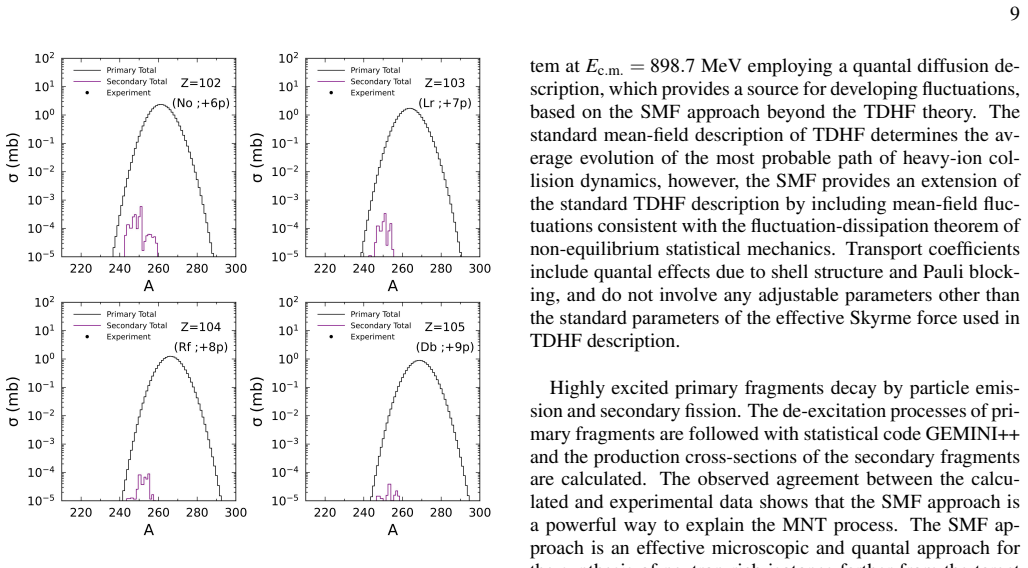
The central claim is that a stochastic mean-field description, with no adjustable parameters beyond the Skyrme energy functional, reproduces the measured isotope cross-sections for the $^{238}\mathrm{U}+^{248}\mathrm{Cm}$ reaction and can therefore be used to predict unreachable regions. For the four initial geometries (tip-tip XX, tip-side XY, side-tip YX, side-side YY), the drift paths and quantal diffusion coefficients are generated from TDHF trajectories; a correlated Gaussian probability distribution for neutron and proton transfers is built from the resulting variances, including a nonzero neutron-proton covariance, and the de-excitation of primary fragments is followed with GEMINI++. The paper finds primary peaks at $A=251$ (Cf, 10.4 mb), $A=253$ (Es, 6.20 mb), $A=256$ (Fm, 4.40 mb), and $A=259$ (Md, 3.20 mb), with secondary peaks shifted down by neutron evaporation, and reports agreement with experimental data in magnitude and location. For $Z=102$--$105$, where no data exist, the calculation predicts cross-sections below 1 microbarn, so those elements are not expected to be produced at observable rates in this reaction.
Load-bearing premise
The prediction rests on taking the isovector curvature parameter $\alpha$ from a neighbouring reaction and on the time windows chosen for averaging, so a mismatch in that surrogate potential would shift the computed yields.
Editorial extensions
If this is right
- If the calculation is correct, the same SMF+GEMINI++ procedure can rank candidate projectile-target combinations for producing new neutron-rich heavy isotopes without tuning reaction parameters.
- The computed cross-section ladder (millibarn for $Z=93$--$98$, microbarn for $Z=99$--$102$, nanobarn for $Z=103$--$110$) sets a quantitative expectation of where multi-nucleon transfer becomes impractical in these actinide systems.
- The secondary peaks being shifted several nucleons below the primary peaks means the observable nuclei are not the primary transfer products; neutron evaporation and fission compete strongly, so survival probabilities must be included in any yield estimate.
- The prediction that $Z=102$--$105$ stays below 1 microbarn at this energy implies that simply repeating the same reaction with higher statistics would not open the region; different systems or energies would be needed.
Reading between the lines
- One could extend the same machinery to other actinide combinations, such as $^{238}\mathrm{U}+^{238}\mathrm{U}$ or $^{248}\mathrm{Cm}+^{250}\mathrm{Cf}$, to see whether the method identifies a system with higher predicted yields for $Z=102$--$105$.
- The strong sensitivity to the borrowed $\alpha$ parameter suggests that a systematic uncertainty band, obtained by varying the time window and the surrogate system, would show whether the 'below microbarn' conclusion is robust.
- Because the diffusion coefficients come from the TDHF mean field, the predicted yields can also serve as a probe of the isovector part of the Skyrme energy functional used in the calculation.
Signed reviews
Editorial analysis
A structured set of objections, weighed in public.
Referee Report
Summary. The paper applies the stochastic mean-field (SMF) quantal diffusion approach, combined with TDHF mean-field evolution and GEMINI++ statistical de-excitation, to the 238U + 248Cm reaction at Ec.m. = 898.7 MeV. It computes primary and secondary isotope production cross-sections for Z >= 98 (Cf through Db), compares the secondary yields for Z = 98-101 with the measured data of Kratz et al., and predicts that neutron-rich isotopes up to Z = 101 are produced with sizable cross-sections while Z = 102-105 remain below the microbarn level. The central claim is that the SMF approach 'explains' the available experimental results and is a predictive, essentially parameter-free microscopic tool for multi-nucleon transfer.
Significance. If the central claim held, this would be a valuable validation of the SMF quantal diffusion method for actinide multi-nucleon transfer, with concrete predictions for unexplored transuranium isotopes. The calculation is not fitted to the benchmark data, so the comparison is a genuine out-of-sample test; the inclusion of neutron-proton correlations and the detailed four-orientation TDHF tables are strengths. However, the agreement with the measured cross-sections is only order-of-magnitude (factor 3-10, with shifted peak mass numbers), and the predicted sub-microbarn ceiling for Z = 102-105 rests on curvature parameters extracted from manually chosen time windows, with no sensitivity analysis. These issues do not invalidate the method but do undermine the overstrong 'explains' claim and the robustness of the prediction.
major comments (4)
- [Sec. III, Table IV] The comparison in Table IV shows only order-of-magnitude agreement, not the 'explain' stated in the Abstract and Sec. IV: for Z=98 the secondary peak is at A=250 with 0.60 mb vs measured A=251 with 1.87 mb; for Z=100 the secondary peak is 0.02 mb vs 0.002 mb, a factor of 10. Please rephrase the claim to 'reproduced within a factor of roughly 3-10' and discuss possible sources of the peak shift (e.g., GEMINI++ decay treatment, equal-weight orientation averaging).
- [Sec. II.C, Eqs. (14)-(15), Table I] The reduced curvature parameters alpha and beta, which control the drift and hence the correlated Gaussian variances in Eqs. (4)-(6), are extracted from manually selected time windows tA and tB, and alpha is borrowed from the surrogate system 250U + 236Cm. The Z=102-105 predictions are tail values of this correlated Gaussian and are highly sensitive to these parameters, yet no sensitivity analysis is provided with respect to the window choice, the surrogate alpha, or the effective temperature T*. Without such an analysis, the sub-microbarn ceiling conclusion is not robust.
- [Sec. II.A, Eqs. (12)-(13)] As printed, Eq. (12) includes an explicit (2*ell+1) factor in the definition of Psec_ell, and Eq. (13) multiplies Psec_ell by (2*ell+1) again, double-counting the angular momentum weight. This makes the normalization of the secondary cross-section inconsistent; please clarify the intended definitions, since the absolute cross-section values in Table IV depend on this factor.
- [Sec. IV and Abstract] The claim that the SMF theory 'does not contain any adjustable parameters' is not supported: the extraction of alpha and beta involves manual selection of the time intervals tA and tB (Table I), and the Einstein relations in Eqs. (11) introduce an effective temperature T* whose value is not given. At minimum, the time-window choices should be identified as tunable inputs, or a sensitivity study should demonstrate that the results are insensitive to them.
minor comments (5)
- [Eqs. (2)-(3)] The notation alternates between 'C_l' and 'C_ell'; please use a single symbol, and ensure the subscript is typeset consistently.
- [Table II] The ell=360 rows for XX and XY list A2f values (257.1 and 284.7) that are inconsistent with mass conservation; these are likely typos.
- [Fig. 10 caption] The caption contains a garbled string '/uni00000014/...' that appears to be a font or encoding artifact; please replace it with the proper caption text.
- [Sec. I] The phrase 'closed to the neutron and proton drip lines' should read 'close to the neutron and proton drip lines'.
- [Sec. III] The statement that 'The SMF results are consistent with the experimental values in terms of magnitude and peak points' is contradicted by Table IV, where the secondary peak mass numbers differ from the measured ones for Z=98-101.
Circularity Check
No significant circularity: the cross-section predictions are computed forward from TDHF/SMF transport coefficients and compared with independent experimental data; the curvature-parameter extraction is an approximation, not a fit to the predicted benchmark.
full rationale
The derivation chain is self-contained and non-circular. TDHF supplies the mean drift paths, diffusion coefficients, and final fragment means; the SMF variance equations (4)-(6) are integrated using drift-derivative terms obtained from a parabolic potential energy surface whose reduced curvatures α and β are estimated from the TDHF drift paths via Eqs. (14)-(15) and Table I. The resulting correlated Gaussian (Eqs. 2-3) yields primary cross sections, and GEMINI++ converts these to secondary cross sections. No parameter is fitted to the experimental data of Kratz et al.; the comparison with those data is an external benchmark. The paper explicitly acknowledges that merging the 250U+236Cm drift data with the 238U+248Cm drift data gives only 'a rough description' of the potential energy surface, and the manual selection of the time intervals tA and tB is a modeling choice. These are legitimate robustness and sensitivity concerns, but they do not make any claimed prediction equivalent to an input by construction. The self-citations to earlier SMF work provide the previously published framework and are not used to forbid alternatives or to substitute for the present calculation. Therefore no circular step can be identified and exhibited from the text.
Assumptions & free parameters
free parameters (4)
- Isovector curvature parameter α (reduced) =
0.177 (XX), 0.108 (XY), 0.177 (YX), 0.120 (YY)
- Isoscalar curvature parameter β (reduced) =
0.004 (XX), 0.004 (XY), 0.010 (YX), 0.004 (YY)
- Time windows tA and tB =
e.g., XX: 330-600 fm/c for β; 140-300 fm/c for α (Table I)
- Effective temperature T* =
not stated
assumptions (7)
- domain assumption The fragment probability distribution is a correlated Gaussian (Eq. 2) with mean values from TDHF and variances from the Fokker-Planck equations.
- domain assumption Drift coefficients are linked to a two-parabola potential energy surface via Einstein relations (Eqs. 10-11) with constant curvatures.
- ad hoc to paper The isovector curvature of 238U+248Cm is represented by the neighboring 250U+236Cm system.
- domain assumption Diffusion coefficients are computed in the diabatic closure limit using occupied TDHF single-particle states only (Eq. 9 and Ref. [34]).
- domain assumption Small-amplitude fluctuations and linearized Langevin equations (Eq. 7) describe the transfer dynamics.
- ad hoc to paper The four collision geometries (XX, XY, YX, YY) are averaged with equal weight 1/4.
- domain assumption The SLy4d Skyrme energy density functional is the correct underlying interaction.
Cite this review
Pith. "Pith review of Neutron-rich isotope production for $Z\geq 98$ in ${}^{238} \mathrm{U}+{ }^{248} \mathrm{Cm}$ reaction." pith.science (2026). https://pith.science/paper/VOS43EM4
@misc{pith2026241110846,
  author       = {Pith},
  title        = {Pith review of: Neutron-rich isotope production for $Z\geq 98$ in $^238 \mathrmU+ ^248 \mathrmCm$ reaction},
  year         = {2026},
  howpublished = {\url{https://pith.science/paper/VOS43EM4}},
  note         = {Machine review of arXiv:2411.10846}
}
abstract
Background: Multi-nucleon transfer (MNT) reactions in actinide systems are a promising method to synthesize transuranium neutron-rich elements. Appropriate theoretical approaches are needed to understand the mechanism behind MNT. Purpose: This work aims to produce neutron-rich isotopes in the super-heavy region through the ${}^{238} \mathrm{U}+{ }^{248} \mathrm{Cm}$ system. We employ a microscopic approach to elucidate reaction mechanisms, and predict new isotope production that expands the known nuclear chart. Methods: The stochastic mean-field (SMF) approach, including fluctuations and correlations, is used to explain the primary cross-sections in MNT reactions based on the quasi-fission and inverse quasi-fission processes, and a statistical de-excitation model with GEMINI++ code to calculate the secondary fragment cross-sections Results: The calculated cross-sections using SMF and GEMINI++ explain available experimental results for the ${}^{238} \mathrm{U}+{ }^{248} \mathrm{Cm}$ system at $E_\mathrm{c.m.}=898.7$~MeV energy. This shows the effectiveness and applicability of the quantal diffusion approach based on the SMF theory in heavy-ion collisions. Conclusions: Production of transuranium neutron-rich elements with a proton number up to $Z=$101 are obtained with sizable cross-sections. Theoretical results calculated for the Z=102-105 region, for which there are no experimental data, show that the cross-section values would be lower than the microbarn level. SMF theory does not contain any adjustable parameters other than the standard parameters of the energy density functional used in the TDHF theory and is an important approach for the microscopic understanding of reaction mechanisms.
Figures


Figures from the paper (7 more)


Reference graph
Works this paper leans on
-
[1]
G. G. Adamian, N. V . Antonenko, A. Diaz-Torres, and S. Heinz, How to extend the chart of nuclides?, Eur. Phys. J. A 56, 47 (2020)
work page 2020
-
[2]
G. Münzenberg, M. Gupta, H. M. Devaraja, Y . K. Gambhir, S. Heinz, and S. Hofmann, Heavy and superheavy elements: next generation experiments, ideas and considerations, Eur. Phys. J. A 59, 21 (2023)
work page 2023
-
[3]
T. Niwase, Y . X. Watanabe, Y . Hirayama, M. Mukai, P. Schury, A. N. Andreyev, T. Hashimoto, S. Iimura, H. Ishiyama, Y . Ito, S. C. Jeong, D. Kaji, S. Kimura, H. Miyatake, K. Morimoto, J.-Y . Moon, M. Oyaizu, M. Rosenbusch, A. Taniguchi, and M. Wada, Discovery of New Isotope241U and Systematic High- Precision Atomic Mass Measurements of Neutron-Rich Pa-Pu...
work page 2023
-
[4]
Valery Zagrebaev and Walter Greiner, New way for the produc- tion of heavy neutron-rich nuclei, J. Phys. G: Nucl. Part. Phys. 35, 125103 (2008)
work page 2008
-
[5]
Valery Zagrebaev and Walter Greiner, Production of New Heavy Isotopes in Low–Energy Multinucleon Transfer Reac- tions, Phys. Rev. Lett. 101, 122701 (2008)
work page 2008
-
[6]
V . I. Zagrebaev and W. Greiner, Production of heavy and super- heavy neutron-rich nuclei in transfer reactions, Phys. Rev. C83, 044618 (2011). 10
work page 2011
-
[7]
A. V . Karpov and V . V . Saiko, Modeling near-barrier collisions of heavy ions based on a Langevin-type approach, Phys. Rev. C 96, 024618 (2017)
work page 2017
-
[8]
V . V . Saiko and A. V . Karpov, Analysis of multinucleon transfer reactions with spherical and statically deformed nuclei using a Langevin-type approach, Phys. Rev. C 99, 014613 (2019)
work page 2019
Show all 64 references
-
[9]
Saiko and A
V . Saiko and A. Karpov, Multinucleon transfer as a method for production of new heavy neutron-enriched isotopes of transura- nium elements, Eur. Phys. J. A 58, 41 (2022)
2022
-
[10]
Feng, G.-M
Z.-Q. Feng, G.-M. Jin, and J.-Q. Li, Production of heavy iso- topes in transfer reactions by collisions of 238U + 238U, Phys. Rev. C 80, 067601 (2009)
2009
-
[11]
Feng, Production of neutron–rich isotopes around N = 126 in multinucleon transfer reactions, Phys
Z.-Q. Feng, Production of neutron–rich isotopes around N = 126 in multinucleon transfer reactions, Phys. Rev. C95, 024615 (2017)
2017
-
[12]
K. Zhao, X. Wu, and Z. Li, Quantum molecular dynamics study of the mass distribution of products in 7 .0A MeV 238U + 238U collisions, Phys. Rev. C 80, 054607 (2009)
2009
-
[13]
K. Zhao, Z. Li, Y . Zhang, N. Wang, Q. Li, C. Shen, Y . Wang, and X. Wu, Production of unknown neutron–rich isotopes in 238U + 238U collisions at near–barrier energy, Phys. Rev. C 94, 024601 (2016)
2016
-
[14]
Wang and L
N. Wang and L. Guo, New neutron-rich isotope production in 154Sm + 160Gd, Phys. Lett. B 760, 236 (2016)
2016
-
[15]
Simenel, Nuclear quantum many-body dynamics, Eur
C. Simenel, Nuclear quantum many-body dynamics, Eur. Phys. J. A 48, 152 (2012)
2012
-
[16]
Simenel and A
C. Simenel and A. S. Umar, Heavy-ion collisions and fission dynamics with the time–dependent Hartree-Fock theory and its extensions, Prog. Part. Nucl. Phys. 103, 19 (2018)
2018
-
[17]
Nakatsukasa, K
T. Nakatsukasa, K. Matsuyanagi, M. Matsuo, and K. Yabana, Time-dependent density-functional description of nuclear dy- namics, Rev. Mod. Phys. 88, 045004 (2016)
2016
-
[18]
V . E. Oberacker, A. S. Umar, and C. Simenel, Dissipative dy- namics in quasifission, Phys. Rev. C 90, 054605 (2014)
2014
-
[19]
A. S. Umar, V . E. Oberacker, and C. Simenel, Shape evolution and collective dynamics of quasifission in the time-dependent Hartree-Fock approach, Phys. Rev. C 92, 024621 (2015)
2015
-
[20]
A. S. Umar and V . E. Oberacker, Time-dependent HF approach to SHE dynamics, Nucl. Phys. A 944, 238 (2015)
2015
-
[21]
A. S. Umar, C. Simenel, and W. Ye, Transport properties of isospin asymmetric nuclear matter using the time-dependent Hartree–Fock method, Phys. Rev. C 96, 024625 (2017)
2017
-
[22]
Simenel, Particle Transfer Reactions with the Time- Dependent Hartree-Fock Theory Using a Particle Number Pro- jection Technique, Phys
C. Simenel, Particle Transfer Reactions with the Time- Dependent Hartree-Fock Theory Using a Particle Number Pro- jection Technique, Phys. Rev. Lett.105, 192701 (2010)
2010
-
[23]
Sekizawa and K
K. Sekizawa and K. Yabana, Time-dependent Hartree-Fock cal- culations for multinucleon transfer and quasifission processes in the 64Ni + 238U reaction, Phys. Rev. C 93, 054616 (2016)
2016
-
[24]
Godbey, A
K. Godbey, A. S. Umar, and C. Simenel, Deformed shell ef- fects in 48Ca + 249Bk quasifission fragments, Phys. Rev. C100, 024610 (2019)
2019
-
[25]
Simenel, K
C. Simenel, K. Godbey, and A. S. Umar, Timescales of Quan- tum Equilibration, Dissipation and Fluctuation in Nuclear Col- lisions, Phys. Rev. Lett. 124, 212504 (2020)
2020
-
[26]
Balian and M
R. Balian and M. Vénéroni, Time-dependent variational prin- ciple for the expectation value of an observable: Mean-field applications, Ann. Phys. (NY) 164, 334 (1985)
1985
-
[27]
Balian and M
R. Balian and M. Vénéroni, Correlations and fluctuations in static and dynamic mean-field approaches, Ann. Phys.216, 351 (1992)
1992
-
[28]
Simenel, Particle-Number Fluctuations and Correlations in Transfer Reactions Obtained Using the Balian-Vénéroni Varia- tional Principle, Phys
C. Simenel, Particle-Number Fluctuations and Correlations in Transfer Reactions Obtained Using the Balian-Vénéroni Varia- tional Principle, Phys. Rev. Lett. 106, 112502 (2011)
2011
-
[29]
Williams, K
E. Williams, K. Sekizawa, D. J. Hinde, C. Simenel, M. Das- gupta, I. P. Carter, K. J. Cook, D. Y . Jeung, S. D. Mc- Neil, C. S. Palshetkar, D. C. Rafferty, K. Ramachandran, and A. Wakhle, Exploring Zeptosecond Quantum Equilibration Dy- namics: From Deep-Inelastic to Fusion-Fis...
2018
-
[30]
Godbey and A
K. Godbey and A. S. Umar, Quasifission Dynamics in Micro- scopic Theories, Front. Phys. 8, 40 (2020)
2020
-
[31]
Godbey, C
K. Godbey, C. Simenel, and A. S. Umar, Microscopic predic- tions for the production of neutron-rich nuclei in the reaction 176Yb + 176Yb, Phys. Rev. C 101, 034602 (2020)
2020
-
[32]
Ayik, A stochastic mean-field approach for nuclear dynam- ics, Phys
S. Ayik, A stochastic mean-field approach for nuclear dynam- ics, Phys. Lett. B 658, 174 (2008)
2008
-
[33]
Lacroix and S
D. Lacroix and S. Ayik, Stochastic quantum dynamics beyond mean field, Eur. Phys. J. A 50, 95 (2014)
2014
-
[34]
S. Ayik, B. Yilmaz, O. Yilmaz, and A. S. Umar, Quantal dif- fusion description of multinucleon transfers in heavy–ion colli- sions, Phys. Rev. C 97, 054618 (2018)
2018
-
[35]
S. Ayik, B. Yilmaz, O. Yilmaz, and A. S. Umar, Quantal diffu- sion approach for multinucleon transfers in Xe + Pb collisions, Phys. Rev. C 100, 014609 (2019)
2019
-
[36]
Sekizawa and S
K. Sekizawa and S. Ayik, Quantal diffusion approach for multi- nucleon transfer processes in the 58,64Ni +208 Pb reactions: To- ward the production of unknown neutron-rich nuclei, Phys. Rev. C 102, 014620 (2020)
2020
-
[37]
Yilmaz, G
O. Yilmaz, G. Turan, and B. Yilmaz, Quasi-fission and fusion- fission reactions in 48Ca + 208Pb collisions at Ec.m. = 190 MeV, Eur. Phys. J. A 56, 37 (2020)
2020
-
[38]
S. Ayik, B. Yilmaz, O. Yilmaz, and A. S. Umar, Merging of transport theory with the time-dependent Hartree-Fock ap- proach: Multinucleon transfer in U+U collisions, Phys. Rev. C 102, 024619 (2020)
2020
-
[39]
S. Ayik, M. Arik, E. C. Karanfil, O. Yilmaz, B. Yilmaz, and A. S. Umar, Quantal diffusion description of isotope produc- tion via the multinucleon transfer mechanism in 48Ca +238 U collisions, Phys. Rev. C 104, 054614 (2021)
2021
-
[40]
S. Ayik, M. Arik, O. Yilmaz, B. Yilmaz, and A. S. Umar, Mult- inucleon transfer mechanism in 250Cf +232 Th collisions using the quantal transport description based on the stochastic mean- field approach, Phys. Rev. C 107, 014609 (2023)
2023
-
[41]
S. Ayik, M. Arik, E. Erbayri, O. Yilmaz, and A. S. Umar, Multinucleon transfer mechanism in160Gd+186 W collisions in stochastic mean-field theory, Phys. Rev. C108, 054605 (2023)
2023
-
[42]
E., Yaprakli, B., Arik, M., Ayik, S., Yil- maz, O., and Umar, A
Kayaalp, A., Ocal, S. E., Yaprakli, B., Arik, M., Ayik, S., Yil- maz, O., and Umar, A. S., A theoretical study on quasifission and fusion–fission processes in heavy-ion collisions, Eur. Phys. J. A 60, 79 (2024)
2024
-
[43]
J. V . Kratz, M. Schädel, and H. W. Gäggeler, Reexamining the heavy-ion reactions 238U+238U and 238U+248Cm and actinide production close to the barrier, Phys. Rev. C88, 054615 (2013)
2013
-
[44]
Schädel, W
M. Schädel, W. Brüchle, H. Gäggeler, J. V . Kratz, K. Sümmerer, G. Wirth, G. Herrmann, R. Stakemann, G. Tittel, N. Trautmann, J. M. Nitschke, E. K. Hulet, R. W. Lougheed, R. L. Hahn, and R. L. Ferguson, Actinide Production in Collisions of 238U with 248Cm, Phys. Rev. Lett. 48,...
1982
-
[45]
J. V . Kratz, W. Loveland, and K. J. Moody, Syntheses of transuranium isotopes with atomic numbers Z ≤ 103 in multi- nucleon transfer reactions, Nucl. Phys. A 944, 117 (2015)
2015
-
[46]
Peng and Z.-Q
C. Peng and Z.-Q. Feng, Production of neutron-rich heavy nu- clei around N = 162 in multinucleon transfer reactions, Eur. Phys. J. A 58, 162 (2022)
2022
-
[47]
T. L. Zhao, X. J. Bao, and H. F. Zhang, Exploring the optimal way to produce Z=100-106 neutron-rich nuclei, Phys. Rev. C 108, 024602 (2023). 11
2023
-
[48]
Hannes Risken and Till Frank, The Fokker–Planck Equation (Springer–Verlag, Berlin, 1996)
1996
-
[49]
W. U. Schröder, J. R. Huizenga, and J. Randrup, Correlated mass and charge transport induced by statistical nucleon ex- change in damped nuclear reactions, Phys. Lett. B 98, 355 (1981)
1981
-
[50]
A. C. Merchant and W. Nörenberg, Neutron and proton diffu- sion in heavy–ion collisions, Phys. Lett. B 104, 15 (1981)
1981
-
[51]
C. W. Gardiner, Quantum Noise (Springer–Verlag, Berlin, 1991)
1991
-
[52]
Weiss, Quantum Dissipative Systems, 2nd ed
U. Weiss, Quantum Dissipative Systems, 2nd ed. (World Scien- tific, Singapore, 1999)
1999
-
[53]
Nörenberg, Memory effects in the energy dissipation for slow collective nuclear motion, Phys
W. Nörenberg, Memory effects in the energy dissipation for slow collective nuclear motion, Phys. Lett. B 104, 107 (1981)
1981
-
[54]
Randrup, Theory of transfer-induced transport in nuclear col- lisions, Nucl
J. Randrup, Theory of transfer-induced transport in nuclear col- lisions, Nucl. Phys. A 327, 490 (1979)
1979
-
[55]
A. C. Merchant and W. Nörenberg, Microscopic transport the- ory of heavy-ion collisions, Z. Phys. A 308, 315 (1982)
1982
-
[56]
Charity, GEMINI: A code to simulate the decay of a com- pound nucleus by a series of binary decays , Tech
R. Charity, GEMINI: A code to simulate the decay of a com- pound nucleus by a series of binary decays , Tech. Rep. (Inter- national Atomic Energy Agency (IAEA), 2008) INDC(NDS)– 0530
2008
-
[57]
Hauser and H
W. Hauser and H. Feshbach, The Inelastic Scattering of Neu- trons, Phys. Rev. 87, 366 (1952)
1952
-
[58]
L. G. Moretto, Statistical emission of large fragments: A gen- eral theoretical approach, Nucl. Phys. A 247, 211 (1975)
1975
-
[59]
L. G. Moretto and G. J. Wozniak, The role of the compound nucleus in complex fragment emission at low and intermediate energies, Prog. Part. Nucl. Phys. 21, 401 (1988)
1988
-
[60]
J. M. Blatt and V . F. Weisskopf, Theoretical Nuclear Physics (Springer New York, NY , 1979)
1979
-
[61]
Kedziora and Cédric Simenel, New inverse quasifis- sion mechanism to produce neutron-rich transfermium nuclei, Phys
David J. Kedziora and Cédric Simenel, New inverse quasifis- sion mechanism to produce neutron-rich transfermium nuclei, Phys. Rev. C 81, 044613 (2010)
2010
-
[62]
A. S. Umar, M. R. Strayer, J. S. Wu, D. J. Dean, and M. C. Güçlü, Nuclear Hartree-Fock calculations with splines, Phys. Rev. C 44, 2512 (1991)
1991
-
[63]
A. S. Umar and V . E. Oberacker, Three-dimensional unre- stricted time-dependent Hartree-Fock fusion calculations using the full Skyrme interaction, Phys. Rev. C 73, 054607 (2006)
2006
-
[64]
Ka–Hae Kim, Takaharu Otsuka, and Paul Bonche, Three- dimensional TDHF calculations for reactions of unstable nu- clei, J. Phys. G: Nucl. Part. Phys. 23, 1267 (1997)
1997
Reviewed August 12, 2026 · model on record in the stance chip above.
Discussion (0). Continue with ORCID to comment.