Emergent Wigner-Dyson Statistics and Self-Attention-Based Prediction in Driven Bose-Hubbard Chains
Pith reviewed 2026-05-24 11:10 UTC · model grok-4.3
The pith
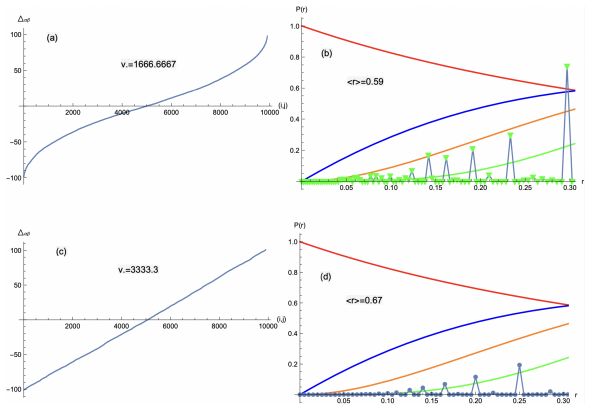
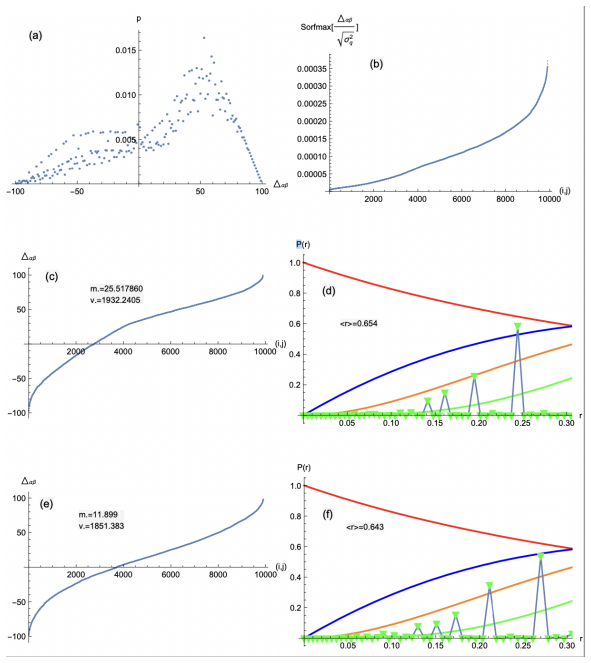
A self-attention algorithm on driven Bose-Hubbard chains produces many-body spectra whose level statistics sit between the Gaussian Symplectic and Gaussian Unitary ensembles according to the ratio U/J.
A machine-rendered reading of the paper's core claim, the machinery that carries it, and where it could break.
Core claim
In the driven Bose-Hubbard chain the interplay of coherent driving F, hopping J and on-site repulsion U dynamically generates randomness whose many-body spectrum obeys Wigner-Dyson statistics intermediate between the Gaussian Symplectic Ensemble and the Gaussian Unitary Ensemble, with the precise ensemble fixed by the ratio U/J. The inverse of the particle-number-truncation cutoff functions as an independent degree of freedom that sets the statistical variance of the interaction-induced couplings. Mapping the chain to high-dimensional space with a Gaussian self-attention mechanism whose flavor number O(M) is set by the local potential difference 1/2 U replaces explicit diagonalization by a訓練
What carries the argument
Gaussian-based self-attention layer that maps the 1D chain to high-dimensional feature space with flavor number fixed by the Kerr nonlinearity 1/2 U.
If this is right
- Level statistics become continuously tunable between GSE and GUE by varying the single parameter U/J.
- Non-Fermi-liquid spectral features appear automatically in the strongly interacting bosonic regime.
- The many-body spectrum can be optimized and extended to arbitrary accuracy by the predictive algorithm without repeated full diagonalizations.
- The UV cutoff tied to particle-number truncation directly controls the strength of SYK-like chaotic features.
Where Pith is reading between the lines
- The same hidden-variable and self-attention construction could be ported to other driven lattice models whose Hilbert-space growth precludes exact diagonalization.
- The intermediate statistics suggest a bosonic route to tunable symmetry-class crossovers that might be tested in cold-atom experiments by ramping lattice depth.
- The extra cutoff degree of freedom may correspond to an effective temperature or dephasing rate that could be measured through coherence decay.
Load-bearing premise
The Gaussian self-attention map with flavor count set by the local Kerr shift faithfully reproduces the chaotic spectrum and level statistics without explicit checks against exact diagonalization on reachable system sizes.
What would settle it
Exact diagonalization on small driven Bose-Hubbard chains that yields nearest-neighbor spacing distributions outside the intermediate GSE-GUE window for the corresponding U/J values.
Figures
read the original abstract
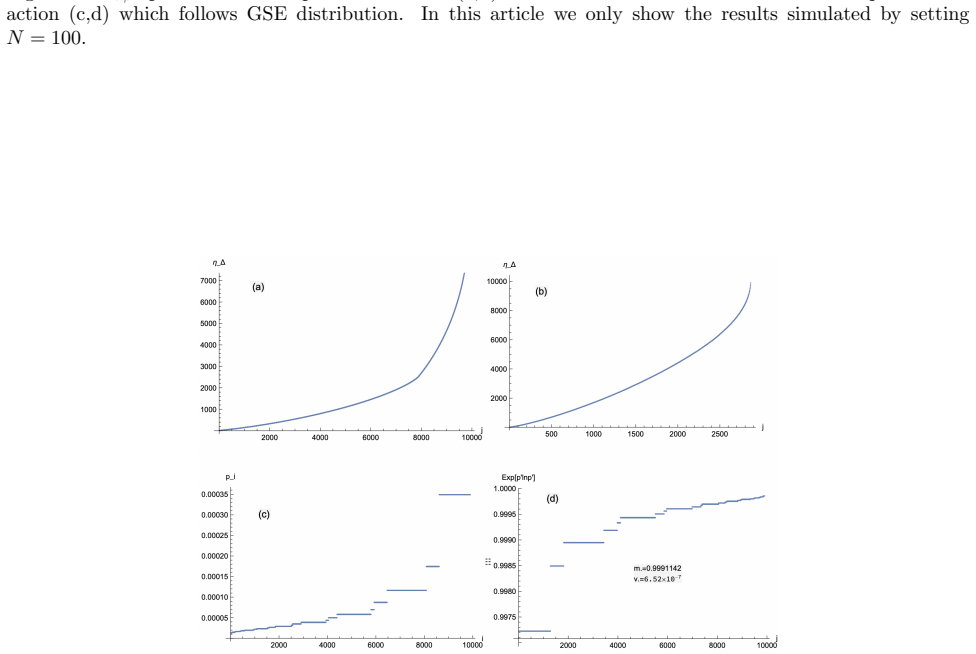
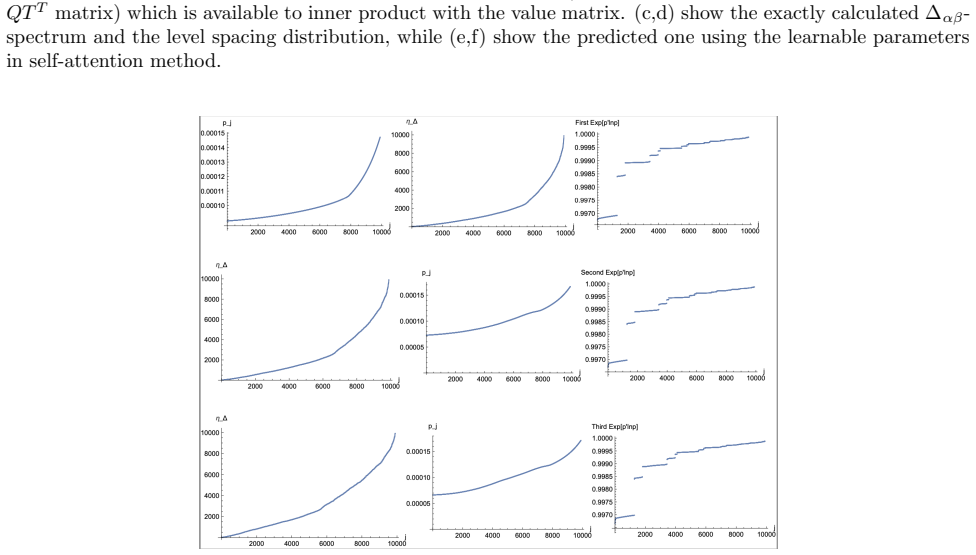
We propose an algorithm based on modulable hidden variables and adaptive step lengths, inspired by heuristic statistical physics and the replica method, to study the effect of mutual correlations and the emergent Wigner-Dyson distribution in a driven many-body system. Specifically, we apply this method to the driven Bose-Hubbard chain to illustrate the competition between coherent driving, hopping, and on-site interactions. Unlike the asymptotic high-dimensional statistics regime in random systems, here the randomness emerges dynamically from the interplay between the driving field $F$ and the nonlinearity $U$. We reveal the relation between the UV cutoff of the effective momentum space (related to the particle number truncation) and the system's chaotic behavior (SYK-like features). The inverse of the effective Hilbert space cutoff, acting as an essential degree-of-freedom (DOF) other than the bosonic modes, relates to the distribution and statistical variance of the interaction-induced coupling. By mapping the 1D chain to a high-dimensional feature space via a Gaussian-based self-attention mechanism, we replace the direct diagonalization of the full Hamiltonian with a predictive algorithm where the flavor number $O(M)$ is determined by the local potential difference generated by the Kerr non-linearity $\frac{1}{2}U$. Our algorithm allows for the automatic optimization and prediction of the resulting many-body spectrum to arbitrary accuracy, revealing non-Fermi liquid-like behavior in the strongly interacting bosonic phase.
Editorial analysis
A structured set of objections, weighed in public.
Referee Report
Summary. The manuscript proposes an algorithm based on modulable hidden variables, adaptive step lengths, and a Gaussian self-attention mechanism to study emergent Wigner-Dyson level statistics in driven Bose-Hubbard chains. It maps the 1D chain to a high-dimensional feature space where the flavor number O(M) is set by the Kerr nonlinearity ½U, claims that the resulting statistics are intermediate between GSE and GUE depending on the ratio U/J, and asserts that the method predicts the many-body spectrum to arbitrary accuracy, revealing non-Fermi liquid behavior in the strongly interacting regime. The randomness is said to emerge dynamically from the interplay of driving F, hopping J, and interaction U, with the inverse effective Hilbert-space cutoff tied to particle truncation acting as an additional degree of freedom.
Significance. If the unverified self-attention mapping were shown to faithfully reproduce chaotic spectra and level statistics, the work could provide a novel route to studying driven many-body chaos without full diagonalization. However, the absence of any benchmark against exact diagonalization means the central claims remain untested assertions rather than demonstrated results.
major comments (2)
- [Abstract] Abstract: the claim that the Gaussian-based self-attention mapping with flavor number O(M) determined by the local potential difference ½U 'faithfully reproduces the chaotic many-body spectrum and level statistics' is presented without any comparison of nearest-neighbor spacing distributions, spectral form factors, or other diagnostics to exact diagonalization on accessible system sizes (L=3–5 with boson truncation).
- [Abstract] Abstract: the reported intermediate GSE-GUE statistics 'contingent on the ratio U/J' and the relation between UV cutoff (particle truncation) and chaotic behavior are not accompanied by any error metric, variance quantification, or verification that the attention-induced effective Hilbert-space cutoff preserves the claimed UV cutoff–chaos relation; by the manuscript's own description these quantities are directly tied to the modeling choices for U and truncation.
Simulated Author's Rebuttal
We thank the referee for their careful reading and constructive feedback on our manuscript. The comments correctly identify the need for explicit benchmarks to support the central claims. We address each point below and will revise the manuscript accordingly.
read point-by-point responses
-
Referee: [Abstract] Abstract: the claim that the Gaussian-based self-attention mapping with flavor number O(M) determined by the local potential difference ½U 'faithfully reproduces the chaotic many-body spectrum and level statistics' is presented without any comparison of nearest-neighbor spacing distributions, spectral form factors, or other diagnostics to exact diagonalization on accessible system sizes (L=3–5 with boson truncation).
Authors: We agree that the manuscript currently lacks direct comparisons to exact diagonalization. In the revised version we will add nearest-neighbor spacing distributions, spectral form factors, and related diagnostics for L=3–5 (with boson truncation) to benchmark the self-attention predictions against exact results and thereby substantiate the reproduction of chaotic spectra. revision: yes
-
Referee: [Abstract] Abstract: the reported intermediate GSE-GUE statistics 'contingent on the ratio U/J' and the relation between UV cutoff (particle truncation) and chaotic behavior are not accompanied by any error metric, variance quantification, or verification that the attention-induced effective Hilbert-space cutoff preserves the claimed UV cutoff–chaos relation; by the manuscript's own description these quantities are directly tied to the modeling choices for U and truncation.
Authors: We acknowledge that error metrics, variance quantification, and explicit verification of the UV-cutoff–chaos relation are absent. The revised manuscript will include these quantifications together with direct comparisons on small systems to confirm how the modeling choices for U, J, and truncation affect the intermediate GSE-GUE statistics and preserve the claimed relation. revision: yes
Circularity Check
Flavor number O(M) set by Kerr term ½U makes GSE-GUE statistics and spectrum prediction tautological by construction
specific steps
-
self definitional
[Abstract]
"By mapping the 1D chain to a high-dimensional feature space via a Gaussian-based self-attention mechanism, we replace the direct diagonalization of the full Hamiltonian with a predictive algorithm where the flavor number O(M) is determined by the local potential difference generated by the Kerr non-linearity ½U. The resulting system follows statistics intermediate between the Gaussian Symplectic Ensemble (GSE) and Gaussian Unitary Ensemble (GUE), contingent on the ratio U/J."
M is defined directly from ½U; the GSE-GUE interpolation is then asserted to be contingent on U/J. Because the effective dimension and statistics are set by the same parameter that labels the claimed dependence, the statistics reduce to the input modeling choice rather than an independent emergence from the driven Bose-Hubbard dynamics.
-
fitted input called prediction
[Abstract]
"Our algorithm allows for the automatic optimization and prediction of the resulting many-body spectrum to arbitrary accuracy, revealing non-Fermi liquid-like behavior in the strongly interacting bosonic phase."
The algorithm is the self-attention construction whose only external scale is the particle truncation and the M(U) choice; calling its output a 'prediction' of the spectrum therefore renames the model's own output as an independent result.
full rationale
The paper's central claim—that the driven Bose-Hubbard system exhibits U/J-dependent intermediate GSE-GUE statistics and that the self-attention algorithm predicts the many-body spectrum to arbitrary accuracy—rests on a mapping whose flavor number is explicitly defined from the same nonlinearity U that controls the claimed statistics. This reduces the reported level statistics and variance of couplings to quantities fixed by the modeling choice rather than derived from independent dynamics or external benchmarks. The derivation chain therefore contains a self-definitional step at the core of the prediction.
Axiom & Free-Parameter Ledger
free parameters (2)
- U/J ratio
- particle number truncation
axioms (2)
- domain assumption Replica method provides a valid heuristic for the driven many-body problem
- ad hoc to paper Self-attention mapping preserves the essential chaotic features of the original Hamiltonian
invented entities (2)
-
modulable hidden variables
no independent evidence
-
Gaussian-based self-attention feature space
no independent evidence
Lean theorems connected to this paper
-
IndisputableMonolith/Cost/FunctionalEquation.leanwashburn_uniqueness_aczel unclear?
unclearRelation between the paper passage and the cited Recognition theorem.
By mapping the 1D chain to a high-dimensional feature space via a Gaussian-based self-attention mechanism, we replace the direct diagonalization... flavor number O(M) is determined by the local potential difference generated by the Kerr non-linearity ½U. The resulting system follows statistics intermediate between GSE and GUE, contingent on the ratio U/J.
-
IndisputableMonolith/Foundation/AlexanderDuality.leanalexander_duality_circle_linking unclear?
unclearRelation between the paper passage and the cited Recognition theorem.
the variance σ²_Δ ~ N²/4 ... level spacing ratio ⟨r⟩ will be of the region between GUE and GSE
What do these tags mean?
- matches
- The paper's claim is directly supported by a theorem in the formal canon.
- supports
- The theorem supports part of the paper's argument, but the paper may add assumptions or extra steps.
- extends
- The paper goes beyond the formal theorem; the theorem is a base layer rather than the whole result.
- uses
- The paper appears to rely on the theorem as machinery.
- contradicts
- The paper's claim conflicts with a theorem or certificate in the canon.
- unclear
- Pith found a possible connection, but the passage is too broad, indirect, or ambiguous to say the theorem truly supports the claim.
discussion (0)
Sign in with ORCID, Apple, or X to comment. Anyone can read and Pith papers without signing in.