REVIEW 5 major objections 5 minor 47 references
Beyond Ground States: Physics-Inspired Optimization of Excited States of Classical Hamiltonians
T0 review · 5 major / 5 minor · reviewed 2026-08-06 · deepseek-v4-flash
Pith's one-line read ExcLQA targets excited Ising states with one inverse-energy penalty, turning ground-state annealing into a tool for finding alternative low-energy configurations.
desk verdict Useful heuristic extension of LQA with a real SVP demo, undermined by an abstract that advertises benchmarks that do not exist in the body. read the letter →
The pith
A machine-rendered reading of the paper's core claim, the machinery that carries it, and where it could break.
The reading
What carries the argument
The load-bearing object is the penalized final cost of Eq. (13), $E_F(\theta)=\langle \hat{H}_z\rangle + \alpha/\langle \hat{H}_z\rangle$, built on top of LQA's restricted product-state ansatz. The product ansatz $|\theta\rangle=\otimes_i\left(\cos(\theta_i/2)|+\rangle + \sin(\theta_i/2)|-\rangle\right)$ keeps the simulation polynomial because no entanglement is stored, and the anneal is discretized into $N$ steps of momentum-assisted gradient descent over $E_{\text{total}}(t,\theta)=(1-t)E_I(\theta)+t\beta\gamma E_F(\theta)$. The inverse term is the ingredient that changes the target: it raises every energy level by an amount that shrinks as energy grows, so tuning $\alpha$ by binary search selects which excitation the landscape's minimum corresponds to. For the shortest-vector benchmark, binary-encoded qudit operators map integer lattice coefficients to qubits, making the Hamiltonian's first excited state encode the shortest nonzero vector.
What would settle it
Compute the exact spectrum of a small Ising Hamiltonian, pick its first excited state, and verify whether that state has near-zero overlap with every product state that is a local minimum of $E_F$ under the paper's annealing schedule; a single instance where exhaustive search finds the state but ExcLQA does not for any $\alpha$ would falsify the general claim. A more direct version is to run the paper's rank-47 q-ary sublattice protocol with local dimension 4 and 100 shots; the central claim predicts at least some exact solutions near rank 46, so a complete collapse to zero solved instances at rank 47 would delimit the method sharply.
Extended reading notes
Core claim
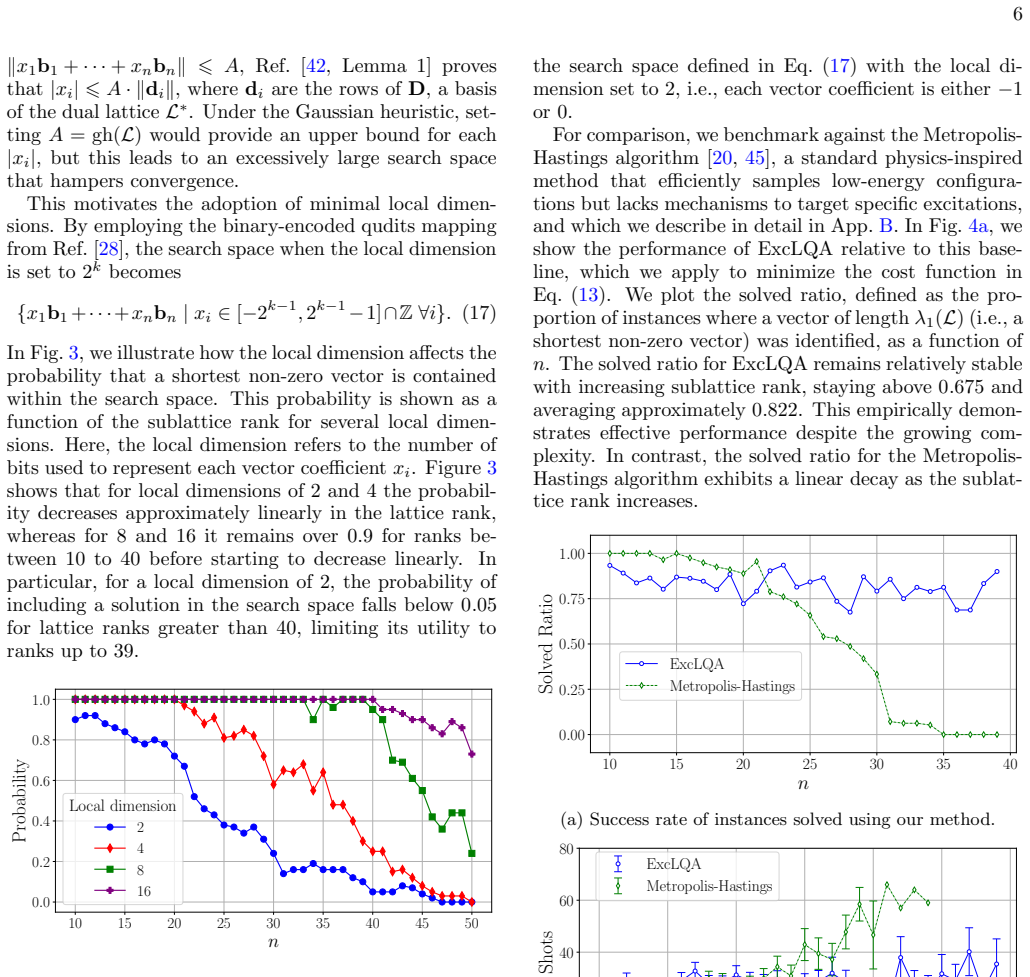
The paper's claim is that an inverse-energy penalty can aim an annealing algorithm at excited states rather than the ground state. For a Hamiltonian with nonnegative spectrum, the cost $E_F(\theta)=\langle \hat{H}_z\rangle + \alpha/\langle \hat{H}_z\rangle$ assigns a larger penalty to lower energies, so its minimum moves up the spectrum; binary search on the single scalar $\alpha$ positions that minimum near the desired level. Interpolating from a transverse-field term to $E_F$ through the product-state ansatz of Eq. (4) and updating via gradient descent yields the first excited state for the shortest-vector test cases. On q-ary sublattices, the solved ratio stays above $0.675$ for ranks 10–39, the average shot count remains below 40, failed instances still come with approximation factor $\gamma<\sqrt{2}$, and local dimension 4 reaches exact solutions on some instances up to rank 46. The paper's comparison against Metropolis-Hastings on the same cost function shows a stable solved ratio for ExcLQA against a linearly decaying one for the baseline.
Load-bearing premise
The whole method rests on the heuristic assumption that momentum-assisted gradient descent over product states can traverse the penalized landscape $E_F$ and land in the intended excited level; no guarantee or proof is supplied, so if that landscape has no accessible path to the target state, the algorithm simply fails.
Editorial extensions
If this is right
- Any quadratic unconstrained binary optimization problem whose ground state is not the desired answer can, in principle, be passed through the same pipeline with the target excitation level selected by one binary-searched parameter.
- For the shortest vector problem, a local search space of one bit per coefficient suffices to maintain a solved ratio above $0.675$ for ranks 10–39, and a two-bit encoding extends exact solutions to some rank-46 instances.
- Because only a lower bound on the ground-state energy is needed to shift the spectrum, the method applies to problems where the exact ground state is unknown and other excited-state methods cannot be initialized.
- On instances where it fails to find the exact shortest vector, its best found vector still respects $\gamma<\sqrt{2}$, which is in the parameter regime where approximate SVP is known to be NP-hard.
Reading between the lines
- We read the inverse-energy penalty as a general landscape-reshaping device that could be dropped into any physics-inspired optimizer with a differentiable energy, not just product-state annealers; the authors mention tensor-network and graph-neural-network solvers as possible hosts but do not test them.
- The penalty term makes the cost function non-physical, so a direct transfer of ExcLQA to quantum annealing hardware would require an additional mechanism; the paper's results are classical and do not imply quantum-device performance.
- The rank-46 ceiling should be read as a statement about hyperparameter tuning difficulty rather than a fundamental limit; a better schedule or an adaptive $\alpha$ might push the method further, but the paper provides no evidence either way.
- A natural stress test is constrained combinatorial optimization with exclusion rules, where the feasible optimum is an excited state by construction; that setting would tell whether the single-parameter control survives when the spectrum is not as structured as in SVP.
Editorial analysis
A structured set of objections, weighed in public.
Referee Report
Summary. The paper introduces ExcLQA, a classical heuristic that extends local quantum annealing (LQA) to excited states of Ising Hamiltonians. The method adds an inverse-energy penalty term α/⟨Hz⟩ to the cost function, tunes α by binary search, and simulates an adiabatic evolution over product states. The benchmark is the shortest vector problem (SVP), whose target vector corresponds to the first excited state of a Hamiltonian built from a lattice Gram matrix. The authors report solved ratios above 0.675 for sublattice ranks 10–39 on instances whose shortest vector lies in a restricted local-dimension-2 search space, fewer shots and better approximation factors than a Metropolis–Hastings baseline, and isolated successes at ranks 43–46 using a larger search space. The paper includes a code repository and data. The abstract supplied with the manuscript additionally claims benchmarks on fully connected Ising models against matrix-product-state and simulated-annealing baselines, but those experiments do not appear in the body of the paper.
Significance. If the SVP results hold as stated, ExcLQA is a useful new heuristic for excited-state optimization and provides a concrete application to a cryptographically relevant lattice problem. The authors are appropriately cautious about the lack of theoretical guarantees and about the difficulty of hyperparameter tuning, and the public code and data are a reproducibility strength. However, two issues substantially weaken the current claims: the advertised fully connected Ising benchmarks are absent, and the SVP benchmark is reported conditionally on a post-hoc filter of instances. The significance of the paper depends on whether the authors can supply the missing experiments and present an unfiltered or clearly conditional evaluation with uncertainty estimates.
major comments (5)
- [Abstract / Section IV] The abstract supplied with the manuscript states that ExcLQA is benchmarked on fully connected Ising models with random interactions and outperforms both a matrix-product-state-based method and simulated annealing, even when only a lower bound on the ground-state energy is given. The full text contains no such benchmark: Section IV is devoted entirely to SVP, and the abstract printed at the head of the full text already restricts the benchmark claim to SVP. This is an internal inconsistency, and it leaves a substantial part of the advertised contribution unsubstantiated. The authors should either add the missing experiments or remove these claims from the abstract.
- [Section IV B, Eq. (17), Table II] The benchmark evaluates only 'valid instances' whose shortest vector lies in the local-dimension-2 search space. For ranks 30–39, Table II shows that only 10–24 of the 100 generated instances qualify; at n=39, ExcLQA solves 9 of 10 valid instances, i.e., 9 of 100 generated instances. The reported 'solved ratio above 0.675' is therefore conditional on a post-hoc filter that excludes instances the method cannot represent in its search space. The comparison with Metropolis–Hastings is performed on the same filtered subset. This filtering systematically inflates the apparent success rate, and the paper should report unconditional solved ratios alongside the conditional ones, or state clearly in every headline number that the ratio is over valid instances only.
- [Section III, Eq. (13), Appendix D] The paper says that α is tuned via binary search, but it never specifies the binary-search objective or the feedback signal used to accept or reject a trial value. In the SVP benchmark, if the search uses the known shortest vector (computed by enumeration) to decide whether a trial α succeeded, the evaluation is circular and the reported success rates are not predictive. Please state explicitly what information the binary search uses, and whether any test-instance information from the fplll enumeration enters the tuning of α, β, γ, μ, η, M, f, or N.
- [Section III, Eq. (14), Table I] The narrative emphasizes a 'single hyperparameter' α, but the method requires many additional hyperparameters: β=3.8 is set 'empirically to enhance performance,' and Table I lists N, γ, μ, η, M, and f, with values that are manually tuned and differ between local dimensions. The single-hyperparameter claim should be restricted to α, or a principled tuning procedure for the remaining parameters should be provided and justified.
- [Section IV B, Figs. 4 and 5] No error bars or variance estimates are reported. With 10–24 valid instances per rank, the binomial standard error on a solved ratio of 0.8 is roughly 0.08–0.13, so the claim that the solved ratio is 'roughly stable across lattice ranks' is not supported by the data as presented. In addition, the approximation-factor comparison in Fig. 5 is averaged over the instances in which each method failed, which are different sets for the two methods; this can bias the comparison in favor of the method that solves more instances.
minor comments (5)
- [Section V] The conclusion states that 'in the instances where the search space with a local dimension of two contained a solution, it achieved an approximation factor γ below 1.185'; Fig. 5 and Table II report averages, so individual instances may have γ above this value. The wording should say 'average approximation factor.'
- [Section IV A] The paper says the algorithm requires 'no additional preprocessing costs,' but the benchmark uses LLL as a preprocessing step. Please clarify whether the claim refers only to the Hamiltonian construction, and state the preprocessing cost explicitly.
- [Fig. 4b] The caption of Fig. 4b should state that the average number of shots is computed only over solved instances, if that is the case, and should report the number of solved instances per rank so the reader can assess the reliability of the average.
- [Table I] The row for M ('Rescaling factor for the Gram matrix') lists values such as ∥G∥, ∥G∥/50, 1, and 16385. The meaning of these values and how they were chosen should be explained in the text or appendix.
- [Appendix C] The alternative cost function uses N=4000 while the main ExcLQA method uses N=100. The statement that the alternative 'consistently requires fewer shots' should acknowledge that this comparison mixes different evolution lengths and computational costs.
Circularity Check
No significant circularity: ExcLQA is a heuristic whose hyperparameters are tuned; the SVP benchmark is externally validated.
full rationale
The paper's derivation chain is not circular. ExcLQA is explicitly a heuristic extension of LQA: it adds an inverse-energy penalty (Eq. 13) to define a new optimization objective, and then uses SGD to minimize it. The hyperparameter alpha in Eq. (13) is a tunable control that selects the energy level; selecting alpha via binary search is a normal hyperparameter choice, not a fitted quantity that by construction outputs the benchmark answer. The SVP results are evaluated against ground truth computed externally with the fplll enumeration library (Ref. 43) and against a Metropolis-Hastings baseline, and code/data are released. The citations to prior work by the same group (Refs. 6 and 26) provide the LQA framework and the general penalty idea, but neither is used to forbid alternatives or to justify the numerical results; the SVP mapping itself is cited from external sources (Refs. 27, 28, 35). The abstract's mention of fully connected Ising benchmarks and MPS/simulated-annealing comparisons is not present in the body, and the benchmark restricts to instances whose solution lies in the chosen search space; these are correctness/completeness concerns, not circularity in the derivation chain. No equation in the paper reduces to its inputs by construction.
Assumptions & free parameters
free parameters (10)
- alpha =
0.055 (local dim 2), 3e-10 (local dim 4)
- beta =
3.8
- gamma =
8 (dim 2), 30 (dim 4)
- N =
100 (dim 2), 250 (dim 4)
- eta =
0.999 (dim 2), 0.009 (dim 4)
- mu =
0.9989 (dim 2), 0.999 (dim 4)
- f =
0.2
- M =
||G|| (dim 2), ||G||/50 (dim 4)
- r =
0.72 * gh(L)^2
- s =
4.6e-7 (dim 2), 0.0005 (dim 4)
assumptions (4)
- domain assumption Product-state ansatz (Eq. 4)
- domain assumption Nonnegative ground-state energy of Hz
- domain assumption Gaussian heuristic for lambda1(L)
- ad hoc to paper Monotonic response to binary-searched alpha
Cite this review
Pith. "Pith review of Beyond Ground States: Physics-Inspired Optimization of Excited States of Classical Hamiltonians." pith.science (2026). https://pith.science/paper/VPLLGH35
@misc{pith2026250712394,
  author       = {Pith},
  title        = {Pith review of: Beyond Ground States: Physics-Inspired Optimization of Excited States of Classical Hamiltonians},
  year         = {2026},
  howpublished = {\url{https://pith.science/paper/VPLLGH35}},
  note         = {Machine review of arXiv:2507.12394}
}
read the original abstract
We introduce excited local quantum annealing (ExcLQA), a classical, physics-inspired algorithm that extends local quantum annealing (LQA) to identify excited states of classical Ising Hamiltonians. LQA simulates quantum annealing while constraining the quantum state to remain in a product state and uses a gradient-based approach to find approximate solutions to large-scale quadratic unconstrained binary optimization problems. ExcLQA extends this framework by adding a penalty term in the cost function to target excited states, with a single hyperparameter that can be tuned via binary search to set the desired penalization level. We benchmark ExcLQA on fully connected Ising models with random interactions and on the shortest vector problem (SVP). The latter is a fundamental lattice problem underlying the security of many post-quantum cryptographic schemes, and its solution can be mapped to the first excited state of an Ising Hamiltonian. For the fully connected Ising models, we show that, on the tested instances, ExcLQA outperforms both a matrix-product-state-based method and simulated annealing. Notably, even when only a lower bound on the ground-state energy is provided, rather than the exact ground-state information required by these competing methods, ExcLQA still achieves superior performance. For the SVP, ExcLQA finds exact solutions for instances up to rank 46, and outperforms the Metropolis-Hastings algorithm in terms of solved ratio, number of shots, and approximation factor on the tested instances.
Figures


Figures from the paper (3 more)


Reference graph
Works this paper leans on
-
[26]
J. Barber` a-Rodr ´ ıguez, N. Gama, A. K. Narayanan, and D. Joseph, Finding dense sublattices as low energy states of a Hamiltonian, Phys. Rev. Res. 6, 043279 (2024)
work page 2024
-
[1]
C. B. Anfinsen, Principles that govern the folding of pro- tein chains, Science 181, 223 (1973)
work page 1973
-
[2]
A. R. Oganov and C. W. Glass, Crystal structure predic- tion using ab initio evolutionary techniques: Principles and applications, The Journal of chemical physics 124 (2006)
work page 2006
-
[3]
K. R. Baker and D. Trietsch, Principles of sequencing and scheduling (John Wiley & Sons, 2018)
work page 2018
- [4]
-
[5]
Kirkpatrick, C
S. Kirkpatrick, C. D. Gelatt, and M. P. Vecchi, Optimiza- tion by simulated annealing, Science 220, 671 (1983)
1983
- [6]
-
[7]
T. V. M. and V. G., Mean field approximation for solving QUBO problems, arXiv:2106.03238 (2021)
arXiv 2021
Show all 47 references
-
[8]
M. J. A. Schuetz, J. K. Brubaker, and H. G. Katzgraber, Combinatorial optimization with physics-inspired graph neural networks, Nat. Mach. Intell. 4, 367–377 (2022)
2022
-
[9]
Fioroni and V
L. Fioroni and V. Savona, Entanglement-assisted vari- ational algorithm for discrete optimization problems, arXiv:2501.09078 (2025)
2025
-
[10]
Farhi, J
E. Farhi, J. Goldstone, S. Gutmann, and M. Sipser, Quantum computation by adiabatic evolution, arXiv:0001106 (2000)
2000
-
[11]
Farhi, J
E. Farhi, J. Goldstone, and S. Gutmann, A quantum approximate optimization algorithm, arXiv:1411.4028 (2014)
2014 arXiv
-
[12]
Peruzzo, J
A. Peruzzo, J. McClean, P. Shadbolt, M.-H. Yung, X.-Q. Zhou, P. J. Love, A. Aspuru-Guzik, and J. L. O’brien, A variational eigenvalue solver on a photonic quantum 12 processor, Nature communications 5, 4213 (2014)
2014
-
[13]
Mugel, C
S. Mugel, C. Kuchkovsky, E. S´ anchez, S. Fern´ andez- Lorenzo, J. Luis-Hita, E. Lizaso, and R. Or´ us, Dynamic portfolio optimization with real datasets using quantum processors and quantum-inspired tensor networks, Phys. Rev. Res. 4, 013006 (2022)
2022
-
[14]
Tesoro, I
M. Tesoro, I. Siloi, D. Jaschke, G. Magnifico, and S. Mon- tangero, Quantum inspired factorization up to 100- bit RSA number in polynomial time, arXiv:2410.16355 (2024)
2024
-
[15]
Jansen, T
D. Jansen, T. Heightman, L. Mortimer, I. Perito, and A. Ac ´ ın, Qudit-inspired optimization for graph coloring, Phys. Rev. Appl. 22, 064002 (2024)
2024
-
[16]
L. A. Wolsey, Integer Programming (Wiley, 1998)
1998
-
[17]
M. S. Daskin, Network and Discrete Location: Models, Algorithms, and Applications , 2nd edition (Wiley, 2013)
2013
-
[18]
M. L. Pinedo, Scheduling: Theory, Algorithms, and Sys- tems, 5th edition (Springer, 2016)
2016
-
[19]
Hukushima and K
K. Hukushima and K. Nemoto, Exchange monte carlo method and application to spin glass simulations, Journal of the Physical Society of Japan 65, 1604 (1996)
1996
-
[20]
Metropolis, A
N. Metropolis, A. W. Rosenbluth, M. N. Rosenbluth, A. H. Teller, and E. Teller, Equation of state calcula- tions by fast computing machines, The journal of chem- ical physics 21, 1087 (1953)
1953
-
[21]
C. P. Robert, G. Casella, C. P. Robert, and G. Casella, The metropolis—hastings algorithm, Monte Carlo statis- tical methods 267–320 (2004)
2004
-
[22]
C. H. Papadimitriou and K. Steiglitz, Combinatorial Op- timization: Algorithms and Complexity (Prentice-Hall, 1982)
1982
-
[23]
R. J. Baxter, Exactly Solved Models in Statistical Me- chanics (Academic Press, London, 1982)
1982
-
[24]
Glover and M
F. Glover and M. Laguna, Tabu Search , Handbook of Combinatorial Optimization: Volume1–3 , edited by D.- Z. Du and P. M. Pardalos, 2093–2229 (Springer US, Boston, MA, 1998)
1998
-
[25]
Lucas, Ising formulations of many NP problems, Fron- tiers in physics 2, 5 (2014)
A. Lucas, Ising formulations of many NP problems, Fron- tiers in physics 2, 5 (2014)
2014
-
[28]
Joseph, A
D. Joseph, A. Callison, C. Ling, and F. Mintert, Two quantum Ising algorithms for the shortest-vector prob- lem, Phys. Rev. A 103, 032433 (2021)
2021
-
[29]
Peikert, Public-key cryptosystems from the worst-case shortest vector problem, Proceedings of the forty-first an- nual ACM symposium on Theory of computing , 333–342 (2009)
C. Peikert, Public-key cryptosystems from the worst-case shortest vector problem, Proceedings of the forty-first an- nual ACM symposium on Theory of computing , 333–342 (2009)
2009
-
[30]
Regev, On lattices, learning with errors, random linear codes, and cryptography, J
O. Regev, On lattices, learning with errors, random linear codes, and cryptography, J. ACM 56 (2009)
2009
-
[31]
A. K. Lenstra, H. W. Lenstra, and L. Lov´ asz, Factor- ing polynomials with rational coefficients, Mathematis- che annalen 261, 515 (1982)
1982
-
[32]
Minkowski, Geometrie der zahlen , volume 1 (BG Teubner, 1910)
H. Minkowski, Geometrie der zahlen , volume 1 (BG Teubner, 1910)
1910
-
[33]
Ducas, M
L. Ducas, M. Stevens, and W. van Woerden, Advanced lattice sieving on GPUs, with tensor cores, Advances in Cryptology – EUROCRYPT 2021 , edited by A. Can- teaut and F.-X. Standaert, 249–279 (Springer Interna- tional Publishing, Cham, 2021)
2021
-
[34]
Micciancio, The shortest vector problem is NP-hard to approximate to within some constant, SIAM Journal on Computing 30, 2008 (2001)
D. Micciancio, The shortest vector problem is NP-hard to approximate to within some constant, SIAM Journal on Computing 30, 2008 (2001). Preliminary version in FOCS 1998
2001
-
[35]
Joseph, A
D. Joseph, A. Ghionis, C. Ling, and F. Mintert, Not-so- adiabatic quantum computation for the shortest vector problem, Phys. Rev. Res. 2, 013361 (2020)
2020
-
[36]
M. X. Goemans and D. P. Williamson, Improved approx- imation algorithms for maximum cut and satisfiability problems using semidefinite programming, Journal of the ACM (JACM) 42, 1115 (1995)
1995
-
[37]
J. B. Lasserre, Global optimization with polynomials and the problem of moments, SIAM Journal on Optimization 11, 796 (2001)
2001
-
[38]
P. W. Anderson, Limits on the energy of the antiferro- magnetic ground state, Phys. Rev. 83, 1260 (1951)
1951
-
[39]
Secretaria d’Universitats i Recerca del Depar- tament de Recerca i Universitats de la Generalitat de Catalunya
This allows ExcLQA to identify lattice vectors whose coefficients are −2, −1, 0 or 1, but also doubles the size of the search space, increasing the number of spins of the Ising Hamiltonian from n to 2 n and significantly com- plicating fine-tuning. Despite these challenges, Ex...
-
[40]
Robbins and S
H. Robbins and S. Monro, A stochastic approximation method, The annals of mathematical statistics 400–407 (1951)
1951
-
[41]
Paszke, S
A. Paszke, S. Gross, F. Massa, A. Lerer, J. Bradbury, G. Chanan, T. Killeen, Z. Lin, N. Gimelshein, L. Antiga, et al. , Pytorch: An imperative style, high-performance deep learning library, Advances in neural information processing systems 32 (2019)
2019
-
[42]
M. Ajtai, Generating hard instances of lattice prob- lems (extended abstract), Proceedings of the Twenty- Eighth Annual ACM Symposium on Theory of Comput- ing, STOC ’96, 99––108 (Association for Computing Ma- chinery, New York, NY, USA, 1996)
1996
-
[43]
M. R. Albrecht, M. Prokop, Y. Shen, and P. Wallden, Variational quantum solutions to the shortest vector problem, Quantum 7, 933 (2023)
2023
-
[44]
T. F. development team, fplll, a lattice reduction library, Version: 5.4.5 (2023). Available at https://github.com/ fplll/fplll
2023
-
[45]
Prokop and P
M. Prokop and P. Wallden, Heuristic time complexity of NISQ shortest-vector-problem solvers, arXiv:2502.05284 (2025)
2025
-
[46]
W. K. Hastings, Monte carlo sampling methods using markov chains and their applications, Biometrika 57, 97 (1970)
1970
-
[47]
M. J. A. Schuetz, J. K. Brubaker, Z. Zhu, and H. G. Katzgraber, Graph coloring with physics-inspired graph neural networks, Phys. Rev. Res. 4, 043131 (2022)
2022
-
[48]
Or´ us, A practical introduction to tensor networks: Matrix product states and projected entangled pair states, Annals of Physics 349, 117 (2014)
R. Or´ us, A practical introduction to tensor networks: Matrix product states and projected entangled pair states, Annals of Physics 349, 117 (2014)
2014
Reviewed August 6, 2026 · model on record in the stance chip above.
Discussion (0). Sign in to comment.