REVIEW 3 major objections 4 minor 55 references
Deep reinforcement learning-based joint real-time energy scheduling for green buildings with heterogeneous battery energy storage devices
T0 review · 3 major / 4 minor · reviewed 2026-08-07 · deepseek-v4-flash
Pith's one-line read The paper claims a deep reinforcement learning scheduler that coordinates stationary building batteries and parked electric-vehicle batteries in real time, and reports 37.94-40.01% lower operating cost than a MILP baseline in a…
desk verdict Competent engineering, but the headline cost reduction rests on an unspecified MILP baseline and a sign error in the objective; both need fixing before the claim can be evaluated. read the letter →
The pith
A machine-rendered reading of the paper's core claim, the machinery that carries it, and where it could break.
The reading
What carries the argument
The central object is the combined battery system (CBS): a controllable pool made of stationary LFP storage and an aggregated fleet of parked NMC electric vehicles, each with its own charging and discharging constraints, scheduling window, and degradation cost. The argument is carried by a degradation-aware reward function in which per-step cycle-aging coefficients, computed with a rainflow cycle-counting algorithm and semi-empirical LFP/NMC aging models, are turned into costs; battery-specific scaling coefficients make the agent treat EV capacity as more expensive than ESS capacity; and a sell-back price ratio together with a net-load ratio shape when charging or discharging is rewarded. A ranking-based dynamic ensemble deep random vector functional link forecaster supplies 24-hour net-load predictions to the state, and the action is chosen from a 25-option discrete ESS-by-EV action set by a double dueling DQN with prioritized experience replay.
What would settle it
Re-run the summer and winter test sets with a written-down MILP whose objective is the one in Section 3.8 and whose constraints include the ESS and EV operating rules, using the same degradation costs, the same 24-hour forecasts, and the same EV state-of-charge departure rule; if the MILP produces a feasible schedule with cost at or below the DRL policy's reported cost, the central cost-reduction claim is falsified.
Extended reading notes
Core claim
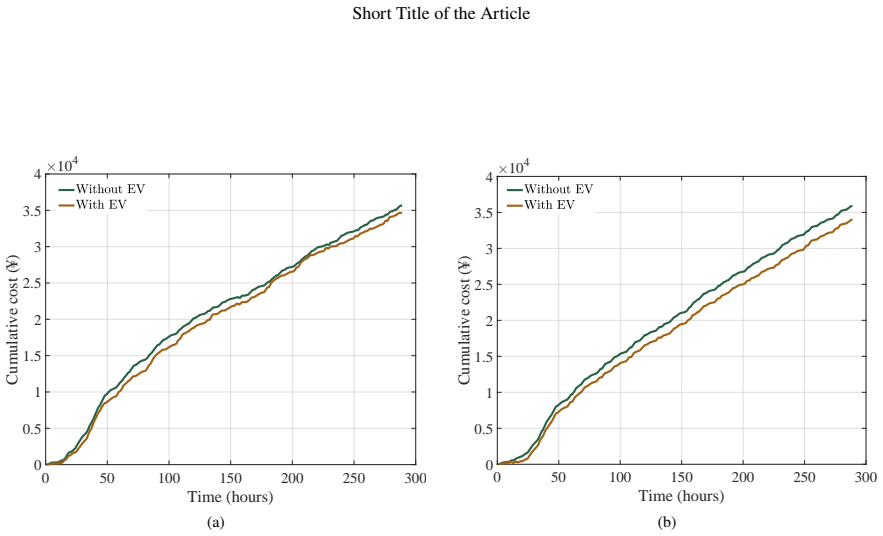
On the paper's own terms, the central discovery is that the RDedRVFL-D3QNPER algorithm—an ensemble deep-learning forecaster feeding a double-dueling deep Q-network with prioritized replay—learns a joint real-time scheduling policy for the combined battery system that reduces system operating costs by 37.94-40.01% relative to a MILP approach on summer and winter commercial-building test sets. The learned policy charges both storage types at valley tariffs, discharges at peak tariffs and high net load, prioritizes the building's load before selling to the grid, and uses the stationary ESS more often than the EV fleet because EV cycle-aging cost is priced higher. It satisfies the travel-dependent constraint that EV state of charge on departure not be lower than on arrival, and it keeps EV state of health above 99% in both seasonal tests. The paper also reports ablations showing that removing the forecast module raises costs by roughly 31%, removing the energy-allocation mechanism raises costs in proportion to the sell-back price gap, and removing the combined battery system raises costs by 25.65% in summer and 16.24% in winter.
Load-bearing premise
The load-bearing premise is that the MILP baseline is a fair and correctly specified solver for the same optimization problem, with the same degradation costs, forecast information, and EV constraints; the paper gives no MILP formulation, so this premise is unverified.
Editorial extensions
If this is right
- If the central claim is correct, commercial-building operators can replace a re-solved MILP with a learned policy that produces decisions in about 0.12 seconds per step, far below the one-hour control interval.
- The learned ESS-first, EV-second dispatch pattern implies that heterogeneous storage can be coordinated without a detailed system model, as long as each battery type's degradation is priced into the reward.
- The ablation results imply that forecast quality and the energy-allocation priority are the main drivers of value: removing the forecast module raises costs by roughly 31%, and removing the allocation mechanism costs more as the sell-back price ratio falls.
- The small EV-only benefit reported in Section 6.4.2 means the practical near-term value of EV participation is flexibility and avoided ESS capacity investment, not large arbitrage profit.
Reading between the lines
- Beyond the paper, the stated 37.94-40.01% gap should be treated as a property of the implemented MILP comparison rather than of the algorithm, because no MILP formulation is given; a reader could test this by re-running the comparison with an explicit MILP that includes the Section 3.8 objective and the degradation costs.
- Beyond the paper, the degradation parameters are calibrated to lab-scale LFP and NMC cells, so applying the method to other chemistries, temperatures, or battery management systems would require recalibrating the aging models before the cost split between ESS and EV is trusted.
- Beyond the paper, the fixed parking window and the arrival-and-departure state-of-charge rule assume predictable EV behavior; adding stochastic departure times, which the paper lists as future work, would probably narrow the reported gap.
- Beyond the paper, the hand-designed exponential scaling in the reward function does much of the work of deciding when an EV is worth scheduling; replacing it with a learned reward or an explicit constraint would show whether D3QNPER alone, or the engineered reward, carries the performance.
Editorial analysis
A structured set of objections, weighed in public.
Referee Report
Summary. The paper proposes a model-free deep reinforcement learning method (RDedRVFL-D3QNPER) for joint real-time scheduling of stationary ESS and EV batteries in a green building, incorporating differentiated battery degradation models, a load/PV prediction module, and an energy allocation mechanism. The central claim is a 37.94%-40.01% reduction in system operating costs compared to a mixed-integer linear programming (MILP) approach, demonstrated on summer and winter commercial-building datasets.
Significance. The problem is well motivated, and the paper includes several strong elements: a differentiated LFP/NMC degradation model, explicit handling of EV range constraints, an ablation study of the prediction module and energy allocation mechanism, and a comparison against DQN and D3QN baselines. The reported inference time of 0.12 s is a practical strength. However, the headline result depends entirely on the MILP comparison, which is not credibly specified, and the objective function in Eq. (53) contains a sign error that would reward degradation. If these issues are corrected, the work could be a valuable contribution to BEMS scheduling with heterogeneous storage; in its current form, the central claim is unsupported.
major comments (3)
- [Section 6.2.4] The MILP baseline is not described beyond stating that it was implemented with CPLEX in Python. No formulation is given for the objective function, decision variables, constraints, treatment of degradation costs, or use of forecast information. For a finite-horizon discrete-action problem (25 actions per hour) with deterministic test data, a correctly specified MILP should match or beat a learned policy. The reported result that MILP is 13.69%-21.60% more expensive than DQN is therefore implausible and strongly suggests the MILP was solving a different or mis-specified problem. Without the MILP formulation, the claimed 37.94%-40.01% cost reduction is not credible.
- [Eq. (53)] The objective in Eq. (53) subtracts C_build, defined in Eq. (51) as a positive battery degradation cost borne by the building. This sign error would reward degradation costs, making the optimization problem incorrect. If the MILP was implemented with this sign, its poor performance is fully explained. The sign must be corrected and all cost comparisons in Fig. 13 re-run before the results can be interpreted.
- [Section 6.1, Section 6.2.4] Each season is evaluated on a single training run; the paper reports no random seeds, multiple independent runs, confidence intervals, or statistical significance tests. DRL training is stochastic, so the reported cost figures (including the headline reduction and the differences among DQN, D3QN, and the proposed method) could be within run-to-run noise. The authors should report mean and standard deviation over at least several seeds, and ideally provide the code or data to enable reproducibility.
minor comments (4)
- [Section 5.1.2] The section title contains a duplicated word: "Double dueling DQN with with prioritized experience replay" should be "Double dueling DQN with prioritized experience replay."
- [Section 3.3.2] There is a typo in the sentence "integrating EVs into the into the BEMS"; the duplicated phrase should be removed.
- [Fig. 13] The y-axis label in Fig. 13 says "Cumulative profits" while the text and captions refer to "cumulative costs"; these labels should be made consistent.
- [References] References [26] and [34] are duplicates, both being A. Buonomano, "Building to vehicle to building concept...", Applied Energy 261 (2020) 114077; one should be removed or the two references should be differentiated.
Circularity Check
No significant circularity: the cost reduction is an empirical simulation result with disclosed reward shaping, and the self-cited predictor is re-benchmarked in this paper.
full rationale
The central claim of a 37.94%-40.01% cost reduction is obtained by simulating the learned policy on held-out 2024 summer/winter data and comparing cumulative operating costs (Figs. 13, Eq. 53) against DQN, D3QN, MILP, and uncontrolled baselines; it is not a quantity fitted from the degradation coefficients or forecast errors. The reward function (Eqs. 61-69) does contain hand-designed terms that explicitly reward valley charging and peak discharging and penalize low-price EV cycling, and Section 6.2.3 partly describes behavior the reward was designed to produce; however, the paper discloses this design choice, and the headline cost saving is still measured under the actual cost objective rather than being definitionally equal to the reward. Degradation-model constants are taken from external semi-empirical studies [31][46], and the RDedRVFL predictor comes from the authors' prior work [2]; the predictor is not merely cited but re-implemented and benchmarked against ARIMA and LSTM on this dataset (Tables 5-6), so the self-citation is independent empirical support. The main weaknesses are correctness and reproducibility concerns rather than circularity: the MILP baseline is not specified with an objective, decision variables, and constraint set, and Eq. (53) appears to have a sign error in the treatment of C_build (the minimization subtracts the degradation cost instead of adding it). These issues mean the MILP comparison may be unfair or the cost metric mis-specified, but they do not make the derivation equivalent to its own inputs. No load-bearing step reduces to a fitted parameter renamed as a prediction, and no uniqueness claim is imported from the authors' prior work.
Assumptions & free parameters
free parameters (6)
- Reward-shaping coefficient w_dis =
Piecewise exponential based on phi_pri and phi_net (Eqs. 61-64)
- Reward-shaping coefficient w_ch =
Piecewise exponential based on phi_pri and phi_net (Eqs. 61-64)
- EV degradation weight w_EV =
theta_EV/theta_base with theta_scale = 0.916 (Eqs. 67-69)
- Initial degradation coefficients alpha_ESS_d and alpha_EV_d =
0.35 and 0.45 (Table 2)
- Degradation model parameters for LFP and NMC =
k_alpha, k_beta, k_gamma, k_delta1-3, k_T, k_t, alpha_SEI, beta_SEI, k_z (Table 3)
- Price coefficient beta_pri =
0.9 (Eq. 34, Table 2)
assumptions (6)
- domain assumption Day-ahead electricity price series is known 24 hours in advance
- domain assumption The load and PV forecasts from RDedRVFL are sufficiently accurate to guide the agent
- domain assumption The semi-empirical degradation models from [31,46] are valid for this scheduling task
- domain assumption EVs are treated as a single aggregate battery with a departure SoC at least as high as arrival SoC
- ad hoc to paper The building manager pays EV cycle degradation costs and EV users bear only calendar aging
- domain assumption The environment is stationary enough for a policy trained on 2023 data to transfer to 2024 test periods
Cite this review
Pith. "Pith review of Deep reinforcement learning-based joint real-time energy scheduling for green buildings with heterogeneous battery energy storage devices." pith.science (2026). https://pith.science/paper/VPVYQTAQ
@misc{pith2026250606824,
  author       = {Pith},
  title        = {Pith review of: Deep reinforcement learning-based joint real-time energy scheduling for green buildings with heterogeneous battery energy storage devices},
  year         = {2026},
  howpublished = {\url{https://pith.science/paper/VPVYQTAQ}},
  note         = {Machine review of arXiv:2506.06824}
}
read the original abstract
Green buildings (GBs) with renewable energy and building energy management systems (BEMS) enable efficient energy use and support sustainable development. Electric vehicles (EVs), as flexible storage resources, enhance system flexibility when integrated with stationary energy storage systems (ESS) for real-time scheduling. However, differing degradation and operational characteristics of ESS and EVs complicate scheduling strategies. This paper proposes a model-free deep reinforcement learning (DRL) method for joint real-time scheduling based on a combined battery system (CBS) integrating ESS and EVs. We develop accurate degradation models and cost estimates, prioritize EV travel demands, and enable collaborative ESS-EV operation under varying conditions. A prediction model optimizes energy interaction between CBS and BEMS. To address heterogeneous states, action coupling, and learning efficiency, the DRL algorithm incorporates double networks, a dueling mechanism, and prioritized experience replay. Experiments show a 37.94 percent to 40.01 percent reduction in operating costs compared to a mixed-integer linear programming (MILP) approach.
Figures


Figures from the paper (19 more)




Reference graph
Works this paper leans on
- [1]
-
[2]
C. Liu, Z. Xu, M. Yuan, J. Xie, Y. Yuan, K. Ma, Building electrical load forecasting with occupancy data based on wireless sensing, Applied Energy 380 (2025) 124960
work page 2025
-
[3]
Z.Yadollahi,R.Gharibi,R.Dashti,A.T.Jahromi,Optimalenergymanagementofenergyhub:Areinforcementlearningapproach,Sustainable Cities and Society 102 (2024) 105179
work page 2024
-
[4]
A. E. Onile, J. Belikov, Y. Levron, E. Petlenkov, Energy efficient behavior modeling for demand side recommender system in solar microgrid applications using multi-agent reinforcement learning model, Sustainable Cities and Society 90 (2023) 104392
work page 2023
-
[5]
X. Zhai, Z. Li, Z. Li, Y. Xue, X. Chang, J. Su, X. Jin, P. Wang, H. Sun, Risk-averse energy management for integrated electricity and heat systems considering building heating vertical imbalance: An asynchronous decentralized approach, Applied Energy 383 (2025) 125271
work page 2025
- [6]
-
[7]
S.-H.Yoon,S.-Y.Kim,G.-H.Park,Y.-K.Kim,C.-H.Cho,B.-H.Park,Multiplepower-basedbuildingenergymanagementsystemforefficient management of building energy, Sustainable Cities and Society 42 (2018) 462–470
work page 2018
-
[8]
G. Zhao, H. Yang, C. Jiang, Direct seamless transfer strategy by limiting voltage drop of interface filter in energy storage equipment of microgrid, IEEE Transactions on Industrial Electronics 67 (12) (2020) 10421–10432.doi:10.1109/TIE.2019.2958296
arXiv 2020
Show all 55 references
-
[9]
M. A. Ortega-Vazquez, Optimal scheduling of electric vehicle charging and vehicle-to-grid services at household level including battery degradation and price uncertainty, IET Generation, Transmission & Distribution 8 (6) (2014) 1007–1016. First Author et al.:Preprint submitted...
2014
-
[10]
Z. Wan, H. Li, H. He, D. Prokhorov, Model-free real-time ev charging scheduling based on deep reinforcement learning, IEEE Transactions on Smart Grid 10 (5) (2018) 5246–5257
2018
-
[11]
M. H. K. Tushar, A. W. Zeineddine, C. Assi, Demand-side management by regulating charging and discharging of the ev, ess, and utilizing renewable energy, IEEE Transactions on Industrial Informatics 14 (1) (2018) 117–126.doi:10.1109/TII.2017.2755465
2018
-
[12]
O.Erdinc,N.G.Paterakis,T.D.P.Mendes,A.G.Bakirtzis,J.P.S.Catalão,Smarthouseholdoperationconsideringbi-directionalevandess utilization by real-time pricing-based dr, IEEE Transactions on Smart Grid 6 (3) (2015) 1281–1291.doi:10.1109/TSG.2014.2352650
2015
-
[13]
Zhang, G
H. Zhang, G. Zhang, M. Zhao, Y. Liu, Load forecasting-based learning system for energy management with battery degradation estimation: A deep reinforcement learning approach, IEEE Transactions on Consumer Electronics (2024)
2024
-
[14]
J.Cao,D.Harrold,Z.Fan,T.Morstyn,D.Healey,K.Li,Deepreinforcementlearning-basedenergystoragearbitragewithaccuratelithium-ion battery degradation model, IEEE Transactions on Smart Grid 11 (5) (2020) 4513–4521
2020
-
[15]
Thomas, O
D. Thomas, O. Deblecker, C. S. Ioakimidis, Optimal operation of an energy management system for a grid-connected smart building considering photovoltaics’ uncertainty and stochastic electric vehicles’ driving schedule, Applied Energy 210 (2018) 1188–1206
2018
-
[16]
Z. Shen, C. Wu, L. Wang, G. Zhang, Real-time energy management for microgrid with ev station and chp generation, IEEE Transactions on Network Science and Engineering 8 (2) (2021) 1492–1501
2021
-
[17]
R.Li,L.Bao,L.Chen,C.Zha,J.Dong,N.Qi,R.Tang,Y.Lu,M.Wang,R.Huang,etal.,Acceleratedagingoflithium-ionbatteries:bridging battery aging analysis and operational lifetime prediction, Science bulletin 68 (23) (2023) 3055–3079
2023
-
[18]
Olmos, I
J. Olmos, I. Gandiaga, A. Saez-de Ibarra, X. Larrea, T. Nieva, I. Aizpuru, Modelling the cycling degradation of li-ion batteries: Chemistry influenced stress factors, Journal of Energy Storage 40 (2021) 102765
2021
-
[19]
Y.Yang,Y.Ye,Z.Cheng,G.Ruan,Q.Lu,X.Wang,H.Zhong,Lifecycleeconomicviabilityanalysisofbatterystorageinelectricitymarket, Journal of Energy Storage 70 (2023) 107800
2023
-
[20]
J. Wen, D. Zhao, C. Zhang, An overview of electricity powered vehicles: Lithium-ion battery energy storage density and energy conversion efficiency, Renewable Energy 162 (2020) 1629–1648
2020
-
[21]
H. Lv, X. Zhu, J. Mei, Y. Xia, B. Wang, Recent progress of in-situ characterization of lini1- x- y co x mn y o2 cathodes for lithium metal batteries: A mini review, Nano Research 17 (3) (2024) 1384–1401
2024
-
[22]
C. Hu, M. Geng, H. Yang, M. Fan, Z. Sun, R. Yu, B. Wei, A review of capacity fade mechanism and promotion strategies for lithium iron phosphate batteries, Coatings 14 (7) (2024) 832
2024
-
[23]
Harnischmacher, L
C. Harnischmacher, L. Markefke, A. B. Brendel, L. Kolbe, Two-sided sustainability: Simulating battery degradation in vehicle to grid applications within autonomous electric port transportation, Journal of Cleaner Production 384 (2023) 135598
2023
-
[24]
Zhang, J
J. Zhang, J. Lee, A review on prognostics and health monitoring of li-ion battery, Journal of power sources 196 (15) (2011) 6007–6014
2011
-
[25]
Q.Wu,M.Shahidehpour,C.Li,S.Huang,W.Wei,etal.,Transactivereal-timeelectricvehiclechargingmanagementforcommercialbuildings with pv on-site generation, IEEE Transactions on Smart Grid 10 (5) (2018) 4939–4950
2018
-
[27]
C. Ma, W. Dong, Y. Shi, F. Zhang, Q. Yang, A fuzzy logic dispatching method based on model predictive control for adaptively addressing uncertain operation scenarios in multi-energy systems, Energy 322 (2025) 135724
2025
-
[28]
F. A. Kassab, B. Celik, F. Locment, M. Sechilariu, S. Liaquat, T. M. Hansen, Optimal sizing and energy management of a microgrid: A joint milp approach for minimization of energy cost and carbon emission, Renewable Energy 224 (2024) 120186
2024
-
[29]
R. Z. Homod, H. I. Mohammed, A. M. Sadeq, B. N. Alhasnawi, A. W. Al-Fatlawi, A. Al-Manea, O. A. Alawi, A. Alahmer, J. M. Mahdi, W.Al-Kouz,etal.,Massiveenergyreductionandstoragecapacityrelativetopcmphysicalsizebyintegratingdeeprlclusteringandmulti-stage strategies into smart bu...
2025
-
[30]
R.Hamdi,E.Baccour,A.Erbad,M.Qaraqe,M.Hamdi,Lora-rl:Deepreinforcementlearningforresourcemanagementinhybridenergylora wireless networks, IEEE Internet of Things Journal 9 (9) (2021) 6458–6476
2021
-
[31]
B. Xu, A. Oudalov, A. Ulbig, G. Andersson, D. S. Kirschen, Modeling of lithium-ion battery degradation for cell life assessment, IEEE Transactions on Smart Grid 9 (2) (2016) 1131–1140
2016
-
[32]
Y. Bai, W. Zhang, X. Hu, A collaborative matching method for multi-energy supply systems in office buildings considering the random characteristics of electric vehicles, Energy and Buildings 303 (2024) 113809
2024
-
[33]
Mohammad, R
A. Mohammad, R. Zamora, T. T. Lie, Transactive energy management of pv-based ev integrated parking lots, IEEE Systems Journal 15 (4) (2020) 5674–5682
2020
-
[34]
Buonomano, Building to vehicle to building concept: A comprehensive parametric and sensitivity analysis for decision making aims, Applied Energy 261 (2020) 114077
A. Buonomano, Building to vehicle to building concept: A comprehensive parametric and sensitivity analysis for decision making aims, Applied Energy 261 (2020) 114077
2020
-
[35]
Y. Wang, D. Xie, P. Zhao, C. Gu, X. Wang, A coordinated optimization strategy for charging station siting and ev dispatch based on response costs: A case study of chicago, Applied Energy 389 (2025) 125791
2025
-
[36]
K. M. Tan, S. Padmanaban, J. Y. Yong, V. K. Ramachandaramurthy, A multi-control vehicle-to-grid charger with bi-directional active and reactive power capabilities for power grid support, Energy 171 (2019) 1150–1163
2019
-
[37]
Liu, X.-F
Z.-F. Liu, X.-F. Luo, X.-X. Hou, J.-L. Yu, J.-X. Li, Generalized energy pool-driven regional integrated energy system dispatch considering multi-time scale synergy carbon-storage game, Renewable and Sustainable Energy Reviews 217 (2025) 115752
2025
-
[38]
Chen, I.-Y
W.-H. Chen, I.-Y. L. Hsieh, Techno-economic analysis of lithium-ion battery price reduction considering carbon footprint based on life cycle assessment, Journal of Cleaner Production 425 (2023) 139045
2023
-
[39]
C. Wu, H. Han, S. Gao, Y. Liu, Coordinated scheduling for multimicrogrid systems considering mobile energy storage characteristics of electric vehicles, IEEE Transactions on Transportation Electrification 9 (1) (2022) 1775–1783
2022
-
[40]
First Author et al.:Preprint submitted to ElsevierPage 35 of 36 Short Title of the Article
H.Farzin,M.Fotuhi-Firuzabad,M.Moeini-Aghtaie,Apracticalschemetoinvolvedegradationcostoflithium-ionbatteriesinvehicle-to-grid applications, ieee transactions on sustainable energy 7 (4) (2016) 1730–1738. First Author et al.:Preprint submitted to ElsevierPage 35 of 36 Short Titl...
2016
-
[41]
Y. Wu, X. Huang, L. Huang, J. Chen, Strategies for rational design of high-power lithium-ion batteries, Energy & Environmental Materials 4 (1) (2021) 19–45
2021
-
[42]
Redondo-Iglesias, P
E. Redondo-Iglesias, P. Venet, S. Pelissier, Efficiency degradation model of lithium-ion batteries for electric vehicles, IEEE Transactions on Industry Applications 55 (2) (2018) 1932–1940
2018
-
[43]
Xiong, P
R. Xiong, P. Wang, Y. Jia, W. Shen, F. Sun, Multi-factor aging in lithium iron phosphate batteries: Mechanisms and insights, Applied Energy 382 (2025) 125250
2025
-
[44]
Kassem, C
M. Kassem, C. Delacourt, Postmortem analysis of calendar-aged graphite/lifepo4 cells, Journal of Power Sources 235 (2013) 159–171
2013
-
[45]
E. M. Krieger, J. Cannarella, C. B. Arnold, A comparison of lead-acid and lithium-based battery behavior and capacity fade in off-grid renewable charging applications, Energy 60 (2013) 492–500
2013
-
[46]
Nájera, J
J. Nájera, J. Arribas, R. De Castro, C. Núñez, Semi-empirical ageing model for lfp and nmc li-ion battery chemistries, Journal of Energy Storage 72 (2023) 108016
2023
-
[47]
J.Wang,P.Liu,J.Hicks-Garner,E.Sherman,S.Soukiazian,M.Verbrugge,H.Tataria,J.Musser,P.Finamore,Cycle-lifemodelforgraphite- lifepo4 cells, Journal of power sources 196 (8) (2011) 3942–3948
2011
-
[48]
B. Xu, J. Zhao, T. Zheng, E. Litvinov, D. S. Kirschen, Factoring the cycle aging cost of batteries participating in electricity markets, IEEE Transactions on Power Systems 33 (2) (2017) 2248–2259
2017
-
[49]
B.Xu,Y.Shi,D.S.Kirschen,B.Zhang,Optimalbatteryparticipationinfrequencyregulationmarkets,IEEETransactionsonPowerSystems 33 (6) (2018) 6715–6725
2018
-
[50]
W. Zhao, J. Zheng, L. Zou, H. Jia, B. Liu, H. Wang, M. H. Engelhard, C. Wang, W. Xu, Y. Yang, et al., High voltage operation of ni-rich nmc cathodes enabled by stable electrode/electrolyte interphases, Advanced energy materials 8 (19) (2018) 1800297
2018
-
[51]
Z. Yang, H. Charalambous, S. E. Trask, A. Montoya, A. Jansen, K. M. Wiaderek, I. Bloom, Extreme fast charge aging: Effect of electrode loading and nmc composition on inhomogeneous degradation in graphite bulk and electrode/electrolyte interface, Journal of Power Sources 549 (2...
2022
-
[52]
A.Chiş,J.Lundén,V.Koivunen,Reinforcementlearning-basedplug-inelectricvehiclechargingwithforecastedprice,IEEETransactionson Vehicular Technology 66 (5) (2016) 3674–3684
2016
-
[53]
R. S. Sutton, A. G. Barto, Reinforcement Learning: An Introduction, 2nd Edition, The MIT Press, 2018. URLhttp://incompleteideas.net/book/the-book-2nd.html
2018
-
[54]
V. Mnih, K. Kavukcuoglu, D. Silver, A. A. Rusu, J. Veness, M. G. Bellemare, A. Graves, M. Riedmiller, A. K. Fidjeland, G. Ostrovski, et al., Human-level control through deep reinforcement learning, nature 518 (7540) (2015) 529–533
2015
-
[55]
X.Xu,L.Guan,Z.Wang,R.Yao,X.Guan,Adouble-layerforecastingmodelforpvpowerforecastingbasedongru-informer-svrandblending ensemble learning framework, Applied Soft Computing (2025)
2025
-
[56]
R. Gao, L. Du, P. N. Suganthan, Q. Zhou, K. F. Yuen, Random vector functional link neural network based ensemble deep learning for short-term load forecasting, Expert Systems with Applications 206 (2022) 117784. First Author et al.:Preprint submitted to ElsevierPage 36 of 36 S...
2022
Reviewed August 7, 2026 · model on record in the stance chip above.
Discussion (0). Continue with ORCID to comment.