REVIEW 4 major objections 6 minor 12 references
Quasi-polar Decomposition of Quantum Neural Networks via Adaptive Non-local Observables
T0 review · 4 major / 6 minor · reviewed 2026-07-30 · grok-4.5
Pith's one-line read Training a quantum neural network can be read as radial spectral growth plus one dominant eigenphase direction that tracks accuracy.
desk verdict Modest observational note on DANO trajectories: real framing, weak isolation of the accuracy correlations from the training schedule. read the letter →
The pith
A machine-rendered reading of the paper's core claim, the machinery that carries it, and where it could break.
The reading
What carries the argument
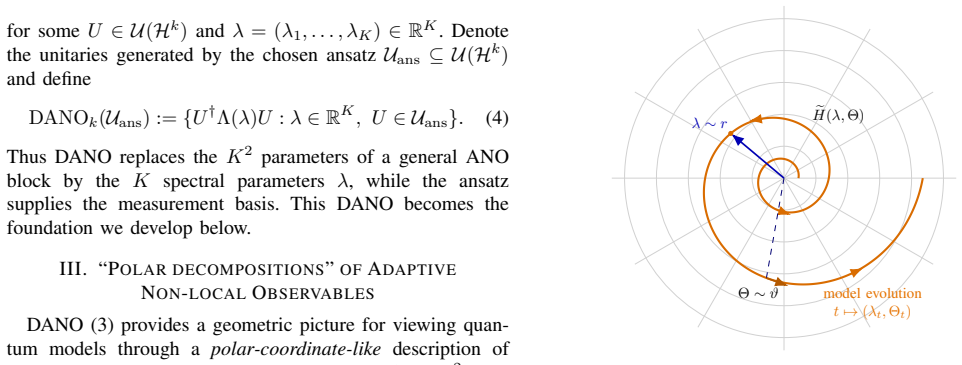
Diagonal Adaptive Non-local Observables (DANO): each observable is written eH(λ,Θ)=e^{-iΘ}Λ(λ)e^{iΘ}, so eigenvalues λ are radial coordinates and the Hermitian generator Θ of the measurement unitary is the angular coordinate; model evolution is the path t↦(λ_t,Θ_t), with eigenphases of Θ used for angular analysis.
What would settle it
Retrain the same DANO models with a different continuous logarithm lift or continuous gauge fixing of Θ_t; if the single accuracy-aligned eigenphase PC1 disappears or no longer tracks test accuracy while radial expansion remains, the angular claim fails.
Extended reading notes
Core claim
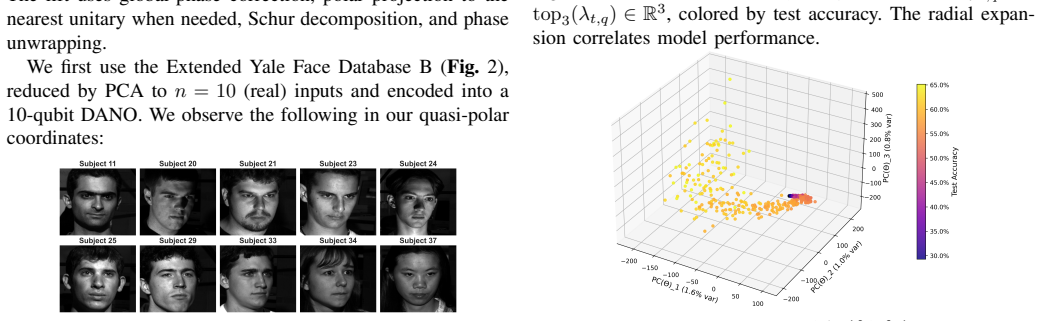
Under the DANO factorization, variational training becomes a trajectory (λ_t, Θ_t) in spectral and Lie-algebra coordinates. Experiments show that the top spectral weights expand with test accuracy, and that the ordered eigenphases of the Hermitian generators Θ_t collapse onto one accuracy-correlated PCA axis that alone accounts for roughly 98.5–99% of eigenphase variance on both Yale-B faces and MNIST.
Load-bearing premise
That the chosen way of taking the matrix logarithm of the trained unitary produces angular and eigenphase coordinates that truly reflect how the model performs, rather than artifacts of phase choices, gauge freedom, or the particular training schedule and circuit layout.
Editorial extensions
If this is right
- Radial growth of DANO spectra can be monitored during training as a performance-linked diagnostic alongside loss and accuracy.
- Angular analysis of VQCs is more informative after passing to ordered eigenphases of the Hermitian generators than in the raw Lie-algebra embedding.
- The same quasi-polar chart applies to any variational quantum algorithm whose output is an expectation value of a trainable or adaptive observable.
- Perturbing Θ along the training path widens an accuracy-ordered trail in eigenphase PCA space, suggesting a low-dimensional effective angular degree of freedom.
Reading between the lines
- If the eigenphase axis is physical rather than a lift artifact, regularizers or initialization that target phase-gap structure could steer accuracy more directly than circuit-parameter noise alone.
- Comparing DANO trajectories across ansatz families would test whether the ~99% PC1 collapse is universal or specific to shallow hardware-efficient circuits with alternating λ/θ updates.
- The interference rewrite in terms of eigenphase gaps suggests a link between class separation and controllable relative phases before measurement, which could be checked with fixed-λ ablations.
Editorial analysis
A structured set of objections, weighed in public.
Referee Report
Summary. The paper proposes Diagonal Adaptive Non-local Observables (DANO) as a quasi-polar chart for variational quantum circuit training: eigenvalues λ of the learned observable act as radial coordinates and a Hermitian logarithm Θ of the ansatz unitary as angular/Lie-algebra coordinates (Eqs. 6–7, Theorem 1). Model evolution is thereby a trajectory t ↦ (λ_t, Θ_t). On two 10-class tasks (PCA-reduced MNIST and Yale-B faces) with 10-qubit, 6-local DANO blocks, the authors report that the top eigenvalues expand with test accuracy, that direct PCA of Θ_t shows little structure, and that ordered eigenphases α_t of Θ_t (Eq. 13) concentrate almost all variance on a single PC1 axis that is visually accuracy-correlated. A brief interference interpretation is offered in Sec. IV-D. The contribution is framed as a diagnostic geometry for VQA/QML dynamics rather than a new algorithm.
Significance. If the reported geometry is intrinsic to model performance rather than an artifact of the optimization schedule or the logarithm lift, the quasi-polar chart would be a useful, reusable diagnostic for observable-side dynamics in VQAs—complementing existing circuit- and feature-map analyses. The mathematical scaffolding (spectral theorem, surjectivity of exp: u(K)→U(K), BCH example) is standard and correctly applied. Strengths include an explicit constructive lift example, two-dataset replication, and a clear separation of radial vs angular coordinates. The work does not claim new accuracy SOTA or a closed-form trainability theorem; its value is interpretive. That value hinges on whether the accuracy correlations survive controls that the present manuscript does not yet provide.
major comments (4)
- [Secs. IV-B–IV-C, Figs. 3, 5, 7] Secs. IV-B–IV-C and Figs. 3, 5, 7: the central empirical claims (“radial spectral expansion correlates with accuracy”; “eigenphase PC1 is strongly accuracy-correlated,” PC1 ≈ 98.5–99% variance) rest only on scatter plots colored by test accuracy. No Pearson/Spearman coefficients, partial correlations controlling for epoch t, confidence intervals, multiple random seeds, or null models are reported. Visual monotonic co-variation with a quantity that itself rises over 30 epochs is not sufficient to establish an intrinsic accuracy geometry.
- [Sec. IV-A] Sec. IV-A: λ enters the class-aligned expectations z_q linearly and is optimized at learning rate 10^{-1} versus 10^{-3} for θ, in alternating 5+5 blocks. Under this schedule, growth of ||λ|| is a near-mechanical way to sharpen logits once measurement directions are roughly correct; correlation of radial expansion with accuracy is then largely expected from the training design rather than a discovered geometric law. A schedule-matched or jointly-optimized control (equal LRs, simultaneous updates, or frozen-λ baselines) is needed to separate the claimed geometry from the optimizer.
- [Sec. IV-B, Eq. (13), Fig. 6] Sec. IV-B and Eq. (13): the angular analysis depends on a numerically chosen Hermitian logarithm (global-phase correction, polar projection to the nearest unitary, Schur decomposition, phase unwrapping). Branch cuts and gauge freedom can induce smooth, time-ordered drift in α_t even without performance-relevant structure; PCA on such a trajectory will place PC1 along the main training path, and coloring by monotonically increasing accuracy will reproduce a time axis. Fig. 6’s perturbations widen the same path rather than providing accuracy-matched, time-controlled contrasts. The manuscript should demonstrate stability of the PC1–accuracy relation under alternative lifts (e.g., principal logarithm with fixed branch, continuous gauge fixing from t=0) and after residualizing α_t on t.
- [Sec. IV-D] Sec. IV-D: the interference rewrite in terms of phase gaps μ_{t,b}−μ_{t,a} is suggestive but does not yet explain why PC1 of the ordered spectrum α_t (rather than of the gaps, or of V_t) carries the accuracy signal, nor why direct PCA of Θ_t (Fig. 4) is structureless while PCA of α_t is not. Without a falsifiable prediction or an ablation that manipulates phase gaps independently of ||λ||, the interpretation remains post hoc relative to the load-bearing empirical claim.
minor comments (6)
- [Abstract, Sec. I] Abstract and Sec. I say “DANO angle coordinates reveal a dominant accuracy-correlated component,” but the body shows that raw Θ PCA does not; only eigenphases α_t do. Align the abstract wording with Figs. 4–5.
- [Sec. III, Theorem 1] Theorem 1 is the standard surjectivity of exp: u(K)→U(K); a citation to a Lie-groups text would suffice and avoid presenting it as a new result.
- [Secs. II–IV] Notation: K is used both as 2^k and in U(K); n vs N=2^{10} for full-system dimension could be stated once in a notation paragraph. Eq. (9) Θ for the 2-qubit example is on H_2⊗H_2, while experimental Θ_t is on the full 10-qubit space—clarify the embedding.
- [Figs. 3, 7] Fig. 3 and Fig. 7 [Left]: top-3 eigenvalues in R^3 are plotted without stating whether they are sorted, absolute-valued, or taken from a single Q_q or pooled; a one-line caption clarification would help.
- [Sec. I] Related work on Lie-algebraic VQA analyses and measurement adaptation is cited; a brief contrast with dynamical Lie algebra / barren-plateau generator analyses (already in [6]) would situate the observable-side focus more sharply.
- [References] arXiv IDs in refs [10] (2605.15410) and the present manuscript’s own stamp look nonstandard relative to current arXiv numbering; verify before camera-ready.
Circularity Check
No definitional circularity in the quasi-polar chart or accuracy correlations; only mild self-citation of the authors' own ANO/DANO coordinate system.
-
self citation load bearing
[Sec. II-B, Eqs. (3)–(4); also Intro and [9],[10]]
"DANO [10] is a canonical case of ANO, where only the spectral variables are changed. By the spectral theorem, every eH∈H(k) admits eH=U†Λ(λ)U ... DANOk(Uans):={U†Λ(λ)U:λ∈R^K, U∈Uans}."
The coordinate system in which all trajectories are plotted is the authors’ own prior ANO/DANO construction ([9],[10], overlapping authors). This is definitional scaffolding for the chart, not a uniqueness result that forces the accuracy correlations; the empirical claims remain external. Mild and non-load-bearing for the strongest experimental statements.
-
renaming known result
[Sec. III, Eqs. (5)–(7) and Fig. 1]
"DANO (3) provides a geometric picture for viewing quantum models through a polar-coordinate-like description of observables. The usual polar coordinates on C≃R^2 have the form p=re^{iϑ} ... Comparing this with Eq. (3), the eigenvalues λ are analogous to the radial part, while the unitary U plays the role of an angular coordinate."
The ‘quasi-polar decomposition’ is the ordinary spectral theorem plus the standard Hermitian logarithm of a unitary, renamed via a polar analogy (λ~r, Θ~ϑ). The renaming organizes known structure; it does not derive a new forced prediction from fitted inputs. Mild reframing, not a closed definitional loop with the accuracy results.
full rationale
The load-bearing mathematical step is the spectral theorem plus the standard surjectivity of exp: u(K)→U(K) (Theorem 1), rewritten as eH(λ,Θ)=e^{-iΘ}Λ(λ)e^{iΘ} and likened to polar coordinates. That identity is not defined in terms of accuracy, loss, or the experimental outcomes; it is ordinary Lie/spectral theory. The claimed results—radial expansion of top-3 eigenvalues correlating with test accuracy, and a dominant PC1 in ordered eigenphases α_t also tracking accuracy—are empirical observations on external label-based metrics after Adam training, not quantities forced by fitting the same target they then “predict.” Self-citations [9] and [10] (overlapping authors) supply the ANO/DANO parameterization that is being plotted, which is normal reuse of prior definitions rather than a uniqueness theorem that forbids alternatives or a self-citation chain that alone justifies the correlations. No fitted parameter is renamed a prediction; no ansatz is smuggled in as a forced form. Confounding of accuracy with training time or with the high learning rate on λ is a correctness/identification concern, not circularity under the stated criteria. Score 2 reflects only the mild, non-load-bearing dependence on the authors’ own observable class as the coordinate chart.
Assumptions & free parameters
free parameters (6)
- learning_rate_lambda =
1e-1
- learning_rate_theta =
1e-3
- alternating_update_schedule =
5+5 iterations
- DANO_locality_k =
6
- ansatz_depth_L =
6
- top3_eigenvalue_visualization =
top-3
assumptions (5)
- standard math Spectral theorem: every Hermitian eH on H_k is unitarily diagonalizable as U†Λ(λ)U.
- standard math Exponential map exp: u(K)→U(K) is surjective, so every unitary has a Hermitian generator Θ with U=e^{iΘ}.
- domain assumption DANO_k(U_ans) is an appropriate canonical observable class for studying general VQC model evolution.
- ad hoc to paper A numerically chosen Hermitian logarithm (phase fix, projection, Schur, unwrapping) yields comparable Θ_t / α_t across iterations for PCA geometry.
- ad hoc to paper Visual correlation between trajectory coordinates and test accuracy constitutes characterization of quantum model behavior.
invented entities (1)
-
DANO quasi-polar chart (λ as radius, Θ/α as angle) for QNN training trajectories
Cite this review
Pith. "Pith review of Quasi-polar Decomposition of Quantum Neural Networks via Adaptive Non-local Observables." pith.science (2026). https://pith.science/paper/VQ2XBCTY
@misc{pith2026260727051,
  author       = {Pith},
  title        = {Pith review of: Quasi-polar Decomposition of Quantum Neural Networks via Adaptive Non-local Observables},
  year         = {2026},
  howpublished = {\url{https://pith.science/paper/VQ2XBCTY}},
  note         = {Machine review of arXiv:2607.27051}
}
read the original abstract
We use Diagonal Adaptive Non-local Observables (DANO) as a canonical decomposition for studying Variational Quantum Circuit model evolution. Separating each learned observable into a diagonal spectrum and a unitary basis gives a quasi-polar description: the spectral weights are viewed as radial coordinates, while the unitary circuit serves as angular coordinates through Lie group identifications. This turns the training process into a trajectory in spectral and Lie-algebra space. Experiments on two classification tasks show that DANO radial spectral expansion correlates with accuracy. DANO angle coordinates reveal a dominant accuracy-correlated component. The framework provides a different perspective to characterize quantum model behavior.
Figures

Figures from the paper (3 more)


Reference graph
Works this paper leans on
-
[9]
Adaptive non-local observable on quantum neural networks,
H.-Y . Lin, H.-H. Tseng, S. Y .-C. Chen, and S. Yoo, “Adaptive non-local observable on quantum neural networks,” in2025 IEEE International Conference on Quantum Computing and Engineering (QCE), vol. 1, 2025, pp. 1884–1893
2025
-
[10]
Diagonal adaptive non-local observables on quantum neural networks,
H.-H. Tseng, Y . Li, H.-Y . Lin, and S. Y .-C. Chen, “Diagonal adaptive non-local observables on quantum neural networks,”arXiv preprint arXiv:2605.15410, 2026
arXiv 2026
-
[1]
Variational quantum algorithms,
M. Cerezo, A. Arrasmith, R. Babbush, S. C. Benjamin, S. Endo, K. Fujii, J. R. McClean, K. Mitarai, X. Yuan, L. Cincio, and P. J. Coles, “Variational quantum algorithms,”Nature Reviews Physics, vol. 3, pp. 625–644, 2021. [Online]. Available: https: //doi.org/10.1038/s42254-021-00348-9
-
[2]
Quantum machine learning,
J. Biamonte, P. Wittek, N. Pancotti, P. Rebentrost, N. Wiebe, and S. Lloyd, “Quantum machine learning,”Nature, vol. 549, pp. 195–202,
-
[3]
Supervised learning with quantum- enhanced feature spaces,
V . Havl ´ıˇcek, A. D. C ´orcoles, K. Temme, A. W. Harrow, A. Kandala, J. M. Chow, and J. M. Gambetta, “Supervised learning with quantum- enhanced feature spaces,”Nature, vol. 567, pp. 209–212, 2019
2019
-
[4]
Power of data in quantum machine learning,
H.-Y . Huang, M. Broughton, M. Mohseni, R. Babbush, S. Boixo, H. Neven, and J. R. McClean, “Power of data in quantum machine learning,”Nature communications, vol. 12, no. 1, p. 2631, 2021
2021
-
[5]
Effect of data encoding on the expressive power of variational quantum-machine-learning models,
M. Schuld, R. Sweke, and J. J. Meyer, “Effect of data encoding on the expressive power of variational quantum-machine-learning models,” Physical Review A, vol. 103, no. 3, p. 032430, 2021. [Online]. Available: https://doi.org/10.1103/PhysRevA.103.032430
-
[6]
A lie algebraic theory of barren plateaus for deep parameterized quantum circuits,
M. Ragone, B. N. Bakalov, F. Sauvage, A. F. Kemper, C. Ortiz Marrero, M. Larocca, and M. Cerezo, “A lie algebraic theory of barren plateaus for deep parameterized quantum circuits,”Nature Communications, vol. 15, p. 7172, 2024
2024
Show all 12 references
-
[7]
Quantum convolutional neural networks,
I. Cong, S. Choi, and M. D. Lukin, “Quantum convolutional neural networks,”Nature Physics, vol. 15, pp. 1273–1278, 2019
2019
-
[8]
Learning to measure: Adaptive informationally complete generalized measurements for quantum algorithms,
G. Garc ´ıa-P´erez, M. A. C. Rossi, B. Sokolov, F. Tacchino, P. K. Barkoutsos, G. Mazzola, I. Tavernelli, and S. Maniscalco, “Learning to measure: Adaptive informationally complete generalized measurements for quantum algorithms,”PRX Quantum, vol. 2, p. 040342, 2021
2021
-
[11]
From few to many: Illumination cone models for face recognition under variable lighting and pose,
A. S. Georghiades, P. N. Belhumeur, and D. J. Kriegman, “From few to many: Illumination cone models for face recognition under variable lighting and pose,”IEEE Transactions on Pattern Analysis and Machine Intelligence, vol. 23, no. 6, pp. 643–660, 2001
2001
-
[2017]
Available: https://doi.org/10.1038/nature23474
[Online]. Available: https://doi.org/10.1038/nature23474
Reviewed July 30, 2026 · model on record in the stance chip above.
Discussion (0). Continue with ORCID to comment.